How to Bake Everything: Simple Recipes for the Best Baking - Mark Bittman (2016)
Pies, Tarts, Cobblers, and Crisps
It’s no wonder that pies are American classics: They combine common, often seasonal, ingredients with a universally beloved treat— a buttery crust. The techniques are easily mastered, and the results are always satisfying. Tarts, which might be thought of as pie’s European cousins, are generally broader and thinner, always one-crusted, and served freestanding rather than in the pan but otherwise quite similar. And then there is the homey pantheon of cobblers, crisps, and other dough- or crumb-topped fruit desserts: This is a group of desserts that everyone makes. And they are all comforting, quick, and easy. These have two essential building blocks: the filling and the crust or topping. Fillings may be cooked or raw fruit, pudding or custard, airy whipped cream, crunchy nuts, sticky caramel, and much more (including savory fillings; see page 519). Almost any filling can be made into a pie, tart, cobbler, or crisp, depending entirely on the crust or topping you use.
The crust itself depends on fat—usually butter—for flavor and tenderness. A simple piecrust is no more than flour, butter, water, salt, and maybe sugar. Crumb toppings combine butter, flour, sugar, and usually a couple of other ingredients—oats, nuts, and the like—to yield sweet crunchiness. Any crust can be varied to make the finished product rustic or refined, humble or elaborate, a quick dish or an all-day project.
Here you’ll find my best crusts and plenty of fillings to go with them. Mix and match at will, letting the season and market, guided by your mood and your pantry, determine what’s best.
Lastly, see pages 301-305 for wonderful cooked fruit dishes that you might think of as crustless pies. You can tailor a dessert by adding any of them to your choice of crust, or leave them be and garnish with ice cream (pages 309-315) or your favorite sauce (pages 572-588).
The Basics of Pie and Tart Crusts
Crust is often the difference between a so-so pie and something truly remarkable. And dedicated pie makers get better and better at producing flavorful, nicely shaped, and beautifully colored crusts. But it need not take years of trial and error to nail the technique; in fact, you can make really good crusts your first time out—mostly, it’s about butter—and you’ll improve quickly and steadily if you use the right ingredients and techniques.
The two most basic and versatile crusts, Flaky Piecrust and Sweet Tart Crust, are worth practicing and perfecting. The former is quintessentially crisp and buttery and easily rolled out and draped into a pie plate; the latter is sweeter, finer, and more crumbly, to be patted directly into a tart pan. Either can be filled right away or prebaked (see page 258) and are both ideal with most any filling.
With a little practice, you should have no problem producing perfect crusts every time, but if you’re pastry averse, try Cookie Crumb Crust, Meringue Nut Crust, and No-Bake Fruit and Nut Crust, which don’t need to be shaped, chilled, or rolled out.
INGREDIENTS
There are so few ingredients in a basic crust that quality is absolutely vital for each one. The best crusts start with fat—almost always butter—although many other fats have virtues, and as you get more experience you may land on a combination whose flavor and texture you like best. I prefer to use all butter.
Never use a commercial piecrust, which won’t ever be as flaky or good-tasting as homemade and will unquestionably contain inferior ingredients. It takes only a few minutes to mix up a crust dough, and wrapped tightly, it freezes beautifully for weeks or even months, so you can have a batch on hand whenever you need it. If you don’t have time to make a crust from scratch, make a crisp or cobbler instead (pages 297-301).
BUTTER
For a rich, delicious flavor and good color, butter is unbeatable. When you handle it properly—don’t let it get too soft—it yields a very flaky crust that browns wonderfully.
OIL
Oils that are solid at room temperature, like coconut, are the best nondairy substitutes. Liquid oils, like vegetable or even olive, won’t produce that characteristic flakiness, but some make a pleasantly mealy crust that works well for custard or savory fillings or quiches.
LARD
Lard and butter complement each other well, especially for flaky pastry crusts. Lard has less flavor than butter but doesn’t melt as quickly, so a combination strikes a balance between good flavor and texture. Sadly, good lard is hard to find. Look for best-quality lard (leaf lard if possible) at a butcher shop.
SHORTENING
With a high melting point, shortening is easy to incorporate and makes for an especially flaky crust. However, health issues aside, it tastes bad. Don’t use it. Period.
EQUIPMENT
Purists may disagree, but I think a food processor makes pie crusts easy as, well, you know. The results are evenly blended and still quite tender. The process is quick, easy, efficient, and nearly foolproof. You can mix the dough by hand, of course, pinching the butter with flour between your fingers or using various utensils like a pastry blender or two forks or knives.
Pie plates have sloped sides, and 9-inch plates that are about 1¼ inches deep are standard—that’s what you’ll need for most of these recipes. Deep-dish versions have an extra ½ to 1 inch of depth; as long as it’s 9 inches in diameter, a batch of crust will fit in either plate, so you can treat them interchangeably based on what you have. I’ll mention it anytime deep-dish is the better choice.
You can also use springform pans for any pie with a crumb crust and, in a pinch, for tarts, although those are really best baked in shallow tart pans with straight fluted walls and removable bottoms for serving; there is a wide range of sizes for tart pans, from 4-inch tartlet pans for individual servings to 11-inch pans. They are also available as squares and rectangles, which is a nice option if you’re baking for a crowd and would like to cut the tart into squares. For something a little more unusual, try a cast-iron skillet, which makes an especially nice presentation for rustic fruit pies and cooks flaky crusts to an even, deep gold. Cobblers, crisps, and the like (pages 297-301) are even simpler—you need just a square, rectangular, or oval baking dish.
TECHNIQUES
MAKING AND RESTING THE DOUGH
Because you want tenderness, not chew, in these crusts they must be handled minimally; you don’t want the gluten to develop as it does in bread dough. Flaky doughs should still have visible bits of butter in them when they’re formed; tart crusts should be more uniform but still reveal small bits of butter—this will make the crust light. Letting any shaped crust rest in the refrigerator or freezer before you fill it enables the gluten to relax, making for a lighter crumb, and hardens the fat a bit so that it holds its shape and texture in baking. It’s not mandatory, but if your time frame is flexible, you can refrigerate it for up to 2 days for an especially flaky, more deeply browned result; wrap well and you can store disks of dough in the freezer for a couple of months. At a minimum, chill dough for an hour before rolling it out.
ROLLING THE DOUGH
Successfully rolling out chilled dough to a fairly uniform and round crust of about ⅛ inch thickness involves a combination of patience and practice. Ideally you’ll roll the dough out only once (rerolling will toughen it), but at first you may need more than one try.
These tips will make rolling dough easier (see illustrations, below, for more detail):
- Start with dough that is firm and slightly chilled. It should yield a bit to pressure, but your fingers shouldn’t sink in. If they do, refrigerate or freeze for a while longer. Conversely, thaw frozen dough in the fridge and let it sit for a few minutes at room temperature if it’s not yet malleable.
- To prevent sticking, flour the work surface, the top of the dough, and the rolling pin. Use flour as sparingly as you can; too much will toughen the dough. As you get the hang of it, you’ll use less and less.
- Another way to prevent sticking is to roll it out between two sheets of plastic wrap or parchment; as long as the dough is not too sticky, this will work just fine, and the wrap makes it easy to move the dough. Many beginners find this the best method.
- Roll from the middle of the disk outward, diagonally to the left and right in a V shape, and rotate the rolling pin and the dough continually to make sure it’s rolled evenly. Apply even and firm (but not hard!) pressure to the rolling pin.
- Fix any holes or tears with tiny scraps of dough; add a dab of water to help seal your patches in place. Don’t try to pinch holes closed.
- If the dough becomes sticky or oily, slide it onto a baking sheet and stick it in the freezer for a few minutes.
- When the dough is rolled out, move it to the pie plate or tart pan by rolling it around the rolling pin and unrolling it directly over the plate; or, if you used plastic wrap or parchment, remove one side, lay it in place, then remove the other side.
- Press the dough firmly into the plate, using the pads of your fingers gingerly. If prebaking (see page 258), prick all over with a fork, taking care not to puncture the dough through to the pan. Trim the edge and form a decorative edge if you like (see page 257). Refrigerate for about an hour before filling (if you’re in a hurry, freeze for a half hour or so). At this point you can press a couple of layers of plastic wrap directly onto the shaped crust and freeze for up to a month or so.
Rolling Pie Dough
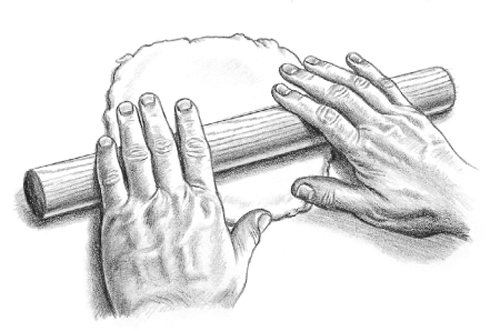
STEP 1 Roll with firm, steady, but not overly hard pressure, from the inside out, sprinkling with tiny amounts of flour if necessary and rotating quarter-turns as you work.
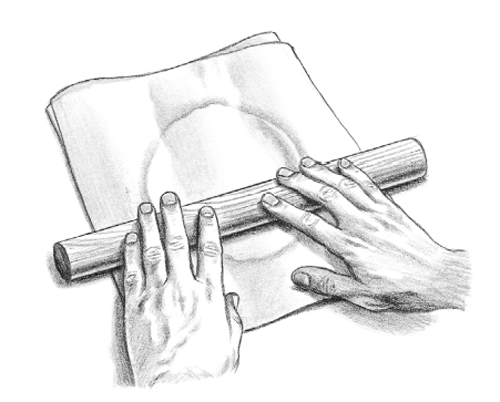
STEP 2 You can also roll between two sheets of parchment or plastic wrap, which is sometimes easier. If at any point during rolling the dough becomes sticky, refrigerate it for 15 minutes or so.
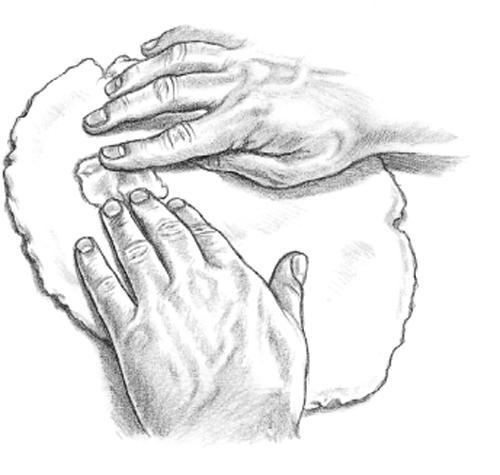
STEP 3 Patch any holes with pieces of dough from the edges.

STEP 4 When the dough is ready, pick it up using the rolling pin (flour the dough and pin very lightly first).

STEP 5 Drape it over your pie plate.
BAKING THE CRUST
Prebaking crusts adds a step, but in some cases it’s absolutely necessary (see the following section), and in many others it gives better results. If your pie has a top crust, brush it with an egg wash or a bit of milk to protect it as it bakes and promote an even, golden, beautifully glossy finish. Garnish this with a sprinkling of coarse sugar if you like.
When you’re baking a filled pie, always put it on a cookie sheet; this encourages bottom browning and prevents spillovers from cooking onto your oven floor. If your crust starts to get too dark before the filling finishes cooking, loosely cover it with foil. For a single-crust pie, wrap a ring of foil around the exposed edges; protect a top crust by making a tent of foil over the whole thing.
WHY AND HOW TO PREBAKE CRUSTS
Pie or tart crusts must be prebaked (also called known as “blind baking”) when their filling will not be baked, as with icebox pies (see page 285), and where the bake time is too short for the crust to cook completely and brown properly. Prebaking also minimizes shrinking, helps produce a nicely shaped crust, and avoides sogginess in pies with very moist fillings. Flaky Piecrust, Sweet Tart Crust, and all their variations can be prebaked; Cookie Crumb Crust is always prebaked, as it’s a moist and porous crust that will otherwise become mushy.
Some crusts are partially prebaked, others fully; recipes indicate which. Either way, you need butter, foil, and a cup or two of something heavy and heatproof to prevent the crust from shrinking and bubbling with air pockets while it’s baking: raw rice or dried beans, pennies, or pie weights all work nicely.
Heat the oven to 425°F. Be sure the crust is pressed firmly into the pan, pricked all over with a fork, and well chilled before baking; the fork pricks and hardened butter in the dough will help the crust keep its shape.
Butter one side of a piece of foil large enough to cover the crust; press the foil onto the crust, butter side down. Scatter your weights in an even layer over the foil and bake for 12 minutes; remove the weights and foil. Reduce the oven temperature to 350°F and continue baking the crust until it starts to develop a golden brown color, another 10 minutes or so. The crust is now partially baked and ready for any filling that you plan to bake.
For a completely baked crust, let it continue to bake, uncovered, until fully golden brown, another 5 minutes or so. Cool the pan on a rack before filling.
Decorating the Crust
Once the dough is in the pan, you’ll want to trim it, and you can also make the edge more attractive or add a top crust or other embellishments. One recipe of Flaky Piecrust makes enough for a double crust; freeze half for another pie if you are making a single crust or roll it out as directed to make a top crust or decorations.
Crimping

PINCHING METHOD: Pinch the edges of the dough between the side of your forefinger and your thumb.
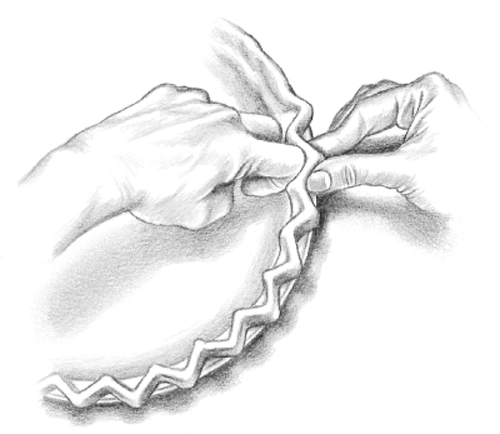
KNUCKLE METHOD: Use the thumb and forefinger of one hand to hold the dough in place. Press a knuckle from your other hand against the crust, pushing it into the space made by your thumb and forefinger.
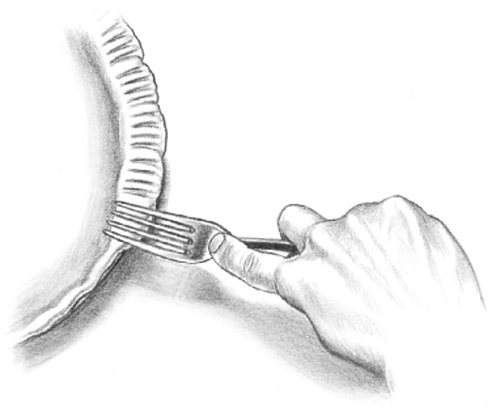
FORK METHOD: Alternatively, you can simply press down with the tines of a fork along the edges of the dough.
Simple Top Crust
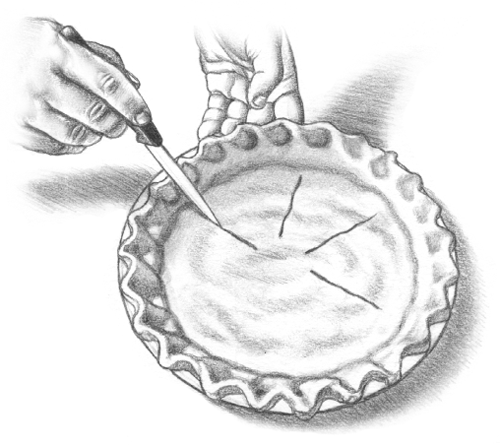
Use a paring knife or cookie cutter to trim simple shapes from the crust if you want. Place the crust over the filling, trim the edge, and crimp the top and bottom crust edges to seal. If you didn’t cut out shapes, cut a few slits in the crust to let steam escape.
Braided Edge
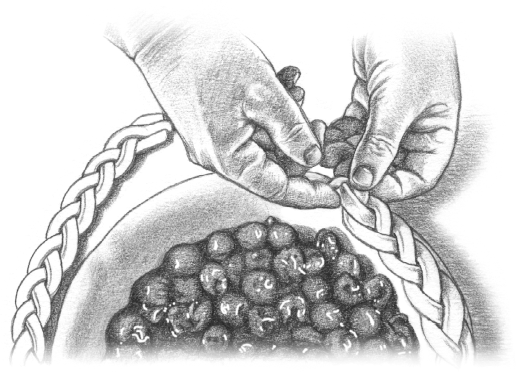
Cut the dough into ¼-inch-wide strips and braid three strips snugly together. Repeat until you have four braids; set them on a plate to chill. Brush egg wash around the sides and “glue” the braids all along the perimeter, braiding the loose ends together so they make one continuous braid. Prebake or fill and bake as directed.
Garnish Crust
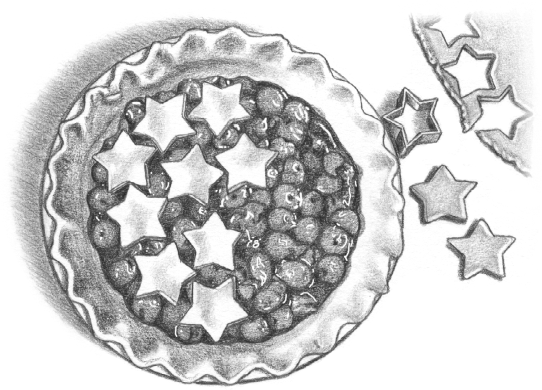
Cut the dough into letters or shapes and place directly over the filling so that some of the filling remains exposed; you can also overlay them around the border of the pie.
Tiled Crust
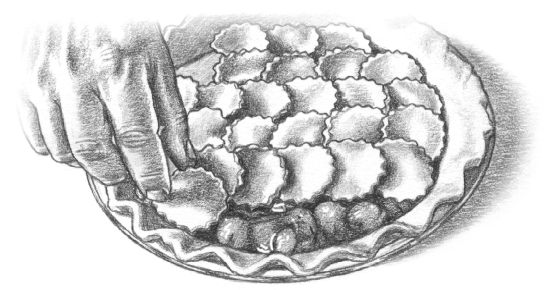
A tiled crust is a more precise version of a garnished one; time-consuming but stunning. Cut the crust into small shapes—circles or stars work well—and layer them over the filling so they overlap.
Making a Lattice Crust
Cut the dough into strips a couple of inches longer than the pie plate, as thick or thin as you like, of uniform or varying widths. Weave perpendicular strips as shown.
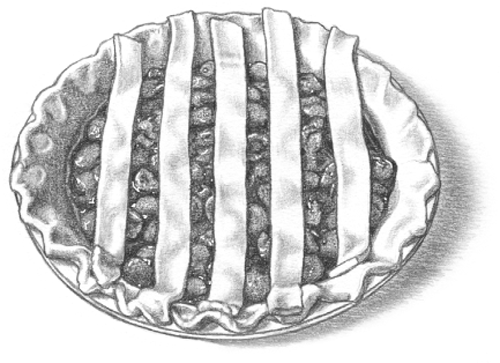
STEP 1 Cut enough strips to cover the pie as much as you like, depending on the width of each strip. For instance, you’ll need nine 1-inch-wide strips if you want to completely cover a pie in a 9-inch plate.
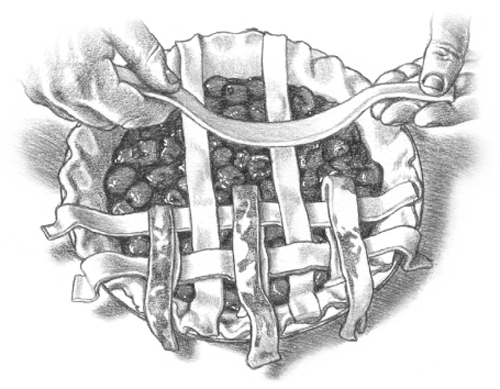
STEP 2 Fold back half of the strips laid in one direction and add strips in the other direction.
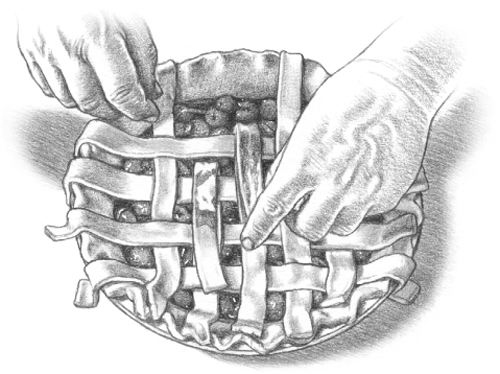
STEP 3 Continue weaving the strips over the top of the pie.
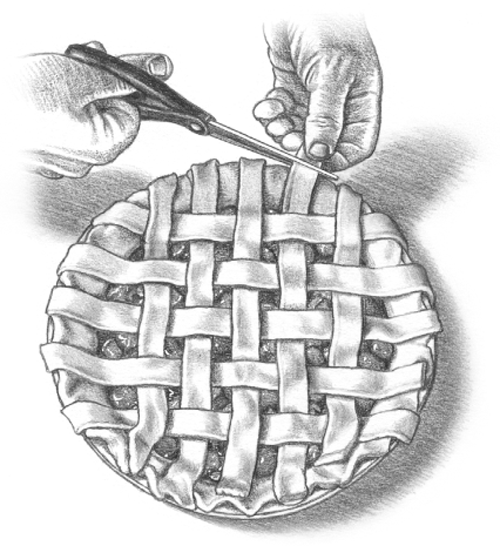
STEP 4 When the weaving is completed, press the edges into the bottom crust and trim.
Recipes
Flaky Piecrust
Vegan Piecrust
Sweet Tart Crust
Cookie Crumb Crust
Meringue Crust
No-Bake Fruit and Nut Crust
Crumb Topping
Flaky Piecrust
Makes: 1 double crust for a 9-inch pie
Time: About 20 minutes, plus time to chill
Because piecrust uses so few ingredients, quality and technique make all the difference in getting a flaky, delicious result. Don’t overwork the dough and keep it cool (see preceding pages for details). See Savory Piecrust for a version designed for vegetable and meat fillings.
- 2¼ cups flour
- 2 teaspoons sugar
- 1 teaspoon salt
- 2 sticks very cold butter, cut into chunks
- 6 tablespoons ice water, plus more if necessary
1. Use a food processor to pulse together the flour, sugar, and salt to combine. Add the butter and pulse until it is just barely blended with the flour and the butter is broken down to the size of peas. If you prefer to make the dough by hand, combine all the dry ingredients and butter in a large bowl. With your fingertips, 2 knives or forks, or a pastry cutter, work the butter pieces into the flour, being sure to incorporate all of the butter evenly, until the mixture has the texture of small peas.
2. Add 6 tablespoons ice water (not just cold water) to the flour mixture. Process for about 5 seconds or mix by hand with a wooden spoon, just until the dough begins to clump together, adding 1 or 2 tablespoons more ice water if necessary (or a little more flour if you add too much water).
3. Divide the dough in half and put each half into a quart-size plastic zipper bag. Press the dough into a disk by mushing along the outside of the bag until you have a thick disk shape. It’s important not to overheat, overwork, or knead the dough; squeeze it with enough pressure just to hold it together. Freeze the disks of dough for 10 minutes or refrigerate for at least 30 minutes before rolling. If you’re making a single-crust pie, freeze one disk for another time.
4. Dust a large pinch of flour over a clean work surface. Sprinkle a little more flour on top of the dough and dust the rolling pin with flour. Too much flour will dry out your dough; you can always sprinkle on a little more if the dough starts to stick. Using firm but not too hard pressure on the pin, start rolling the dough from the center and outward to form a circle. If the dough feels too hard or is cracking a lot, let it rest for a few minutes. As you roll, add flour as needed and rotate and turn the dough with a spatula to form an even circle.
5. When the dough circle is about 2 inches larger than the pie plate and less than ⅛ inch thick, it’s ready. Roll the dough up halfway onto the pin so it’s easy to move, then center it over the pie plate and unroll it into place. Press the dough into the contours of the dish without squishing or stretching it; patch any tears with a small scrap of dough, sealed with a drop of water. Trim any excess dough to about ½ inch all around.
6. If you’re making a single-crust pie, tuck the edges under themselves so the dough is thicker on the rim than it is inside; if you’re making a double-crust pie, leave the edges untucked for now. Put the pie plate in the fridge until the crust feels cool to the touch before filling or prebaking. For a top crust or embellished crust, roll the second disk into a circle on a flat baking sheet (dusted with flour) and put that in the fridge too; then, when you’re ready to assemble, follow the directions for decorative crusts (page 257).
LARD OR DUCK-FAT PIECRUST Although less flavorful, lard makes for a wonderfully flaky crust (rendered duck fat is also terrific): Substitute ½ cup lard or duck fat for 1 stick of the butter.
WHOLE WHEAT PIECRUST Whole wheat flour absorbs more water than white, so take care: Substitute whole wheat pastry flour for the all-purpose flour. Increase the water to ½ cup, adding more, a tablespoon at a time, until the dough forms.
NUT PIECRUST Delicious: Substitute nut flour of your choice for 1 cup of the all-purpose flour. Toast the nut flour on a baking sheet in a 350°F oven for 5 minutes or until fragrant and lightly browned. Proceed as directed.
OAT PIECRUST Crumbly and homey: Substitute ground rolled oats for 1 cup of the flour; run the oats in a food processor until they have the consistency of a fine meal.
PIECRUST COOKIES The perfect way to make sure you waste none of your delicious dough, and a real treat: If you’re using leftover dough, gently press the scraps into a disk, wrap in plastic, and chill until cool. Heat the oven to 350°F and combine ¼ cup sugar with 1 tablespoon ground cinnamon. Roll the disk of dough as directed, sprinkle it with the cinnamon sugar, and cut it into circles or other shapes. Bake the cookies on an ungreased baking sheet until golden and tender, about 10 minutes.
BIG PIECRUST For a 10-inch double-crusted pie: Increase the butter to 2½ sticks, the flour to 2¾ cups, the sugar to 1 tablespoon, and the salt to 1½ teaspoons. Start by adding 8 tablespoons of ice water to the flour mixture; after that, add 1 tablespoon at a time as needed until a dough forms.
Prebaking the Crust
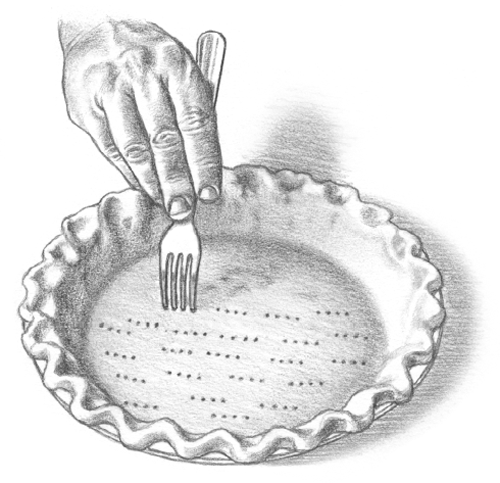
STEP 1
Prick the dough with a fork (called docking) before prebaking; this allows steam to escape so that the crust doesn’t bubble up.
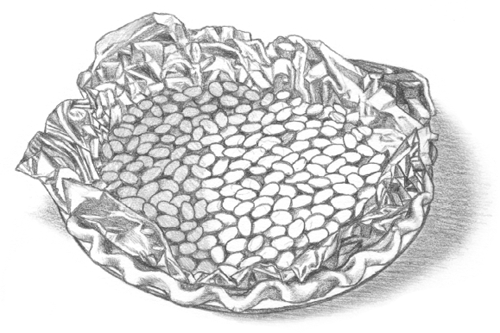
STEP 2
Line the shell with buttered foil and fill with weights to help the crust hold its shape during baking.
Making Pie Dough
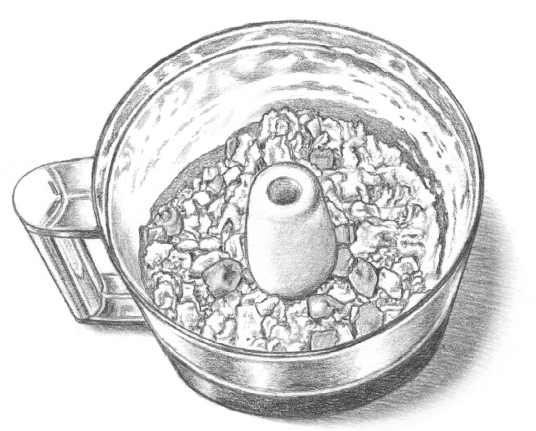
Pulse the ingredients in the food processor until just barely blended with the flour and the butter is broken down into pieces the size of small peas.
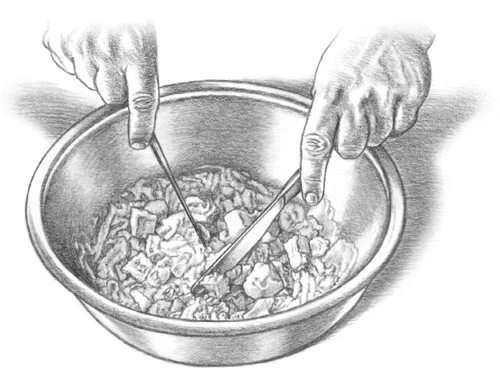
If you are mixing the dough by hand, use two knives or forks to cut the butter into the flour mixture.
Vegan Piecrust
Makes: 1 double crust for a 9-inch pie
Time: About 20 minutes, plus time to chill
Coconut oil will give you a flaky, tender crust, without butter. The usual rules apply: Work quickly, keep the oil cool and firm, and don’t overwork the dough. Refined oil has a far more neutral, versatile flavor than unrefined.
- 2¼ cups flour, plus more for dusting
- 2 teaspoons sugar
- 1 teaspoon salt
- ¼ cup coconut oil, chilled
- 6 tablespoons ice water, plus more if necessary
1. Combine the flour, sugar, and salt in a food processor and pulse to combine. Add the oil and pulse until it is just barely blended and crumbly. If you prefer to make the dough by hand, combine all the dry ingredients and oil in a large bowl. Use your fingers to work the oil into the flour mixture until it’s just barely blended.
2. Add 6 tablespoons ice water (not just cold water) to the flour mixture. Process for about 5 seconds, or mix by hand, just until the dough begins to clump together, adding 1 or 2 tablespoons more ice water if necessary (or a little more flour if you add too much water).
3. Divide the dough in half and put each half into a quart-size plastic zipper bag. Press the dough into a disk, taking care not to overheat, overwork, or knead the dough; use just enough pressure to hold it together. Freeze the dough for 10 minutes or refrigerate for at least 30 minutes before rolling. If you’re making a single-crust pie, freeze one disk for another time; wrapped tightly, the dough will keep for several months.
4. Dust a clean work surface with a large pinch of flour. Add the dough and sprinkle just a bit more flour over it. Use a rolling pin to firmly and evenly roll the dough, starting in the center and working outward, rotating a quarter-turn each time to make an even circle. If the dough is too stiff, let it rest for a few minutes. Sprinkle a bit of flour on the dough and rolling pin as needed to prevent sticking.
5. When the dough circle is about 2 inches larger than the pie plate and less than ⅛ inch thick, it’s ready. Roll the dough up halfway onto the pin so it’s easy to move, then center it over the pie plate and unroll it into place. Press the dough into the contours of the dish without squishing or stretching it. Trim the excess dough to about ½ inch all around.
6. If you’re making a single-crust pie, tuck the edges under themselves so the dough is thicker on the rim than it is inside; if you’re making a double-crust pie, leave the edges untucked for now. Put the pie plate in the fridge until the crust feels cool to the touch before filling or prebaking, at least 15 minutes. For a top crust or embellished crust, roll the second disk into a circle on a flat baking sheet, dusted with flour, and put that in the fridge too; then, when you’re ready to assemble, follow the directions for decorative crusts.
Sweet Tart Crust
Makes: One 9-inch tart shell
Time: About 15 minutes
Tart shells are generally sweeter than traditional piecrusts and have a finer crumb. They’re the perfect complement for custard and cream fillings especially, as the tighter crumb structure prevents cracks and leaks. I love them for fruit tarts too—the buttery, light sweetness accentuates the flavors of the filling.
- 1¼ cups flour
- ¼ cup confectioners’ sugar Pinch of salt
- 1 stick very cold butter, cut into small pieces, plus butter for greasing
- 1 large egg yolk
- 1 tablespoon ice water, plus more if necessary
1. Use a food processor to pulse together the flour, sugar, and salt to combine. Add the butter and pulse until it has the texture of cornmeal. If you’re making the dough by hand, combine the dry ingredients in a large bowl; then, use your fingertips, 2 knives or forks, or a pastry cutter to mash the butter into the flour mixture.
2. Add the egg yolk and pulse to combine (or use a fork to incorporate it), then pulse in the ice water, adding more ice water as necessary, a tablespoon at a time, until the dough starts to form a ball. Turn the dough out onto a lightly floured counter and knead it until it’s just combined and smooth.
3. Gently press the dough into a generously buttered tart pan, being sure to tuck it into the corners. Trim the dough even with the top of the pan. Freeze the crust in the pan for 20 minutes before baking. To roll out the dough instead, form the dough into a disk and refrigerate until firm, at least 1 hour. Dust a clean work surface with a large pinch of flour. Add the dough and sprinkle just a bit more flour over it. Use a rolling pin to firmly and evenly roll the dough, starting in the center and working outward, rotating a quarter-turn each time to make an even circle. If the dough is too stiff, let it rest for a few minutes. Sprinkle a bit of flour on the dough and rolling pin as needed to prevent sticking.
4. When the dough circle is about 2 inches larger than the tart pan and less than ⅛ inch thick, it’s ready. Roll the dough up halfway onto the pin so it’s easy to move, then center it over the pie plate and unroll it into place. Press the dough into the contours of the pan without squishing or stretching it. Trim the excess dough even with the top of the pan. Put the tart pan in the fridge for about 30 minutes or freeze for at least 10 minutes, until the crust feels cool to the touch, before filling or prebaking.
CORNMEAL TART CRUST A delicious, rustic crust that’s ideal for jammy fruit fillings: Add ½ cup cornmeal and decrease the flour to 1 cup. Decrease the sugar to 2 tablespoons.
NUT TART CRUST A wonderful base for a Chocolate Tart : Substitute a nut flour of your choice—I like hazelnut or almond—for ½ cup of the flour. Decrease the confectioners’ sugar to 2 tablespoons. If your dough seems a bit dry, add a tablespoon or 2 of ice water to it when you’re kneading.
CHOCOLATE TART CRUST I love a chocolate crust at the bottom of a Berry Tart : Substitute ¼ cup Dutch-process cocoa powder for ¼ cup of the flour.
SPICED TART CRUST A natural pairing for an Apple Tart : Whisk 1 teaspoon cinnamon, ½ teaspoon nutmeg, and ¼ teaspoon ground cloves into the flour mixture.
COCONUT TART CRUST Add ½ cup shredded unsweetened coconut and decrease the flour to 1 cup. Toast the coconut on a baking sheet in a 350°F oven for about 8 minutes, until golden brown. For a tighter crumb, pulse the coconut together with the dry ingredients in a food processor until combined, then add the yolk and pulse a few more times until a soft dough forms.
11 Ways to Flavor Any Pie or Tart Crust
- Chopped fresh herbs, 1 tablespoon, added to the flour mixture
- Ground spices, like ginger, cinnamon, cardamom, clove, allspice, nutmeg, anise, or coriander, up to 1 teaspoon each, added to the flour mixture
- Minced fresh ginger, 1 teaspoon, added with the ice water
- Nut butter, chilled, up to 4 tablespoons in place of regular butter
- Finely grated citrus zest, up to 1 tablespoon, added with the ice water
- Vanilla extract, 1 teaspoon, added with the ice water
- Almond extract, ½ teaspoon, added with the ice water
- Bourbon or rum, chilled, in place of some of the ice water
- Finely chopped dried fruit, up to ½ cup, worked in with the butter or oil
- Chopped toasted seeds, like sesame, poppy, sunflower, or pumpkin, or nuts, up to ½ cup, worked in with the butter or oil
- Grated cheese, like sharp cheddar, Gouda, or Parmesan, ½ cup, worked in with the butter or oil
Cookie Crumb Crust
Makes: One 9-inch piecrust
Time: 15 minutes
A fun, flavorful, and easy alternative to the traditional piecrust is to make it from cookies, pretzels, or crackers. Reduce them to crumbs (blitz them in a food processor, or put in a plastic bag and go at them with the smooth side of a meat mallet or a rolling pin) and combine with a little sugar and melted butter; prebaking is essential.
These are even more delicious made with homemade cookies; see my suggestions below.
- 1½ cups cookie crumbs (graham cracker, wafer—any cookie you like)
- 3 tablespoons sugar
- 6 tablespoons (¾ stick) butter, melted
1. Heat the oven to 350°F. Place the cookie crumbs in a large bowl and toss with the sugar. Add the melted butter and mix to combine.
2. Pour the mixture into a pie plate and use your fingers to spread and press the mixture evenly into the dish and up the sides.
3. Bake the crust for 8 to 10 minutes, until slightly browned and fragrant. Let cool completely before filling.
ALL-COCONUT CRUST Just as easy, but chewy instead of crisp and also gluten free; use coconut oil instead of butter to amp up the flavor and make this vegan-friendly: Substitute 1½ cups shredded unsweetened coconut for the cookie crumbs and decrease the butter to 4 tablespoons. Pulse in a food processor for a finer crust if you like.
OATMEAL-COCONUT COOKIE CRUST A fun, flavor-packed twist for Coconut Cream Pie or Grapefruit Icebox Pie : Substitute 1½ cups oatmeal cookie crumbs and ½ cup shredded unsweetened coconut for the cookie crumbs; decrease the butter to 4 tablespoons.
GRANOLA PIECRUST A naturally gluten-free crust (as long as you double-check the granola’s ingredients) with all the nutty, buttery, caramelized qualities of the graham cracker version: Substitute plain granola for the graham cracker crumbs. In a food processor, combine the granola and sugar and pulse until crumbly. Add the butter and proceed.
11 Great Crumb Crusts
Any crisp cookie or cracker can become a flavorful crust with an addictive texture. Here are some of my favorite homemade cookies to use; you can substitute the store-bought equivalent if you like.
- Faux-reos
- Chocolate Wafer Cookies
- Vanilla Wafer Cookies
- Whole Wheat Digestive Biscuits
- Sugar Cookies
- Gingersnaps
- Chocolate-Covered Mint Cookies
- Speculaas
- Nut Shortbread
- Lemon Thins
- Graham Crackers
Making a Tart Crust
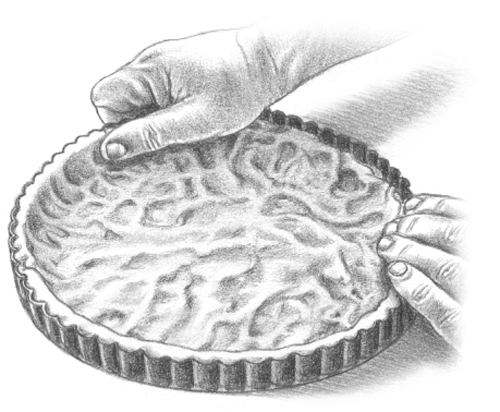
STEP 1
Gently press the dough into a generously buttered tart pan, being sure to tuck it into the corners.
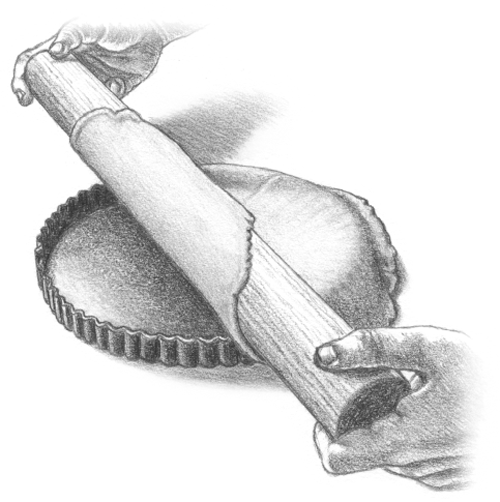
STEP 2
Alternatively, you can roll out the dough and then use the rolling pin to transfer it to the pan.
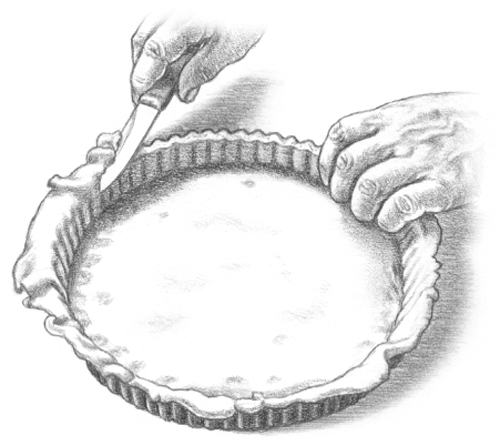
STEP 3
Trim the dough even with the top of the pan.
STEP 4
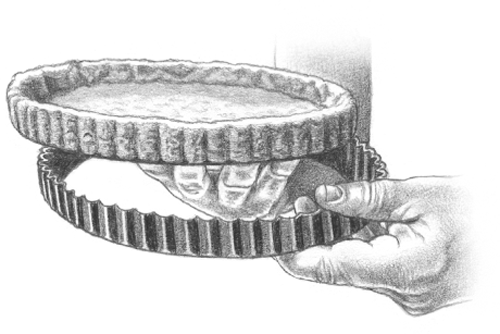
To remove the baked tart shell or tart from the pan, simply remove the outer ring.
Meringue Crust
Makes: One 9-inch piecrust
Time: About 30 minutes
The first pie I ever made featured a meringue crust, and it worked wonderfully. They’re awesome, unexpected, naturally gluten-free, and delicious. Fill with anything that doesn’t need to be cooked—any icebox pie filling (pages 285-289). Custards and puddings like lemon curd and chocolate mousse also pair well with this delicate, airy crust.
- Butter for greasing
- 3 egg whites at room temperature
- ¼ teaspoon cream of tartar
- Pinch of salt
- ½ teaspoon vanilla extract
- ¼ cup sugar
1. Generously butter a 9-inch pie plate and heat the oven to 350°F.
2. Use a hand-held mixer or a stand mixer with the whisk attachment to beat the egg whites until foamy. Add the cream of tartar, salt, and vanilla and continue to beat until soft peaks form. As you continue to beat the egg whites, slowly add the sugar, a little at a time, to the mixture. Beat until stiff peaks form.
3. Spread the mixture evenly into the bottom and up the sides of the prepared pie plate. Bake for 20 minutes or until the meringue is set and becomes golden. Remove from the oven and let cool completely. Fill the crust either just before serving (if the filling isn’t too thin) or fill and then immediately refrigerate or freeze if you plan to serve the pie cold. Eat within a day.
MERINGUE NUT CRUST Ideal for chocolate fillings: After stiff peaks form, fold in ½ cup finely chopped pecans, almonds, or walnuts.
No-Bake Fruit and Nut Crust
Makes: One 9-inch piecrust
Time: 10 minutes, plus time to chill
The quickest and easiest piecrust, which also happens to be both gluten-free and vegan. (It’s tasty enough to satisfy those with no dietary restrictions.) Gather some dried fruit and nuts, give each a whirl in the food processor, and combine. What you’re left with is a sweet, chewy, no-bake crust; finish with any icebox pie filling (pages 285-289) or your favorite pudding or custard.
- 1 cup nuts, like pecans, almonds, or walnuts, toasted
- ¾ cup packed pitted dried fruit, like cherries, apricots, or raisins
1. Use a food processor to pulse the nuts to a fine meal—but not so much that they turn to butter. Place in a large bowl and set aside.
2. Add the dried fruit to the food processer with a couple teaspoons of water and grind until a smooth paste forms. Mix the paste with the nuts until combined. Form the “dough” into a disk and refrigerate for at least 30 minutes or wrap well and freeze until you’re ready to use it. Press the mixture evenly into a pie plate then add your filling.
NO-BAKE FRUIT AND COCONUT CRUST Substitute 1½ cups shredded unsweetened coconut for the nuts. You can skip processing the coconut, but processing it will produce a finer texture for the crust.
NO-BAKE FRUIT AND GRANOLA CRUST A crunchier take on the chewy crust: Substitute your favorite granola for the nuts. If your granola is super-clumpy, give it a whirl in the food processor.
Crumb Topping
Makes: 2½ cups, enough for any size pie
Time: 10 minutes, plus time to chill
The easiest pie topping there is and maybe the tastiest—use it for Cherry-Almond Pie or in place of the top crust on any other fruit pie. It also takes the fuss out of fruit desserts (pages 297-301) and allows you to embrace imperfection. Prepare it by hand or in a food processor; adapt the mixture to your taste and to match your fillings.
- 1 cup flour
- ½ cup packed brown sugar
- ½ cup granulated sugar
- ½ teaspoon cinnamon
- ¼ teaspoon salt
- 1 stick butter, chilled and cut into pieces
1. Put the flour, sugars, cinnamon, and salt in a large bowl; whisk to combine. Add the butter and use your hands to rub it into the dry ingredients until the mixture becomes clumpy and crumbly and the butter is well incorporated. Refrigerate for at least 15 minutes or up to a week before using.
2. Sprinkle evenly over the top of the pie, crisp, or other dessert, covering the filling. Bake as directed in the recipe.
GLUTEN-FREE CRUMB TOPPING Rice flour makes this very delicate: In place of the all-purpose flour, use ¾ cup rice flour and ½ cup almond flour (see page 15 to make your own). Decrease the brown sugar to ¼ cup.
VEGAN CRUMB TOPPING Decrease the flour to ¾ cup and add ½ cup almond flour (see page 15 to make your own). Decrease the brown sugar to ¼ cup. Instead of butter, use ¼ cup chilled coconut oil and 2 tablespoons neutral oil (such as grapeseed or corn).
OAT CRUMB TOPPING Use this for something a little crisper and heartier: Substitute ½ cup rolled oats for half of the flour and, if you like, maple syrup for the brown sugar.
NUT CRUMB TOPPING A crumble nut topping is perfect for quick breads, muffins, tarts, and pies; apply this to any of the preceding variations too: Omit the granulated sugar and use 1 cup brown sugar. Add ½ cup chopped nuts—like pecans, walnuts, hazelnuts, or almonds, preferably blanched—to the dry ingredients and a tablespoon of fresh lemon juice with the butter. If you like, substitute nut flour for up to half of the all-purpose.
COCONUT CRUMB TOPPING Follow the same instructions for the Nut Crumb Topping, but swap in shredded unsweetened coconut for the nuts. Omit the cinnamon if you like.
12 Things to Add to Crumb Toppings
- 1 teaspoon ginger, ½ teaspoon cardamom, ¼ teaspoon ground cloves, ¼ teaspoon allspice, and/or ¼ teaspoon nutmeg
- Minced fresh herbs, like thyme, rosemary, or sage, up to 1 tablespoon
- Citrus zest, 1 tablespoon, rubbed into the sugar before adding the butter
- Seeds from 1 vanilla bean
- Brown butter, substituted for half of the softened butter
- Graham cracker crumbs, ½ cup
- Olive oil, substituted for half of the butter: good for a refined, slightly more savory twist
- Dried fruit, finely chopped, like raisins, dried cranberries, or dates, up to ½ cup
- Chopped dark chocolate, up to ½ cup
- Shredded unsweetened coconut, up to ½ cup
- Cooked grains, like farro, quinoa, or barley, ½ cup
- Crumbled crunchy cookies, like gingersnaps or chocolate wafer cookies, ½ cup
The Basics of Fruit Pies
Fruit pies are a joyful way to celebrate peak-season produce; avoid making them too sweet or thick so the fruit retains its character. Some berries can be quite tart and will take relatively large amounts of sugar, but perfectly ripe and in-season fruit usually needs very little. You can’t go wrong if you start with ingredients that you’d love to eat raw and keep things simple; see the chart on page 270 for other fantastic additions.
Although frozen fruit has improved greatly in recent years, it tends to become watery as it thaws; increase both sugar and thickener a little when you’re using it to improve winter pies. Usually there is no need to thaw frozen fruit before baking, although if the pieces are large—like peach halves—they should be defrosted enough to slice.
Most fruit pies are double-crusted, and Flaky Piecrust is the classic foundation. There’s also a whole genre of fruit tarts (pages 290-294) in which fruit fills a shorter, crisper crust. Feel free to tinker as you like: Crumb Topping is an easy substitute for the top crust. And you never really need a bottom crust—without one, your pie becomes a cobbler, crisp, or crumble, which is just as tasty.
Recipes
Apple Pie
Pear Galette
Blueberry Pie
Peach or Other Stone Fruit Pie
Mincemeat Pie
Apple Pie
Makes: One 9-inch pie, enough for about 8 servings
Time: 1½ hours
It’s hard to imagine autumn without apple pie. Whether for Thanksgiving dinner or a dessert that lasts all week, this is the classic recipe you’ll turn to again and again when the weather turns crisp. The best pies, of course, are made with the best apples.
This pie is also fabulous with a Crumb Topping, and, if you like, add up to ½ cup finely chopped walnuts to the filling for more texture.
- ¼ cup flour
- ¾ cup sugar, plus more for sprinkling
- ½ teaspoon cinnamon
- ½ teaspoon nutmeg
- ¼ teaspoon salt
- 3 pounds firm, sweet apples, like Honeycrisp, Pink Lady, or Northern Spy, peeled, cored, and sliced into wedges about ¼ inch thick
- 1 tablespoon fresh lemon juice
- 2 tablespoons butter, cut into pieces
- Flaky Piecrust, bottom crust fitted into a 9-inch pie plate, top crust transferred to a rimless baking sheet, both chilled Milk as needed
1. Heat the oven to 450°F. In a small bowl, whisk together the flour, sugar, spices, and salt. In a large bowl, mix together the apples and lemon juice. Add the dry ingredients to the apples and toss to coat.
2. Layer the apple mixture in the rolled-out pie shell (make sure to pour in any excess juices), then dot with the butter. Cover with the top crust, crimp the edges of the 2 crusts together, then decorate the edges with a fork or your fingers as illustrated on page 257.
3. Put the pie on a baking sheet and brush the top lightly with milk; sprinkle with sugar. Use a sharp paring knife to cut two or three 2-inch-long slits in the top crust; this will allow steam to escape. Bake for 10 minutes; reduce the heat to 350°F and bake for another 40 to 50 minutes or until the pie is golden brown. Check on the pie when it has been cooking for a total of 35 minutes and tent the edges of the crust with aluminum foil to prevent burning. Cool on a rack before serving warm or at room temperature.
PEAR-GINGER PIE This also tastes great as an open-faced pie, with a Cookie Crumb Crust made with gingersnaps: Substitute firm pears for the apples and ginger for the cinnamon. Swap in brown sugar for the granulated sugar just in the filling.
DUTCH APPLE PIE A little cream makes this pie special: Add 2 tablespoons cornstarch or 3 tablespoons instant tapioca to the dry mixture. Proceed as directed, making sure to cut a large vent hole in the center of the top crust. About 30 minutes into the baking time, pour ½ cup cream into the vent hole and finish baking as directed.
CIDER APPLE PIE Intensify the apple flavors for a pie with oomph: Omit the lemon juice. Place the apples and 2/3 cup apple cider in a large pot. Bring the cider to a boil, cover, and cook over high heat for about 5 minutes, stirring occasionally. Drain the apples and reserve the cider. Transfer the cider to a small saucepan and, over medium-high heat, reduce it to about ⅓ cup. Add the reduced apple cider back to the apples, let cool completely, then proceed with the recipe.
APPLE PIE WITH CHEDDAR CRUST For a sweet and savory twist—many people swear by this combination; try it with fresh herbs as in the list below: Mix 1 cup shredded sharp cheddar cheese into the dry ingredients of Savory Piecrust.
SALTED CARAMEL APPLE PIE A decadent, oozing pie: Make the Salted Caramel Sauce in advance. When it comes time to assemble the pie, layer a third of the apple mixture in the pie shell, then drizzle a third of the caramel sauce over it; repeat until the last layer of apples is covered in caramel. Bake as directed.
BROWN BUTTER APPLE PIE The nutty flavor of brown butter doubles the cozy, homey flavor of this classic pie: Decrease the sugar to ¼ cup and omit the spices. Melt 4 tablespoons (½ stick) butter over medium heat in a heavy skillet or saucepan, watching closely until the butter smells great and is a nice copper color. Let cool for a couple minutes before adding to the apple mixture.
8 Additions to Apple Pie
Apples are well complemented by ingredients that emphasize their warmth, like nuts, booze, or spices, as well as brighter flavors like berries and citrus:
- Chopped nuts, ½ to 1 cup
- Warm spices, like minced fresh, candied, or ground ginger, cardamom, allspice, or cloves, 1 teaspoon or more to taste
- Bourbon or rum, about 2 tablespoons sprinkled over the fruit
- Whole cranberries, about 1 cup, plus an extra ¼ cup sugar
- Pitted stone fruit, like plums or cherries, cut up, or whole raspberries, blueberries, or blackberries, 1 cup or more, the amount of apples reduced accordingly
- Dried fruit, like raisins, dried cherries, cranberries, pineapple, mango, or blueberries or some dried apple slices to intensify the apple flavor, ½ to 1 cup
- Grated lemon or orange zest, 1 tablespoon
- Finely minced fresh herbs, like rosemary, thyme, or sage, 1 tablespoon
Pies 1-2-3
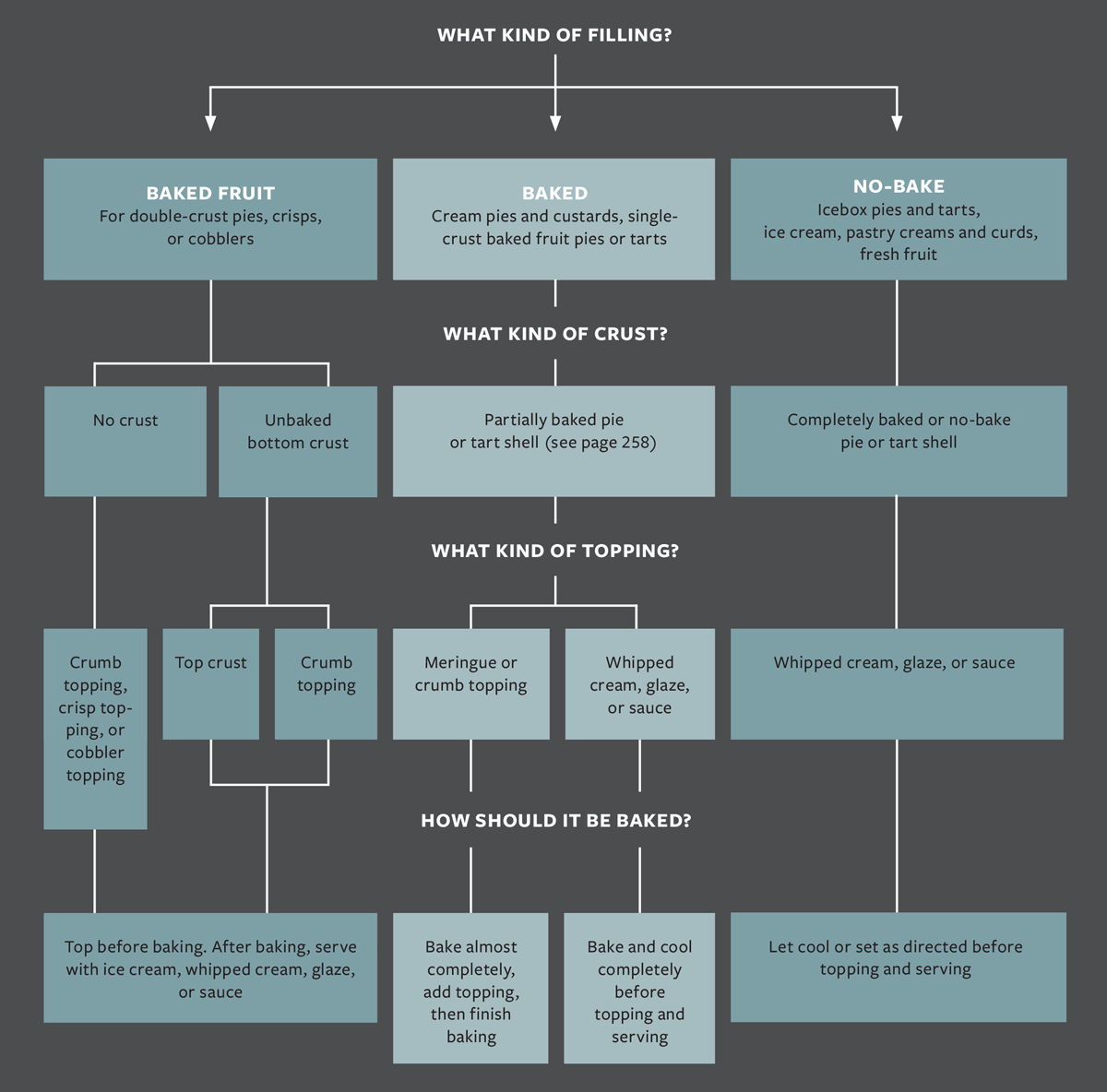
Combine a sweet filling and tender crust in any way you like—you can’t go wrong. Some pies and tarts are laden with fruit, others have velvety custards, and still others aren’t baked at all; if you can’t be bothered with rolling out a crust, pile a bit of crumb topping over the filling instead. Here are the building blocks.
- BAKED FRUIT FILLING: For double-crust pies, crisps, or cobblers
- CRUST: No crust
- TOPPING: Crumb topping, crisp topping, or cobbler topping
- BAKING METHOD: Top before baking. After baking, serve with ice cream, glaze, or sauce
- BAKED FRUIT FILLING: For double-crust pies, crisps, or cobblers
- CRUST: Unbaked bottom crust
- TOPPING: Top crust
- BAKING METHOD: Top before baking. After baking, serve with ice cream, glaze, or sauce
- BAKED FRUIT FILLING: For double-crust pies, crisps, or cobblers
- CRUST: Unbaked bottom crust
- TOPPING: Crumb topping
- BAKING METHOD: Top before baking. After baking, serve with ice cream, glaze, or sauce
- BAKED: Cream pies and custards, single-crust baked fruit pies or tarts
- CRUST: Partially baked pie or tart shell (see page 258)
- TOPPING: Meringue or crumb topping
- BAKING METHOD: Bake almost completely, add topping, then finish baking
- BAKED: Cream pies and custards, single-crust baked fruit pies or tarts
- CRUST: Partially baked pie or tart shell (see page 258)
- TOPPING: Whipped cream, glaze, or sauce
- BAKING METHOD: Bake and cool completely before topping and serving
- NO-BAKE: Icebox pies and tarts, ice cream, pastry creams and curds, fresh fruit
- CRUST: Completely baked or no-bake pie or tart shell
- TOPPING: Whipped cream, glaze, or sauce
- BAKING METHOD: Let cool or set as directed before topping and serving
Pear Galette
Makes: 6 to 8 servings
Time: 1 hour
Galettes are free-form, rustic, no-fuss tarts; they look imperfect, but their taste more than makes up for that. See these illustrations for a visual guide.
More formula than recipe, try this with any filling you’re craving at the moment; see 8 Simple Ideas for Free-Form Tarts on the following page and Improvising Fruit Fillings for ideas. This crisp cornmeal crust goes well with pears, but you can also use Flaky Piecrust or Puff Pastry.
- Cornmeal Tart Crust, prepared through Step 2
- 2-3 large pears, peeled, cored, and cut into thin wedges (about ¼ inch thick)
- 2 tablespoons butter, melted
- Milk as needed
- 1 tablespoon sugar
1. On a lightly floured surface, roll the crust out into a 10-inch round. Transfer the dough to a baking sheet and refrigerate the dough for at least 15 minutes or until you’re ready to assemble the galette.
2. Heat the oven to 425°F. Arrange the pears on the dough, starting from the inside and moving toward the rim in concentric circles, leaving a 2-inch-or-so border. Brush or drizzle the pears with the melted butter, then fold the edges over the filling and brush the crust with milk. Dust everything with sugar.
3. Bake for 25 to 30 minutes or until the rim is golden brown and the pears have softened. Cool the galette to room temperature before serving.
RED WINE-POACHED PEAR GALETTE An ultra-sophisticated take on an otherwise rustic dessert: Make a batch of Red Wine-Poached Pears, halving the pears instead of leaving them whole. Arrange the pear halves in a circle on top of the dough and drizzle them with the leftover juices. Bake as directed.
PEAR GALETTE WITH BALSAMIC SYRUP Play with sweet and a little bit of savory: While the galette is baking, make Balsamic Syrup. Let the galette cool slightly before drizzling the syrup over it.
APPLE-BUTTERSCOTCH GALETTE Like an undone caramel apple: Substitute apples for the pears. Arrange them as instructed, then drizzle Butterscotch Sauce over them, reserving a bit of sauce for serving.
PEACH-RASPBERRY GALETTE For when summer calls: Omit the pears and melted butter. Pit and slice 3 medium peaches. In a medium bowl, combine them with 1 cup raspberries, 1 teaspoon fresh lemon juice, 1 tablespoon flour, and ¼ cup sugar. Place the filling in the center of the piecrust and proceed with the recipe.
JAM GALETTE As easy as it gets: Omit the pears, butter, and sugar. Spread 1½ cups jam over the center of the piecrust. If you like, sprinkle a handful of chopped nuts on top for a bit of crunch. You can also spread a thin layer of a complementary jam flavor under any of the preceding galette recipes for an extra layer of sweetness.
Fruit Thickeners
Fruit gives off a lot of juice as it bakes, so thickeners are often added to keep the filling from getting too runny. Every thickener is different, and in general, the softer the fruit, the more thickener you need; frozen fruit also needs a bit more thickener than fresh (an extra ½ to 1 tablespoon). If you like, let the fruit sit with ¼ cup sugar for 30 minutes or so, then drain any excess liquid before adding the thickener; otherwise, just toss powdered thickeners with the fruit until it’s evenly coated.
The suggested quantities are for 5 to 6 cups of filling (about the amount for a 9-inch pie), but remember that this is all a matter of personal preference, so use this guide as a starting point and take notes as you go to achieve your favorite consistency.
THICKENER: All-purpose flour
PROS: Imparts a smooth, velvety texture, especially with heartier fruit like apples or pears, which need less thickener than softer fruit.
CONS: Produces a cloudy, opaque filling; may thin if overcooked or taste starchy if undercooked; too much creates a pasty texture.
HOW MUCH TO USE FOR 5 TO 6 CUPS FRUIT: ¼ cup for hard fruit (apples, pears, etc.); ½ cup for soft fruit (berries, stone fruits, etc.)
THICKENER: Arrowroot powder
PROS: Creates a clear, smooth, neutrally flavored filling; finished pie can be frozen.
CONS: Not ideal for pies with long baking times since it loses potency at higher temperatures; it becomes slimy when mixed with dairy.
HOW MUCH TO USE FOR 5 TO 6 CUPS FRUIT: 1 tablespoon for hard fruit; ¼ cup for soft fruit
THICKENER: Cornstarch
PROS: Creates an incredibly smooth, neutral-tasting filling without the pastiness of flour.
CONS: Must be cooked to remove the starchy, chalky flavor; breaks down relatively quickly and thins out considerably if cooked too long; is less effective with more acidic fruit; becomes spongy if frozen.
HOW MUCH TO USE FOR 5 TO 6 CUPS FRUIT: 1½ teaspoons for hard fruit; 2 tablespoons for soft fruit
THICKENER: Instant ClearJel (modified cornstarch)
PROS: Stable at all temperatures and with acidic ingredients; has a neutral flavor; can be used to thicken raw fruit fillings; won’t break down if the baked pie is frozen and thawed.
CONS: Produces a slightly opaque filling
HOW MUCH TO USE FOR 5 TO 6 CUPS FRUIT: 1 tablespoon for hard fruit; ¼ cup for soft fruit
THICKENER: Tapioca (instant powder, quick-cooking beads, or whole pearls)
PROS: Has a neutral flavor and imparts a lovely high gloss; thickens quickly, so it’s good for especially juicy fillings; finished pies can be frozen.
CONS: The clear, quick-cooking beads should be used only with double-crust pies; if exposed directly to the oven, they may not dissolve completely.
HOW MUCH TO USE FOR 5 TO 6 CUPS FRUIT: 2 tablespoons for hard fruit; ¼ cup for soft fruit. When using beads, let them sit in the filling for at least 30 minutes before baking.
Improvising Fruit Fillings
Bright and sweet, almost infinitely variable, fruit pies are always inviting. These are some of my favorite combinations—from the classic to the slightly more unusual—to help you pick and choose. Add the crust (including puff pastry) and/or topping of your choice to turn it into a pie, tart, galette, cobbler, crisp, pandowdy, or brown betty. Or, on a really lazy day, omit the crust or topping, bake the prepped fruit filling in a pie plate or baking dish, and serve with Whipped Cream or vanilla ice cream.
Aim for 5 to 6 cups’ worth of prepared fruit for a double-crust pie or crisp or cobbler; a little less for a tart or galette. Some fruit can be added raw to a baked crust and is good to go, while others should be cooked, with or without a thickener this chart will give you all of your options.
FRESH FRUIT: Apples
PREP: Peel, core, and chop or slice; toss with 1 tablespoon fresh lemon juice
ADDITIONS (CHOOSE ONE OR MIX AND MATCH A FEW): ½ cup raisins or dried cranberries; ½ cup chopped pecans or walnuts; 2 tablespoons bourbon; 1tablespoon minced fresh ginger; 1 tablespoon minced fresh thyme; 1 teaspoon cinnamon or ginger; ½ teaspoon cardamom, nutmeg, cloves, and/or allspice
HOW TO USE: Cooked (thickened with flour or cornstarch)
FRESH FRUIT: Bananas
PREP: Cut into ¼- to ½-inch slices
ADDITIONS (CHOOSE ONE OR MIX AND MATCH A FEW): ½ cup chopped walnuts or peanuts; ¼ cup honey; 2 tablespoons rum; 1 tablespoon vanilla extract; 1 teaspoon cinnamon
HOW TO USE: Cooked or raw
FRESH FRUIT: Berries (blueberries, raspberries, blackberries, strawberries) and/or currants
PREP: Hull and chop if necessary
ADDITIONS (CHOOSE ONE OR MIX AND MATCH A FEW): ½ cup raisins or dried cranberries; ¼ cup chopped fresh mint, basil, or tarragon; ¼ cup fruity red wine; 2 tablespoons Chambord or Grand Marnier; 1 tablespoon grated lemon or lime zest; 1 tablespoon minced fresh ginger; 1 tablespoon vanilla extract; 1 tablespoon orange blossom water or rose water; ½ teaspoon cinnamon
HOW TO USE: Cooked (thickened with cornstarch, arrowroot, or tapioca) or raw
FRESH FRUIT: Cranberries
PREP: Add at least ¾ cup sugar or maple syrup
ADDITIONS (CHOOSE ONE OR MIX AND MATCH A FEW): ¼ cup fruity red wine; 2 tablespoons bourbon, rum, or Grand Marnier; 1 tablespoon grated orange zest; 1 tablespoon minced fresh ginger; 1 tablespoon minced fresh rosemary; 1 teaspoon cinnamon or ginger; ½ teaspoon nutmeg, cloves, and/or allspice
HOW TO USE: Cooked (thickened with cornstarch, arrowroot, or tapioca)
FRESH FRUIT: Figs
PREP: Chop
ADDITIONS (CHOOSE ONE OR MIX AND MATCH A FEW): ½ cup chopped pistachios or pine nuts; ¼ cup fruity red wine; ¼ cup honey; 1 tablespoon grated orange or lemon zest; 1 tablespoon vanilla extract; 1 tablespoon orange blossom water or rose water; 1 teaspoon cinnamon; ½ teaspoon cardamom
HOW TO USE: Cooked or raw
FRESH FRUIT: Pineapple
PREP: Peel, core, and chop or slice
ADDITIONS (CHOOSE ONE OR MIX AND MATCH A FEW): ½ cup shredded unsweetened coconut; ¼ cup chopped fresh mint; 2 tablespoons rum; 1 tablespoon grated orange or lime zest
HOW TO USE: Cooked (thickened with cornstarch, arrowroot, or tapioca) or raw
FRESH FRUIT: Mangoes
PREP: Peel, pit, and chop or slice
ADDITIONS (CHOOSE ONE OR MIX AND MATCH A FEW): ½ cup shredded unsweetened coconut; ½ cup chopped macadamia nuts; ¼ cup chopped fresh mint; ¼ cup honey; 2 tablespoons rum or Grand Marnier; 1 tablespoon grated orange or lime zest; 1 tablespoon minced fresh ginger; ½ teaspoon cardamom and/or cinnamon
HOW TO USE: Cooked (thickened with cornstarch, arrowroot, or tapioca) or raw
FRESH FRUIT: Oranges or grapefruit
PREP: Peel, seed, and remove the pith if you like
ADDITIONS (CHOOSE ONE OR MIX AND MATCH A FEW): ¼ cup chopped fresh mint; 2 tablespoons Grand Marnier; 1 tablespoon grated orange or grapefruit zest; 1 tablespoon minced fresh ginger; 1 tablespoon vanilla extract; 1 tablespoon orange blossom water or rose water; ½ teaspoon cardamom and/or cloves
HOW TO USE: Raw
FRESH FRUIT: Peaches, nectarines, plums, apricots, or cherries
PREP: Pit and chop or slice
ADDITIONS (CHOOSE ONE OR MIX AND MATCH A FEW): ½ cup chopped pistachios, almonds, or pecans; ¼ cup chopped fresh mint, basil, or tarragon; ¼ cup honey; 2 tablespoons minced fresh rosemary or thyme; 2 tablespoons bourbon; 1 tablespoon grated lime zest; 1 tablespoon minced fresh ginger; 1 tablespoon vanilla extract; 1 teaspoon cinnamon; ½ teaspoon almond extract; ½ teaspoon cardamom or cloves
HOW TO USE: Cooked (thickened with cornstarch, arrowroot, or tapioca) or raw
FRESH FRUIT: Pears
PREP: Peel, core, and chop or slice; toss with 1 tablespoon fresh lemon juice
ADDITIONS (CHOOSE ONE OR MIX AND MATCH A FEW): ½ cup raisins or dried cranberries; ½ cup chopped almonds; 2 tablespoons bourbon; 1 tablespoon minced fresh ginger; 1 tablespoon minced fresh rosemary; 1 teaspoon cinnamon or ginger; ½ teaspoon almond extract; ½ teaspoon cardamom, nutmeg, cloves, and/or allspice
HOW TO USE: Cooked (thickened with flour or cornstarch)
FRESH FRUIT: Rhubarb
PREP: Chop into ½-inch pieces; add at least 1 cup sugar
ADDITIONS (CHOOSE ONE OR MIX AND MATCH A FEW): Any berries, on their own or seasoned as suggested on the previous page
HOW TO USE: Cooked (thickened with cornstarch)
Blueberry Pie
Makes: One 9-inch pie, enough for about 8 servings
Time: About 1½ hours
If your berries are perfectly ripe and in season, use the lesser amount of sugar, keep the spices to a minimum, and let the berries shine. (Add more if they’re not at their peak.) This can also be paired with Crumb Topping instead of a top crust.
- 5 cups blueberries, picked over, rinsed briefly, and dried lightly
- ½−1 cup sugar, to taste, plus a little for the top
- 2 tablespoons plus 1 teaspoon cornstarch
- Pinch of salt
- ½ teaspoon cinnamon
- Pinch of allspice or nutmeg
- 1 teaspoon grated lemon zest (optional)
- 1 tablespoon fresh lemon juice
- Flaky Piecrust, bottom crust fitted into a 9-inch pie pan, top crust transferred to a rimless baking sheet, both chilled
- 2 tablespoons butter, cut into bits
- Milk as needed
1. Heat the oven to 450°F. Gently toss the blueberries with the sugar, cornstarch, salt, and spices. Stir in the lemon zest if you’re using it and the juice and pile into the rolled-out shell, making the pile a little higher in the center than at the sides. Dot with the butter.
2. Cover with the top crust. Crimp and decorate the edges with a fork or your fingers, using any of the methods illustrated on page 257.
3. Put the pie on a baking sheet and brush the top lightly with milk; sprinkle with sugar. Use a sharp paring knife to cut two or three 2-inch-long slits in the top crust to allow steam to escape. Bake for 10 minutes; reduce the heat to 350°F and bake for another 40 to 50 minutes or until the pie is golden brown. Do not underbake. Cool on a rack entirely, about 1 hour, before serving to let the filling set. Serve warmed up or at room temperature.
BLUEBERRY-LEMON PIE For a bit more zing: Use all the zest and juice from the lemon.
MIXED BERRY PIE Empty out your fridge: Use a total of 5 cups of berries, in any combination you like, making sure to remove stems and seeds when needed. Use 3½ tablespoons cornstarch. If your berries aren’t very sweet, be sure to add a bit more sugar too.
STRAWBERRY, RHUBARB, OR STRAWBERRY-RHUBARB PIE Use a total of 5 cups of fruit, in any combination you like. String rhubarb, then cut it into 1-inch pieces. Hull the strawberries; slice in half or leave whole. If you’re using rhubarb, use at least 1 cup sugar. Use 3 tablespoons cornstarch or ¼ cup instant tapioca as thickener. Omit the lemon juice and zest.
BLACKBERRY AND RED WINE PIE Red wine is the secret weapon in this sophisticated pie: Mix ½ cup fruity red wine with the sugar, cornstarch, salt, spices, lemon juice, and zest if using. Swap blackberries for blueberries, pour the wine mixture over them, and simmer over medium heat until the mixture thickens and the liquid becomes syrupy, 30 to 45 minutes. Proceed as directed.
RASPBERRY-LIME PIE Substitute raspberries for the blueberries and 2 tablespoons fresh lime juice and 1 tablespoon grated lime zest for the lemon juice and zest.
All About Galettes
These simple and rustic tarts are baked free-form, without a tart pan. Called galettes in France and crostatas in Italy, these can be made with sweet or savory dough and fillings (see page 519 for some savory options). Start with Flaky Piecrust, Sweet Tart Crust, any of their variations, or puff pastry, then try any of the ideas below for a pastry as adaptable as it is accessible.
Making a Galette
STEP 1
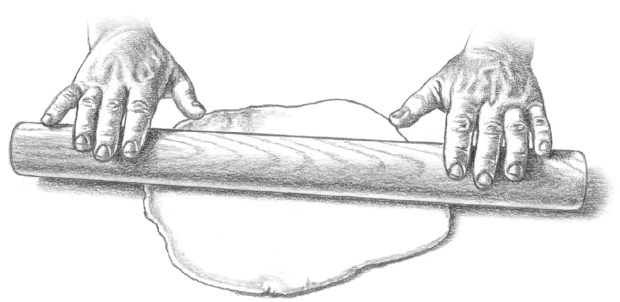
Roll out your chilled dough. Don’t worry about making it perfect, as long as it’s evenly thick; uneven edges are part of the appeal. Chill for at least 15 minutes.
STEP 2
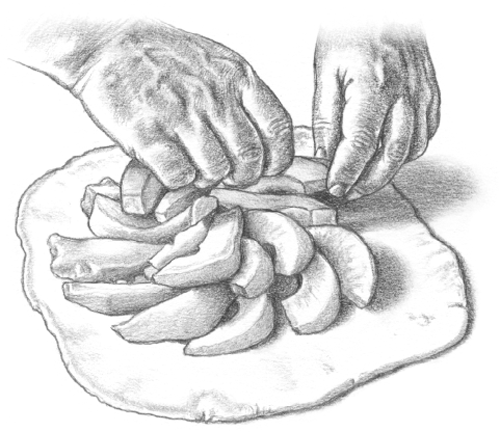
Add the filling, arranging or spreading it to just an inch or two from the edge.
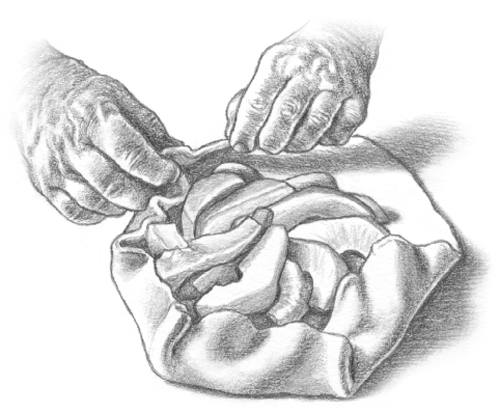
STEP 3
Fold the edges over part of the filling, pleating them so they remain in place to contain any errant juices.
8 Simple Ideas for Free-Form Tarts
▪ Put a layer of crushed nuts, coarse sugar, graham cracker crumbs, or shredded coconut under the fruit, particularly if the filling is especially juicy so that the bottom layer can soak up some of the liquid.
▪ Combine the melted butter with 2 tablespoons honey before brushing it over the fruit.
▪ Toss the fruit with 1 teaspoon or more cinnamon, ground ginger, and/or minced candied ginger.
▪ Spread a thin layer of goat cheese, cream cheese, Caramel Sauce, or your favorite jam (see page 575 for homemade) under the fruit.
▪ Macerate the fruit with ¼ cup Simple Syrup or your favorite liqueur and thoroughly drain it before adding to the crust.
▪ Toss the filling with 1 tablespoon finely minced fresh herbs, like rosemary or thyme, or grated citrus zest.
▪ Top the fruit filling with ½ cup Crumb Topping before baking.
▪ Garnish baked galettes with a dollop of mascarpone or Whipped Cream, a drizzle of Fruit Sauce or Chocolate Ganache Glaze, or a scoop of ice cream.
Peach or Other Stone Fruit Pie
Makes: One 9-inch pie, enough for about 8 servings
Time: About 1½ hours
Perfectly ripe fruit is crucial to the success of this pie, and it’s hard to beat peaches, nectarines, or apricots, all interchangeable. (Or look at the variations for other fruits and flavors.)
- About 2 pounds peaches (6 to 10 peaches, depending on size)
- 1 tablespoon fresh lemon juice
- About ½ cup sugar, more if the peaches are not quite ripe, plus a little for the top
- 1½ tablespoons cornstarch or 2 tablespoons instant tapioca
- ¼ teaspoon cinnamon or ½ teaspoon almond extract
- ⅛ teaspoon nutmeg or allspice if you use cinnamon
- Flaky Piecrust, bottom crust fitted into a 9-inch pie pan, top crust transferred to a rimless baking sheet, both chilled
- 2 tablespoons butter, cut into bits
- Milk as needed
1. Heat the oven to 450°F. Peel the peaches (see page 33). Pit, slice, and toss with the lemon juice.
2. Mix together the dry ingredients (plus the almond extract if you’re using it) and toss the peaches with this mixture. Pile into the rolled-out shell, making the pile a little higher in the center than at the sides. Dot with the butter. Cover with the top crust. Crimp and decorate the edges with a fork or your fingers, using any of the methods illustrated on page 257.
3. Put the pie on a baking sheet and brush the top lightly with milk; sprinkle with sugar. Use a sharp paring knife to cut two or three 2-inch-long slits in the top crust to allow steam to escape. Bake for 10 minutes; reduce the heat to 350°F and bake for another 40 to 50 minutes or until the pie is golden brown. Do not underbake. Cool on a rack before serving warm or at room temperature.
PEACHES AND CREAM PIE Rich, sweet, classic: Start with half a batch of Flaky Piecrust, fitted into the pie pan. Partially bake the crust (see page 258) and let cool completely before filling. Omit the lemon juice, spices, and butter. In a medium bowl, beat 2 eggs lightly, then add the sugar and 2 tablespoons cornstarch with ¾ cup cream. Place the peaches in the pie plate, then pour the cream mixture over them. Crimp the crust and top with milk and sugar; bake at 450°F for 10 minutes, then reduce the heat to 375°F and bake for another 30 to 40 minutes at 375°F, until the mixture shakes like Jell-O but is still quite moist.
PEACH-RASPBERRY PIE Add 1 cup raspberries to the mixture of peaches or other fruit. Blueberries are another classic pairing.
PEACH-GINGER PIE Add 1 tablespoon minced fresh ginger or 1 teaspoon ground to the mixture (use the cinnamon and nutmeg; do not use the almond extract).
CHERRY PIE Tart cherries are best for pie: Substitute 4 to 5 cups pitted sour cherries for the peaches; omit the lemon juice. If you use canned tart cherries, drain them well and increase the thickener by 1 tablespoon.
CHERRY-ALMOND PIE Tart cherries are balanced by the earthy almond flavor and an irresistible crumb topping: Swap out the peaches for 4 to 5 cups of pitted tart cherries and use almond extract instead of the spices. Top the pie with Nut Crumb Topping using almonds in place of the top crust.
CHERRY-BOURBON PIE A bit of kick: Use 4 to 5 cups of pitted tart cherries and add ⅓ cup bourbon to the pie filling mixture. Omit the lemon juice.
CHERRY CUSTARD PIE Total luxury: Start with half a batch of Flaky Piecrust, fitted into the pie pan. Bake the crust completely, and let cool before filling. In a medium bowl, beat together 3 eggs, 1 cup cream, the sugar, and the spices. Omit the lemon juice, cornstarch, and butter. Place 4 cups pitted tart cherries in the pie shell and pour the egg mixture over them. Bake for 30 to 40 minutes at 375°F or until the mixture shakes like Jell-O but is still quite moist.
PLUM PIE Delicate and delicious: If possible, use the small prune (Italian) plums that come into season in early autumn.
Mincemeat Pie
Makes: One 9-inch pie, enough for about 8 servings
Time: About 1½ hours
Full of sweet dried fruit, apple, cinnamon, and brandy, this English classic is fruitcake in a pie. Historically, mincemeat did include finely chopped meat or suet, hence the name, but this version is more appealing. Use any combination of dried fruit you like. Add some chopped candied fruit peel for even more zing. Top with Hard Sauce.
- 3 tart apples, peeled, cored, and cut into chunks
- 2½ cups chopped dried fruit—I like a combination of apricots, currants, raisins, cranberries, and cherries
- 1¼ cups packed brown sugar
- 2 tablespoons brandy
- 2 tablespoons cornstarch
- 3 tablespoons butter
- 1 tablespoon grated orange zest
- ½ teaspoon cinnamon
- ¼ teaspoon ginger
- ¼ teaspoon nutmeg
- Pinch of salt
- Flaky Piecrust, bottom crust fitted into a 9-inch pie pan, top crust transferred to a rimless baking sheet, both chilled
1. Heat the oven to 375°F. In small batches, use a food processor to pulse the apples until they are in small pieces. Add them to a large saucepan, then pulse the dried fruit into small pieces in the food processor.
2. Add the dried fruit to the saucepan with the apples along with the brown sugar, brandy, cornstarch, butter, orange zest, spices, and salt. Simmer over medium-low heat, keeping a close eye on it and stirring until the mixture becomes very thick, about 10 minutes. Remove from the heat and let cool completely.
3. Place the pie plate on a baking sheet, then fill the shell with the fruit filling. Cover the pie with the top crust, crimping the edges with your fingers or the tines of a fork using any of the methods on page 257. Use a sharp knife to make small incisions all over the top of the piecrust in a decorative pattern.
4. Transfer the baking sheet to the oven and bake for about 15 minutes; reduce the heat to 350°F and bake for another 45 minutes to an hour until the filling is bubbling and the crust is golden brown. Cool on a rack completely for the filling to set and rewarm before serving.
The Basics of Custard Pies
The common thread among all custard pies, from smooth Vanilla Cream Pie (this page) to nut-studded Pecan Pie, is the inclusion of eggs, which lend characteristic thickness and creaminess to the baked filling. For best results, make sure all filling ingredients are at room temperature, unless directed otherwise. And make the filling only when you’re ready to add it to the crust; otherwise, as the sugar and eggs interact, they may start to lose their smoothness.
Recipes
Vanilla Cream Pie
Lemon Meringue Pie
Key Lime Pie
Pumpkin Pie
Pecan Pie
Mississippi Mud Pie
Buttermilk Pie
Chess Pie
Maple Pie
Shoofly Pie (Molasses Pie)
Vanilla Cream Pie
Makes: One 9-inch pie, enough for about 8 servings
Time: About 1½ hours, plus time to chill
Learn this basic recipe and the sky is the limit for variations. Although it’s called “cream pie,” it’s actually best made with whole milk; cream leaves the texture too thick and with a less pleasant mouthfeel. While the classic pie is topped with meringue, you can use Whipped Cream if you’d rather; in that case, skip the baking and put the pie straight into the fridge to set.
- ½ recipe Flaky Piecrust or 1 recipe Cookie Crumb Crust made with graham crackers, fitted or pressed into a 9-inch pie plate and chilled
- ¾ cup granulated sugar
- 2 tablespoons cornstarch
- Salt
- 4 eggs, separated
- 2½ cups whole milk or 2¼ cups low-fat milk mixed with ¼ cup cream
- 1 vanilla bean or 2 teaspoons vanilla extract
- 2 tablespoons butter, softened
- ¼ cup confectioners’ sugar
1. Bake the flaky piecrust completely (see page 258) or bake the crumb crust as described in the recipe. Start the filling while the crust is in the oven. When the crust is done, leave the oven at 350°F and cool the crust slightly on a rack. In a small saucepan, combine the granulated sugar with the cornstarch and a pinch of salt.
2. Mix the egg yolks and milk together. If you’re using a vanilla bean, split it and scrape the seeds into the milk mixture. Stir the milk-egg mixture into the sugar-cornstarch mixture over medium heat; at first, whisk occasionally to eliminate lumps. Then whisk almost constantly until the mixture boils and thickens enough to coat the back of a spoon, about 10 minutes. Stir in the butter (and vanilla extract if you’re using it) and set aside.
3. Make the meringue: Beat the egg whites with a pinch of salt until foamy. Keep beating, gradually adding the confectioners’ sugar, until the mixture is shiny and holds fairly stiff peaks.
4. Pour the warm filling into the crust. Cover with the meringue, making sure to spread the meringue all the way to the edges of the crust; this will keep it from shrinking. As you spread the meringue, make peaks and swirls if you like. Put the pie plate on a rimmed baking sheet to prevent drips and bake for 10 to 15 minutes, until the meringue is lightly browned. Cool on a rack, then refrigerate for at least 2 hours; serve cool.
CREAM-TOPPED CREAM PIE If you love whipped cream, this version works for the main recipe or any of its variations: Use only 2 eggs and add the whole eggs to the filling. After pouring it into the baked shell, press a sheet of plastic wrap right on the surface of the custard (this will prevent a skin from forming) and refrigerate until cool, at least 1 hour. Top with whipped cream, spiked, if you like, with ½ teaspoon vanilla or almond extract or a shot of brandy or rum.
BANANA CREAM PIE For the custard, use 2 whole eggs instead of 4 yolks and increase the butter to 3 tablespoons. Stir 1 cup thinly sliced banana into the filling just before pouring it into the pie shell. Top with a thick layer of whipped cream instead of meringue and refrigerate right away. Alternatively, prepare Bananas Foster and let cool a bit before spreading it in an even layer over the crust; top with the vanilla custard and whipped cream.
CHOCOLATE CREAM PIE Bittersweet chocolate works best: Add 2 ounces chopped or grated dark chocolate to the milk mixture as it cooks.
TRIPLE-CHOCOLATE CREAM PIE Over the top, if you like it that way: Substitute Cookie Crumb Crust made with chocolate wafer cookies for the Flaky Piecrust and use the Chocolate Cream Pie variation filling above. Add 3 tablespoons cocoa powder to the meringue along with the confectioners’ sugar.
MOCHA CREAM PIE A bit more sophisticated: Substitute Cookie Crumb Crust made with chocolate sandwich cookies or wafer cookies for the Flaky Piecrust and use the Chocolate Cream Pie variation filling, adding 2 tablespoons instant espresso powder to the sugar mixture in Step 1.
GINGER CREAM PIE Lightly spicy: Substitute Cookie Crumb Crust made with gingersnaps for the Flaky Piecrust. Add ½ teaspoon ginger and ¼ teaspoon cinnamon to the sugar mixture in Step 1.
ALMOND BANANA CHOCOLATE CREAM PIE For those who like many strong flavors: Use the Banana Cream Pie variation with the Chocolate Cream Pie filling. Substitute 1 teaspoon almond extract for the vanilla extract. Stir ⅓ cup chopped almonds into the chocolate cream with the butter in Step 2.
COCONUT CREAM PIE A classic: Toast 1 cup shredded unsweetened coconut by placing it in a dry skillet over very low heat and cooking, shaking almost constantly, until it begins to brown, 3 to 5 minutes. Immediately remove from the pan and stir into the thickened Vanilla Cream Pie filling. Add a drop of almond extract to the meringue along with the confectioners’ sugar. Top the meringue with ½ cup untoasted coconut before baking.
ORANGE CREAM PIE Your favorite hot-weather treat in the form of a pie: Substitute ½ cup fresh orange juice for ½ cup of the milk and add 1 tablespoon grated orange zest; add both to the milk mixture in Step 2. Proceed with the recipe.
EGGNOG CREAM PIE This pie screams Christmas: Use a Cookie Crumb Crust made with Speculaas (to make your own) in place of the Flaky Piecrust. Substitute eggnog for 1 cup of the milk. Add ½ teaspoon nutmeg to the sugar mixture. If you like, stir 2 to 3 tablespoons rum into the egg and milk mixture.
ADAPTING RECIPES
Making Hand Pies
Hand pies are a fun variation on pie that travels well. Because the baking time is so much shorter, however, you’ll need to thicken the filling to keep it from leaking out of the crust. To make them, roll out Flaky Piecrust and cut it into 5-inch squares. Brush the edges with egg wash. Cut any fruit pie filling recipe in half and add ½ teaspoon cornstarch. Bring the filling to a boil in a saucepan, stirring often, then stir in ½ cup chopped dried fruit to soak up excess liquid. Let cool. Spoon about ¼ cup filling into the center of each square and fold in half; pinch the edges to seal. Poke holes with a fork to let steam escape, brush with milk or egg wash, and dust with sugar. Bake at 375°F for 30 to 35 minutes, until golden and crisp.
Lemon Meringue Pie
Makes: One 9-inch pie, enough for about 8 servings
Time: About 45 minutes, plus time to chill
Light but powerful, Lemon Meringue Pie highlights its smooth, tart filling with a cloud of sweet meringue on top. As with Vanilla Cream Pie, you can skip the meringue topper, use Whipped Cream, and skip the final baking step altogether.
- ½ recipe Flaky Piecrust or 1 recipe Cookie Crumb Crust made with graham crackers, fitted or pressed into a 9-inch pie plate and chilled
- 1 cup granulated sugar
- ½ teaspoon salt
- 2 cups boiling water
- 4 eggs, separated
- ⅓ cup cornstarch
- 2 tablespoons butter, softened
- 2 teaspoons grated lemon zest
- 6 tablespoons fresh lemon juice
- ¼ cup confectioners’ sugar
1. Bake the flaky piecrust completely or bake the crumb crust as described in the recipe and start the filling while the crust is in the oven. When the crust is done, leave the oven at 350°F and cool the crust slightly on a rack.
2. In a small saucepan, combine the granulated sugar, ¼ teaspoon of the salt, and the boiling water and cook, stirring frequently until the sugar dissolves, just a minute or 2; keep warm. Beat the egg yolks and cornstarch until smooth. Whisk about ½ cup of the sugar mixture into the egg yolks. Immediately stir the egg yolk mixture back into the sugar mixture and bring to a boil, whisking constantly. Keep whisking and let it boil for less than a minute, then turn off the heat and add the butter. Stir in the lemon zest and juice. Set aside.
3. Make the meringue: Beat the egg whites with the remaining ¼ teaspoon salt until foamy. Keep beating, gradually adding the confectioners’ sugar, until the mixture is shiny and holds stiff peaks.
4. Pour the filling into the crust and cover with the meringue, making sure to spread it all the way to the edges of the crust to keep the meringue from shrinking. As you spread the meringue, make peaks and swirls if you like; you could also pipe the meringue onto the filling for a more refined look. Put the pie plate on a rimmed baking sheet to prevent spills and bake for 10 to 15 minutes, until the meringue is lightly browned. Cool on a rack, then refrigerate for at least 2 hours; serve cool.
LEMON MERINGUE WITH CREAMY FILLING Richer: Instead of water, use 2 cups warmed cream, half-and-half, or milk.
LEMON-MARSHMALLOW MERINGUE PIE Like a citrusy s’more: Substitute Fluffy Marshmallow Filling for the meringue and use Cookie Crumb Crust made with vanilla wafers.
LEMON-BERRY PIE Quite a beauty: Skip the meringue, press a sheet of plastic wrap onto the surface of the filled pie to prevent a skin from forming, and refrigerate until the filling is cold, at least 2 hours. Top with ½ cups mixed whole berries, like raspberries, blueberries, and blackberries, cut into smaller pieces if they’re big. Serve each slice with a dollop of Whipped Cream.
LIME MERINGUE PIE For an even tarter twist: Substitute lime zest and juice for the lemon zest and juice.
Key Lime Pie
Makes: One 9-inch pie, enough for about 8 servings
Time: About 45 minutes, plus time to chill
I love the contrasts of Key Lime Pie: the smooth, tart filling balanced by the sweet crunch of graham cracker crust. Regular (Persian) limes will do here, but if you come across the smaller key limes, by all means use them. Don’t bother with bottled Key lime juice, though, it tastes bottled. If you prefer Whipped Cream to meringue, bake the filling until it’s just set, refrigerate until completely cooled, and top with the whipped cream immediately before serving.
- Cookie Crumb Crust made with graham crackers, pressed into a 9-inch pie pan
- 4 eggs, separated
- One 14-ounce can sweetened condensed milk
- ⅓ cup fresh lime juice
- Pinch of salt
- ¼ cup confectioners’ sugar
1. Bake the crust completely as directed in the recipe and start the filling while the crust is in the oven. When the crust is done, leave the oven at 350°F and cool the crust slightly on a rack.
2. Beat the egg yolks just until combined. Beat in the condensed milk, then the lime juice, a little at a time; the mixture will thicken. Put the pie plate on a baking sheet. Pour the filling into the warm crust and bake for 10 to 15 minutes, until the filling is just firm; check at 10 minutes as this pie bakes fast. Remove and cool on a rack while you make the meringue.
3. In a medium bowl, beat the egg whites and salt with an electric mixer until foamy. Keep beating, gradually adding the confectioners’ sugar, until the egg whites are shiny and hold fairly stiff peaks.
4. Cover the pie with the meringue, making sure to spread the meringue all over the filling to the edges of the crust; this keeps the meringue from shrinking as it bakes. As you spread the meringue, make peaks and swirls if you like. Bake for 10 to 15 minutes, until the meringue is lightly browned. Cool on a rack, then refrigerate for at least 1 hour; serve cool.
CHOCOLATE KEY LIME PIE For those who believe there’s no such thing as dessert without chocolate: Either drizzle the finished pie with Rich Chocolate Sauce when serving or make the crust using chocolate wafer cookies.
ORANGE PIE WITH ALMOND TART CRUST Substitute a Nut Tart Crust made with almonds for the Cookie Crumb Crust. Replace the lime juice with the juice and zest of 2 large oranges.
Meringue-Topped Anything
Tall and billowing, meringue topping is more than a handy way to use up leftover egg whites: it’s also a delicious and visually stunning way to complete any pie. It’s best with custard pies, where it offers a great textural contrast with the thick, dense filling, but nothing’s stopping you from adding it to, say, Blueberry Pie or even a tart if the spirit moves you. Remember, though, that the meringue can be in the oven for only about 15 minutes, so it needs to be added to a pie with a cooked filling and short bake time or applied to the pie close to the end of its baking time.
No matter where you add it, the technique is the same: Beat 4 egg whites with a pinch of salt until the mixture is frothy. Continue beating as you gradually add ¼ cup confectioners’ sugar, 1 tablespoon at a time, and beat until the mixture is glossy and holds stiff peaks. Pile the meringue over the filling so that the pie is completely covered to the edge; this will keep the meringue from shrinking. You can use a spatula or spoon to make pretty dips and swirls or use a pastry bag to pipe it in a design. Bake as the recipe directs until the meringue is lightly browned, about 15 minutes. Cool before serving.
Pumpkin Pie
Makes: One 9-inch pie, enough for about 8 servings
Time: About 1 hour
A foolproof fall favorite, equally good with squash purée and best served with a dollop of Whipped Cream spiced with nutmeg, cinnamon, or ginger.
- 1 recipe Cookie Crumb Crust made with gingersnaps or graham crackers or ½ recipe Flaky Piecrust, pressed or fitted into a 9-inch pie plate and chilled
- 3 eggs
- ½ cup sugar
- ½ teaspoon cinnamon
- ¼ teaspoon ginger
- ⅛ teaspoon nutmeg
- ⅛ teaspoon allspice
- ¼ teaspoon salt
- 1½ cups canned pumpkin purée
- 1 cup half-and-half, cream, or milk
1. Bake the crumb crust as described in the recipe or partially bake the flaky piecrust. Start the filling while the crust is in the oven. When the crust is done, turn the oven up to 375°F and cool the crust slightly on a rack.
2. Use an electric mixer or a whisk to beat the eggs with the sugar, then add the spices and salt. Mix in the pumpkin purée and then the half-and-half.
3. Put the pie plate with the crust on a rimmed baking sheet. Pour the pumpkin mixture into the crust all the way to the top (you might have some left over). Transfer the baking sheet to the oven and bake for 45 to 55 minutes, until the mixture is firm along the edges but still a bit wobbly at the center. Cool on a rack until it no longer jiggles, then slice into wedges and serve, or refrigerate for a day or 2.
PUMPKIN PIE WITH CRUMBLE TOPPING Bake the pie with no topping for 20 minutes. Remove from the oven, top with Crumb Topping, and finish baking.
SWEET POTATO PIE A hint of orange takes this pie to new heights: Substitute puréed cooked sweet potato for the pumpkin and add 2 teaspoons grated orange zest.
PUMPKIN-TOFU PIE Use ½ recipe Vegan Piecrust for an all-vegan dessert: Substitute 1 pound silken or other soft tofu for the eggs and half-and-half. Drain the tofu, purée it with the other ingredients, then pour into the crust and proceed with the recipe.
CANDIED GINGER PUMPKIN PIE Add a hint of sweet spice: Sprinkle ⅓ cup chopped candied ginger over the filling before baking.
PUMPKIN PRALINE PIE A pumpkin-pecan pie crowd pleaser: While the pie bakes, combine ¾ cup chopped pecans, ¼ cup packed brown sugar, a pinch of salt, and 1 tablespoon melted butter. Sprinkle over the baked pie and return to the oven for 5 to 8 minutes or until the topping is toasted and fragrant.
CHILE PUMPKIN PIE WITH CARAMEL SAUCE The subtle heat of chipotle powder gives this pie a mysterious heat. (And who doesn’t love Caramel Sauce?) Add ½ teaspoon chipotle powder with the other spices. Make a batch of Caramel Sauce and drizzle it over the pie slices to serve.
MARBLE PUMPKIN-CHOCOLATE PIE A beautiful way to incorporate chocolate into pumpkin pie: Melt 4 ounces dark chocolate and let cool. Reserve 1 cup of the pumpkin filling and stir the chocolate into it. Pour the plain pumpkin filling into the crust (about three-quarters full) and dollop it with the chocolate filling. Using a knife or a toothpick, swirl the chocolate in large figure-eight motions. Do not overswirl or the effect will be lost. Bake as directed.
MARBLE PUMPKIN-CREAM CHEESE PIE A refreshing dose of tartness cuts through the warm spices: Make a batch of Cream Cheese Filling from the Chocolate-Cream Cheese Swirl Cake variation. Pour the pumpkin filling into the crust (about three-quarters full), then swirl the cream cheese filling into the pumpkin as instructed in the Marble Pumpkin-Chocolate Pie above.
PUMPKIN MERINGUE PIE WITH GINGERSNAP CRUST A meringue topping makes this exotic: Use a Cookie Crumb Crust made with gingersnaps. Bake the pie as directed, then let cool completely (you can speed this part up in the fridge). Make meringue as described and pile it over the top of the pie, making sure to spread it all the way to the edges of the crust. Set the pie plate on a cookie sheet and bake at 425°F for 6 to 10 minutes, until lightly browned.
Pecan Pie
Makes: One 9-inch pie, enough for about 8 servings
Time: About 1½ hours
There is a reason Pecan Pie is a classic: It’s a standout—rich and sweet and nutty. I’ve bucked tradition and made it without corn syrup. White and brown sugar give you a denser result. Top with ice cream or Whipped Cream.
- ½ recipe Flaky Piecrust, fitted into a 9-inch pie plate and chilled
- 2 cups pecans
- 5 eggs
- 1 cup granulated sugar
- ½ cup packed brown sugar
- Pinch of salt
- 6 tablespoons (¾ stick) butter, melted
- 1 tablespoon vanilla extract
1. Partially bake the crust meanwhile, toast the pecans in a dry skillet, shaking and stirring, for about 5 minutes or until the pecans are hot. Cool the pecans and coarsely chop.
2. Start the filling while the crust is in the oven. In a medium saucepan, beat the eggs well until foamy. Beat in the sugars, salt, and melted butter. Warm this mixture over medium-low heat, stirring occasionally, until hot to the touch; do not boil. When the crust is done, turn the oven up to 375°F.
3. Stir in the vanilla and pecans. Put the pie plate on a baking sheet. Pour the filling into the still-hot crust and bake for 30 to 40 minutes, until the mixture shakes like Jell-O but is still quite moist. Cool on a rack and serve warm or at room temperature.
BOURBON-PECAN PIE A sweet pie with a kick: Substitute ¼ cup bourbon for the vanilla extract.
SYRUPY PECAN PIE For those who prefer to use corn syrup: Substitute 1 cup light corn syrup for the granulated sugar.
COFFEE-PECAN PIE For a second wind—and perhaps a second slice: Add 1 tablespoon instant espresso powder with the vanilla.
CHOCOLATE-PECAN PIE The added step for chocolate lovers: Before beginning Step 2, melt 2 ounces dark chocolate with 3 tablespoons butter until smooth. Let cool while you beat the eggs, sugars, and salt (omit the remaining butter). Combine the chocolate and egg mixtures and warm gently as in Step 2, then proceed as directed.
BUTTERSCOTCH-PECAN PIE Extra sugary and caramelly: Use 4 eggs, 1 cup brown sugar, and add ¾ cup cream. Omit the granulated sugar. Add the cream with the sugar and butter in Step 2 and proceed as directed.
CHOCOLATE-HAZELNUT PIE Make the Chocolate-Pecan Pie variation above, but substitute hazelnuts for the pecans.
CARAMEL-PEANUT PIE This is really killer: Substitute peanuts for the pecans. Place the sugars in a medium saucepan over medium heat and cook until the sugar melts and the mixture turns a deep amber color, resisting the urge to stir as this can cause the sugar to crystallize. Remove from the heat and whisk in ¼ cup cream (be careful; it can foam up) along with the vanilla and salt. When the caramel is warm but not hot, add the eggs and melted butter and beat until smooth. Stir in the peanuts and proceed with the recipe.
Mississippi Mud Pie
Makes: One 9-inch pie, enough for about 8 servings
Time: About 2 hours, plus time to chill
Chocolate custard poured over chocolate cake over a chocolaty crust—what could be bad? For even more depth, add ¼ cup ground toasted pecans to the crust before baking it. Note that you need a deep-dish pie plate for this recipe. If you don’t have one, you’ll have some leftover filling, which you can eat as a pudding.
- 2 recipes Cookie Crumb Crust made with chocolate wafers, pressed into a 9-inch deep-dish pie plate and baked
- ½ recipe Dense Flourless Chocolate Cake
- 1 cup sugar
- 2 tablespoons cornstarch
- Pinch of salt
- 4 egg yolks, beaten
- 1¾ cups whole milk or half-and-half
- 2 teaspoons vanilla extract
- 6 ounces dark chocolate, melted and cooled
- Whipped Cream
1. When the crust is done, leave the oven at 350°F. Prepare the Flourless Chocolate Cake batter and pour it into the crust. Bake for 30 to 40 minutes, until the cake is set but still jiggles like Jell-O, then let cool on a rack while you make the custard.
2. Combine the sugar, cornstarch, and salt in a medium bowl. Add the egg yolks and whisk until the yolks are pale and well incorporated; set aside.
3. In a medium saucepan, bring the milk to a boil over medium-low heat, then remove it from the heat and stir in the vanilla. Whisk the milk into the egg mixture a little at a time to temper the eggs. When all of the milk is added, transfer it back into the saucepan and cook over low heat, whisking constantly, until the mixture thickens and begins to bubble, about 5 minutes. Whisk vigorously for another minute, then remove from the heat and add the chocolate. Whisk until smooth and the chocolate is fully mixed in, then pour the filling over the cake in the piecrust.
4. Cover the pie with plastic wrap, smoothing the plastic against the surface of the filling so a skin won’t develop. Chill for at least 4 hours before topping with whipped cream and serving. Store refrigerated for up to a week.
MINTY MISSISSIPPI MUD PIE Mint cuts through the rich chocolate beautifully: For the Cookie Crumb Crust, swap in Chocolate-Covered Mint Cookies for the chocolate wafers. Substitute 1 teaspoon mint extract for the vanilla extract.
ICE CREAM PIE Move over, ice cream cake: Fill the cooled baked crust with softened ice cream in the flavor of your choice instead of the cake and pudding. Drizzle the ice cream with Rich Chocolate Sauce and/or Caramel Sauce, top it with whipped cream, or sprinkle nuts on top; freeze until firm.
Buttermilk Pie
Makes: One 9-inch pie, enough for about 8 to 10 servings
Time: About 1 hour, plus time to chill
This homey pie is the ideal blend of sweet, tangy, and creamy and the perfect base for a number of variations. The filling may crack when baking, but that’s part of its old-fashioned appeal. For an extra-rustic treatment, make it with an Oat Piecrust.
- Sweet Tart Crust, fitted into in a 9-inch pie plate and chilled
- 1 cup buttermilk
- 1 cup cream or half-and-half
- 4 eggs plus 2 egg yolks
- ½ cup sugar
- Pinch of salt
- 1 teaspoon vanilla extract (optional)
1. Heat the oven to 350°F and partially bake the crust. Leave the oven on when it’s done.
2. While the crust bakes, put the buttermilk and cream in a medium saucepan and heat until steaming. In a bowl, whisk together the eggs, yolks, sugar, salt, and vanilla if you’re using it; gradually pour in the buttermilk and cream while whisking. Pour the buttermilk mixture into the crust and return to the oven.
3. Bake for 35 to 45 minutes, until the mixture is not quite set—it should jiggle a bit in the middle. Use your judgment; it will set and thicken more with cooling. Remove and let cool to room temperature on a rack, then cover and chill in the refrigerator for at least 2 hours. Serve or store in the refrigerator for up to 4 days.
ORANGE BUTTERMILK PIE Citrus cuts through the creaminess: Reduce the vanilla extract to ½ teaspoon and add 1 tablespoon plus 1 teaspoon grated orange zest and ⅓ cup fresh orange juice.
BLUEBERRY BUTTERMILK PIE I love how the blueberries create a jammy layer on top of the pie: Evenly distribute 1 cup blueberries over the filling before baking.
DARK CHOCOLATE BUTTERMILK PIE Decadent with a Nut Tart Crust: Put 12 ounces chopped dark chocolate in a bowl and pour the hot buttermilk mixture over the top. Stir until the chocolate is melted and incorporated, then stir into the egg mixture. Proceed with the recipe. Serve with crème fraîche.
BANANA BUTTERSCOTCH PIE Extra sweet: Substitute dark brown sugar for the granulated sugar and milk for the buttermilk. Peel and cut 2 medium bananas into ¼-inch-thick slices; arrange the slices in the baked piecrust in a single overlapping layer (you may not need all the banana slices). Gently pour the butterscotch mixture over the bananas so as not to dislodge any. Serve with a generous dollop of Whipped Cream.
Chess Pie
Makes: One 9-inch pie, enough for about 8 servings
Time: About 1 hour
Chess pie is a Southern specialty, perhaps descended and deriving its name from a cheese pie made in England during colonial times. (Others maintain that it got its name from the “pie chest,” where pies and other food items were stored, the chess pie being a good keeping pie.) The addition here of cornmeal thickens the filling and makes it a bit coarse. Still a winner.
- Sweet Tart Crust, fitted into a 9-inch pie plate and chilled
- 1 tablespoon stone-ground yellow cornmeal
- 1 tablespoon all-purpose flour
- Pinch of salt
- 1½ cups sugar
- ½ cup half-and-half
- 3 eggs
- 1 teaspoon vanilla extract
- 4 tablespoons (½ stick) butter, melted
1. Partially bake the crust and start the filling while the crust is in the oven. When the crust is done, leave the oven at 350°F and cool the crust slightly on a rack.
2. Combine the cornmeal, flour, salt, and sugar in a medium bowl. Add the half-and-half, eggs, vanilla, and melted butter and mix well until the mixture is smooth and well incorporated.
3. Put the pie plate with the crust on a rimmed baking sheet. Pour the filling into the crust all the way to the top. Transfer the baking sheet to the oven and bake for 40 to 50 minutes, until the mixture is golden and shakes like Jell-O but is still quite moist in the center. Cool on a rack until it no longer jiggles, then slice into wedges and serve or refrigerate for a day or 2.
CHOCOLATE CHESS PIE Add 3 tablespoons cocoa powder to the cornmeal. To double down on the chocolate, swap in a Chocolate Tart Crust for the Sweet Tart Crust.
MAPLE CHESS PIE Tastes great for breakfast too: Substitute 1 cup packed brown sugar for the granulated sugar and add ½ cup maple syrup to the filling.
LEMON CHESS PIE Pucker up: Add 2 tablespoons grated lemon zest and ⅓ cup fresh lemon juice to the filling.
VINEGAR PIE A recipe that harks back to pioneer days; with pantry and finances limited, cheaper vinegar provided the tartness of the much dearer lemon: Omit the cornmeal and half-and-half. Reduce the sugar to 1 cup, the butter to 2 tablespoons, and increase the eggs to 4. Add 2 tablespoons cider vinegar. Stir the ingredients continuously over medium heat for 10 to 15 minutes or until thickened. Pour into the pie shell and bake. You can top with meringue, but I prefer it bare.
Maple Pie
Makes: One 9-inch pie, enough for about 8 servings
Time: About 1 hour
French Canadians wait eagerly for maple syrup season to arrive each year—and with it, maple pie. Sweetened only with maple syrup, it’s a pie that’s about the simplicity and pleasure of natural flavors. It’s a cinch to make and a natural and unexpected stand-in for pecan or even pumpkin pie during the holidays.
- ½ recipe Flaky Piecrust, fitted into a 9-inch pie plate and chilled
- ½ cup cream
- 2 tablespoons cornstarch
- 1¼ cups maple syrup
- 4 tablespoons (½ stick) butter, cut into cubes
- 2 eggs, beaten
- ½ teaspoon salt
1. Partially bake the crust and start the filling while the crust is in the oven. When the crust is done, leave the oven at 350°F and cool the crust slightly on a rack.
2. Whisk the cream and cornstarch together to make a slurry. In a heavy saucepan, bring the maple syrup to a simmer over medium-low heat. (Watch carefully and reduce the heat if necessary; it will quickly bubble over if it gets too hot.) Whisk in the cream mixture, reduce the heat to low, and whisk frequently for another 2 or 3 minutes, until slightly thickened.
3. Remove the pan from the heat, stir in the butter until melted, and let cool just until lukewarm. Add the eggs and salt and beat until smooth. Place the pie plate on a baking sheet, then fill the shell with the maple filling.
4. Transfer the baking sheet to the oven and bake for 45 to 55 minutes or until the top of the pie is bubbly and golden brown; it should shake like Jell-O in the center but still be moist and firm along the edges. Cool on a rack and serve warm or at room temperature.
MAPLE PIE WITH NUT PIECRUST Add a nutty undertone to the sugary pie: Substitute a Nut Piecrust made with pecans for the crust.
MAPLE-MOLASSES PIE For a darker, spicier, sweeter pie: Substitute molasses for ½ cup of the maple syrup. Add ½ teaspoon cinnamon and ¼ teaspoon nutmeg to the mixture with the heavy cream.
HONEY PIE A lighter, delicately sweet pie: Substitute honey for the maple syrup.
BOURBON-MAPLE PIE Stir ¼ cup bourbon into the maple syrup mixture with the heavy cream.
Shoofly Pie (Molasses Pie)
Makes: One 9-inch pie, enough for about 8 servings
Time: About 1 hour
This traditional Pennsylvania Dutch pie is said to attract flies because of its sugary molasses filling—hence the name. It’s also supremely easy to make. Add cinnamon or another warm spice if you like or leave it out if you’re a purist.
- ¾ cup molasses
- 1 teaspoon baking soda
- ⅔ cup boiling water
- 1 egg, lightly beaten
- 1 teaspoon vanilla extract
- ½ teaspoon cinnamon (optional)
- ½ recipe Flaky Piecrust, fitted into a 9-inch pie plate and chilled
- ½ recipe Crumb Topping
1. Heat the oven to 400°F. Combine the molasses and baking soda in a medium bowl. Pour the boiling water over it and stir well. Whisk in the egg, vanilla, and the cinnamon if you’re using it.
2. Place the pie plate on a baking sheet, then fill the shell with the filling. Sprinkle the pie with the Crumb Topping.
3. Transfer the baking sheet to the oven and bake for about 15 minutes; reduce the heat to 350°F and bake for another 25 to 30 minutes or until the filling shakes like Jell-O but is still quite moist. Cool on a rack and serve warm or at room temperature.
The Basics of Icebox Pies
As the name implies, icebox pies are refrigerated or frozen until they’re chilled. This allows them to set up, so you can cut lovely, smooth slices that won’t collapse. They require baking only for the crust, which is usually a variety of a Cookie Crumb Crust.
Recipes
Banoffee Pie
Peanut Butter Pie
Chocolate Chiffon Pie
Chocolate-Coconut Tart
Strawberry Pie
Grapefruit Icebox Pie
Banoffee Pie
Makes: One 9-inch pie, enough for about 8 servings
Time: About 1 hour
This banana and toffee mash-up—beloved in the UK but, for reasons unknown, lesser known stateside—tastes like a banana split. Make the crust with digestive biscuits to stick with tradition or substitute chocolate wafers. Graham crackers work too.
- 1 stick butter
- ⅓ cup packed brown sugar
- One 14-ounce can sweetened condensed milk
- 1 teaspoon vanilla extract
- Cookie Crumb Crust, pressed into a 9-inch pie plate, baked, and cooled
- 6 bananas
- Whipped Cream
- Grated dark chocolate for sprinkling
1. Melt the butter in a small saucepan over low heat. Add the brown sugar and cook until melted, then add the sweetened condensed milk and vanilla. Turn up the heat and bring the mixture to a boil. Cook for another 3 to 4 minutes, stirring constantly, until the mixture turns a light golden brown.
2. Pour the filling into the cooled piecrust and chill for at least 1 hour or until the toffee is firm. When the filling is firm, slice the bananas and arrange in a single layer over the pie. Top with whipped cream and grated chocolate. Store in the refrigerator until ready to serve.
PEANUT BUTTER-BANANA PIE A winning combination, especially with a crust made from chocolate wafers: Swap in ½ cup creamy peanut butter for the brown sugar.
PEACH-TOFFEE PIE Perfect for a late summer barbecue: Substitute 4 peaches, pitted and sliced, for the bananas.
Peanut Butter Pie
Makes: One 9-inch pie, enough for about 8 to 15 servings
Time: About 1 hour
If you love peanut butter, you’ll go crazy for the smooth, airy filling of this pie. It’s rich (you’ll only need a sliver), but the light whipped cream-based texture keeps it balanced and civilized. Sprinkle chocolate crumbs or grated chocolate over the top if you like an extra kick or add slices of banana in between layers of filling.
- ¾ cup creamy peanut butter
- One 8-ounce package cream cheese, softened
- 1 teaspoon vanilla extract
- ½ cup confectioners’ sugar
- ½ recipe Whipped Cream
- Cookie Crumb Crust made with chocolate wafers or sandwich cookies, pressed into a 9-inch pie plate, baked, and cooled
1. In a medium bowl, mix together the peanut butter, cream cheese, and vanilla until smooth. Add the confectioners’ sugar and beat until combined, then fold in the Whipped Cream.
2. Spread the filling evenly into the cooled piecrust and refrigerate for at least 1 hour before serving.
CHOCOLATE PEANUT BUTTER PRETZEL PIE Peanut butter and chocolate play perfectly off the salty crunch of pretzels: Substitute crushed pretzel bits for ½ cup of the crumb mixture in the Cookie Crumb Crust. Fold 4 ounces cooled melted dark chocolate into the filling.
CHOCOLATE-HAZELNUT PIE Substitute a Nut Tart Crust made with hazelnuts for the Cookie Crumb Crust. Substitute Chocolate-Hazelnut Spread for the peanut butter.
6 More Nut Butter Pies
Use the Peanut Butter Pie as a template and swap the nut butters and crusts for something completely your own. Some nut butters may be hard to find in the store. No problem—making your own (see page 586) is a cinch.
|
NUT BUTTER FILLING |
CRUST |
|
Cashew butter |
No-Bake Fruit and Nut Crust |
|
Almond butter |
Meringue Nut Crust |
|
Hazelnut butter or Chocolate-Hazelnut Spread |
Chocolate Tart Crust |
|
Tahini |
Coconut Tart Crust, All-Coconut Crust, or Nut Tart Crust made with pistachios |
|
Pecan butter |
Cookie Crumb Crust made with gingersnaps |
|
Pistachio butter |
Cookie Crumb Crust made with lemon wafers |
Chocolate Chiffon Pie
Makes: One 9-inch pie, enough for about 8 servings
Time: About 1 hour, plus time to chill
Light as air but packed with flavor, chiffon pie achieves its silky texture from beaten egg whites folded into a custard base; the crunch of the Cookie Crumb Crust is the perfect counterpoint to the smooth filling. Most chiffon pie recipes use unflavored gelatin to thicken the filling; I prefer cornstarch. To go even lighter, try it with a Meringue Crust.
- 3 tablespoons cornstarch
- 3 eggs, separated
- ¾ cup sugar
- 1¼ cups cream
- Pinch of salt
- 6 ounces dark chocolate, finely chopped
- 2 teaspoons vanilla extract
- Cookie Crumb Crust made with chocolate wafers, pressed into a 9-inch pie plate, baked, and cooled
- Whipped Cream
1. Prepare an ice bath by partially filling a large bowl with ice water.
2. In a medium saucepan, stir together the cornstarch, yolks, ½ cup of the sugar, the cream, and the salt until combined. Cook over medium heat without letting it boil until the mixture thickens, 5 to 8 minutes. Remove from the heat and add the chopped chocolate and vanilla; stir until the chocolate is melted and combined. Transfer the saucepan to the ice bath and whisk until the custard is thick, 3 or 4 minutes. Remove from the ice bath. Don’t be alarmed if the mixture seems greasy. It will sort itself out when the meringue is folded in.
3. Using a hand-held mixer or a stand mixer with the whisk attachment, beat the egg whites until soft peaks form. Add the remaining ¼ cup sugar and continue to beat until stiff peaks form. In thirds, fold the egg whites into the chocolate custard. Transfer the custard to the pie shell and refrigerate for at least 4 hours before serving, topped with whipped cream.
LEMON CHIFFON PIE The perfect flavor for such a light filling: Make the crust using vanilla wafers. Omit the chocolate and add 1 tablespoon grated lemon zest and ½ cup fresh lemon juice to the yolk mixture.
RASPBERRY CHIFFON PIE A pretty pink pie for summer or any time: Make the crust using vanilla wafers or substitute No-Bake Fruit and Nut Crust omit the chocolate. Heat 3 cups fresh or frozen raspberries over low heat to extract the pulp and juices. Strain the seeds from the fruit and proceed with Step 2, combining the juice with the yolk mixture. If you like, fold the leftover raspberries into the filling at the end.
PUMPKIN CHIFFON PIE The lightest pumpkin pie you’ll ever eat: Make the crust with gingersnaps and omit the chocolate. Substitute brown sugar for granulated sugar in Step 2 and reduce the cream to ¾ cup. Add one 15-ounce can pumpkin purée to the yolk mixture. If you like, add a couple pinches of warm spice like nutmeg or cinnamon to the whipped cream for an extra-cozy pie.
Chocolate-Coconut Tart
Makes: One 9-inch pie, enough for about 8 servings
Time: About 1 hour
Candy bar taste in dinner party dress. Be sure to watch the pudding carefully as it cooks, whisking constantly so it doesn’t scorch. The Vegan Whipped Cream is simply whipped coconut cream—the perfect sweet, coconutty topper even if you’re not vegan.
- 1 cup sugar
- 3 tablespoons cornstarch
- Pinch of salt
- 2½ cups milk
- 4 egg yolks
- 6 ounces dark chocolate, chopped
- 1 teaspoon vanilla extract
- 1 tablespoon butter
- ½ cup shredded unsweetened coconut
- Cookie Crumb Crust made with graham crackers or CocoNut Tart Crust, pressed into a 9-inch tart pan or pie plate, baked, and cooled
- Vegan Whipped Cream (optional) for serving
1. Put the sugar, cornstarch, and salt in a medium saucepan and whisk to combine. Whisk in the milk and egg yolks, then put over medium heat and cook, whisking often, until the mixture starts to bubble and thicken, 5 to 10 minutes. Remove the pan from the heat and add the chocolate, vanilla, and butter. Stir until smooth.
2. Spread the coconut in a layer in the cooled tart crust. Spoon the pudding on top of that and chill until cold, about 3 hours. Serve with Vegan Whipped Cream, if you like.
CHOCOLATE-COCONUT ALMOND TART For when you feel like a nut: Use a Nut Tart Crust made with almonds and substitute ½ teaspoon almond extract for the vanilla extract.
TOASTED COCONUT CHOCOLATE TART Swap the Vegan Whipped Cream for plain Whipped Cream and top with ¼ cup toasted shredded unsweetened coconut (see page 57).
8 Simple Ideas for Icebox Pies
The combination of a from-scratch crust and cold, sweet filling is an irresistible and simple pleasure. Use or combine any of these ideas:
- Pastry Cream, flavored with 1 teaspoon cinnamon, ¼ teaspoon cardamom, or 1 tablespoon brandy or Grand Marnier if you like
- Lemon Curd or any of its variations
- Chocolate Ganache, topped with 1 cup chopped toasted nuts if you like
- Chocolate Mousse or any cooked pudding, garnished with fruit
- Mascarpone or Greek yogurt topped with Broiled Peaches, Honey-Roasted Figs, berries, or sliced raw figs, peaches, or apricots and drizzled with honey
- Chocolate-Hazelnut Spread, topped with sliced banana or pitted cherries
- Dulce de Leche topped with sliced bananas and/or Whipped Cream
- Any ice cream, softened before filling and then refrozen
Strawberry Pie
Makes: One 9-inch pie, enough for about 8 servings
Time: About 1 hour, plus time to chill
This pie is a standout, also remarkable with Cornmeal Tart Crust or, for something even faster and easier, No-Bake Fruit and Nut Crust. For more ideas for macerated fruit toppings, see the variations that follow.
- ½ recipe Flaky Piecrust, fitted into a 9-inch pie plate and chilled
- 2½ cups sliced strawberries
- ¼ cup chopped fresh mint (optional)
- ¼ cup granulated sugar
- 1 8-ounce package cream cheese, softened
- 1 teaspoon vanilla extract
- ½ cup confectioners’ sugar
- 1 recipe Whipped Cream
1. Bake the crust completely. Cool the crust on a rack while you make the filling.
2. Combine the strawberries and the mint if you’re using it with the granulated sugar and set aside to soften for at least 30 minutes.
3. In a medium bowl, beat together the cream cheese and vanilla until smooth. Add the confectioners’ sugar and beat until combined, then fold in the whipped cream.
4. Drain the strawberries, reserving the excess liquid. Spread the creamy filling evenly into the cooled crust and top with the macerated strawberries, drizzling on a bit of the juices to taste. Refrigerate for at least 1 hour before serving.
STRAWBERRY-BALSAMIC PIE A classic Italian pairing in pie form: Omit the mint. Decrease the granulated sugar to 2 tablespoons and add 2 tablespoons good-quality balsamic vinegar.
BOURBON-PEACH PIE A quintessentially southern confection: Instead of the strawberries and mint, combine 2½ cups chopped pitted peaches with 2 tablespoons bourbon, 2 tablespoons light brown sugar, and, if you like, 1 teaspoon cinnamon.
RASPBERRY-CHAMBORD PIE Super-elegant: Substitute 2½ cups raspberries for the strawberries. Macerate with 2 tablespoons Chambord (or other raspberry liqueur) and 2 tablespoons granulated sugar.
MANGO-LIME PIE Tropical and perky, this is great with Coconut Tart Crust: Use mango for the fruit; keep the mint if you wish or swap it out for 1 tablespoon finely grated fresh ginger. Macerate with ¼ cup fresh lime juice and 1 tablespoon granulated sugar.
TANGY BLUEBERRY PIE Fresh and beautiful: Use blueberries instead of strawberries; add mint if you want. Decrease the granulated sugar to 2 tablespoons and add 2 tablespoons fresh lemon juice. Stir 1 tablespoon grated lemon zest into the berries just before adding to the crust.
Grapefruit Icebox Pie
Makes: One 9-inch pie, enough for about 12 servings
Time: About 45 minutes, plus time to chill
I love a pie that requires little hands-on effort. The filling is entirely no-cook—just blend together, pour into the prebaked cookie crumb crust, and pop into the freezer or fridge. It’s especially refreshing in summer; the grapefruit provides a pleasant tartness that’s altogether different from lemon or lime. You can mix up your citrus by blending lemon, orange, and grapefruit together or try one of the variations that follow.
- 2 8-ounce packages cream cheese, softened
- 1 14-ounce can sweetened condensed milk
- 2 tablespoons grated grapefruit zest
- ½ cup fresh grapefruit juice
- Pinch of salt
- ¼ cup confectioners’ sugar
- Oatmeal-Coconut Cookie Crust, pressed into a 9-inch pie plate, baked, and cooled
1. Use an electric mixer to beat the cream cheese in a large bowl until light and fluffy. Add the sweetened condensed milk, grapefruit zest, and juice and mix until combined. Fold in the salt and confectioners’ sugar.
2. Spread the filling evenly into the cooled piecrust and freeze until solid, at least 3 hours. Let the pie sit for 10 minutes at room temperature before serving.
LIME-PISTACHIO ICEBOX PIE Pistachios make a lavish yet delicate crust that’s an awesome and unusual complement to the tart lime filling: Substitute lime zest for the grapefruit zest and ⅓ cup lime juice for the grapefruit juice. Swap in a Nut Tart Crustmade with shelled pistachios for the Oatmeal-Coconut Cookie Crust.
ORANGE-ALMOND ICEBOX PIE More complex: Replace the grapefruit zest and juice with orange zest and juice. Add ½ teaspoon almond extract to the filling. Use a Nut Tart Crust made with almonds instead of the Oatmeal-Coconut Cookie Crust.
LEMON-VANILLA ICEBOX PIE Sweeter, and more like a creamsicle: Substitute lemon zest and juice for the grapefruit zest and juice. Add 1 teaspoon vanilla extract to the filling. Use a Cookie Crumb Crust made with vanilla wafers.
BLOOD ORANGE-CHOCOLATE ICEBOX PIE A pie that brings the drama: Substitute blood orange zest and juice for the grapefruit zest and juice. Substitute a Cookie Crumb Crust made with chocolate wafer cookies for the Oatmeal Coconut Cookie Crust.
COCONUT-COCONUT ICEBOX PIE If you’re feeling especially tropical: Substitute full-fat coconut milk for the grapefruit juice and lime zest for the grapefruit zest. Top the pie with ¼ cup toasted shredded unsweetened coconut (see page 57).
MINT-CHOCOLATE ICEBOX PIE An entirely different direction: Omit the grapefruit juice and zest. Add 2 teaspoons peppermint extract and 4 ounces melted dark chocolate to the filling. Substitute a Cookie Crumb Crust made with chocolate-covered mint cookies for the Oatmeal-Coconut Cookie Crust.
The Basics of Tarts
Tarts differ from pies in two main ways: the type of crust and the pan in which they’re baked. Whereas traditional pies are typified by their delicate, flaky dough, tart crust has a fine crumb, similar to shortbread, and can be rolled or pressed right into the pan. The pan has shallow, straight sides that are smooth or fluted, and when the finished tart is removed from the pan, the crust holds its shape. What’s most important is that the bottom of the pan can easily be separated from the sides; otherwise it’s difficult (or impossible) to serve neatly. Your best option is a tart pan, typically 9-inch round, with a removable bottom, although you can also find square, rectangular, or individual tartlet pans that make for a striking presentation. Springform pans work too.
Tarts are no more difficult to make than pies, but they somehow seem fancier and more refined—perhaps it’s the French origin—and, I think, are better suited for delicate fruit fillings that you really want to highlight.
Still, although there are distinctive recipes for each category, anything you can bake as a pie can also be baked as a tart and vice versa, so feel free to adapt any of the pies elsewhere in this chapter to fit into a tart crust.
Recipes
Apple Tart
Berry Tart
Apricot Tart
Mixed Fruit Tart
Fig Tart
Plum Frangipane Tart
Almond Tart
Chocolate Tart
Lemon Tart
Tarte Tatin
Ricotta and Goat Cheese Tart
Apple Tart
Makes: One 9-inch tart, enough for about 8 servings
Time: About 1½ hours
This is a straightforward apple tart that lets the filling shine. It’s no problem to swap in stone fruit or pears here, as in the variations that follow. Top this with cinnamon-spiced Whipped Cream or vanilla ice cream.
- Sweet Tart Crust, fitted into a tart pan and chilled
- 2-3 pounds tart apples, like McIntosh, peeled, cored, and thinly sliced (about ⅛ inch thick)
- 1 tablespoon fresh lemon juice
- 2 tablespoons sugar
- ½ teaspoon cinnamon
- 1 tablespoon butter
- ⅓ cup raspberry, apricot, or currant preserves (optional)
- 1 tablespoon water, rum, or brandy (optional)
1. Partially bake the crust. When the crust is done, turn the oven up to 375°F. Set the crust aside to cool.
2. Toss the apples with the lemon juice so they don’t brown. Arrange the apple slices in concentric circles in the tart shell, with the circles overlapping. Sprinkle with the sugar and cinnamon, then dot with the butter. Put the tart pan on a baking sheet and bake for about 40 minutes, until the apples are quite soft (a thin-bladed knife will pierce them easily) but still hold their shape. Cool on a rack for about 20 minutes.
3. To glaze, if desired: While the tart is cooling, warm the preserves with the water or liqueur in a very small saucepan over medium-low heat until thinned, then strain. Brush this over the top of the tart. Serve the tart at room temperature.
SALTED CARAMEL TART Like eating a caramel apple but better: Make the Salted Caramel Sauce in advance. When it comes time to assemble, layer half of the apples in the crust, then drizzle half of the caramel sauce over them; repeat. No need to glaze with the preserves. Bake as directed.
PEAR TART With good pears … incredible: Substitute pears for the apples and ground ginger for the cinnamon.
PEAR-HAZELNUT TART Nothing screams harvest season quite like this tart: Substitute pears for the apples and swap in a Nut Tart Crust made with hazelnuts. If you like, top with Nut Crumb Topping made with hazelnuts as well.
PEACH TART For pre-apple season: Substitute 3 to 4 pounds peaches, pitted and sliced thinly, for the apples.
APPLE-ALMOND TART The nuts make a huge difference: Toast ¾ cup blanched almonds while you heat the oven for the tart shell. Cool, then put them in a food processor and finely grind them, stopping before they turn into a paste. Toss with ¼ teaspoon cinnamon and 1 tablespoon sugar, then spread them on the bottom of the prebaked tart shell before topping with the apples and proceeding with the recipe.
TWO-APPLE TART Nice change: You’ll need about twice as many apples. Prepare half of them as directed. Peel, core, and coarsely chop the other half, then cook them in a saucepan over low heat, partially covered and stirring occasionally, with 1 teaspoon grated lemon zest, 1 tablespoon fresh lemon juice, and ¼ cup water, until soft but still holding their shape, about 15 minutes. Add sugar to taste, about ½ cup. Cool, then spread this mixture on the bottom of the prebaked tart shell before topping with the uncooked apples and proceeding with the recipe.
APPLE CUSTARD TART Gooey and good: Increase the sugar to ¾ cup and the butter to 8 tablespoons (1 stick). Omit the preserves. In a large skillet, melt 2 tablespoons of the butter. Add about half of the sugar to it and cook over high heat until it begins to brown. Turn down the heat to medium and add the apples. Cook, stirring minimally, until the apples begin to caramelize, about 10 minutes. Melt the remaining butter and set aside. In a medium bowl, beat 2 eggs with the remaining sugar until thick. Stir in the butter and cinnamon. Arrange the apples in the tart shell and cover with the egg mixture. Bake as directed.
APPLE-WALNUT CREAM TART Proving that cream equals comfort: Omit the butter and preserves. Swap in a Nut Tart Crust made with walnuts for the Sweet Tart Crust. In a small bowl, beat together ¾ cup cream and 2 egg yolks. Stir in the cinnamon and sugar. If you like, add 1 tablespoon bourbon or ½ teaspoon almond extract. Pour over the arranged apples in the tart pan. Bake as directed.
Berry Tart
Makes: One 9-inch tart, enough for about 8 servings
Time: About 1 hours
There is no better use for a summer berry haul than a tart. This version crushes some of the berries and leaves the others whole for a beautiful mashup of texture and taste. You can add spices, but I like to let the berries take center stage during their all-too-short seasons.
- Sweet Tart Crust, fitted into a tart pan and chilled
- ½ cup sugar
- ¼ cup cornstarch
- 3 cups strawberries, raspberries, blackberries, and/or blueberries, picked over, stemmed, and hulled if necessary
1. Partially bake the crust and start the berries while the crust is in the oven. When the crust is done, leave the oven at 350°F and let the crust cool a bit on a rack.
2. Rub the sugar and cornstarch together with your fingers until well combined. Toss with about 2 cups of the berries; crush some of the berries with a fork or potato masher to help dissolve the sugar. Pile the sugared berries into the tart crust, then top with the remaining berries, left whole (or halved if they are large strawberries).
3. Put the tart pan on a baking sheet and bake until the fruit mixture is bubbly, about 30 minutes. Cool, then serve warm or at room temperature.
CHOCOLATE-RASPBERRY TART A chocolate-lined tart shell is always a pleasant surprise: Substitute raspberries for the strawberries. Finely chop 3 ounces of milk, dark, or white chocolate and melt it however you like (see page 58). Spread it in a thin layer in the empty prebaked tart shell before adding the raspberries.
STRAWBERRY-RHUBARB TART A must for that brief window when rhubarb and strawberries are in season together: Use half strawberries and half rhubarb for the filling. String the rhubarb, then cut it into 1-inch pieces. Hull and crush 1½ cups strawberries; leave the rhubarb in pieces. Increase the sugar to ¾ cup and toss all the strawberries and rhubarb together with the sugar-cornstarch mixture.
BERRY TART WITH PORT Full-flavored spirits are great options for macerating fruit. Campari also works: Add ⅓ cup port to the crushed berries, letting them marinate for 15 to 20 minutes before straining them and adding them to the tart crust.
BLUEBERRY CORNMEAL TART A crunchier crust: Use Cornmeal Tart Crust instead of Sweet Tart Crust and use blueberries for the filling. Add 2 tablespoons fresh lemon juice to the crushed blueberries.
CONCORD GRAPE TART The fall grape harvest isn’t only about wine: Substitute skinned and seeded purple or white Concord grapes for the berries. (You can crush the grapes in your fingers to separate the pulp from the skin. Use a food mill to remove the seeds.) Halve the remaining grapes that aren’t crushed. Add 1 tablespoon grated lemon zest to the crushed grapes.
Apricot Tart
Makes: One 9-inch tart, enough for about 8 servings
Time: About 2½ hours
This tart gains flavor by marinating the fruit in its own juices and then baking slowly. The juices are then boiled down to create a sweet sauce to serve alongside the tart, a stunning presentation. Use any fruit instead of the apricots, or a combination; figure 5 to 6 cups of chopped fruit or whole berries. This is fantastic with a Nut Tart Crust.
- About 2 pounds apricots (20 or so), pitted and quartered
- 1 cup turbinado or other raw cane sugar or packed brown sugar
- Sweet Tart Crust, fitted into a 9-inch tart pan and chilled
1. Combine the apricots and sugar in a bowl and toss until mixed; macerate at room temperature for at least an hour or cover and refrigerate for up to 4 hours.
2. Partially bake the crust for only 12 minutes, stopping after you remove the foil and pie weights so the crust is just set but not yet golden. Turn the oven down to 350°F and cool the crust slightly on a rack.
3. Drain the apricots for at least 10 minutes, reserving the juice. Put the fruit in the crust and press down gently to make sure the tart is filled to the edges. Bake, undisturbed, for about 1½ hours, until the crust is firm and browned and the fruit is caramelized and softened.
4. While the tart is baking, put the juice in a small saucepan over medium heat and boil, stirring occasionally, until it reduces to a thick syrup, about 15 minutes. Cool and serve the syrup alongside the tart.
CHERRY TART WITH BRANDY For cherry season: Substitute 5 to 6 cups halved and pitted sweet cherries for the apricots and ½ cup sugar for the full cup; add ½ cup brandy to the fruit in Step 1. (If you’re using tart cherries, keep the sugar at 1 cup.)
APRICOT TART WITH ROSEMARY Fragrant and mysterious: Rub 1 tablespoon chopped fresh rosemary into the sugar before combining it with the apricots in Step 1 and add a sprig of fresh rosemary to the juices while they boil; remove the sprig before serving.
RED WINE AND GRAPE TART Unusual and delicious: Substitute 5 to 6 cups seedless grapes for the apricots and ½ cup sugar for the full cup; add ⅔ cup fruity red wine or ruby port to the fruit in Step 1.
GRAND MARNIER AND BLACKBERRY TART You can use any fruit liqueur here, but Grand Marnier (or Cointreau, or other orange-flavored spirits) work really well: Substitute 5 to 6 cups blackberries for the apricots and substitute ½ cup sugar for the full cup. Add ½ cup Grand Marnier and 1 tablespoon grated orange zest to the fruit in Step 1.
Mixed Fruit Tart
Makes: One 9-inch tart, enough for about 8 servings
Time: About 1½ hours
Pastry cream and fruit is a classic and ridiculously fine combination. It’s also easy to make, as is this tart: Bake the crust, fill it with cream (Boozy Pastry Cream, is a fun alternative), and top with fruit. Glazing is a nice touch but entirely optional.
- Sweet Tart Crust, fitted into a tart pan and chilled
- 1 recipe Vanilla Pastry Cream, chilled
- 1 cup sliced kiwi
- 1 cup halved red grapes
- 1 cup raspberries, blueberries, blackberries, or hulled strawberries
- ½ cup strained raspberry, apricot, or currant preserves (optional)
- 1 tablespoon water or liqueur like Grand Marnier or Chambord
1. Bake the crust completely. Cool on a rack. You can start the filling while the crust is baking or wait a few hours.
2. Spread a layer of pastry cream on the bottom of the shell (you may not need all of it). Arrange the fruit on the cream, packing in as many pieces as you can. If you’d like to glaze the tart, warm the strained preserves with the water or liqueur in a very small saucepan over medium-low heat until thinned. Brush the top of the fruit with this mixture and serve.
BANANA CREAM TART Not exactly elegant, but rich and satisfying: Peel and thinly slice 6 bananas; toss them with 1 tablespoon fresh lemon juice and 1 tablespoon brown sugar. Arrange half of them on the cooled tart shell, then top with the pastry cream, then the remaining banana slices.
STRAWBERRY LEMON TART This is sophisticated and gorgeous: Substitute 2 to 3 cups sliced strawberries for the mixed fruit, but any type of berries will work. Swap in Lemon Curd for the pastry cream and proceed with the recipe.
COCONUT FRUIT TART A coconutty surprise: Substitute Vegan Whipped Cream—whipped coconut cream—for the pastry cream. Toast ⅓ cup shredded unsweetened coconut in the oven at 350°F for 5 to 8 minutes or until golden brown. Layer the toasted coconut beneath the cream.
Adapting Recipes
How to Make Mini Pies and Tarts
Miniature pies and tarts can feel special: everyone gets their own. And they’re not hard to prepare: You can invest in tartlet pans, though a muffin pan does just as well. Use your favorite pie or tart crust or puff pastry. Heat the oven to 350°F and lightly grease the pan(s). Puff pastry dough should be rolled out, cut to size, and fitted into the muffin cup or tartlet pan. Pie or tart dough need not be rolled: just form into small mounds and use your fingers to gently pat them in an even layer into the bottom and up the side of each cup or pan. (You can, of course, roll out if you want to.) Prick the bottom a couple of times with a fork and refrigerate until the dough is cool, at least 15 minutes. Fill and bake (usually about 30 minutes for most baked fillings) or prebake the crusts if needed. For crusts that are completely prebaked, cool on a rack, then loosen and remove the shells from the muffin pan with a dull knife or remove the rings from the tartlet pans before filling.
Fig Tart
Makes: One 9-inch tart, enough for 8 to 10 servings
Time: About 40 minutes
Make this beautiful and utterly simple tart only with sweet, fresh figs, which are available in summer and most of the fall. Their distinctive flavor plays off the delicate combination of crème fraîche and honey.
- Cornmeal Tart Crust or Sweet Tart Crust, fitted into a 9-inch tart pan and chilled
- 1 cup crème fraîche or mascarpone
- 15-20 ripe fresh figs, sliced
- 3 tablespoons good-quality honey
- Whipped Cream
1. Bake the crust completely and cool on a rack.
2. Spread the crème fraîche or mascarpone over the cooled tart shell, then arrange the sliced fresh figs over it in overlapping circles.
3. Drizzle the honey over the figs and chill the tart for at least 15 minutes before serving with whipped cream.
BALSAMIC FIG TART A beautiful, elegant, sweet and lightly sour dessert: Instead of the honey, drizzle Balsamic Syrup over the figs.
Plum Frangipane Tart
Makes: One 9-inch tart, enough for about 12 servings
Time: About 1½ hours
Incredibly delicious. The tart looks spectacular, and the almonds make it light and rich at the same time, with a buttery, crumbly crust that offsets the creamy filling and juicy fruit.
- Sweet Tart Crust, fitted into a tart pan and chilled
- 2-3 plums
- 1 recipe Frangipane
- ¼ cup plum, apricot, or raspberry preserves
- ¼ teaspoon almond extract
1. Partially bake the crust and cool on a rack. Turn the oven up to 375°F.
2. Cut the plums in half and remove the pits. Slice each half into 5 slices; discard the smallest end slices with peel on one side.
3. Pour or spread the frangipane in an even layer in the tart pan, then arrange the plum slices artfully over it in concentric circles; don’t overlap them. You want gaps; the frangipane will puff up into these spaces as it bakes.
4. Heat the preserves in a small saucepan over low heat. Stir in the almond extract and press the preserves through a fine-mesh strainer if necessary to remove seeds. Brush the preserves over the plums.
5. Bake the tart for 35 to 40 minutes or until the frangipane feels set and is lightly browned. Cool completely on a rack. Serve or chill until ready to serve.
PEAR FRANGIPANE TART Equally beautiful: Substitute 2 peeled, cored, and thinly sliced pears for the plums; arrange the slices in a pretty spiral design.
Almond Tart
Makes: One 9-inch tart, enough for about 8 servings
Time: 1 hour
This is a crunchy and slightly chewy tart that will thrill nut lovers. You can substitute hazelnuts, walnuts, pecans, macadamias, peanuts, or cashews; they’re all great. Make this with any tart crust you like (see page 262 for ideas).
- Nut Tart Crust made with almonds, fitted into a 9-inch tart pan and chilled
- 1¼ cups almonds
- 3 eggs
- ½ cup granulated sugar
- ¼ teaspoon cinnamon
- ½ teaspoon grated lemon zest
- ⅓ cup raspberry jam
- Confectioners’ sugar for dusting
1. Partially bake the crust. Start the filling while the crust is in the oven. When the crust is done, leave the oven at 350°F and cool the crust slightly on a rack.
2. Grind ¾ cup of the almonds to a powder in a food processor or spice mill. Chop the remaining almonds. Beat the eggs and sugar together, preferably in a stand mixer, until thick and light in color (if you are doing this by hand, it will take a good 10 minutes or more). Stir in the cinnamon, lemon zest, and all the almonds.
3. Spread the raspberry jam over the bottom of the cooled crust. Pour the almond mixture on top and spread it around evenly.
4. Bake for 30 to 45 minutes or until a toothpick inserted in the center comes out clean. Cool on a rack for at least 15 minutes. Dust the top with confectioners’ sugar and serve warm or at room temperature.
RICH NUT TART With cream for richness and honey for sweetness: Use any nuts you like, or a combination, in both the crust and filling; pecans or macadamias make a really rich tart. Substitute ½ cup cream for 2 of the eggs and ½ cup honey for the granulated sugar.
ROSEMARY-PINE NUT TART Almost savory and terrific with an after-dinner cheese course. Use walnuts for the crust; you can replace some of the filling’s pine nuts with walnuts too: Use pine nuts in place of the almonds and 1 tablespoon minced fresh rosemary for the cinnamon; leave all the pine nuts whole instead of grinding. Add up to ¾ cup golden raisins if you like.
ORANGE-ALMOND TART A tad more exotic, with no more work: Substitute 1 tablespoon grated orange zest for the lemon zest, beating it into the eggs with the sugar. If you like, add ¼ cup Grand Marnier to the filling as well.
Chocolate Tart
Makes: One 9-inch tart, enough for about 8 servings
Time: About 30 minutes with all the components prepared, plus time to chill
This tart is all about assembly. Whip up the components in advance and the rest comes together in no more than half an hour, with little effort. It’s the perfect solution for a dinner party, because you’re never stuck in the kitchen. Plus, it’s always well received.
- Chocolate Tart Crust, baked completely (see page 258) and cooled
- Chocolate Pastry Cream, chilled
- ½ recipe Chocolate Ganache Glaze
1. Fill the tart crust with the pastry cream to ¼ inch from the top of the edge; smooth the surface as much as you can. Put it in the fridge or freezer until the surface of the cream chills and stiffens a bit. Use an oiled spatula to spread the glaze over the surface of the whole tart. Chill until set. Serve chilled or at room temperature.
CHOCOLATE-CINNAMON TART Mexican in spirit: Add 1 teaspoon cinnamon to the chocolate pastry cream; if you like, add a layer of Spiced Caramel Sauce to the tart shell and let it cool and set up a bit before adding the pastry cream and proceeding with the recipe.
CHOCOLATE-CARAMEL TART Decadent, and a crowd pleaser: Add a layer of Caramel Sauce to the tart shell and let it cool and set up a bit before adding the pastry cream and proceeding with the recipe.
CHOCOLATE-ORANGE TART Another lovely combination: Add 1 tablespoon grated orange zest to the Chocolate Pastry Cream.
CHOCOLATE TART WITH HAZELNUT CRUST Toasted chopped hazelnuts make a great garnish for this: Substitute a Nut Tart Crust made with hazelnuts for the Chocolate Tart Crust.
CHOCOLATE-MOCHA TART This will end any dinner party on a high note: Substitute Coffee Pastry Cream for the Chocolate Pastry Cream.
CHOCOLATE-PEANUT BUTTER TART I have a weakness for chocolate and peanut butter: Chill Peanut Butter Sauce in the freezer for an hour, then combine it with the chocolate pastry cream and proceed with the recipe.
Lemon Tart
Makes: One 9-inch tart, enough for about 8 servings
Time: About 30 minutes with all the components prepared
Another simple assembly job. Make the lemon curd and crust in advance and you’ll eliminate any stress associated with entertaining. (Use Meyer lemons for the curd if you can find them.) Top with whipped cream to soften the delicious tartness of the curd filling.
- Sweet Tart Crust, baked completely (see page 258) and cooled
- Lemon Curd
- Whipped Cream (optional)
Fill the tart with the lemon curd to the top of the edge and smooth it gently. Allow the curd to set at room temperature, then top with whipped cream if you like. Serve chilled or at room temperature.
CARAMELIZED LEMON TART Like a tart Crème Brûlée: Turn on the broiler. Skip the whipped cream and top the lemon curd with ⅓ cup sugar. Stick the tart in the broiler about 5 inches from the heat source. Broil 4 minutes, then open the door and watch carefully as the sugar bubbles, tans, and eventually turns the color of café au lait. It won’t take more than 7 minutes and might take much less.
COCONUT-LIME TART A tropical vacation in a tart pan: Swap in a Coconut Tart Crust for the Sweet Tart Crust and Lime Curd for the Lemon Curd.
MANGO TART With ripe but not-too-soft mango meat, a real hit: Substitute Mango Curd for the Lemon Curd. If you like, top the tart with Vegan Whipped Cream.
Tarte Tatin
Makes: One 9-inch tart, enough for about 8 servings
Time: About 1 hour
Tarte tatin is beautiful and incomparably delicious; really, it makes most apple pies look sad. However, it is not the easist thing to make: An upside-down apple tart, it starts with caramelizing the apples in a mix of sugar and butter on the stovetop, then draping the apples with the rolled-out dough and popping the skillet in the oven until the crust is golden brown. The tart is then flipped out of the pan to serve. Bake it just as you’re sitting down for dinner, so you can enjoy it hot out of the oven. Vanilla ice cream or Crème Anglaise makes a great accompaniment. Puff pastry (for homemade) is also an excellent substitute for the tart crust.
- 6 Granny Smith or other tart, hard apples
- Juice of ½ lemon
- 1 stick butter, cut into pieces
- ¾ cup sugar
- Sweet Tart Crust, dough chilled but not rolled out
1. Heat the oven to 400°F. Peel, core, and quarter the apples; toss with the lemon juice in a bowl.
2. Press the butter into the bottom and sides of a heavy ovenproof (cast iron is good) 10-inch skillet. Sprinkle the butter with the sugar. Press the apple quarters into the sugar, arranging them in concentric circles and making certain to pack them in tightly; they will shrink considerably during cooking.
3. Put the pan over medium-high heat. Cook until the butter-sugar mixture has turned a very deep, dark brown, 15 to 20 minutes; rotate the pan and give it a gentle shake if it’s cooking unevenly. Meanwhile, roll out the dough just a little bigger than the pan. When the apples are ready, remove the pan from the heat. Lay the dough on top of the apples, bringing the dough to the edges of the pan to seal it. Prick the dough with a fork and bake until the crust is golden brown, about 20 minutes.
4. Remove the tart from the oven and let it sit for 5 minutes. Shake the hot pan to loosen the apples from the bottom of the skillet. Invert the whole tart onto a large serving dish, taking care not to burn yourself (the juices are hot). Serve immediately or at room temperature.
CARAMELIZED PEAR-GINGER TART The alternative fall tarte tatin: Substitute pears for the apples. Sprinkle 1 tablespoon minced or grated fresh ginger over the arranged pears before you begin to cook them.
CARAMELIZED PINEAPPLE TART You must use fresh pineapple for this; canned won’t work: Substitute slices of pineapple (roughly the size of apple slices) for the apple.
CARAMELIZED PEACH TART Save this for stone fruit season in the summer: Substitute slightly soft peaches or plums for the apples.
PUMPKIN TARTE TATIN Nothing like it: Substitute a butternut squash or small to medium sugar pumpkin for the apples and brown sugar for the granulated sugar. Combine the sugar with ½ teaspoon cinnamon, ¼ teaspoon allspice, and ¼ teaspoon nutmeg. Peel, seed, and cut the squash or pumpkin into ¼-inch slices.
Ricotta and Goat Cheese Tart
Makes: One 9-inch tart, enough for about 8 servings
Time: 45 minutes
Rustic and tangy, this cheesy tart is a sophisticated not-too-sweet dessert—a super alternative to a cheese course. Drizzle with Balsamic Syrup or honey. For a slightly more refined presentation, use a Sweet Tart Crust.
- Cornmeal Tart Crust, pressed into a 9-inch tart pan
- 2½ cups ricotta cheese, drained
- 2 ounces cream cheese, softened
- ¼ cup goat cheese
- 1 egg
- ½ cup sugar
- 1 tablespoon grated lemon zest
- Balsamic Syrup (optional) or honey
1. Partially bake the crust, then cool while you make the filling. Turn the oven up to 375°F.
2. Use an electric mixer or food processor to combine the cheeses, egg, sugar, and lemon zest until smooth. Pour into the prepared crust and bake until the filling starts to brown on top, about 30 minutes. If you like, serve the tart with a drizzle of Balsamic Syrup or honey.
BLUEBERRY SWEET CHEESE TART If pastry cream tarts are too sweet for you, you’ll love this: Macerate ½ cup fresh blueberries in water or Grand Marnier (see page 575) for at least 30 minutes or up to 2 hours at room temperature. Drain any excess liquid and then fold the berries into the prepared filling before pouring it into the crust.
The Basics of Crisps and Cobblers
These are comforting, easy desserts that take advantage of the fruit harvest—whatever it might be locally—in a way that works on weeknights or even the spur-of-the-moment. In general, we’re talking about a fruit mixture topped with a crumbly or cakey pastry, then baked.
For such a simple concept, there is an amazing array of wonderful names like crisp (fruit topped with crumbs), cobbler (topped with a moist biscuitlike dough), slump (like the cobbler but first cooked on the stovetop), betty (fruit layered with bread crumbs), pandowdy (topped with a patchwork pastry crust), and more.
Any of the fruit pie fillings from can be used here, too, or improvise your own filling using this chart. You don’t even need a topping: see pages 301-305 for desserts like broiled peaches, poached pears, and Bananas Foster—cooked fruit that stands on its own. The one commonality is that all of the recipes that follow are a cinch to put together, great to make with kids, and a perfect way to end a family meal, especially served warm with vanilla ice cream.
Recipes
Apple Crisp
Blueberry Cobbler
Cranberry Slump
Pear Brown Betty
Peach Pandowdy
Baked Apples
Broiled Peaches
Roasted Figs with Mascarpone
Poached Pears
Bananas Foster
Cherries Jubilee
Apple Crisp
Makes: 6 to 8 servings
Time: About 1 hour
Use any fruit you like in place of apples—seasonal berries are fabulous—or a combination; see the variations for some ideas. It’s easy to adapt this to your needs by switching in Gluten-Free Crumb Topping, or use Vegan Crumb Topping and coconut oil instead of butter.
- 5 tablespoons cold butter, plus more for greasing
- 6 cups peeled, cored, and sliced apples (2 to 3 pounds)
- Juice of ½ lemon
- ⅔ cup packed brown sugar
- ½ cup rolled oats (not instant)
- ½ cup flour
- Pinch of salt
- ¼ cup chopped nuts (optional)
- Vanilla ice cream or Whipped Cream (optional) for serving
1. Heat the oven to 400°F. Cut the butter into ¼-inch bits and put in the fridge or freezer. Lightly butter a square baking pan. Toss the apples with the lemon juice and 1 tablespoon of the brown sugar in a large bowl and spread them out in the prepared pan.
2. Combine the chilled pieces of butter with the remaining brown sugar, the oats, flour, salt, and nuts if you’re using them in a food processor and pulse a few times, then process for a few seconds more, until everything is combined but not too finely ground. (To mix by hand, mash the mixture together between your fingers.)
3. Crumble the topping over the apples and bake for 30 to 40 minutes, until the topping is browned and the apples are tender and bubbling. Serve hot, warm, or at room temperature, with ice cream or whipped cream if you like.
BLUEBERRY-LEMON CRISP Sweet, tart, and lovely: Substitute 6 cups blueberries for the apples. Toss the blueberries with 1 tablespoon grated lemon zest and the juice of 1 whole lemon, then toss with 2 tablespoons flour or cornstarch to help thicken the juices as they bake.
GINGER-PLUM CRISP Spicy and juicy: Substitute sliced pitted plums for the apples. Toss the plums with 1 tablespoon grated fresh ginger along with the lemon juice. Add 1 teaspoon ground ginger to the food processor with the other topping ingredients.
RASPBERRY-PEACH CRISP With ripe peaches and good raspberries, a real treat: Substitute 3 cups raspberries and 3 cups sliced pitted peaches for the apples. Toss the fruit with 2 tablespoons flour or cornstarch along with the lemon juice to help thicken the juices as they bake.
OATMEAL-ALMOND PEAR CRISP Almonds and pears are a classic and wonderful combo: Substitute cored and sliced pears for the apples. Omit the flour and use ¾ cup rolled oats and ½ cup chopped almonds for the topping.
STRAWBERRY-RHUBARB CRISP Spring is calling: Use 3 cups hulled and halved strawberries and 3 cups chopped rhubarb instead of the apples. Increase the brown sugar to 1 cup, adding ¼ cup of it to the strawberry-rhubarb mixture. Toss the fruit with 2 tablespoons flour or cornstarch along with the lemon juice to help thicken the juices as they bake.
BANANA CRISP These bananas should not be too ripe: Substitute sliced bananas for the apples. Serve with Whipped Cream and Rich Chocolate Sauce if you like.
INDIVIDUAL FRUIT CRISPS All for you: Divide the fruit among individual ovenproof custard cups or ramekins (6- to 8-ounce) and sprinkle some topping on each.
Blueberry Cobbler
Makes: 6 to 8 servings
Time: About 1 hour
A humble, homey dessert, cobbler embodies everything we love about rustic, gooey, straight-out-of-the-oven treats. Eat with vanilla ice cream.
- 1 stick cold butter, plus more for greasing
- About 6 cups blueberries, rinsed and drained
- 1½ cups sugar
- 1 cup flour
- 1 teaspoon baking powder
- Pinch of salt
- 2 eggs
- 1 teaspoon vanilla extract
- 1 teaspoon grated lemon zest (optional)
1. Heat the oven to 375°F. Lightly grease a square baking pan with some butter. Toss the blueberries with ½ cup of the sugar in a medium bowl and put them in the prepared pan.
2. Cut up the stick of butter into ¼-inch bits. Put the flour, baking powder, salt, and remaining cup sugar in a food processor and pulse once or twice. Add the butter and process until the mixture is just combined (you should still see bits of butter), just a few seconds. Beat in the eggs, vanilla, and lemon zest if you’re using it, by hand with a fork (you can do this right in the food processor—remove the blade first—or transfer the mixture to a bowl if you like).
3. Drop this mixture onto the blueberries, 1 heaping tablespoon at a time, until you use it all up (space the mounds of dough as evenly as you can, but don’t spread them out). Bake for 35 to 45 minutes, until the topping is just starting to brown and the blueberries are tender and bubbling. Serve hot, warm, or at room temperature.
PEACH COBBLER Another classic cobbler: Instead of the blueberries, slice and pit 2 pounds of peaches (peeled, if you like—see page 33).
APRICOT COBBLER If you’re lucky enough to have good apricots—and haven’t eaten them all raw—make this: Use 2 pounds sliced and pitted apricots for the blueberries.
PEAR-BOURBON COBBLER Southern spirit: Substitute 2 pounds pears for the blueberries. Pour ¼ cup bourbon evenly over the pears in the prepared pan before adding the topping.
CHERRY-ALMOND COBBLER Among the best-tasting cobblers you can make: Instead of the blueberries, remove the pits from 6 cups sweet cherries. Toss the cherries with ⅓ cup chopped almonds. Substitute almond flour (to make your own, see page 15) for ¼ cup of the all-purpose flour.
BALSAMIC-BERRY COBBLER Different, in a good way: Swap in mixed berries of your choice for the blueberries; hull and halve the strawberries if using them. Drizzle ⅓ cup Balsamic Syrup over the berries in the prepared pan before adding the topping.
BLUEBERRY-CORN COBBLER The ultimate backyard barbecue dessert: Substitute 2 cups fresh corn kernels for 2 cups of the blueberries.
APPLE COBBLER Simple: Instead of the blueberries, core and slice 2 pounds apples (don’t bother peeling them).
7 Easy Additions to Cobbler Toppings
The thicker, biscuitlike dough can handle more substantial additions than crumb topping, so you can use it as a springboard for new flavors and textures:
- 1 teaspoon cinnamon, 1 teaspoon ginger, ½ teaspoon cardamom, ¼ teaspoon ground cloves, ¼ teaspoon allspice, and/or ¼ teaspoon nutmeg
- Minced fresh herbs, like thyme, rosemary, or sage, up to 1 tablespoon
- Grated citrus zest, 1 tablespoon, rubbed into the sugar before the butter is added
- Cornmeal, substituted for up to half of the flour
- Molasses or honey, up to ½ cup, roughly folded into the finished dough
- Grated hard cheese, like cheddar, Gouda, or Parmesan, up to 1 cup; an especially good complement to apples
- Nuts or seeds, toasted and finely chopped, up to 1 cup
12 Accompaniments for Crisps, Cobblers, and Other Fruit Desserts
- Whipped Cream or Vegan Whipped Cream
- Ice cream or Frozen Yogurt
- Greek yogurt, crème fraîche, or mascarpone
- Jam Glaze or Lemon Glaze
- Hard Sauce
- Rich Chocolate Sauce
- Caramel Sauce, Butterscotch Sauce, or Dulce de Leche
- Balsamic Syrup
- Orange Butter Sauce
- Lemon Curd
- Zabaglione
- Peanut Butter Sauce
Cranberry Slump
Makes: 6 to 8 servings
Time: About 1 hour
The New England take on cobbler, slumps have fruit fillings that are cooked on the stovetop before the topping is added, so they’re extra-jammy with concentrated fruit flavor. They’re equally simple, delicious, and fabulous with ice cream.
- About 6 cups cranberries, rinsed and drained
- 1½ cups sugar
- 1 tablespoon grated orange zest
- 1 cup flour
- 1 teaspoon baking powder
- Pinch of salt
- 1 stick cold butter, plus more for greasing
- 2 eggs
- 1 teaspoon vanilla extract
1. Heat the oven to 375°F. Combine the cranberries, ½ cup of the sugar, ½ cup water, and the orange zest in an ovenproof skillet over medium heat. Bring to a boil, stirring to dissolve the sugar, then remove from heat.
2. Put the flour, baking powder, salt, and remaining cup sugar in a food processor and pulse once or twice. Cut the butter into ¼-inch cubes, then add it to the mixture and pulse for a few seconds until it’s just combined; you should still see bits of butter. Use a fork to gently mix in the eggs and vanilla, and don’t worry about the dough being perfectly smooth. (If you don’t have a food processor, you can make this topping entirely by hand with a fork or pastry cutter.)
3. Drop the dough in heaping tablespoons, spaced as evenly as you can, over the berry mixture and transfer the skillet to the oven. Bake for 15 minutes, then cover loosely with aluminum foil to allow the dough to steam. Bake for another 10 minutes or so, until the berries are bubbling. Serve hot, warm, or at room temperature.
APPLE-MAPLE SLUMP Real maple syrup is a must, as always: Core and slice 2 pounds of apples (6 to 8) and substitute them for the cranberries. Substitute ½ cup maple syrup for the sugar in the apple mixture and omit the orange zest. Cook the apples until soft before topping with the dough and baking.
CHERRY-ORANGE SLUMP Fresh-squeezed, please: Use 6 cups pitted sweet cherries in place of the cranberries. Instead of water, use orange juice.
Pear Brown Betty
Makes: At least 8 servings
Time: About 1 hour
The ultimate pantry dessert, a Brown Betty is what you should make when your bread is stale and your cupboards bare. Serve with Ginger Ice Cream for dessert or Greek yogurt for a delicious leftovers breakfast. And yes, of course you can use apples instead of pears.
- 8 1-inch slices of brioche or sweet white bread like challah (for homemade), cubed
- 6 tablespoons (¾ stick) butter, cut into small cubes, plus more for greasing
- 4-6 pears, peeled, cored, and sliced into ¼-inch pieces
- 1½ cups packed brown sugar
- 1 teaspoon ginger
- ½ teaspoon cinnamon
- ½ teaspoon cardamom
- Pinch of salt
- ¼ cup apple cider or water
- 1 teaspoon apple cider vinegar
1. Heat the oven to 350°F. Spread the bread over a baking sheet and toast until dry, 5 to 10 minutes. Let cool, then transfer the bread to a food processor and process into coarse bread crumbs.
2. While the bread is toasting, butter a deep-dish pie plate or a 13 × 9-inch baking dish. In a small bowl, combine the pears, sugar, spices, and salt. Pour the apple cider or water and vinegar over the pear mixture and toss to coat.
3. Spread about about a third of the bread crumbs evenly over the prepared pie plate. Cover the crumbs with about half of the pears, then top with another third of bread crumbs. Spread the remaining pears on top and cover with the remaining bread crumbs. Cover with the cubes of butter. Tent loosely with foil.
4. Bake for 30 minutes, remove the foil, and bake for 15 to 30 minutes more, until the pears are tender and the juices are bubbling out from the golden brown bread crumbs. Let cool slightly before serving.
BISCUIT BROWN BETTY Extra buttery and rich: Substitute about 6 cups toasted Buttermilk Biscuit pieces for the bread.
Peach Pandowdy
Makes: At least 8 servings
Time: About 1½ hours
Pandowdy is exactly how it sounds: fun, laid-back, and messy. It’s a rustic take on a pie that encourages the fruit’s juices to ooze and bubble haphazardly; this is achieved by slashing the pie dough halfway through baking. Serve in bowls with spoons to scoop up all of the delicious juices.
- Butter for greasing
- 4 peaches, pitted and sliced
- ¼ cup packed brown sugar
- Pinch of salt
- 1 tablespoon fresh lemon juice
- Flour for dusting
- ½ recipe Flaky Piecrust made with 10 tablespoons butter, chilled
- Cream for brushing
1. Heat the oven to 400°F. Butter a 9- or 10-inch pie plate or a similarly sized baking dish and set aside. Toss the peaches with the brown sugar, salt, and lemon juice, then transfer them to the greased pie plate.
2. On a lightly floured surface, roll the piecrust into a 9- or 10-inch circle. Chill it for a few minutes if it starts to get warm or greasy. Wrap it around the rolling pin to lift easily, then unroll it over the fruit, sealing the edges of the dough around the pie plate.
3. Brush the dough with some cream; then, with a sharp knife, cut a couple of vents into the top of the dough. Bake for about 25 minutes, then remove it from the oven and use a sharp knife to cut the dough roughly into squares—the shape doesn’t really matter; you just need to get some more holes in the dough to release the juices. Return the pandowdy to the oven and bake for another 20 to 30 minutes or until the juices are bubbling and the crust is golden brown. Cool slightly before serving.
APPLE-ROSEMARY PANDOWDY Surprising: Substitute apples, peeled and cored, for the peaches. Knead 1 tablespoon chopped fresh rosemary into the Flaky Piecrust dough.
Baked Apples
Makes: 4 servings
Time: 1 hour
Simple and elegant, especially considering it’s almost no work. It’s a no-brainer for anyone following a special diet too; nothing here but fruit and sugar (which you can omit), although crème fraîche or yogurt are nice accompaniments. For more indulgent options, try one of the variations that follow. This recipe is also lovely with Bosc pears.
- 4 large round baking apples, preferably Cortland or Ida Red
- About 1 cup water, sweet white wine, or apple juice
- Granulated or brown sugar as needed (optional)
- 1 teaspoon cinnamon or ½ teaspoon nutmeg and ½ teaspoon cardamom (optional)
1. Heat the oven to 350°F. With an apple corer or sharp paring knife, carefully core each apple from the stem end down, leaving about 1 inch of core intact at the bottom. If you don’t have an apple corer, a melon baller, grapefruit spoon, or small metal spoon is useful for scooping out the tough core. Peel the top half of each apple and put them in a baking dish with about ½ inch of your liquid on the bottom.
2. If you’re using sugar, put about 1 teaspoon in the cavity of each apple and sprinkle another teaspoon or so on top. If you are using spices, dust them over the apples.
3. Bake the apples, stem side up and uncovered, for about 1 hour, until very tender. If the apples look like they are drying out after the first 30 minutes, tent with foil for the rest of the cooking and baste them with the cooking liquid a couple of times. Cool and serve warm or at room temperature or refrigerate for up to a few days (it’s best to bring the apples back to room temperature before serving).
BUTTERY-BAKED APPLES Richer, of course: Cream the sugar or spices with 2 tablespoons butter before adding it.
MAPLE OR HONEY BAKED APPLES Better: Substitute maple syrup or honey for the sugar.
JAM-FILLED BAKED APPLES Pick a flavor to complement apple, like quince or apricot: Fill the apple cavities with jam about 10 minutes before the end of baking.
CRUMBLE-STUFFED BAKED APPLES Like Apple Crisp but even less work: Fill the cavities of the apples with Crumb Topping. They’re also wonderful filled with Coconut Crumb Topping or Nut Crumb Topping made with hazelnuts.
APPLES BAKED IN CRUST Sometimes called apple dumplings: Make ½ recipe Flaky Piecrust. Cut the dough into 4 circles large enough to cover each apple. Encase the apples in the dough, pinching to seal the edges at the top. Brush each crust with a bit of cream or egg wash. Bake as directed until the crust is golden brown; if the crust darkens too quickly, tent the apples loosely with foil.
CHEESE-STUFFED BAKED APPLES Savory: Skip the sugar and fill the apple cavities with grated cheddar or crumbled blue cheese before baking.
Broiled Peaches
Makes: 4 servings
Time: 20 minutes or less
A simple, sophisticated, and delicious dessert. It’s so obvious yet almost always unexpected. This recipe is best made with ripe freestone peaches. Serve with Whipped Cream or Mascarpone Ice Cream.
- 4 peaches
- About 2 tablespoons butter
- About 2 tablespoons honey
1. Heat the broiler and put the rack about 4 inches from the heat source.
2. Cut the peaches in half and remove the pits. Set each one on its “back” and fill the cavities with about a teaspoon each butter and honey. Broil for 3 to 5 minutes, until the edges just begin to brown or a little longer. Serve hot or warm.
BROILED PEACHES WITH MOLASSES Substitute molasses for the honey for richer, more intense flavor.
BROILED PEACHES WITH HONEY AND ROSEMARY A really nice balance of flavors: Add 1 teaspoon chopped fresh rosemary to the cavity of each peach.
BROILED GRAPEFRUIT Breakfast turned dessert: Omit the honey and butter and replace the peaches with 2 halved grapefruits. Sprinkle the pulp of each grapefruit with 1 tablespoon brown sugar and broil until brown and bubbling.
Roasted Figs with Mascarpone
Makes: 4 servings
Time: 25 minutes
A last-minute dessert, and an easy way to take advantage of the fleeting fig season. Try to find Mission figs and mascarpone if you can (whipped cream works nicely in a pinch). For extra sweetness, dissolve a tablespoon of sugar into the butter for drizzling.
- 8 fresh figs, halved
- 3 tablespoons butter, melted
- Mascarpone cheese or Whipped Cream
Heat the oven to 400°F. Spread the fig halves on a baking sheet and drizzle with the melted butter. Bake the figs until they become very tender, about 10 minutes. Let cool slightly and serve with a dollop of mascarpone or Whipped Cream.
HONEY-ROASTED FIGS For a bit more sweetness and caramelization: Decrease the butter to 2 tablespoons and melt with 2 tablespoons honey until dissolved. Drizzle over the figs before baking.
ROASTED PINEAPPLE Increase the heat to 425°F. Arrange about eight ½-inch-thick pineapple slices on a baking sheet. If you like, melt a tablespoon or 2 granulated sugar with the butter. Bake until they are soft and begin to turn color.
Poached Pears
Makes: 4 servings
Time: About 20 minutes
Poached pears make a dramatically beautiful dessert, especially when you use red wine (see the variation). Your fruit doesn’t need to be perfectly ripe for this to be a good dessert; adjust the sugar level accordingly. When halved or quartered, poached pears are also a great filling for tarts like the Red Wine-Poached Pear Galette.
- 2½ cups sugar
- ½ vanilla bean, split lengthwise
- 4 pears (Anjou, Bosc, and Seckel are good choices)
1. Combine the sugar and vanilla with 5 cups water in a medium saucepan (large enough to accommodate the pears) over high heat and bring to a boil. Peel the pears, leaving their stems on. Core them by digging into the blossom end with a melon baller, spoon, or paring knife.
2. Lower the pears into the boiling sugar water and adjust the heat so that it simmers gently. Cook, turning the pears every 5 minutes or so, until they meet little resistance when prodded with a thin-bladed knife, usually from 10 to 20 minutes. Turn off the heat and allow to cool in the liquid.
3. Transfer the pears to serving plates. (At this point you may cover and refrigerate the pears in their poaching liquid for up to a day; bring to room temperature before serving.) Reduce the poaching liquid to a cup or less (this can also be stored for a day), then spoon a little over each pear before serving.
RED WINE-POACHED PEARS The best: Use 1½ cups water, 1½ cups red wine, ¾ cup sugar, one 3-inch cinnamon stick, and 1 lemon, sliced, for the poaching liquid.
POACHED APPLES A nice alternative, and unexpected: Substitute apples for the pears and swap in a cinnamon stick for the vanilla bean.
POACHED PEARS IN GINGER SYRUP The spice is warm and lovely here: Omit the sugar and replace 2 cups of the poaching water with ginger-infused Simple Syrup strain the simple syrup before poaching).
POACHED PEARS WITH ASIAN SPICES Exotic, but easy: Add 3 star anise, 5 slices fresh ginger, and 2 cloves to the poaching mix.
Bananas Foster
Makes: 4 to 6 servings
Time: 30 minutes
Bananas Foster is as showy as the city of its birth, New Orleans. Remember to use a pan without any coating for this or other flambéed desserts. For a new take on Banana Cream Pie, use these bananas as a layer underneath the vanilla or chocolate cream.
- 4 tablespoons (½ stick) butter
- ¾ cup packed brown sugar
- 1 teaspoon cinnamon
- 4 ripe but not mushy bananas, peeled, halved lengthwise, then halved crosswise
- ¼ cup dark rum, whisky, or bourbon
- 1 teaspoon vanilla extract
- Vanilla ice cream
1. In a large sauté pan, heat the butter, brown sugar, and cinnamon over medium heat. Cook, stirring, until the butter is melted and the sugar dissolved, about 5 minutes. Add the banana slices and cook until they’re just turning tender and brown, a couple of minutes per side.
2. Mix together the rum and vanilla in a small bowl. Remove the bananas from the heat and add the rum mixture. Use a long lighter or match to flambé the bananas by placing the flame inside the outer edge of the pan (see illustration). Keep your face and hands as far away from the pan as possible while lighting; the flame should extinguish within 10 seconds. Toss the bananas in the sauce to coat.
3. Scoop vanilla ice cream into bowls, then spoon the bananas and sauce over it. Serve immediately.
APPLES AND PEARS FOSTER A nice combo: Substitute 1 apple and 1 pear, cored and cut into ½-inch slices. If you like, substitute bourbon for the rum and add ½ teaspoon ginger to the butter mixture.
Flambéing Bananas Foster
Use a long lighter or match to ignite the rum, placing the flame inside the outer edge of the pan.
Cherries Jubilee
Makes: 4 to 6 servings
Time: About 30 minutes
This is a classic dessert that’s said to have been invented by Escoffier for one of Queen Victoria’s jubilee celebrations. Like Bananas Foster (previous recipe), the fruit is flambéed just before serving. Apricots, cranberries, currants, grapes, blueberries, and peaches (see variation) can be substituted with ease.
- 2 pounds cherries, preferably tart, pitted
- Vanilla ice cream
- Sugar to taste
- ¼ cup brandy
1. Combine the cherries with 1 cup water in a medium saucepan over medium-high heat and cook, stirring occasionally, until the cherries are very tender, about 20 minutes.
2. Divide the ice cream among bowls. Stir the sugar and brandy into the cherries. Use a long lighter or match to flambé the cherries by placing the flame inside the outer edge of the pan. Keep your face and hands as far away from the pan as possible while lighting; the flame should extinguish within 10 seconds. Spoon the cherries over the ice cream and serve.
PEACHES JUBILEE Show some southern hospitality: Substitute 4 peaches, pitted and sliced, for the cherries and bourbon for the brandy.