Dogma and Ritual of High Magic Part II - Eliphas Levi 1896
Transmutations
St. Augustus speculates, as we have said, whether Apuleius could have been changed into an ass and then have resumed his human shape. The same doctor might have concerned himself equally with the adventure of the comrades of Ulysses, transformed into swine by Circe. In vulgar opinion, transmutations and metamorphoses have always been the very essence of Magic. Now, the crowd, being the echo of opinion, which is queen of the world, is never perfectly right or entirely wrong. Magic does change the nature of things, or rather modifies their appearances at pleasure, according to the strength of the operator's will and the fascination of ambitious adepts. The spoken word creates its form, and when a person held infallible confers a name upon a given thing, the latter is really transformed into the substance signified by the name. The masterpiece of speech and of faith in this order is the real transmutation of a substance without change in its externals. Had Apollonius offered a cup of wine to his disciples, and said to them: “This is my blood, of which ye shall drink hence-forth to perpetuate my life within you”; and had his disciples through centuries believed that they effected transformation by repeating the same words; had they taken the wine, despite its odor and taste, for the real, human and living blood of Apollonius, we should have to acknowledge this master in theurgy as the most accomplished of enchanters and most potent of all the Magi. It would remain for us then to adore him.
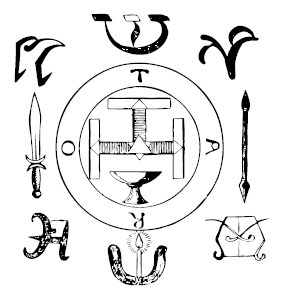
Now, it is well known that mesmerists impart for their somnambulists any taste that they chose to plain water; and if we assume a Magus with sufficient command over the astral fluid to magnetize at the same moment a whole assembly of persons, otherwise prepared for magnetism by extreme super-excitement, we shall
be in a position to explain readily, not indeed the Gospel miracle of Cana but works of the same class. Are not the fascinations of love, which result from the universal Magic of Nature, truly prodigious, and do they not actually transform persons and things? Love is a dream of enchantments that transfigures the world; all becomes music and fragrance, all intoxication and felicity. The beloved being is beautiful, is good, is sublime, is infallible, is radiant, glows with health and happiness. When the dream ends we seem to have fallen from the clouds; we are inspired with disgust for the brazen sorceress who took the place of the lovely Melusine, for the Thersites whom we deemed was Achilles or Nereus. What faith is that which we cannot inspire in those who love us? But also what reason or justice can we instill into those who have finished with such love? Love begins magician and ends sorcerer. After creating the illusions of heaven on earth, it realizes those of hell. Its hatred is absurd like its ardour, because it is passional, that is, subject to the fatalities of its own influences. For this cause it has been proscribed by sages, who declare it the enemy of reason. Are they to be envied or commiserated for thus condemning, doubtless without understanding, the most alluring of miscreants? All that can be said is that when they spoke thus, either they had not yet loved or else they loved no longer.
Things that are external are for us what our word internal makes them. To believe that we are happy is to be happy; whatsoever we esteem becomes precious in proportion to the estimation itself: this is the sense in which we can say that Magic changes the nature of things. The METAMORPHOSES of Ovid are true, but they are allegorical, like the GOLDEN ASS of rare Apuleius. The life of beings is a progressive transformation, and its forms can be deter-mined, renewed, prolonged further, or destroyed sooner. If the doctrine of metempsychosis were true, might one not say that the debauch represented by Circe really and materially changes men into swine, seeing that, on this hypothesis, the retribution of vices would be a relapse into animal forms corresponding thereunto? Now, metempsychosis, which has been misinterpreted frequently, has a perfectly true side; for animal forms communicate their sympathetic impressions to the astral body of man, which reacts speedily on his lineaments according to the force of his habits. A man of intelligent and passive mildness assumes the inert physiognomy and ways of a sheep, but in somnambulism it is a sheep that is seen, and not a man with a sheepish countenance, as the ecstatic and learned Swedenborg experienced a thousand times. In the kabalistic book of Daniel the seer, this mystery is represented by the legend of Nebuchadnezzar changed into a beast, which, after the common fate of magical allegories, has been mistaken for an actual history. In this way, we can really transform men into animals and animals into men; we can metamorphose plants and alter their virtue; we can endow minerals with ideal properties: it is all a question of willing. We can equally render ourselves visible or invisible at will, and this enables us to explain the mysteries of the Ring of Gyges.
In the first place, let us remove from the mind of our readers all supposition of the absurd - that is, of an effect devoid of cause or contradicting its cause. To become invisible one of three things is necessary - the interposition of some opaque medium between the light and our body, or between our body and the eyes of the spectators, or the fascination of the eyes of the spectators in such a manner that they cannot make use of their sight. Of these methods, the third only is magical. Have we not all of us observed that under the government of a strong preoccupation we look without seeing and collide with objects in front of us? “So do, that seeing they may not see,” said the Great Initiator, and the history of this Grand Master tells us that one day, finding Himself on the point of being stoned in the Temple, He became invisible and went out. There is no, need to reproduce the mystifications of popular Grimoires about the ring of invisibility. Some specify that it shall be composed of fixed mercury, enriched by a small stone which is indispensable to find in a pewit's nest, and kept in a box of the same metal. The author of the Little Albertordains that this ring should be composed of hairs torn from the head of a raging hyena, which recalls the history of the bell of Rodilard. The only writers who have discoursed seriously of the Ring of Gyges are Jambli-chus, Porphyry and Peter of Apono. What they say is evidently allegorical, and the representation which they give, or that which can be drawn from their description, proves that they are speaking in reality of nothing but the Great Magical Arcanum. One of the figures depicts the universal movement, harmonic and equilibrated in imperishable being; another, which should be formed from an amalgam of the seven metals, calls for a description in detail. It has a double collet and two precious stones - a topaz constellated under the sign of the sun and an emerald under the sign of the moon. It should bear on the inner side the occult characters of the planets and on the outer their known signs, duplicated and in kabalistic opposition to each other; that is, five on the right and five on the left; the signs of the sun and moon resuming the four several intelligences of the seven planets. Now, this configuration is no other than that of a Pantacle signifying all mysteries of magical doctrine, and here is the occult significance of the ring: to exercise omnipotence, of which ocular fascination is one of the most difficult demonstrations to give, we must possess all science and know how to make use of it.
Fascination is accomplished by magnetism. The Magus inwardly forbids a whole assembly to see him, and it does not see him. In this manner he passes through guarded gates and comes out of prison in the face of his petrified gaolers. At such times a strange numbness is experienced, and they recall having seen the Magus as if in a dream, but never till after he has gone. The whole secret of invisibility consists therefore in a power which is capable of definition - being that of distracting or paralysing attention, so that light reaches the visual organ without impressing the eye of the soul. To exercise this power we must possess a Will accustomed to sudden and energetic actions, great presence of mind and skill no less great in causing diversions among the crowd. Let a man, for example, who is being pursued by his intending murderers, dart into a side street, return immediately, and advance with perfect calmness towards his pursuers, or let him mix with them and seem intent on the chase, and he will certainly make himself invisible. A priest who was being hunted in '93, with the intention of hanging him from a lamp-post, fled down a certain street, assumed a stooping gait, and leaned against a corner with an intensely preoccupied expression; the crowd of his enemies swept past; not one saw him, or rather, it never struck anyone to recognize him: it was so unlikely to be he! The person who desires to be seen always makes himself observed, but he who would remain unnoticed effaces himself and disappears. The true Ring of Gyges is the will; it is also the wand of transformations, and by its precise and strong formulation it creates the magical word. The omnipotent terms of enchantments are those which express this creative power of forms. The Tetragram, which is the supreme word of Magic, signifies: “It is that which it shall be,” and if we apply it to any transformation whatsoever with full intelligence, it will renew and modify all things, even in the teeth of evidence and common sense. The hoc est of the Christian sacrifice is a translation and application of the Tetragram: hence this simple utterance operates the most complete, most invisible, most incredible and most clearly affirmed of all transformations. A still stronger word than that of transformation has been judged necessary by councils to express the marvel - that of transubstantiation.
The Hebrew terms  , have been considered by all Kaba-lists as the keys of magical transformation. The Latin words, est, sit, esto, fiat, have the same force when pronounced with full understanding. Montalembert relates seriously, in his legend of St. Elizabeth of Hungary, how one day this saintly lady, surprised by her noble husband, from whom she sought to conceal her good works, in the act of carrying bread to the poor in her apron, told him that she was carrying roses, and it proved on investigation that she had spoken truly; the loaves had changed into roses. This story is a most gracious magical apologue, and signifies that the truly wise man cannot lie, that the word of wisdom determines the form of things, or even their substance independently of their forms. Why, for example, should not the noble spouse of St. Elizabeth, a good and firm Christian like herself, and believing implicitly in the Real Presence of the Saviour in true human body upon an altar where he beheld only a wheaten host, why should he not believe in the real presence of roses in his wife's apron under the appearances of bread? She exhibited him loaves undoubtedly, but as she had said that they were roses, and as he believed her incapable of the smallest falsehood, he saw and wished to see roses only. This is the secret of the miracle. Another legend narrates how a saint, whose name has escaped me, finding nothing to eat on a Lenten day or a Friday, commanded the fowl to become a fish, and it became a fish. The parable needs no interpretation, and it recalls a beautiful story of St. Spiridion of Tremithonte, the same who evoked the soul of his daughter Irene. One Good Friday a traveller reached the abode of the holy bishop, and as bishops in those days took Christianity in earnest, and were consequently poor, Spiridion, who fasted religiously, had in his house only some salted bacon, which had been made ready for Easter. The stranger was overcome with fatigue and famished with hunger; Spiridion offered him the meat, and himself shared the meal of charity, thus transforming the very flesh which the Jews regard as of all most impure into a feast of penitence, transcending the material law by the spirit of the law itself, and proving himself a true and intelligent disciple of the Man-God, who hath established His elect as the monarchs of Nature in the three worlds.
