Dogma and Ritual of High Magic Part II - Eliphas Levi 1896
Necromancy
We have declared boldly our opinion, or rather our conviction, as to the possibility of resurrection in certain cases: it remains for us now to complete the revelation of this arcanum and to expose its practice. Death is a phantom of ignorance; it does not exist; everything in Nature is living, and it is because it is alive that everything is in motion and undergoes incessant change of form. Old age is the beginning of regeneration; it is the labour of renewing life; and the ancients represented the mystery we term death by the Fountain of Youth, which was entered in decrepitude and left in new childhood. The body is a garment of the soul. When this garment is worn out completely, or seriously and irreparably rent, it is abandoned and never rejoined. But when it is removed by some accident without being worn out or destroyed, it can, in certain cases, be reassumed, either by our own efforts or by the assistance of a stronger and more active will than ours. Death is neither the end of life nor the beginning of immortality: it is the continuation and transformation of life. Now a transformation being always a progress, few of those who are apparently dead will consent to return to life, that is, to take up the vestment which they have left behind. It is this which makes resurrection one of the hardest works of the highest initiation, and hence its success is never infallible, but must be regarded almost invariably as accidental and unexpected. To raise up a dead person we must rivet suddenly and energetically the most powerful chains of attraction which connect it with the body that it has just quitted. It is, therefore, necessary to be acquainted previously with this chain, then to seize thereon, finally to project an effort of will sufficiently powerful to link it up instantaneously and irresistibly. All this, as we say, is extremely difficult, but is in no sense absolutely impossible. The prejudices of materialistic science exclude resurrection at present from the natural order of things, and hence there is a disposition to explain all phenomena of this class by lethargies, more or less complicated with signs of death and more or less long in duration. If Lazarus rose again before our doctors, they would record in their memorials to official academies a strange case of lethargy, accompanied by an apparent beginning of putrefaction and a strong corpse-like odour: the exceptional occurrence would be labelled with a suitable name, and the matter would be at an end. We have no wish to alarm anyone, and if, out of respect for men with diplomas who represent orthodox science, it is requisite to term our theories concerning resurrection the art of curing exceptional and aggravated trances, nothing, I hope, will hinder us from making such a concession. But if ever a resurrection has taken place in the world, it is incontestable that resurrection is possible. Now, the bodies corporate protect religion, and religion asserts positively the fact of resurrections; therefore resurrections are possible. From this escape is difficult. To say that such things are possible outside the laws of Nature, and by an influence contrary to universal harmony, is to affirm that the spirit of disorder, darkness and death can be sovereign arbiter of life. Let us not dispute with worshippers of the devil, but pass on.
It is not religion alone which attests the facts of resurrection: we have collected a number of cases. An occurrence which impressed the imagination of Greuze the painter has been reproduced by him in one of his most remarkable pictures. An unworthy son, present at his father's deathbed, seizes and destroys a will unfavourable to himself; the father rallies, leaps up, curses his son and then drops back dead a second time. An analogous and more recent fact has been certified to ourselves by ocular witnesses: a friend, betraying the confidence of one who had just died, tore up a trust-deed he had signed, whereupon the dead person rose up and lived to defend the rights of his chosen heirs, which this false friend sought to set aside; the guilty person went mad, and the risen man compassionately allowed him a pension. When the Saviour raised up the daughter of Jairus, He was alone with three faithful and favoured disciples: He dismissed the noisy mourners, saying: “The girl is not dead but sleeping.” Then, in the presence only of the father, mother and the three disciples, that is to say, in a perfect circle of confidence and desire, He took the child's hand, drew her suddenly up and cried to her: “Young girl, I say to thee, arise!” The undecided soul, doubtless in the immediate vicinity of the body, and possibly regretting its extreme youth and beauty, was surprised by the accents of that voice which was heard by her father and mother, trembling with hope and on their knees; it returned into the body; the maiden opened her eyes, rose up and the Master commanded immediately that food should be given her, so that the functions of life might begin a new cycle of absorption and regeneration. The history of Eliseus raising up the daughter of the Shunamite, and of St. Paul raising Eutychus are facts of the same order; the resurrection of Dorcas by St. Peter, narrated so simply in the Acts of the Apostles, is also a history the truth of which it is difficult to dispute with reason. Apollonius of Tyana seems to have accomplished similar miracles, while we ourselves have been the witness of facts which are not wanting in analogy with these; but the spirit of the century in which we live imposes in this respect the most careful reserve upon us, the thaumaturge being liable to a very indifferent reception at the hands of a discerning public - all which does not hinder the earth from revolving or Galileo from having been a great man.
The resurrection of a dead person is the masterpiece of magnetism, because it needs for its accomplishment the exercise of a kind of sympathetic omnipotence. It is possible in the exhaustion of death by congestion, by suffocation, by exhaustion or by hysteria. Eutychus, who was resuscitated by St. Paul after falling from a third storey, had doubtless suffered no serious internal injuries, but had succumbed to asphyxia, occasioned by the rush of air during his fall, or alternatively to violent shock and terror. In a parallel case, he who feels conscious of the power and faith necessary for such an achievement must, like the apostle, practise insufflation, mouth to mouth, combined with contact of the extremities for restoration of warmth. Were it simply a matter of what the ignorant call miracle, Elias and St. Paul, who made use of the same procedure, would have spoken in the name of Jehovah or of Christ. It is enough sometimes to take the person by the hand and raise them quickly, summoning them in a loud voice. This procedure, which succeeds frequently in swoons, may even have effect upon the dead, when the mag-netizer who exercises it is endowed with powerfully sympathetic speech and possesses what may be called eloquence of tone. He must be also tenderly loved or greatly respected by the person on whom he would operate, and he must perform the work with a great burst of faith and will, which we do not always find ourselves to possess in the first shock of a great sorrow.
What is vulgarly called Necromancy has nothing in common with resurrection, and it is at least highly doubtful whether, in operations connected with this application of magical power, we really come into correspondence with the souls of the dead whom we evoke. There are two kinds of Necromancy, that of light and that of darkness - the evocation by Prayer, Pantacle and Perfumes, and the evocation by blood, imprecations and sacrilege. We have practised only the first, and advise no one to devote themselves to the second. It is certain that the images of the dead do appear to the magnetized persons who evoke them; it is certain also that they never reveal any mysteries of the life beyond. They are beheld as they still exist in the memories of those who knew them, and doubtless as their reflections have left them impressed on the Astral Light. When evoked spectres reply to questions addressed them, it is always by signs or by interior and imaginary impressions, never with a voice which really strikes the ears; and this is comprehensible enough, for how should a shadow speak? With what instrument could it cause the air to vibrate by impressing it in such a manner as to make distinct sounds? At the same time, electrical contacts are experienced from apparitions and sometimes appear to be produced by the hand of a phantom; but the phenomena is wholly subjective, is occasioned solely by the power of imagination and the local wealth of that occult force which we term the Astral Light. The proof of this is that spirits, or at least the spectres pretended to be such, may indeed touch us occasionally, but we cannot touch them, and this is one of the most affrighting characteristics of these apparitions, which are at times so real in appearance that we cannot unmoved feel the hand pass through that which seems a body and yet make contact with nothing.
We read in ecclesiastical historians that Spiridion, Bishop of Tremithonte, afterwards invoked as a saint, called up the spirit of his daughter, Irene, to ascertain from her the whereabouts of some concealed money which she had taken in charge for a traveller. Swedenborg communicated habitually with the so-called dead, whose forms appeared to him in the Astral Light. Several credible persons of our acquaintance have assured us that they have been revisited for years by the dead who were dear to them. The celebrated atheist Sylvanus Marechal appeared to his widow and one of her friends, to acquaint her concerning a sum of 1,500 francs which he had concealed in a secret drawer. This anecdote was related to us by an old friend of the family.
Evocations should have always a motive and a justifiable end; otherwise, they are works of darkness and folly, most dangerous for health and reason. To evoke out of pure curiosity, or to find out whether we shall see anything, is to court fruitless fatigue. The transcendental sciences admit of neither doubt nor puerility. The permissible motive of an evocation may be either love or intelligence. Evocations of love require less apparatus and are in every respect easier. The procedure is as follows. We must collect, in the first place, carefully the memorials of him-or her-whom we desire to behold, the articles he used, and on which his impression remains; we must also prepare an apartment in in which the person lived, or otherwise one of similar kind, and place his portrait veiled in white therein, surrounded with his favourite flowers, which must be renewed daily. A fixed date must then be chosen, being that of the person's birth, or one that was especially fortunate for his and our own affection, one of which we may believe that his soul, however blessed elsewhere, cannot lose the remembrance. This must be the day of evocation, and we must prepare for it during the space of two weeks. Throughout the period we must refrain from extending to anyone the same proofs of affection which we have the right to expect from the dead; we must observe strict chastity, live in retreat and take only one modest and light collation daily. Every evening at the same hour we must shut ourselves in the chamber consecrated to the memory of the lamented person, using only one small light, such as that of a funeral lamp or taper. This light should be placed behind us, the portrait should be uncovered, and we should remain before it for an hour in silence; finally, we should fumigate the apartment with a little good incense, and go out backwards. On the morning of the day fixed for the evocation, we should adorn ourselves as if for a festival, not salute anyone first, make but a single repast of bread, wine and roots, or fruits. The cloth should be white, two covers should be laid, and one portion of the broken bread should be set aside; a little wine should be placed also in the glass of the person whom we design to invoke. The meal must be eaten alone in the chamber of evocations and in presence of the veiled portrait; it must be all cleared away at the end, except the glass belonging to the dead person, and his portion of bread, which must be set before the portrait. In the evening, at the hour for the regular visit, we must repair in silence to the chamber, light a clear fire of cypress-wood and cast incense seven times thereon, pronouncing the name of the person whom we desire to behold. The lamp must then be extinguished, and the fire permitted to die out. On this day the portrait must not be unveiled. When the flame dies down, put more incense on the ashes and invoke God according to the forms of that religion to which the dead person belonged, and according to the ideas which he himself possessed of God. While making this prayer, we must identify ourselves with the evoked person, speak as he spoke, believe in a sense as he believed. Then, after a silence of fifteen minutes, we must speak to him as if he were present, with affection and with faith, praying him to appear before us. Renew this prayer mentally, covering the face with both hands; then call him thrice with a loud voice; remain kneeling, the eyes closed or covered, for some minutes; then call again thrice upon him in a sweet and affectionate tone, and slowly open the eyes. Should nothing result, the same experiment must be renewed in the following year, and if necessary a third time, when it is certain that the desired apparition will be obtained, and the longer it has been delayed the more realistic and striking it will be.
Evocations of knowledge and intelligence are performed with more solemn ceremonies. If concerned with a celebrated personage, we must meditate for twenty-one days upon his life and writings, form an idea of his appearance, converse with him mentally and imagine his answers. We must carry his portrait, or at least his name, about us, following a vegetarian diet for twenty-one days and a severe fast during the last seven. We must next construct the magical oratory, described in the thirteenth chapter of our “Doctrine”, and see that all light is excluded therefrom. If, however, the proposed operation is to take place in the day-time, we may leave a narrow aperture on the side where the sun will shine at the hour of evocation, place a triangular prism before this opening and a crystal globe filled with water facing the prism. If the experiment has been arranged for night, the magic lamp must be so situated that its single ray shall fall upon the altar smoke. The purpose of these preparations is to furnish the Magic Agents with elements of corporeal appearance, and to ease as much as possible the tension of imagination, which could not be exalted without danger into the absolute illusion of dream. For the rest, it will be understood easily that a beam of sunlight or the ray of a lamp coloured variously and falling upon curling and irregular smoke can in no way create a perfect image. The chafing-dish containing the sacred fire should be in the centre of the oratory and the altar of perfumes hard by. The operator must turn towards the east to pray, and the west to invoke; he must be either alone or assisted by two persons preserving the strictest silence; he must wear the magical vestments, which we have described in the seventh chapter, and must be crowned with vervain and gold. He should bathe before the operation, and all his undergarments must be of the most intact and scrupulous cleanliness. The ceremony should begin with a prayer suited to the genius of the spirit about to be invoked and one which would be approved by himself if he still lived. For example, it would be impossible to evoke Voltaire by reciting prayers in the style of St. Bridget. For the great men of antiquity, we may use the Hymns of Cleanthes or Orpheus, with the oath terminating the Golden Verses of Pythagoras. In our evocation of Apollonius, we used the Magical Philosophy of Patricius for the Ritual, containing the doctrines of Zoroaster and the writings of Hermes Trismegistus. We recited the Nuctemeron of Apollonius in Greek with a loud voice and added a Conjuration beginning: “Let the Father of all be Counsellor and thrice-great Hermes guide.”
For the evocation of spirits belonging to religions issued from Judaism, the following Kabalistic Invocation of Solomon should be used, either in Hebrew or in any other tongue with which the spirit in question is known to have been familiar:
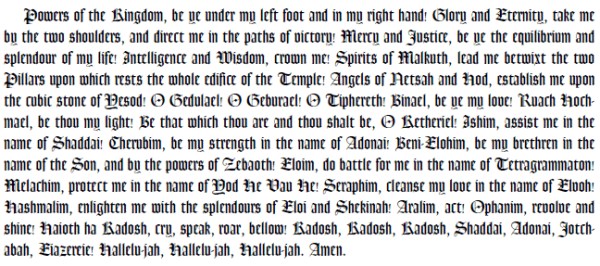
It should be remembered, above all in conjurations, that the names of Satan, Beelzebub, Adramelek and others do not designate spiritual unities but legions of impure spirits. “Our name is legion, for we are many,” says the spirit of darkness in the Gospel. Number constitutes law, and progress takes place inversely in hell as the domain of anarchy. That is to say, the most advanced in Satanic development and consequently the most degraded and the least intelligent and feeblest. Thus, a fatal law drives demons downward when they wish and believe themselves to be ascending. So also those who term themselves chiefs are the most impotent and despised of all. As to the horde of perverse spirits, they tremble before an unknown, invisible, incomprehensible, capricious, implacable chief, who never explains his laws, whose arm is ever stretched out to strike those who fail to understand him. They give this phantom the names of Baal, Jupiter and even others more venerable, which cannot, without profanation, be pronounced in hell. But this phantom is only the shadow and remnant of God, disfigured by wilful perversity, and persisting in imagination like a visitation of justice and a remorse of truth.
When the evoked spirit of light manifests with sad or irritated countenance, we must offer him a moral sacrifice, that is, be inwardly disposed to renounce whatever offends him; and before leaving the oratory, we must dismiss him, saying: “May peace be with thee! I have not wished to trouble thee; do thou torment me not. I shall labour to improve myself as to anything that vexes thee. I pray and will still pray, with thee and for thee. Pray thou also both with and for me, and return to thy great slumber, expecting that day when we shall awake together. Silence and adieu!”
We must not close this chapter without giving some details on Black Magic for the benefit of the curious. The practices of Thessalian sorcerers and Roman Canidias are described by several ancient authors. In the first place, a pit was dug, at the mouth of which they cut the throat of a black sheep; the psyllae and larvae presumed to be present, and swarming round to drink the blood, were driven off with the magic sword; the triple Hecate and the infernal gods were evoked, and the phantom whose apparition was desired was called upon three times. In the Middle Ages, necromancers violated tombs, composing philtres and unguents with the fat and blood of corpses combined with aconite, belladonna and poisonous fungi. They boiled and skimmed these frightful compounds over fires fed with human bones and crucifixes stolen from churches; they added dust of dried toads and ash of consecrated hosts; they anointed their temples, hands, and breasts with the infernal unguent, traced diabolical Pantacles, evoked the dead beneath gibbets or in deserted graveyards. Their howlings were heard from afar, and belated travellers imagined that legions of phantoms rose out of the earth. The very trees, in their eyes, assumed appalling shapes; fiery orbs gleamed in the thickets; frogs in the marshes seemed to echo mysterious words of the Sabbath with croaking voices. It was the magnetism of hallucination and the contagion of madness.
The end of procedure in Black Magic was to disturb reason and produce the feverish excitement which emboldens to great crimes. The Grimoires, once seized and burnt by authority everywhere, are certainly not harmless books. Sacrilege, murder, theft, are indicated or hinted as means to realization in almost all these works. Thus, in the Grand Grimoire and its modern version the Red Dragon, there is a recipe entitled “Composition of Death, or Philosophical Stone”, a broth of aqua fortis, copper, arsenic and verdigris. There are also necromantic processes, comprising the tearing up of earth from graves with the nails, dragging out bones, placing them crosswise on the breast, then assisting at midnight mass on Christmas eve, and flying out of the church at the moment of consecration, crying: “Let the dead rise from their tombs!” Thereafter the procedure involves returning to the graveyard, taking a handful of earth nearest to the coffin, running back to the door of the church, which has been alarmed by the clamour, depositing the two bones crosswise and again shouting: “Let the dead rise from their tombs!” If the operator escapes being seized and shut up in a madhouse, he must retire at a slow pace, and count four thousand five hundred steps in a straight line, which means following a broad road or scaling walls. Having traversed this space, he lies down upon the earth, as if in a coffin, and repeats in lugubrious tones: “Let the dead rise from their tombs!” Finally, he calls thrice on the person whose apparition is desired. No doubt anyone who is mad enough and wicked enough to abandon himself to such operations is predisposed to all chimeras and all phantoms. Hence the recipe of the Grand Grimoire is most efficacious, but we advise none of our readers to test it.
