The Mystical and Magical System of the A .'. A .'. - The Spiritual System of Aleister Crowley & George Cecil Jones Step-by-Step - Eshelman James A. 2000
FOREWORD
to the Third Revised Edition
-
52, There was also an humming-bird that spake unto the horned cerastes, and prayed him for poison. And the great snake of Khem the Hole One. the royal Erceus serpent, answered him and said'
-
53. 1 sailed over the skv of 5ii in the car-called Millions-qf-Years. and I saw not any creature upon Seb that was equal to me. The venom of my fang is the inheritance o f my father. and of my father’s father; and how shall 1 give it unto thee'.' Live thou and thy children as J and my fathers have lived, even unto an hundred millions of generations and it may be that rhe mercy of the Mighty Ones may bestow upon thy children a drop of the poison of eld.
-
54. Then the humming-bird was afflicted in his spirit, and he flew unto the flowers, and it was as if naught had been spoken between them. Yet in a little while a serpent struck him that he died.
-
55. But an Ibis that meditated upon the bank of 5'ile the beautiful god listened and heard. And he laid aside his Ibis ways, and became as a serpent, saving Peradventure in an hundred millions of millions of generations of my children. they shall attain to a drop of the poison o f the fang o f the Exalted One.
-
56. And behold! ere the moon waxed thrice he became an Uraus serpent, and the poison of the fang was established in him and his seed even for ever and for ever.
- Liber Cordis Cincti Serpente.
Cap, V. vv. 54-56
Do what thou wilt shah be the whole of the Law,
Initiation is a reality. Humanin' has a potential to grow far beyond its own native stale of consciousness and capability. This growth is a spiritual growth, and its fruits inform and empower every facet of human, mortal expression, in addi
tion to disclosing to each of us our own inherently immortal natures.
It is on this spiritual growth, more than any other thing, that the future welfare and progress of humanity depends.
We know the means of unlocking and awakening this grow th, and of bringing its fruit to maturity. That is. we know how to unleash genius at will, and to produce its miracles on demand. It is not an overnight process, but it is a sure process for those w ho persevere. The means of doing this are not my discovery, or that of any person in recent history: rather, they have been known for thousands of years.
In modem English we say that a person is a genius; but the ancient Greeks and Romans, who originated the word, said a person has a genius, by which they meant a protective and instructive spiritual being - a holy guardian angel, one might say - that inspires, awakens, and fulfills us each.
The word “genius." at root, means, “that which begets and gives birth." Whether anthropomorphized. as an angel or spirit or god - w hether understood as a force of nature, or as cosmic consciousness or. for that matter, as any other thing w hatsoever - there is that within each of us. immortal and infinitely creative, which truly gives us birth. Something in us knows, instinctively, that we must (each in our own ripe time) seek this, embrace this, and surrender to this as we would to the most overpowering and fulfilling love. And then we must give it expression in our lives and our w ork, must pour forth the very essence of ourselves into that which we love most. I say “must,” because it feels deeper than a biological imperative. and. in time, grips us with an inner conviction before which the best reasoned logic is impotent.
In this entwining of love and will, we find not only the greatest joy and fulfillment of life, but
also the most loving and fruitful path of service for ourselves. In the East, this is called dharma. We give it the Greek name ©rAcpa - Thelema.
If I never say another thing in the whole of my life, 1 am satisfied that the above will serve to speak for me. It is what 1 have waited a lifetime to say: True spiritual initiation exists - and we know how one mav bring it about for themselves at will.
Since 1993. when the first edition of The Mystical <& Magical System of the A.'.A.'. was published. it has received a gratifyingly warm response from many quarters of the Thelemic community. For this, 1 am personally appreciative. When writing this book. 1 thought it might, perhaps. be of interest to some of the students of A.•.A.1., working directly with my teacher or myself. It has. however, drawn a far wider audience.
Many of those drawn to it have written me that they have chosen to work independently, and this book has provided them the program and materials that they have needed to undertake the Great Work on their own. Still others have acquired this book at the recommendation of teachers in other lineages of A.-.A.’, with which 1 am not associated. I am certain that this book's value to them is that it describes the A.’.A.’, system as designed by its creators; that is. it is an ark. preserving the svstem as originally formulated, for those thatfollow.
To those working independently. I continue to say that I believe the best value is to be had. generally, by entering into the system formally, and working with one who has gone ahead on the Path. However, this is not possible for all aspirants, and not desirable to others. One must walk as one is drawn to walk. We happily accept the duty of assisting. when we can. all who would pursue the Work, w ithout exacting a price in the com of any realm. It was part of the initial plan of A.'. Ac. to make its teachings available to all. The basic techniques described in this book are open to all. The sequence of applying those methods rests on an accurate understanding of the inherent constitution of our psychological - one might say. psychospiritual - constitution, and thereby forms a "graded path” in much the same sense as the ontogenetic stages of biological development.
To those working with other lineages, we continue to extend our fraternal greeting. Because there has been, tn the past, misunderstanding of
our position on this point. 1 want to state it clearly. For many years, the following summary has appeared on a web site maintained by the College of Thelema pertaining to A /. A.-.:
Various [A.-.A.-.] lineages have survived. Claims are periodically encountered that one individual or another is an authentic link to A.'.A.'.. Some of these claims are quite real: some are honest mistakes; and some are fraudulent. It is not our present purpose to play arbiter to these claims, to upraise one or knock down another. It is a universal truth of initiation that each student, at each step along the way. gets the teacher he or she "deserves." based on the real maturity and needs of the soul; and that while sometimes spiritual growth is fostered by finding the BEST teacher, at other times it is best fostered by lessons of discrimination taught in the School of Hard Knocks.
In this matter we give but one sage piece of advice: "By their fruits shall ye know them’." The Works of the Adept, the fruits of his or her garden, are the signs of his or her attainment.
Where our tolerance falls short, at times, is in tolerating intolerance. Occasionally, there emerge those who would arrogate the entirety of A.-.A.-, to themselves as if it were property. This is plain silly. The last large-scale attempt of this kind was by Marcelo Ramos Motta, a Neophyte under Karl Germer w ho made a bid to control all of organized Thelema. He failed at that, though he succeeded in leaving a diverse body of successors w'hom he raised sufficiently far through the system that many have carried on one or another form of the teachings of the Order to a new generation. Successorship was his proof.
A .-.A.-, is not property, not a political entity or arena, and not a club. It cannot be "owned" any more than the spirit of human courage can be owned. In an essay titled "An Account of A.-.A.-.." adapted from the writings of Karl von Eckartshausen. this is explained:
From all time, therefore, there has been a hidden assembly, a society of the Elect, of those who sought for and had capacity for light, and this interior society was the Axle of the R.O.T.A. All that any external order possesses in symbol, ceremony, or rite is the letter ex
pressive outwardly of that spirit of truth which dwelleth in the interior Sanctuary. Nor is the contradiction of the exterior any bar to the harmony of the interior.. . .
But all exterior societies subsist only by virtue of this interior one. As soon as external societies wish to transform a temple of wisdom into a political edifice, the interior society retires and leaves only the letter without the spirit. It is thus that secret external societies of wisdom were nothing but hieroglyphic screens, the truth remaining inviolable in the Sanctuary so that she might never be profaned.
In this regard, the singular criticism levied against this present book, from its First Edition on. was that it pul forth the idea of multiple lineages within A.’.A.’.. If 1 am being faulted for religious tolerance, then I happily accept the blame. It is not even a valid argument that no such idea of lineages existed in Aleister Crowley’s time: Crowley recognized various individuals as high grade initiates of A.•.A.*, w’ho had no formal relationship at all to himself or to the system he w as given to put forward. In our own time, can w e do less than acknowledge the authenticity' of all w ho descend, by one or another channel from a common source? Political power plays alienate the Work from its inner moorings. Should we shame ourselves in comparison to the many lineages of Buddhism that peacefully coexist in acceptance of each other? It would be a shame if we did! The mystical and magical system of the A.-.A... and the Law of Thelema which it put forth to the world nearly a hundred years ago. is. above all. ecumenical and inclusive.
No question has been asked more often concerning this book, in the last five years, than this: Why’ have 1 not listed other legitimate A.’.A.-. links or lines. The answer is that, to name those we endorse as legitimate, would appear to castigate those we fail to mention. There is greater wisdom, methinks, in practicing the Fourth Power of the Sphinx.
When I first was admitted into A.’.A.’, as a Probationer, in 1979. 1 remember being in awe of the magnitude of its teachings, and of the precision of its pathway - a step-by-step unfolding of oneself unto a particular spiritual goal. In subsequent
years. I lost that initial, childlike sense of wonder. In the last two or three years, it has revisited me often.
Thinking back to that first, innocent exposure. 1 recall a thought that passed through my mind at the time. Not a goal, hardly a plan, barely a re\-ene. Just a thought. It was that if 1 followed this system, step-by-step, and succeeded in it. this would be a proof to the world that the system bore inherent virtue, and would instill confidence m the method itself. So. with this thought behind me. 1 threw myself into it. To reach the full measure of my initial goal took 14 years. For what it may be w’orth to anyone else. I have walked the A.’.A.-, ’s prescribed path, step by meticulous step, until 1 came to its end: and I stand as a single (but hardly singular) witness that it fulfilled every one of its promises to me. and more.
There is no claim that the mystical and magical system of the A .-.A.-, is the only path. It is a path, not the path. The present book endeavors to document this particular system by which all. w'ho are drawn to it. may attain direct and living communion with the Divine.
Among the many changes and additions to this Third Revised Edition are several aimed at those who wish to work independently. The book no longer assumes that its reader will probably have Gems From the Equinox at his or her elbow', and be already familiar with all the practices described. More discussion and definition are given regarding the actual assignments and tasks. An Appendix G has been added, containing some of the most important and essential documents, which are widely used throughout the stages of the Work.
This book, especially in its new' edition, is written for every ibis that would lay aside its ibis ways and become a serpent, for the promise of the generations that come after it. May each, as well, receive the royal rew ard of liberty' for themselves.
Love is the law. love under will.
James A. Eshelman, Los Angeles, CA July 4. 2000 E.V. in the 96,h Year of the Alon of Horus
Introduction
. . . if there is ever to be a universal religion, it must be one which will have no location in place or time: which will be infinite, like the God it will preach, and whose sun will shine upon the followers of Krishna and of Christ, on saints and sinners, alike: which will not be Brahniinical or Buddhist. Christian or Mohammedan, but the sum total of all these, and still have infinite space for development: which in its catholicity will embrace in its infinite arms, and find a place for. even.' human being, from the lowest grovelling savage, not far removed from the brute, to the highest man. towering by the virtues of his head and heart almost above humanity, making society stand in awe of him and doubt his human nature. It will be a religion which will have no place for persecution or intolerance in its polity, which will recognize divinity in every man and woman, and whose whole scope, whose w hole force, w ill be centred in aiding humanity to realize its own true, divine nature.
— Swami Vivekananda. 1893 e.v.
Do what thou wilt shall be the w hole of the Law.
HIS book explores, in close detail, the spiri-T^rliual disciplines of the Order called A .-.A.-.. c*™The goals of the A.'.A.', are those which have motivated spiritual exploration and religious inquiry throughout human history.
Its methods are those of science. Its aims are those of religion.
However, many religions promise their rewards only in some far distant future, perhaps beyond the iimen of death. This is not the view or approach of the A.’.A.'.. In our most revered book, the Divine ALL, personified as the Goddess of Infinite Space, is quoted as saying:
1 give unimaginable joys on earth; certainty, not faith, while in life, upon death: peace unutterable. rest, ecstasy; nor do I demand aught in sacrifice.1
Each of history 's great religions (of those for which we have a record of their establishment) *
’ Liber Legis, Cap. I. v. 58. (See Appendix G.)
was founded by an individual who actually experienced what may be called realization, or liberation. or a consciousness of the Divine, or a union with God. or superconsciousness - the exact description does not matter, only that the experience transcended, by an incalculable factor, the commonplace experiences of human life. From culture to culture, religion to religion, era to era. the language employed has varied, because language itself necessarily fails to encompass that which cannot be defined and barely can be described.
Yet despite the tremendous diversity of details, each of these liberated individuals w'as transformed: each had actually experienced something of immeasurable, and possibly infinite, proportion; and each began to leach in terms that are phenomenally similar in meaning, if only the detritus of culture and era be discarded. Their messages have been w ondrously alike.
Furthermore, where we have adequate biographical records, we find that each of these founders of a religion underwent some form of isolation. or retirement from normal life, immediately
before emerging enlightened and ready to teach. Moreso, where either the master’s teachings or the biographical details are preserved adequately, we find that essentially identical practices (or religious observances, or methods of spiritual inquiry) were employed in each case. The methods, where known, are so universal that only the enormity of human religious prejudice, intolerance, and bigotry could have kept this similarity from being recognized widely all along.
The A .•.A/, teaches, therefore, that the goals of religious aspiration - actual spiritual experience - are attainable in this life, on earth, now; that while the nature of the Supreme Experience (or Truth) is necessarily unique for each individual. it can be recognized universally by all: and that these wonderful results are producible by known methods that, in one or another variety, have been employed throughout history.
1 love you; I would sprinkle you with the divine dew of immortality.
This immortality is no vain hope beyond the grave: 1 offer you the certain consciousness of bliss.
1 offer it at once, on earth; before an hour hath struck upon the bell, ye shall be with Me in the Abodes that are beyond Decay."
The general populace, when sufficiently content with their circumstances in life, may not choose to undertake this great spiritual adventure, which we call the Great Work. For these masses, conventional religions are provided. Each such orthodoxy is suitable to the lime and place that it serves. In these orthodox religions, we therefore find diversity and multiplicity of outer form and specific doctrine. Yet behind each, serving each, and the source of each, are universal and ecumenical spiritual principles. These principles are known. They can be verified - in fact, discovered anew - by each individual without the need of dogmatic assertion. Personal experience will confirm or deny the efficacy of these methods of mysticism and of ceremony - that is. of yoga and of ritual magick - so that each person who undertakes these methods will know, from practice and experimentation, what is true for him or her. and what is false.
The method is that of science. The aim is that of religion.
An introductory lecture on the A.-.A.-, system says the following:
In all systems of religion is to be found a system of Initiation. w>hich may be defined as the process by which a man comes to learn that unknown Crown.
Though none can communicate either the knowledge or the power to achieve this, which we may call the Great Work, it is yet possible for initiates to guide others.
Every man must overcome his own obstacles. expose his own illusions. Yet others may assist him to do both, and they may enable him altogether to avoid many of the false paths, leading no whither, which tempt the weary feet of the uninitiated pilgrim. They can further insure that he is duly tried and tested...
Now the Great Work is one. and the Initiation is one. and the Reward is one. however diverse are the symbols wherein the Unutterable is clothed.’
Hence, there have existed, in all known periods of history, societies or orders or schools (or whatever) that have taught magick or mysticism or spirituality (or whatever). The maxim of these orders has been. “Know thyself" The selfknowledge acquired has been represented as “Light in extension" (or by a cognate expression). Those who have attained to Beauty. Understanding. and Wisdom must, by virtue of who they are and what they have received, give it forth to those who seek it. Hence, the Wisdom Schools have propagated, from generation to generation.
There have also been, in each age. those who have sought to leach without knowing the first thing about their subject. The blind endeavor to lead the blind. In some cases this is from noble (albeit ignorant) motives, and in some cases not. Regardless, each has its use in nature's plan. First, they provide subtle tests in discrimination, winnowing from the crowd those not yet ready to essay the true spiritual slopes. In other words, every student gets the teacher he or she “deserves." based on the real maturity and needs of the soul. Also, every lie or folly (whether uttered by the malicious or the naive) is exactly the “truth” needed by some young seeker to direct him or her tow ard the next step of the Path.
When the student is ready, the teacher will appear. Each w ill be led to the level of teaching he or
’ Liber T:addi vel Hamus Hermencus vv. 28-30.
’ Liber 61 vel Causa. w, 2-5.
she can hear. Inherent safeguards ward the inmost sanctuaries from those not ready for them.
But for those who are prepared, there comes the method of the A.•.A/.. This book, now in your hands, gives you the opportunity to explore it.
This book does not. how ever, contain all of the actual technical instructions or methods. These are readily available, and we will tell you exactly w here to find them. What the present book provides is comprehensive description of the course of study that allows you to employ these methods effectively. Previously, so comprehensive a guidebook has not been readily available.
HOW IT WORKS
The A .’.A.’, is an organization whose heads have obtained by personal experience to the summit of this science. They have founded a system by which every one can equally attain, and that with an ease and speed which was previously impossible. (Book 4. Part II)
In the A.-.A.-., the blind do not lead the blind.
Progress is measured by a series of grades. The theoretical and practical basis for these grades will be discussed later.
Each person is admitted by a teacher, a fellow seeker, who is at least one grade further along in the system. This person, in turn, is responsible to his or her own teacher, and so forth up the line.
Primarily, this Body exists for the purpose of conferring Initiation. Secondarily. It prepares people for initiation by means of courses of instruction."
The A.’.A/, is not a group system. It is a method of individual training and progress.
The aspirant learns the methods that are taught, applies them, observes the consequences of this practice, and keeps a journal of these results. In this way. each person is provided with all of the essentia] tools, or methods, and receives examination to ensure that he or she is proficient in their use. Each leams by experience which methods are most helpful and productive of results. Being thus prepared, the student gradually progresses in selfunderstanding. gradually matures in spiritual per
ception. and gradually awakens to That which first inspired the sacred quest.
In all thy wanderings through darkness, this lamp went before thee, though thou sawest it not. It is the symbol of the light of occult wisdom. which the profane see not, neither do they know.
None of the instructional materials are secret, except for the actual ceremonies of initiation. All of the formal teachings are published openly. It may be that this published information is all that a given seeker needs in order to advance to the Next Step of his or her own inner development; in which case, the Order has served its purpose with respect to that individual. However, the usual method is for an aspirant to affiliate formally w ith the Order, gaining the benefit of personal instruction from those who have walked similar ground. One thereby becomes a new link in an unbroken chain that reaches back to the dawn of history.
In the remainder of this Introduction, w”e will discuss the modem history of the formation of the A.•.A.’, system that we have today; the theoretical models, w hich frame the stages of measured progress; and how to employ this book to best effect. We encourage the reader to proceed patiently. For many in the West, it is a novel thought that spiritual awareness can be drilled and accelerated in the same fashion that a muscle can be strengthened or a golf game improved. Not many decades ago. the same would have been thought concerning mental and emotional health; yet the methods of psychotherapy, founded on increasing knowledge of human behavior, have shown otherwise. An ear trained to listen to music detects wondrous subtleties that the untrained ear misses; the same can be said of the palate trained to distinguish fine food and wine, the touch drilled to read Braille text, or the eye trained to discriminate nuance in any of a thousand areas. Perception can be refined and, as night the day. heightened awareness follow's. You have to learn w here to look, and to recognize what you see. The remainder is a continuous unfolding and maturation of appreciation. And. while this lengthy metaphor is not entirely descriptive of all the processes that lie before you. it does aim your attention in the right direction.
Let them that have eyes see.
4 .4 .'.A.'. Pra’monstrance A Manifesto of the Great White Brotherhood, in The EOUINOX. Vol. 111. No. 1.
5 Hermetic Order of the Golden Dawn, 0=0 initiation ritual.
First Order
0°=0°& l°=10D
Second Order
2°=9d thru 7°=4°
Third Order 8°=3° thru 10°=lD

PRELIMINARIES
Collegium Exterior
G.D..
Collegium Interior
R C.
Collegium Summum
s.-.s.-.
THE TREE OF LIFE
On the preceding page is a diagram of the grades of the Fratemitas A.-.A... The form of this diagram is a Qabalistic map called the Tree of Life.
h is impossible, in the space now available, to introduce the Tree of Life more than passingly to those not familiar with it. Most readers of this book will have familiarity with it: and anyone else is encouraged to undertake its stud} as a basic prerequisite to understanding much about this svstem of attainment. Particularly recommended as well-rounded introductory texts are The Mystical Qabalah by Dion Fortune; The Sword & the Serpent by Melita Denning and Osbome Phillips: The Ladder of Lights by William Gray; and The Siudv of the Kabalah by William Wynn W’estcott.
The Tree of Life is a map of the aspects of human consciousness. As such, it becomes a “filing cabinet." or pattern for categorization, of all things that can be perceived by us. Therefore, it is a "map of the universe;" that is. the interrelationship of all things can be demonstrated on this diagram, by one who has practical familiarity w ith it.
Because it is a categorical map of human consciousness (the universe “within" us) and. at the same time, of all things knowable by us in our world (the universe “outside” of us), the Tree of Life also sen es as the perfect scheme for plotting the stages of progressive initiation; that is. of progressive unfoldment of aspects of expanded consciousness.
Pay close attention to this common representation of (a) human consciousness, (b) the universe. and (c) the path of initiation. Your understanding of your inner processes will grow, to the extent that you perceive the absolute NECESSITY that all three be represented by a common model, and are able to witness the ongoing patterns of their interrelationship.
Take a feu moments to look at the diagram of the Tree of Life. See its basic pattern. It consists of ten circles, arranged in three columns of a three, four, and three circles, respectively. Alternately it may be viewed as three trian-gles. beneath which a final circle is pendent. V Small channels, or paths, connect all the cir- ® cles.
The ten circles are representative of the ten sephiroth (singular, sephirah}. or "emanations.” Each sephirah represents an aspect of human con
sciousness. Their names are given in transliterated Hebrew. Each has a literal translation, and is associated with a planet or other cosmic principle, as indicated in the box on the next page.
Ten numbered grades (or steps) of the A.-.A.-, system correspond to these ten sephiroth in reverse numerical order; that is. from sephirah 10 (Malkuth)to sephirah 1 (Kether).
It may. perhaps, be easier to understand the formation of this diagram if it is view ed, first, in a different way. Sephiroth 3 through 9 represent the seven planets known to the ancients. These are used by astrologers, and in numerous other occult theories, to describe a w ide range of phenomena including (especially) human behavior and destiny. These seven planets are the basic categories employed by the magician to represent the forces that the magician would govern. They represent various faculties of the human psyche, according to the following table:*’
3 |
Saturn |
Intuition |
4 |
Jupiter |
Memory' |
5 |
Mars |
Volition |
6 |
The Sun |
The Ego-center |
/ |
Venus |
Desire |
8 |
Mercury |
Intellect |
9 |
The Moon |
Automatic consciousness |
This seven-fold scheme has beautiful interconnecting symmetries. It deserves much consideration and meditation, and may be expanded readily into the ten-sephirah Tree of Life as follows: The principle of Saturn (sephirah 3). related to intuition or superconsciousness, is expanded into a trinity, of which it is the lowest representative. This defines Chokmah (sephirah 2. “Wisdom”) and Kether (sephirah 1. “The Crown") as other aspects of transrational or superconscious experience.
The principle of The Moon (sephirah 9), representing the autonomic and other automatic func-
These are adapted from similar attributions given .by Aleister Crowley in "The Temple of Solomon the King" in Thf Equinox. Vol. 1. No. 5.
The Sun - the sephirah Tiphereth - is the center of the planetary scheme, even as it is the vertical and horizontal center of the Tree of Life. The other six can be arranged around it to form a hexagram by taking all planets exactly as they are placed on the Tree of Life, but moving the circle for Saturn (Binah) to complete an isosceles triangle with those of Jupiter (Chesed) and Mars (Geburah). The resulting diagram is called "The Seven Palaces.”
€Vi>iJii>nrru oi7 tut tdcf nr i irir w aS a* ma J Ixv * •* r a mUlL 1 JtCLaSaS v^a* a_^J> aS
1 |
Kether |
The Crown |
Primum Mobile |
2 |
Chokmah |
Wisdom |
Sphere of Zodiac (or Fixed Stars) |
3 |
Binah |
Understanding |
Saturn |
4 |
Chesed |
Mercy |
Jupiter |
5 |
Geburah |
Strength |
Mars |
6 |
Tiphereth |
Beauty |
The Sun |
7 |
Netzach |
Victory |
Venus |
8 |
Hod |
Splendor |
Mercury |
9 |
Yesod |
Foundation |
The Moon |
10 |
Malkuth |
Kingdom |
The Earth (Sphere of the Elements) |
tions, is extended further into manifestation, formulating the tenth sephirah. Malkuth. "The Kingdom.” which represents manifest sensory reality.
Hundreds of pages could be written on each of these ten principles. Furthermore, each is said to exist simultaneously on four planes or worlds! For our present purposes, these four Worlds actuallv simplify things for us. For. although all ten sephi-roth exist on all four planes. Qabalists sometimes represent the Tree of Life in such a way that progress up the Tree (from Malkuth to Kether) is parallel to progress upward through the Four Worlds. In some applications, this would cause a misrepresentative view of things. However, w hen the path of initiation, or spiritual progress, is being studied, it is exceedingly helpful to use this “composite Tree."
Readers are. once more, encouraged to leant all they can about the Tree of Life, and the representation of the ten Sephiroth in the Four Worlds. However, for what follows, we will take the practical approach of acting as if the Four Worlds and the ten emanations combined in a simpler way. In this "composite Tree." it is acknowledged that all real spiritual progress is along the Middle Pillar of the Tree of Life. That is (referring to the appended figure), from sephirah 10 to sephirah 9. then to sephirah 6. then to sephirah 1. Although the A.-.A.-, grades also incorporate the six sephiroth on either side of the Middle Pillar, those grades are of a different type. The main progress is in the grades of the Middle Pillar.
The discussion following is. admittedly and purposely, simplistic; but it should get the basic idea across.
Assiah
In the "composite Tree” view, the sephirah Malkuth (10) is uniquely assigned to the fourth World, the World of Assiah - the “World of Action." This is the material world as we know it. perceptible to the five physical senses. The first stage of the initiatory process is. therefore, to start exactly where you are. and to become aware of who you are and how the world is about you.
Yetzirah
In the next stage, advancing to the sephirah Yesod (9). awareness is also opened to the next higher (that is. the next most subtle or inner) of the Four Worlds, the World of Yetzirah - the “Formative World.” This is a direct consequence of the work undertaken in the previous stage. Yetzirah is what we conveniently call the “astral plane.” In human psychology, the Yetziratic level corresponds to the reactive and adaptive aspects, including the entire range of emotion: to the capacity to form and perceive images (imagination); and to the intellect.' That is. it corresponds to the field of human personality. Accordingly, of the vast hosts of spiritual (nonmaterial) beings, diverse angels, governors, spirits, intelligences, and demons of many ty pes are attributed to Yetzirah; for these correspond to the equally diverse scope of the human personality, from its most morbid depths to
This is the unawakened intellect. The self-consciousness of the Adept operates in Briah. However, the psychological attribution of emotion, imagination, and intellect to Yetzirah is otherwise accurate, and very useful in understanding the process of the various mystical and magical practices that will be assigned.
its greatest heights; from its visions of Hell to its visions of Heaven; from its most insidious and incapacitating fears, to its most ennobling and inspiring hopes.
The seventh, eighth, and ninth sephiroth are. therefore, attributed to the World of Yetzirah. Of these. Yesod's usual attributions are almost interchangeable with those of Yetzirah. Yesod especially corresponds to the generative, creative, and vitalizing forces of the psyche. Hod and Netzach (Mercury and Venus) represent the polarities of intellect vs. desire, theory vs, experience, form vs. force, structure vs. life, etc. The deeper meanings of these sephiroth are learned by study, by applying the Tree of Life labeling system to categorize the experiences of life, and by the work of actually passing through (developing and incorporating) the energies of each sephirah when working its corresponding grade.
In awakening to this World of Yetzirah from that of Assiah. we learn to see past the world of the physical senses and matter to the wondrous nonmaterial world behind it. a world of magic and fantasy, of psychological (and psychic) realities and shifting tides of energies too subtle for the physical senses. Gradually, we become as much at home and as able to function in this world as we ever have been in the world of matter.
Briah
The advance to sephirah 6. Tiphereth. Beauty, the Sphere of the Sun. also represents the awakening of consciousness from the Yetziratic level to that of the next highest plane, the World of Briah. or the “Creative World.” Magicians say that archangels are native to Briah. as the direct agents, or messengers, of God. Briah is a level above that at which most people operate but - a very' important point! - it is the natural level of the aw-akened or fulfilled human being. The initiation unto the sphere of Tiphereth. and the concurrent awakening unto the Briatic Plane, is the spiritual destiny of even person. This experience has been described under many different names; but the drafters of the present A .'.A.'. system elected to use the mystical term, “the Knowledge and Conversation of the Holy Guardian Angel.” This attainment is discussed in Chapters 8 and 9 of the present book. It is the goal to which the aspirant to the A.'.A.', system is directed, the Next Step of humanity, the
fulfillment of the inherent spiritual destiny of Homo sapiens at this stage of our collective development. One who has attained this is called an Adept.
Qabalists sometimes associate Briah with the element Water. This is not the turbulent water of troubled emotions, but the serene embrace of the Great Mother, the "passionate peace" or "peace profound” (Pax profunda} of a great inner, vital stillness. Once more, you are referred to Chapters 8 and 9 for a discussion of some of these correspondences in consciousness. In the present discussion. 1 want to employ this “water" metaphor in two ways. First, in contrast to the divisive, excited, and tumultuous characteristics of Yetzirah. Briah represents a tranquil and clear lake that has become capable of reflecting sunlight, brilliantly, even blindingly, without diminishment or distortion. Second, in relationship to the Atziluthic Plane still above (the plane of unconditioned divinity), Briah is like a chalice which becomes filled by Divine Inspiration, a womb that has become fertilized by a Sacred Seed, and, again, a lake lucidly reflecting the One Light of the Spiritual Sun It is a consciousness beyond emotion, beyond thought and word, even beyond image.
It is usual to say that where Yetzirah manifests a diverse range of colors, in Briah there is Color, an essential and imageless idea transcending chromatic diversity; that where, in Yetzirah, are all possible numbers, in Briah is the idea of Number. And so forth. This concept is hard to grasp unless one has experience of it; and that experience appears. initially, to be wholly intuitive. Later, it may become a more commonplace state of mind.
Also, although some theorists w ould relate the experience of samadhi to a higher level than Briah? classical descriptions of samadhi provide an almost perfect description of the Plane of Briah. For example, according to Swami Vivekananda,
Suppose 1 am meditating on a book; 1 have gradually succeeded in concentrating the mind on it. and then in perceiving only the internal sensations, the meaning, unexpressed in any form. That state of dhyana is called samadhi.9 10
9 Some forms of samadhi are certainly of a higher level than that presently discussed
10 Raja Yoga, pp. 183f.
Compare this description to the examples given in the previous paragraph. Patanjali's description of samadhi11 i: - that, by it, “is taken off everything that hides the lordship of the soul" - is quite accurate in its description of the Briatic level. These are examples of attempts to describe the phenomena of Briatic consciousness.
Briatic consciousness is. thus (in the composite Tree), characteristic of the three sephiroth numbered 4. 5. and 6. Tiphereth is par excellence the sephirah associated with the Adept. Geburah and Chesed (Mars and Jupiter) represent further developments of this attainment, and the eventual confrontation and balancing of the seeming polarities of Strength and Mercy. Power and Love. magick and mysticism, and many others.
In brief terms, the awakening to this World of Briah from that of Yetzirah is an unveiling of the spiritual realities that are hidden by the drape of human thought and emotion. It is a perceiving past the transient to the Eternal, past the ever shifting and personal to the still, serene, and transpersonal. Briatic consciousness is. to use Vivekananda’s phrase, a disclosure of “the lordship of the soul” -of the inherent stellar divinity of every' man and every woman.
Atziluth
The highest (inmost, most exalted, most subtle) of the Four Worlds is the World of Atziluth. called (somewhat misleadingly. post-Jung) the "Archetypal World." It is the realm of unconditioned divinity. That which is Alziluthic is the Essence behind the highest intuitive and philosophical perceptions of "God" that humanity has had. Therefore, the three highest sephiroth - Binah. Chokmah. and Kether, known collectively as the “Supernal Triad." and corresponding to Atziluth on the composite Tree - are regarded, in this present approach, as purely Divine, each representing an aspect of superconsciousness (cosmic consciousness). The Supernal Triad is the Sanctum Sanctorum, the “Holy of Holies." the highest or inmost sanctuary- of the human spirit. One who is admitted into this Sanctuary- is called a Master.
Sephiroth & Grades
To each of these ten sephiroth is attributed one of the main grades of the A.*.A.-, system. Their names and numerical designations are given on the Tree of Life diagram. These are also given, in tabular form, in the essay One Star in Sight in Appendix C.
Two numerals, separated by an "equal sign." form the numerical designation of each grade. The two numbers of a grade designation always total to 11. a number which has great magical and mystical importance. The first of the tw o numbers is the grade number; the second is the sephirah number. Thus, the Neophyte Grade, assigned to Malkuth. is the First Grade of the Order, and associated with sephirah 10: its number is. therefore. “l = 10."l_
After each number, in these equations, is a special symbol. Following the first number is a small circle c: following the second, a small square D The circle is not a degree symbol, as often thought, but. rather, an emblem of eternity, of that which has neither beginning nor end. In contrast, the square symbolizes the temporal, material, and mundane. These figures refer to esoteric mysteries of "squaring the circle." a phrase that has many interpretations, all of which pertain, ultimately, to the spiritual and alchemical (transmutative) process called the Great Work, the quest for spiritual attainment. Each represents an aspect of the union of the Macrocosm and the Microcosm, or of "heaven" and "earth." Further interpretations of these numerical grade designations are given later in the present book: and the symbols are interpreted more thoroughly within the formal sanctuaries of initiation.
“Colleges” and “Orders”
Notations along the side of the Tree of Life diagram indicate two different ways that A.’.A.-, grades are categorized into three subparts. One schema designates these as “colleges;" the other enumerates them as “orders." Both schemata are used within the A ..A... To make matters even more confusing, the “colleges" are given names of "orders"! Though in most respects these differences are only semantical, we need to devote a
11 Smras. by Patanjali.
1
i: "1 from the bottom and 10 from the top.” as a dear sister (Sor. A.A.) once phrased it.
little time to sorting out their respective meanings, both within and without of the A/. A/..
Prior to the A.'.A.'.’s formulation, in an earlier Order from which it evolved.1' the Tree of Life grade structure was divided into three segments: a First Order, comprising the grades of the four lowest sephiroth on the Tree of Life (all of those below Tiphereth); a Second Order, comprising grades corresponding to Tiphereth. Geburah. and Chesed: and a Third Order, corresponding to the Supernal Triad.
These categorizations changed in A.-.A.-.; but the change came slowly, and was not always expressed consistently. Old habits sometimes die hard. Probably the use of two schemata evolved from practical advantages of dividing the Tree of Life into its three natural Triads, yet with a new view of where the "second order" rightly begins.
In the A .’.A.'., the grades corresponding to Malkuth. Yesod. Hod. and Netzach constitute the Collegium Exterior, or "outer college." designated also by the initials G.’.D. .. ' The grades corresponding to Tiphereth. Geburah. and Chesed comprise the Collegium Interior, or “inner college."'" represented by the initials R.-.C... The grades corresponding to Binah, Chokmah. and Kether comprise the Collegium Summum. or "highest order."* is 16 represented by the initials S.*.S... More will be said concerning these initials later.
This is the most familiar, and most commonly encountered, categorization of A/.A.. grades.
The Hermetic Order of the Golden Dawn, and its successor, the Rosicrucian Order of the Alpha et Omega. The H.O.G.D.
is discussed later in this Introduction.
|;1 Collegium does mean “college" in the contemporary academic sense, but also nearly any gathering of colleagues. Depending on context, it may be translated alternately as "association. society, board, guild, company." etc. In modem English, it is used to designate a convened association of peers, whether a college of physicians, the College of Cardinals. an electoral college, etc. Its use in the present context is traditional.
The Latin word interior may be translated variously as "inner, secret, private, deeper, more intimate." Collegium Interior, therefore, may be read not only as “inner college” but also as “secret society," “intimate association." etc. All of these possible meanings are accurately descriptive, and may be helpful in understanding the real nature of the Order R.'.C.'..
Summum means "highest, uppermost, greatest, consummate. most distinguished."etc. The main idea is “at the top"-that is. this is the summit of the system overall.
However, there is another classification. In this, only Malkuth is included in the First Order. The grades corresponding to Yesod. Hod. Netzach. Tiphereth. Geburah. and Chesed fomi the Second Order. Grades corresponding to Binah. Chokmah. and Kether (that is. the Collegium Summum) form the Third Order. Reasons for marking the start of the Second Order at Yesod are explained more fully in Chapter 4. once we have a better foundation. Even with what little has been explained thus far. you can see that the passage from Malkuth to Yesod marks a transition from the purely elemental and terrestrial domain to the planetary sephiroth (which begin with Yesod). and from the World of Action (Assiah) to the World of Formation (Yetzirah).
Three grades do not correspond to any se-phirah. At the bottom of the diagram, below Malkuth. you will find mention of the Probationer Grade. 0°=0°. This is the transitional grade into the First Order. Not indicated on the diagram are two unnumbered grades. The first, between Netzach and Tiphereth (often diagrammed directly on the Middle Pillar, on the 25,h Path of Samekh. C. corresponding to the sign Sagittarius) is the Grade of Dominus Liminis (or Philosophus Major), the transitional grade into the Inner College. Also, between Chesed and Binah (often diagramed, as before, directly on the Middle Pillar, but this time on the 13'h Path of Cimel. 2. corresponding to the Moon) is the Grade of Babe of the Abyss (or Adeptus Exemptus Major), the transitional grade into the Order S.-.S.-..
Finally, we turn our attention to the pathways that connect the ten sephiroth. These Paths are 22 in number. Each corresponds to one of the 22 Hebrew letters. Each also corresponds to a planet. Zodiacal sign, or element. Each also corresponds to one of the 22 Atus or Trumps (Major Arcana) of the Tarot. Each Path represents a transition of consciousness from one sephirah to another. Jn the system of spiritual training discussed in the present book, each represents a power or spiritual capacity that is to be gained, a skill mastered, a reality explored; in short, a task of each grade which must be completed, an experience incorporated. before moving on to the next. These 22 Paths (including their Tarot attributions) constitute one of the most extensive areas of study in Qa-balah. They may be studied in The Book of Thoth by the Master Therion, and in numerous other works. They are mentioned here only to help de
mystify the Tree of Life diagram for those not yet thoroughly familiar with it.
These several pages have represented only the briefest introduction to the Tree of Life and the Qabalistic theories of the Four Worlds. They are fundamental to the A.-.A.-, grade model, and frequently employed for reference or metaphor throughout the instructional papers of the A.’.A.-, system. A comfortable familiarity* with all of these terms and concepts - as detailed in the various books recommended above, and others - should be obtained by the Student (see Chapter 1) before seriously entering upon the work of the Probationer Grade.
A BRIEF HISTORY
OF THE A. .A/.
By the name "A.-.A.'.." we designate that One and Eternal Order that Paul Foster Case and Kenneth Mackenzie called the “True and Invisible Order.” and Karl von Eckartshausen titled the “Interior Church" or ' community' of light." Having existed throughout history', silently guiding humanity's cultural and spiritual evolution, it is the Arcanum Arcanorum. the Holy of Holies wherein that Sacred Ark rests inviolate. Every' legitimate magical order, mystery' school, fraternity, religion, or other agency disseminating some portion of W'isdom has been but an Outer Vehicle of this Inner Fellowship of Light.
It has been known by uncountable names and terms throughout history', the name "A .'.A.'." being only one of the more recent ones.
In the magical tradition, the A..A.', often is referred to as the "Third Order." or the "Inner School." Its members have been poetically depicted as "Secret Chiefs." “Hidden Masters." and "Invisible Guardians." It is the Collegium Sum-mum. the highest companionship.
It may be that, rather than an actual society', it is but a spirit of Wisdom that has persisted in the background throughout human history; but. if so. we may ask ourselves how there can be continuity of Understanding. Wisdom, and Illumination
without a vehicle to convey them, an Ark that is their repository.
This is the highest and purest meaning of the name A.'. A .
More commonly, however, we use "A/.A.." to mean not only the invisible Third Order.”' but a particular outer vehicle or terrestrial incarnation of the Interior School, which came into being, beginning in 1906. at the hands of two adepts. Aleister Crowley and George Cecil Jones. It teaches a method of aspiration and attainment called Scientific Illuminism or Skeptical Theurgy.
The biographies of these two individuals (especially Crowley), and the exoteric history of the A.'.Aare discussed in numerous other works. It is not possible to explore these histories in detail in the present place. Although we now will give an outline history of Crowley. Jones, and the Order wherein they were first trained, the reader is primarily referred to other biographical and historical works for more details.
Aleister Crowley (1875-1947) ’
Of the two founders, the better known, and ultimately the more influential, was Aleister Crowley (ne Edward Alexander Crowley). Bom in England. and raised by Christian Fundamentalist parents. his lifepath was altered forever by a seemingly spontaneous experience of cosmic consciousness at age 21 in December 1896. He received initiation into Isis-Urania Temple of the Hermetic Order of the Golden Dawn on November 18, 1898. and into its Second Order (as an Adeptus Minor) on January 23. 1900. He became a pawn -something of a centerpiece around which warring factions circled - during the revolt within the Order that erupted in 1900. When the smoke had cleared. Crowley retained his loyalty to S.L. Mac-Gregor-Mathers (G.'.H Frater Deo Duce Comite Ferro) in the formation of the new Isis Temple of what came to be called the "Rosicrucian Order of the A.'.O/. [Alpha et Omega].”
' For the benefit of the Children of the Light entrusted to my care tn another Hidden setting. 1 should add discreetly that by "A.-. A.'." I mean nothing different than is intended by those few letters most visible on the base of the pyramid, especially when all of the 56 rays are visible, and the Eye is opened. . . .
,f Invisible only because unrecognized when seen. It is the Order and its characteristics that are invisible, not the people who are within its embrace.
Crowley traveled extensively after 1900. especial lv tn the Far East where he received formal training and practical experience in the different forms of yoga. This began an important period of his life, an exploration of the magical and mystical methodologies, of East and West alike, which eventually converged into the basic pattern of the A.'.A.’. system.
In 1904. Crowley experienced the most important single event of his life. Over three consecutive davs - April 8. 9. and 10 - he received what we might call the "channeled" dictation of the three chapters of a book called Liber Legis, or The Book of the Law.''’ The intelligence dictating the Book declared its Name to be Aiwass."" and identified itself as "the minister of Hoor-paar-kraat” - that is. the minister of the God of Silence, virtually the “Voice of the Silence" itself. Years later. Crowley discovered that Aiwass was. in fact, his own Holy Guardian Angel.
The Book of the Law declared the dawning of a new spiritual era for humanity, an /Eon governed by Horus. Child of Isis and Osiris, rather than by the “slain god" archetype of Osiris or Christ which had governed, in different forms, the few thousand years preceding.
The significance of such a world transition must not be missed. Mystics for many decades had been promising the emergence of a New Age. which some of the astrologically minded identified as an Age of Aquarius.The implication is that those universal archetypes most likely to draw human consciousness inward toward its superconscious roots, the archetypal forces that oversee both the intentional and the natural evolution of humanity, had undergone a quantum shift. The Slain or Sacrificed God had been replaced by the Eternally Boming Child.
From the skeptical position taught by the A.’.A.’, system, these extraordinary claims or possibilities are obviously premises that must be in-
See The Equinox of the Gods for the full story. The text of Liber Legis is reproduced tn Appendix G of the present book.
?<1 In Hebrew. = 93. In Greek. Aiwo; =418.
The actual Age of Aquarius - that is. the recession of the Northern Hemisphere's vernal equinoctial point into the astrological constellation Aquarius - we now know will not commence until 2376 e v (year 472. or XX1IU. of the Thelemic Era). It should not be confused with the dawning of the ,4.on of Horus in 1904 e.\.

vestigated. and not accepted on faith;” but. each aspirant having investigated the matter for himself or herself, and having (may we presume?) embraced the new formulae based upon reason and experience, the wonderful message of The Book of the Law signals a stupendous advance in humanity's collective spiritual awakening.
The Book o f the Law declares that the old ritual forms and their accouterments were abrogated, and that new formulae were to be prepared from the ashes. It charged Crowley with certain responsibilities in disseminating its message, and in preparing the new w ays of teaching.
Crowley's subsequent personal journey of initiation is a lengthy and interesting tale. In brief, he virtually ignored Liber Legis for several years (1904 until mid-1909. when he again picked up, with new commitment, the particular tasks assigned to him thereby). In 1906. during a months-long expedition across China, he commenced the mystical undertaking called The Sacred Magick of Abra-Melin the Mage (described in Chapter 8),
■■ For those fundamentalist Thelemites who think this last statement heretical. I would refer them to the closing pages of Crow ley's extraordinary and epic poem. Aha! Draw your own conclusions. (Furthermore, the idea of a “heretical Thelemite" is amusing.)

HORUS
This “god of War and of Vengeance.” son of Isis and Osins, was adapted, in The Book of the Law. to serve as Hierophant (“Revealer of the Mysteries”) for the new ZEon, “the Hawk-headed mystical Lord.” The HawkHeaded Lord of silence & of Strength." child of Nuit and Hadit. The visible object of worship.” This present image is of Amen-Ra-Heru-KhutL an aspect of the God closely related to Ra-Hoor-Khuit (Ra-Heru-Khuti), amalgamated with aspects of Amen (Amoun).
which he successfully completed later that year. Upon his return to England, he consulted with his original sponsor and mentor in the Hermetic Order of the Golden Dawn. George Cecil Jones, and presented his work and accomplishments of the six years preceding. Jones (who had the authority to do so) confirmed Crowley's entitlement to the 7=4 Grade of Adeptus Exemptus.
Thereupon these two adepts conferred together. saying: May it not be written that the tribulations shall be shortened? Wherefore they resolved to establish a new Order which should be free from the errors and deceits of the former one.
Without Authority they could not do this, exalted as their rank was among adepts. They resolved to prepare all things, great and small, against that day when such Authority should be received by them, since they knew not where to seek for higher adepts than themselves. but knew that the true way to attract the notice of such was to equilibrate the symbols. The temple must be budded before the God can indwell it.
The story of their collaboration will be given in more detail a little later. Suffice it to say that they began building (over the 32 months following) what was to become the A.*. A.’. system, while continuing with their own mystical and magical progress.
The system they built is the topic of this present book.
In March 1909. Crowley published the first issue of The Eqlinox. a large, hardcover periodical (about 400 pages per average issue) which came out twice each year for a five-year period (1909-1913).“4 It described itself, on its title page, as “The Official Organ of the A.’.Ac. - The Review of Scientific Illuminism." Its motto was. “The Method of Science - The Aim of Religion."
The Eqlinox was amazing! A veritable encyclopedia of the Great Work, it contained the majority of all A.. A/. official instructions as they were issued, openly published and available for all to use. To better fill the periodical. Crowley included poems, plays, and short stories by himself and others, along with book reviews, artwork, musical
Liber 61 vel Causa. v. 20. Crowley's diary for July 29. 190b records ibis discussion: "DD.S. [Jones] and P. [Crowley] discuss a new Order. D.D.S. wants authority, 1 should write and say. ’Perfect the lightning-conductor and the Hash will come.'**
Other volumes subsequently issued, years later, eventually increased the total number by seven in Crowley’s lifetime, and another five (so far) by his successors. The pseudo-Eolinoxes issued by Marcelo Mona and his magical progeny-are without authority. Although The Equinox was originally "The Official Organ of the A..A.’..“ commencing with Vol. IH. No. 7 it is. instead, wholly under the editorial control of Ordo Templi Orientis. as Aleister Crowley apparently intended.
scores, and some of the sassiest editorials in the history of occultism"
Aleister Crowley continued his personal initiatic progress while persisting in his work on behalf of the A.and his mundane occupation of poet. The two most significant subsequent landmarks of his magical career were his full initiation to the 8C=3D Grade of Magister Tempi) in December 1909. and his advancement to the 9C=2° Grade of Magus in October 1915.
No summan' of Crowley’s life would be complete without acknowledging the significant role of the neomasonic fraternity called Ordo Templi Orientis (O.T.O.).
O.T.O. was the brainchild of Karl Kellner in collaboration with Theodore Reuss. Kellner dreamed of an Academia Masonica. a compilation tor "ark") of all the essential secrets of the diverse and numerous Masonic rites which had proliferated in the 19th Century. Furthermore. Kellner had realized, by 1895. a Central Mystery that synthesized and fulfilled even
Masonic teaching, and a practical magical-mystical secret based upon that Central Mystery. Kellner organized his teachings into a three-degree system. One of the prerequisites of admission to Kellner’s “Order of Oriental Templars" was that one had passed “fully" through Freemasonry, which (originally) meant the three Craft Degrees followed by the Scottish Rite degrees through 33°.
Reuss eventually simplified "the whole of Freemasonry" into six degrees, which included the

THE EQUINOX
Volume I was published ISOSISIS. Its bearings (above) show insignia of the Golden Dawn and the Rosy Cross on a shield, beneath the Eye-in-the-Triangle ensign of the Silver Star; all between symbols of Aries and Libra to signify the two Equinoxes of each year. Note the motto, above and beneath. Aries and Libra correspond to Tarot trumps numbered IV (The Emperor) and VIII (Adjustment), celebrated arcanely in the A.-. A.-. Equinox ceremony by the words, “Let the Eight inform the Four;/ Let the Four adore the Eiqht!"
three Craft Degrees and the Royal Arch. Rose-Croix, and Kadosh Degrees, followed by an honorary acknow ledgement of a 33c mason as a VIK of O.T.O. Kellner s magical-mystical triad was then placed atop this as the VIE. VIIE. and IX’of O.T.O
Contrary to published "ghost stories" (Magick li'irhotii Tears. Letter 25: Confessions: and elsewhere) about time-traveling phantom Grand Masters walking through walls to confront Crow lex w ith copies of books he had not yet written. Crowley's entry into O.T.O. was much less fantastic. In early 1910. Crowley was involved in a lawsuit filed by S.L. Mathers, then the governing Chief of the Hermetic Order of the Golden Dawn.26 Mathers sought to stay Crow ley’s publication of the Order’s secret Adeptus Minor initiation ceremony in The Equinox No. 3. scheduled for release in March 1910. While testifying. Mathers said he was the head of the Rosicrucians. When the newspapers circulated this story. Crowley was inundated with offers of help from (seemingly) every other
occult group in England and Europe that claimed they w ere the real representatives of the Rosicrucians. Many of these groups gave Crow ley, sight unseen, every' grand-sounding title, dignity, and office that they had to spare, to fortify him for his labor against Mathers. Among these generous-if-tedious entitlements was Theodore Reuss’ unsolicited acknow ledgement of Crow ley as a member of O.T.O. with an honorary VI1°.
■" In 1970. Israel Regardie compiled and edited nearly all of the actual magical and mystical papers from the eleven main issues of The Equinox and from Crowley's Magick in Theory d Practice, into a collection called Gems From the Equinox. If you have any practical interest in the A.■.A.', at all. get this book, even if you already have a complete set of The Equinox. Gems is an “A.-.A.', bible." in the industrial rather than religious sense of the word. No single reference will begin to serve you as well as this magnificent and worthy compilation of the practical instructions from Crowley's magnificent encyclopedia.
To be more precise, the Hermetic Order of the Golden Dawn had ceased to exist in 1900-1901. fragmenting like a ruptured seedpod across the British and French landscapes. Mathers, the surviving Chief of the old Order, was. by 1910, head of a nearly identical successor Order title "The Rosicrucian Order of the A.'.O..." Other former members of the H.O.G.D. had similarly founded derivative Orders, of which the chief examples were the Stella Matutina. under Dr. Robert William Felkin (Fra. Finem Respice, or Aur Mem Mearab) with John William Brodie-Innes (Fra. Sub Spe), and the Rosicrucian Fellowship learher. the Independent and Rectified Rite) under Arthur Edward Waite (Fra. Sacramentum Regis).
At first, Crowley did not take O.T.O. too seriously. He thought it was just one more parama-sonic association, like so many he had seen; but, as he and Reuss talked sometime later, he came to realize that a significant teaching lay behind the veil of the VII°, in Kellner’s mysterious upper triad. Over the next two to three years, Crowley systematically worked his way through the higher O.T.O. degrees, attaining the 1X° by 1912. He also received the X°, designating a national governor, and was appointed Grand Master in the United Kingdom where he established one working lodge. The British outer degrees of O.T.O. were called Mysteria Mystica Maxima (M/.M.'.M.’.). Beginning in Equinox No. 8 (Autumn, 1912) a brief introduction of O.T.O. was included in the front matter; and by No. 9 (Spring, 1913) the following conservative notice was added:
The Praemonstrator of the A. . A.-, permits it to be known that there is not at present any necessary incompatibility between the A.-.A.". and the O.T.O. and M.. M.'. M... and allows membership of the same as a valuable preliminary training.
Perhaps because of this statement, a false opinion has circulated, in more recent times, that Crowley intended O.T.O. to serve as the “preliminary training” for the A.-.A/.. It has never held this official position. In fact, over the course of his remaining life. Crowley wrote, on various occasions. concerning the differences between A.’.A/, and O.T.O. Probably his clearest discussion was in a letter written to Karl J. Germer (S.’.H.-. Frater Satumus) on September 16. 1946:
The difference between the A.-. A and the O.T.O.. is very clear and simple. The A .-.A.-, is a sempiternal institution, and entirely secret. There is no communication between its members. Theoretically, a member knows only the superior who introduced him. and any person whom he himself has introduced. The Order is run on purely spiritual lines.
The object of membership is also entirely simple. The first objective is the Knowledge and Conversation of the Holy Guardian Angel. The next objective, omitting considerations for the present of the [6C=5°] and [7C=4°] degrees. is the crossing of the Abyss, and the attainment of mastership of the Temple. This is described very fully especially in Liber 418. Much less is written about the [5c=6a] degree.
i.e.. the Knowledge and Conversation, because it is too secret and individual. It is impossible to lay down conditions, or to describe the experiences involved in detail.
The O.T.O. has nothing to do with this, except that The Book of the Law and the Word of the /Eon are essential principles of membership. In all other respects, it stands by itself as a body similar to Freemasonry, but involving acceptance of a social and economic system which is intended to put the world on its feet. There is also, of course, the secret of the 1XC which is. so to say. the weapon which they may use to further these purposes.
To show you the difference. Theodore Reuss was Supreme Head of the O.T.O.. but was not even a probationer in the A .•. A.-. ?'
Related correspondence, dated December 8, 1944, from Crowley to young Kenneth Grant, is reproduced in the latter’s book. Remembering Aleister Crowley.2* A similarly relevant discussion. in greater detail, emerged in letters to an unnamed student that eventually appeared as Letters D and G in Crowley’s Magick Without Tears.
Similar views were expressed by the current O.T.O. leadership in the following notice published in Vol. VI., No. I of its newsletter, The Magical Link:
A number of correspondents have raised the question of our relation to the A .'.A.-.. It is simply this. We bear no absolute relation with them, nor they with us. One of their number received a holy book, which our Order has adopted as our Volume of the Sacred Law Any connection to either Order must be made by each individual for him or herself. Claims to affiliation with either Order reflect upon the claimant, not on either Order.
My only point here is that O.T.O. and A.'.A.-. are entirely separate entities. Their only direct connection is that O.T.O. formally adopted The Book of the Law and the Law of Thelema, which it teaches. The only reason for discussing this so extensively is that it has been misunderstood by so many and so often.
Originally published in In the Continuum. Vol. I, No. 2 (1973). Despite Crowley’s word choice in this particular letter. the term "grade" is more characteristic of A/.A.-, usage than "degree "
38 London: Skoob Books Publishing, 1991.
Having said that. ] must add that there are, in 1993?y within the O.T.O. membership, A.-.A.-, members of adequate grade to admit Probationers. 1 state this from personal knowledge. Some of these individuals descend through the Soror Estai (Jane Wolfe) lineage, and some through other authentic lineages. Nor is their ranking in O.T.O. necessarily indicative of their A.-.A.-, grade. Scattered among the current O.T.O. membership, therefore, are ’•contact points” which are alternatives to the College of Thelema and Temple of Thelema routes that are discussed at greater length in Chapter 1. However, O.T.O.. per se. takes no official recognition of any A.-.A.-, grade or lack thereof.
By 1912, Crowley was at a crossroads. Of the original three A.'.A/. Chiefs. Cecil Jones had faded mostly into the background (for reasons explained in his own history, which follows), and J.F.C. Fuller also had broken with Crowley at about the same time (for a variety of interpersonal reasons). Within about a year of those departures, Crowley had national (and potentially world) O.T.O. leadership thrust into his hands. By agreement with Reuss. O.T.O. adopted The Book of the Law, and Crowley was given leave to incorporate some of its philosophy into revisions of the O.T.O. initiation rituals - which. up to that lime, had been essentially the ceremonies of Craft Freemasonry and the British Royal Arch. Rose-Croix, and Ka-dosh ceremonies. Crowley saw in O.T.O. a vehicle to popularly promulgate The Book of the Law, which he believed would have broad appeal. In his lifetime, this promise never manifested, but in the hands of his heirs? - Ah, who can tell what may yet happen?30
By 1913, one can see Crowley’s attention clearly centering on O.T.O. rather than A .-.A.’.. By 1919 he had written most of his important
~K This is left as written in the First Edition. We know of no reason to suppose it is any less true today, m 2000.
311 To help dispel cumulative misinformation: It now has been established, in repeated legal proceedings, that Crowley's successor {Caliph, lit., “follower") as Outer Head of O.T.O. was Karl J. Germer (Frater Satuntus). and that Germer's successor was Grady L. McMurtry (Frater Hymenams Alpha). McMurtry's successor is Frater Hymenaeus Beta (I am not at liberty to disclose the civil name of the living Frater Superior). whose installation I was privileged to witness, and whom 1 was pleased to serve in my office of Deputy Grand Master General.
Kenneth Grant was never Grand Master or Outer Head of O.T.O. Marcelo Motta was never a member.
work for the A.-.A.-.. Although the A.-.A.-, writings which followed - Magick in Theory & Practice. commentaries on Liber 220 and Liber 65. The Equinox of the Gods. The Book of Thoth. and the beautiful Heart of the Master - w ere major w orks of classic proponion, even these cannot compare to the volume, quality, and importance of the earlier work which actually defined and established A-'.A.’. between 1906 and 1919. As a Maeus 9C=2C. Crowley was technically the senior initiate incarnate on earth, and responsible for all the Work of the Order. But as Aleister Crowley, the man. he began, increasingly, to direct his attention elsewhere, especially to O.T.O. which ’’concerns itself with material things.’”1 and where he could better fulfill his personal True Will of spreading the doctrine of The Book of the Law to the world at large.
Aleister Crowley's original aspiration name in the Hermetic Order of the Golden Daw n was Per-durabo. which he translated, ’’1 shall endure to the end.” His motto for the 5O=6D Grade of Adeptus Minor was Christeos Luciftias22 (C.L.: “Let There Be Light"); for 6C=5°. 01 Sonuf Vaoresaji (O.S.V.: “1 reign over ye’’); for 7°=4D, Ou Mq (O.M.: “The Not"); for 8°=3°. Vi Veri Vniversum Virus Vici (V.V.V.V.V.; “By the power of Truth. 1. in my lifetime, have conquered the Universe"); as 9°=2D. To Mtya Oqptov (666: “The Great Beast”): and as 10°= 1D.....
Crowley died on December 1. 1947. * 32
” Liber 300. Khabs Am Pekht (1919).
32 In the First Edition of this book. Crowley’s Adeptus Minor motto was intentionally withheld. It is the general rule of A.-. A.:, that the sacramental name of the Adeptus Minor is not openly disclosed outside of the Order, and certainly not without good cause; see especially Crowley’s own footnote in Chapter IV of The Equinox of the Gods. Furthermore. Crowley repeatedly went out of his way to conceal this one mono, which would seem to indicate his personal wishes, which we respect. Nonetheless, all of this is now moot, since the motto subsequently was published openly, rendering it a matter of public record.
"Christeos Luciftias" is the Enochian phrase meaning. "Let there be Light." It likely was inspired, in pan. by Crowley’s mentor Allan Bennett, whose motto. lehi Or. has the same meaning in Hebrew To my knowledge, Crowley only signed one published work with this name, that being Ambrosii Magi Hortus Rosarum (1902). later included in Vol. 11 of his Collected Works; and he did not there disclose that it was his Adeptus Minor motto.
George Cecil Jones33 34 35 (1873-1953)
An analytical chemist by profession, and Welsh by birth, Cecil Jones was initiated a Neophyte (0=0) of the Hermetic Order of the Golden Dawn on July 12, 1895. taking the aspiration name Volo Noscere (V.N.: “I Will to Know”). Eighteen months later, on January II. 1897. he had completed the First Order course and was advanced to the 5=6 Grade of Adeptus Minor. His Second Order motto bore the initials D.D.S.
It was Jones who, almost two years later in October 1898. recommended that Crowley join the Hermetic Order of the Golden Dawn, and sponsored him for his Neophyte initiation. For that ceremony. Frater V.N. served as Kerux. an officer who. in many ways, corresponds to The Hermit of the Tarot, and to the god Mercury or Hermes. For years after. Crowley referred to Jones as “The Hermit.” and dedicated to him a poem by that name in The Winged Beetle (1910). The poem is a marvelous depiction of a man who lives in accord with the Tao; that is. the Qabalistic “Pure Fool." A brief excerpt will make the point well enough:
God sent all plagues; he laughed and heeded not.
Till people took him for an idiot.
God sent all joys; he only laughed amain.
Till people cenified him as insane.
But somehow all his fellow-lunatics Began to imitate his silly tricks.
And stranger still, their prospects so enlarged.
That one by one the patients were discharged.
Along with Allan Bennett (V.-.H.-. Frater lehi Aur), Jones was one of Crowley's two primary mentors and tutors during the Englishman's early days of magical training.
During the revolt that erupted in the Order in 1900. Jones sided with Mathers against the rebellious London Isis-Urania members. His name appears on the earliest rosters of the new Isis Temple that was formed by Mathers. Westcott. Berridge.
33 George Cecil Jones is not to be contused with Charles Stansfeld Jones, one of Crowley's students and the eventual Cancellanus of the A.'.A.'., best known by his motto Frater Achad. (Students sometimes have difficulty keeping up with Crowley's Joneses.)

GEORGE CECIL JONES asG.-.H. . Fra. D.D.S.
and a number of loyalists. Sometime before the summer of 1906. he had attained the Grade of Adeptus Exemptus. 7=4.
What we know of Cecil Jones, the man. is fragmentary. His diaries and private papers are preserved by a university archive here in the United States; but. as yet. they have not been fully available for review’. Most of what we
know of him came from brief remarks by his friends.
Crowley, in his autobiographical Confessions, described Jones as follows;
He possessed a fiery’ but unstable temper, was the son of a suicide, and bore a striking resemblance to many conventional representations of Jesus Christ. His spirit was both ardent and subtle. He was very widely read in Magick; and. being by profession an analytical chemist, was able to investigate the subject in a scientific spirit.
He was a family man, a proud and caring father and (eventually) grandfather. Julian Baker (V.-.H.-. Frater Causa Scientiae) described him as “a man who is a much greater magician than 1 am myself.” His colleague. Captain (later General) J F C. Fuller4 described Jones as having “had a peculiarity’, which was that he told the truth." Sir Gerald Kelley'5 (Frater Eritis Similis Deo) wrote of him that. “There was only one member {of the G.D.]. . . whom 1 was impressed by and whom I
34 Frater Per Ardua. 0C=0G; as V.-.H/. Fra. Non Sine Fulmine (5c=6a Honorary), the first Cancellarius of the A/. A/..
35 Sir Gerald F. Kelley, an Isis-Urania initiate before 1900. later became Aleister Crowley's brother-in-law. He ts best known as an academic painter, a President of the Royal Academy. and a Commander of the Legion of Honour. His view of Jones is placed in perspective by considering Kelley's criticism of Crowley (whom he otherwise quite enjoyed as a chum), that he was “not exactly a gentleman;" and. regarding his fellow G.D. members. Kelley wrote, "1 was quite shocked by the vulgarity and commonness of most." The present quotation regarding G.C. Jones is from a 1965 letter from Sir Gerald to author hhell Colquhoun. as quoted in her book. Sword of Wisdom. (Incidentally, there was only one man named Jones ever initiated into Isis-Urania Temple.)
liked. His name was Jones and there were very few as sincere as he was."
From reports, he was levelheaded and to the point. Crowley recorded numerous anecdotes of this. When Crowley took a flat in London under the name Count Vladimir Svareff. to live quietly and anonvmously. Jones told him a wiser man would have called himself “Smith." In 1900. when the London adepts were in revolt, running around hysterically trying to decide if Mathers was rightfully their Chief. Jones observed that, if Mathers were not the head of the Order and the trusted representative of the Secret Chiefs as claimed, then there was no Order to fuss about. When Crowley showed Jones The Book of the Law, Jones said Chapter 111 reminded him a lot of the Old Testament Jehovah (a warrior god demanding abundant blood rites that make those of Horus seem tame in comparison) and The Book of Revelations.
He reportedly said of himself. “1 am not an ap-preciator of poetry, and 1 have no Keats."
On July 27. 1906. Crowley and Jones held a private celebration during which they reenacted the old Adeptus Minor ceremony through which they had passed six and nine years earlier, respectively. Crowley recorded this in his diary as. “P. crucified by D.D.S " To their mutual surprise, they obtained a striking mystical result, far exceeding what either had experienced from the ceremony before. Two evenings later, these adepts discussed the formation of a new Order. Jones required the sanction of higher authority. Nonetheless, they set out together to pul the new system in place, anticipating the time such Authority might arise.
They celebrated the Autumnal Equinox on September 22. and continued their work of building. Then, between September and December, something extraordinary happened. From Crowley's diaries and papers, we have a pretty clear idea what magical work he was performing; but we do not know what Jones was doing. We only know the result. By December, they each had been prepared for admission to the Third Order and the Grade of Master of the Temple.
Crowley recorded that on December 7. 1906. "Jones writes from the Samadhi-dhattu." i.e.. the more or less continuing state of Samadhi.
On December 10. Jones visited Crowley. “Jones says Ou Mrj [Crowley] is 8C=3D.” Crow ley recorded. Certain other confirmations followed. Crowley summarized this period in his Confessions:

SAMUEL & MOINA MacGREGOR MATHERS Frater 'S Rioghial Mo Dhream and Soror Vestigia Nulla Retrosum in 1900, soon after the London Revolt.
In the month of December, the Secret Chiefs formally invited me, through G.R. [s/c] Fraier D.D.S.. to take my place officially in the Third Order. 1 still felt that 1 was not worthy....
The two spent the Christmas season together. Crowley wTOte a satirical account of this visit as AH Sloper: or. The Forty Liars in his anthology. Konx Om Pax. published the follow ing year.
One can only guess at the amazing character of that time. Together. Crowley and Jones were reaching mystical levels for which they had long hoped, but which neither had ever seen approached by any other member of the Order that raised them. Together they were building the foundation of a reformed and renewed Order, to transmit w'hat thev had been given to those who w ould come after them.
By April 8. 1907. Crowley had written, and Jones had approved, the History Lection of the A.•.A/. {Liber 61 vel Causce). which is quoted in various parts of this book. Therefore, every event described in Liber 61 already had occurred. They had received the Authority Jones required.
Just before the dramatic events of December 1906. Crowley summarized his personal feelings about Jones. The third and final volume of Crowley’s Collected Works was being prepared for publication.'' On November 18. 1906, the eighth anniversary of his Neophyte initiation, Crowley
36 The Collected Works of Aleister Crowley (1905-1907) served as a compendium of Crowley’s poems and essays to that time.
wrote the following “Epilogue and Dedication” of Volume III to Jones:
MY DEAR ION. - I address you by the unfamiliar title in giving you. a man self-damned, God knows how unjustly, as the author of the phrase, “1 am not an appreciator of poetry, and I have no Keats.” these volumes. For the matter thereof is already in great pan yours and as such cannot be given. The rest I offer because it is hardly possible to close definitely, as I do now, a period of many years' work, without reflecting upon that period as a whole. And. when 1 do so. 1 find you at the beginning like Ladas or Pheidippides of old. running - ready to run until you achieve the goal or your heart burst; but you are among a crowd. 1 join you. Eight years ago this day you. Hermes, led me blindfold to awake a chosen runner of the course. "In all my wanderings in darkness your light shone before me though I knew it not."’ To-day (one may almost hope, turning into the straight) you and 1 are alone. Terrible and joyous! We shall find companions at the End. at the banquet, lissome and cool and garlanded; companions with a Silver Star or maybe a Jewelled Eye mobile and uncertain - as if alive - on their foreheads. We shall be bidden to sit. and they will wreathe us with immortal flowers. and give us to drink of the seemly wine of lacchus - well! but until then, unless my heart deceives me. no third shall appear to join us. Indeed, may two attain? It seems a thing impossible in nature. May it not be that - near as the resounding roar of the viewless spectators sounds to our dust-dimmed ears - there stands some awful opposer in the way. some fear or some seduction? Why do you grip that bar in your left hand? Does not this loin-cloth irk my limbs? We should have shaved our heads before the race - the curls are moist and heavy! Why did we cumber ourselves with sandals? Long ere now our feet would have grown hard. Well, if my heart bursts, it bursts; you must give these volumes to the young athletes, that they may learn wherefore 1 failed - wherefore it was given unto me to run thus far. For. if I have put nothing else therein, most surely that is there.
Such is the available record of George Cecil Jones. Only a few’ years later he lost an embarrassing and highly publicized libel suit against The Looking Glass, a leading tabloid of the day, which
Jones believed had inferred (inaccurately) the existence of a homosexual relationship between himself and Crowley. In London in 1911, not many years after the Wilde trial, this was a devastating accusation. The trial was an absurd affair - space constraints prevent a detailing of the ridiculous course the proceedings took - with the net result being that Jones, as plaintiff, w-as found not to have made his case against The Looking Glass. Consequently, as a family man and professional. Jones no longer could afford to be formally associated with Crowley. Although he continued to lend his name, as Premonstrator. to the various A.’.A.’, formal instructions, he apparently took no active role in the management of the Order after 1911. ”
The purpose for which the two men had come back together in 1906 had been accomplished. Like paired kentbim. they had invited the mystical Lightning Flash, and it had come. By their fused polarity, they had received both the bones and the flesh of the new system. They had founded the new Order.
Eight years later. Crowley recorded the follow ing in his diary for December 30, 1919. just after a visit with Jones:
It was a sad interview. He is the same dear man as he was. strangely gray for 46. but his turning back from the Abyss is evident. He is just a nice simple bourgeois, interested in the number and quality of his offspring.
Crowley considered that Jones had fallen back from the Great Work to become a provincial grandfather. It is clear that the two men had different priorities for their respective incarnations! One wonders, though, whether anyone who had accomplished what G.'.H.-. Frater D.D.S. had accomplished could be regarded a failure. Had he persisted further in his active role in the Order, could Crowley's personality have long tolerated the continued presence (as an equal) of this man he regarded as his mentor? If Crowley’s other friendships are any clue, the polite answer is. "Probably not.”
There is a private history of George Cecil Jones' subsequent spiritual work, which is not yet a matter of public record; nor does it relate directly to the topic of the present book. He died in 1953.
A paraphrase of a line in the Golden Dawn Neophyte ritual referring to Jones' office of Kerux.
The Hermetic Order of the Golden Dawn
Founded in 1887. and commencing open temple work in 1888. the Hermetic Order of the Golden Dawn has been the single most important influence on the development of the Western Mystery Tradition over the last century’.
The history of the Golden Dawn has been told redundantly by many authors. As a way to con-ciselv review the tale. 1 will quote extensively from the A.’.A.'. History Lection. Liber Causa, adding supplemental explanations:
Some years ago a number of cipher MSS. were discovered and deciphered by certain students. They attracted much attention, as they purported to derive from the Rosicrucians. You will readily understand that the genuineness of the claim matters no whit, such literature being judged by itself, not by its reputed sources.
The discovery- reportedly was made in the mid-1880s. By one or another means, the “cipher manuscripts" came into the hands of William Wynn Westcott, a high ranking freemason and scholar of Qabalistic and other occult matters. He arranged for them to be deciphered by one of his brethren. Samuel Liddell Mathers.
Among the MSS. was one which gave the address of a certain person in Germany, who is known to us as S.D.A. Those who discovered the ciphers wrote to S.D.A.. and in accordance with instructions received, an Order was founded which worked in a semi-secret manner.
“S.D.A.” was G.’.H.’. Soror Sapiens Dominabitur Astris (Anna Sprengle). 7C=4D. Some historians, who believe the cipher manuscripts to have been forgeries, have disputed her existence. Her first letter to Westcott is dated November 26, 1887. The Order that came into being was called the Hermetic Order of the Golden Dawn. By “semisecret" is meant that its existence w'as disclosed to any who were interested, but the actual proceedings of the Order were reserved to initiated and obligated members.
After some time S.D.A. died: further requests for help w’ere met with a prompt refusal from the colleagues of S.D.A. it was written by one

WILLIAM WYNN WESTCOTT
Frater Sapere Aude of the First Order, or G.-.H.-. Frater Non Omnis Moriar of the Second Order. Despite Mathers’ greater visibility, Westcott’s was the primary spiritual force behind the Hermetic Order of the Golden Dawn. After the Revolt in 1900 he remained in close association with both primary factions, quietly revising the rituals of the Stella Matutina tor Dr. Felkin while serving initially as Praemonstrator of Mathers' Isis Temple of the Alpha et Omega.
of them that S.D.A.'s scheme had always been regarded with disapproval. But since the absolute rule of the adepts is never to interfere with the judgment of any other person whomsoever - how much more. then, one of themselves, and that one most highly revered! - they had refrained from active opposition. The adept who wrote this added that the Order had already quite enough knowledge to enable it or its members to formulate a magical link with the adepts.
The letter, from Soror S.D.A.’s colleague, G.’.H.'. Fra. Ex Lno Disces Omnes, is dated August 23, 1890.
Shortly after this, one called S.R.M.D. announced that he had formulated such a link, and that himself and two others were to govern the Order. New and revised rituals were issued. and fresh knowledge poured out in streams.
S.R.M.D. is Mathers, as known in the First Order: Frater ’S Rioghail Mo Dhream. The two others were Brother Westcott (Frater Sapere Aude in the First Order: or G.-.H.*. Frater Non Omnis Moriar), and Brother William Robert Woodman (Frater Magna est Veritas in the First Order; or G.’.H.'. Frater Vincit Omnia Veritas).
We must pass over the unhappy juggleries which characterized the next period. It has throughout proved impossible to elucidate the complex facts.
We content ourselves, then, with observing that the death of one of his two colleagues [Woodman], and the weakness of the other [Westcott], secured to S.R.M.D. the sole authority. The rituals were elaborated, though scholarly enough, into verbose and pretentious nonsense: the knowledge proved worthless, even where it was correct: for it is in vain that pearls, be they ever so clear and precious, are given to the swine.
The ordeals were turned into contempt, it being impossible for any one to fail therein. Unsuitable candidates were admitted for no better reason than that of their worldly prosperity.
In short, the Order failed to initiate.
Scandal arose and with it. schism.
In 1900 one P“ a brother, instituted a rigorous test of S.R.M.D. on the one side and the Order on the other.
P. is Frater Perdurabo - Aleister Crowley.
He discovered that S.R.M.D., though a scholar ot some ability and a magician of remarkable powers, had never attained complete initiation: and further had fallen from his original place, he having imprudently attracted to himself forces of evil too great and terrible for him to withstand.
The claim of the Order that the true adepts were in charge of it was definitely disproved.
In the Order, with two certain exceptions and two doubtful ones, he found no persons prepared for initiation of any son.
He thereupon by his subtle wisdom destroyed both the Order and its chief.
One awkward semantic matter should be cleared up now. The Hermetic Order of the Golden Dawm is popularly known simply as "the Golden Dawn.” However. Golden Dawn is also the proper name of the Outer College of the A.-.A.-. - mentioned earlier in this Introduction as
G D. Obviously, we must be able, in the chapters that follow, to distinguish easily between these two Orders. It is not convenient always to give the full title “Hermetic Order of the Golden Dawn;" and its abbreviation (H.O.G.D.) always comes out sounding less than respectful when pronounced aloud.38 Whenever this problem has arisen. 1 have referred to the H.O.G.D. as "the old Order." or "the old Golden Dawn,” or "Mathers’ Golden Dawn," or some other phrase that makes clear w'hat is meant. This frees the simple term “Golden Dawn” for unambiguous application to the Outer College of the A.-.A.-..
Also, the Second Order from which the Mathers Golden Dawn depended was properly called Rose? Rubeoe ei Aurece Cntcis (“The Ruby Rose & the Golden Cross”), or R.R. ei AC. This is not to be confused with the Inner College of the A.-. A... which is called simply R.-.C... To increase the likelihood of my being understood in w'hat follows. 1 have uniformly ignored the name R.R. ei A.C. 39 and referred to it simply as "the Golden Dawn Second Order.” or some such phrase.
As with the AA , the old Golden Dawn had a grade structure based upon the sephiroth of the Tree of Life, with similar nomenclature. The table on the next page summarizes and compares the two systems. Several points should be noted in these tables.
First, the circle and square characters have been used in this book with A.•.A.-, grade designations (e.g. 0c=0D) but not with old G.D. grade designations (eg. 0=0). This is purely a convention adopted to distinguish easily which grades are being discussed at any given point. The circle and square characters are equally applicable, as symbols, to the grades of the old Order.
Matching grade numbers in each column reflect matching sephirothic attributions. For example. 3=8 and 3°=8D both refer to a grade corresponding to sephirah 8. Hod. The Tree of Life diagram on page 4 can be consulted in this respect.
The first three grade names differ somewhat in the two lists; then, beginning with Practicus. they are the same in each list, except for the Portal Grade, which, in A.-.A.-., is openly called Domi-nus Liminis.
38 I prefer "HO GoD!" to "Hogd."
■’ Crowley occasionally, though rarely, also called the A/. A.-. Inner College the R.R. et A.C.; witness, for example, passages tn his commentary to Liber 65.
|
OLD G.D. GRADES |
A,’.A.-. |
GRADES |
|
0=0 |
Neophyte |
qC_qD |
Probationer |
1 = 10 |
Zelator |
lc=10D |
Neophyte |
2=9 |
Theoricus |
2C=9° |
Zelator |
3=8 |
Practicus |
3c=8d |
Practicus |
4=7 |
Philosophus Portal |
40=70 |
Philosophus Dominus Liminis |
5=6 |
Adeptus Minor Zelator Adeptus Minor (ZAM) Theoricus Adeptus Minor (ThAM) Practicus Adeptus Minor (PAM) Philosophus Adeptus Minor (PhAM) Adeptus Adeptus Minor (AAM) |
5°=6d |
Adeptus Minor Adeptus Minor Without Adeptus Minor Within |
6=5 |
Adeptus Major |
6°=5d |
Adeptus Major |
7=4 |
Adeptus Exemptus |
70=40 |
Adeptus Exemptus |
Although matching grade numbers in the two lists correspond to identical sephiroth. they do not correspond to the same sephiroth on the same level. For example, the 2=9 Grade of the old Order. and the 2°=9° Grade of the A.'. A.-. both correspond to the sephirah Yesod; but they represent very different levels of responding to Yesod consciousness.
Two simple examples should suffice to clarify this point: To pass from the 1 = 10 Grade to the 2=9 Grade of the old Order, one had to memorize a few' pages of intellectual matter consisting primarily of definitions of terms used in alchemy and qabalah. After passing an examination in this memorization, the candidate then passed through a ritual of advancement, taking about an hour, and was declared a 2=9. In contrast, the chief requirement to pass from the ] °=1O° Grade to the 2C=9D Grade of the A.’.A.’, is to acquire mastery of the so-called "astral plane.” opening oneself at will to conscious awareness in the World of Yetzirah with full mobility and control of one’s excursions. As 1 am sure you see. this is quite a difference! For this reason, advancement in the old Order scheme is often said to be “formal,” while advancement in the A.’.A.-, is said to be “actual.”
Another example: A full Adeptus Minor 5=6 of the old Order swore, at his or her initiation, to attain the mystical experience called the Knowledge and Conversation of the Holy Guardian Angel, or “to unite myself to my higher and Divine Genius.” The 5=6 initiation represented the beginning of that clear aspiration. In contrast, the full Adeptus Minor 5°=6D of the A.’.A.’, is one who actually has attained this result. Although the old 5=6 ini
tiation. when properly done, hardly can be called a mere formality (1 write as one who has been on both sides of the Pastos lid), it is. nonetheless, surely obvious that the actuality of the 5°=6° attainment in the A .’.A.-, is incomparably greater.
The reason for this disparity lies in the subtle structure of the Hermetic Order of the Golden Dawn. If you examine the foregoing table, you will see that the grades of Zelator through Adeptus are repeated within the Adeptus Minor Grade itself. The grades 1 = 10 through 4=7 were, so to speak, “dry runs” - a ceremonial exposure to the symbolism of the sephiroth. an imprinting of a pattern on subconsciousness, but without substantially inward "working” of the actual transformative phenomena of each sephirah. This is not to say that the old First Order ceremonies are ineffective; nor am 1 implying that, under the guidance of able Chiefs, members of such an association never work. However, the level of that work in the best situations is but a hint of what is to come later. The Elemental Powers, equated and equilibrated in the old First Order ceremonies, are predominantly aspects of the personality (that is, microcosmic Yetziratic forces); and there are higher places to fly!
Having completed this “dry run” of the sephiroth from Malkuth to Tiphereth, the new Zelator Adeptus Minors would find themselves again as at the base of the Tree of Life. The theory was that, within the subgrades of Adeptus Minor, the aspirant actually would ’work’ the sephiroth, requiring actual inner transitions from sphere to sphere and plane to plane. By this schema, the Adeptus Adep-
tus Minor would have attained what the Zelator Adeptus Minor had sworn to undertake.
It did not work. The Order failed to initiate.
As an example of how poorly it worked, Mathers never finished writing the instructional papers for the Theoricus Adeptus Minor subgrade, and scarcely even outlined his intent for the higher subgrades.
Ideally, the Adeptus Major. 6=5. should have completed all the subgrades of 5=6 through Adeptus Adeptus Minor (A.A.M.). It seems never to have happened. When Mathers became eager to test the effects of his new 6=5 and 7=4 ceremonies, he selected four leading 5=6 members40 and announced that he would pass them through the 6=5 ceremony once they had completed the Z.A.M. work, and through the 7=4 ceremony once they had completed the Th.A.M. work.
This is one example of why Crowley and Jones claimed that the old Order failed to initiate.
When the A .'.A.'. was founded. Fratres D.D.S. and O.M. essentially dispensed with the old First Order altogether. For their new Outer College, they took the old Adeptus Minor subgrades. They also incorporated the methods of yoga into each grade, according to its symbolism - for example, Gnana Yoga (Union by Knowledge) for Hod. and Bhakti Yoga (Union by Devotion) for Netzach.
In summary, though the new’ grades had identical numerical designations, and similar or identical names, they represented entirely different attainments. A Zelator (2°=9D). or even an advanced Neophyte (1 °=10D). of the A.’.A.-, is every' bit the equal of a 5=6 of the old Order. A 5°=6C of the A.'.A.*. - had such ever appeared during Mathers' watch - would have been considered an 8=3 in the old Order’41
■"* Unfortunately. his objectivity in this selection is not unequivocal. since one was his wife and another was the primary financial sponsor of the Order.
■" For the most pan. there is no evidence that any of the "adepti" of the old Order attained to the Knowledge and Conversation of the Holy Guardian Angel while still a member of the Order, although several did so after leaving it. founded on what they had received there. Crowley and Jones are just two examples. Dr. Henry Pullen-Burry (V.-.H.-. Frater Anima Pura Sit) was another. In later generations. Paul Foster Case and Israel Regardie became striking and important examples. If there was one exception to the general rule - one original H.O.G.D. adept who truly attained - it surely was Florence Farr (V.-.H.-. Soror Sapientia Sapienti Dona Data). Her story, alone with much more of this general history of the Order, can be found in Mary Greer's remarkable book.
This raises an interesting question about the actual attainment of Fratres O.M. and D.D.S. in 1906. When they recorded that they had been admitted to the Magister Templi Grade, was this by Old or New standards? There is some evidence for the former. For example. Crowley's attainment was the result of performing the Sacred Magick of Abra-Melin, a Work usually related to the Adeptus Minor (5C=6C) Grade; and it was a reenactment of a critical part of the old 5=6 ceremony (in July 1906) that opened a gate to the greater attainment reached by both adepts later that year. Crow ley also felt that he did not really deserve the 8C=3C Grade in 1906 - not. in fact, until three years later. Unfortunately, in the absence of adequate records - in the absence of any available diaries from Jones - we are not in a place to know' for sure whether he actually attained, in 1906. what today would be called 8°=3D. or only what we now call 5°=6D. '
Occasionally, in the chapters here following, quotations from the old Golden Dawn rituals will be used to highlight various instructional points. This should not be interpreted to imply anything more than analogy. When establishing the new' A.'.A.', system, its founders' only experience of the nature and symbolism of the sephirothic grades was in the grade ceremonies through w'hich they themselves had passed, and which Jones repeatedly had helped administer.
LIGHT IN EXTENSION
In its highest interpretation, the Order A.•.A.', is identical with the Third Order, or Collegium Summum. which is also identified by the letters S.'.S.’..
Were we not otherwise informed, we might suspect that these initials refer to the Arcanum Ar-canorum (“Secret of Secrets"), which is to be found within the Sanctum Sanctorum (“Holy of Holies"). In fact, the initials have a different meaning.
It has been stated frequently and correctly that the letters A .'.A.'. refer to the phrase “Silver Star." which is. in fact, what the letters S.'.S.'. represent.
However, something that has been stated almost as frequently is that the true name of the Or-
Women of the Golden Dawn (Rochester. Vermont: Park Street Press. 1995).
der is the Latin phrase for “silver star." Argentium Astrum. This is not correct.
During Aleister Crowley's life, he took care not to disclose the actual name of the Order except to its initiates. However, since his death, certain previously unpublished documents and notes have been circulated widely among peripheral groups of magick students. A point has been reached where there are more people unassociated with the A.’.A.', who know its actual name than there are initiates. This being the case, there is no longer a good reason for keeping a nonsecret secret from the people it was intended most to serve.
The name is Astron Argon (AETPON APTON). It is the Greek - not Latin - phrase meaning "silver star."
At first it may seem that it does not really matter whether the initials A.A. are Greek or Latin if the translation means the same thing. However, to the Qabalist. there is a great difference. By gematria - a Qabalist's numerology - the Greek Astron Argon enumerates to 451. the value of the Greek words Konx Om Pax (Kov£ dp tied;).
Konx Om Pax - an important mystical phrase, interpreted in the old Golden Dawn as meaning “Light in Extension" - is also the name of the only book Aleister Crowley wrote and published during the two year period (1906-07) when he and Jones were most concentratedly formulating the A.•-A.', system.4'
Konx Om Pax. the book, is seen, on inspection, to be a veritable Manifesto of the A.’.A.'., it includes an introductory and dedicator)' essay that gently criticizes the old Order while stating the emerging principles of the new one. Its dedication (virtually an invitation) is to those who have fallen away from the old Order, yet are true children of the Light. Then follows The Wake World, a Qa-balistic fairy tale outlining the structure of the Order: Ali Sloper, or The Forty Liars, a satire on the Crowdey-Jones collaboration in December 1906. and a spoof on the major players of the old Order; Thien Tao, an essay on the art of government and producing genius at will; and a long piece called The Stone of Abiegnus, at least the title of which has great relevance to the attainment of the Great Work.
Konx Om Pax - Light in Extension. This, in a phrase, is the entire meaning, purpose, and
What later became Liber 777 was also written during that time, but not published until 1909.
method of the Order A .-.A... And that Light is the Light of a Silver Star, by w'hich simple name we know the Third Order and the Masters thereof.
451 also has other significance. Among its several important Hebrew correspondences is the phrase Eth ha-Adam (C”K“ TIN), “The Essence of Humanity." In the A .’.A.’, is found that true "essence of humanity " which is indigenous to even one of us.
The initials R/.C... applied to the Inner College of the A. •.A/., stand for "Rosy Cross."
As said previously, the initials G.-.D.-. (the title of the First Order) stand for "Golden Dawn."
One Star in Sight
Besides Astron Argon, and the oft-repeated Latin equivalent, other ideas surface, from time to time, of what the letters A.-.A.-, might mean. A frequent request from readers of earlier editions of this book is that we discuss some of these.
The non-Latin alternative to Astron Argon suggested most often is Aster Argos (AITHP APFOL). It. too. is a correct Greek rendering of the words "Silver Star.” It is particularly attractive to many students because it appears in either the public writings or private papers of three A.•.A.-, members from Crowley's lifetime: Charles Stansfeld Jones (Frater Achad). C.F. Russell (Frater Genesthai). and Kenneth Grant (Frater Aossic). At first, these three appear to be a significant number of diverse initiates seeming to have the same “inside information." However, these are not three separate witnesses. Though all three men had personal access to Crowley. Genesthai w'as a student working directly under Achad. and Grant, had extensive contact w ith Achad. This rendering of the name, therefore, tracks back to only a single source: Frater Achad.
Achad had impressive credentials within the A .'.A.'.. One would like to trust his statement on the name of the Order. Yet it is AITPON APTON, not AETHP APTOZ. that we find recorded at least twice in Crowley's handwTiting (once in a note, and once in an official document). Any other claims regarding the actual name of the Order must take second place to this.
What makes Aster Argos particularly interesting. though, as a secondary form of the name, is its numerical value. 489. This is also the value of ZoOiq. Sothis, the Greek name of the star Sirius,
brightest star in the nocturnal sky. Sirius commonly is held to be the physical expression of that “Silver Star” after which the Order is named.43
Even before the founding of the current incarnation of the Order circa 1906. the letters A.'.A.-, had a long, if relatively obscure, history in Western esoteric tradition. They appear, in passing, as a name for a secret Order in the 19lh Century writings of Pascal Beverly Randolph. They also appeared in 16th and 17th Century’ British manuscripts and woodcuts peripheral to early Masonic and Rosicrucian circles. Furthermore, beyond these historical uses, personal interpretations of the dou-ble-A emerge in the work of individual aspirants. They are affectionately understood, as well, to refer to the Angel and the Abyss (the two main threshold attainments in the Order), or to the relationship of the Angel and the Adept (which was nearly a subtitle of the First Edition of this book).
But Astron Argon is the name handed down to us bv one of onlv two sources who were there at the start of the Order, and likely to know what they meant the letters to stand for.
THE HOLY SEAL OF THE A.-.Ar.
On the front of this book is the Sigillum Sanctum Fraternitatis A.-.A.'. - the Holy Seal of the Fraternitas A .'.A...
This Seal first appeared in Book IF, Part 1 (1911). It did not appear anywhere in the first volume (first ten numbers) of The Equinox.
The central part - the seven-pointed star and its embellishing features - also appeared in Crowley's The Book of Lies (1913). Cap. 49. By itself, it is called the Seal, or Star, of Babaion.
The heptagram is an ensign of the Great Order at every level. It is the pattern of the Seven-Branched Candlestick, the Vault of the Adepti. and the seal upon the gates of the City of Pyramids - demarcating, respectively, admission to the First Order, the Second, and the Third.
With two points uppermost and one point downward, the heptagram assumes a distinctly feminine quality’. This is reinforced by the predominance of the name BABALON. which is the basis of this entire seal. BABALON is a holy
4' This correspondence is so attractive that when the Chiefs of the Soror Estai lineage of A.’. A.’, decided to assign (internal to the lineage) an official catalogue number to the important essay “One Star in Sight." they labeled it Liber 489.
name associated with Binah. She is essentially equivalent to Shakti, or to the most ecstatic formulations of the Shekinah. BABALON can be studied deeply in The Vision & the Voice (Liber 418). For now. it is only important that you understand that she is the manifestation of that Reality which betokens admission to the Third Order; that Her name consists of seven letters; and that it enumerates to 156.
The seven-pointed star refers, among other things, to the seven letters of Her name, which are placed within the points of the Star. (The point of the heptagram at which the name begins is. by Hermetic tradition, attributed to the Moon, to the Hebrew- letter Gimel. and to the Tarot Trump whose esoteric name is "The Priestess of the Silver Star.” This may or may not have been intended m the original design of this Seal.)
Before going further. 1 must digress to explain one of the entertainments and. simultaneously, an exercise in mental discipline with which Crowley and his friend Oscar Eckenstein occupied themselves on mountain climbing excursions (presumably not during the actual climbing). They would anempt to represent any number soever by employing the number 4 exactly four times, in combination with any mathematical symbols they chose. For example:

THE CEILING OF THE VAULT OF THE ADEPTI The heptagonal "Vault of the Adepti." from the 5=6 Grade of the old Order, certainly was an inspiration for the Seal of Babaion. Note the attributions of the sephiroth to the points of the heptagram. This Vault is the cup, or womb, of BabaIon. into which the Adept offers every drop of his blood (or life) in the Mysteries of the Rosy Cross.
1 = (4-r4) -4-4
2 = (4-t-4) + (4-M)
18 = (4x4.4)* .4
128 = 44* (4 - x'4)
Crowley recorded that, by this device, they had succeeded in generating every number (every' positive integer) up to about 170 except 113; and from there to about 300 with very few gaps.
This is relevant to the present discussion because the Sigillum Sanctum of the A .’.A.’. is formed on a similar principle, using the number 7 seven times. Remembering that the name BABALON consists of seven letters and enumerates to 156. we find that:
( 7 + 7 \
156 = 77+ -—- +77
I 7 )
By taking slight artistic license with the size and distribution of the numerals and mathematical svmbols. we obtain the following:
7+7
77 +0+ 77
7
Virtually no imagination is required to bridge between this and the final design:

Therefore, in addition to the geometric symbolism of the heptagram, a divided Vessica Piscis. and the three crosses, w-e have important mathematical and artistic symbolism whereby the design represents the name BABALON itself, as ensign of the Third Order. This. then, is the heart of that image which has been adopted as the seal - the sigil - of the Great Order itself.
WORKING THE A.-.A.\ SYSTEM
Since the death of Frater O.M. in 1947 and Frater D.D.S. a few years later, there have been no universal Chiefs of the A .’.A.’.. Crowley's appointed successor in the O.T.O.. S.’.H/. Frater Satumus (Karl Germer). 8C=3D. was also one of the senior living A .’.A.’, members at Crowley's death, and many turned to him for guidance. After Germer's death, there clearly was no one who emerged visibly as a central guiding figure.
This does not mean, however - as some have suggested - that the A .’.A.', ceased to exist or to function as a manifest Order. The central unit of the A.’.A..'s functioning is the work of a given teacher with a given student.
It is written that an A.•.A.1, member only officially knows his or her own teacher, and any students that the member may have admitted to the system. This instruction has given rise to a lot of silliness and paranoid secrecy by people who have overlooked or misunderstood the word "officially." Let me. then, say plainly that this secrecy is not required. Nor does it accord with the published working descriptions of the A .’.A.-. system.
For example, in one grade, the Imperaior and Prasmonstrator of the Order specially evaluate the aspirant, even if neither of these officers is his or her Superior. In each grade, one’s Superior is instructed to file the record of one's admission or advancement with the Cancellarius (see Liber 185 in Appendix B). Also, responsibility for a student “floats uphill." The senior member of a lineage44 is ultimately responsible for the work not only of his or her own students, but of their students, and their students, and their students....
Finally, one's membership in A.’.A.-. simply is not secret: in fact, as explained more fully in Chapter 2. quite the opposite may be true, depending on circumstances.
The real purpose of the rule not officially to know other members in general is that peers are not to work together. As Frater O.M. wrote in One Star in Sight:
44 Consistent with Eastern customs governing lineages of a received tradition (and also in the spirit of the Rosicrucian tradition which is Europe's chief foundation in High Magick), a senior member may appropriately designate one student to assume responsibility, at the senior's death, for the lineage and all of its students. This requires a certain prior familiarity between the designated successor and the others.
The real object of the rule was to prevent Members of the same Grade working together and so blurring each other's individuality; also to prevent work developing into social intercourse.
A member may (in a limited way) work with those ahead of him or behind, but not those who are undergoing the same processes through which he also is passing.
Also, even though there is no world governing authority of the A A . its continued governance on Earth is ensured by the responsibility borne by each member for his or her students, and the continuity of the lineal descent implied by membership. Although not of an episcopal character, this lineal succession and continuity is no less ’apostolic’4’ than that on which the Church of Rome is built. A given lineage of the A.’.A.’, may have its own Chiefs - Praemonstrator. Imperator. Cancel-larius - who only bear authority with respect to those students for whom they are responsible.4*’
Occasionally 1 encounter a person who informs me that he (so far it always has been a “he”) is in the A.*. A.-.. On further discussion, it becomes evident that, by this, he means he has acquired the appropriate books and is doing his best, on his own. to follow the Order’s curriculum. This effort is worthy of praise. Any such work stands an excellent chance of yielding some sort of profit (or even a prophet!). But it is not A.’.A.-.; nor has the Student any assurance, without supervision, that he is working correctly. Inherent in the very definition of the A.’.A.*, system is the condition of direct transmission of a linkage from teacher to student; and the ceremony of admitting a Probationer is based on this reality'.
For those who have no teacher, and wish to undertake the work as best they can alone, this present book should provide more than a little help: but let the student not fool himself into thinking that an authentic linkage is irrelevant. On the other hand, since all of the essential instructions are openly published, a given aspirant may
45 Literally, "one sent forth." Its usage here is more precisely accurate than many be apparent at first.
Historically, members below the Grade of Zelator. 2C=9C. did not communicate directly with the Chiefs as such. As an open example of this, compare, in Appendix B. the instructions written at the top of The Task of the Probationer with the corresponding instructions written near the top of The Task of the Neophyte.
have all that he or she needs to take up the Great Work and bring it to conclusion. Having considered the matter, let each make his or her own decision accordingly.
Something needs to be said concerning the adaptation of the formal A.-.A.-, system to the individual needs of a particular aspirant. First, let it be clear that the system is inherently individual, even though the assignments are precise and the thresholds invariable. There is no contradiction between a firm curriculum and individual needs; for the formal curriculum is merely that, a defining form within which the personal development of each seeker occurs. Although the grade assignments (discussed in detail in the chapters to come) designate specific thresholds which must be confronted and surpassed, the real work is often behind the scenes, in the response of the student’s character, environment, and karma to the parameters of passage. There always must be the latitude or freedom to look behind the letter of an assignment and discover its spirit: nor can any person, no matter how wise, know in advance exactly what is required by the soul of another. But these are the exceptions which confirm the basic pattern: and never must they be allowed to become excuses for bypassing or avoiding an honest assignment due to some inner resistance or inability to perform it.
Although 1 have been careful to make this book descriptive of the A/.A.-. pattern per se. rather than of my own personal Path, a couple of personal anecdotes may be appropriate in this Introduction to emphasize these last points. Those with experience say that at least one of the Outer College grades is especially hard, and at least one especially easy, for each aspirant. In my own case. I spent seven years in one grade, and only one month in another: nor was either of these the outcome I would have guessed in advance. The grade that - based on my personality and prior experience - I thought would take the least time of all. actually took many times longer than 1 would ever have guessed.
By hindsight, however, the reasons for all of this are now quite clear to me. At each stage, the Holy Guardian Angel has Its own ideas (if 1 may be forgiven for the anthropomorphization) of what transformations are to be accomplished, what work is to be done. During the grade that lasted for seven years. 1 needed every one of those years to accomplish much that was not listed in the formal assignments, but which my life made evident to
me. Then, having put off for more than six and a half vears an assignment that 1 was sure would take a couple of years to perfect. I took up the neglected task and mastered it in about two months.
This is not boasting. It is profound humility. 1 had little to do with it. The Angel had Its own schedule and plans.
On another occasion. I had completed every formal requirement of a certain grade but one. the memorization of 27 short sentences. Even though 1 had previously memorized ten times that much of similar material. I sat for nearly two years, seem-inelv going no place, entirely blocked on that one task. 1 now know that it simply took the extra time for me to be ripened inwardly on certain points; and that 1 still had more work to do in that stage, whether I knew it then or not.
The main point here is that following the A.'.A.-, system cannot fail to be a most intimately personal journey, if it is pursued earnestly and wholeheartedly.
From the foregoing, we now turn to the secular. Perhaps money should not be an issue where purely spiritual matters are concerned; yet both the practical exigencies of books and other supplies on one hand, and the unstable thoughts and emotions routinely excited by considerations of cash on the other, require that we address the matter of money and the A. ’.A... if but to lay it to rest. Fortunately, we have a perfectly clear instruction in the essay One Star in Sight:
There is however an absolute prohibition to accept money or other material reward, directly or indirectly, in respect to any service connected with the Order, for personal profit or advantage. The penalty is immediate expulsion. with no possibility of reinstatement on any terms soever.
Unfortunately, even the plainest statements are not likely to be understood if read superficially. For example, the above does not mean that there is no exchange of money. On the contrary, that most canonical of A/.A.-, documents, Liber 185 (see Appendix B). instructs that the Neophyte and Ze-lator shall each pay a certain sum, prior to initiation, in exchange for certain documents.
Additionally, we must consider the more subtle circumstances of the original A.•.A.’. Student program. As is detailed in Chapter 1 of this book,
Crowley eventually required that, before any person could be admitted as an A.•.A.-. Probationer, they must possess approximately two dozen specific books. 80% of which were written andor published by Crowley. However, this apparent commerce did not violate the A.’.A/. rule stated above. Crowley made a habit of selling his books for a price barely above cost. He diverted any small surplus of funds back into the support of the Great Work - generally for more publishing.
Nor did he hesitate to ask others for direct financial contributions to the Order, and especial!} toward its publishing program. According to the evidence, he was ruthlessly honest in using such donations strictly for the purposes designated, and not for personal ends.
The relevant rule, it will be recalled, is that no A.•.A.’, member is to receive, with respect to the Order, any money or other material reward for personal profit or advantage. At the same time we are equally admonished in our most sacred text. The Book of the Law:
Establish at thy Kaaba a clerk-house: all must be done well and with business way.
It is a hallowed principle within all authentic initiatory schools that initiation is not for sale. Spirit may not be bought. Enlightenment is not a marketable commodity. The “Gold of the Wise" is an interior gold immeasurably more valuable than coin; or. more accurately, the two are incommensurable.
ON USING THIS BOOK
English vs. Non-English Titles
Certain conventions have been adopted in the preparation of this book.
Official A.'.A.’. instructions most often have Latin titles, and are numbered with Roman numerals. In this book, the more familiar Arabic numerals have been substituted, except in direct quotations. Where useful or meaningful, document titles have been translated into English.
Earlier in this century, when most of this material was written, it was commonplace that educated people were familiar with the classics and could read ancient Greek and Latin. Lamentably, this is no longer the situation. Certainly, readers
will approach the present book with disparate educations, and with little guarantee of easy familiarity with ancient languages. 1 should, therefore, particularly mention that the Latin word liber simply means “book," and vel means “or.” Thus, for example. Liber E vel Exercitiorum literally means, “Book E, or The Book of Exercises.” It is also called Liber IX, which does not mean it is a book called “lx," but that it is cataloged as Book 9.4'
The Pronoun Problem
A problem, which every conscientious writer must address, is how to handle the gender of pronouns. English does not have an ungendered personal pronoun; and it has long become unacceptable to me to employ uniformly masculine pronouns as though they were neuters. Different stylistic solutions are appropriate in different situations. However, the mere minimalization of pronouns, or avoiding them altogether, is not fully satisfactory. Studies have clearly shown that when English-speaking people hear masculine pronouns, they usually imagine pictures of men; when they hear feminine pronouns, they usually (but less frequently!) form inner pictures of women; and when gender is not specific in the language used, people usually visualize images only of men!!
The mental pictures we formulate and maintain define the parameters of our world, and of our actions. thoughts, feelings, and speech in that world. Only by explicit verbal inclusion of women in our world view can we heal, within each of us individually and all of us collectively, the indifference to. if not outright suppression of. the feminine.
This issue became unusually important to me in writing the present book, for two reasons.
First, throughout the book are frequent quotations. composed by other writers during an earlier era when the linguistic invisibility of the feminine
It is disturbingly common to hear young magical students refer to Crowley’s Liber J" ve/ Reguli as "Liber Vee.” or as "Vel Reguli." The "V” is a Roman numeral 5. and the title is properly Liber Five, or Liber Reguli, or (when fully translated) The Bonk of the Prince. No condescension is intended toward any readers by this painstaking example. Sadly, it has been found necessary’. The truly serious explorer of magical and mystical texts should consider seriously the advantages of familiarizing herself with Latin, ancient Greek, and ancient Hebrew, at least to the point that one can read their alphabets as readily as one’s own. can readily use a dictionary or lexicon. and is not intimidated by the enigmas of their basic grammar.
was taught, by sophisticated thinkers, as being grammatically correct. It was simply the way people spoke and wrote. Over this quoted material. 1 have little control if 1 wish to represent my sources honestly. By themselves, the quotations paint vivid images of an almost exclusively male involvement in things magical and mystical. This is unacceptable. It troubles me that even the greatest of modem occult writers (who should have known better) have perpetuated this unconscious affront.
The second reason that the gender issue is so important in the present book is that those of you reading these pages, as a group, have minds of tremendous power compared to the majority of humanity. Your thoughts, your words, your inner pictures have a tremendously greater potential to affect (and. 1 suppose, to effect) the collective images of humanity as a whole. Therefore, the images 1 offer for your consideration, the pictures which form in your minds as a result of these written words, have an unusually great power to heal -but only if they are healing words.
Therefore. I have elected to balance the extensive and almost exclusive use of quoted masculine pronouns in Chapters 1 through 11 by using almost exclusively feminine pronouns in my own original paragraphs. Some of those friends and associates who have read these chapters for me have been startled by the pointed, intended feminine presence invoked thereby. Encountering unanticipated feminine pronouns has often made even the most feminist of my copyreaders uncomfortable. because of its frank unusualness. I invite you. each time you are startled by a generic “her” or “herself in these chapters, to observe how infrequently you are exposed to inclusive feminine images in your usual reading and thinking; and. perhaps, when reading other books hereafter, to jostle yourself consciously by substituting feminine pronouns into your reading until you are entirely comfortable with their presence.
In this century, the Western Mysteries alone have produced such teachers as Dion Fortune, Ann Davies. Phyllis Seckier, Melita Denning, and others less well known - women of wisdom, understanding, compassion, strength, and light. In principle. these Mysteries have long “supported the admission of both sexes to our Order, on a perfect equality;” but that “perfect equality” has rarely been perfect in practice. Perhaps our small editorial decision and these present remarks will open the gates a little wider. It does little good to talk


/-Sor. Sapientia Sapienti Done Data) Noted stage actress. Chief Adept of r r. et A.C. in Britain. Praemon-strator of Aleister Crowley s temple.

(Sor. Deo Non Fortuna)
Author, psychologist. Founder. Society of the Inner Light. Crowley confidante at the end of her life.

ANN DAVIES (Sor. Resurgam) American dancer. Prolocutor General of Builders of the Adytum. Successor of Paul Foster Case.

LEAH HIRSIG (Sor. Alostrael) American artist. Joined Crowley at the Abbey of Theiema in Cefalu. One of the greatest Scarlet Woman avatars thus far in the XEon of the Child. Soror. S.-.S...

NV1T
The Gofcbess of Infinite Spacc

LEILA WADDELL (Sor. Agatha)
Gifted Australian violinist. A.-.A.-. member. and Crowley's collaborator (and muse) in The Rites of Eleusis. Later. IXC and Grand Secretary General of O.T.O.


JANE WOLFE
(Sor. Estai or Sor. Fiat Yod) Noted film actress. Entered A.-.A.-. under Crowley while at Cefalu, and bore the Order forward to new generations.

PHYLLIS SECKLER (Sor. Metai) Artist, educator. Founder, College of Theiema. Publisher, in the Continuum for 24 years. Co-Founder & Prolocutor General. Temple of Theiema. IXC O.T.O. Soror. R.-.C...

ANNA-KRIA KING
Baroque & Renaissance musician. Co-Founder & Past Grand Imperator, Temple of Theiema. Soror. R.-.C.-.. E.G.C. Bishop of Los Angeles.
CLASSIFICATIONS OF OFFICIAL A.-.A.% INSTRUCTIONS
Class A Documents Consists of books of which may be changed not so much as the style of a letter: that is. they represent the utterance of an Adept entirely beyond the criticism of even the Visible Head of the Organization.
Class B Documents Consists of books or essays which are the result of ordinary scholarship, enlightened and earnest.
Class C Documents Consists of matter that is to be regarded rather as suggestive than anything else.
Class D Documents Consists of Official Rituals and Instructions.
Class E Documents Deal especially with the propagation of the Law ofThelema.
Notice that the first four have a successive correspondence to the four Qabalistic Worlds; or. one might rather say. they are of Neshamah (or Spirit). Ruach (here as the higher aspects of mind). Nephesh (the emotional plane where inference and allegory prevail), and the plane of direct action. Class E Documents. the last group to be added, then carry this further, out into the world.
and write about magick if we do not use our words, as well, actually to perform magick -actually to heal, freely, ourselves and our world.
Sections of the Book
Immediately following this Introduction are three preliminary documents that provide a further introduction of the A.’.A.’.’s principles, in the words of one of its founders. Liber Porta Lucis is one of the Thelemic Holy Books, and is considered inspired (for lack of a better one-word description). rather than authored. "Postcards to Probationers" and the Editorial from No. 2 of The Equinox provide summaries of the essential premises of Scientific llluminism. the technical training system employed by the A.’.A.’..
Chapters 1 through 11 successively describe the various stages or grades of A.'.A.’., from Student to Exempt Adept. Their purpose is to explain the formal requirements of each stage, relying, where feasible, on quoted source materials, supplemented by explanations of more obscure points.
I have carried the discussion only as far as the 7c=4d Grade of Adeptus Exemptus. 1 felt no need at all to discuss the Third Order grades.48 First, I seriously question whether any Magister Templi needs the help! Second. I have seen too many students obsessed with "crossing the Abyss" (attain
The Third Order, or S.'.S... is accuraiely portrayed in An Account of .4 .-.A.-. in The Equinox No. 1. and Appendix G.
ing to the Third Order) when they have not even grounded themselves in the basics of the First Order. Their underlying motivation seems to be a belief that if the 5°=6D Grade is cool, then 8°=3° must be cooler. For those so motivated, 1 will offer a more prudent alternative: Attain to adepthood, through the Knowledge and Conversation of the Holy Guardian Angel; then let the Angel guide you on the remainder of the journey, in whichever incarnation you are prepared to undertake it!
The Appendices are a small book in themselves. For the first time, all of the primary defining A.’.A.’. documents have been gathered in one place. The first three appendices - Liber Graduum Montis Abiegni (Liber 13), Liber Collegii Sanctii (Liber 185), and One Star in Sight - are the descriptive papers that define the A.’.A/. grade tasks. To these have been added two additional documents: Appendix D contains official syllabi (reading and study lists) for each grade. Appendix E is a catalog of official documents categorized in five official Classes. Both lists are original compilations. Appendix D is based on the more limited syllabi published in The Equinox No. 11 (that is. Vol. 111. No. 1). fleshed out with other documents which Liber 13 and Liber 185 state are required for the grade. Nothing has been added to these lists unless one of the Order’s defining documents called for it. Finally, Appendix F discusses several matters of lesser importance, but without which the description of the Order would not be complete: viz.. the characteristic robes and signs (ges
tures) of each grade, and the Order’s internal governmental structure.
Finding the Books of Instruction
Formal instructions of A .-.A/. - nearly all of which are writings of Aleister Crowley - frequently move in and out of print, one new edition of a particular work eventually replacing the last. Therefore, it would be futile, in most cases, to mention particular publishers or publications. Nonetheless, with the references available to book retailers, such as the annual publication Books in Print, and with high quality Internet commercial sites such as www.Amazon.com, you should have little trouble finding what is currently available. Bookstores specializing in occult or metaphysical subjects also often have used-book sections where out-of-print editions frequently float to the surface.
In the chapters that follow, many instructional papers and books will be mentioned. For those of you who decide to acquire these materials and pursue the A.•.A.*, methods, you may want to plan carefully how to get the most while shopping prudently. Appendix D gives assistance in finding where particular instructions are published. 1 will try. in the next few paragraphs, to summarize that information into a few pointers.
As indicated previously, most of the instructions (especially most of the important ones) are in Gems From the Equinox, edited by Israel Re-gardie. Gems should be your primary acquisition, to be followed in close order by Magick in Theory' & Practice* by Aleister Crowley, and The HolyBooks of Thelema. These three volumes should be the foundation of your A .-.A.’, library.
Most of the rest can be found in The Equinox itself. Instructions which are in the first eleven issues of The Equinox but are not included in Gems include: John St. John. The Chymical Jousting of Brother Perardua, A Note on Genesis. Liber Gaias (A Handbook of Geomancy), Aha!, Thesau-rou Eidolon, The High History of Good Sir Pala-medes the Saracen Knight, Gematria (from “The
4*i Magick in Theory <£ Practice, though often published by itself, is part of a larger composite work. Book 4. The definitive edition of this complete work (alternately titled Magick or Liber ABA), edited and annotated by Frater Hymenasus Beta, is the first one-volume publication of ail four parts, these being: (1) Mysticism and (2) Magick, previously published together under the title Book Four; (3) Magick in Theory & Practice; and (4) The Equinox of the Gods.
Temple of Solomon the King"). Across the Gulf. Adonis. A Description of the Cards of the Tarot, Sepher Sephiroth, The Key of the Mysteries, and The Message of the Master Therion.
If you cannot afford an Equinox set. you can obtain much of the same material by other routes. Most A.,.A.-. documents are available in plaintext form for free download at multiple World Wide Web locations. Other print availability includes the following:
Several important works are stand-alone books, obtainable in none of the anthologies. These include: The Equinox o f the Gods. Eight Lectures on Yoga, The Book of Thoth, Liber Aleph (The Book of Wisdom <£• Folly), Khing Kang King. The Book of Lies, The Key of the Mysteries by Eliphas Levi. Aha!. The Book of Changes, and Tao Teh King. Some of these works, and others relevant to the A.-.A.’, tasks, are published by the College of Thelema; currently available titles are listed at the end of the present volume. Such smaller documents as Liber Gaias. A Note on Genesis, and Liber 78 (retitled Tarot Divination) have been available more recentlv as stand-alone booklets from various publishers.
Some of these documents are contained in the more available Vol. 111. No. 10 of The Equinox. published by O.T.O. These include many documents originally published in Vol. 111. No. 1.
In a modem anthology variously called The Qabalah of Aleister Crowley or 777 and Other Qabalistic Writings are included three important Qabalistic works: Liber 777, after which the collection is sometimes named: the Hebrew gematria lexicon called Sepher Sephiroth: and an introductory article on “Gematria." which was originally part of the Temple of Solomon the King installment in Equinox No. 5.
In the out-of-print and unauthorized volume, Secret Rituals of the O.T.O, by Francis King, are published three A.’.A.*. Class B documents: De Nuptiis Secretis Deorum cum Hominibus, De Na-tura Deorum. and De Homunculo: and the Class D document. Liber Agape.
The Paris Working is contained in The Vision & the Voice with Commentary and Other Papers (Equinox Vol. IV. No. 2), published by Samuel Weiser, Inc. Liber Artemis Iota is contained in Aleister Crowley’s final book. Magick Without Tears. The essays Science & Buddhism and The Sword of Song are contained in The Collected Works of Aleister Crowley. The Wake World and
Thien Tao are contained in the anthology Konx Om Pax, mentioned earlier.
THE DON OF DGHT
For thousands of years, the principal methods of spiritual progress have been confined predominantly to the Mystery Schools, or initiated instruction. in the East and West alike. Some of the root principles of these methods often have been present even in conventional, orthodox religions, but visible only to those few who had the eyes to see what was before them.
Nearly four hundred years ago. a cunent was unleashed upon the Western world with the intent of preparing the day when the full secrets could be disclosed. The opening years of the 17lh Century brought one of the greatest declarations of spiritual liberation in modem times - a message not yet for even' man and woman, but. at first, only for the erudite, the elite, the spiritually privileged who would bear, thereby, the responsibility of establishing its principles for all. by necessary’ political, economic, social, and religious reforms m the centuries following. Europe was ripe with child: and the birth announcement came under the banner of a Rosy Cross.
Early in the 17th Century, two small books appeared. initially in Germany, called Fama Frater-nitatis of the Meritorious Order of the Rosy Cross, and The Confession of the Rosicrucian Fraternity. They are most commonly identified as the Fama Fratermtatis and the Confessio Fraternitatis: or. more simply, as the Fama and the Confessio.^ These two pamphlets purported to be the manifestos of the Fraternity of the Rosy Cross, more popularly called the Rosicrucians.
Centuries of debate have ensued as to the identity of those who issued these manifestos. In the final analysis, it does not really matter who they were. No matter what individuals lent their hands to the production of these documents, the true Authorship. and the motivation for their production, must be credited to the Secret Masters of the Third Order. The Fama and the Confessio were, above all. Their manifestos, announcing Themselves
The Fama was written in 1604. It was circulated in manuscript form m Germany m 1610. It saw publication m 1612. then again in 1614 and 1615. In 1615. the Confessio was also released.
anew to certain individuals who had a capacity to serve.
In the Fama, the authors indicated that. “The word R.C. should be their seal. mark, and character.” In addition to other meanings, it would be clear to any Qabalist that “the word R.C.” (in Hebrew, *p) is equal to the number 220. w'hich is. therefore, equally the signature of the Hidden Order.
When The Book of the Law was dictated to Aleister Crowley by Aiwass in 1904. it contained numerous internal references that seemed, to some, to allude to the Rosicrucian Order; but the final clue, and certainly the most important, was that it contained 220 verses. Crowley even catalogued it as Liber 220.
The Book of the Law might as well have been signed with the letters "R.C." It is a new manifesto authored by the same Source as the Fama and Confessio. addressed to men and women of a new age. No longer is the message addressed only to an elite. No. the new law is for all. and is open to every person in the world.
Crowley was instructed (by those who proved to him that they were legitimate representatives of the Third Order) to publish most of what had been previously secret. Because it was to these Hidden Masters that he had taken his orieinal oblieations of service and silence, his publication of the hitherto secret instructions was a fulfillment, not a violation. of his oaths.
Crowley's identification of himself as The Great Beast. 666. has raised considerable alarm in the minds of many w ho were raised on an anxious diet of The Book o f Revelations. Some of this apprehension w as probably intentional on Crow ley's pan. in an effort to shake off the chains of Western humanity's centuries-long bondage. In any case, the primary meaning of 666 has escaped the interpretive eyes of most Christian scholars. As 6 is the number of the Sun (because Tiphereth. the Sphere of the Sun. is numbered 6 on the Tree of Life), so is 666 the fourth and greatest of the numbers traditionally sacred to the Sun (the others being 6. 36. and 111). It corresponds to the heart, to transcendent Beauty, and to that Life. Love. Liberty’, and Light which are perhaps best symbolized by the most luminous sunlight.
The primary' message of The Book of the Law is in the Greek words thelema (GcXripa), meaning “will” - referring to the True Will, or dharma, or Divine Word inherent in each person - and in
agape (dyanq), meaning “love" - specifically bhakti, or passionate love of the Divine, as a basis for authentic human love. Both thelema and agape, in the Greek Qabalah. enumerate to 93. one of the most important numerical keys to The Book of the Law, probably again refemng. in the final analysis, to the central, unitive image of our Sun. 93 million miles from us.
666 is the actual Qabalistic numeration of the Greek phrase to mega therion (to pcya Qcpiov). meaning “the great beast.” Of this, there should never have been any scholarly question. Nor should there have been any question in the minds of those versed in the Qabalistic system (on which the Old Testament was founded) that the nature of that Beast was the Light of the Sun. the Gnostic Redeemer-Lion-Serpent, the solar-phallic kundalini of the Hindus (Hebrew U. Teth. “serpent" = Leo, “lion”). 666 is a liberating, enlightening, illuminating. vivifying Lion of Light. In Crowley's assumption of this name and number to fulfill the duty imposed upon him by the Third Order, he assumed a karma to fulfill a prophesy from the original manifestos, and to make available methods of attainment open to everyone: for m the Confessio Fraternitatis. our predecessors prophesied concerning the revelation of our own age, in the following words:
... our treasures shall remain untouched, till the Lion shall arise and exact them as his right, receive and employ them for the establishment of his kingdom.
This time is now come, and the Lion hath indeed arisen to declare His Word Thelema. for the establishment of the Kingdom of Horus.
The full revelation of the methods of attainment has been offered to all in the system of Scientific llluminism. which is the pragmatic foundation of the Order A.'.A.*.. The gates have been opened whereby every sound person may enter in and undertake to bring the Great Work to perfection.
To you. dear children of the Light, do we deliver freely what has been given unto us. May the Way be opened for all that would walk it. proudly, joyously, serenely - with strength, wisdom, love, and the Light which informs them with Beauty’.
O Child of Eternity, seek only the True Crown through the Knowledge of your True Will. Then the Hidden Light shining in your heart shall expand and extend until it becomes the White Brilliance of the Sun.
Love is the law. love under will.

Liber
jPorta
jLucis
sub figura X
(A .'.A Publication in Class A)
-
1. 1 behold a small dark orb. wheeling in an abyss of infinite space. It is minute among a myriad vast ones, dark amid a myriad bright ones.
-
2. I who comprehend in myself all the vast and the minute, all the bright and the dark, have mitigated the brilliance of mine unutterable splendour. sending forth V.V.V.V.V. as a ray of my light, as a messenger unto that small dark orb.
-
3. Then V.V.V.V.V. taketh up the word, and saveth:
-
4. Men and women of the Earth, to you am I come from the Ages beyond the Ages, from the Space beyond your vision; and 1 bring to you these words.
-
5. But they heard him not. for they were not ready to receive them.
-
6. But certain men heard and understood. and through them shall this Knowledge be made known.
-
7. The least therefore of them, the servant of them all. writeth this book.
-
8. He writeth for them that are ready. Thus is it known if one be readv. if he be endowed with certain gifts, if he be fined by birth, or by wealth, or bv intelligence, or bv some other manifest sign. And the servants of the master of his insight shall judge of these.
-
9. This Knowledge is not for all men: few indeed are called, but of these
few many are chosen.
-
10. This is the nature of the Work.
-
11. First, there are many and diverse conditions of life upon this earth. In all of these is some seed of sorrow. Who can escape from sickness and from old age and from death?
-
12. We are come to save our fellows from these things. For there is a life intense with knowledge and extreme bliss which is untouched by any of them.
-
13. To this life we attain even here and now. The adepts, the servants of V.V.V.V.V.. have anained thereunto.
-
14. It is impossible to tell you of the splendours of that to which they have attained.
Little by little, as your eyes grow stronger, will we unveil to you the ineffable glory of the Path of the Adepts, and its nameless goal.
-
15. Even as a man ascending a steep mountain is lost to sight of his friends in the valley, so must the adept seem. They shall say: He is lost in the clouds. But he shall rejoice in the sunlight above them, and come to the eternal snows.
-
16. Or as a scholar may leam some secret language of the ancients, his friends shall say: “Look! he pretends to read this book. But it is unintelligible - it is nonsense.” Yet he de
lights in the Odyssey, while they read vain and vulgar things.
-
17. We shall bring you to Absolute Truth. Absolute Light. Absolute Bliss.
-
18. Many adepts throughout the ages have sought to do this: but their words have been perverted by their successors, and again and again the Veil has fallen upon the Holy of Holies.
-
19. To you who yet wander in the Court of the Profane we cannot yet reveal all: but you will easily understand that the religions of the world are but symbols and veils of the Absolute Truth. So also are the philosophies. To the adept, seeing all these things from above, there seems nothing to choose between Buddha and Mohammed. betw'een Atheism and Theism.
-
20. The many change and pass: the one remains. Even as wood and coal and iron bum up together in one great flame, if only that furnace be of transcendent heat; so in the alembic of this spiritual alchemy, if only the ze-lator blow sufficient!) upon his furnace all the systems of earth are consumed in the One Knowledge.
-
21. Nevertheless, as a fire cannot be started with iron alone, in the beginning one system may be suited for one seeker, another for another.
-
22. We therefore who are without the chains of ignorance, look closely into the heart of the seeker and lead him by the path w'hich is best suited to his nature unto the ultimate end of all things, the supreme realization, the Life w hich abideth in Light, yea. the Life w'hich abideth in Light.
POSTCARDSTO
n
1 ROBAT1ONERS
by Aleister Crowley
THEOREMS
-
I. The world progresses by virtue of the appearance of Christs (geniuses).
-
11. Christs (geniuses) are men' with super-consciousness of the highest order.
-
III. Super-consciousness of the highest order is obtainable by known methods.
Therefore, by employing the quintessence of known methods we cause the world to progress.
ESSENTIALS OF METHOD
-
1. Theology is immaterial; for both Buddha and St. Ignatius were Christs.
-
II. Morality is immaterial; for both Socrates and Mohammed were Christs.
-
III. Super-consciousness is a natural phenomenon; its conditions are therefore to be sought rather m the acts than the words of those who attained it.
The essential acts are retirement and concentration - as taught by Yoga and Ceremonial Magic.
MISTAKES OF MYSTICS
-
1. Since truth is supra-rational. it is incommunicable in the language of reason.
-
II. Hence all mystics have written nonsense, and what sense they have written is so far untrue.
-
111. Yet as a still lake yields a truer reflection of the sun than a torrent, he whose mind is best balanced will, if he become a mystic, become the best mystic.
Repnnted from The Equinox. Vol. 1. No. 2.
And women! - JAE
THE METHOD OF EQUILIBRIUM
-
I. THE PASSIONS. ETC.
-
1. Since the ultimate truth of teleology is unknown, all codes of morality are arbitrary.
-
11. Therefore the student has no concern with ethics as such.
-
Ill. He is consequently free ’to do his duty in that state of life to which it has pleased God to call him.'
-
II. THE REASON
-
I. Since truth is supra-rational. any rational statement is false.
-
II. Let the student then contradict every proposition that presents itself to him.
-
III. Rational ideas being thus expelled from the mind, there is room for the apprehension of spiritual truth.
It should be remarked that this does not destroy the validity of reasonings on their own plane.
-
III. THE SPIRITUAL SENSORIUM
-
I. Man being a finite being, he is incapable of apprehending the infinite. Nor does his communion with infinite being (true or false) alter this fact.
-
II. Let then the student contradict every vision and refuse to enjoy it: first, because there is certainly another vision possible of precisely' contradictorv nature: secondly, because though he is God. he is also a man upon an insignificant planet. '
Being thus equilibrated laterally and vertically, it may be that, either by affirmation or denial of all these things together, he may attain the supreme trance.
-
IV. THE RESULT
-
1. Trance is defined as the ek-stasis of one particular tract of the brain, caused by meditating on the idea corresponding to it.
-
11. Let the student therefore beware lest in that idea be any trace of imperfection. It should be pure, balanced, calm, complete, fitted in every way to dominate the mind, as it will.
Even as in the choice of a king to be crowned.
-
III. So will the decrees of this king be just and wise as he was just and wise before he was made king.
The life and work of the mystic will reflect (though dimly) the supreme guiding force of the mystic, the highest trance to which he has attained.
YOGA AND MAGIC
-
I. Yoga is the art of uniting the mind to a single idea. It has four methods.
add
Gnana-Yoga. Raja-Yoga. Bhakta-Yoga. Hatha-Yoga. .Mantra-Yoga. Karma-Yoga.
Union by Knowledge.
Union by Will.
Union by Love.
Union by Courage.
Union through Speech Union through Work.
These are united by the supreme method of Silence.
-
11. Ceremonial Magic is the art of uniting the mind to a single idea It has four Methods.
add
The Holy Qabalah.
The Sacred Magic.
The Acts of Worship.
The Ordeals.
The Invocations.
The Acts of Service.
Union by Knowledge.
Union by Will.
Union by Love.
Union by Courage.
Union through Speech.
Union through Work.
These are united by the supreme method of Silence.
-
Ill. If this idea be any but the Supreme and Perfect idea, and the student lose control, the result is insanity, obsession, fanaticism, or paralysis and death (add addiction to gossip and incurable idleness), according to the nature of the failure.
Let then the Student understand all these things and combine them in his Art. uniting them by the supreme method of Silence.
jEditorial
from The Equinox.
Vol. 1, No. 2
by Aleister Crowley
is four hundred and seventy-seven years n" since the trouble in the Monastery. There were Jr assembled many holy men from every part of the civilised world, learned doctors, princes of the Church, bishops, abbots, deans, all the wisdom of the world; for the Question was important - how-many teeth w-ere there in a horse's mouth.
For many days the debate swung this w'ay and that, as Father was quoted against Father. Gospel against Epistle. Psalm against Proverb; and the summer being hot. and the shade of the monasterygardens pleasant, a young monk wearied of the discussion, and rising presumptuously among those reverend men. impudently proposed that they should examine the mouth of a horse and settle the question.
Now. there was no precedent for so bold a method, and we are not to be surprised that those holy men arose right wrathfully and fell upon the youth and beat him sore.
Having further immured him in a solitary' cell, they resumed debate; but ultimately “in the grievous dearth of theological and historical opinion" declared the problem insoluble, an everlasting mystery by the Will of God.
To-day. their successors adopt the same principles with regard to that darkest of horses, the A.’.A.’. They have not only refused to open our mouths, but have even refused to look into them when we ourselves have gone to the length of opening them w ide before them.
However, there have been others. Whether we w-ere too confident or they too easily discouraged is a question unnecessary- to discuss. We hoped to sever at one blow- their bonds; at least w-e should have loosened them. But their struggle, which
should have aided our efforts, seemed to them too arduous. They have been perplexed rather than illumined by the light which we flashed upon them; and even if it show-ed a road, gave no sufficient reason why it should be followed.
Of such w-e humbly crave the pardon; and in answer to a seemingly widespread desire to know if we mean anything, and if so. What? we request those who would know the Truth of Scientific II-luminism to look into the open mouth of its doctrine. to follow its simple teachings step by step, and not to turn their backs on it and. w alking in the opposite direction, declare so simple a problem to be an everlasting mystery'.
We are therefore not concerned with those w-ho have not examined our doctrine of sceptical Theurgy. or scientific illuminism. or that which lies beyond. Let them examine w ithout prejudice.
Some, too, have raised weapons against us. thinking to hurt us. But malice is only the result of ignorance; let them examine us. and they will love us. The sword is not yet forged that can divide him whose helmet is Truth. Nor is the arrow vet fledged that will pierce the flesh of one who is clothed in the glittering armour of mirth. So here, and now. and with us; he who climbs the Mountain we point out to him. and w'hich we have climbed; he who journeys by the chart we offer to him. and which we have followed, on his return w’ill come in unto us as one who has authority; for he alone who has climbed the summit can speak with truth of those things that from there are to be seen, for HE KNOWS. But he who stands afar off, and jests, saying: “It is not a Mountain, it is a cloud: it is not a cloud, it is a shadow; it is not a
shadow, it is an illusion: it is not an illusion, it is indeed nothing at all!” - who but a fool will heed him? for not having journeyed one step, HE KNOWS NOT concerning those things of which he speaks.
To make ourselves now utterly plain to all such as have misunderstood us. we will formulate our statement in many ways, so that at least there may be found one acceptable to each seeker who is open to conviction.
1
-
1. We perceive in the sensible world. Sorrow. Ultimately that is; we admit the Existence of a Problem requiring solution.
-
2. We accept the proofs of Hume, Kant. Herbert Spencer. Fuller, and others of this thesis:
The Ratiocmative Faculty or Reason of Man contains in its essential nature an element of selfcontradiction.
-
3. Following on this, we say:
If any resolution there be of these two problems. the Vanity of Life and the Vanity of Thought, it must be in the attainment of a Consciousness which transcends both of them. Let us call this supernormal consciousness, or. for want of a better name. “Spiritual Experience.”
-
4. Faith has been proposed as a remedy. But we perceive many incompatible forms of Faith founded on Authority' - The Vedas. The Quran. The Bible: Buddha. Christ. Joseph Smith. To choose between them we must resort to reason, already shown to be a fallacious guide.
-
5. There is only one Rock which Scepticism cannot shake; the Rock of Experience.
-
6. We have therefore endeavoured to eliminate from the conditions of acquiring Spiritual Experience its dogmatic, theological, accidental, climatic and other inessential elements.
-
7. We require the employment of a strictly scientific method. The mind of the seeker must be unbiased; all prejudice and other sources of error must be perceived as such and extirpated.
-
8. We have therefore devised a Syncretic-Eclectic Method combining the essentials of all methods, rejecting all their trammels, to attack the Problem, through exact experiments and not by guesses.
-
9. For each pupil we recommend a different method (in detail) suited to his needs; just as a
physician prescribes the medicine proper to each particular patient.
-
10. We further believe that the Consummation of Spiritual Experience is reflected into the spheres of intellect and action as Genius, so that by taking an ordinary man we can by training produce a Master.
This thesis requires proof: we hope to supplv such proof by producing Genius to order. '
11
-
1. There is no hope in physical life, since death of the individual, the race, and ultimately the planet, ends all.
-
2. There is no hope in reason, since it contradicts itself, and is in any case no more than a reflection upon the facts of physical life.
-
3. What hope there may be in Investigation of the physical facts of Nature on Scientific lines is already actively sought after by a powerful and well-organized body of men of perfect probity and high capacity.
-
4. There is no hope in Faith, for there are many warring Faiths, all equally positive.
-
5. The adepts of Spiritual Experience promise us wonderful things, the Perception of Truth, and the Conquest of Sorrow , and there is enough unity in their method to make an Eclectic System possible.
-
6. We are determined to investigate this matter most thoroughly on Scientific lines.
-
Ill
-
1. We are Mystics, ever eagerly seeking a solution of unpleasant facts.
-
2. We are Men of Science, ever eagerly acquiring pertinent facts.
-
3. We are Sceptics, ever eagerly examining those facts.
-
4. We are Philosophers, ever eagerly classifying and co-ordinating those well-criticised facts.
-
5. We are Epicureans, ever eagerly enjoying the unification of those facts.
-
6. We are Philanthropists ever eagerly transmitting our knowledge of those facts to others.
-
7. Further, we are Syncretists. taking truth from all systems, ancient and modem; and Eclectics, ruthlessly discarding the inessential factors in any one system, however perfect.
-
IV
-
1. Faith. Life. Philosophy have failed.
-
2. Science is already established.
-
3. Mysticism, being based on pure experience, is always a vital force; but owing to the lack of trained observation, has always been a mass of error. Spiritual Experience, interpreted in the terms of Intellect, is distorted: just as sunrise shows the crass green and the sea blue. Both were invisible until sunrise: yet the diversity of colour is not in the sun. but in the objects on which its light falls, and their contradiction does not prove the sun to be an illusion.
-
4. We shall correct Mysticism (or llluminism) by Science, and explain Science by llluminism.
-
V
]. We have one method, that of Science.
-
2. We have one aim. that of Religion.
-
VI
There was once an Inhabitant in a land called Utopia who complained to the Water Company that his water was impure.
"No." answered the Water Man, “it can’t be impure, for we filter it."
“Oh. indeed!" replied the Inhabitant, “but my wife died from drinking it."
“No." said the Water Man: “1 assure you that this water comes from the purest springs in Utopia: further, that water, however impure, cannot hurt anybody: further, that 1 have a certificate of ns purity from the Water Company itself.
“The people who pay you!” sneered the Inhabitant. “For your other points. Haeckel has proved that all water is poison, and 1 believe you get your water from a cesspool. Why. look at it!”
“And beautiful clear water it is!” said the Water Man. "Limpid as crvstal. Worth a guinea a drop!” ’
"About what you charge for it!" retorted the incensed Inhabitant. “It looks fairly clear. 1 admit, in the twilight. But that is not the point. A poison need not cloud water.”
“But.” urged the other,” one of our directors is a prophet, and he prophesied - clearly, in so many words - that the water would be pure this year. And besides, our first founder was a holy man.
who performed a special miracle to make it pure for ever!”
“Your evidence is as tainted as your water.” replied the now infuriated householder.
So off they went to the Judge.
The Judge heard the case carefully. “My good friends!" said he. “you've neither of you got a leg to stand on: for in all you say there is not one gram of proof. - The case is dismissed."
The Water Inspector rose jubilant, when from the body of the Court came a still small voice.
“Might 1 respectfull) suggest, your Worship, that the water in question be examined through my Microscope?"
“What in thunder is a Microscope0" cried the three in chorus.
“An instrument, your Worship, that 1 have constructed on the admitted principles of optics, to demonstrate by experience what these gentlemen are arguing about d priori and on hearsay."
Then they both rose up against him. and cursed him.
“Unscientific balderdash!" said the Water Man. for the first time speaking respectfully of Science.
“Blasphemous Nonsense!” said the Inhabitant, for the first time speaking respectfully of Religion.
“Wait and see.” said the Judge; for he was a just Judge.
Then the Man w’ith the Microscope explained the uses of this new and strange instrument. And the Judge patiently investigated all sources of error. and concluded in the end that the instrument was a true revealer of the secrets of the water. And he pronounced just judgement.
But the others were blinded by passion and self-interest. They only quarrelled more noisily, and were finally turned out of court. But the Judge caused the Man with the Microscope to be appointed Government Analyst at £12.000 a year.
Now the Water Man is the Believer, and the Inhabitant the Unbeliever. The Judge is the Agnostic - in Huxley’s sense of the word; and the Man with the Microscope is the Scientific Illuminist.
Curious as it may seem, all this was most carefully explained in No. 1 of this Review', in Mr. Frank Harris’s “The Magic Glasses.”
Mr. Allett is the Materialist. Canon Bayton the Idealist, the Judge’s daughter is the Agnostic, and Matthew Penry the Scientific Illuminist. If the little girl had been able to “follow up the light,” she
' That is. in The Equinox No. 1. published six months before this particular essay. - JAE
might there have seen Penry standing, his head and his feet white like wool, and his eyes a flaming fire!
This, then, in one language or another, is our philosophical position. But for those who are not content with this, let it be said that there is something more behind and beyond. Among us are those who have experienced things of a nature so exalted that no words ever penned could even adumbrate them faintly. The communication of such knowledge, so far as it is at all possible, must be a personal thing; and we offer it with both hands.
It is simple to write to the Chancellor of the A.’.A/. at the care of the publishers. 23 Paternoster Row, E.C.;4 a neophyte of the Order will be detailed to meet the inquirer. He will read to him the History' of the Order and explain the task of the Probationer. For we give to each inquirer a year's study; mutual, so that he may decide whether we can indeed give that which he wishes, and so that we may know' exactly w'hat training is suitable for him.
Also, because we are subtle of mind, many are offended. For we wished to test the world by the touchstone of The Equinox. Those who perceived the essential gold that lay hidden in that hard rock are now' busy delving out the same; many are thereby become rich.
So 1 who write this for the Brethren, with all humility and awe. do seriously summon all men unto the Search, even those who are offended because I laugh, gazing into the Eyes of the Beloved: and those w'ho are offended because I hate the veil of words that hides the face of the Beloved; and those w ho are offended because my passion for the Beloved is too virile and eager to suit their awe; perhaps they forget that passion means suffering.
But let them know' that my Beloved is mine and 1 am his; he feedeth among the lilies.


" This address, from J 909 e.v.. is. of course, no longer valid. However, it is simple to write to a representatives of one living. thriving lineage of the A.’.A.'. in care of the College of Thelema at 222 North Manhattan Place. Los Aneeles. CA 90004. '
The reader may also have knowledge of legitimate representatives of other authentic lineages. Both the criteria and procedures of admission are now different than discussed in the present paragraph, and may be studied in Chapter I of the present book. - JAE
OrdoG/.Da
t ■
OCTOBER DAWN
From out of the darkness came Dawn,
And Dawn's light.
Its wondrous, lustrous dew transfiguring
All things of sight, of taste, of touch.
Touched by miraculous fingers of incandescent life.
My heart expands <£ wakes, even before the roses.
Three lotuses lay open before this morning s glory.
All of me is laid bare & open & awake before Thee;
And in the offering of myself naught withheld.
I hear, at last, rhe Song of that deafening silence.
Quiet moonlight implodes in silvery dance within the folds of that silent song.
In eternal Night, the river offorthpouring stars runs ever serenely <& keenly, all in their appointed Way.
1 have known the night, the darkness, the dread weariness.
And been lost, through my frailty, in its leaden shroud:
Yet this new Night, more luminous than any Day, Expands me beyond whatever used to pass for me On the prior day of barren, cavernous aloneness.
Now, within this Dawning Night,
The without & within, mysterious twins.
Are lost in each other.
The veil between them indistinguishable from the continuous living texture of their shared substance.
1 shall know the dim and empty night again, no doubt.
Only one lamp, one love, shall conduct me surely through that nacreous nocturne:
it is a single scarab, immortal.
A midnight sun that burns with unwavering heat even in the otherwise empty void.
Sacred twin columns of silver & gold.
Rapturous dance of our disparate essences.
Alive in the beauty of diurnal glory;
Enswathed in the pleasure of luminous night.
Water to quench the immense conflagration;
Flame to sublime the cascading desire.
Spiraling waves, intertwined, oscillating, Enfolding, enswathing each other each hour.
Secret, obscure, enigmatic twin mirrors.
There is no difference; they are one - and are not.
Veil of Mystery withdrawn -
Union, communion of October dawn -
In silence 1 bite back this rapture, and then. In thunderous song we are One. Amen.
Chapter 1
Tm A • A ■ Student
HE jfJl .. ijL U TUDENT
AN OPEN DOOR
(E1R0M ITS BEGINNING, the A/.A.-. phi-losophy supported the admission of any inter-''^ested person soever into the instruction and practice of Scientific Illuminism. That is, anyone could write to the A.-.A.-, and request an interview with a Neophyte, who (all things proceeding agreeably to the applicant) would admit the individual as a Probationer forthwith.
This, like the A.-.A.*.’s open publication of nearly all official instructions in magick and yoga, was a dramatic innovation in the esoteric initiatory tradition! Although the first year of a person's association with the A .’.A.', was. indeed, probationary. each aspirant was, nonetheless, given immediate access to the essence of the work, and to all of the technical methods on which even the most advanced techniques would be based. (The Probationer’s curriculum is explained in Chapter 2.)
The A.'.A.’.'s founders dispensed with the preparatory' First Order of the old Hermetic Order of the Golden Daw n, and introduced the aspirant, at once, to techniques that previously w'ould have been disclosed only to the more advanced Second Order.
Unfortunately, for most seekers this generous approach did not work!
Occasional notes and memos to Probationers began appearing in each issue of The Equinox. suggesting that many were having more than a little trouble in their work. Aleister Crowley later estimated that approximately seven out of every eight Probationers did not persevere adequately to advance to Neophyte.
THE ORIGINAL A. . A.-. STUDENT PROGRAM
By early 1912. in Equinox No. 7. a new notice appeared, which was run thereafter in every’ issue of Volume 1. The following is quoted from the slightly longer version that first appeared six months later in Equinox No. 8:
Owing to the unnecessary strain thrown upon Neophytes by unprepared persons totally ignorant of the groundwork taking the Oath of a Probationer, the imperator of A.-.A.-., under the seal and by the authority of V.V.V.V.V.. ordains that every person wishing to become a Probationer of A.-.A.-, must first pass three months as a Student of the Mysteries.
He must possess the following books: -
-
1. THE EQUINOX from No. 1 to the current number.
-
2. “Raja Yoga." by Swami Vivekananda.
-
3. “The Shiva Sanhita." or “The Hathayoga Pradipika."
-
4. “Konx Om Pax."
-
5. “The Spiritual Guide." by Miguel de Mo-linos.
-
6. “777."
-
7. “Rituel et Dogme de la Haute Magie.” par Eliphas Levi, or its translation, by A. E. Waite.
-
8. “The Goetia of the Lemegeton of Solomon the King."
-
9. “Tannhauser." by A. Crowley
-
10. “The Sword of Song." by A. Crowley
-
11. “Time." by A. Crowley
-
12. "Eleusis," by A. Crowley
[These four last items are to be found in his Collected Works.]
-
13. “The Book of the Sacred Magic of Abra-melin the Mage.”
-
14. The Tao Teh King and the Writings of Kwang Tzu (Sacred Books of the East. Vois. XXX1X.XL).
An examination in these books will be made. The Student is expected to show a thorough acquaintance with them, but not necessarily to understand them in any deeper sense. On passing the examination he may be admitted to the grade of Probationer.
The same year this notice first appeared, a similar discussion was included in Book Four. Part 1. by Frater Perdurabo. Following the book list just given, the Book Four discussion added:
These books should be well studied in any case in conjunction with the second pan -Magick - of this Book IV.
Study of these books will give a thorough grounding in the intellectual side of Their system.
After three months the Student is examined in these books, and if his knowledge of them is found satisfactory, he may become a Probationer.
A further explanation of the purpose of this requirement was given by Crowley in Eight Lectures on Yoga. Cap. Vlll. r24:
You are expected to spend three months at least on the stud}- of some of the classics on the subject. The chief object of this is not to instruct you. but to familiarise you with the ground work, and in particular to prevent you getting the idea that there is any right or wrong in matters of opinion. You pass an examination intended to make sure that your mind is well grounded in this matter, and you become a Probationer.
Let us examine the original Equinox notice carefully, so that we understand just what had happened before, and what was expected now.
First. Probationers who had been admitted under the original liberal rules were being found, all too often, painfully unready. They were characterized as "unprepared. . . totally ignorant of the groundwork." Even with the help available through their supervising Neophytes (their private tutors), they were not "making the grade."
Furthermore, this was throwing “unnecessary strain” upon the Neophvtes. They were overtaxed by their combined duties of supervising unprepared Probationers, and of getting on with their own grade work.
Therefore, this Student program was instituted - not as a part of the A.-.A.', system, but as a preliminary to it.
As a first requirement, every person who wanted to be a Student of A .'.A.-, had to acquire certain basic, itemized textbooks. She then had to spend at least three months studying them. Anytime after that, the Student could be examined in what she had read.
Various Student Examinations have survived. The earliest in our collection dates from 1916? and the latest from 1945. All contain variations on the same basic themes. All were "open book” examinations. Their purpose was to find out if the Student had studied the assigned material and could find her way around it in some functional way. In short, she had to prove that she had acquired a "thorough acquaintance" with the assigned materials, and stood a reasonable chance of succeeding in the work of the Probationer Grade and beyond.
A.*.A.\ STUDENT SYLLABUS
A brief discussion of each of these assigned books seems warranted at this point, to help the aspirant to the A.’.A.', understand the type of preliminary education a Student is expected to acquire.
The Equinox and Konx Om Pax were discussed in the Introduction to the present book. The Book of the Sacred Magic of Abra-melin the Mage will be discussed in Chapter 8.
The Tao Teh Ching and The Writings of Kwang-Tze are well-known Chinese (Taoist) classics that warrant little introduction, other than to mention that Crowley eventually produced his own translation of the former, an official A.-.A/, instruction in Class B published posthumously as The Equinox. Vol. III. No. 8?
Some undated examinations appear to be later than the one dated January . 1916. but may. in fact, be a little earlier.
’ An edition of Crowley’s Tao Teh King is available from the College of Thelema. Crowley's excellent Introduction to the Tao Teh King can be found also in Magick Without Tears.
Similarly, we shall let speak for themselves the four essays itemized on lines 9-12 above, all written by Aleister Crowley early in his career and collated in his Collected Works. Their careful perusal is encouraged.
Introductions to the seven remaining titles are provided below.
Raja Yoga
Raja Yoga, by Swami Vivekananda (18631902). was. by all appearances, one of the most influential works in Crowley’s own training and in the formulation of the A/.A.'.'s essential methodology. The A.•.A.', motto. "The Method of Science - The Aim of Religion." was ven likely inspired by Vivekananda's statement that. "Raja-voga is the science of religion:" and one has but to compare Raja Yoga to the Introduction and other essential themes of Crowley's Book Four, Part 1 to see the remarkable influence Vivekananda had on Crowley's thinking. In the same way that the Hermetic Order of the Golden Dawn provided the primary roots of the A:.A:, s teachings in ceremonial magick, it is clear that the many writings of Swami Vivekananda, and his Raja Yoga in particular, were the primary influences upon, and derivation of, its teachings in yoga. For this reason. as well as for the substantial intrinsic value of the book, we highly recommend it to the early attention of any student interested in A .’.A.', work.'
The first half of Raja Yoga consists of a learned discussion of the subject by Swami Vivekananda. The last half consists of his "rather free translation" and commentary upon the Yoga Sutras of
' Similarly, the Student should not fail to become thoroughly familiar with the symbols, ritual formulae, and methods of the Hermetic Order of the Golden Dawn. In several instances. A .’.A.-, official instructions were merely old Golden Dawn papers slightly rewritten. In other cases, where no distinctive A.-.A.', instruction ever was issued, the aspirant apparently, was referred to the same G.D. instructions from which Fras. D.D.S. and O.M. first received their own training. To put it more simply: One cannot understand the A.'.A.-, system and its teachings without a primary education in the traditional G.D. system and its teachings. Although a summary- of old G.D. rituals is given in Volume 1 of The Equinox. Nos. 2 and 3. this is not adequate. The Student can do no better than to obtain The Golden Dawn by Israel Regardie. originally published in 1937-1940. and kept tn continuous publication for many decades by Llewellyn Publications. (This early work by Regardie. including his magnificent Introductions, is far superior to his later efforts at revision.)
Patanjali, the ancient classic that rightfully provides the foundation for all modem teachings on the subject.
Raja Yoga's practice is traditionally structured in eight stages: yama (restraint), niyama (observances). asana (posture), pranayama (breathcontrol). praryahara (withdrawal), dharana (concentration). dhyana (contemplation) and samadhi (fusion).'
In theory, it is quite simple: Arrange your life, within and without, to be supportive of meditation. Bring the physical body to stillness, and the inner vital rhythms to a dynamic equilibrium. These steps serve also to quiet the emotional waves and mental jabberwocky that preoccupy and distract our workaday consciousness. Next, begin to meditate - to direct your attention to the flow of consciousness itself. The veils of physical sensation, emotion, and thought having been withdrawn, one discovers, by direct and repeated experience, a profound of Beauty at the center of one's being, and slips silently into it. even as a lover surrenders to the arms of the beloved.
Or. as Swami Vivekananda summarized:
When, by analyzing his own mind, a man comes face to face, as ii w ere, w ith something which is never destroyed, something which is, by its own nature, eternally pure and perfect, he will no more be miserable, no more be unhappy. All misery comes from fear, from unsatisfied desire. . . .
There is only one method by which to attain this knowledge, and that is concentration. . . There is no limit to the power of the human mind. The more conceniraied it is. the more power is brought to bear on one point. That is the secret. .. .
In his Introduction. Swami Vivekananda delineated themes that should be quite familiar to the student who has read thus far:
Thus it is clear that all the religions of the world have been built upon that one universal and adamantine foundation of all our know-ledge direct experience. The teachers all saw God: they all. saw their own souls, they saw thetr souls' future and their eternity; and what they saw they preached. Only there is this difference: By most of these religions, especially
4 These simple translations, though literal, do not adequately explain any of the steps. Most of these will be addressed in later chapters.
in modem times, a peculiar claim is made, namely, that these experiences are impossible at the present day; they were possible only to a few men, who were the founders of the religions that subsequently bore their names. At the present time these experiences have become obsolete, and therefore we now have to take these religions on faith.
This 1 entirely deny. If there has been one experience in this world in any particular branch of knowledge, it absolutely follows that that experience has been possible millions of times before and will be repeated eternally...
The teachers of the science of Raja-yoga, therefore, declare not only that religion is based upon the experiences of ancient times, but also that no man can be religious until he has had the same experiences himself. Rajayoga is the science which leaches us how to get these experiences. It is not much use to talk about religion until one has felt it. . . If there is a God we must see Him: if there is a soul we must perceive it: otherwise it is better not to believe. It is better to be an outspoken atheist than a hypocrite. . . Man wants truth, wants to experience truth for himself. When he has grasped it. realized it, felt it within his heart of hearts, then alone, declare the Vedas, will all doubts vanish, all darkness be scattered, and all crookedness be made straight. . . The science of Raja-yoga proposes to put before humanity a practical and scientifically worked out method of reaching this truth. . . [N]o faith or belief is necessary. Believe nothing until you find it out for yourself. . . The best guide in life is strength. In religion, as in all other matters, discard everything that weakens you.
And so he continues, in passage after passage, along similar lines. It is. perhaps, needless to add that this is entirely consistent with the basic approach of the mystical and magical system of the A.-.Aa.
The Shiva Samhita &
The Hatha Yoga Pradipika
The Shiva Sanhila (or Samhita) and The Hatha Yoga Pradipika are two Sanskrit yoga texts of Hindu orientation. Although they often use substantially different terminology than Patanjali employed in his Yoga Sutras. they are of considerable importance. Each is a self-contained treatise on yoga methodology. Each, independently, could sene as the basis for many practical experiments.
The Shiva Samhita consists of five chapters. It is written as though authored by Ishvara. who describes Himself as “the lover of my devotees, and Giver of spiritual emancipation to all creatures." That is. He is one expression, or way of representing, what we mean by “the Holy Guardian Angel." He defines the “science of yoga" as being “for the spiritual disenthralment of persons whose minds are undistracted and fully turned towards Me."
Chapter 1 explains that Spirit is the only reality , and that all else is illusion. The subsequent discussion is reminiscent of similar Rosicrucian and other Hermetic teachings from Europe. The five Elements YTattwasj and the three Gunas are then delineated. Chapter II discusses the nerve channels of the human body, and the operation of the principles called the Sun. the Moon, and Fire therein. Chapter HI begins a careful discussion of the stages of yoga practice in general (a curriculum that continues and is elaborated throughout the rest of the book), with particular discussions of prana and pranavama. the guru, criteria for success, and four primary postures. Chapter IV opens with advanced and remarkably beautiful yogic practices, then concludes with a discussion of mudras and the awakening of Kundalini. Chapter V discusses further practices and results that rightly follow upon those of the four chapters preceding. Chapter V is also greatly important because it includes the most complete discussion of the individual chakras in any classical Eastern source generally available in English translation.
From internal evidence, we know that The Shiva Samhita was intended to be an esoteric text, probablv of a secret tradition, supplementing the ritual initiations mentioned in Cap. IV. s. 6. The author certainly knew what points to drive home most strongly to new students, as this advice from Cap. IV. s. 9 shows:
Therefore, those who wish for emancipation should practice this daily. Through practice, success is obtained: through practice one gains liberation.
Reiterating the same point, sutra 11 of Cap. IV also demonstrates that the text was not intended for general circulation. Having just explained the practice called Yoni-Mudra. the author wrote.
Through practice one gets the power of prophecy, and the power of going everywhere, through mere exertion of will. This Yoni-
mudra should be kept in great secrecy, and not be given to everybody. Even when threatened with death, it should not be revealed or given to others.
Later, in Cap. V. he more carefully stated the criteria originally imposed regarding the disclosure of these teachings to others:
The Yogi, desirous of success, should keep the Hatha Yoga as a great secret. 11 becomes fruitful while kept secret: revealed, it loses its power. . . Let this science be recited to all holy men. who desire emancipation. By practice success is obtained: without it. how can success follow?
The Hatha Yoga Pradipika proceeds along different lines, although it also elucidates the essential yoga practices, and in a way that more closely parallels Patanjali’s teachings. The four chapters instruct, respectively, regarding U) asanas (with general preliminaries and basics of practice), (2) pranayama. (3) mudras, and (4) samadhi. This book is organized much better than The Shiva Samhita. Emphasizing practice over theory', it w isely concludes:
As long as the Prana does not enter and flow in the middle channel and the vindu does not become firm by the control of the movements of the Prana; as long as the mind does not assume the form of Brahma without any effort in contemplation, so long all the talk of knowledge and wisdom is merely the nonsensical babbling of a mad man.
The Spiritual Guide
The Spiritual Guide, by Spanish Priest Miguel (or Michael) de Molinos (c. 1627-1700). is a European treatise on Raja Yoga - or. to use its author’s language, on “internal recollection,” the practices of those known as the Quietists.
This book is hard to find, yet of such importance that someone should keep it in print. A highly successful international “best seller” of its day. it w>as first published in 1675, praised by the Inquisition in 1682, then summarily condemned by the same office as heretical in 1685. 5 Untold
copies were burned. The best copy in our possession is a 1911 reproduction of the 1699 English edition.
Bowdlerized and highly fragmentary small editions have appeared in the last few years, including one in which the editor happily explains that he has removed everything that would be unacceptable to evangelical Christians, then almost apologetically adds that. "1 have also left some things in the book that seem to be uniquely Michael Molinos'!” Hopefully, it is unnecessary to say that we do not recommend these slaughtered versions.
According to the 1699 title page, the full designation of the w ork w as. The Spiritual Guide which Disentangles the Soul; and brings it. by the inward way to the getting of perfect contemplation and the Rich Treasure of Internal Peace. The follow ing excerpt from Molinos' brief Preface states his basic premise, which (overlooking minor terminological differences) may surprise some Thelemites with its close conformity to their own doctrine:
The way of inward peace is in all things to be conform [sfc] to the pleasure and disposition of the Divine Will. . . Such as would have ail things succeed and come to pass according to their own fancy, are not come to know this way. . . [a]nd therefore lead a harsh and bitter life, always restless and out of humour, without treading in the way of peace which consists in a total conformity to the will of God.
This Conformity is the sweet yoke that introduces us into the regions of internal peace and serenity. Hence we may know that the rebellion of our will is the chief occasion of our disquiet; and that, because we will not submit to the sweet yoke of the Divine Will, we suffer so many straits and perturbations. O Soul! If w'e submitted our own to the Divine Will, and to all His disposition, what tranquility should we feel! What sweet peace! What inw'ard serenity! What supreme felicity and earnest bliss! This, then, is to be the burden of this book. May it please God to give me His divine light, for discovering the secret parts of this inward way. and chief felicity of perfect peace.
In these few words. Abraham the Jew would have recognized the doctrine of the Holy Guardian Angel, Lao-Tze would have seen life in the Tao,
■ Molinos. after renouncing his ’’heresy." was sentenced to life imprisonment. Hundreds of his followers were prosecuted actively by the Church.
6 The full work consists of two parts, of 16 and 22 chapters respectively.
The Shiva Samhita's author would have beheld Ishvara, and Swami Vivekananda would have perceived the seeds of Vedanta and the methods of Raja Yoga. What Molinos called “prayer,” Vivekananda called “meditation.”
It is impossible to summarize the details and depth of the doctrine that fills these 162 pages of tiny type. We shall content ourselves with brief points, relying heavily on quotations from the text itself to convey its flavor.
Molinos’ simple premise orbits “internal recollection,” which is “faith and silence in the presence of God.” It is apparent from the text that “internal recollection” is what the Qabalist would call Briatic awareness, and the Hindu samyama (a stage of meditation beyond that of pratyahara). In Cap. XVI Molinos wrote in a language that we are accustomed to find only in Asian works:'
There are three kinds of silence: the first is of words, the second of desires, and the third of thoughts. The first is perfect, the second more perfect, and the third most perfect. In the first, that is, of words, virtue is acquired: in the second, to wit. of desires, quietness is attained to; in the third, of thoughts, internal recollection is gained. By not speaking, nor desiring, and not thinking, one arrives at the true and perfect mystical silence, wherein God speaks with the soul, communicates Himself to it, and in the abyss of its own depth teaches it the most perfect and exalted wisdom.
Earlier in the book. Molinos had described this practice as “beholding [God] in the most inward recess of thine own soul, w ithout form, likeness, manner, or figure." and as “settling in that holy repose, with quietness, silence, and tranquility; and endeavoring for a whole day, a whole year, and thy whole life, to continue that first act of contemplation. by faith and love."
Much of The Spiritual Guide deals with the ordeals of the spiritual life, the inner despair and darkness (or "dryness") of which St. John of the Cross was the classic exponent? Much of the last half of the book focuses on this aspect of the journey. Molinos addressed this “Path of Darkness”
Students may wish to compare what follows to practices assigned, in the A/. A.-., to the Practicus. Philosophus. Domi-nus Liminis. and Adeptus Minor (Chapters 5 through 9 of the present book).
’ Dark Sight of the Soul by St. John of the Cross (1542-1591).
far more extensively than any modem w riter in the mystical-magical tradition; yet every aspirant encounters these problems at some point - usually at many points - in her career. It is unfortunate that, in the quotations below, more emphasis is placed on the nature of the problem (w'hich is simpler and thus more quotable) than on the solution (for which Molinos wrote dozens of eloquent pages).
Thou wilt find thyself, as all other souls that are called by the Lord to the inward way, full of confusion and doubts. . . It will seem to thee that God does no more assist thee as formerly...
Thou oughtest then to be persuaded, that thou mayest not draw back, when thou wantest expansion and discourse in prayer, that it is thy greatest happiness, because it is a clear sign that the Lord will have thee to walk by faith and silence in His Divine presence, which is the most profitable and easiest path. . .
Though 1 have spent forty years in reading and prayer, yet I could never find anything more efficacious, nor compendious, for attaining to mystical theology, than that our spirit should become like a young child and beggar in the presence of God. (Cap. II)
Thou shall know that there are two sorts of prayer, the one tender, delightful, amiable, and full of sentiments: the other obscure, dry', desolate, tempted, and darksome. The first is of beginners, the second of proficients, who are in the progress to perfection. God gives the first to gain souls, the second to purify them.. .
Know that the Lord makes use of the vail of dryness, to the end we may not know what He is working in us. and so be humble; because if we felt and knew- what He is working in our souls, satisfaction and presumption would get in. imagining that we were doing some good thing, and reckoning ourselves very near to God: which would be our undoing. (Cap. IV)
Yet. in no way is Molinos’ doctrine solely that of darkness, suffering, and martyrdom, and certainly - despite the course his ow n life took - it is not solely a path of outer affliction. His chief premise was that all outer acts, practices, and even ordeals are secondary' to the more advanced and subtler inner way. We begin to see his direction more clearly in Cap. VI of Part II:
The other more profitable and meritorious martyrdom in souls already advanced in per-
fection and deep contemplation [emphasis added] is a fire of Divine love which bums the soul and makes it painful with the same love. Sometimes the absence of its beloved afflicts it; sometimes the sweet, ardent, and welcome weight of the loving and Divine Presence torments it. This sweet martyrdom always makes it sigh: sometimes if it enjoys and has its Beloved. for the pleasure of having Him. so that it cannot contain itself; other times if he does not manifest Himself through the ardent anxiety of seeking, finding, and enjoying Him. All this is panting, suffering, and dying for love.
Oh. that thou couldst but come to conceive the contrariety of accidents that an enamoured soul suffers! The combat so terrible and strong on one side, so sweet and melting and amiable on the other! The martyrdom so piercing and sharp with which love torments it. and the cross so painful and sweet withal,’ without ever being in the mind of getting free from it whilst thou livest!...
Sometimes it hears the inward voice of its Beloved, which courts and calls it. and a soft and delicate whisper which goes forth from the secret of the soul where it abides, which pierces it strongly, even like to melt and dissolve it. in seeing how near it hath Him within itself, and yet how far off from it. whilst it cannot come to possess Him. This intoxicates it. embases it. scares it. and fills it with unsat-isfiableness; and therefore love is said to be as strong as death, whilst it kills just as that doth.
Finally, we find clear evidence that the author knew this way as a Way of Joy - that after the darkness comes a dawn. In Part II. Cap. XII. having identified “true solitude" as that wherein “the soul reposes w ith a sweet and inward serenity in the arms of its chiefest good," he wrote further:
Oh, what infinite room is there in a soul that is arrived at this Divine solitude! Oh. what inward. what retired, what secret, what spacious, what vast distances are there within a happy soul that is once come to be truly solitary! There the Lord converses and communicates Himself inwardly with the soul; there He fills it with Himself, because it is empty; clothes it with light and with His love, because it is naked; lifts it up. because it is low; and unites it with Himself, and transforms it. because it is alone.
O delightful solitude and cipher of eternal blessings! O mirror in which the Eternal Fa-
’ This says far more than it appears io say on the surface.
ther is always beheld! There is great reason to call thee solitude: for thou art so much alone that there is scarce a soul that looks after thee, that loves and knows thee. O Divine Lord! How is it that souls do not go from earth to this glory? How come they to lose so great a good, through the only love and desire of created things? Blessed soul, how happy wilt thou be. if thou dost but leave all tor God! Seek Him only, breathe after none but Him: let Him only have thy sighs. Desire nothing, and then nothing can trouble thee: and if thou dost desire any good, how spiritual soever it be. let it be in such a manner that thou mayest not be disquieted i f thou miss it.
“Let it be in such a manner that thou mayest not be disquieted if thou miss it." This is Raja Yoga, plain and simple. The mind must be stilled; the emotions must be at peace; then only do the true mind and heart enter into direct converse with the soul and the Author of the soul, in a "passionate peace" or “peace profound." The rapture of the author here disclosed is the outer elation of the attained yogi or adept, though his language is that of a vastly different other religion.
Dogme et Ritual de la Haute Magie
Eliphas Levi's Dogme et Rituel de la Haute Magie (not Rituel et Dogme. as Crowley mistakenly wrote in the Student syllabus) was the preeminent work on ceremonial magick of its day. While still in its original French, it profoundly influenced both the practical methods and theoretical instructions of the Hermetic Order of the Golden Dawn. A.E. Waite’s English translation, Transcendental Magic - Its Doctrine & Ritual, was completed in late 1896, about two years before Crowley’s initiation into the H.O.G.D.; and it was certainly one of his early basic texts.
Levi originally issued this work in two volumes, his Dogme (Theory) in 1855 and his Rituel (Practice) in 1856. Each book consisted of 22 chapters, corresponding numerically and thematically to one of the 22 Trumps of the Tarot. It is easy to see that the title and format of this work inspired those of Crowley’s own 22-chapter magnum opus of High Magick, entitled Magick in Theory & Practice.
Even now, almost a century and a half after it was written, Dogme et Rituel has tremendous value. Yet, with the passage of time, other works
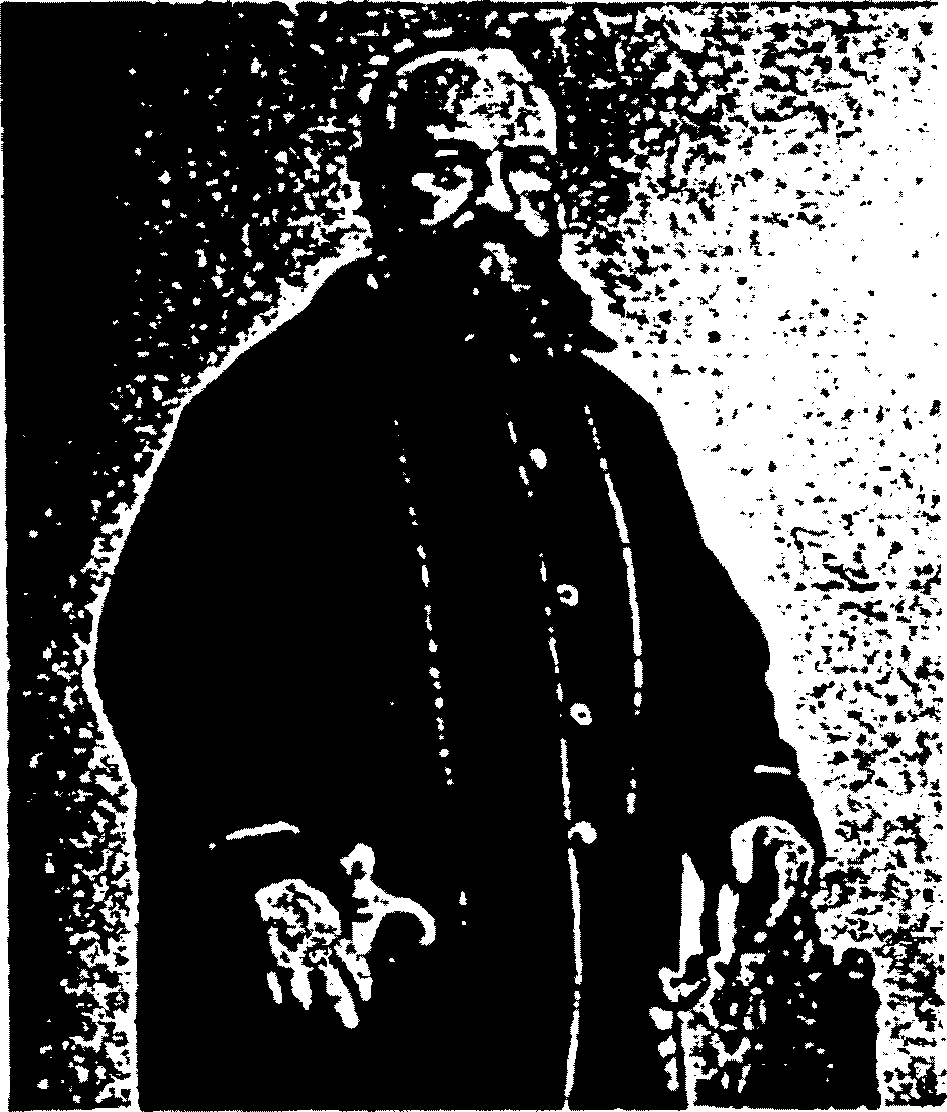
ELIPHAS LEVI (1810-1875) He bore sufficient resemblance to Aleister Crowley’s father, that Crowley at times confused their images. Crowley came to recognize himself as the reincarnation of Levi, who had died six months before Crowley's birth.
naturally have surpassed it. Crowley's Magick in Theory & Practice is foremost of these. The Tree of Life by Israel Regardie is another masterful treatise of theoretical and practical magick, virtually encyclopedic in its scope, and well worth the Student's conscientious review.
The Goetia, or The Lemegeton of Solomon the King
The Goetia is one of the most famous of the medieval grimoires (or “grammaries") of ceremonial magick. Primarily discussing the evocation of "spirits," it is one of five parts of a larger work (much of which has never been readily available) called The Lemegeton. or Clavicula Salomonis Regis. "The Key of Solomon the King."10 and is.
H We are not aware that any of the other four pans of The Lemegeton is in print. We have a copy of the whole of Part 4. The Almadel moi io be confused with The Grtmotre of ,4r-madei. translated by S.L. Mathers in the latter 1890s) from Sloane Ms. *2731 in the British Museum. All five pans of The Lemegeton exist in manuscript form, and other pans may have been published outside of our know ledge.
itself, commonly called “The Lesser Key of Solomon.” The Goeiia describes itself as follows:
CLAVICULA SALOMONIS REGIS, which containeth all the Names. Offices, and Orders of all the Spirits that ever he [Solomon] had converse with, with the Seals and Characters to each Spirit and the manner of calling them forth to visible appearance: In 5 parts, viz.:
THE FIRST PART is a Book of Evil Spirits. called GOETlA. showing how he bound up those Spirits, and used them in general things, whereby he obtained great fame....
The available edition of The Goeiia was prepared by S.L. Mathers as a work for hire, then edited and published by Aleister Crowley.1 11 However it began, this project did not end as a cooperative venture. Crowley's most neutral description of the events was included in his Confessions:
1 had employed Mathers to translate the text of The Lesser Key of Solomon the King of which The Goetia is the first section. He got no further; after the events of 1900 [the schismatic breakup of the Hermetic Order of the Golden Dawn], he had simply collapsed morally. 1 added a translation of the conjurations into the Enochian or Angelic language; edited and annotated the text, and prefixed a 'Preliminary' Invocation.' added a prefatory' note, a Magical Square (intended to prevent improper use of the book) and ultimately an Invocation of Typhon when the First Magical War of the .-Eon of Horus was declared.
As just described, prefatory to the translation proper was a short ritual labeled “Preliminary Invocation." Thereafter. Crowley regularly referred
1 Crowley wrote in his Confessions that the finished work, released in 1904. took three years to get to press; therefore, it was begun in approximately 1901. Crowley's "Prefatory Note" is dated "CJorpus] C[hristi], 1903 A.D.;" i.e.. June 11. 1903. Two months and a day later. Crowley was married, and
left on an extended honeymoon which climaxed the following April in Cairo, with the dictation of The Book of the Law. It was. therefore, after his return to England - thus, after the dictation of The Book of the Law - that The Goetia finally was printed. This may be significant timing; for. prefatory to his appendix of conjurations rewritten in the Enochian language. Crowley identified himself as "ye Wise Perdurabo. that My-ghtye Chiefe of ye Rosy-Cross Fratemitye. now- sepulchred in ye Vault of ye Collegium S.S" It is not clear whether this paragraph was written almost a year before, or immediately following, the "Cairo Working" and his resultant ordination by the goddess Nuit and receipt of The Book of the Law.
to this as “The Preliminary Invocation of the Goetia.” However, it had absolutely no connection to the original manuscript of The Lemegeton. Instead. it was a transcription of a fragment of an ancient Graeco-Egyptian magical ceremony contained in a papyrus, published in translation by Charles Wycliffe Goodwin in 1852.12 Although never an official ritual of the Hermetic Order of the Golden Dawn, it was well-known among that Order's adepts as “The Bomless Ritual for the Invocation of the Higher Genius:’’ and, in fact, it was the ritual later employed by Crow ley in 1906 in his own invocation of the Genius (or. in Crowley’s preferred language, the Augoeides or Holy Guardian Angel). Two decades later, he issued his personal reconstruction and adaptation of the ritual as an A.’.A.’, instruction for the Adeptus Minor called Liber Samekh, discussed in Chapter 8 of this present book.
Following this “Preliminary Invocation.” Crowley inserted “The Initiated Interpretation of Ceremonial Magic,” a short essay interpreting magical phenomena solely from a rationalistic -today we could say. from a psychological -perspective.
Thereafter follows The Goetia itself. The body of the work consists of a catalog of 72 goetic spirits. Although these are characterized by The Lemegeton itself as “Evil Spirits.” it should be noted that not all of their claimed functions would usually be regarded as “evil” in intent. A majority are said to grant knowledge of diverse and wide-ranging types. The spirit Buer "teaches Philosophy. both Moral and Natural, and the Logic Art. and also the Virtues of all Herbs and Plants. He healeth all distempers in man. and giveth good Familiars” - hardly the characteristics of an “Evil Spirit” to most people’s minds.
Similarly. Gusion “conciliateth and reconcileth friendships, and giveth Honour and Dignity' unto any;’’ Bime “giveth Riches unto a Man. and maketh him Wise and Eloquent:” and Andromal-ius can “bring back both a Thief, and the Goods which be stolen.” These spirits, and others resembling them, are collated with others of less savory descriptions, the w hole composing one of the most consulted Medieval catalogs of theurgy'.

A MAGICAL CIRCLE & TRIANGLE OF EVOCATION from The Goetia. “This is the Form of the Magical Circle of King Solomon, the which he made that he might preserve himself therein from the malice of these Evil Spirits." It is 9 ft. across and contains, on the body of the entwining serpent, sacred Names of the Sephiroth from Kether to Yesod.
The catalog is supplemented by basic instructions in ceremonial magick, including brief sections on the timing of magical ceremonies; preparation of the Magical Circle and Triangle, and of the Hexagram and Pentagram seals and other like devices; the ceremonial mode of bathing, anointing. and vesting; and formal spells - conjurations, constraints, invocations, curses, and the like - to be employed in the evocation of these spirits.13
Finally, the book concludes wdth Crowley’s translation of The Goetia s spellbook into the Enochian (or “Angelic”) language, according to the magical system of Dr. John Dee. The “Invocation of Typhon” mentioned by Crowley is a Greek “spell” copied nearly verbatim from the Leyden Papyrus (Col. XXIII), incorporated at the front of
'■ See Ceremonial Magic by Israel Regardie for the most
available accurate reproduction of the original Greek text. Goodwin's translation, the version from The Goetia, and Crowley's later adaptation.
Any reader interested in the present author’s assessment of the Goetic methodology, and of the technique of evocation in general, can consult the article "Practical Notes on Evocation - A Personal Journey." in In the Continuum. Vol. V, No. 3.

A PANTACLE OF JUPITER Unlike The Goetia, the so-called “Greater” Key of Solomon has designs for planetary pantacles. This one, said to bestow “honors, dignities, riches, and all kinds of good, together with great tranquility of mind" is included here as a benediction upon the readers of this book. May you acquire the One Treasure that is never exhausted!
the book before the title page without explanation - but not without Mathers’ name being added to it!
There is a separate work from the 14Ih or 15th century entitled The Key of Solomon the King (Clavicula Salomonis), translated by S.L. Mathers and first published in 1888. It is commonly labeled, by students of magick, as “The Greater Key of Solomon," even as The Goetia is called “The Lesser Key;’’ but these comparative appellations are not actually part of the title of either. This "Greater Key” is a work of vastly different style than The Goetia, and deals predominantly with planetary magick. It was one of the primary references employed by Eliphas Levi in his owm work
ings and writings. The "Greater Key" and The Goetia are of comparable, but different, importance, and it is unclear why Crowley did not include the former in the Student curriculum as well, in the same way that he listed both The Shiva Samhita and The Hatha Yoga Pradipika.
777
Book 777, compiled in 1906 by Aleister Crowley and published anonymously in 1909. is a fundamental reference of Qabalistic correspondences and magical symbolism. The story of its writing is given briefly in Crowley's autobiographical Confessions. Describing a health crisis in December 1906. Crowley wrote:
I was obliged to put myself once more in the doctor's hands and go to Bournemouth. I was now thoroughly prepared to take up my W ork of initiating mankind, but 1 was still determined to do it on the old lines.
I had no books of reference at Bournemouth. and it struck me that it would be very convenient if I possessed a volume giving ail the correspondences of the Cabbala in a compact form. 1 spent a week in writing this down from memory and the result is Liber 777.
Crowley’s diaries of this period mention his journey to Bournemouth on December 11. and two to three hours per day of work on the "Table of Correspondences” for December 15. 16. and 18. By December 19 he noted. "Table of Correspondences became chronic." On Christmas he was. "At work all day and night on table." On the next day we find. "More Table until Jones14 broke down.”
This detailed accounting is given because it often has been alleged (but w ithout a hint of evidence) that Crowley had stolen Liber 777 from S.L. Mathers, or otherwise was not responsible for its preparation. However. Crowley's magical diary' of the time confirms his later public statement
on the matter.
An advertisement for the book in The Equinox summarized its importance as follows:
This book contains in concise tabulated form a comparative view of all the symbols of the great religions of the world; the perfect attributions of the Taro, so long kept secret by the Rosicrucians, are now for the first time . published; also the complete secret magical correspondences of the G.'. D.-. and R.R. et A.C. It forms, in short, a complete magical and philosophical dictionary; a key to all religions and to all practical occult working.
For the first time Western and Qabalistic symbols have been harmonised with those of Hinduism. Buddhism. Mohammedanism, Taoism. etc. By a glance at the Tables, anybody conversant with any one system can understand perfectly all others.
These claims are not seriously exaggerated. Cecil Jones, in a semi-anonymous critique of the work in the Occult Review, evaluated it as follows:
Despite its cumbrous sub-title [Prolegomena Symbohca ad Sysiemam Sceptico-Mysiica rice Explicanda. Fundamentum Hieroglyph-icum Sanctissimorum Scientia Summa] and high price per page, this work has only to
14 George Cecil Jones, his host for the holidays.
come under the notice of the right people to be sure of a ready sale. In its author’s words, it represents ’an attempt to systematise alike the data of mysticism and the results of comparative religion.’ and so far as any book can succeed in such an attempt, this book does succeed: that is to say. it condenses m some sixty pages as much information as many an intelligent reader at the Museum has been able to collect in years. The book proper consists of a Table of ’Correspondences.’ and is. in fact, an attempt to reduce to a common denominator the symbolism of as many religious and magical systems as the author is acquainted with. ..
The Qabalistic information is very full, and there are tables of Egyptian and Hindu deities, as well as of colours, perfumes, plants, stones, and animals. The information concerning the tarot and geomancy exceeds that to be found in some treatises devoted exclusively to those

MATHERS' PROTEGE
Crowley’s early magical stylization was strongly emulative of that of his mentor, S.L. MacGregor Mathers. The deep admiration he originally felt, and their originally close working relationship, did not survive the passage of time.
subjects. The author appears to be acquainted w ith Chinese. Arabic, and other classic texts. Here your reviewer is unable to follow him. but his Hebrew does credit alike to him and his printer. . . A knowledge of the Hebrew alphabet and of the Qabalistic Tree of Life is all that is needed to lay open to the reader the enormous mass of information contained in this book. The ’Alphabet of Mysticism.’ as the author says - several alphabets, we should prefer to say - is here. Much that has been jealously and foolishly kept secret in the past is here, but though our author has secured for his work the imprimatur of some body with the mysterious title of the A/.A.\ and though he remains himself anonymous, he appears to be no mystery-monger. Obviously he is widely read, but he makes no pretence that he has secrets to reveal. On the contrary , he says, ’an indicible arcanum is an arcanum which cannot be revealed.’ The writer of that sentence has learned at least one fact not to be learned from books.
The original work was quite small, approximately sixty pages, and consisted almost entirely of tabulations. How ever, its author left behind voluminous notes, commentaries, explanations, and expansions so that, in the 1950s. Karl Germer. was able to edit and release 777 Revised. Virtually all copies that it is now possible to find are of this expanded and revised edition. For over twenty years the most accessible form of this reference work has been in the excellent anthology published by Samuel Weiser. Inc., alternately called 771 and Other Qabalistic Writings or The Qa-balah of Aleister Crowley.
LATER DEVELOPMENTS
Although this formal Studentship was inaugurated in 1912, and although Crowley gave examination in it as late as 1945 (about two and a half years before his death), there is little evidence that he paid much attention to it, in that form, during the intervening 33 years.
In the three final decades of his life, Crowley tried numerous ways of preparing people to undertake the Probationer Grade of the A .’.A/.. He moved from one approach to the next, apparently adapting each to the needs of a particular student as best he could.
At his Abbey of Thelema in Cefalii, and elsewhere during the remainder of his life. Crowley
ARTIST & ADEPT
Phyllis Seckier (Soror Meral) was admitted to the A.-.A.-, in 1940, and received the Knowledge and Conversation of her HGA in 1952. It was many years before she would speak of this except to intimates. “There is a certain sense of shyness and reticence about events connected with the Holy Guardian Angel," she wrote in 1992. Phyllis expressed this “Light of Life in spiendrous rapture of delight/ Who fills my veins with life in majesty of might" primarily through her poetry. She concretized the experience in her personal iamen (the magical seal of an Adept), shown at right, which she later used as well for the College of Thelema that she founded as a spiritual school of selfknowledge and self-understanding, and for the Temple of Thelema, which it birthed in 1987.
simply taught students one-on-one. Sometimes this was as part of one or another magical or fraternal order, and sometimes not. The nature and amount of teaching depended very much on the student. Although Crowley would have disparaged this kind of “hand holding” in the early days of the A.’.A.-.. eventually it became his standard. At the end of his life, discussing this change of philosophy, he wrote the following in Magick Without Tears:
The reason for the relaxation of the [original] rule was that it was thought better to help people along in the early stages of the work, even if there was no hope of their turning out first-class.
THE COLLEGE OF THELEMA and TEMPLE OF THELEMA
In the late 1960s. a sister of the A.-.A.-. - educator and artist Phyllis Seckier, better known in magical circles as Soror Meral - began to accept Probationers in the A,-.A,’, and. soon after, established the College of Thelema. With this college, she sought to guide students to an understanding of the Law of Thelema (the life philosophy presented in The Book of the Law), especially through a deeper understanding of themselves and of their dharma, or True Will.15 Her methods have included Qabalistic study, the practice of certain magick rituals, self-examination and introspection.
The College of Thelema offers four courses which students may complete more or less at their own pace. These courses are equivalent to the third and fourth years of an undergraduate program, and require two years of college (or the equivalent) as a prerequisite.
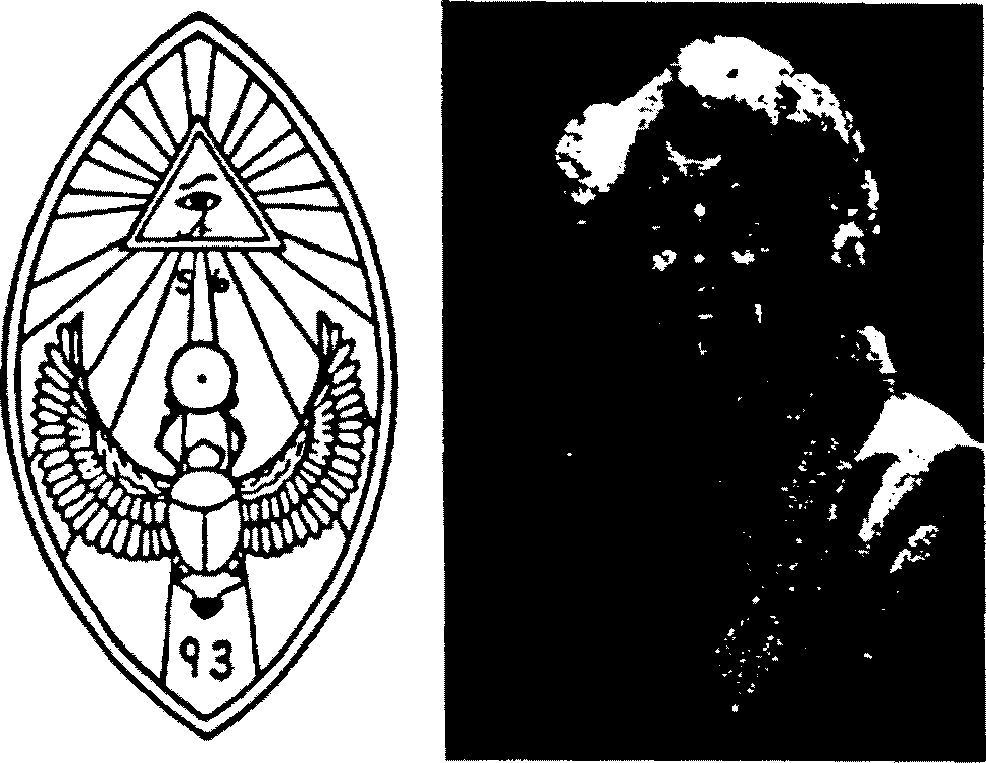
attention to physical and psychological health, astrology. and other methods.
During the College of Thelema's early years. Soror Meral rediscovered the same hard facts Crowley had learned by 1912. She found that most A.-.A.-. Probationers that she admitted fell by the wayside. They demonstrated little interest in serious work. Often they simply vanished without explanation. But there were exceptions! And. nearly to a one. those exceptions were people who, before being admitted as Probationers, had completed an initial course of study in the College of Thelema.
in other words, those who had served a studentship, and persevered through it. were likely to succeed as Probationers. Others (with only a couple of exceptions) were not. Soror Meral thereafter decided, around 1980. that she w ould not admit as a Probationer any person who had not first completed C.O.T. Course I.
A further major evolution occurred in the College of Thelema in late 1987. While continuing its traditional curriculum, the College also gave birth to a group ceremonial and initiatory system - a modem Mystery School - called the Temple of Thelema. This Order employs ceremonies similar to those of the old Hermetic Order of the Golden Dawn, but recrafted to conform to the symbols and principles of the Thelemic dispensation declared in The Book of the Law and the w ritings of Aleister Crowley.16 Along with much other practical in
16 No “warrant" or "charter” outwardly conferring authority can determine entirely the merits or legitimacy of any magical Order. Similarly, “interiorly received" mandates (i.e.. apparent authorization to an individual from "invisible" or spiritual sources) amount to nothing more than one person's private spiritual experience, unless and until they manifest in the creation of something actual tn the World of Action. A garden is judged, ultimately, by the plants it produces. At the same time, such warrants are not inconsequential. It makes a
struction, the First Order of the Temple of Thelema incorporates the entire curriculum of College of Thelema Course 1. Additionally, its initiates pass through a series of “grades” symbolically equivalent to the A.-.A.’, grades, but on a “lower octave.” In this way, the Temple of Thelema has renewed and revitalized the preliminary First Order of the old Hermetic Order of the Golden Dawn both for its own sake, and as an optional "primary education” for those who approach the AA .
In the chapters that follow, each grade of the A.*.A/, system will be discussed in detail, from Probationer (0c=0°) through Adeptus Exemptus (70=4°'). phis discussion will be based on the Order's fundamental defining documents: Liber 13 (The Book of the Slopes of Mt. Abiegnus). Liber 185 (The Book of the Holy Society), and the essay One Star in Sight, supplemented by additional clarifying information from many sources. This discussion is an expression not of one or another ’branch’ of the A.’.A. .. but of the authentic system as promulgated by its two founders. However, with the Student stage - which was a subsequent adaptive adjustment - a different approach has been necessary . Having already described the classic Student system, it was felt necessary to describe the workings of that particular branch of the "A.’.A.', family tree” which sprang from Hollywood film actress Jane Wolfe, who was generally known within the Order as Soror Estai. Soror Estai admitted only one Probationer into A.*.A.*., that being Phyllis Seckier (Soror Meral).
Under Soror Meral's direction and guidance, the Soror Estai lineage has held to the fundamental definitions of the A.’.A.', contained in Liber 13, Liber 185, and One Star in Sight, in every' grade from Probationer onward. However, in the preliminary’ Student stage, we do not follow the exact pattern of earlier generations, even as Crow ley did not constrain himself to one interpretation of the Student period. We follow' his informal lead.
palpable difference when the leaders of a group are the rightful heirs of a received heritage. Two of the three founders of the Temple of Thelema had been initiated and trained tn the traditional G.D. system (both First and Second Orders) by an Order descended lineally from S.L. Mathers. In addition to the A.’.A.', linkage of its founders, and certain inner warrants, the founding of T.'.O.'.T.-. was authorized by the head of this other Order. In this sense, it is not a “new order" per se, but a significant reformation of an ancient one. conformed to the new spiritual conditions of the planet.
STUDENT OPTIONS
Today, the Soror Estai A/.A.’. lineage adheres to the basic requirement, issued under the seal and by the authority of V.V.V.V.V.. that "every person wishing to become a Probationer of A A must first pass three months as a Student of the Mysteries." and pass examination therein.
We formally note that The Master Therion employed. over the years, many different approaches to this task, “to help people along in the early stages of the work.” We have done the same. We recognize three or four forms of the Student task, each an avenue of approach to the Probationer Grade.
First, we recognize the original Student program, published in The Equinox and quoted, in full, early in this chapter. A Student can get the assigned books, study them, and take examination.
Also, we recognize the successful completion of Course 1 of the College of Thelema as fulfillment of the Student requirement. Similarly, passage through the First Order of the Temple of Thelema satisfies the Student requirement. This is primarily because a person who completes the First Order grades w ill, in the course of their w ork, have completed the w hole of C.O.T. Course 1.
Additionally, there is an occasional individual whose personal study and life experience are clearly equivalent to any of the foregoing. Such a seeker may be admitted as a Probationer without further requirements. However, such individuals are rare.1,
THE EXPANDED READING LIST
Many w'ho explore this work believe that the correct Student curriculum is that given in The Equinox. Vol. Ill, No. 1. beginning on page 19 - a list of seven or eight dozen occult classics. A similar list was published in Appendix 1 of Magick in Theory & Practice.
There is no need to reproduce this list in the present book, because it is so readily available in the original works just cited.
1 We have observed that, generally, where a Probationer has been admitted on this basis and has passed on to other grades, they have gone back and undertaken one or more of the other offered programs as well. This kind of behavior is not at all surprising, considering the character type of those aspirants who typically succeed.
This expanded Student reading list is of considerable importance; but it is not the preliminary reading list on which the A .'.A.'. Student is examined before passing to Probationer. In fact, the commentary appended to this larger list is quite clear that, “The A.’.A.’. does not offer examination in this course, but recommends these books as the foundation of a library."
One of the greatest virtues of this expanded reading list, however, is the appended commentary, which discusses the state of mind the Student should strive to develop while preparing for her approach to the A .•.A/.. As stated in Equinox 111:1:
The object of this course of reading is to familiarize the student with all that has been said by the Great Masters in every time and country. He should make a critical examination of them: not so much with the idea of discovering where truth lies, for he cannot do this except by virtue of his own spiritual experience. but rather to discover the essential harmony in those varied works. He should be on his guard against partisanship with a favourite author. He should familiarize himself thoroughly with the method of mental equilibrium, endeavoring to contradict any statement soever. although it may be apparently axiomatic.
The general object of this course, besides that already stated, is to assure sound education in occult matters, so that when spiritual illumination comes it may find a well built temple. Where the mind is strongly biased towards any special theory', the result of an illumination is often to inflame that portion of the mind which is thus overdeveloped. with the result that the aspirant, instead of becoming an Adept, becomes a bigot and fanatic.
ADDITIONAL GRADES OF STUDENTSHIP
Also in the eleventh number of The Equinox (Vol. 111. No. 1). a new structuring of the A.’.A.’. system was introduced; and although this new plan was abandoned almost immediately in practice, it is still worth discussing for the perspective it gives on other points.
An article titled A.’.A.'. Curriculum began as follows;
In order to facilitate the study of The Official Instructions and other publications of the A.’.A.’.. the Przemonstrator of the Order1 ’ now issues a series of courses corresponding to the various grades. The grades themselves represent magical and mystical progress, corresponding to which will be grades of studentship representing intellectual progress, and an examination in each such grade must be passed before the equivalent magical grade is officially conferred.
It must be understood that the highest occult attainments are possible even to people who have no intellectual knowledge whatsoever. But this has been in the past a source of great iniquity, as it represents an overdevelopment of one organ of the Nature at the expense of others.
In other words, it was. at that time, contemplated that the A.’.A.’. would follow two parallel tracks, each member passing through “Student Grades” before having conferred the corresponding "Magical Grades." For example, a Neophyte l°=10D. who had in every respect qualified to be advanced to the 2°=9D Grade of Zelator. first would have been required to spend time as a “Student Zelator." studying and passing intellectual examination on the 2C=9C written curriculum, before having the actual 2C=9C Grade conferred upon her.
If taken literally, the plan quoted above not only would be pretty confusing, it would place undue emphasis on intellectual development -producing exactly the kind of “overdevelopment of one organ of the Nature at the expense of the others” that it was designed to prevent. Other problems become obvious on even a little inspection of the plan. It would have been a horror, both procedurally and developmentally!
What has been retained, however, is the basic idea that the intellectual development must be as thorough as that in other areas. Although two parallel tracks of “Student Grades" and "Magical Grades” are not followed, the published reading lists, or syllabi, of the respective grades are taken *
1!' Although G.’. H.’. Frater D.D.S. was still Praemonstrator in 1919 e.v.. it is evident that these “Grades of Studentship" were Crowley’s work. As imperator. Crowley retained responsibility for the “hands on” governing of the Order. Nonetheless. the formal introduction of new courses of study required the Przemonstrator's sanction, for (as One Star in Sight reminds us) “the authority of the Teaching and Governing Adept is the basts of all orderly work."
seriously. The aspirant must, in each grade, pass appropriate examination in the prescribed course of study - but as part of, rather than as a preliminary to, its “equivalent magical grade.”
This Curriculum makes clear that such examinations of intellectual progress “must be passed” in each grade. One Star in Sight, written a few vears after, reinforces the importance of this aspect of testing when it says:
Even' Member of the A.-.A.-, must be armed at ail points, and expen with even' weapon. The examinations in even Grade are strict and severe; no loose or vague answers are accepted. In intellectual questions, the candidate must display no less mastery of his subject than if he were entered in the “final” for Doctor of Science or Law at a first class University.
ADVANCEMENT TO PROBATIONER
These additional "grades of studentship." how ever. go beyond our immediate topic. The real point of this chapter is. simply, that a person preparing to enter into a lifelong relationship with magick and mysticism should find out something about them first! She should educate herself in the classics, survey the more popular literature, and develop a background sufficient to let her understand (and even participate in) a reasonable discussion of the topics. Once she has this background. and has demonstrated a willingness - or. rather, a real enthusiasm! - to invest time and effort into the matter, she may be admitted to the Grade of Probationer.
Chapter 2: (0°=0D)

ROBATIONER
(jRADE
gj1HE Great Work, for the Probationer, is. “to TVrlobtain a scientific knowledge of the nature *~cl ”and powers of my own being.” From the beginning, the nature of the Work is self-knowledge.
“Probation” is defined as a trial period, during which a person's fitness for membership is tested. The word comes from the Latin probaiio. the root of which is probare,' "to prove.” Thus, in Liber 185 the Probationer is advised to, “be mindful that the word Probationer is no idle term, but that the Brothers will in many a subtle way PROVE him. when he knoweth it not.”
ADMISSION TO THE PROBATIONER GRADE
In the original A.-.A.-, system, any person soever could be received as a Probationer. However, because so many candidates approaching the Great Work proved to be unprepared, the Chiefs of the Order, in 1912. instituted the Student “Grade” discussed previously. The rule (as published in Book Four) then became.
After three months the Student is examined. . . and if his knowledge. . . is found satisfactory, he may become a Probationer....
The Probationer (0°=0D) is received by an initiate who is at least a Neophyte (1 °= 10°). The Neophyte. in turn, is responsible to her Zelator (2°=9n). This serial responsibility is the rule, regardless of the actual grades held. *
Prohatio enumerates to 86. and probare to 67 by Latin Qa-balah Simplex. The individual seeker is encouraged to investigate these numbers, both in Latin and in Hebrew, for additional clues to the nature and purpose of this probation.
The ceremony of admission, though usually simple, may carry a tremendous impact. It is not felt necessary to reproduce this ceremony in full, since any Neophyte qualified to admit a Probationer will have the know ledge of what is required. The most important details, in any case, have been published in Liber 185. and are as follows:
The aspirant to the A.-. A.-, shall hear the Lection (Liber LXI) and this note of his office [The Task o f the Probationer, from Liber 185}-. IF HE WILL, shall then procure the robe of a Probationer: shall choose with deep forethought and intense solemnity a motto. . . On reception, he shall receive the robe, sign the form provided and repeat the oath as appointed. and receive the First Volume of the Book.
“The Book”
“The First Volume of the Book” consists of Liber 61. called Liber Causae: and Liber 65. called Liber Cordis Cincti Serpente. There were originally three small, white “Volumes of the Book.” one each for the Probationer, the Neophyte, and the Zelator. Mostly, these contained the text of Thelemic “Holy Books" (“channeled” communications of exalted verse), parts of which the aspirant is to memorize at various stages of progress. The “First Volume,” given to the Probationer, contained Liber 65 because the Probationer is required to commit to memory one chapter of Liber 65. It also contained Liber 61. Liber Causae the History Lection of the A.-.A.*. - and. incidentally, the one document in the three “Volumes of the Book” which was not considered a “Holy Book” - because this is the introductory document which
!
j
ro”UC*iTOX IM CLASS *
I
I
INo Call Ext
Q.S. V.
>o”p.
1NMQMAT0IU V.V.V.V.V. Fro Co*. ScMM.
DD.S. ) Q CkU,
V. N.
F.
i. I w” fee iUwt; mm3 tW Scfet is co-t“feH
AW iW fefMbta aw of fet mmmI
Kite, 0 ”J Httfcf J |i m M* b fer hoar Of the hoofed aad brty fetfefa fe-“. Bkf, 0 “y ttfey nto hriUMMce tf tat— Oo the corpu <rfQfeU short k fee loabl 0 of ay moUki” wj ■*“. onm earn, Tboo at pm to Nik, w fee ww Typfeon t Ah aef btu tbtftofy erf nwfef *“■ EmwoXs thee and wafM few in intf *1
tk tdl, 0 mt aoi I UkU the jpoflmayfeookt At fee wtfes an apahod, tad the oras
ikteaM! ” ”y bcarty few yoyws TUo on, ’ OSosWifelcoriBMsife tiovntfMMwbrvtl feboidl we on one, oorf fee leopm of y“on Gat fewtuifc fed. and the Barth umojm.
“THE BOOK"
Each Probationer, according to Uber 185. receives “The First Volume of the Book" 0EAHMA, containing Liber Causae (the Preliminary Lection and History Lection tor A.-.A.-.). and Liber 65 (Liber Cordis Cincte Serpen-te}. At left, the first page of Liber 65. shown opposite its original Imprimatur. D.D.S. and V.N. were G.C. Jones. O.M., O.S.V.. and P. were Crowley. P.A. was J.F.C. Fuller.
On the next page is a rare look at the last page of 0EAHMA, Vol. I. This copy belonged to Soror Meral, who received it from her Neophyte, Soror Estai (Jane Wolfe).
explains the system, and which plays a significant role in the aspirant's reception as a Probationer.
At the present, rather than provide the candidate with these separately printed little books, the Probationer is advised to purchase The Holy Books of Thelema (The Equinox. Vol. 111. No. 9). The so-called “Blue Equinox.” which is Vol. 111. No. I, also contains the two books, Liber 61 and Liber 65, required by the Probationer.
The Robe
The robe of a Probationer is a white Tau robe, udthout a hood, and with gold braid along the bottom hem. the cuffs, and near the neckline. On the front is a scarlet pentagram. On the back is a hexagram, formed from a descending blue triangle interwoven with an ascending red triangle, and with a gold Tau in the center. Thus, it conforms to the older style of the Lesser Ritual of the Pentagram which declares, “Before me flames the Pentagram, and behind me shines the Six-Rayed Star.”
What is of particular note, however, is that this robe, which every Probationer is to procure, is actually the robe of an Adeptus Minor! Here is a potent symbol for the Probationer, and especially a reminder that, from the beginning, the purpose of the A.-.A.’. work is one, and it is that very task which is best identified with the Minor Adept: to attain to the Knowledge and Conversation of the Holy Guardian Angel.
The Aspiration Name
It is generally known that students of magick assume a special “magical name” or “motto" by which to distinguish their magical personalities from their mundane or civil identities. Depending on the situation or context, these “magical names" may serve quite varied purposes.
The particular type of “magical name” or “motto” which the Probationer-candidate is to select generally is called an "aspiration name.” It is a declaration of the seeker's spiritual aspiration, to the best of her ability to articulate this at the beginning of the journey. Usually these are phrased in Hebrew, Greek, or Latin; but we have seen a few expressed in the person’s native language. There is no rule on this.
In Book Four (Part II, Cap. 6), Frater Perdu-rabo commented:
Word should express will: hence the Mystic Name of the Probationer is the expression of his highest Will.
There are. of course, few Probationers who understand themselves sufficiently to be able to formulate this will to themselves, and therefore at the end of their probation they choose a new name.’
2 See the chapter following, on the Neophyte Grade.
OVERVIEW OF THE PROBATIONER WORK
Any attempt to specify the tasks assigned to the Probationer must necessarily be vague.3 This is because every aspirant approaching the A.'.A.', comes with different history, different capacities and interests, different strengths and weaknesses, different karma. The real purpose of the probationary grade is for the aspirant to explore the widest possible selection of material and, primarily, to find her own methods and styles of working. The Probationer’s Great Work, remember, is "to obtain a scientific knowledge of the nature and powers of my own being." Although the Probationer is certainly expected to w ork - and there is quite a lot of work to do! - considerable care is taken to ensure that the supervising Neophyte does not intrude upon this process.
Thus, we can best describe the assignment of the Probationer in general language, and a few simple rules. One Star in Sight summarizes the Probationer's "principle business" as, "to begin such practices as he may prefer, and to write a careful record of the same for one year."
The period of Probation is a minimum of one year. After six months or more, select Probationers are admitted to a special ceremony. Ritual 28 or Liber Septem Regnum Sanctorum (The Book of the Seven Holy Kings). The nature of this ceremony is. necessarily, never disclosed publicly nor to the candidate in advance. Nor is it appropriate for all candidates. Neophytes of the A.’.A.’, are provided w ith precise criteria for determining w hich Probationers are best suited to benefit from Ritual 28.
Supervising the Probationer's work is a Neophyte w hose experience can guide the Probationer. However, the Probationer alone must determine the essential path and direction of the work.
The Probationer is given an extensive curriculum of study materials. This syllabus is included in Appendix D of the present volume, and w ill be discussed more thoroughly below. It consists primarily of all A.-.A.-, publications in Class B. ’
The Neophyte Grade shares this vague quality, to a certain extent: subsequent grades become much more precise in their requirements. This is a consequence of the complex and diverse nature of the First Matter - the aspirant - who is approaching the work in its earls stages.
The full knowledge of the interpretation of this book is concealed from ail, save only the Shining Triangle.
The Probationer must nevertheless acquire a copy and thoroughly acquaint himself with the contents. He must commit one chapter to memory.
This copy belongs to
...J.K^.tz..$J...^....?...2..^...................................
By authority of V. V. V. V. V. this book is published and issued.
The Price, one Guinea, is to be remitted to the Treasurer through the Neophyte introducing.
This course will furnish the Probationer with a thorough general knowledge of the whole system of Attainment, and of the practices tending to this goal, so that he may choose freely as to what way he will take in his Beginning. For this is always left by the A.-.A.-, to his Free Wilk They only begin to advise and criticize him on the information supplied to Them by himself in the Magical Record which he prepares for Their Instruction."
He may select any practices that he prefers, but in any case must keep an exact record so that he may discover the relation of cause and effect in his working, and so that the A.'.A.’, may judge of his progress and direct his further studies.'
However, this does not relieve the Probationer of the responsibility to become familiar with all of the assigned material. For one thing, one cannot tell if a particular practice is useful in one's own
4 A .-.ACurriculum in The Eot'INOX. Vol. III. No. 1.
' Book Four. Part I.
Great Work without trying it. Also, and at least as important a reason, the Probationer, when eventually advanced to Neophyte, must be fully equipped to answer the questions of the next generation of Probationers. It will. then, be seen that, from the ven’ beginning, the A.-.A.-. trains a seeker not alone for that individual’s own advancement but. equally, for those who come after.
One specific assignment is that the Probationer must memorize one of the five chapters of Liber 65 (Liber Cordis Cincli Serpente. “The Book of the Heart Girt with a Serpent"), an account of the relations of the aspirant with her Holy Guardian Angel. It is not an exaggeration to say that this book is one of the most beautiful and stirring works of mystical verse in the history of the world. Liber 65 consists of five chapters (of exactly 65 verses each) attributed, respectively, to the elements Earth. Air. Water. Fire, and Spirit.
Additionally, the Probationer “shall perform any tasks that the A.-.A.-. may see fit to lay upon him." However, except in certain cases, these are not specific tasks assigned by the supervising Neophyte. With rare exception, these additional tasks take the form of life ordeals. (More on this later.)
It is frequently stated - incorrectly! - that A.-.A.-. membership is secret, that one is not permitted to talk about it. This is absolutely false. Granted, discretion rightly prevails in many life circumstances, and a person can be expected to be naturally cautious about discussing matters that he or she holds to be intimate and sacred. Yet. the actual "rule” needs to be clearly stated, once and for all. from Liber 185:
He shall everywhere proclaim openly his connection with the A.-.A.-. and speak of It and Its principles (even so little as he under-standeth) for that mystery is the enemy of Truth.
This instruction persists in every grade of the Outer College (G.-.D. .). Finally.
He shall hold himself chaste, and reverent toward his body, for that the ordeal of initiation is no light one. This is of peculiar importance in the last two months of his Probation.

THE PROBATIONER’S JOURNEY
Perhaps more than any other grade of the A.-.A... Aleister Crowley wrote extensively on the nature of the Probationer Grade and its work. We can do no bener than to quote him at length. In Eight Lectures on Yoga. Cap. VJH. ”r22. 24, he outlined how the beginning stages of the A.-.A.-. work were designed:
The question for me is.. . to describe a method of procedure which w ill be sufficiently elastic to be useful to every human being. 1 have tried to do this by combining the two paths of Magick and Yoga. If we perform the preliminary practices, each according to his capacity, the result will surely be the acquisition of a certain technique, And this will become much easier as we advance, especially if we bear it well in mind not to attempt to discriminate between the two methods as if they were opposing schools, but to use the one to help out the other in an emergency. . .
You are expected to spend three months at least [the Student period] on the study of some of the classics on the subject. The chief object of this is not to instruct you. but to familiarize you with the ground work, and in particular to prevent you getting the idea that there is any right or wrong in matters of opinion. You pass an examination intended to make sure that your mind is well grounded in this matter, and you become a Probationer. Your reading will have given you some indication as to the sort of thing you are likely to be good at. and you select such practices as seem to you to promise well. You go ahead with these, and keep a careful record of what you do. and what results occur. After eleven months you submit your record to your superior: it is his duty to put you right where you have gone wrong, and particularly to encourage you where you think you have failed.
I say this because one of the most frequent troubles is that people who are doing excellent w ork throw it up because they find that Nature is not what they thought it was going to be. But this is the best test of the reality of any experience. .. .
The basic instructions in "the two paths of Magick and Yoga” are, respectively, the Class B documents entitled Liber O vel Manus et Sagitta (The Book of the Hand d- the Arrow) and Liber E vel Exercitiorum (The Book of Exercises). With
—..........

THE ROBE OF THE PROBATIONER is white, with gold braid at the color, cuffs, and hem. On its front is a red pentagram: on its back, the hexagram. The Adeptus Minor (5°=6°) robe is identical.
These photographs, taken in 1910 in London, show scenes from the Rites of Eleusis that Crowley staged (along with many members of the Equinox staff, and other A.-.A.-. members). At left, the Rite of Saturn;
—2—* at right, the Rite of Luna.

apologies for the pun on “errors and omissions" coverage, these unquestionably may be considered the “E&O insurance" which protect against "magical malpractice." These clear, to the point, practical instructions are, in other words, the foundation of the entire A.-.A.-. system of Scientific Hluminism.6 G.-.H.-. Frater O.M. emphasized their importance plainly in an editorial in Equinox, No. 7 (March 1912). Every “fundamental practice” mentioned in the paragraph below is taught in Liber E or Liber O:
I am authorised to say that no one will be admitted as a Neophyte unless his year's work [as a Probationer] gives evidence of considerable attainment in the fundamental practices. Asana. Pranayama, assumption of God-forms, vibration of divine names, rituals of banishing and invoking, and the practices set out in sections 5 and 6 of Liber 0. Although he is not examined in any of these, the elementary experience is necessary in order that he may intelligently assist those who will be under him.
Several other quotations from Crow ley, in one or another of his official capacities or identities, disclose much about the Probationer process:
When a man ceremonially affirms his connection with the A.-.A.-. he acquires the full powers of the whole Order. He is enabled from that moment to do his true will to the utmost without interference. He enters a sphere in which even disturbance is directly and instantly compensated. He reaps the reward of every action on the spot. This is because he has entered what I may call a fluid world, where even stress is adjusted automatically and at once. . .
The penalties of wrong-doing are applied not by the deliberate act of the Chiefs of the Order; they occur in the natural course of events. I should not even care to say that these events were arranged by the Secret Chiefs.
. . . Every one who signs the oath of a Probationer is stirring up a hornets' nest.
A man has only to affirm his conscious aspiration; and the enemy is upon him.
It seems hardly possible that any one can ever pass through that terrible year of probation - and yet the aspirant is not bound to anything difficult: it almost seems as if he were not bound to anything at all - and yet experience teaches us that the effect is like plucking a man from his fireside into mid-Atlantic in a gale. The truth is. it may be. that the very simplicity of the task makes it difficult.
The Probationer must cling to his aspiration - affirm it again and again in desperation.
He has. perhaps, almost lost sight of it; it has become meaningless to him; he repeats it mechanically as he is tossed from wave to wave.
But if he can stick to it he will come through.
And. once he is through, things will again assume their proper aspect; he will see that mere illusion were the things that seemed so real, and he will be fortified against the new trials that await him.
But unfortunate indeed is he w-ho cannot thus endure. It is useless for him to say, 'I don’t like the Atlantic: I will go back to the fireside.'
Once take one step on the path, and there is no return, . . The statement that the Probationer can resign when he chooses* is in truth only for those who have taken the oath but superficially?
] have been asked by Authority to say a few words on the relations which should subsist between a Neophyte and his Probationers. Though a Neophyte is obliged to show ’zeal in service’ towards his probationers, it is no part of his duty to be continually beating the tattoo. He has his own work to do - very serious and important work - and he cannot be expected to spend all his time in making silk purses out of pigs' ears. He is not expected to set definite tasks, nor has he authority to do so. The Probationer is purposely left to himself, as the object of probation is principally that those in authority may discover the nature of the raw material. It is the duty of the Probationer to perform the exercises recommended in his text-books, and to submit the record of his results for criticism. If he finds himself in a difficulty, or if any unforeseen result occurs, he should communicate with his Neophyte, and he should remember that although he is permined to select the practices which appeal to him. he is expected to show considerable acquaintance with all of them. More than acquaintance, it should be experience; otherwise what is he to do when as a Neophyte he is consulted by his Probationers? It is important that he should be armed at all points...
But let no one imagine that those in authority will urge probationers to work hard. Those who are incapable of hard work may indeed be pushed along, but the moment that the pressure is removed they will fall back, and it is not the purpose of the A.’.A.*. to do anything else than to make its students independent and free. Full instruction has been placed within the reach of everybody; let them see to it that they make full use of that instruction.1"
Probationers are reminded that the object of Probations and Ordeals is one: namely, to se
lect Adepts. But the method appears twofold: (i) to fortify the fit; (ii) to eliminate the unfit.1
I believed then, and believe now. that the probationer of A.’.A.’. is nearly always offered the opportunity to betray the Order.. . ,!’
The Chancellor of the A.’.A.’. views without satisfaction the practice of Probationers working together. A Probationer should work with his Neophyte, or alone. Breach of this rule may prove a bar to advancement.1 ’
This last sentence requires comment. The stated rule is sincere, and is basic fare to the A.’.A.’. system. That is. peers are always expected not to work together because they are almost certain to cloud and confound each other's work. But the penalty' delineated is rarely enforced by one’s superiors in the Order. Rather, it is the unfolding of natural law. It is the "working together” itself that is almost certain to bar one’s real advancement. rather than one’s Neophyte refusing to pass along the next grade paper!
Quite a lot more has been written about the relationship betw een the Probationer and his or her supervising Neophyte:
in the A.’.A.’. the superior is. so to speak, the sparring partner of the pupil. His function is to discover the prejudices, fears, and other manifestations of tendency w'hich limit the pupil, by observing the instinctive reactions which may follow any order. The pupil discovers his own weaknesses, w hich he then proceeds to destroy by analysing them, somewhat as Freud has recently suggested. . . as well as to-master them by habitually ignoring their inhibition. If the superior is anything of a psychologist, he should be able to teach the average w-eakling fairly perfect self-control in three months at the outside.14
It is presumptuous for a Neophyte to lay down rules: for (a) he cannot possibly know what his Probationer needs, having no record to guide
* “He may at any moment withdraw from his association with the A.’.A.’. simply notifying the Neophyte who introduced him." iLiber J85)
“■ Book Four, Part 11. Cap. 6.
" Announcement by the Chancellor (Cancellarius) of the A.’.A.’. in many issues of The Equinox Vol. 1.
'■ The Confessions of Aleister Crowley, p. 659.
13 Announcement by the Chancellor of the A.’.A.’., in many issues of The Equinox Vol. 1.

The Oath of a Probationer.
I,__________, being of sound mind and
body, on this/Zjr£__day of *■*( [An x*lf—Q in
_____° of -J± . do hereby resolve: in the Presence nf (o a MOf&y** °f ^e A.’.A.'.
To prosecute the Great Work: which is, to obtain a scientific knowledge of the nature and powers of my own being.
May the A.’.A.'. crown the work, lend me of Its wisdom in the work, enable me to understand the work!
Reverence, duty, sympathy, devotion, assiduity, trust do I bring to the A.'.A. . and in one year from this date may 1 be admitted to the knowledge and conversation of the A.’.A. J

Motts---Ec C_/. A 1.


SOROR ESTAI’S PROBATIONER CERTIFICATE
"Modified by the official Regulations applicable to Residents of an Abbey of Thelema." Aleister Crowley wrote on Jane Wolfe’s Probationer Oath on June 11, 1921. before signing his name as a Magus 9C=2C - not a Neophyte, tn the nearly 80 years intervening, the original wax seals have cracked and fallen away, although portions of two of them remain, and the original wax’s coloration remains, staining the paper crimson and dark purple in the two other locations. The sealing wax was in the colors of the Sephiroth Binah. Chesed. Geburah. and Tiphereth in the so-called “King Scale’’ of Color.

him; (b) the Probationer’s task is to explore his own nature, not to follow any prescribed course. A third objection is that by putting the Probationer in Corsets, an entirely flabby person may sneak through his year, and become a Neophyte, to the shame of the Order. But this objection is theoretical: for Initiation is overseen from the Third Order, where no Error may endure.* 1'
the probationer syllabus
Study material for the Probationer Grade comprehends all Class B documents of the A a A.-.. Class B documents are generally scholarly works, of an informative and practical nature. With this basis, the Probationer Syllabus incorporates nearly all of the major practical instructions of the remaining grades of the Outer College. I°=1OD through 4C=7°. Additionally, several other documents are unique to the Probationary .
The complete syllabus of this grade, and of all others, is given in an appendix of the present work. We will here discuss only selective points.
As stated above. Liber O and Liber E are the foundation of the AaAa system. They become centra] to the specific curricula of the ] c=] 0D and 2c=9d grades, respectively; but they have an importance that reaches far beyond those levels, and should not be neglected nor deprecated by any Probationer.
Several Class A documents - the so-called “Holy Books of Thelema” - are mentioned specifically in the Probationer Syllabus. The Book of the Law is the literary embodiment of the spiritual impetus of the entire Thelemic dispensation, and is part of the syllabus of every grade of the Order. Besides this, and Liber 65, there are specific references to Liber Porta Lucis, Liber Tzaddi. and Liber A 'ash. We would advise, however, that the Probationer become as familiar as possible with all of the Class A documents. They are gathered together in The Holy Books of Thelema.
Four A.'.A.'. Class B documents are also official papers of the Thelemic fraternity known as Ordo Templi Orientis (O.T.O.). Three of these are official and confidential instructions of that order's vn°, Vlir. and Xc. This presents a problem; for the Probationer is required to study and be tested on all Class B Documents, yet the supervising
l? Footnote by G.'.H.', FraterO.M. in Liber 165. A Master of the Temple.
Neophyte, if now or in the past a member of O.T.O., cannot distribute these three papers without breaking solemn, honorable obligations. A solution is made possible, however, by the fact that all of these documents have been illicitly published by mainstream publishers, and are not impossible to find with a little effort. If the Probationer acquires these on her own. the Neophyte is then at liberty to discuss them to the limit of the Probationer's independent understanding of them, which is usually more than sufficient!^
Among the works on divination. Liber 78 remains an excellent guide to traditional teachings on the Tarot, although The Book of Thoth has superseded it in many ways Liber Gaias. the instruction on geomancy. is limited, and admittedly contains blinds (intentionally erroneous information). We recommend A Practical Guide to Geo-mantic Divination by Israel Regardie. an excellent substitute.
Among the Chinese works. Khing Kang King (a very’ small, very wonderful poem on yoga) is usually out of print, but small enough for any Neophyte to photocopy. Crowley's translations of the Tao Teh Ching and the / Ching' are available from the College of Thelema.
Of the Class B documents, a few are assigned only to the Probationer level, and to no other grades. These include: Blavatsky’s The Voice of the Silence. The Two Paths, and The Seven Portals (with commentary by GaHa Frater O.M.); Liber Aleph, The Book of Wisdom or Folly. The Heart of the Master; Little Essays Towards Truth: A Mas
Because the Probationer cannot reasonably be tested on an instruction she cannot obtain, we have not listed these documents on the Probationer Syllabus in Appendix D. although they are listed with the other Class B Documents tn Appendix E. There is some question of the relevance of some or all of these particular papers to the Probationer process of someone who is not an advanced O.T.O. member: but. of course, that cannot be determined a priori, nor by anyone but the individual Probationer. Based on this principle, and the firm requirement that each Probationer study all Class B Documents, it would be neither honest nor within our prerogative to fail to mention them altogether, despite the understandable proprietary’ feelings of those (including ourselves) who pledged not to disclose their contents.
1 Due to European scholarly efforts to transliterate Asian languages, the Western spellings of these book titles (and others) vary widely. The pronunciation, however, is no mystery', due consideration being given to small dialectic differences. According to V.-.H.-. Sor. F.. a native Chinese speaker, these two book titles are pronounced DOWda ZHINC and EE ZHINC. respectively. Thien Tao is TEEen DOW
ter of the Temple; Liber Artemis lota vel De Coitu Scholia Trivice; The Paris Working; and The Greek Qabalah (which should be in the Practicus curriculum, but was never added officially).
There are also documents other than Class B that show up only in the Probationer syllabus and. therefore, deserve particular attention here. These include: An Account of A.\A.\; the important solar adorations in Liber Resh vel Helios; the short but brilliant pamphlet called The Message of the Master Therion; Liber CL vel A Sandal. De Lege Libellum; Khabs am Pekht: and The Law of Libert}'. This would also include the four parts of Book Four; but these are of such general value that they virtually become handbooks of whatever grade one is in.
ADVANCEMENT TO NEOPHYTE
Advancement within the grades of the A.’.A.', is, at each step, the result of actual accomplishment; one might say actual attainment. The crite
rion for moving to the next grade (other than certain minimum time requirements) is that one has accomplished the task of the present grade. Thus, according to Liber 185, "any Probationer who has accomplished his task to the satisfaction of the A.•.A/.” is to be prepared for advancement to Neophyte.
The Probationer Grade lasts at least one year, approximately. The actual earliest date of advancement is “When the sun shall next enter the sign under which he hath been received" (Liber 185). To prepare for this, the Probationer is instructed to deliver a copy of the Record of the Probationer period to the supervising Neophyte, and. at that time, to recite the chosen chapter of Liber 65. This is to occur one month before the completion of the Probationary' period, i.e“ at least eleven months after admission.
The Probationer is to remain free from all other engagements for one whole week, which is the length of the Neophyte initiation process.
Chapter3: (l°=10D)
The TVeophyte
Grade
gTTHE Great Work, for the Neophyte, is de-■"Wl fined as. “to obtain control of the nature and empowers of my own being.’’ Compare this to the Work of the Probationer, where one was to obtain knowledge of the nature and powers of one’s own being. The obtaining of self-knowledge is a never-ending task; but. some significant measure of that self-knowledge having been obtained, one now undertakes to gain self-control.
We are reminded of a corresponding paragraph in the 1 = 10 ceremony of the Hermetic Order of the Golden Dawn. At the time that Aleister Crowley and Cecil Jones passed through it, the ceremony read as follows:
The [0=0] Grade is a preparation for other Grades, a threshold before our discipline, and it shows, by its imagery’, the Light of the Hidden Knowledge dawning in the Darkness of Creation; and you are now [in the 1 = 10 Grade] to begin to analyze and comprehend the Nature of that Light. . . Prepare to enter the Immeasurable region.
The word “neophyte,” in English, generally means any beginner, novice, tyro, or new convert. It also has come to bear distinctly religious connotations, being the title of a novice in some religious orders, and of a newly ordained Roman Catholic priest.
“Neophyte” is a purely English word. Its Latin antecedent is neophytus.' This, in turn, comes
1 Neophytus enumerates to 127 by the Latin Qabalah Simplex. Other Latin words bearing the same enumeration include mysterium, meaning “secret" or “mystery;” and sapientia verci, “true wisdom,” phrases of particular significance for
from the Greek vroouroc. "new plant;” from flxrrot;, which refers to that which is shaped by nature, i.e. raw material: the Masonic “rough ashlar.” or the alchemical "green lion.” From this we understand that the Neophyte, an initiate of the element of Earth, has "taken root” as a “new plant” in the “garden” of the Masters who govern the work of the A a A... This beautiful metaphor can be studied more fullv in Liber 418, The Vision & the Voice, the 13'h ^Ethyr.
An official commentary on the grade name is given in Liber 185:
Let him be mindful that the word Neophyte is no idle term, but that in many a subtle way the new nature will stir within him. when he knoweth it not.
To borrow a phrase from alchemy, the Neophyte Grade marks a “volatilizing of the fixed,” an intentional stirring into instability of a relatively inert prima materia (“first matter”), as a necessary stage of its transformation.
SYMBOLS OF THE NEOPHYTE GRADE
The Neophyte Grade is attributed to the tenth sephirah of the Tree of Life, called Malkuth, the Kingdom. Malkuth corresponds to the Sphere of the Four Elements; and, in a different way, specifically to the element Earth.
most who enter upon this decisive level of initiation into the magical Mystery Tradition.
This grade also incorporates the symbolism of the 32nd Path of Tav (Fl), which opens from the Sphere of the Elements in Malkuth unto the Sphere of the Moon in Yesod. Tav means "cross" - the Cross of the Four Elements. It corresponds to the planet Saturn, to the element Earth, and to the XXIs' Trump of the Tarot. The Universe (esoteri-cally, “The Great One of the Night of Time").
Additionally, there is preliminary' work associated with the Paths of Shin (127) and Qoph (p), the other two Paths that open from Malkuth to higher sephiroth.
The net result is to empower and balance the individual with respect to the Malkuth stage of development, and to secure actually - not just metaphorically - the Neophyte’s advancement to the very threshold of the Sephirah Yesod. the World of Yetzirah. and the Grade of Zelator.
The Neophyte’s work encompasses more or less all of the practical teachings previously given in the Adeptus Minor Grade of the old Hermetic Order of the Golden Dawn. Ceremonial magick and “astral" explorations are the primary' methods learned and applied. Among the most important in its teachings are those for which the grade itself is named: the Neophyte Formula, a magical formula of exceptional versatility, from which the Neophyte Initiation ceremony is itself derived.
ADVANCEMENT TO THE NEOPHYTE GRADE
Liber 185 describes the procedure for the advancement of a Probationer to the Grade of Neophyte:
Let any Probationer who has accomplished his task to the satisfaction of the A.’. A.', be instructed in the proper course of procedure: which is:- Let him read through this note of his office, and sign it. paying the sum of One Guinea for Liber VII which will be given him on his initiation, and One Guinea for this Portfolio of Class D publications. B-G. Let him obtain the robe of a Neophyte, and entrust the same to the care of his Neophyte.
He shall choose a new mono with deep forethought and intense solemnity, as expressing the clearer consciousness of his Aspiration which the year's Probation has given him.
Let him make an appointment with his Neophyte at the pleasure of the latter for the ceremony of Initiation.
As indicated in the preceding chapter, advancement within A.-.A.-, grades is the result of work actually accomplished. Therefore, the first step of advancement is that the Probationer “has accomplished his task to the satisfaction of the A.-.A.-.."
In practice, the formal reading of the Task of the Grade, and the ascription to the Oath, are normally done on the occasion of the initiation ceremony itself. Also, in modem times, the Neophyte does not pay a guinea for a copy of Liber 7 but. rather, is already in possession of The Holy Books of Thelema, which includes it. The phrase “this Portfolio of Class D publications” refers to Liber 185. the Task and Oath papers for each grade from Neophyte through Adeptus Minor (Without), reproduced in Appendix B of this present book.
The robe of a Neophyte is a black Tau robe, hooded, and totally unadorned with no other symbols or insignia. This black robe is the robe of the Outer College of the A.'.A.'.. Other symbols will be added to the robe as one progresses through the grades.
The instruction with respect to selecting a new aspiration name is self-explanatory'. Contrary’ to a popular belief, it is not required, or even expected, that the aspirant select a new name at each grade. The passage to Neophyte is the only stage at which it is mandatory' to do this. Otherwise it is left to the aspirant's discretion: or. rather, to the aspirant’s inner prompting or guidance.
Having dispensed with these preliminaries, there remains only the actual ceremony of initiation.
THE NEOPHYTE INITIATION CEREMONY
Liber 185 instructs:
When the sun shall next enter the sign under which [the Probationer] hath been received, his initiation may be granted unto him. He shall keep himself free from all other engagements for one whole week from that date.
and
Let him make an appointment with his Neophyte at the pleasure of the laner for the ceremony of Initiation.
Similarly, Liber 13 says:
At the end of the Probation he passes Ritual DCLXX1 [i.e., 671] which constitutes him a Neophyte.
There are controversies about the interpretation of these sections. In order to discuss these controversies. we first must give a history of the document - actually, documents - called Ritual 671.
At the Autumnal Equinox. 1906 e.v.. during the initial period of formulation of the A.-.A.'. system. G.'.H.-. Frater D.D.S. (Cecil Jones) reduced the Neophyte Ritual of the Hermetic Order of the Golden Dawn to skeleton form, “eliminating all unnecessary features and quintessentializing the magical formulae.”' From this. G.'.H.'. Frater O.M. (Aleister Crowley) wrote, on September 30, the first draft of a new Neophyte ceremony. He began working with this ceremony and further revised it “on 7th Oct. and other dates.” On October 9, by its use. he was “permitted. . . to perceive the Vision of IAQ.” which he elsewhere described with the words, “received the great Initiation." Thereupon, on that date, he “did duly write out for the third time this ritual. ... it having been in its crude form of assistance to him in the obtaining of the chrism aforesaid."
Crowley submitted the final draft to Jones for approval. Together, they made a few “slight alterations.” The final copy was named Liber T'raa' (Ninn). It was given the number 671. the numerical value of the Chaldee word t'raa (RL’ID), meaning “gate,” a title of the sephirah Malkuth. This number. 671, is also the value of the Divine Name Adonai, when each of its letters - Aleph, Daleth. Nun. Yod - is spelled out in full: ”T yiD
Adonai is a Divine Name especially associated with Malkuth and the element Earth. Therefore, the ritual was given the subtitle, “The Spelling of the Name of Adonai by the Ritual of the Pyramid ” Approximately two years later, at
the Autumnal Equinox 1908. it received the official Imprimatur of V.V.V.V.V.. 8C=3D.
This, then, is the ritual originally designated Ritual 671. ' "
Liber T'raa is a temple ceremony for two visible officers. Its rubric describes, in detail, the six days of preparation through which the candidate is to pass in anticipation of the initiation ceremony itself, which occurs on the seventh day.
It is clear from internal clues that the manuscript copy of Liber T'raa in our possession was prepared during the last week of September 1908. or later. Crowley thereafter put it to a further persona] use. which, even today, continues to confuse many students and scholars.
What Crowley undertook, beginning "in the last days of September 1908"4 was a magical retirement. in which he w rote a custom adaptation of Liber T'raa for his personal use. In the Hermetic Order of the Golden Dawn he had learned that the Neophvte Initiation Ritual is based on a formula, called “The Formula of the Magick of Light.” w'hich was discussed in a Second Order manuscript called Z 2: Second Order members of the old Order were instructed (in Z 2) how to adapt the Neophyte Ceremony to derive other magical ceremonies for purposes including evocation, consecrations. divination, alchemy, invisibility, astral transformations, and - the apex of the Z 2 teaching - spiritual development. The latter was called the “Shin of Shin” working. Eventually, every Adeptus Minor of the Hermetic Order of the Golden Dawn was expected to make such a personal “Shin of Shin" adaptation of the Neophyte Ritual, and apply it to her spiritual progress.
In the fall of 1908 - only one week after Liber T'raa had become finalized and officially approved within the A.-.A.-. system - Crowley undertook a thirteen-day magical retirement for the purpose of ceremonially advancing himself to the grade of Adeptus Major, 6°=5a. ("Distinction is to be made.” he wrote in his diary at that time, "between attainment of this grade in the natural and in
1 The Confessions of Aleister Crowley. Cap. 60. (All other quotations in this paragraph are excerpted from a paragraph, written by Crowley, which introduces the official ritual typescript of Liber T'raa ’’issued to appointed Officers, who must pass the test of efficiency.”)
■' More commonly written as "Throa." or “ThROA." an attempt at transliterating the Hebrew which would be pronounced 1 'ra a.
■’ This confirms the statement in Liber 185, that the Neophyte Initiation occupies "one whole week.”
-
4 John Sr. John. The Record of the Magical Retirement of G.H. Frater. O.\M... published in The Equinox No. ], Spring Equinox. 1909 e.v. (reprinted in a supplemented edition. including the text of Liber Pyramidos. by the College of Thelema. 1998). '
-
5 Z 2 is reproduced, almost in its entirety, in Equinox No. 3.
W BOOK III PART W: SPIRITUAL DEVELOPMENT
-
A. The Sphere ol Sensation.
-
B. The Augoeides.
-
C. The Sephiroth, &c. employed.
-
D. The Aspirant, or Natural Man.
-
E. The Equilibration ot the Symbols.
-
F. The Invocation of the Higher, the limiting and controlling ot the lower; and the closing ot the material senses to awaken the Spiritual.
-
G. Attempting to make the Natural Man grasp the Higher by first limiting the extent to which mere intellect can help him herein, then by the purification of his thoughts and desires. In doing this let him formulate himself as standing between the pillars of Fire and of Cloud.
-
H. The aspiration of the whole Natural Man towards the Higher Self, and a prayer for Light and guidance through his Higher Self addressed to the Lord of the Universe.
-
I. The Aspirant affirms aloud his earnest prayer to obtain divine guidance; kneels at the West of the Altar in the position of the Candidate in the "Enterer," and at the same time astrally projects his consciousness to the East of the Altar, and turns, facing his body to the West, holding astrally his own left hand with his astral left; and raises his astral right hand holding the presentment of his Lotus Wand by the white portion thereof, and raised in the air erect.
-
J. Let the Aspirant now slowly recite an oration unto the Gods and unto his Higher Self (as that of the Second Adept in the entering of the Vault), but as if with his astral consciousness; which is projected to the East of the Altar.
(NOTE. - If at this point the Aspirant should feel a sensation of faintness coming on, he should at Once withdraw the projected astral, and properly master himself before proceeding any further.)
Now let the Aspirant concentrate all of his intelligence in his body, lay the blaoe of his sword thrice on the Daath point of his neck, and pronounce with his whole will the words: “So help me the Lord of the Universe and my own Higher Soul.’
Let him then rise facing East, and stand for a few moments in silence, raising his left hand open, and his right hand holding the Sword of Art. to their full length above his head: the head thrown back, the eyes lifted upwards. Thus standing, let him aspire with his whole will towards his best and highest ideal of the Divine.
-
K. Then let the Aspirant pass unto the North, and facing East solemnly repeat the Oration of the Hierophant, as before endeavoring to project the speaking conscious self to the place of the Hierophant (in this case the Throne of the East).
Then let him slowly mentally formulate before him the Eidolon of a Great Angelic torch-bearer: standing before him as it to lead and light his way.
-
L. Following it, let the Aspirant circumambulate and pass to the South, there let him halt and aspire with his whole will: First to the Mercy side of the Divine Ideal, and then unto the Severity thereof. And then let him imagine himself as standing between two great pillars of Fire and of Cloud, whose bases indeed are buried in black enrolling clouds of darkness: which symbolizes the seeming chaos of the world of Assiah, but whose summits are lost in glorious light undying: penetrating unto the White Glory of the Thrown of the Ancient of Days.
-
M. Now doth the Aspirant move unto the West: faces South-West, repeats alike the speeches of the Hiereus and of the Hegemon.
-
N. After another circumambulation the Adept Aspirant halts at the South and repeats the meditations in L.
-
O. And as he passes unto the East, he repeats alike the words of the Hierophant and of the Hegemon.
-
P. And so he passes to the West of the Altar, led ever by the Angel torch-bearer. And he lets project his astral, and he plants therein his consciousness: and his body knows what time his soul passes between the pillars, and prayeth the great prayer of the Hierophant.
-
Q. And now doth the Aspirant's soul re-enter under his gross form, and he draws in Divine Exstasis of the glory ineffable which is in the Bomless Beyond. And so meditating doth he arise and lift to the heavens his hand, and his eyes, and his hopes, and concentrating so his Will on the Glory, low murmurs he the Mystic Words of Power.
-
R. So also doth he presently repeat the words of the Hierophant concerning the Lamp of the Kerux, and so also passeth he by the East of the Altar unto between the Pillars, and standing between them (or formulating them if they be not there, as it appears unto me) so raises he his heart unto the highest Faith, and so he meditates upon the Highest Godhead he can dream on, or dream of. Then let him grope with his hands in the darkness of his ignorance: and in the "Enterer" sign invoke the Power that It remove the darkness from his Spiritual Vision. So let him endeavor to behold before him in the Place of the Throne of the East a certain Light or Dim Glory which shapeth itself into a form.
(NOTE. - And this can be beholden only by the Mental Vision: Yet owing unto the effect of the Spiritual Exaltation of the Adept it may appear as if he beheld it with his mortal Eye.)
Then let him withdraw awhile from such contemplation, and formulate for his equilibration once more the pillars of the Temple of Heaven.
-
S. And so again does he aspire to see the Glory enforming; and when this is accomplished he thrice circumambulateth, reverently saluting with the "Enterer" the Place of Glory.
-
T. Now let the Aspirant stand opposite unto the Place of that Light, and let him make deep meditation and contemplation thereon: presently also imagining it to enshroud him and envelope, and again end endeavoring to identify himself with its Glory. So let him exalt himself in the form or Eidolon of a Colossal Power, and endeavour to realise that this is the only true Self: And that one Natural Man is, as it were, the Base and Throne thereof: and let him do this with due and meek reverence and awe. And thereafter he shall presently proclaim aloud: “Thus at length have I been permitted to begin to comprehend the Form of my Higher Self.’
-
U. Now doth the Aspirant make treaty of that Augoeides to render comprehensible what things may be necessary for his instruction and comprehension.
-
V. And he consults it in any manner wherein he may especially sought for guidance from the Beyond.
-
W. And, lastly, let the Aspirant endeavor to formulate a link between the Glory and his Self-hood: and let him render his obligation of purity of mind before It. avoiding in this any tendency to fanaticism or spiritual pride.
And let the Adept remember that this process here set forth is on no account to be applied to endeavouring to come in contact with the Higher Soul or Genius of another. Else thus assuredly will he be led into error, hallucination, or even mania.
The 3 qf'W ponton of Z 2: a formula of Spiritual Development. (See The Equinox No. 3 for the remainder ofZ 2.)
the spiritual world. The former 1 long since possessed.”) For this purpose, he adapted the A .’.A.’. Neophyte Ceremony (.Liber T'raa) along “Shin of Shin” lines into a self-initiation ceremony. The new self-initiation ceremony eventually was named Liber Pyramidos J The record of Crowley's magical retreat, and the process of deriving Liber Pvramidos from Liber T'raa, is recorded in detail in Liber 860. called John Si. John, and published six months later in the first issue of The Equinox.
Unfortunately. Liber Pyramidos - it seems -was also given the number 67P
There are those, therefore, who have argued that Liber Pyramidos, the self-initiation ceremony, was intended to replace Liber T'raa. the official temple initiation ceremony for Neophyte. We do not believe this conclusion is supported by the facts. For example. Liber 185 and Liber 13 refer to details of the Neophyte initiation process that occur only in T'raa. not in Pyramidos. Liber 185, in a passage apparently not written until 1919, also requires that the Dominus Liminis "shall accept an office in a Temple of Initiation, and commit to memory a part appointed by the Imperator of the A.■.A.*.:" a situation that, of course, requires an initiation ceremony having "parts.” As late as September 1913. Crowley wrote that Liber 671 bore its number. “From KV*1D, the Gate, and the spelling in full of the name Adonai.”s
Actually, ii is noi at all clear that Crowley himself ever named this ritual Liber Pyramidos. His personal copy is not so labeled. The earliest copy known to bear this title is a typescript made by Jane Wolfe (Soror Estai). possibly while living at the Abbey of Thelema in Cefalii. Sicily during the 1920s. It is clearly a typescript of Crowley’s handwritten and hand painted (“illuminated") copy, the illustrations having been translated into limited stage directions. Every other copy of this self-initiation ritual that we have seen bearing the name Liber Pyramidos is either a direct or secondary copy of Jane Wolfe's typescript. The secondary typescript we have from Fra. E.A.O.A. of the so-called Kowal Manuscript does not bear the name Liber Pyramidos anywhere: and Fra. E.A.O.A. has confirmed, in private conversation, that the original Kowal Manuscript from which his copy derives is also untitled. For the purpose of this present discussion, however, we are following the post-Crowley convention of labeling the self-initiation version Liber Pyramidos. (It is clear that Crowley. by late 1913. had labeled some ritual Liber Pyramidos: but there is. if anything, more evidence to suggest that this was a renaming of the original Liber T'raa than that it was his personal self-initiation formula which the present generation of magicians calls Liber Pyramidos. )
f A Syllabus of the Official instructions of A.: A.: Hitherto Published, in I he Equinox No. 10.
There are those, however - including those that have our greatest respect - who want nothing to do with T'raa or temple initiations: who instruct their Probationers that to pass to Neophyte they must, instead, memorize and perform Liber Pyramidos as a self-initiation. Given the beauty and efficacy which most aspirants find in Liber Pyramidos. we appreciate these teachers' desire that their students work with it; and. in fact, our own practice also requires even Neophyte to master Liber Pvramidos, but during the course of their time as a Neophyte, as an important aspect of working with the Neophyte Formula per se. not as their rite of passage into the Neophyte Grade. The passage itself is celebrated by the Temple initiation ceremony originally known as Liber T'raa.
It is not our purpose to require other Zelatores to agree with us on this point. There is room for such disagreement. We seek only to contribute certain facts and points of view so that others are better equipped to make their own determinations.
In any case. Liber Pyramidos has served. and served well, as a fallback when it is not possible for a Probationer to pass properly through Liber T'raa. There were many years when a copy of T'raa was not available, and Pyramidos was al! w'e had; so the Probationers and Neophytes of those years had to work a little harder and do the best they could to "bootstrap” themselves with w hat was at hand.
We also have used Pyramidos successfully when a Probationer was at too great a physical distance to reasonably make the trip to an established Temple of Initiation at the proper time. In this case, the aspirant was provided with a copy of Liber Pyramidos and required to learn and perform it; and was then given supplemental instructions. in sealed envelopes, to use in a personal one-week magical retreat. Having made arrangements for seven days of undisturbed isolation, the member was given a page of general instructions, which also stated when each of the sealed envelopes was to be opened. This recreated the preparatory period of Liber T’raa as best as could be done under the circumstances. Near the end of the week, at the appointed hour, the member then again performed Liber Pyramidos as a climax to the week's retreat, at the exact place where he otherwise would have passed through Liber T'raa9
’ Regarding Secrecy: The only vintage copy of Liber T'raa which we know to exist bears on its cover page the clear statement. "Not for Publication." (continued!
OVERVIEW OF THE NEOPHYTE WORK
Most of the work assigned to the Neophyte can be categorized easily as referring to the symbolism of Malkuth (as Earth and as cycle of Four Elements); or to the Path of Tav; or to the collateral Paths of Shin and Qoph. However, behind all of
Furthermore, the manuscript contains instructions for the week of preparation; and these instructions are more effective if they are not known in advance.
Also, the body of the ritual manuscript contains information that, for the most effective initiation, should not be disclosed to the candidate in advance. For example, it contains notes on how the officers are to evaluate the candidate's responses at different points in the ceremony, in order to determine whether the initiation is going properly. Anyone who has studied this manuscript will understand that, if a candidate saw the manuscript in advance, it would invalidate those built-in tests.
We therefore view with sadness those who have seen fit to publish or otherwise circulate (however small the edition) copies of Liber T'raa. Such publication or circulation deprives interested students of the opportunity eventually to pass through the ceremony with full effect.
Magical "secrets" are kept secret for a variety of reasons. In the immediate case, the present author would not object at all to the widespread publication of all of the A.-.A.’. initiations ceremonies if they were only going to be read by people who never planned on entering the A.-.A.-.. We would not really mind “outsiders" having full access to these "secrets." Such a disclosure would not cause any real harm. However, it is rarely the disinterested outsider who would undertake to study these documents. Usually it is the enthusiastic. serious student - beginning an A/.A.-, probation, or preparing to one day take that step - that would most eagerly study these manuscripts. These are the very individuals who, sadly, would be most hurt by having access to the rituals in advance, because they are the very individuals who would benefit the most from a “virginal” exposure to Rimal 671 when the time comes for their Neophyne initiation, a once-in-an-mcamation passage.
It is our policy to give copies of necessary materials to legitimate, verifiable A.’.A.'. lineages that do not possess them. We happily would provide copies of Liber T'raa to an authentic A.-.A.-. Zelator. We also would provide the Word of the Neophyte to any who is entitled to it. There is no issue of mystery mongering.
But we do resent those who profess to value the A.-.A.. sy stem, y et nonetheless set out to circulate its “Not for Publication” rituals, to the probable detriment of those who eventually would benefit from them the most. If these persons believe that Liber T'raa is an outmoded antique, rightfully replaced by Liber Pyramidox. we do not wish to interfere with their interpretation; nor do we rnv ite them to interfere with ours By these present comments, we ask them publicly, as we have asked them privately, to be tolerant and supportive of those who would pass through the A.-.A.-. system as it was designed by- its founders. The ceremonies of a living Order generally have no place in print!
these details, there is the one, guiding, underlying goal of progress in the Neophyte's Great Work, defined as “to obtain control of the nature and powers of my own being."
In what are apparently his earliest notes on the formalization of the A.-.A.-. curriculum. Crowley summarized his view of this 1 c= 10° Grade as follows:
The duties of a Neophyte are in Malkuth. in which is Kether. Therefore he still tries many paths, vet alwavs with the idea of the One Path.
There are a few miscellaneous tasks that do not fall so readily into this Qabalistic treatment but are, instead, inherent in the grade's sequential placement in the A.-. Ascheme:
The Neophyte must memorize one of the seven chapters of Liber 7. called Liber Liberi vel Lapidis Lazuli, Adumbratio Kabbalce .Egyptiorum (The Book of Liber0, or The Book of Lapis Lazuli. Outline of Egyptian Qabalah).
Additionally, the Neophyte "shall perform any tasks that his Zelator in the name of the A.-.A.-, and by its authorin’ may see fit to lay upon him." Please notice that this is distinctive from a similar requirement of the Probationer. Probably more Neophytes have fallen from failing this particular test than from any other cause besides laziness!
On reaching the Neophyte Grade, an aspirant is authorized to admit Probationers. This is subject to the approval and ultimate supervision of the Neophyte's immediate superior (and so on up the chain, to the senior living member of the lineage). Accepting responsibility for such students is one of the most sacred duties an initiate can undertake, and only should be done with full preparedness for the task. One of the six founding rules of the Rosicrucian Fraternity, it will be recalled, was. “Every brother should look about for a worthy person who. after his decease, might succeed him."11 Accordingly. the Neophyte obligation includes the promise “to observe zeal in service to the Probationers under me. and to deny myself utterly on 10 11
10 Liber is a slightly obscure ancient Roman fertility god, later subsumed into the idea of Bacchus. His name then acquired the commonplace meaning, in the Latin language, of “wine" The title Liber Liberi likely refers to the ecstatic nature of the book.
11 Fama Fraternitatts of the Meritorious Order of the Rosy Cross. 1604 e.v.
their behalf.” Similar pledges are made in subsequent grades.
In addition, the Neophyte is to undertake the study of the Formula of the Neophyte.
The Neophyte Formula
Liber 185, as part of the Task of the Neophyte, states that the aspirant, “shall apply himself to understand the nature of his Initiation.”
At its simplest, of course, this means that the Neophyte is to do what even aspirant to self-knowledge and spiritual progress is encouraged to do; namely to witness, and seek to understand, the actual process, the patterns, the road signs of her particular journey.
However, much more is expected of the Neophyte than this. She is to study and practice the actual Neophyte Initiation ceremony and. especially. the Neophyte Formula which underlays it.
Crow ley made clear, in his writings, the great importance that he placed on the Neophyte Formula. He devoted to it the whole of Chapter 6 in Magick in Theory & Practice, concluding;
Numerous examples of this formula are given in Equinox 1. Nos. Il and Ill. It is the formula of the Neophyte Ceremony of the G.D. It should be employed in the consecration of the actual weapons used by the magician, and may also be used as the first formula of initiation.
In the book called Z 21" (Equinox I. Ill) are given full details of this formula, which cannot be too carefully studied and practised [emphasis added]. It is[.] unfortunately, the most complex of all of them. But this is the fault of the first matter of the work, which is so muddled that many operations are required to unify it.
Z 2 was discussed earlier in this chapter.
From the Syllabus published in The Equinox No. 10. we learn that Liber 671 “includes subrituals numbered from 672 to 676.” We believe that these five unpublished Class D “sub-rituals” (which have not survived as such) constitute the five parts of Z 2. No other satisfactory interpretation has been proffered, and this one is very attractive. Whether or not this is a correct interpretation, it is nonetheless certain that the study and practical
' “Those sections dealing with divination and alchemy are the most grotesque rubbish in the latter case, and in the former obscure and unpractical." - A C.
application of the Neophyte Formula is of paramount importance to the Neophyte.'-' Crowlev's excellent discussion of the main types or categories of magical operations (Magick in Theory & Practice. Cap. 21. Sec. 11) is primarily a discussion of the sections of Z 2 and. thus, of the Neophyte Formula.
The Feast of the Equinox
The Equinox of the Gods is the term used to describe the Beginning of a New .-Eon. or a New Magical Formula. It should be celebrated at every Equinox, in the manner known to Neophvtes of the A.-. A... (Vew Comment to Liber L.. Cap. 11. v. 40)
One specialized application of the Neophvte Formula which is particularly referred to the Neophyte (and. implicitly, to initiates of all higher Grades) is the Feast of the Equinox.
The Ceremony of the Feast of the Equinox serves two purposes. First, it is a ritual by which each initiate magically can unite her consciousness with that of the Sun. and attune herself thereby to a new magical cunent inaugurated twice annually, at the commencement of spring and autumn. Second. by this same ceremony is derived a Word which quintessentializes the nature of the magick cunent prevailing for the six months following.
During Crowley's life, he regularly obtained this Word for the Order at each Equinox. Our archives contain a listing of most such words from 1907 to 1927; and. from later years, letters survive by which the Word was transmitted to A.’.A.-. Neophytes (or those of higher grade) worldwide. For many years. Jane Wolfe (Soror Estai) and Karl Germer (Frater Satumus) w-ere the only ones in America who received these letters. From these letters, we know that Crow-ley customarily would derive, at each Equinox, not only a Word, but also an Oracle (a word or phrase selected by biblio-mancy from Liber Legis). and an Omen (a hexagram of the 1 Ching).
1' Z 2 originally was divided into five sections, corresponding to the five letters of the Pentagrammaton. “IIP”*. However, the V.' portion was divided further into three subsections. As quoted above. Crowley had no respect for the 1 (Divination) and “ (Alchemy) sections. Therefore, the five “sub-rituals" of the Neophyte Formula would be either the original five sections or. more likely, sections on Evocation ('). Consecration (“). invisibility (N of U7). Transformations (0 of IP), and Spiritual Development (IP of IP).
In the years since Crowley’s death, the responsibility for deriving and transmitting the Word has necessarily fallen to others. Soror Meral. the senior living member of the Soror Estai lineage, has assumed this responsibility for many years.
A memorandum survives from the Cefalu period. describing the rules applicable to the Word of the Equinox. It is signed by Soror Alostrael14 * (then the Cancellaria of the Order), and appears to have been dictated to her by Frater To Mega Therion. In part, it reads as follows;
Attention is called to the regulations of the Order pertinent to the Pass Word. The Pass Word is changed at each Equinox. It indicates the nature of the Magical energy which should predominate in the work of the Order generally and each of its members severally. It serves as a forecast of the quintessence of the event [sic] of the following 6 months.
Neophytes of the Order are entitled to receive the Word from the Chancellor.I? Prae-monstrator or Orator. It is also communicated at his discretion to any person working under his direct supervision by any member of the Third Order. Anyone not in possession of the current Pass Word is not to be recognized as a member of the Order, whatever his previous standing may have been, or whatever claims he may put forward.16
In Liber Aleph, Cap. 113. Crowley briefly discussed the magical significance of the Equinox Ceremony itself, and of similar traditional ceremonies:
My Son. our Father in Heaven hath passed into the Sign of the Ram. It is Spring. 1 have performed the Rite of Onion with Him according to the Antient Manner, and 1 know the Word that shall rule the Semester. Also it is given unto my Spirit to write unto thee concerning
u . generally written as 31 -666-31.
'' "Chancellor" is the English translation of the Chief title Cancellarms.
The remainder of the paper here quoted contains eery strange instructions on certain secret identification codes that are to he employed when members of the Order correspond with each other We are unaware of even a single example of correspondence where this was used: and. for a variety of tedious reasons, it is a hopeless and self-defeating system that, in any case, has hide clear use tn an Order where individual members mostly do not interact with each other as such. Fortunately. the svstem appears never to have been implemented.
the Virtue of this Rite, and many another, of Antiquity. And it is this, that our Forefathers made of these ceremonies an Epitome Mnemonic, wherein certain Truth, or True Relation. should be communicated in a magical Manner. Now therefore by the Practice of these mays! thou awaken thy Wisdom, that it may manifest in thy Conscious Mind. And this Way is of Use even when the Ceremonies, as those of the Christians, are corrupt and deformed: but in such a Case thou shall seek out the true antient Significance thereof. For there is That within thee which remembereth Truth, and is ready to communicate the same unto thee when thou hast Wit to evoke it from the Adytum and Sanctuary of thy Being. And this is to be done by this Repetition of the Formulas of that Truth. Note thou further that this w'hich I tell thee is the Defence of Formalism; and indeed thou must work upon a certain Skeleton. but clothe it with live Flesh.
LIBERO
... he shall study and practice Liber O in all its branches. (Liber 185)
Examination in Liber O. caps. 1-1V. Theoretical and Practical. (Liber 13)
The importance of Liber O and Liber E was discussed in the preceding chapter. As a Neophyte, the magician especially gains both theoretical and practical mastery' of the former of these, in the Zelator Grade which follows. Liber E is emphasized.
Section I of Liber O may. on first reading, appear too vague to warrant an actual examination; but its prudent teachings should permeate all of the Neophyte's work: for they are representative of the basic tenets of Skeptical Theurgy:
-
1. This book is very easy to misunderstand; readers are asked to use the most minute critical care in the study of it. even as we have done in its preparation.
-
2. In this book it is spoken of the Sephiroth and the Paths; of Spirits and Conjurations; of Gods. Spheres. Planes, and many other things which may or may not exist.
It is immaterial whether these exist or not. By doing certain things certain results will follow; students are most earnestly warned against attributing objective reality or philosophic validity to any of them.. .

-
4. The student, if he attains any success in the following practices, will find himself confronted by things (ideas or beings) too glorious or too dreadful to be described. It is essential that he remain the master of all that he beholds. hears or conceives: otherwise he will be the slave of illusion, and the prey of madness. ..
-
5. There is little danger that any student, however idle or stupid, will fail to get some result; but there is great danger that he will be led astray, obsessed and overwhelmed by his results, even though it be by those which it is necessan that he should attain. Too often, moreover, he mistaketh the first resting-place for the goal, and taketh off his armour as if he were a victor ere the fight is well begun.
It is desirable that the student should never attach to any result the importance which it at first seems to possess.
Section 11 requires the memorization of certain Qabalistic material from Liber ~7~, as a foundation for understanding the Tree of Life. It then discusses the practical application of this information in the designing of magical ceremonies, encouraging originality over the slavish imitation of published rituals.
Section 111 teaches the methods called “Assumption of God-forms" and “Vibration of Divine Names." Technically, the latter method taught is called “Vibration of Divine Names by the Formula of the Middle Pillar.” Both of these are techniques for uniting the magician's consciousness with the Divine Consciousness she seeks to invoke. The careful study, and even painting, of the visual images of the Egyptian pantheon is assigned, as preparation for the assumption of Egyptian God-forms. Obviously, any magician who feels drawn to a different pantheon is encouraged to supplement this “basic training” by similar study of the images of the gods and goddesses of the other tradition.
Section IV teaches the lesser and greater Rituals of the Pentagram and Hexagram.
All of these methods can be examined in detail in Liber O itself (see Appendix G).
For all the foregoing, much supplemental instruction has been published from the traditional Golden Dawn Second Order teachings. This should be explored carefully. The Neophyte is also encouraged to obtain detailed personal instruction from her immediate superior in the Order.
Examination on these points is designed bv the
1 “ ** *
supervising Zelator. Both theoretical knowledge and practical skill are to be examined.
Sections V and VI of Liber O are discussed below, under the heading. “Mastery of the Astral Plane.”
BUILDING THE PANTACLE
Furthermore, he shall construct the magic Pantacle. according to the instruction in Liber A. (Liber 185)
Further, he builds up the magic Pantacle. (Liber 13)
The Pantacle is the magical implement attributed to the element of Earth. As such, it is the characteristic implement of the Neophyte.
As the Magick Cup is the heavenly food of the Magus, so is the Magick Pantacle his earthly food...
The name Pantacle implies an image of the All. omne in pan-o: but. this is by a magical transformation of the Pantacle. . . That which is merely a piece of common bread shall be the body of God!
The Wand was the will of man. his wisdom, his word; the Cup was his understanding, the vehicle of grace; the Sword was his reason; and the Pantacle shall be his body, the temple of the Holy Ghost.’*
The instruction from Liber A is as follows:
Take pure wax. or a plate of gold, silver-gilt or Electrum Magicum. The diameter shall be eight inches, and the thickness half an inch.
Let the Neophyte by his understanding and ingenium devise a symbol to represent the Universe.
Let his Zelator approve thereof.
Let the Neophyte engrave the same upon his plate with his own hand and weapon.
Let it when finished be consecrated as he hath skill to perform, and kept wrapped in silk of emerald green.
1 * That Zelator is. of course, responsible to her Practicus. and should follow any specific instruction "passed down the line" on how these examinations should be conducted.
'* Book 4, Pan 11. Cap. IX
In each of the five grades. Neophyte through Dominus Liminis, one of the five elemental magical implements is created: Pantacle. Dagger, Cup, Wand, and Lamp. At each stage, the magician is also required, as part of the creation of this tool, to compose, “by his understanding and ingenium" -that is, by both intuition and reason. The Qabalistic Neshamah and Ruach working in concert -some specified type of synthesis of her comprehension of the Universe up to that point in her development. For the Neophyte, this is "a symbol to represent the Universe." It must be approved in advance by the Neophyte's Zelator.
These five magical implements represent far more than would appear on the surface. “Building up the magick Pantacle" is actually the entire inner process of the Neophyte's ongoing attunement to. and assimilation of, the element of Earth. The respective chapters in Book Four, Part 11 provide profound analysis of the inner meanings of the various magical implements: study of those chapters is recommended.
Because the "building of the Pantacle" is an ongoing process for the Neophyte, the original "symbol to represent the Universe" often w ill not be the final one used. It is also possible that the Zelator will reject the Neophyte's first submission, and require the Neophyte to start over again. This usually comes from an initial misperception of what the Pantacle is to represent. Nonetheless. the Pantacle design must be truly the Neophyte's own. It is the only to ensure that the assignment erlv understood and executed.

THE PANTACLE OF FRATER ACHAD
Zelator's duty tas been prop-
One additional level on which the "building up of the Pantacle" is to be understood is found in Liber 185:
He shall in exery way tonify his body according to the adx ice of his Zelator. for that the ordeal of adxancement is no light one.
One example of hoxx to approach the ceremonial consecration of the Pantacle is gix-en in Magick in Theory <V Practice, Cap. VI]]. Sec. III. It is a practical application of the Neophyte For
mula. and appropriately encouraged for the Neophyte, who. especially, is studying and applying this formula. Nonetheless, the actual method of consecration is. per Liber A, at the discretion of the Neophyte.
THE 4 POWERS OF THE SPHINX Malkuth & The Path ofTav
He shall pass the four tests called the Powers of the Sphinx. (Liber 185)
Examination in The Four Powers of the Sphinx. Practical. Four tests are set. (Liber 13)
To Know. To Will. To Dare, and To Keep Silent: these are the four traditional maxims of the aspiring magician, the Four Poxvers of the Sphinx.
These Four Poxvers are attributed to the four elements. They frequently are symbolized by the four Kerubic (or "Fixed") signs of the Zodiac, the images of Taurus. Leo. Scorpio, and Aquarius.
The mysterious symbolism of the Sphinx itself also is attributed to the sephirah Malkuth. especially in the sense that it is a visual and symbolic synthesis of the four elements through these gox-eming Kerubic forms.
Different writers have allocated these Four Powers to the four elements in different ways. Nor did Crowley limit himself to one way of listing their correspondences. The exact attributions do not matter for our present pur
poses. They can be exaluated by each Neophyte individually, in the process of building her oxvn understanding of the Four Powers of the Sphinx, and in the process of evolving her own inner symbol system and magical methodology. Among Crowley's writings, the primary references for these different views can be found in De Lege Libellant, and in Liber Aleph, The Book of Wisdom & Folly, both of xvhich were a part of the Probationer Syllabus. There is additional teaching in a document given to the Probationer on the occasion of her initiation. A still different formulation is given in Liber 777, Col. L. Another helpful reference is Magick in Theory & Practice, Cap. XXL Sec. V.

THE FOUR-HEADED KERUBIM
from Ezekiel’s vision are the symbolic basis of the so-called Four Powers of the Sphinx. In this illustration by Eliphas Levi, they are shown correctly as a single four-headed creature - for the Powers of the Sphinx are diverse capacities of a single living thing.
It is important to understand that these “powers" develop in ascending layers. One never ’ masters” them in the sense of having fully acquired them. They continue to reappear on ever-higher levels, appearing in progressively more subtle aspects,19 For this reason they are represented as the four sides of a solid, balanced foundation - the first row of brick and mortar, so to speak - of the
1,1 Al the beginning, the names of these Four Powers mean, essentially, what they mean in everyday conventional language. Knowledge is the practical acquisition of facts; will is the firm capacity to exercise choice and execute action; courage has its conventional meaning; and silence means keeping your facts to yourself and minding your own business! On the psychological (or characterological) plane, these same principles may be viewed, for example, as encouraging within oneself such traits as promptness and activity (Air), energy and strength (Fire), flexibility and attentiveness to images (Water). and endurance and patience (Earth), while discouraging their negative counterparts.
Yet to the Adept, these Four Powers will have become nearly one. Knowledge is Gnosis: Will is the True Will; Courage is the soul's willful embrace of every' experience, and Silence is the love of the Holy Guardian Angel. (These phrases, as may be suspected, mean more than appears on their surface.)
Pyramid of Initiation which the magician is building toward the stars. Without such a solid and balanced foundation, the structure eventually will topple and fall. The higher goes the building (the closer to its apex one reaches), the more likely the fall. This is as true psychologically and spiritually as it is in architecture. For this reason, the A.’.A.'. encourages - in fact, requires - a gradual, progressive. balanced advance in the Great Work, resting upon a solid, sure foundation. As the Probationer was taught in Liber Libree,
Therefore. . . . Establish thyself firmly in the equilibrium of forces, in the centre of the Cross of the Elements, that Cross from whose centre the Creative Word issued in the birth of the dawning Universe.
As Liber 185 and Liber 13 tell us. the Neophyte is given four distinct practical tests in these Four Powers of the Sphinx. These tests are designed by the Neophyte's Zelator. From unpublished instruction by Crowley, we know that these Four Powers are to be attained "on the material plane.” This is consistent with the understanding that the Powers will be tested and refined as one progresses onward through the grades. Crowley's unpublished guidelines are available for Zelatores to use in designing these four tests. It would not be proper to include them here - for not all of these tests are given with the Neophyte's knowledge.
MASTERY OF
THE ASTRAL PLANE The Path ofTav
Neophyle. - Has to acquire perfect control of the Astral Plane. (One Star in Sight)
He will further be examined in his power of Journeying in the Spirit Vision. (Liber 185)
R The Formulation of the Body of Light.
Liber O. (Liber Viarum Vice)
The magical practice that opens, for the skilled Neophyte, the direct pathway unto the Grade of Zelator is the “mastery of the Astral Plane.” Just as the 1 = 10 of the old Order was symbolically admonished, so must the l°=10D of A.’.A.’. “Prepare to enter the Immeasurable region.”
The phrase “perfect control of the Astral Plane” is hyperbolic, like many similar statements in One Star in Sight. There is no more “perfect control” of
THE MAGICIAN
O Lord, deliver me from hell's great fear and gloom! Loose thou my spirit from the larvae of the tomb!
I seek them in their dread abodes without affright: On them will I impose my will, the law of light.
I bid the night conceive the glittering hemisphere. Arise. O sun, arise! O moon, shine white and clear!
1 seek them in their dread abodes without affright: On them will I impose my will, the law of light.
Their faces and their shapes are terrible and strange. These devils by my might to angels 1 will change. These nameless horrors 1 address without affright: On them will 1 impose my will, the law of light.
These are the phantoms pale of mine astonied view. Yet none but 1 their blasted beauty can renew;
For to the abyss of hell I plunge without affright: On them will 1 impose my will, the law of light.
"The Magictan" is Aleister's Crowley's translation of Eliphas Levi's version of a famous hymn. Originally published by Crowley in The Winged Beetle, it gives a remarkable picture of what the magician may encounter in her explorations of the astral plane, and how she must confront these.
these phenomenon than there could be of the Four Powers of the Sphinx. One increases in skill as one advances. Nonetheless, a high level of authentic and verifiable experience is required. In this, the founders of the A.’.A.', substantially took their lead from their earlier Golden Dawn training. As GHFras. D.D.C.F. and N.O.M."0 wrote in Flying Roll No. 11:
An old name of Clairvoyance in our Ancient M.S.S. was "Skrying in the Spirit Vision” -"becoming a Skiver” was not simply a Seer, but one who descries what he seeks, not only the impassive receiver of visions beyond control or definition. . . .
The importance of this capacity is addressed tn many of the formal writings of A .'.A.-.. One of the most succinct discussions is given tn Cap. 15 of Liber Aleph, titled "De Via Per Empyraeum” (On Travel Through the Empyrean):
Concerning thy Travellings in the Body of Light, or Astral Journeys and Visions so-called. do thou lay this Wisdom to thine Heart.
■ S.L. MacGregor-Mathers and W. Wynn Westcott, respectively
o my son. that in this Practice, whether Things Seen and Heard be Truth and Reality, or whether they be Phantoms in the Mind, abideth this supreme Magical Value, namely: Whereas the Direction of such Journeys is consciously willed, and determined by Reason, and also unconsciously willed, by the True Self, since without it no Invocation were possible. we have here a Cooperation or Alliance between the Inner and the Outer Self, and thus an Accomplishment, at least partial, of the Great Work
And therefore is Confusion or Terror in any such Practice an Error fearful indeed, bringing about Obsession, which is a temporary or even it may be a permanent Division of the Personality. or Insanity, and therefore a Defeat most fatal and pernicious, a Surrender of the Soul to Choronzon.
The essential instructions for this method are given in Liber O. Caps. V-VL Liber O makes clear that the training from its earlier chapters “should be completely mastered before the dangerous Methods of Chapter V and VI are attempted.”
There is much written material, including some good material, in print about the subject of “astral travel.” Personal instruction from one s Zelator also is encouraged. Ultimately, however, one must develop this capacity on one s own.
Crowley correctly viewed this as the basic practice behind all magick. He wrote of it extensively. although often only in passing, in the course of discussing other topics. The best teacher, however, is experience! As one senior magician sagely put it early in our own training, “Sonny, you just have to learn how to get out and fly. You gotta learn to travel. Then you’ll know- how' to leant all kinds of things!”
Crowley, at different times and (presumably) with different students, employed different methods of testing this skill. Below are quotations from his writings on the method of examination, and on the technique in general:
Astral travel - development of the Astral Body is essential to research; and. above all. to the attainment of “the Knowledge and Conversation of the Holy Guardian Angel."'
The first step is the separation of (what w-e call, for convenience) the astral body from the physical body. As our experiments proceed.
Magick Without Tears. Letter G.
we find that our astral body itself can be divided into grosser and subtler components, in this way we become aware of the existence of w'hat we call, for convenience, the Holy Guardian Angel." and the more we realise the implications of the theory' of the existence of such a being, the clearer it becomes that our supreme task is to put ourselves into intimate communication with him.
For one thing, we shall find that in the object of sense which we examine there are elements which resist our examination. We must raise ourselves to a plane in which we obtain complete control of such.'
It is of the utmost importance to the “Clairvoyant" or "traveller in the fine bod}" to be able to find his way to any desired plane, and operate therein as its ruler.
The Neophyte of the A.'.A.'. is examined most strictly in this practice before he is passed to the degree of Zelator.'"
He is tested in "the Spirit Vision" or “Astral Journeying" by giving him a symbol unknown and unintelligible to him. and he must interpret its nature by means of a vision as exactly as if he had read its name and description in the book when it was chosen."
The Master Therion's regular test is to write the name of a Force on a card, and conceal it; invoke that Force secretly, send His pupil on the Astral Plane, and make him attribute his vision to some Force. The pupil then looks at the card; the Force he has named is that written upon it.'(’
So far as can be told from examinations that have survived from earlier in this century'. Crowlev gave a “final examination" to every Neophyte.
" This is the manifestation of what is called “The Vision of Adonai." or “The Vision of the Holy Guardian Angel." attributed i with sound reason) to Malkuth. It is a natural occurrence of the Neophyte Grade, and an early hint of that Knowledge and Conversation which the aspirant seeks
ibid.. Letter 83.
■’ Magick in Theory & Practice. Cap. XV111. q v.
-
’ One Star in Sight
Magick in Theory & Practice. Appendix 111. p. 256. n. 1.
It was to investigate astrally the Qlippoth" of the Neophyie's astrological Sun-sign, a way of investigating some of the darkest aspects of the magician's own character. It may be worth saying that this is not a task to be undertaken lightly, nor without proper preparation. We only know of Crowley assigning it to those who believed thev w'ere ready for examination to pass on to the Grade of Zelator.
THE ORDEAL OF THE NEPHESH
Related to the awakening pow ers of astral perception. and those personal energies that accompany their awakening, are certain ordeals, common enough for Crow ley to have issued special warnings:
It is even said that to every Neophyte of the Order of A/.A/, appeareth a demon in the form of a woman to pervert him; w ithin Our own know ledge have not less than nine brethren been unerly cast out thereby.'1'
-
1 believed then, and believe now. that. . . the neophyte is nearly always tempted by a w oman '9
A few comments are warranted here.
First, in our experience and observation, this is a reasonable warning.
Second, despite the sexist and helerosexist phrasing of Crowley's remarks (possibly due. in this instance, to his having observed the phenomenon only with male Neophytes and in this form), the ordeal is as likely to appear to female Neophytes as to males, and is by no means limited to heterosexuals.
Third, the real demon w'ith which the Neophyte struggles is w ithin. However, this does not prevent the ordeal from manifesting as an outward projec-
’ Qhppoth imD’bp) literally means "shells, husks, sloughs” in the sense of an outer layer that is shed, or which drops off. in practice, the term refers to degenerate, demonic manifestations of a Qabalistic principle. The best view is. perhaps, that they are atavistic residua that have been outgrown and rightly should be shed, but have not been released, or have retained a life of their own. One paper of the R.R. et A.C. calls them "the fallen Restrictions of the Universe; the Sloughing of the Coils of the Stooping Dragon."
-
■' De Nupiiis Secrens Deorum cum Hominihus /Liber 24).
-
•’ The Confessions of Aleister Crowley.
tion onto an individual in the environment, if the real inner battle is not fought and won.
LIBER HHH & DIVINATION The Paths of Shin & Qoph
Liber 185 also specifies that the Neophyte “shall begin to study Liber H and some one commonly accepted method of divination.’’ Liber H is Liber 341, more fully identified as Liber HHH.
It will be seen in later chapters that these assignments are attributed to the Paths of Shin and Qoph. respectively. In their more thorough forms, they are part of the Work of the Zelator (Shin. U,’, Liber HHH} and of the Practicus (Qoph. p. divination). This is the only example in the A.-.A.’. system where the subject matter of collateral Paths is explicitly assigned "early." However, this work is quite compatible with the Neophyte's other work, and has been assigned here explicitly.
To assist in the study of divination, the Neophyte Syllabus includes A Description of the Cards o f the Tarot and
Liber Gaias. A Handbook of Geomancy. Other divination instruction was included previously in the Probationer Syllabus.
THE NEOPHYTE SYLLABUS
A complete Neophyte syllabus is given in Appendix D of this book. As with our discussion of the Probationer Syllabus, we will only address selective points. Most of the documents in the syllabus are included for obvious reasons, based upon the foregoing discussion of assigned work.
Liber Septem Regum Sanctorum (The Book of the Seven Holy Kings) is provided because the Neophyte may need this ceremony for select Probationers under her care.
Energized Enthusiasm is assigned as an important aid in the practice of ceremonial magick and astral journeying. It is also the theoretical adjunct to the meditations given in Liber HHH, and a preparation for the Zelator Grade. The essay is a

A FLAMING SWORD One of the oldest images of the Tree of Life, the Flaming Sword, or Lightning Flash, shows the One Divinity simultaneously manifested in all ten Sephiroth; that is, 1C=1OC. It corresponds to a critical juncture in the Neophyte initiation ceremony.
development of the three “frenzies" previously distinguished by Cornelius Agrippa, i.e., three means of “stirring the Astral Light," or of arousing the necessary magical force within the psyche of the magician. These are sacraments of Dionysus. Aphrodite, and Apollo, representing the application of the ecstasies of inebriation, rhythm, and love - what one generation called "wine, women, and song." and another popularized as "sex. drugs, and rock’n’roll." This art requires great subtlety; for while a genuine inflaming of the magician is essential to her work - is the very lifeblood of her work! - magick is inherently a science of control. Asceticism is a matter of self-discipline, of precise training, not of self-denial. Let the Neophyte carefully consider all of this.
Liber Os Abysmi vel 711’1 (The Book of the Mouth of the Abyss, or The Book of Daath). is primarily a 7C=4D practice. According to the A.-.A.'. Curriculum in EQUINOX 111:1. it is. "An instruction in a purely intellectual method of entering the Abyss.” It seems out of place on the Neophyte Syllabus. Nonetheless, it was included here by the framers of the A .’.A.’.
system, and should not be missed by the Neophyte. For some Neophytes, a version of the practices of Liber Os Abysmi. in conjunction with Section 1 of Liber O. w ill be helpful in maintaining balance and clear thinking during their passage of the Path ofTav.
Two other references are strongly recommended to the Neophyte, although they are not on the official Syllabus.
First. Magick in Theory & Practice, almost in its entirety, deals extensively with much of the subject matter of the Neophyte Grade. In particular. Cap. XI. Sec. Il discusses advanced body of light work; Cap. XV111 discusses clairvoyance, the body of light, and divination; Cap. XXL Sec. V discusses the Four Pow ers of the Sphinx and other Neophyte matters, and suggests a curriculum of practice. The whole of this book should be a tremendous aid to the Neophyte for the general practice of ceremonial magick and undertaking of astral exploration.
Also. Magick Without Tears discusses much which is of use to the Neophyte, including multiple references to astral work: a discussion of geo-mancy (Letter 59); and a discussion of the pantacle (Letter 20).
ADVANCEMENT TO ZELATOR
According to Liber 185. "any Neophyte who has accomplished his task to the satisfaction of the is to be prepared for advancement to Zelator.
The Neophyte Grade lasts at least eight months, approximately. The actual earliest date of advancement is. "When the sun shall next enter the sign 240 degrees to that under which he hath been received" (Liber 185). To prepare for this, the Neophyne is instructed to deliver a copy of the Magical Record of the Neophvte period to the supervising Zelator. and. at that time, to recite the chosen chapter of Liber This is to occur one month before the completion of the Neophyie period.
The Neophyte is to remain free from all other engagements for four days, which is the length of the Zelator advancement process.
Chapter 4: (2°=9D)

ELATOR
(trade
STJ HE Great Work, for the Zelator. is defined ^Has, "to obtain control of the foundations of ci”my own being.” By "foundations” is here
meant the Automatic (or Lunar) Consciousness.
The word "zelator” is a rare Latin word meaning, “a zealous person.” 1 In the Hermetic Order of the Golden Dawn, it was the name of the 1 = 10 Grade. In their advancements to that grade. Aleis-ter Crowley and Cecil Jones heard the name explained as meaning, “the 'Zealous Student* whose first duty was to blow the Athanor or fire which heated the Crucible of the alchemist."
Any Zelator who has performed even one hour of pranayama will identify readily with the student who was "pumping the bellows” of the alchemist's furnace!
Within the A.-.A... the official commentary on the grade name is given in Liber 185, as follows:
Let him be mindful that the word Zelator is no idle term, but that a certain Zeal will be inflamed within him. why he knoweth not.
However. "Zelator" was not only the name of the 1 = 10 Grade of the Hermetic Order of the Golden Dawn. It was also the name of the first grade of its Second Order. Zelator Adeptus Minor (Z.A.M.). This is the actual reason that the name was given to the A.-.A.-. 2C=9D Grade. Of the so-called “Golden Dawn” grade ceremonies, only two have the actual characteristics of an initiation, that is. an inauguration, these being the Neophyte (0=0) and Zelator Adeptus Minor (5=6) ceremo
1 It enumerates to 85. Other Latin w ords of matching numeration are domtnus. "lord." and veritas. "truth."
nies which open the First and Second Orders, respectively. G.-.H.-. Fratres D.D.S. and O.M. dispensed w ith all of the old ceremonies except these two. Both the Neophyte and Z.A.M. ceremonies were reduced to an outline of their underlying magical formulae. On these derived skeletons were written anew into w hat became the Neophyte and Zelator ceremonies of the A A.-..
In the A.-.A.-.. therefore, the 2C=9C ceremony is equivalent to the 5=6 (Second Order) initiation of the old Golden Dawn. In one of his magick workbooks. Crowley actually referred to the A.-.A.-. 2°=9° ceremony as “the Zelator A.M. (Rfosy] C[ross]) Ritual." It is clear, from this, and from certain characteristics of the Zelator Grade, that the advancement to 2C=9D is a passage into not only a new grade, but an entirely new "order" of the A.-.A.-.. This is true in actuality, not just symbolically. The Zelator (who now. for the first time, has an unobstructed view of the luminous sphere of Beauty, Tiphereth. shining overhead) is advised to consider that the Moon's light is truly sunlight caught in reflection. Even though there are three other grades intervening between this grade and the Order of the Rosy Cross, the mysteries of self and the universe that the Zelator will come to understand are only a breath away - and yet a world removed - from the central Mystery of the Sun toward w hich she so zealously aspires.
One further clue of the magnitude of this step is given as an admonishment accompanying the otherwise routine statement in Liber 185 allowing a member to resign from the Order. For the Zelator, the statement reads:
He may at any moment withdraw from his
The initiate will now perceive that the sum
association with the A.*.A.\ simply notifying
of the motions of his mind is zero, while, be-
the Practicus who introduced him.
Yet let him remember that being entered thus far upon the Path, he cannot escape it. and return to the world, but must ultimate either in the City of the Pyramids or the lonely towers of the Abyss.
In other words, having entered into the Second Order which begins in Yesod and culminates in Chesed. the aspirant will - in one lifetime or another - run its full course and confront the Ordeal of the Abyss, which lies between the Second Order and the Third. "City of Pyramids" is a term for the province of Binah. the natural domain of the Master who abides in Supernal consciousness. .
SYMBOLS OF THE ZELATOR GRADE


low their moon-like phases and their Air-like divagations, the sex-consciousness abides untouched, the true Foundation of the Temple of his body, the Root of the Tree of Life that grows from Earth to Heaven. This Book [of the Law] is now to him “as silver". He sees it pure, white and shining, the mirror of his own being that this ordeal has pureed of its complexes. To reach this sphere he has had to pass through the path of darkness where the Four Elements [Tav] seem to him to be the Universe entire. For how should he know that they are no more than the last of the 22 segments of the Snake that is twined on the Tree'7
Assailed by gross phantoms of
THE SERPENT OF matter, unreal and unintelligible, his
WISDOM ordeal is of terror and darkness. He
may pass only by favour of his own silent God. extended and exalted within him
by virtue of his conscious act in affronting the ordeal.
The Zelator Grade is attributed to the ninth sephirah. called Yesod. the Foundation. Yesod corresponds to the element Air. and is the Sphere of the Moon.
This grade also incorporates the symbolism of the 31s1 Path of Shin (IT) and the 30,h Path of Resh (1). which open (from Malkuth and Yesod. respectively) unto the sephirah Hod. preparing the way for the Zelator's eventual advancement to the following grade. Practicus.
Shin means "tooth.” i.e.. something which rends or breaks down the fabric of reality’. It corresponds to the element Fire: to the element Spirit (the Akasha tattwa); and to the XXlh Trump of the Tarot, popularly called The /Eon. and esoterically called “The Spirit of the Primal Fire.”
Resh means “head" (specifically the face, or countenance of the Divine), the seat of consciousness. intelligence, and illumination. It corresponds to the Sun, and to the XlX'h Trump of the Tarot, which is also called, popularly. The Sun and. esoterically, “The Lord of the Fire of the World."
In discussing the attainment of Yesod in his Commentaries to The Book of the Law, the Master Therion wrote the follow ing:
ADVANCEMENT TO THE ZELATOR GRADE
Liber 185 describes the procedure for the advancement of a Neophyte to the Grade of Zelator:
Let any Neophyte who has accomplished his task to the satisfaction of the A.'.A.-, be instructed in the proper course of procedure: which is this: -
Let him read through this note of his office, and sign it, paying the sum of Three Guineas for the volume containing Liber CCXX, Liber XXVII and Liber DCCCX11L which will be given him on his initiation.
Let him cause the necessary- addition to be made to his Neophyte’s robe, and entrust the same to the care of his Zelator.
Let him make an appointment with his Zela-tor at the pleasure of the latter for the ceremony of initiation.
By the original plan, in this grade the third of the "three volumes of the Book" was presented to the aspirant. It contained three Thelemic Holy Books: The Book of the Law, Liber Trigrammaton, and Liber Ararita. As will be seen, these are, re
spectively. the basis of the memorization assignments for the Zelator, Practicus, and Philosophus Grades. As with Liber 65 and Liber 7, they can be found in The Holy Books of Thelema (The Equinox, Vol. Ill, No. 9).
The robe of a Zelator is that of a Neophyte with the addition of a silver "Eye in the Triangle" to the forehead portion of the hood. In a later grade, silver rays will be added to the outside of the triangle. in the shape of a hexagram: but these are not part of the 2°=9° apparel. a
The following procedure
will allow you to determine the JhhL correct size of the triangle:* ASMSk Draw a circle, eight inches in diameter. Within this circle,
draw the largest regular hexagram ("Star of David") that you can. This is most easily done by marking off 60° intervals with a protractor, and connecting every other point to form two interlocking equilateral triangles. Measure in about one inch from each point of the upright triangle, and connect these points to form a second upright equilateral triangle within the first. This inner, or second, upright triangle is the triangle template for the hood insignia.
Having dispensed with these preliminaries, there remains only the actual ceremony of initiation.
The Zelator Initiation Ceremony
According to Liber 13. the Neophyte “passes Rimal CXX. which constitutes him a Zelator." This ritual is alternately called Liber Cadaveris and The Passing Through the Tuat.
"Tuat" (pronounced doo-aht, not nva/J) is the Egyptian name for the chambers of the dead and of night where the Sun travels between sunset and sunrise. Therefore, this ceremony of the Moon is a ceremony of night, and of the Hidden Sun of midnight. Within it is to be found, as well, the Reality of a Hidden God.
Even as the old aeon (Osinan) Z.A.M. ritual undertook to unite the aspirant with Osiris or the Christos, this present ceremony fulfills the purpose of uniting the candidate's khu ("spirit:" apparently the higher Ruach) with Ra-Hoor-Khuit.
’ A good view of the finished hood is given in the next chapter. and also may be found, in larger size, in the cover photo for Israel Reeardie's biographv of Crowlev. The Eye in the Triangle.
Liber Cadaveris is a moving ceremony, w hich, in the hands of an able initiator, stirs powerful currents in the subconscious, in the Yetziratic foundation of the candidate, and in the deeper aspects of her psyche. Unfortunately, it requires an elaborate temple for its staging. At a minimum, it requires only one officer, a Hierophant; but the script alludes to others being present and. for certain physical details, the Hierophant absolutely can benefit from the presence of a couple of assistants.
As was mentioned at the end of the Neophyte chapter, four days are required for this initiation. How these four days are spent, and how the candidate is then prepared for the Zelator Initiation itself. is essentially outlined in Liber 418. The Vision <£• the Voice, the Cry of the 18lh /Ethyr:
Let there be a room furnished as for the ritual of passing through the Tuat. And let the aspirant be clad in the robes of. and let him bear the insignia of. his grade. And at the least he shall be a neophyte.
Three days and three nights shall he have been in the tomb, vigilant and fasting, for he shall sleep no longer than three hours at any one time, and he shall drink pure water, and eat little sweet cakes consecrated unto the moon, and fruits, and the eggs of the duck, or of the goose, or of the plover. And he shall be shut in. so that no man may break tn upon his meditation. But in the last twelve hours he shall neither eat nor sleep.
Then shall he break his fast, eating rich food, and drinking sweet wines, and wines that foam. . . .
Earlier we stated that this ceremony admits one not only into a new grade, but also into a new Order. In Liber 81. G.-.H.’. Frater O.M. referred to. "the Second Order which reaches from Yesod to Chesed." This idea, often confusing to students more familiar with the H.O.G.D. structure, was addressed briefly in the Introduction as well: the 2C=9“ initiation in A.-.A.’. is broadly equivalent to the passage to 5=6 in the Hermetic Order of the Golden Dawn. This transition from Malkuth to Yesod is of unusual - should we say epochal? -importance for two reasons.
First, it is a direct advance along the Middle Pillar of the Tree of Life. The Middle Pillar sephiroth are sometimes called “Gate Sephiroth." 3 be-
' The initiation into Tiphereth includes the passage of a "gate" into the world of Bnah; and the admission to the Third Order
cause they open to new dimensions of awareness. By mastering the “body of light" practices associated with the Path of Tav. the Neophyte not only has moved from Malkuth to Yesod. but has awakened from the material and sensual plane of Assiah to the astral splendor of the higher (subtler, more interior) plane of Yetzirah.
Second, whereas Malkuth embodies the Four Elements, or Mysteries Terrestrial (so-called). Yesod is the first of seven sephiroth that represent the Planetan Powers, or Mysteries Celestial. The former is commanded by the Pentagram: the latter by the Hexagram/ (See Liber 0.}
Thus. Fra. O.M.'s reference to the "Second Order" beginning in Yesod is not so confusing. The actual details of what this means will become apparent to the Zelator upon her passage through the initiation ceremony of Liber Cadaveris: and it would not be prudent to say much more in the present document, intended as it is for general circulation. However. Crowley once described his own passage into the Second Order of the H.O.G.D. (the 5=6 Grade) in a way that portrays quite an accurate feeling of this transition into the Second Order of the A.•.A/, in the 2C=9° Grade, in the following, from Equinox No. 3 in "The Temple of Solomon the King." ’P.’ refers to Fra. Perdurabo. i.e.. Crowley. The rituals referenced are those of the old Order:
By thus passing through the ritual of the [Zelator Adeptus Minor]. P._ in pan at least unveiled that knowledge which he had set out in the 0c=0c ritual to discover. For as the first grade of the First Order endows the Neophyte with an unforgettable glimpse of that Higher Self, the Augceides. Genius. Holy Guardian Angel or Adonai: so does the first grade of the Second Order engender within him that divine spark, by drawing down upon the Aspirant the Genius in Pentecostal Flames: until it no longer enshrines him like the distant walls of
through the ■■gate" of Daath admits to direct Atziluthic consciousness. These terms (not readily understood except by experience) are given here to show the pattern of the working of L V.X. in the Path of Initiation.
" This was the exact qualitative distinction, by the way. between the First and Second Orders of the old Golden Dawn system as well. The First Order, operating in a four-sided room, dealt with ceremonial attunement to the four elements, and employed the Pentagram Ritual to command them. The Second Order, operating in a seven-sided room, dealt with planetary mysteries, and employed the higher frequency Hexagram Ritual to command them.
the starry abyss, but bums within him. pouring through the channels of his senses an unending torrent of glory, of that greater glory which alone can be comprehended by one who is an Adept: yet again, but the shadow of that supreme glory which is neither the shrine nor the flame, but the life of the Master.
ASANA & PRANAYAMA
Zelator. - His main work is to achieve complete success m Asana and Pranayama. tOnc Star in Sight}
Central to the mystery of Yesod is the idea that “change is stability and stability change." This is coded into the numerical designation of the grade. 2C=9C; for 2 refers to the sephirah Chokmah. and the Law of Change (Anikka). while 9 refers to Yesod. the foundation, and the stability thereof, even as any multiple of 9 has 9 for the sum of its digits.5
It is the chief task of the initiate of Yesod to establish this foundation of stability. That is. where the nature of the Neophyte Grade was to "volatilize the fix." that of the Zelator Grade is to "fix the volatile." The techniques for attaining this are yoga practices of asana and pranayama.
Asana is posture (from the Sanskrit root as-. meaning "to sit"). It may be almost any posture, provided that it is firm and steady. Patanjali {Yoga Sutras. Cap. Il) also characterizes an asana as "easy." but this is a description of success in the practice, not of the beginning stages. Pranayama is literally "control of prana:" but this is effected by exercising control of breathing. Specific exercises are assigned that first establish rhythm and depth of respiration, and increased awareness of the relationship between (a) different kinds of breathing and (bi the conditions of the mind and physical body. After this, more advanced practices emphasize slower cycles and greater retention of the breath between inhalation and exhalation. “By that." Patanjali asserted, "the veil of the light of the china [the root substance of mind; consciousness itself] is attenuated. The mind becomes fit for dharana [concentration]."
Liber E is the primary - but not exclusive -instruction for this. The student is also referred to Book Four, Part 1. and to Eight Lectures on Yoga.
’ Similarly. “1' 10°” is another way of saying "Kether is in Malkuth;" ••5C=6O" is another way of saying "Deus est Homo. ' and so forth for all the others.
Additionally, the Zelator Syllabus includes a more extensive instruction in pranayama, Liber l“l vel Spiritis (Book Ru, or The Book of the Breath).
In the practice of pranayama, it is recommended that the Zelator work directly under the supervision, and even the scrutiny, of her Practi-cus. Pranayama practices generally are not dangerous if done properly, but can produce serious problems if done ignorantly. The chief precaution is to be sure not to strain at any point? If Liber E and Liber Ru are followed, it will be found that they repeatedly advise that the student not go ahead to more advanced practices until the present level of work is perfectly easy. Woe be it to the eager-beaver and over zealous Zelator who ignores both her holy guru and her common sense!
Examinations in both of these practices are objective.
The primary' test for asana, as given in Liber 185. is that the Zelator “shall have attained complete success. . . i.e.. the chosen posture shall be perfectly steady and easy." Liber E (Cap. III. v. 9) embellishes this:
When you have progressed up to the point that a saucer filled to the brim with water and poised upon the head does not spill one drop during a whole hour, and when you can no longer perceive the slightest tremor in any muscle; when, in short, you are perfectly steady and easy, you will be admitted for examination. . ?
* Crowley’s neglect of this consideration was surely an exacerbating factor in his progressive asthma condition. Though he counseled others not to strain, his diaries show that, in his own practice, he treated pranayama as a struggle. If you have an airway disorder such as asthma, consult with your physician before undertaking these practices. While the present writer is in no wav offering medical advice (nor is he qualified to do so), his own physicians have counseled that deep, rhythmic, attentive breathing has been found to reduce asthma sy mptoms - provided that there is never any struggle or strain involved. The author of The Hatha Yow Pradipika may have discovered the same thing: for he wrote (11:1"). "Hiccough, asthma, cough, pain in the head, the ears, and the eyes: these and other various kinds of diseases are generated bv the disturbance of the breath."
This does not mean the shallow near-plate which passes for a "saucer" in contemporary America: but. rather, the deeper, rounder, half-bowls that are more characteristic of Great Britain and Europe, and of this country earlier in the present century.
' Some people, it has been found, could not have a saucer balanced upon their head if they were dead and tn rigor mor
For pranayama. Book Four and Eight Lectures on Yoga detail the various stages of physical phenomena that mark progress in the practice. According to Liber 185, to pass examination the Zelator must have “attained the second stage. . . i.e.. automatic rigidity." This refers to the second of four stages of pranayama-related phenomena itemized in The Shiva Samhita. Cap. Ill:
40. In the first stage of pranayama, the body of the Yogi begins to perspire. When it perspires, he should rub it well, otherwise the . body of the Yogi loses its dhdtu (humors).
41. In the second stage, there takes place the trembling of the body; in the third, the jumping about like a frog; and when the practice becomes greater, the adept walks in the air.
Crow ley summarized these, in his various writings. as perspiration, automatic rigidity, “jumping about like a frog." and levitation. It should, perhaps. be noted, though, that these are actually phenomena not of pranayama per se, but, rather, of intensified kundalini flow. Their relationship to pranayama is only that the latter practice intensifies kundalini flow.
FORGING THE MAGICK DAGGER
... he shall construct the magic Dagger, according to the instruction in Liber A. (Liber 185)
Further, he forges the magic Sword. (Liber 13) '
The Dagger is the magical implement attributed to the element of Air. As such, it is the characteristic implement of the Zelator.
... the Magick Sword is the Reason, “the Son.” the six Sephiroth of the Ruach. . .
The Magick Sword is the analytical faculty: directed against any demon it attacks its complexity?
tis. Sawing off chunks of their skull has been judged counterproductive to the purposes of the A.-.A.', training. Therefore, alternate ways of judging their success have been identified. They must, in any case, have become “perfectly steady and easy" for an entire hour.
6 Book 4. Pan II. Cap. VIII.
Liber 185 refers to this implement as a “Dagger.” Liber 13 refers to it as a “Sword.” For the most pan. the only difference between two such implements is their size, and some details of design. What is important in differentiating between the two implements is the symbolism attributed to each, by intent and by consecration.
Usually a “dagger" is consecrated as an j. Air implement, whereas a “sword" is !' generally consecrated to Mars and Ge-burah. The Zelator is to prepare the Air l! blade. Il is clear, from the following instructions in Liber A. that a small im- h plemenl. only eight inches in length, is contemplated: .
Let the Zelator take a piece of pure steel, and beat it, grind it. sharpen it. and polish it. according to the art of the swordsmith
Let him further take a piece of oak wood, and carve a hill. The length shall be eight inches.
Let him by his understanding and mgenium devise a Word to represent the Universe.
Let his Practicus approve thereof.
Let the Zelator engrave the same upon his dagger with his own hand and instruments.
Let him further gild the wood of his hilt.
Let it when finished be consecrated as he hath skill to perform, and kept wrapped in silk of golden yellow .
For this grade, the synthesis of the magician's understanding of reality is distilled in the form of “a Word to represent the Universe." This Word must be approved in advance by the Zelator's Practicus.
As before, the aspirant is encouraged to stud) the appropriate chapter in Book Four. Pan 11. for the insight it may give on the inner significance of the implement that is being “forged." What is it within the magician that is being beaten, ground, sharpened, and polished? Note, however, that the chapter in Book Four for the Air blade calls it (awkwardly) the sword.10 Do not let the variable labels get in your way!
One additional level on which the "forging of the magical blade" may be understood is found in Liber 185:
He shall in every way establish perfect control of his Automatic Consciousness according to the advice of his Practicus. for that the ordeal of advancement is no light one.
LIBER HHH
The Paths ofShin&Resh
The Zelator is to practice the first two meditations in Liber HHH. These are labeled MAIM and AAA. (See Appendix G.) Today they would be called "guided meditations." in which successive details are prewritten as a sequence of images and experiences that the aspirant is to duplicate by a meditative journey.
The three meditations in Liber HHH are named after the three Mother Letters of the Hebrew alphabet. Mem (D). Aleph (R). and Shin (IZJ). These practices represent the receptive or reflective applications of the principles enunciated in the essay Energized Enthusiasm.
The first of these practices. MMM. called "The Illumination of the Sphere.” is a meditative reenactment of the inner operation of the Neophyte Ceremony. Ritual 671. It is assigned to the Path of Resh.
The second of these practices. AAA, called “The Passage of the King's Chamber," corresponds (as a meditative, rather than ceremonial, practice) to the process of the Zelator Ceremony. Ritual 120. It is assigned to the Path of Shin.
The "cry of triumph” mentioned in par. 15 of AAA is Section Gg from Liber Samekh: but this would likely will be apparent to any Zelator who had passed through Liber Cadaveris.
Liber 185 requires that the Zelator "show some acquaintance w ith and experience of these meditations. For purposes of examination, it specifies that “his Record shall be his witness." Liber 13 clarifies further:
'0 A separate chapter, discussing the dagger, treats that blade as a member of an alchemical triad of Mercury-Sulphur-Sail, along with the scourge and chain. Anyone experienced with the A..A.*. Neophyte Initiation ceremony, or its more public self-initiation adaptation in Liber Pyramidos. will understand the significance of that triad of implements.
Examination is only in the knowledge of, and some little practical acquaintance with, these meditations. The complete results, if attained, w ould confer a much higher grade.
THE FORMULA OF THE ROSY CROSS
He also begins to study the formula of the Rosy Cross. (One Star in Sight)
This short sentence from One Star in Sight. without further clear, published explication, has led to controversy and misunderstanding. We apologize in advance for "talking in circles.” The limits of common language require this, if we are to discuss the matter at all.
One author of considerable erudition and intuition has gone so far as to state that, by “the formula of the Rosv Cross.” Crowlev simply meant sex magick. This is the most common opinion a-mong those who have looked at the question and undertaken to form an opinion.
Unfortunately, the opinion is wrong. At the same time, it is incorrect to say that the opinion is
Mm
in Cruo

Romi
Victeri*
THE ROSY CROSS
This form shows the Cross planted deeply within the heart of the Rose. The mono refers, in part, to the Sephirah Netzach: “My Victory is in the Rosy Cross.”
wrong.
What is here discussed exists at once both microcosmically and macrocosmicaily. The Moon's light is truly sunlight caught in reflection.
In his Commentaries to The Book of the Law, Frater To Mega Therion wrote the follow ing concerning the initiate of Yesod:
[In Yesod] he leamt that his Body was the Temple of the Rosy Cross, that is. that it was given him as a place wherein to perform the Magical Work of uniting the oppositions in his Nature.
It may be useful to consider, in this regard, that the symbol employed in the old G.D. to admit an aspirant to the mysteries of the 2=9 Grade was a form of the Caduceus of Hermes.
Sacred twin columns of silver & gold.
Rapturous dance of our disparate essences.
Alive in the beauty of diurnal glory: Enswathed in the pleasure of luminous night. Hater to quench the immense conflagration:
Flame to sublime the cascading desire.
Spiraling waves, intertwined, oscillating. Enfolding, enswathing each other each hour. Secret, obscure, enigmatic twin mirrors.
There is no difference: they are one - and are not.
An important perspective can be gained by observing that, while the Zelator “begins to study" this formula, only the Adeptus Minor Within - one w ho has attained to the Know ledge and Conversation of the Holy Guardian Angel - "is admitted to the practice of the formula of the Rosy Cross on entering the College of the Holy Ghost" (emphasis added). If the Zelator is able to study, why does not the Zelator. or the Practicus. or the Philoso-phus. or the Dominus Liminis. or - at the very least! - the Adeptus Minor Without practice the formula as well?
Unless they can't.
1 don't mean shouldn't. I mean can't.
By definition, only the Adeptus Minor Within is admitted to the practice of this formula of the Rosy Cross that the Zelator commences to study.
And. while there is much that we might write of this formula, in both its natural and its spiritual forms, there is no guarantee that any of it w ould be significant to anyone else: for the mysteries of the Rosy Cross are the most personal of all mysteries. No one can interpret them for another. They are as personal, as intimate, as subtle, as silent, as evasive. and as ubiquitous as love.
We shall content ourselves with recalling Aleister Crowley's observation that the Rosy Cross is formulated in the annihilation of the self in the Beloved.
Crowley's one direct attempt to discuss this under this name, is in
Magick in Theory & Practice. Cap. XII. Sec. II. This is. mostly, the text that has caused so much confusion. Most students have overlooked. or failed to understand. the statement that. "It is also extremely desirable that [the magician] have attained. . . that purity' of spirit which results from a perfect understanding both of the
la in any detail.

THE CADUCEUS
OF HERMES
The three Mother Letters. N. C and ~ are the key to this true Magician’s Wand.
differences and harmonies of the planes upon the Tree of Life” (emphasis added).
It would also be beneficial to study Liber Aleph, Caps. 106-108 and 135.
In a book review published in The Equinox No. 4. Crowley disclosed more about his thoughts on these symbols than in perhaps any other of his writings:
If we are in any way to shadow forth the Ineffable. it must be by a degradation. Every symbol is a blasphemy against the Truth that it indicates. A painter to remind us of sunlight has no better material than dull ochre.
So we need not be surprised if the Unity of Subject and Object in Consciousness which is Samadhi, the uniting of the Bride and- the Lamb which is Heaven, the uniting of the Magus and the God which is Evocation, the uniting of the Man and his Holy Guardian Angel which is the seal upon the work of the Adeptus Minor, is symbolized by the geometrical unity of the circle and the square, the arithmetical unity of the 5 and the 6. and (for more universality of comprehension) the uniting of the Lingam and the Yoni. the Cross and the Rose. For as in earth-life the sexual ecstasy is the loss of self in the Beloved, the creation of a third consciousness transcending its parents, which is again reflected into matter as a child; so. immeasurably higher, upon the Plane of Spirit. Subject and Object join to disappear, leaving a transcendent unity. This third is ecstasy and death: as below, so above.
It is then with no uncleanness of mind that all races of men have adored an ithyphallic god: to those who can never lift their eyes above the basest plane the sacrament seems filth.
... 1 really fail to see much difference between this doctrine and our own of attaining the Knowledge and Conversation of the Holy Guardian Angel, or the Hindu doctrine of becoming one with God.
We are reminded also of the passage in The Book of Lies, Cap. 11. which reads: “Cast down through The Abyss is the Light, the Rosy Cross, the rapture of Union that destroys, that is The Way. The Rosy Cross is the Ambassador of Pan.”
Nor should we forget the gloria that hallows one of the least read paragraphs of Liber Jugorum: “Glory to Nuit and to Hadit. and to Him that hath given us the Symbol of the Rosy Cross!” In the cosmogony of The Book of the Law, this is a refer
ence to Ra-Hoor-Khuit. the Qabalistic “child.” who is a generic symbol of the Holy Guardian Angel of each person.
The symbols exist everywhere one looks. To many of us. they are especially wondrous when expressed in the language of love and echoing the sacred rapture of earthly love. The reality behind the symbols, however, is not to be stated in coherent language. Although the Zelator has awakened to lucid perception in Yetzirah. her mind is not yet opened unto the consciousness of Briah where the inexpressible is directly perceived and known.
In our own small way we have sought to express the same ideas thus:
And then these veils lift, or part, like delicate tumescent folds of flesh opening inward to admit the whole of me.
Bright star disclosed anew.
One star in sight.
Beyond death, beyond space, beyond reason.
1 am lost & found at once & forever & never.
Two. one. naught.
Naughty play as we/l/she meet in the center of ecstasy & pain, beyond light into starlit night.
and spill.
twin fountains o f silver <£ gold pulsing, pulsars, quasars.
eruptive <£ unceasing streams of liquid starlight, screaming lost in Silence, into the greater creative pulse of the boundless, soundless ' BEAUTY of Thee.
So much for an explanation of the Formula of the Rosy Cross.
Within the Zelator Syllabus are several instructions designed to assist in the beginning studies of this formula. In addition to some already mentioned in this chapter, there are The Star Sapphire; The Book o f Lies, falsely so-called; Energized Enthusiasm: and Thesauro Eidolon (The TreasureHouse of Images). We would also suggest adding - particularly since the Path of Samekh has become visible to the initiate of Yesod - Liber Samekh and its extraordinary' commentary by S.-. H.-. Fra. To Mega Therion. ’ '
OTHER TASKS OF THE ZELATOR
The Zelator is to commit to memory one chapter of Liber vel Legis, The Book of the Law.
“Beside all this, he shall apply himself to work for the A/.A.-, upon his own responsibility',” according to Liber 185. This should be contrasted to the parallel responsibilities of the Probationer and Neophyte.
THE ZELATOR SYLLABUS
A few other items on the Zelator Syllabus deserve comment.
Liber Jugorum (The Book of Yokes) is an important feature of the three grades following this one (Practicus. Philosophus. and Dominus Limin-is). Its presence on the Zelator Syllabus is apparently to give the 2°=9D the opportunity to work with it in advance. It also may provide a useful technique for the control of the Automatic Consciousness. In Chapter 5 of the present book. Liber Jugorum is discussed more completely, with certain precautionary advice. (Liber Jugorum is reproduced in Appendix G.)
Liber 1AO apparently was never written. It was intended to complete the triptych begun by Energized Enthusiasm and Liber HHH. As they were the theoretical and the reflective, so was it to include the active aspect of the meditation of the principles discussed.
Liber Thisharb, Vice Memorice (The Book of the Journey of the Memory) is primarily a 7C=4C instruction in the recovery of past life memories. However, its deeper purpose, the conscious discovery of the True Will, is entirely suited to the Grade of Zelator.
ADVANCEMENT TO PRACTICUS
According to Liber 185. "any Zelator who has accomplished his task to the satisfaction of the A.•.A.-." is to be prepared for advancement to Practicus.
There is no minimum time that one must remain in the Zelator Grade. One advances when ready. “The Zelator shall proceed to the grade of Practicus at any time that authority confers it." according to Liber 185. Some aspirants may pass through this grade in a matter of weeks: others may remain for many years. If the Zelator task is completed, then, as soon as “One month after his admission to the grade." he may “go to his Practicus. pass the necessary tests, and repeat to him his chosen chapter of Liber CCX" that is. of Liber Legis.
No ritual admits to the grade of Practicus. which is conferred by authority when the task of the Zelator is accomplished. (Liber 13)
When authority confers the grade, he shall rejoice therein; but beware, for that this is his first departure from the middle pillar of the Tree of Life. (Liber 185)

Chapters: (3°=8°)

RACT1CUS
(trade
|3 HE Great Work, for the Practicus, is defined Julias. “to obtain control of the vacillations of *M”my own being.’’
“Practicus” is a Latin word, generally rendered, “one who practices.” or “one who takes action." It derives from the homonymous Greek praktikos, “fit for action, fit for business, business-like, practical: active, effective.” The root idea is one of activity. Thus, in commenting on the grade name in Liber 185, the A.-.A.*. founders remarked: “Let him remember that the word Practicus is no idle term, but that Action is the equilibrium of him that is in the House of Mercury, who is the Lord of Intelligence.”
By gematria (a major area of practice in this grade), the Latin word practicus enumerates to 100. or 10 x 10. This value corresponds to several important Latin phrases that reflect the symbolic goal of the Sun or Tiphereth still shining before the Practicus on the Path.1 Among these phrases are: ad aurorum, “to the dawn”; anima solis, “soul of the Sun;” and crux aurea, “golden cross.”
Directing our attention to Hebrew, we note that 100 is the value of the letter Qoph, assigned to one of the Paths of the Tree of Life which the Practicus will traverse. In consideration of the grade’s attribution to water, and to the symbolism of the Magick Cup, it is significant that 100 is the value of yamim (□*□“), “seas;” keliyim (D*5o), “vases, vessels;” pak QD), “flask, bottle:” and kaph (""p), the name of the eleventh letter of the Hebrew alphabet, usually translated “palm of the hand,” but
1 Or, they may refer to the fact that this initiate has now “known and passed.” that is, assimilated, the experiences of the Path of Resh, also attributed to the Sun.
also meaning a curved item such as a dish or saucer. The same number corresponds to the Greek engkainia (EyKOttvta). the name of the feast for the dedication of the temple.
One hundred is also the value, using Hebrew characters, of N.N.. the name of the Rosicrucian frater who, in the legend of the Fama Fraternita-lis, discovered the Mystic Vault. He was the successor of Bro. A., the head of the Rosicrucian fraternity. His initials are used, in printed Rosicrucian rituals, to represent the motto of the candidate; that is, each initiate, in his or her ripening, becomes Frater N.N.
The Greek form, npctKTiKoq, enumerates to 801. Probably the most important correspondence of this number is to A Q, that is. Alpha and Omega, the first and last letters of the Greek alphabet. and a mystic symbol of that which is Eternal. which exists both "at the beginning” and “in the end.”
SYMBOLS OF
TOE PRACTICUS GRADE
The Practicus Grade is attributed to the eighth sephirah of the Tree of Life, called Hod, Splendor. Hod corresponds to the element Water, and to the Sphere of Mercury. This grade also incorporates the symbolism of the 29,h Path of Qoph (p), the 28,h Path of Tzaddi (X), and the 27lh Path of Peh (□), which open (from Malkuth, Yesod, and Hod, respectively) unto the sephirah Netzach, preparing the way for the Practicus’ eventual advancement to the Philosophus Grade.
Qoph means “the back of the head,” where certain brain functions are situated, especially those most operative during sleep or other so-called “unconscious” states. Qoph corresponds to the sign Pisces, and to the XVIII'h Trump of the Tarot, popularly called The Moon, and esoterically called “The Ruler of the Flux & Reflux; The Child of the Sons of the Mighty.”
Tzaddi means “fish-hook.” Qabalistically, a “fish-hook” is that which lifts a “fish” (Nun, X the fourteenth Hebrew letter, attributed to the sign Scorpio) out of the “water” (a powerful symbol of diverse significance). Tzaddi corresponds to the sign Aries, and to the IV'h Trump of the Tarot, popularly called The Emperor, and esoterically called “Sun of the Morning, Chief Among the Mighty.”
Peh means “mouth.” This projective, penetrating, potent letter-sound especially refers to the mouth as an organ of speech, and comes from a root meaning “breathing.” It corresponds to the planet Mars, and to the XVI,h Trump of the Tarot, popularly called The Tower or The House of God, and esoterically called “The Lord of the Hosts of the Mighty.”
ADVANCEMENT TO
THE PRACTICES GRADE
There is no admission ritual to the grades of Practicus. Philosophus, or Dominus Liminis. Although each aspirant may see fit to mark the occasion in a style, ceremonial or otherwise, that is personally significant, the actual requirements are quite simple. Advancement “is conferred by authority when the task of the Zelator is accomplished."2 The details are given in Liber 185, Paper D., par. 0, as follows:
Let any Zelator be appointed by authority to proceed to the grade of Practicus.
Let him then read through this note of his office, and sign it.
Let him cause the necessary addition to be made to his Zelator's robe.
Let him make an appointment with his Practicus at the pleasure of the latter for the conferring of advancement.
’ Liber 13.

FRATER O.M.
in the Sign of 7C=4°. The hood design is the ensign of a Practicus. 3C=8°.
The Practicus robe is identical to that of the Zelator, but with the addition of a silver hexagram of 48 rays surrounding the triangle on the hood. Refer back to the robe instructions in the previous chapter to read how this is drafted. The hexagram is that which previously was drawn within an eight-inch circle during the process of obtaining the triangle template. The shape and distribution of the 48 silver rays within this hexagram are best taken from the photograph at right.
One “rule” changes in the Practicus Grade.
The Probationer, Neophyte, and Zelator were advised that they might resign from the A.-.A.-. at any time; membership is entirely voluntary (in both the popular and subtle meanings of that word). However, being away from the Middle Pillar of the Tree of Life, the Practicus and Philosophus are counseled in Liber 185 not to attempt to withdraw from their association with the A.-.A.-.. The intent is that they persevere at least to the point of equilibrating themselves, again on the Middle Pillar, in the Grade of Dominus Liminis.
QABALAH
Practicus. - Is expected to complete his intellectual training, and in particular to study the Qabalah. (One Star in Sight)
He shall pass examinations in Liber DCCLXXVII. the Qabalah. and the Sepher'Sephiroth. (Liber 185)
Instruction and Examination in the Qabalah and Liber DCCLXXVII. (Liber 13)
Hod is attributed to the planet Mercury, and to the aspirant’s intellectual faculties. The Qabalah is a Hermetic system that organizes and coordinates all of one’s available knowledge. It is, therefore, an appropriate study for the Practicus Grade.
At the same time, remember that the word Qabalah comes from a root that means “receiving.” True Qabalah is not something learned from a book or teacher as data; it is a developed faculty of
reception. Therefore, this practice also corresponds to the element of Water and the symbolism of the Magick Cup. As we shall see. there are many practices undertaken by the Practicus which not only continue to develop and control the Yetziratic consciousness to which she became more or less fully awakened in the advance to Yesod. but w hich also begin to make her consciously receptive to the higher Briatic consciousness which is the natural legacy of the Adept.
Liber 777 and Sepher Sephiroth are both listed as specific items of study for the Practicus. Liber 777, by this time, w ill have become entirely familiar to the magician. Even as a Neophyte, in her initial work w'ith Liber O, the student was required to memorize substantial portions of this extensive catalog of Qabalistic correspondences. Sepher Sephiroth is probably also quite familiar to the aspirant even before reaching the Practicus Grade. It contains lists of Hebrew words and other correspondences. cataloged according to their numerical values. It is the foundation of most of the work with gematria (Qabalistic numerology) that the magician will undertake.3
Additionally, the Practicus Syllabus contains several other official Qabalistic instructions: Gematria (Liber 58, Equinox V); Liber Arcanorum (The Book of Sacred Mysteries): Liber Tav vel Kabbalce Trium Literarum (Book Tav, or The Book of the Qabalah of Three Letters): and A Note on Genesis.
Beyond this, further studies in the Qabalah depend on the needs, interests, and inner promptings of the Practicus.
For the most part, the method of testing the Qabalistic progress is left to the supervising Phi-losophus. However, one specific examination is described in One Star in Sight:
In the Qabalah. the candidate must discover for himself, and prove to the examiner beyond all doubt, the properties of a number never previously examined by any student.
' Gematna. to be of any real use beyond the decoding of ancient manuscripts, must far exceed the intellectual memorization of attributions and tabulation of calculations. It must, for each aspirant, become a living thing, an an form framed by the most acute discipline and firm definition, w ithin which the
bounds of the magician's intuition can come to flourish. Sepher Sephiroth is only the beginning of this - and an excellent one. at that!
This particular task may dovetail nicely with one assignment pertaining to the casting of the Magick Cup. w-hich will be discussed below m the appropriate section.
GNANA YOGA
Instruction in Philosophical Meditation (Gnana-Yoga). (Liber 13)
Ghana yoga is usually translated. “Union by Knowledge." To a great extent, this comprises an intellectual route to attainment, albeit one that requires an illuminated intellect. However, the Sanskrit word gnana comes from the same root as as the Greek word gnosis. Although literally these two w'ords may be rendered “knowledge." or "knowing," their deeper meaning transcends the operations of the intellect. As the Shiva Samhita says in its first verse:
The Ghana alone is eternal; it is without beginning or end: there exists no other real substance. Diversities which we see in the world are results of sense-conditions; w hen the latter cease, then this Ghana alone, and nothing else, remains.
These words of the Shiva Samhita are attributed to Ishvara, another name for the Holy Guardian Angel.4 This shines a different light on the phrase. “Union by Knowledge."
Private notes by Crow ley indicate that the Practicus is not only to study, but also to practice. Gnana Yoga; and. for this purpose, we can feel secure in following his own definition of Gnana Yoga in Liber 13. “philosophical meditation." Compare this to Yogi Ramacharaka’s description in Gnani Yoga - Yogi Philosophy:
He who wishes to develop by "knowing” - by studying the fundamental principles, and the wonderful truths underlying Life, follows the path of “Gnani Yoga.”
Qabalah is actually the Ghana Yoga of the magical tradition. However, it is clear from the separate references to the two topics in the A.’.A.'.
q n-lNlC” = 522. the value of Eloah va-Daath (PVTI mbfr). a Divine Name attributed to Tiphereth. Ishvara is roughly homonymous with Yeheshua fmWTl'). the Qabalistic Penta-grammaton. also designating the Holy Guardian Angel. There may be an etymological link as well.
foundation literature, that study and practice of Ghana Yoga were contemplated that are distinctive from the study and practice of Qabalah per se.
Crowley wrote no official instruction on Ghana Yoga. In Liber Aleph, Cap. 137, he mentioned,
Ghana Yoga. . . of which 1 have written only here and there, as one who would strew great stones upon the Earth in Disorder, by Default of building them nobly into a Pyramid.
Since the Practicus is required to undertake its study and practice anyway, she is left to other resources, such as the Eastern source literature. Vivekananda’s Jnana-Yoga is recommended.5
Most of the material in standard Ghana Yoga texts amounts to what we might call “occult philosophy” or “occult theory.” The body of Western occultism - for example, most of the writings of Dion Fortune, and almost anyone else who came from a Theosophical background - is filled with this type of thing. Most students interested in occult or magical training stuff themselves full of this kind of theoretical teaching early in their studies. In contrast, the A .'. A.'. has little of it. Of the traditional Rosicrucian grade names, only that of Theoricus (“theoretician") was dropped from the system. The A.’.A.'. theme of. “The Method of Science, the Aim of Religion.” and the empirical basis of the whole system of Scientific llluminism or Skeptical Theurgy, certainly leaves little room for conjecture.
We find it interesting, therefore, that the required exploration of this method of llluminism. which relies for its source material on occult or philosophical theories or models, is deferred until the fairly advanced grade of Practicus, a grade which relatively few have attained since the A.’.A.'. system was formulated nearly a century ago. Perhaps it was felt that the Practicus had enough experience to be able to approach the Theory Bog with adequate prophylactic skepticism.
In any case, the practice of Ghana Yoga requires more than simple acquisition of more knowledge. It is a method of meditation, of philosophical reflection, which provides an expanded and reoriented window on reality.
5 Within Thelemic literature, the best source material for a Gnana Yoga type of philosophical meditation is, in our opinion. The Master Thenon's commentaries on The Book of the Law. published as The Law is For All. or as Magical <£ Philosophical Commentaries on the Book of the Law.

THE CUP OF THE STOLISTES Many diagrams and illustration in the HOGD 3=8 Grade provided a form of Ghana Yoga, especially descriptive of the Cabalistic model ot the human psyche. The diagram of the Cup of the Stolistes (at left) symbolically depicts the triad of Neshamah (superconsciousness). Ruach (ego-consciousness), and Nephesh (subconsciousness) in relationship to the ten sephiroth of the Tree of Life.
CONTROL OF SPEECH
Instruction and Examination in Control of Speech. Practical. (Liber 13)
He shall attain complete success in Liber ///.Cap. (Liber 185)
The actual task is "control of speech.” One tool that is given for this purpose is Liber 3. w'hich is Liber Jugorum (The BookofYokes)b
Liber Jugorum is one of the earliest A.'.A.', instructions. It is an instruction in “behavior modification” or “operant conditioning,” written decades before those terms existed in their contemporary sense. Three of its sections are dedicated to exercises for establishing, first, control over one’s speech (for the Practicus), then control over one’s actions (for the Philosophus). and. finally, control over one’s thoughts (for the Dominus Liminis; originally for the Adeptus Minor).
Speech is metaphorically represented by the Unicom; action by the Horse; and thought by the Ox. Liber Jugorum teaches methods to “yoke” these beasts and bring them under one’s own control.
The essential method is to set a discipline for oneself - for example, deciding that, for a particular period of time, one will not utter a certain common word such as “but” - then vigilantly witness one’s success. For each failure, a razor blade is used to cut one’s own arm. The cut must be in the immediate aftermath, so as to associate, unquestionably, the response with the slip. The arm then becomes, as well, a physical record of the success of the practice!
6 See Appendix G.
The same method is applied later for control of action and control of thought.
There are those who consider this to be a barbaric practice, however successful it might be! This criticism warrants a few remarks.
First, the underlying practice is control of speech. The Practicus is not limited to this particular way of gaining that control.
Second, there are other devices for sending a sharp pain signal and building a “vigilance reflex" (the building of which is an important pan of the idea in this practice). A reasonably tight (but not constricting) rubber band wom around the wrist allows for a good sharp snap that gets the point across, and still lets one function reasonably in the business world (unlike the razor blade method!).
Third, if a blade is used, keep it antiseptic. Perseverance in this practice does not warrant unhealthful actions. (An otherwise virgin blade can be carried in a little box. folded into a sponge saturated with alcohol, for example.)
Fourth, if you are avoiding the razor because of fear of pain, fear of blood, or an aversion to cutting yourself, then, at some point, you likely will have to confront that fear and conquer it. On the other hand, if you are using the razor method because you enjoy it. or if you have any prior pattern of self-inflicted injury', you are advised to cease this practice at once and consider seeking good professional psychological help.
Fifth - which is especially important if you are really bad in your control of speech - don’t be stu
In his Confessions. Cap. 23. Crowley described an earlier and alternative form of the same practice, from the period of his early days as a 5=6 member of the old “Golden Dawn" Order: “As a member of the Second Order. 1 wore a certain jewelled ornament of gold upon my heart. 1 arranged that when 1 had it on. 1 was to permit no thought, word or action, save such as pertained directly to my magical aspirations. When 1 look it off I was. on the contrary, to permit no such things; 1 was to be utterly uninitiate. It was like Jekyll and Hyde, but with the two personalities balanced and complete in themselves. 1 found this practice of very great service. It was in fact essentially a beginning of systematic control of thought. The method is now incorporated in the instructions of the A.•.A.'. (See Liber Jugorum.)"
From these hints, the Practicus can develop numerous variations suitable to her own nature. We personally can recommend this variant practice to any magician who. in addition to her A. . A.', work, is involved in regular temple group work. The donning of the ceremonial robe or, more often, a particular ornament or insignia of one’s grade or office - or. as others have suggested, the assumption of a Magick Ring -can be employed very' profitably as a signal for the assumption of a magical personality in thought, w ord, and deed.
pid. Never carry the practice, in any form, to the place where it threatens physical damage, scar tissue. serious blood loss, or anything of the kind? Do not use the blade method if you are a diabetic or hemophiliac.
Sixth, behaviorism has learned, in more recent times, that rewarding a desired behavior is generally far more effective than punishing a bad one. Liber Jugorum's methods may have been innovative for 1910 (when the paper was first published). but behavioral psychologists would consider them primitive barbarisms today. Keep attention on the underlying goal, and not so much on the method!
CASTING THE MAGICK CUP
Furthermore, he shall construct the magic Cup. according to the instruction in Liber A. i Liber 185)
Further, he casts the magic Cup. (Liber 13)
The Cup is the magical implement attributed to the element of Water. As such, it is the characteristic implement of the Practicus.
As the Magick Wand is the Will, the Wisdom. the Word of the Magician, so is the Magick Cup his Understanding.
. . . And it is also the cup in the hand of OCR LADY BABALON. and the cup of the Sacrament. . . And as the current of thought is the blood of the mind, it is said that the Magick Cup is filled with the blood of the Saints. All thought must be offered up as a sacrifice.’
The instruction from Liber A is as follows:
Let the Practicus take a piece of Silver and fashion therefrom a cup. The height shall be 8 inches, and the diameter 3 inches.
Let him by his understanding and ingenium devise a Number to represent the Universe.
Let his Phiiosophus approve thereof.
Let the Practicus engrave the same upon his cup with his own hand and instrument.
> The practice of monitoring one's speech always can be undertaken by itself, without the "punishment” signal, just to develop, by simple vigilance and will, a fair level of skill in control before one undertakes the more extreme practice. Set yourself up for success!
9 Book 4. Pan 11, Cap. VII
<■“”

Let it when finished be consecrated as he hath skill to perform, and kept wrapped in silk of azure blue.
For this grade, synthesis of the magician’s understanding of reality is formulated as “a Number to represent the Universe.”
As with the Pantacle and the Dagger, the aspirant is encouraged to study the appropriate chapter in Book Four, Part II, this time on the symbolism of
the Cup. One level of its inner meaning is given in Uber 185 for the guidance of the Practicus:
He shall in every way establish perfect control of his wit according to the advice of his Phi-iosophus, for that the ordeal of advancement is no light one...
EXPANSION OF CONSCIOUSNESS
Liber 536 has the longest one-word name of any of the official instructions of the A/.A.’.. It is called Liber BaTpaxo(|)p£vopooKoqjopaxia (i.e., Batrachophrenobookosmomachia). which means. “The Battle of the Frog, the Mind, the Roar, and the Universe." The humorous reference is to the classics, but likely will acquire its own particular meaning for the Practicus who practices it. Its number, 536. is the value of the word Masloih (iTfcD), the Sphere of the Fixed Stars.
An explanation is warranted as to our organization of the information in this chapter. According to the Qabalistic scheme which Fras. V.N. and P. learned in the Hermetic Order of the Golden Dawn, the Path of Heh was attributed to the l\’lh Tarot Trump. The Emperor, and the Path of Tzaddi to the XVU11' Trump. The Star. When Crowley received The Book of the Law. he was alened that there was some error connected w ith the attribution of The Star. He eventually resolved this by discovering that the Heh and Tzaddi attributions had been wrongly given historically, and should be swapped. One result of this was that, m the early days of the A.'.A.'., symbolism was attributed to the Path of Tzaddi which was still consistent with The Star rather than The Emperor. Originally. Liber 536 was attributed to the Path of Tzaddi. because it corresponded to the symbolism of Aquarius and The Star.
We have altered the labeling of two techniques, by assigning Liber 536 to Hod as essentially a practice of the Water element: and have listed Meditation SSS as the practice for Tzaddi. corresponding as it does to the exact meaning of The Emperor's symbolism. This does not at all alter the requirements of the grade, nor how anyone undertakes those prac-
This is a meditation-practice on expansion of consciousness. It provides preliminary practices to prepare the mind for its Practice C, the “main event.”
C. Let the Practicus form a mental picture of the Earth, in particular striving to realize the size of the Earth in comparison w ith himself, and let him not be content until by assiduity he has well succeeded.
Let him add the moon, keeping well in mind the relative sizes of. and the distance between, the planet and its satellite.
He will probably find the final trick of the mind to be a constant disappearance of the image. and the appearance of the same upon a smaller scale. This trick he must outwit by constancy of endeavour.
He will then in add in tum Venus. Mars. Mercury and the Sun.
It is permissible at this stage to change the point of view to the centre of the Sun. and to do so may add stability to the conception.
The Practicus may then add the Asteroids. Jupiter. Saturn. Uranus and Neptune. The utmost attention to detail is now necessary, as the picture is highly complex, apart from the difficuliy of appreciating relative size and distance.
Let this picture be practised month after month until it is absolutely perfect. The tendency which may manifest itself to pass into Dhyana and Samadhi must be resolutely combated w ith the whole strength of the mind.
Let the Practicus then re-commence the picture. starting from the Sun. and adding the planets one by one. each with its proper motion. until he have an image perfect in all respect of the Solar System as it actually exists. Let him particularly note that unless the apparent size approximate to the real, his practice is wasted. Let him then add a comet to the picture: he may find, perhaps that the path of this comet may assist him to expand the sphere of his mental vision until it include a star.
And thus, gathering one star after another, let his contemplation become vast as the heaven, in space and time ever aspiring to the perception of the Body of Nuit; yea. the Body of Nuit.
It will be noticed that at least basic skill in dha-rana - concentration - is a prerequisite for this practice. There has been no prior stage where the
tices; it is only an effort to conform the organization of information to the Order’s present view- of its symbols.
aspirant has been tested in concentration. The Probationer was introduced to Liber E where dharana exercises are taught. The Zelator worked extensively with Liber E, but was not examined in that particular section. Now the preliminary test is implicit. The ability to concentrate the mind's attention is necessary for success in the present practice. and in Liber Turris (which is discussed later in this chapter).
DIVINATION The Path of Qoph
He shall further show some acquaintance with and experience of his chosen method of divination. Yet he shall be his ow'n judge in this matter. (Liber 185)
Examination in some one mode of divination: e.g.. Geomancy. Astrology, the Tarot. Theoretical. (Liber 13)
Divination is attributed to the Path of Qoph. This study and practice were inaugurated during the Neophyte period. As a Practicus. it must be brought to a high standard of perfection. One Star in Sight, in its somewhat overstated style, admonishes that, “in divination, the answer must be as precise as a scientific thesis, and as accurate as an audit" The point is that the answer has to be clear, relevant, and accurate. Fuzzy, prevaricating answers will not do. It is insufficient, when consulted by a party concerning the outcome of a competition, to say. “1 foresee a great victory.”
Once more, we have a practice intended to bridge the gap between the Yetziratic and Briatic modes of consciousness. Divination, properly done, both mobilizes Yetziratic faculties and potencies in a magical way, and provides a reliable channel of access to the practitioner's intuition. It is a device for increasing one’s skill at listening to the Inner Voice, which is the voice of the Holy Guardian Angel.
The Master Therion's most extensive discussion of divination is in Magick in Theory & Practice, Cap. XVI11. Sec. IV (the chapter Symbolic-

B+o-s-
TAROT
One of the most beloved of all divination methods among Western mystics, Tarot is a pictorial model of Cabalistic fundamentals. Mentioned in the Rosicrucian Fama Frat-ernitatis under the anagram “Rota,” or “wheel.” Tarot comprises several wheels. Its 22 Trumps correspond to the 22 Hebrew letters; its 10 numbered cards in four suits, to the 10 Sephiroth in the Four Worlds; its 16 Court cards to permutations of the four letters of Tetragrammaton.
ally corresponding to the Path of Qoph). This extraordinary' (if short) essay could serve well as the introduction to any book on divination ever written! We recommend it enthusiastically to the aspirant.
QUICKENING OF THE LIGHT The Path of Tzaddi
Further. he shall pass in the meditation practice S.S.S.. in Liber HHH. (Liber 185)
Two of the structured meditations in Liber HHH were undertaken by the Zelator. Called MMM and AAA. they corresponded to Water and Air. respectively.
The Practicus must undertake the third, called SSS. It is attributed to the element Fire, and deals w ith the conscious raising of kundalini. (See Liber HHH in Appendix G for the full method.)
Kundalini phenomena likely wall have been occurring within the aspirant for some time, in various forms. However. symbolically. these phenomena are especially characteristic of the sephirah Hod. To recognize this, one has only to observe the Caduceus symbol bome by the god Mercury, or to note the ready association of the numeral 8 (or its meaningful variation, the infinity symbol ■”) with a serpent. These developments also conform to certain transformations of the sexual force that naturally occur as part of the Practicus stage of development.
Additionally, SSS is best undertaken by one who has mastered the pranayama and asana requirements of the Zelator Grade. This guards against the worst potential problems.
This particular practice also corresponds exceedingly well to the symbolism of the Path of Tzaddi; Atu IV. The Emperor; and the zodiacal constellation Aries wherein Mars rules and the Sun is exalted. Tzaddi means “fish-hook” - the “fish” being Nun, 2, or Scorpio, one symbol of the hidden “serpent-power” or kundalini.
DESTRUCTION OF THOUGHT The Path ofPeh
He shall. . . pass examinations in the Ritual and meditation practice given in Liber XVI. (Liber 185)
He is given a meditation-practice in the destruction of thoughts. (Liber 13)
D The Destruction of the House of God.
Liber XVL (Liber Viarum Vice)
Liber 16 is Liber Turris vel Domus Dei (The Book of the Tower, or The Book of the House of God). It is the “meditation-practice in the destruction of thoughts” mentioned in Liber 13.
Liber Turris is issued to the Philosophus as well as the Practicus and is one of the best preparations for the forms of Raja Yoga required of the Dominus Liminis. Success, for the Practicus, therefore, does not mean anything approaching complete success in Liber Turris. As the paper states in its opening paragraphs:
This practice is very difficult. The student cannot hope for much success unless he have thoroughly mastered Asana, and obtained much definite success in the mediationpractices of Liber E and Liber HHH.
On the other hand, any success in this practice is of an exceedingly high character, and the student is less liable to illusion and selfdeception in this than in almost any other that We make known.
There follows a technique for annihilating thought as it arises in the mind, and then even more advanced techniques beyond that.
This. too. is a practice that develops control over the Yetziratic consciousness (that part categorized as thought, emotion, and images), and prepares the aspirant's mind for the reception, in its due season, of the Briatic consciousness.
OTHER TASKS OF
THE PRACTICUS
In every G.\D.\ grade, there is memorization from the Holy Books of Thelema. The Practicus is to commit to memory Liber Trigrammaton (The Book of Trigrams). This Class A document is “an account of the cosmic process: it describes the Course of Creation under the Figure of the Inter
play of Three Principles,” according to the Syllabus. It is a type of commentary on the “Stanzas of Dzyan” which are found in Blavatsky’s writings.
Liber 185 additionally describes a background practice that is to characterize this stage of development:
Besides all this, he shall apply himself to a way of life wholly suited to the Path.
THE PRACTICUS SYLLABUS
Three documents on the Practicus Syllabus have not yet been addressed in this chapter.
Liber Israfel is a ritual to invoke Thoth. the Egyptian form of Mercury. It is a superb model of a ritual of invocation, and has broad, general applicability to practical magick, through adaptations that are taught in private. (See Part 2 of the “Ceremonial Magick" series, in Black Pearl Vol. I, No. 2.) The Master Therion wrote an analysis of the construction and use of Liber Israfel in Magick in Theory' & Practice, Cap. II.
Liber Chanokh, A Brief Abstract of the Symbolic Representation of the Universe, is the A.-.A.’, summary' instruction in the Enochian system of magick. This opens an entire new universe of study and practice! As with Liber Israfel, it provides bountiful possibilities of practical magick to the Practicus.
The Sword of Song is also included (Collected Works of Aleister Crowley, Vol. II. pp. 140-212). It is not entirely clear to us why, although it borders on the requirements for a Ghana Yoga reference. Crowley characterized it as. “A critical study of various philosophies. An account of Buddhism,” according to the Syllabus.
ADVANCEMENT TO PHILOSOPHUS
According to Liber 185, the process of advancing to Philosophus and. later, to Dominus Liminis is identical to that of advancing to Practicus. There is no minimum time. There is no ritual of advancement beyond the reading of the Task and the ascription to the Oath. One advances when the work of the previous grade is finished.
Liber 185 offers one parting piece of advice, similar to that given to the Zelator approaching Hod:



THE FOUR GREAT WATCHTOWERS, OR ENOCHIAN ELEMENTAL TABLETS Liber Chanokh, in the Practicus curriculum, is a summary of the vast Enochian system of magick, arising from the 16th Century skrying by Dr. John Dee and Edward Kelly. Much of that system is based on, or intimately related to, these four Elemental Tab-lets. (Original artwork by Steve Hedrick, reproduced courtesy of Temple of Thelema.)
When authority confers the grade [of Philoso-phus], he shall rejoice therein: but beware, for
that that is his second departure from the middle pillar of the Tree of Life.

Chapter 6: (4°=7D)
The ^Philosophus

RADE
£ TZHE Great Work, for the Philosophus, is de-■'WY fined as, “to obtain control of the attractions
Ci ®and repulsions of my own being."
“Philosophus" is a Latin noun meaning, “philosopher." It comes from the homonymous Greek philosophos. literally “a lover of wisdom." or, by derivation, "philosopher.”
The term philosophos was used originally by Pythagoras (c. 570-475 BCE). The "philosophers" of his day designated themselves by the noun sophos, “a sage,” or “one who has wisdom.” Pythagoras, instead, called himself a "lover of wisdom." The term then came to mean not only “phi
losopher" in the contemporary' sense, but also a “man of learning or of science." This remains a worthy and distinguished title for the highest grade of the Outer College of “Scientific Illuminists"

PYTHAGORAS
The First Philosophus
Commenting on the grade name, the authors of Liber 185 advised:
Let him remember that the word Philosophus is no idle term, but that Philosophy is the Equilibrium of him that is in the house of Venus that is the Lady of Love.
This is an exact balance to the parallel admonishment given to the Practicus. (See the preceding chapter.)
SYMBOLS OF THE PHILOSOPHUS GRADE
The Philosophus Grade is attributed to the seventh sephirah, called Netzach, Victory. Netzach corresponds to the element Fire, and to the Sphere of the planet Venus.
This grade also incorporates the symbolism of the 26th Path of A’ayin (V), the 25,h’Path of Sa-mekh (D), and the 24<h Path of Nun (3), which open (from Hod, Yesod. and Netzach, respectively) unto the sephirah Tiphereth. These are the three pathways that link the Outer College - the Order of the Golden Dawn - with the Inner College, or Order of the Rosy Cross. They prepare the way for the aspirant’s eventual advancement unto the sacred office of Adept.
A 'ayin, by its usual translation, means “eye.” The word also means “(surface) appearances; to flow out; fountain; the sparkling of wine,” etc. It corresponds to the sign Capricorn, where Saturn rules and Mars is exalted; and to the XVth Trump of the Tarot, popularly called The Devil, and esoterically called “The Lord of the Gates of Matter; The Child of the Forces of Time.”
Samekh means “prop” or “support”; and “that which aids, sustains, upholds, or uplifts.” These meanings reflect the nature of the Holy Guardian Angel. The Path of Samekh opens from Yesod to Tiphereth. and specifically unites the Sun and the Moon. As we shall see later, the next grade. Dominus Liminis (which is not attributed to any sephirah on the Tree of Life), is predominantly a grade of the Path of Samekh. This path corresponds to Sagittarius, ruled by Jupiter; and to the XlVlh Trump of the Tarot, popularly called Art,1 and esoterically called “The Daughter of the Reconcilers; The Bringer-forth of Life.” It is the second leg of the “Path of the Arrow,” the direct route of mystical ascension up the Middle Pillar of the Tree of Life, unto the Knowledge and Conversation of the Holy Guardian Angel.
Nun means “fish,” or “to sprout, to grow.” Its symbolism is vast, and especially related to both religious and sexual avenues of the propagation of new life, the renewal of existence in new forms. As such, especially in the last aeon (that of Osiris), it was a symbol of the Redeemer. Nun corresponds to the sign Scorpio, ruled by Mars; and to the Xlll'h Trump of the Tarot, popularly called Death, and esoterically called “The Child of the Great Transformers; The Lord of the Gate of Death.”
ADVANCEMENT TO PHILOSOPHUS

EQUILIBRATING THE ELEMENTS To the 4°=7° robe, a 4-armed, 8-colored cross is added. In the Dominus Liminis Grade, a rose is added to its center, as above displayed. The cross is of 6 squares, and the rose of 5 petals, implying the mysteries of the 5=6 Grade, and the Knowledge & Conversation of the Holy Guardian Angel.
An eight-colored Calvary Cross is added to the breast of the Practicus robe, to produce the robe of a Philosophus.
There is no insignia at the center of the cross.
The cross is sized and proportioned as if it were composed of six one-inch squares. That is. the vertical bar is one inch wide and four inches high; and the horizontal bar is one inch high and three inches wide.
Photographs make clear that the “eight colors” come from halving the horizontal bar horizontally, and the vertical bar vertically. The result is eight separate color zones.
From the point of view of looking at the cross? the top bar (Air) is yellow on the right and violet on the left; the left bar (Fire) is red on the top and green on the bottom: the right bar (Water) is orange on the top and blue on the bottom; and the bottom bar (Earth) is black on the left and white on the right.
Initiates of lesser grades have been addressed as “Frater" (brother) or “Soror” (sister). In comparison, the Philosophus is addressed as “Honored Frater” or “Honored Soror.”
As in the Practicus Grade, the Philosophus is admonished not to venture, while a member of this
grade, to attempt to withdraw from association with the Order.
DEVOTION
Philosophus. - Is expected to complete his moral training. He is tested in Devotion to the Order. (One Star in Sight)
He practices Devotion to the Order. (Liber 13)
He shall in every way establish perfect control of his devotion according to the advice of his Dominus Liminis, for that the ordeal of advancement is no light one. (Liber 185)
To Netzach, the Sphere of Venus, is attributed the capacity for devotion. In most cases, the profound devotion of the aspirant to the A.-.A.'. would have been evident long before this; but if not, it now must be tested. In any event, the process of initiation and the course of the initiate's life may provide its own tests, when the Philosophus expects them least.
-
1 Previously it was called Temperance. This title still is used sometimes.
-
2 In contrast, that is. to the point of view of one wearing it. for whom left and right would be reversed from the directions given here.

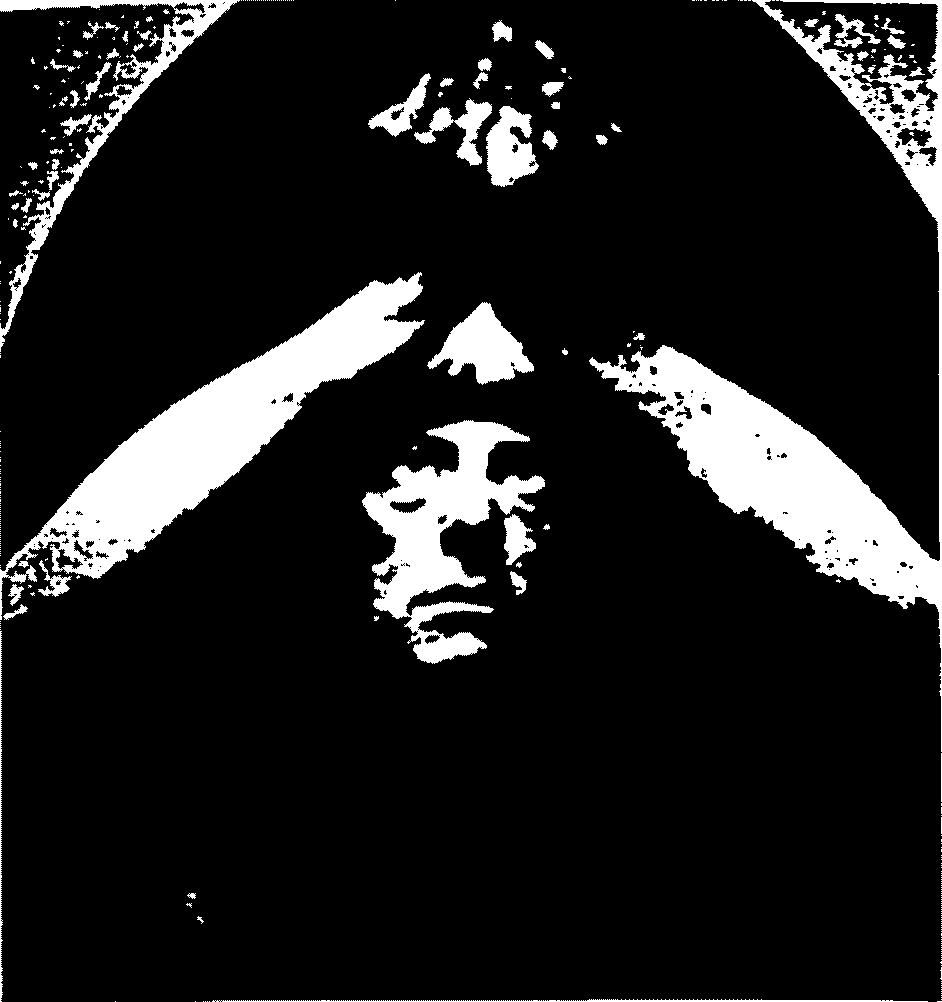
THE MYSTIC ALEISTER CROWLEY in devotional worship.
Throughout all of these grades, it must be remembered. inner processes are working which often seem distinct from the exact requirements of the formal system. We have not discussed these even where that would have seemed possible, because they are. ultimately, individual to each person. These inner, alchemical processes, arranged and fueled by the Holy Guardian Angel, provide that which is truly needed by the aspirant. What a formal system such as A.’.A.-. provides, in addition to the specific training that is visible on the surface, is a “containment vessel" for the alchemical work that is underway. The Order and its requirements must be strong enough, invariable and unwavering enough, that they form an enduring and secure matrix within which the gestating Adept can develop, and against the limits of w'hich she can struggle. In this sense, the definitions of the A.’.A.’, system must be maintained firmly, almost arbitrarily. On the other hand, the very' reason for this is that the system is ultimately elastic where it needs to be, recognizing that the Path of the Great Work is as individual and unique for each person as are fingerprints or the formation patterns of snow’flakes.
The Philosophus Grade is the final grade of the Outer College. This kindles certain inner recognitions in those who hold this grade: certain patterns appear complete, fulfilled. It is clear that Fratres O.M. and D.D.S. recognized a singular quality of this grade and its position in the system as a
whole. They were, perhaps, reminded of the final w'ords each of them heard during the ceremony of his own advancement to the analogous Philosophus Grade of the Hermetic Order of the Golden Dawn;
Honored Frater. as a member of this important Grade. . . you are furthermore expected, as having risen so high m the Order, to. . . study thoroughly the mysteries which have been unfolded to your view, in your progress from the humble position of a Neophyte, so that yours may be not the merely superficial know ledge which marks the conceited and ignorant man; but that you max really and thoroughly understand what you profess to know, and not by your ignorance and folly bring disgrace on that Order which has honored you so far. Your duty is also. . . to make yourself as far as possible an omament alike to your Temple and to your Order.
BHAKTI YOGA
He shall pass examinations in Liber CLXXV. (Liber 185)
Instruction and Examination in Methods of Meditation bv Devotion (Bhakti-Yoga). (Liber 13)
Not only is the Philosophus tested in Devotion so far as the Order goes; she is also assigned, as a task central to this grade, to undertake that form of yoga, or magick, which has devotion as the core of its operation.
To define Bhakti Yoga as “Methods of Meditation by Devotion" is to paint a pale picture of a vivid and majestic landscape. Netzach is associated with Fire as well as with Venus; and, far from being the placid affection we often have heard described. Bhakti Yoga is a fiery devotion to the Divine - generally in the “person” of a particular deity whom one can regard as one’s personal “Lord" or “Lady." Swami Vivekananda3 quoted Narada as explaining. "Bhakti is intense love for God.” Nor is this passionate devotion for the timid. Vivekananda continues:
The. . . means to the attainment of Bhakti-Yoga is strength. “The Atman is not to be at
3 Bhakti-Yoga by Swami Vivekananda. We give our highest recommendations for this text, to supplement the specific instructions in Bhakti Yoga published by the Ac. A.-..
tained by the weak,” says the Sruti. Both the r physical and the mental weaknesses are re-ferrcd to in the above text. “The strong and the hardy,” are the only fit students of religion.
To which The Book of the Law responds, “Wisdom says: be strong! Then canst thou bear more joy”; and, “The Sun, Strength & Sight, Light; these are for the servants of the Star & the Snake”; and, “Beauty and strength, leaping laughter and delicious languor, force and fire are of us.”
The official A .-.A.*, instruction in Bhakti Yoga is Liber 175. called Liber Astarte v'el Beryllt - The Book of Astarte, or The Book of the Beryl. It describes methods of union with the Divine by love, by devotion. Unlike exclusively Eastern texts on the matter, it allows for the ready incorporation of the aspirant’s considerable skill and capacity in ceremonial magick. The Philosophus is to undertake the work of Liber Astarte.
Additionally, Eliphas Levi's most mature work. The Key of the Mysteries (his thesis for the Grade of Adeptus Exemptus. 7°=4a), is prescribed as a further aid in the attainment of Bhakti-Yoga. Its singular message is simple: The ’Key of the Mysteries’ is love.
Unpublished instructions by Crowley confirm that the Philosophus is only required to pass examination in methods, not in results, of Bhakti Yoga. True, results likely will ensue if method is correct;4 but the perfection of this practice of “Union by Devotion" is not required until a much higher grade. (See Chapter 11.)
It perhaps need not be added that Bhakti Yoga is one of the most effective methods for awakening to the Briatic consciousness.
CONTROL OF ACTION
Instruction and Examination in Control of Action. (Liber 13/
He shall moreover attain complete success in Liber 111. Cap. 11. (Liber 185)
Liber Jugorum was discussed at length in the previous chapter, with reference to the Practicus’
" Method must include fervor. There is nothing dry or mechanical about this moving, loving practice. It is hard to imagine. therefore, that desirable results would not occur with correct practice. Nonetheless, no amount of technique will prevail without a genuine giving up of oneself to the act.
. assigned task of acquiring “control of speech.” Similarly, the Philosophus is required to build the same vigilance and control over her actions.
Readers are referred back to the remarks on Liber Jugorum in the Practicus chapter. The same remarks apply to the Task of the Philosophus.
CONSTRUCTING THE MAGICK WAND
Furthermore, he shall construct the magic Wand, according to the instruction in Liber A. (Liber 185)
Further, he cuts the Magic Wand. (Liber 13)
The Wand, or Baculum, is the magical implement attributed to the element of Fire. As such, it is the characteristic implement of the Philosophus. (The magician may use many different wands. This one is specifically a Fire Wand.) The instruction from Liber A is as follows:
Let the Philosophus take a rod of copper, of length eight inches and diameter half an inch.
Let him fashion about the top a triple flame of gold.
Let him by his understanding and ingenium devise a Deed to represent the Universe.
Let his Dominus Liminis approve thereof.
Let the Philosophus perform the same in such a way that the Baculum may be partaker therein.
Let it when finished be consecrated as he hath skill to perform, and kept wrapped in silk of fiery scarlet.
For this grade, a synthesis of the magician’s understanding of reality is formulated not as a symbol or word or number, but as a Deed to represent the Universe; and this Deed must be one that the Philosophus performs, incorporating the Wand - the Will - into the performance. Will becomes translated into Deed.
This is the fourth and final of the traditional magical implements; but there is one other, a fifth, known to the Dominus Liminis, which provides the Light whereby the magician can see to wield the four.
THE MYSTIC ALEISTER CROWLEY in devotional worship.
Throughout all of these grades, it must be remembered. inner processes are working which often seem distinct from the exact requirements of the formal system. We have not discussed these even where that w'ould have seemed possible, because they are. ultimately, individual to each person. These inner, alchemical processes, arranged and fueled by the Holy Guardian Angel, provide that which is truly needed by the aspirant. What a formal system such as A .-.A.-, provides, in addition to the specific training that is visible on the surface, is a “containment vessel” for the alchemical work that is underway. The Order and its requirements must be strong enough, invariable and unwavering enough, that they form an enduring and secure matrix within which the gestating Adept can develop, and against the limits of which she can struggle. In this sense, the definitions of the A/.A.-, system must be maintained firmly, almost arbitrarily. On the other hand, the very reason for this is that the system is ultimately elastic where it needs to be, recognizing that the Path of the Great Work is as individual and unique for each person as are fingerprints or the formation patterns of snow-flakes.
The Philosophus Grade is the final grade of the Outer College. This kindles certain inner recognitions in those w ho hold this grade: certain patterns appear complete, fulfilled. It is clear that Fratres O.M. and D.D.S. recognized a singular quality of this grade and its position in the system as a
whole. They were, perhaps, reminded of the final words each of them heard during the ceremony of his own advancement to the analogous Philosophus Grade of the Hermetic Order of the Golden Dawn:
Honored Frater. as a member of this important Grade. . . you are furthermore expected, as having risen so high in the Order, to. . . study thoroughly the mysteries which have been unfolded to your view, in your progress from the humble position of a Neophyte, so that yours may be not the merely superficial know ledge which marks the conceited and ignorant man: but that you may really and thoroughly understand what you profess to know, and not by your ignorance and folly bring disgrace on that Order which has honored you so far. Your duty is also. . . to make yourself as far as possible an ornament alike to your Temple and to your Order.
BHAKTI YOGA
He shall pass examinations in Liber CLXXV. (Liber 185)
Instruction and Examination in Methods of Meditation bv Devotion (Bhakti-Yoea). (Liber 13) ' ~
Not only is the Philosophus tested in Devotion so far as the Order goes: she is also assigned, as a task central to this grade, to undertake that form of yoga, or magick, which has devotion as the core of its operation.
To define Bhakti Yoga as “Methods of Meditation by Devotion” is to paint a pale picture of a vivid and majestic landscape. Netzach is associated with Fire as well as with Venus; and, far from being the placid affection we often have heard described. Bhakti Yoga is a fiery' devotion to the Divine - generally in the “person” of a particular deity whom one can regard as one’s personal “Lord" or “Lady." Swami Vivekananda* quoted Narada as explaining, “Bhakti is intense love for God.” Nor is this passionate devotion for the timid. Vivekananda continues:
The. . . means to the attainment of BhaktiYoga is strength. “The Atman is not to be at-
■ Bhakii-Yoga by Swami Vivekananda. We give our highest recommendations for this text, to supplement the specific instructions in Bhakti Yoga published by the A.1. A.’..
EVOCATION & TALISMANS The Path of A’avin
He shall pass examinations. . . in Construction and Consecration of Talismans and in Evocation. Yet in this matter he shall be his own judge. (Liber 185)
Instruction and Examination in Construction and Consecration of Talismans, and in Evocation. Theoretical and Practical. (Liber 13)
V The Sabbath of the Adepts. Liber CCCLXX. (Liber Viarum Vice)
Two aspects of traditional ceremonial magick must be mastered at this point: evocation, and the construction and consecration of talismans.
Some experience along these lines probably was acquired long before. The Z 2 adaptations of the Neophyte Formula, studied and practiced in the l°=10D Grade, begin with techniques of evocation and the consecration of talismans.
“A talisman.’- Crowley wrote in Magick Without Tears, “is a storehouse of some particular kind of energy, the kind that is needed to accomplish the task for which you have constructed it.” In Magick in Theory & Practice he defined it more simply as, “something upon which an act of will (that is, of Magick) has been performed in order to fit it for a purpose.” Most broadly speaking, any object at all may serve as a talisman, and the aspirant will likely need to understand it in this light. However, in the classical sense it has a more particular application, referring to specific “objects of power” created according to known formulae to be optimally suited to receive their charge. Examples of these, in different forms, can be found in the Lesser and Greater Keys of Solomon, and the writings of Agrippa, Barrett, Levi, and others.
Evocation is more difficult to define simply, because conflicting definitions are proffered by diverse reputable authorities. In simple terms, this is the classical method of commerce with that class of nonmaterial beings commonly titled “demons” or “spirits.” Some hold that these “spirits” are objective, distinct beings. Others side with Crowley’s view at the time he edited The Lesser Key of Solomon, that, “The spirits of the Goeiia are portions of the human brain.” Still others, more familiar with later psychologies, credit them as semi-autonomous aspects of subconsciousness. We do not undertake to resolve these differences
in the present place. What can be said with general agreement is that the “spirits” in question are "elementals" in the pure sense of the word, i.e., constituent parts of a microcosm. They are evoked - called forth, or called out of oneself - whereas Divine and Archangelic beings are invoked, or called into oneself, to fill oneself. These elementary spirits are native to the densest parts of Yetzirah. verging on physical manifestation, so that they are favored by magicians who aspire to have direct magical impact on physical phenomena.
From the quotations heading this section, we know that the examination is both theoretical and practical. The magician not only must know how to make and create talismans, and how to evoke spirits, but actually must do so. However, consistent with the greater reliance that is placed on the Philosophus* inner guidance, she is herself the judge as to her success in this.
One Star in Sight gives the standards that are to be used in evaluating success:
The power to make and “charge” talismans is tested as if they were scientific instruments of precision, as they are... in evocation, the spirit called forth must be at least as visible and tangible as the heaviest vapours.
There are no official A/.A.-, instructions specifically devoted to these topics. The Philosophus will need to consult traditional magical literature. However, in addition to the important methods of the Neophyte Formula, there are a few useful guidelines in the official instructions.
For example, a technical discussion of various methods of evocation is given in Magick in Theory <£ Practice, Cap. IL A discussion of talismans can be found in the same work. Cap. XVI, Part II, Sec. V. and in Magick Without Tears, Letter 20. One specialized evocation method is taught in the Class B Document Liber 24, De Nuptiis Secrelis Deor-um cum Hominibus. An elaborate example of ceremonial evocation by Crowley is given as The Evocation of Bartzabal in The Equinox No. 9.

MEDITATION: MAHASATIPATTHANA
The Path of Nun
Further, he shall apply himself to study and practice the meditations given in Liber V. (Liber 185)
He is given a meditation-practice on the Senses, and the Sheaths of the Self, and the Practice called Mahasatipatthana. (See The Sword of Song, Science and Buddhism). (Liber 13)
2 The Preparation of the Corpse for the Tomb. Liber XXV. (Liber Viarum Vice)
Although the citations above are a little obscure, it is absolutely clear what practice is being assigned. The method is called Mahasatipatthana. It is a structured application of Buddhist methods of “mindfulness,” applied to such body phenomena as breathing and walking.
The reference to Liber 5, or Liber 25, is confusing. Crowley eventually gave the number 5 (V) to a ritual called Liber Reguli. He also gave the number 25 (XXV) to his revised form of the Pentagram Ritual. The Star Ruby. Yet. years earlier, one or the other of these numbers was applied to what he expected would be an official instruction on a meditation involving the five senses.
Therefore, Liber 5. in this instance, is the essay Science & Buddhism, which can be found in Crowley’s Collected Works. Similarly. Liber Viarum Vice is speaking of the same document and the same practice when it assigns to the Path of Nun, "The Preparation of the Corpse for the Tomb. Liber XXV.”
Here is the entire text of the instruction for this meditation, from Science & Buddhism.'
This meditation differs fundamentally from the usual Hindu methods by the fact that the mind is not restrained to the contemplation of a single object, and there is no interference with the natural functions of the body as there is. e.g.. in Pranayama. It is essentially an observation-practice. which later assumes an analytic aspect in regard to the question. “What is it that is really observed?”
The Ego-idea is resolutely excluded from the start. . . The breathing, motions of walking, &c.. are merely observed and recorded; for instance. one may sit down quietly and say:
5 Collected Works. Vol. II. pp. 252ff.
“There is an indrawing of the breath.” “There is an expiration.” &c. Or, walking, “There is a raising of the right foot." and so on. just as it happens. The thought is of course not quick enough to note all the movements or their subtle causes. For example, we cannot describe the complicated muscular contractions. &c.; but this is not necessary. Concentrate on some series of simple movements.
When this through habit becomes intuitive so that the thought is really “There is a raising.” as opposed to “1 raise” .... one may begin to analyse. . . and the second stage is “There is a sensation (Vedana) of a raising. &c.” Sensations are further classed as pleasant or unpleasant.
When this is the true intuitive instantaneous testimony of consciousness (so that “There is a raising. &c.” is rejected as a palpable lie).6 we proceed to Sanna, perception.
“There is a perception of a (pleasant or unpleasant) sensation of a raising. &c.”
When this has become intuitive - why! here’s a strange result! The emotions of pain and pleasure have vanished. They are subincluded in the lesser skandha of Vedana. and Sanna is free from them. And to him who can live in this third stage, and live so for ever, there is no more pain; only an intense interest similar to that which has enabled men of science to watch and note the progress of their own death-agony. Unfortunately the living in such a state is conditional on sound mental health, and terminable by disease or death at any moment. Were it not so, the First Noble Truth would be a lie.
The two further stages Sankhara and Vifi-nanam pursue the analysis to its ultimation. “There is a consciousness of a tendency to perceive the (pleasant or unpleasant) sensation of a raising of a right foot” being the final form. And 1 suppose no psychologist of any standing will quarrel with this.. . Reasoning in fact leads us to this analysis; the Buddhist goes further only so far as he may be said to knock down the scaffolding of reasoning processes, and to assimilate the actual truth of the matter.
It is the difference between the schoolboy who painfully construes “Balbus murum aedi-
6 “Why should you expect Vedana to make Rupa appear illusory?” asked a fnend of mine, on reading through the MS. of this essay. The reason of my omission to explain is that to me it seemed obvious. The fact had been assimilated. To meditate on anything is to perceive its unreal nature. Notably this is so in concentrating on parts of the body, such as the nose. On this phenomenon the Hindus have based their famous aphorism. “That which can be thought is not true." - A.C.
ficavit,” and the Roman who announces that historic fact without a thought of his grammar.
1 have called this meditation the most famous of the Buddhist meditations, because it is stated by the Buddha himself that if one practices it honestly and intelligently a result is certain. And he says this of no other.
This is one of the most effective and extraordinary techniques in the entire canon of A.-.A.*. methods. By itself, it allows for the transition of consciousness from one plane to the next. By the act of observing a phenomenon, you actually gain objectivity’ on the phenomenon, which means you begin to witness from a point of view exterior to it. You “kick yourself up a plane" from the one you are observing.
The layers, or planes, that emerge successively in this meditation are the Buddhist skandas. or characteristic-layers. From outermost inward, these are nama-rupa, literally the name and form of the object itself; vedana, sensation; sahna, perception; samskara, ’tendency’ or karma-based ha-bituations; and vinnanam. consciousness itself.
This method of “mindfulness" will be helpful to us in describing, in the next chapter, certain practices assigned to the Dominus Ltminis.
RISING ON THE PLANES
The Path of Samekh
He shall show some acquaintance with and experience of Liber O. Caps. V. V], Whereof his Record shall be witness. (Liber 185)
Examination in Rising on the Planes (Liber
O. caps. V, VI). Practical. (Liber 13)
C Skrying in the Spirit Vision. ’The Ladder of Jacob.’ LiberO. (Liber Via rum Via-/
The technique of Rising on the Planes is described in Liber O, Caps. V and VI. A further discussion on the method is given in Magick in Theory & Practice, Cap. XV111, Sec. 111.
As stated in the quotations above, the examination in this method is practical; that is. one must not merely study it. but must do it! The Philosophus' record is used to witness her practical experience. and as the basis of passing her.
As with so many of the Philosophus methods, this is a technique that directly bridges the planes
Or. ai least, there is a consciousness of a tendency to perceive the existence of an idea that this is so.
between Yetzirah and Briah. The aspirant is approaching very close to the Veil that separates the First Order from the Second; that is. she is approaching very close to Tiphereth. In some ways. Rising on the Planes (using the Middle Pillar of the Tree of Life as one’s basis, rather than a particular sephirah) is the whole of the Great Work, embodying within itself, when successful, a direct transition between the Four Worlds.
CLASS C DOCUMENTS & THE
PHILOSOPHUS SYLLABUS
In the catalog of official A.*.A.*, instructions. Class C consists of matter that is to be reearded rather as suggestive than anything else. Plays, poetic works, and allegory' constitute the majority of these instructions.
Although Class C documents per se are not assigned to the Philosophus Grade, several of them are found on the Philosophus Syllabus. These include. The Chymical Jousting of Brother Perar-dua: The Sword of Song: Across the Gulf: The High History of Good Sir Palamedes the Saracen Knight and of his following of the Questing Beast: Aha!: and Adonis. These works apparently are intended to fulfill the expectation that the Philosophus study philosophy. Most of them map, allegorically. the course of the Great Work.
OTHER TASKS OF THE PHILOSOPHUS
As usual, there is a memorization assignment from the Thelemic Holy Books. As stated in Liber 185, the Philosophus is to commit to memory one of the seven chapters of Liber 813. This is Liber Ararita. w hich is also given the number 570.
813 is the value of the Hebrew notariqon Ararita (KiTYKYK). The seven words of which it is the abbreviation are:
’nN Ehad One.
URY |
rosh |
the Beginning of |
irmnR |
ahe 'dutho |
His Unity [One-ness |
'□RY |
rosh |
the Beginning of |
iDTiiri* |
yihudutho |
His Uniqueness, |
iminn |
I muratho |
His Permutation |
yhk |
ehad |
One |
The number 570 is part of the actual title of Liber Ararita sub figura DLXX. and apparently was “channeled” along with the rest of the Holy Book. It is of no apparent Qabalistic significance unless we consult the Latin Qabalah Simplex (which was unknown to Crowley), where it is found to be the value of the phrase. Visita hite-riora Terrce Reclificando Invenies Occullum Lapi~ dem (“Visit the interior of the earth, by rectification thou shall find the Hidden Stone.") The initials of this latter sentence form the important alchemical notariqon VITRIOL. This is a striking correspondence. Both ARARITA and VITRIOL are seven-letter notariqons of similar alchemical import. In his notes on The Vision & the Voice. Crowley described Liber Ararita as follows:
The use of this Name and Formula is to equate and identify every idea with its opposite; thus being released from the obsession of thinking any one of them as "true" (and therefore binding). one can withdraw oneself from the whole sphere of the Ruach. [. . .] Contrast each \erse in Cap. I with the corresponding verse of Cap. II for the first of these methods. Thus in Cap. HI (still verse by verse correspondence), the Quintessence of the ideas is extracted: and in Cap. IV they are withdrawn each one into the one beyond it. In Cap. V they have disap
peared into the Method itself. In Cap. VI they reappear in the Form appointed by the Will of the Adept. Lastly, in Cap. VII they are dissolved, one into the next until all finally disappear in the Fire Qadosh. the Quintessence of Reality.
“Besides all this," we read in Liber 185. "he shall make constant and profound reflections upon the Path." This is a habit that likely will have evolved much earlier than Philosophus, but is especially called for here.
ADVANCEMENT TO DOMINUS LIMINIS
Authority grants advancement from Philosophus to Dominus Liminis when the Task of the Philosophus has been satisfactorily completed. As with the preceding grade, there is no minimum time and no ritual of advancement.
“When the title of Dominus Liminis is conferred upon him.” Liber 185 counsels, “let him rejoice exceedingly therein: but beware, for that it is but the false veil of the moon that hangs beneath the Sun."

Chapter 7

OMINL’S
jLlMINIS

RADE
HE Great Work, for the Dominus Liminis. Jlis defined as. "to obtain control of the aspi-^rations of my own being."
Dominus Liminis is a grade of aspiration. It is attributed to no sephirah on the Tree of Life. It would be accurate, however, to attribute it to the Path of Samekh. which opens from the Sphere of the Moon unto the Sphere of the Sun.
We occasionally receive questions as to whether the Dominus Liminis Grade is considered pan of the Outer College (G/.D.-.) or pan of the Inner College (R.-.C/.). Philosophically, this is actually an important question. The best answer is. “both and neither." Technically, the Dominus Liminis Grade remains pan of the Outer College: yet. it is also just as accurate to consider it the probationary phase of the Adeptus Minor Grade, and therefore linked to the Inner College. The Dominus Liminis stands in exactly the same relationship to the Order of the Rosy Cross as does the Probationer with respect to the Order of the Golden Dawn.
This paradox is symbolized on the Dominus Liminis robe. It is still the black robe of the Outer College: yet upon its breast, for the first time, is the symbol of a red five-petaled Rose upon the six-squared Cross of the Elements.
The nature of this “bridge grade" is probably best understood in terms of the analogous Portal Grade of the Hermetic Order of the Golden Dawn. The Portal Ceremony consists of two pans, or “points.’- The First Point is a symbolic summary of the Outer College grades through which the initi
ate already has passed, balancing, equilibrating, and synthesizing the Four Elements into a central unity. Following this, the Second Point is primarily a ritual of the Path of Samekh, dramatizing the direct approach toward the sephirah Tiphereth. Like the Dominus Liminis Grade, it bridges between the Outer and the Inner.
These are, of course, only metaphors of w hat actually is occurring. However, an understanding of this symbolism is occasionally quite helpful to the Dominus Liminis. who may at times feel like a fully equipped ship at sea. yet with no perceptible place to sail. Discovering, without doubt, “where to sail" is pan of her Task.
There is a further reason for regarding the Dominus Liminis as a "Probationer Adeptus Minor." To the Path of Samekh. Qabalists attribute a mode of consciousness called the Intelligence of Probation. Recall, from Chapter 2, that “probation" comes from a root meaning “to prove,” or "to be tried.” One manuscript of the traditional Portal Ceremony comments that the Path of Samekh. “is the prime test, by which the Creator tries the devotion of all who aspire to be worthy of the title, ’Master of Compassion.’ The essence of this trial is the ever present temptation to depart the straight and narrow way of single-hearted devotion to the One." That “One” is, of course, what we term the Holy Guardian Angel.
“Dominus Liminis" is Latin for “Master of the Threshold.” It is synonymous with the Hebrew name of the old Portal Grade, Ba ’al Sha ’ar, “Lord
of the Gate.” 1 In whichever form it appears, this grade name refers to the position of the aspirant immediately upon - not before, but actually upon - the threshold of the Inner College, the Order of the Rosy Cross. As comment on the grade name, we find in Liber 185:
Besides all this, he shall abide upon the Threshold. Let him remember that the word Dominus Liminis is no idle term, but that his mastery will often be disputed, when he knoweth it not.
By Latin Qabalah Simplex, Dominus Liminis enumerates to 162. This is the value of several other phrases that directly refer to the Inner College and the pending initiation of Tiphereth. Among these phrases are the following:
Frater Rosa Rubea. “Brother of the Ruby Rose”
Lumen in Centrum, “The Light in the Center”
Lapidem angulorum. “cornerstone,” a Hermetic metaphor (with Biblical roots) for an Adept
Corpus Christi, lit. “Body of Christ;” the name of the conventional holiday which Mathers’. Second Order employed as its “Day C,” an annual festival intimately related to the Adeptus Minor Grade
Mercurius sum, "lam Mercury”
For completeness, we should mention that this unnumbered grade also is called, historically, Philosophus Major, or 4°=7D Major: however there is no record of these terms actually being used in the A.-.A... The Master Therion did, on occasion, refer to the Dominus Liminis by its other traditional designation, “Lord (or Lady) of the Paths of the Portal of the Vault of the Adepti.”
LIBER MYSTERIORUM
Let him receive Liber Mysteriorum. . . He shall accept an office in a Temple of Initiation, and commit to memory a pan appointed by the Imperator of the A.-.A... (Liber 185/
He receives Liber Mysteriorum and obtains a perfect understanding of the Formulae of Initiation. (Liber 13)
The original A.-.A.-. document called Liber Mysteriorum has not survived under that name into modem times. Many hold that it never existed.* 2 However, there is sufficient evidence for us to identify it. with certainty, as the confidential ritual manual for A.-.A,-. initiation officers.
The title Liber Mysteriorum means “The Book of the Mysteria.” Mysteria is the plural of the Latin word mysterium, which means “secret religion. secret rite or worship, divine mystery;” that is. what the ancient world knew as “the Mysteries,” or formal rites of initiation.
Fortified with this information, it is. thus, self-evident how. upon receiving Liber Mysteriorum, the Dominus Liminis “obtains a perfect understanding of the Formulae of Initiation.” By all indications it is the initiates of this grade (and higher) who are expected to serve as the officers for Neophyte and Zelator initiations.
Accordingly, although no Class A Document is assigned for memorization purposes in this grade, the memorization assignment is of an officer’s role in one of the A.-.A.-. initiation ceremonies, as appointed by the Imperator of the A.-.A.-., Since there is no longer one Imperator for all branches of the A.-.A.-., in this matter the Dominus Liminis shall receive her assignment from the Imperator of her own A.-.A.-. lineage; or, if there be none, then from her Superior who is an Adeptus Minor.
PRATYAHARA & DHARANA: CONTROL OF THOUGHT
He shall pass examination in Liber 111. Cap.
111. (Liber 185/
He is given meditation-practices on the Control of Thought, and is instructed in Raja Yoga. (Liber 13)
Liber Jugorum was discussed in the Practicus chapter, with reference to the task of acquiring “control of speech.” The Philosophus similarly undertook to gain “control of actions.” The Domi-
Limen means “threshold, doorway. entrance, portal.” etc.
Dominus means “Lord” or "Master.”
: It must not be confused with the John Dee diary titled Liber Mysiertorum, though this may have been - and probably was - the source of the title.
nus Liminis is required to build the same vigilance and control over her thoughts.1
This “control of thought,” the main theme of Raja-Yoga, takes a particular form. One Star in Sight explains that the Dominus Liminis “Is expected to show mastery of Pratyahara and Dharana.”* * * 4
Dharana is simple concentration. It is described in Liber E, and practiced from the Probationer Grade onward. A significant measure of success in dharana is prerequisite to certain practices assigned to the Practicus and Philosophus.5 *
Pratyahara takes this a big step further. However. it has been defined variously and ambiguously.' As Frater Perdurabo wrote in Book Four. Part 1. Cap. 4:
The word is used by different authors in different senses. The same word is employed to designate both the practice and the result. It means for our present purpose a process rather strategical than practical: it is introspection, a sort of general examination of the contents of the mind which we wish to control: Asana having been mastered, all immediate exciting causes have been removed, and we are free to think what we are thinking about.. .
... we must consider what is meant by success in Pratyahara. This is a very extensive subject, and different authors take widely divergent views. . . However, the main point is to acquire some sort of inhibitory power over the thoughts.
From a practical point of view. we would describe pratyahara as “mindfulness of mind." The
Philosophus who has mastered the method of Ma-hasatipatthana will understand entirely what we mean by this, and will be well prepared to undertake it. But this does not mean that it is suddenly easy! Heisenberg’s principle of uncertainty or indeterminacy applies no place better than in the observation of the contents of the mind. It is. hopefully, self-evident that it is impossible to make any observations about the contents of one's mind without instantly altering the observed phenomenon. Nonetheless, one must try . And in the trying, and in the accomplishment thereof, there will come the success which the Dominus Liminis seeks.
We have yet to make clear, however, what level constitutes success in pratyahara. Frater Perdurabo discussed this at the end of the same chapter of Book Four:
In some people this inhibitory power may flower suddenly in very much the same way as occurred with Asana. Quite without any relaxation of vigilance, the mind will suddenly be stilled. There will be a marvelous feeling of peace and rest, quite different from the lethargic feeling w’hich is produced by over-eating.
It is difficult to say w hether so definite a result would come to all. or even to most people. The matter is one of no very great importance. If you have acquired the power of checking the rise of thoughts7 you may proceed to the next stage [emphasis added}.
EQUILIBRIUM OF KNOWLEDGE & POWER
’ Therefore, the rumors are true that the A.’.A.'. practices
"thought control." What differentiates this system of training
from certain others, however. is that you are expected to learn to control your own thoughts, not those of your students.
4 In addition to Liber E. these yoga practices are discussed at length m.Book Four. Pan 1. and in Eight Lectures on Yoga.
■ In Raja Yoga, dharana. dhyana. and samadhi are three stages
collectively called samyama. Dharana is the method that eventuates in the other two. Also, pratyahara is generally given as an earlier stage than dharana. This is the result of varying classical definitions; that is. there is a vast difference between simple introspection and the arresting of thought'
** Literally, the word is probably best translated as “withdrawing" or “holding back" (of the thought); from prati, “back.” -* hrra. “to hold.” This does not. however, do full justice to the actual method.
He shall meditate on the diverse knowledge and Power that he has acquired, and harmonize it perfectly. And in this matter shall he be judged by the Praemonstrator of the A .•.A.’..
(Liber 185)
This grade is one of equilibration. All four elements having been mastered - all parts of the puzzle having been placed on the table - the Dominus Liminis now- must bring them into proportion with each other.
At the time that Jones and Crowley passed through the old Portal ceremony of the Hermetic
' Liber Turris, issued in poor grades, is the chief instruction in this.
Order of the Golden Dawn, it included the following admonishment, as part of a comment on Atu XIV, “Temperance”:
Let this remind you once more that only in and by the reconciliation of opposing forces is the pathway made to true occult knowledge and practical power.
The balance that the Dominus Liminis must reach involves not only knowledge and power, but all “opposing forces.” What is sought here is nothing less than a balancing and integration of all the forces within the magician’s personality, a harmonious synthesis of all that she is.
Inasmuch as there is no longer one Praemon-strator for all branches of the A .-.A.-., in this matter the Dominus Liminis is to be judged by the Praemonstrator of her own lineage; or. if there be none, then by her Superior, who is an Adeptus Minor.
LIGHTING THE MAGICK LAMP

THE MAGICAL LAMP
as conceived by Eliphas Levi, here shown with wand, sword, and crescent-handled dagger.
. . . he shall construct the magic Lamp, according to the instruction in Liber A. (Liber 185)
Further, he lights the Magic Lamp. (Liber 13)
Whereas the Pantacle. Dagger. Cup. and Wand correspond to the four arms of the Elemental Cross, there is also a fifth, quintessential point of Spirit, which transforms this Cross into a Pentagram. It is the unity that transcends their diversity. As it is written in Liber Legis, Cap. 11. v. 49:
This is of the 4: there is a fifth who is invisible. & therein am I as a babe in an egg.
To this fifth point is attributed the magician’s Lamp. Liber A provides the following instruction:
Let the Dominus Liminis take pure lead. tin. and quicksilver, with platinum, and. if need be. glass.
Let him by his understanding and ingenium devise a Magick Lamp that shall bum without wick or oil. being fed by the Aethyr.
This shall he accomplish secretly and apart, without asking the advice or approval of his Adeptus Minor.
Let the Dominus Liminis keep it when consecrated in the secret chamber of Art.
This then is that which is written: "Being furnished with complete armour and armed, he is similar to the goddess.”
And again. ”1 am armed. I am armed.”
As this is to be accomplished “without asking the advice or approval” of even the Dominus Liminis’ Superior in the Order, we will not comment further on this assignment.
CONTROL OF INTUITION
He shall in every way establish perfect control of his intuition, according to the advice of his Adeptus Minor, for that the ordeal of advancement is no light one. (Liber 185)
This assignment will be clear enough; and the Dominus Liminis is otherwise to consult the Adeptus Minor who is her Superior.
LUMEN IN CENTRUM
Perhaps it will have become apparent by now that all of these tasks are essentially the same One Task.
The Dominus Liminis. we have seen, is required
-
• to "abide upon the Threshold."
-
• to obtain control of the aspirations of her being.
-
• to control the flow of her thoughts.
-
• to harmonize the unreconciled forces within herself.
-
• to control her intuition, and
-
• to light the Magick Lamp.
Within their seeming diversity, these tasks display a unity.
But I have burnt within thee as a pure flame without oil. In the midnight 1 was brighter than the moon; in the daytime 1 exceeded utterly the sun; in the byways of thy being J flamed, and dispelled the illusion?
By her practices of magical and mystical art. therefore, let the Dominus Liminis find this unity: yea. let her find the Unity.
THE DOMINUS LIMINIS SYLLABUS
According to the A .'.A .’. Curriculum given in The Equinox. Vol. Ill, No. 1. the Dominus Liminis is to be examined in certain instructions including Liber Legis. The Wake World. John St. John. Liber 8. Liber NV Liber HAD. and Liber IOD.
Two points are of special interest about this curriculum.
First, the explanation given for their assignment is that they are "specially adapted to facilitate the Task proper to the Grade of Adeptus Minor. the Attainment of Raja-Yoga and of the Know ledge and Conversation of the Holy Guardian Angel.This is unique among the grade syllabi. In all other cases, the assigned materials pertain to the grade for w hich the work is assigned.
Second, a number of papers appear for the first time on the Dominus Liminis syllabus. Recall that
* Liber Cordis Cincti Serpente. Cap. V. v. 9.
the Probationer syllabus contained most of the fundamental instructions through Philosophus. but not including the Dominus Liminis material. Although the assiduous student likely will have encountered all of these instructions before, not one of them (except for Liber Legis and Liber Ar-morum) was assigned in any previous grade.
Liber 8 is derived from the Cry of the 8,h /Ethyr from The Vision <£■ the Voice. It will be discussed more extensively in the next chapter, and is reproduced in Appendix G.
Liber .VI' and Liber H A D are practical instructions based on the first two chapters of Liber Legis. We heartily recommend these wonderful instructions to anyone. Something of particular interest in each of them concerns the imprimatur page: Both Liber AL and Liber HAD are labeled. "For the Winners of Ordeal X," referring to a passage in Liber Legis. Cap. 111. v. 22. where Heru-Ra-Ha is represented as saying.
1 am the visible object of worship; the others are secret; for the Beast & his Bride are they, and for the w inners of the Ordeal x. What is this0 Thou shalt know.
Thelemttes have debated the exact meaning of this passage for decades: nor do we propose an absolute interpretation at this point. Nonetheless, the phrase "Ordeal x" has usually been interpreted as hinting at O X. i.e., the various meanings applied to the symbolic union of a Circle and Cross (especially as ® or t). Among other things, this is a well-known equivalent for the symbol of the Rosy Cross. Inasmuch as Liber NV and Liber HAD are first officially issued in the A/.A.’. to the Dominus Liminis - and that as an aid in undertaking the work of an Adeptus Minor - G.*.H.’. Frater O.M. very likely w-as interpreting the “Winners of the Ordeal X” as those who had gained authentic admission to the Order of the Rosy Cross.
Liber IOD contains a series of practices, both of magick and of yoga, for bringing all things together to a single point: that is. of "reducing the manifold consciousness to the unity." according to the Curriculum.
Liber A 'ash vel Capricorni Pneumatici is a Class A Document, included here because of a colophon which appeared with it in The Equinox, No. 6. referring the book to this present grade.
ADVANCEMENT TO
ADEPTUS MINOR
Advancement from the Grade of Dominus Liminis to the Adeptus Minor Grade is granted, by authority, when the Task of the Dominus Liminis has been satisfactorily completed. There is no minimum or maximum time in the grade per se. However, according to Liber 185, the Dominus Liminis must wail until at least six months after admission to this grade before he may "go to his Adeptus Minor, pass the necessary tests, and repeat to him his appointed pan in the Temple of Initiation.”9
The advancement we are discussing here is to the subgrade called Adeptus Minor Without, the first grade of the Inner College, the Order of the Rosy Cross. It is from the platform of that new grade that the aspirant will undertake to complete the Great Work of attaining to the Knowledge and Conversation of the Holy Guardian Angel.
Liber 185 puts this long-sought, hard-earned, joyous step into perspective: "When at last he hath attained to the grade of Adeptus Minor, let him humble himself exceedingly.”


FRANK BENNETT
V.-.H.-. Frater "fix
“G.H. Frater AHAH 6C=5C R.R. et A.C. is the humblest
of the Brethren of the Order. He has worked with his hands since he was nine years old and he understands and loves the Law and its Logos as a child does its mother and father. He has my respect and affection as no other of my Brethren: for he represents to me mankind incarnate at its weakest (and therefore strongest) and noblest (and therefore most ’common’). He is, in a word, that ’Man’ of whom I am, being 666 (the number of a man) and whom I love and serve. An illuminating incident: he cannot spell, but under inspiration writes as none has ever done save one — John Bunyan!"
— Aleister Crowley
The Confessions of Aleister Crowley, Cap. 81
’ The records of Frank Benneit. variously known in the A.'.A.', as Fra. Sapientia Amor Potentia. Fra. Progradior. Fra. 176. and V.-.H.’. Fra. Ahah (7“K). demonstrate that Crowley, as Imperator. could waive this six month rule, at least under some circumstances. But Brother Bennett was an unusual case. Crowley wrote of him, in his Confessions, that. "My success with him is enough to wipe out a dozen failures and more." Living in Australia during World War I. Bennett was out of direct communication with his Superior (Frater Achad. residing in Canada) for nearly a decade. As a result of this, he fulfilled many of the conditions of the grades 2C=9C through 5C=6“ before he was ever formally passed to the lc= 10^ Grade in February' 1920 ex Therefore, when he resided with Crowley for several months in 1921 e.v.. at the Abbey of Thelema in Cefalii. he was able to make unusually good use of the time. Accordingly. Crowley advanced Fra. Progradior to Zelator in July, soon after his arrival: and to Practicus. Philosophus. Dominus Liminis. and Adeptus Minor by the end of October, based on work actually done. Crowley later identified Bennett as a 6C=5C. indicating further advancement beyond what was accomplished at Cefaiu. A footnote in The Confessions of Aleister Crowley. Cap. 81. is a moving, if brief, testimonial to this Adept.
Ordo R.\C.\
THALIA
Solar-serpent caressing my heart.
Tongue of inspiration darting teasingly and pleasingly within the expanding vault of my soul,
unsealing its warded mysteries from behind their brazen plaque.
My passion rises from timorous flame to surging solar fury until, head flung back, my sweat-soaked mane tossed madly about in concert with the thrashing rhythm of my rider,
1 surrender to the blinding shaft of insupportable splendor. That floods me. slays me, flays, betrays me
with its resurgent venomous coruscations.
My mind reeling in the intoxication of this madness. The grape's royal blood infuses veins made void of corpuscular life.
Wine blazes through my soul, its moist fire spreading from my center, outward, to poison every cell every memory every dream
With the ineradicable kiss, imprint, and seal of this muse
whose elixir of inspiration unleashes me, whose Genius releases me,
Pregnant with Life unguessed.
Chapter 8: (5°=6D)
The /I
DE PTE’S
71
iWlNOR
CjRADE (WITHOUT)

HE Great Work, for the Adeptus Minor, is “to attain to the knowledge and conversation of the Holy Guardian Angel." As an examination of Liber 185 and Liber 13 will show, this is the sole task of the junior Adeptus Minor, the Adeptus Minor Without.
Truly, this is the definition of the Great Work for every' man and every' woman from the beginning of their journey on the mystical path. Now, however, the preliminaries are over. Now the tools are all in hand. Skills have been acquired, wonders have been witnessed, magical adventures have been experienced, all part of the sometimes beautiful. sometimes horrific passage through one’s own Inner Kingdom, safari for one’s own hidden Beast, expedition up one’s own Mystic Mountain, trek to one’s own distant Star. This is the only voyage, the one true adventure. It is nearly always represented as a journey, because the Fifth Power of the Sphinx, the power of Spirit, the power of a god who Know's. Wills. Dares, and is Silent, is the power To Go.
THE DOVE & THE ROSE
The Latin word adeptus is the past participle of adipiscor, “to reach, get. attain, win.” An adeptus is “one w ho has attained."
Adeptus enumerates to 78 by the Latin Qabalah Simplex. This is a number of great sanctity. It is the total number of arcana in the full Tarot pack, representing thereby the consummate Qabalistic model of the universe. It is the value of the Latin word iibertas. “liberty:’’ and an Adept is certainly one who has gained freedom. In Hebrew it is the
value of mezla (K^tD). the influence from Kether, which is the First Matter of creation; of Hekel Ahabah (“DDR “Temple (or Palace) of
Love;” of chanok (“20), "to initiate." the name we know as Enoch: and of both lekhem (DO1?), “bread.” and melakh (O^Q). “salt." the two halves of the Eucharist of Substance.
The complete title. Adeptus Minor, simply means “lesser adept.” It is a comparative, contrasting w ith the name of the grade that follow s, that of the "greater adept." Yet. Adeptus Minor enumerates to 139. This is identical with the value of Ip-sissimus, the title of the 10°=lD Grade, attributed to Kether! Ipsissimus means, “he that is most himself.” At its own (lesser) level, the accomplishment of the Adeptus Minor seems deserving of this description as well.1 In any case, the "center” or “self attained by the initiate of Tiphereth is a reflection of Kether on this lesser plane.
The number 139 is also the value of the Latin phrases custos rosa?, “guardian of the rose,”2 and stat veritas, “truth endures." both of which have clear relevance to the Adeptus Minor Grade. Finally. in Greek, it is the value of ij nt At to. “the dove," a symbol of mystical revelation, of grace, of love, of that Divine Seed which fertilizes the
1 As Tiphereth has been called "the Sun of the Soul.’’ Kether may be considered "the Sun behind the Sun" Kether is represented as the ultimate "center of Self;" yet to one who is not yet a full adept. Tiphereth is rightly regarded as the "heart" of the self, the “center" toward which the aspirant journeys. Either is beyond the limits of reason to define. The metaphors applied to each scarcely differ from those of the other except as to arbitrary distinctions of magnitude or finality.
* This is a technical term within the Temple of Thelema.
prepared Virgin, of “the Holy Ghost” - in short, of all that descends the 13th Path of Gimel, 1. from Kether unto Tiphereth.
We should mention that the Mystic Title of the 5°=6° Grade is Hodos Chamelionis, “Path of the Chameleon." This refers not only to the mystical phenomenon called (among other things) the “Path of the Rainbow." but also to the basic Rosicrucian policy of blending into one's surroundings and conforming to the customs and practices of a place. Camouflage can be the Adept's best friend! As Liber Legis states it.
Yet there are masked ones my servants: it may be that yonder beggar is a King. A King may choose his garment as he will: there is no certain test: but a beggar cannot hide his poverty.’’
As a formality, the Adeptus Minor is addressed as “Very' Honored Frater" or "Very' Honored So-ror."
THE ADEPTUS MINOR INITIATION
Advancement to the junior Adeptus Minor Grade is a matter of reading the task and subscribing to its oath. Thereafter, the Adeptus Minor initiation is a process of self-initiation. It must be so. in a way that does not apply to any prior grade; for the further initiation of the Adept, to the Grade of Adeptus Minor Within, is identical with the attainment of the Know ledge and Conversation of the Holy Guardian Angel.
In the original plan of the A.*. A.-. system, a formal 5C=6D initiation ceremony was contemplated. This was later changed.
As was explained in Chapter 4. the 5=6 (Zelator Adeptus Minor) ceremony of the old Order was adapted by the A.'.A.', founders into the A..A/. 2°=9D (Zelator) initiation ceremony. Liber Ca-daveris. In his initial 1908 w ritten outline of the A.-.A.', system. Crowley then penned, regarding the advancement to Adeptus Minor. “Then follows a ritual = real R.C. ritual." It is likely' that, at that time, he contemplated that this would be “The Bomless Ritual." an ancient Graeco-Egyplian ceremony which he himself had employed successfully in 1906 for the attainment of the Knowl
edge and Conversation of the Holy Guardian Angel.4
Such was his thinking in 1908.
Then, about a year later, in December 1909. Crowley undertook the series of initiatory' visions w’hich eventually were published as Liber 418, The Vision & the Voice. These were mystical sojoum-ings of the 30 AEthyrs (essentially, "concentric dimensions"). which constitute one aspect of the Enochian system of magick. This experience resulted in Crowley attaining to the 8°=3° Grade. Magister Ternpli. Of these 30 visions, that of the 8,h Athyr constituted a direct communication from Crowley's own Holy Guardian Angel. Aiwass. w ho had dictated to him The Book of the Law five and a half years earlier. In this “Cry’ of the 8th Athyr." Aiwass described the self-initiation process whereby - it was promised - all can complete the Great Work. “And to him that understandeth.” Aiw ass said to the new Magister Ternpli. "at last do 1 deliver the secrets of truth in such wise that the least of the little children of the light may run to the knees of the mother and be brought to understand. And thus shall he do who will attain unto the mystery of the knowledge and conversation of his Holy Guardian Angel. .. ."
The method given is a refinement - we would say. the quintessence - of the methods traditionally attributed to Abra-Melin the Mage.
The Book of the Sacred Magic of Abra-Melin the Mage is a 15lh Century classic of High Magick. It gives, in fine detail, a method of concentrated and profound worship and devotion that can lead to the attainment of the Know ledge and Conversation of the Holy Guardian Angel. Its authorship is credited to an Adept named Abraham, a student of a great magician named Abra-Melin. This book was translated into English, from a French manuscript, by S.L. Mathers, and was w'ell known to the senior members of the Hermetic Order of the Golden Daw n. At the recommendation of Cecil Jones. Aleister Crowley first began to apply its methods in early 1900. and resumed them and brought them to fulfillment in 1906 during a sojourn across China. Then, three years later, during his investigation of the 8lb /Ethyr. he received the instruction from Aiwass. now under discussion.
4 Crowley included this ritual as a “Preliminary Invocation" in his edition of The Goetia. As such, it was discussed briefly in Chapter 1. In 1921 he issued his personalized version of the ritual as Liber Samekh. which was given the number 800 -even as the 5C=6C initiation was to be numbered 8.
which refined the system and promised to bring it to perfection.5
This Vision of the 8* zEthyr was then labeled Liber 8, or Ritual 8, and became the central official A.'.A.-. instruction provided for the Adeptus Minor Without. (See Appendix G.) The following spring, when Liber Graduum Montis Abiegni was published in The Equinox, it specifically stated that the Adeptus Minor “is to follow out the instruction given in the Vision of the Eighth /Fthyr for the attainment of the Knowledge and Conversation of the Holy Guardian Angel,"
However, of all magical operations that can be undertaken, none is more personal than this, none more individual. As Fra. O.M. later wrote in One Star in Sight,
It is impossible to lay down precise rules by which a man may attain to the knowledge and conversation of His Holy Guardian Angel: for that is the particular secret of each one of us: a secret not to be told or even divined by any other, whatever his grade. It is the Holy of Holies. whereof each man is his own High Priest, and none knoweth the Name of his brother's God. or the Rite that invokes Him.
Liber 8. hardly constitutes “precise rules." It is a highly elastic methodology that provides ample opportunity, and even requirement, for the Adept to design her own personal and unique methods of operation.
Even within this liberal, flexible approach, however, and even with the promises from Aiwass that this recommended method is suitable for all. it may be that the method recommended in Liber 8 is foreign to what a particular Adept requires. Having completed the w ork of a Dominus Liminis. the new Adeptus Minor is certainly in a place to trust her intuition, her inner guidance, in designing the approach she will use to attain to this Knowledge and Conversation. Ultimately, the Adept simply must decide what to do. following her inner promptings. It is the universal testimony of Adepts that the Holy Guardian Angel w ill. Itself, guide the Adept in this matter, will instruct the Adept in how to effectuate the approach of the Angel. Although the Adeptus Minor can still definitely benefit from
5 Liber A appears to presume thorough familiarity with The Book of the Sacred Magic of Abra-Melin the Mage. In any case, even if the adept elects to follow Liber A meticulously, we certainly would encourage thorough study and familiarity with its medieval parent.

THE LAMEN
Though its creation is not required by any formal instruction, the lamen is a traditional magical ’tool’ of the Adept. It symbolizes Tiphereth, and the Great Work itself is the subject of the design. “In this Lamen," Crowley wrote in Book Four, “the Magician must place the secret keys of his power.” Above, the lamen of Frater Achad.
the counsel and experience of her Superior in the Order, it is. unquestionably. the A.-.A.. s policy to support the Adept's own decision of how to undertake this operation. No one else can make such a decision. “Success is your proof.”
One Star in Sight continues:
The Masters of the A.-.A.-. have therefore made no attempt to institute any regular ritual for this central Work of their Order, save the generalized instructions in Liber 418 (the 8th Aethyr) and the detailed Canon and Rubric of the Mass actually used with success by Frater Perdurabo
in His attainment. This has been written down
by Himself in Liber Samekh. . . They have taken the only proper course; to train aspirants to this attainment in the theory and practice of the whole of Magick and Mysticism, so that each man may be expen in the handling of all known weapons, and free to choose and to use those w’hich his own experience and instinct dictate as proper when he essays the Great Experiment.
All of the A.-.A.-. work to this point - every detail of theory and practice in every grade so far-has been aimed at equipping the magician for this moment, this hour. She will draw on what she has learned, and will apply what she judges best.
In the paragraph last quoted above from One Star in Sight, mention is made of Liber Samekh. This document was w ritten and issued in 1921 for the use of the Adeptus Minor. As stated previously, it is Frater Perdurabo’s personal revision of a very ancient Greek ritual called “The Bomless One.” the actual ritual that he used as his own invocation during the season of his performance of the Sacred Magick of Abra-Melin the Mage in 1906. It incorporates w ell into the format of Liber
8, if the magician is so directed to proceed in that fashion. Crowley’s commentary (“scholion”) to Liber Samekh. is arguably the finest, most insightful, most helpful, and most exalted discussion of High Magick ever published.
The tools of an Adeptus Minor are, therefore, Liber 8 and Liber Samekh; but also they include the entire range of skills and capacities developed during the whole course of magical training. By this stage it will have become even more obvious that Liber E and Liber O have been the foundation of virtually every other aspect of the training and. even now. are the basis for what carries the Adept forward. Additionally, recall that the Dominus Liminis syllabus was selected to be “adapted to facilitate the Task proper to the Grade of Adeptus Minor, the Attainment of Raja-Yoga and of the Knowledge and Conversation of the Holy Guardian Angel.” All of these Dominus Liminis instructions. therefore, deserve particular consideration by the Adept as to their possible usefulness in her Great Work.
THE HOLY GUARDIAN ANGEL
What is this Holy Guardian Angel, whose knowledge and conversation6 the Adept seeks? Is it a separate being, a great Agent of God. celestial lover and companion, sent forth to guide, lead, and protect the Adept? Or is it best categorized as an exalted aspect of the Adept’s higher consciousness? Or does this question even matter?
From his earliest commitment to teach humanity. Crowley pointedly elected not to attempt to resolve the raging conflict between the numerous phrases historically employed to describe the goals of magical, mystical, or religious attainment. The Great Work is utterly individual, utterly personal, particular, specific, and unique to each who undertakes it. Whether the object of aspiration is personified as the True Self, the Augoeides, the Genius. Ishvara. the Logos, the Christos. Atman. Adonai. the Holy Guardian Angel, or any of 56 other possibilities: whether the goal is called adeptship, attainment, initiation, mastership, cosmic consciousness, samadhi, union with God. spiritual development, mahatmaship. moksha, liberation. or whatever: it is nonetheless true that, deep wnthin each seeker is the Key to THAT
h Both of these '•’■ords are synonymous with sexual intercourse. What is sought is intimate union.
which is sought, and which, though perhaps ultimately identical for each that has attained, is also utterly unique for each that aspires. Each name, each label, implies a rational or metaphysical theory that, being rational, cannot be true. By choosing the title of "the Knowledge and Conversation of the Holy Guardian Angel” which had been employed by Abra-Melin. Crowley admittedly elected a term that he felt had the least metaphysical baggage, and yet was so simple that even a child could relate to it.
A private letter written by Crow ley, and reproduced on pp. 159-60 of The Equinox No. 1. itemized his thinking on this point:
Lytton calls him Adonai in ’Zanoni.’ and 1 often use this name in the note-books.
Abramelin calls him Holy Guardian Angel.
I adopt this:
-
1. Because Abramelin’s system is so simple and effective
-
2. Because since all theories of the universe are absurd it is better to talk in the language of one which is patently absurd, so as to mortify the metaphysical man.
-
3. Because a child can understand it.
Theosophists call him the Higher Self. Si
lent Watcher, or Great Master.
The Golden Dawn calls him the Genius.
Gnostics say the Logos.
Egyptians say Asar Un-nefer.
Zoroaster talks about uniting all these symbols into the form of a Lion - see Chaldean Oracles.
Anna Kingsford calls him Adonai (Clothed with the Sun). Buddhists call him Adi-Buddha - (says H.P.B.)1,
The Bhagavad-Gita calls him Vishnu (chapter xi.).
The Yi A'ing calls him “The Great Person." The Qabalah calls him Jechidah.’
We also get metaphysical analyses of His nature, deeper and deeper according to the subtlety of the writer; for this vision - it is all one same phenomenon, variously coloured by
•’The Supreme Divine Spin! overshadowing man. The crown of the upper spritual Triad in man - Atman." [Theosophical glossary. H.P. Blavatsky.]
H.P. Blavatsky. In her Theosophical Glossary she defined Adi-Buddha as. "The First and Supreme Buddha. . . The Eternal Light."
M ““Ti', Yechidah. lit. "the only one.”
our varying Ruschs'" - is. 1 believe, the first and the last of all Spiritual Experience. For though He is attributed to Malkuth. and the Door of the Path of His overshadowing. He is also in Kether (Kether is in Malkuth and Malkuth in Kether - “as above, so beneath"), and the End of the “Path of the Wise" is identity with Him.
So that while he is the Holy Guardian Angel. He is also Hua'1 and the Tao.k
For since Intra Nobis Regnum del1' all things are in Ourself, and all Spiritual Experience is a more or less complete Revelation of Him.
Yet it is only in the Middle Pillar that His manifestation is in any way perfect.
The Augoeides invocation14 is the whole thine. Only it is so difficult: one goes along through all the fifty gates of Binah at once, more or less illuminated, more or less deluded. But the First and the Last is this Augoeides invocation.
As the foregoing, hopefully, has made clear, even this basic elected term of the A.•.A.’. - the Holy Guardian Angel - must not be taken by the aspirant to imply any specific dogmatic or sectarian

ADONAI HA-ARETZ To the Neophyte 1c=10c comes the “Vision of the HGA." While not to be contused with the 5c=6D's “Knowledge & Conversation," it is an early stage of the same class of phenomena. Above, a representation of ’God’ in Malkuth, Adonai ha-Aretz, as one aspirant's conception of this Angel (based on a technique of the H.O.G.D.).
theory. As the Probationer was advised at the beginning of this quest, in Liber Causa:
Therefore by the order of D.D.S. did P. prepare all things by his arcane science and w isdom. choosing only those symbols which were common to all systems, and rigorously rejecting all names and words which might be supposed to imply any religious or metaphysical theory. To do this utterly was found impossible. since all language has a history. and the use t for example ) of the word “spirit" implies the Scholastic Philosophy and the Hindu and Taoist theories concerning the breath of man. So was it difficult to avoid implications of some undesirable bias by using the words “order." "circle." "chapter." "society." "brotherhood." or any other to designate the body of initiates.
Deliberately, therefore, did he take refuge in vagueness. Not to veil the truth to the Neophyte, but to warn him against valuing non-essentials. Should therefore the candidate hear the name of any God. let him not rashly assume that it refers to any known God, save only the God known to himself. Or should the ritual speak in terms (however vague) which seem to imply Egyptian.
Taoist. Buddhist. Indian. Persian. Greek. Judaic. Christian, or Moslem philosophy, let him reflect that this is a defect of language; the literary limitation and not the spiritual prejudice of the man P.
Especially let him guard against the finding of definite sectarian symbols in the teaching of his master, and the reasoning from the known to the unknown which assuredly will tempt him.
We labor earnestly, dear brother, that you may never be led away to perish upon this point; for thereon have many holy and just men been wrecked. By this have ail the visible systems lost the essence of wisdom.
This question of the exact nature of the Holy Guardian Angel, although only resolvable by the experience of each Adept, is, nonetheless, a reasonable and expected question from any aspirant to this attainment. We will limit ourselves, here, to
“Roach: the third form, the Mind, the Reasoning Power, that which possesses the Knowledge of Good and Evil." [Unattributed footnotes to ihis passage given as direct quotations are from The Equinox and were written either by Crowley or by J.F.C. Fuller ]
’' “The supreme and secret title of Kether.” [Heb. N"l“. Hu. lit. “He."]
“ "The great extreme of the Yi A'ing."
' - "I.N.R.I." [This is a Latin phrase meaning. "The Kingdom of God is Within Us."]
14 In other words, the Inxocanon of the Holy Guardian Angel. At that time. Crowley understood this (for himself, at least) as meaning “The Bomless Ritual." as later written down by him in Liber Samekh. According to one of Crowley’s standard references. Blavatsky’s Theosophical Glossary, "Augoeides" is defined as follows: “Bulwer Lytton calls it the ’Luminous Self, or our Higher Ego But Occultism makes of it something distinct from this. It is a mystery. The Augoeides is the luminous divine radiation of the Ego which, when incarnated.
is but its shadow - pure as it is yet.. . ."
Crowley’s answers. Crowley provided different answers at different times, depending on what it seemed necessary for the particular student to hear. For example, in Magick Without Tears, a book aimed especially at beginners, he made the following statements:
The Holy Guardian Angel is the Unconscious Creature Self - the Spiritual Phallus.
[In this ritual, the magician’s Will is to be] understood thoroughly as the dynamic aspect of his Creative Self. ..

THE SUN OF THE SOUL One representation of the Holy Guardian Angel (Original artwork by Angela Wixtrom, from Black Pearl 1:6.)
There is only one point of theory which matters to our practice. We may readily concur that the Augoeides, the “Genius” of Socrates, and the “Holy Guardian Angel" of Abramelin the Mage, are identical. But we cannot include this “Higher Self'; for the Angel is an actual Individual with his own Universe. exactly as a man is. . . He is not a mere abstraction, a selection from, and exaltation of, one's own favourite qualities, as the “Higher Self* seems to be. The trouble is (i think) that the Hindu passion for analysis makes them philosophize any limited being out of existence.
This matter is of importance, because it influences one's attitude to invocation. 1 can. for instance. work myself up to a "Divine Consciousness." in which 1 can understand, and act. as I cannot in my normal state. 1 become “inspired"; I feel, and I express, ideas of almost illimitable exalta
tion. But this is totally different from the “Knowledge and Conversation of the Holy Guardian Angel." which is the special aim of the Adeptus Minor. It is ruin to that Work if one deceives oneself by mistaking one s own "energized enthusiasm" for external communication. The parallel on the physical plane is the difference between Onanism and Sexual Intercourse. (Letter 42)
... the Holy Guardian Angel. . . is a Person, a macrocosmic Individual. (We do not know about his birth and so on; but that is because he is. so speak a private God; he only appears to the world at ail through some reference to him by his client; for instance, the genius or Augoeides of Socrates.) (Letter 76)
Also. Letter 43 discusses the question of “The Holy Guardian Angel as an Objective Individual.”
In seeming contrast, we have the scholion appended to Liber Samekh, specifically prepared for the study of the Adeptus Minor. The following passages are excerpted from that commentary:
The Angel is 'King', the One who ’can-, the ’source of authority and the fount of honour;' also the King (or King’s Son) who delivers the Enchanted Princess, and makes her his Queen. He is ’Ruler’, the ’unconscious Will’; to be thwarted no more by the ignorant and capricious false will of the conscious man. And He is ’Helper’, the author of the infallible impulse that sends the Soul sweeping along the skies on its proper path with such impetus that the attraction of alien orbs is no longer sufficient to swerve it.
. . . His Angel is indeed himself, with intimacy so intense as to become identity, and that not in a single Ego, but in every' unconscious element that shares in that manifold uprush.
The main purpose of the Ritual is to establish the relation of the subconscious self with the Angel in such a way that the Adept is
aware that his Angel is the Unity which expresses the sum of the Elements of that Self, that his normal consciousness contains alien enemies introduced by the accidents of environment. and that his Knowledge and Conversation of His Holy Guardian Angel destroys all doubts and delusions, confers all blessings, teaches all truth, and contains all delights.
. . . recognition of the Angel as the True Self of his subconscious self, the hidden Life of his physical life.
Tiphereth is the Sun. and the Angel is the spiritual Sun of the Soul of the Adept.
. . . this Name [of the H.G.A.j. understood rightly and fully, declareth the nature of the Angel in every’ point, wherefore also that Name is the formula of the perfection to which the Adept must aspire, and also of the power of Magick by virtue whereof he must work.
This then is the true aim of the Adept in this whole operation, to assimilate himself to his

Angel by continual conscious communion. For his Angel is an intelligible image of his own true Will, to do which is the whole of the law of his Being.
... the Angel is in truth the Logos or articulate expression of the whole Being of the Adept, so that as he increases in the perfect understanding of His name, he approaches the solution of the ultimate problem. Who he himself truly is.
In his Neu' Comment to The Book of the Lem-, written during the 1920s.1 Frater To Mega Therion made numerous additional comments upon the nature of the Holy Guardian Angel. These short passages are also particularly important because (unlike the other passages quoted above), they specifically integrate the symbolism of the Thel-emic pantheon, introduced in The Book of the Law, with the more universal and .Ton-transcending phenomena of the Knowledge and Conversation of the Holy Guardian Angel. Commenting on Cap. I. v. 7, he wrote:
... the “Small Person” of Hindu mysticism, the Dwarf, insane yet crafty, of many legends in many lands, is also this same “Holy Ghost.” or Silent Self of a man. or his Holy Guardian Angel.
He is almost the “Unconscious” of Freud", unknown, unaccountable, the silent Spirit, blowing “whither it listeth, but thou canst not tell whence it cometh or whither it goeth.” It commands with absolute authority w hen it appears at all. despite conscious reason and judgment.
Aiwass" is then. . . the “minister" of this Hoor-paar-Kraat. that is of the Saviour of the World in the larger sense, and of mine own “Silent Self in the lesser. . . He was the intelligible medium between the Babe God - the New A.on about to be bom - and myself. . . But on [Hoor-paar-Kraat s] appearing. He assumes the active form twin to Harpocrates, that of Ra-Hoor-Khuit. The Concealed Child becomes the Conquering Child, the armed Ho
1 Published as The Law is For All. edited by Israel Regardie; or as Magical & Philosophical Commentaries on The Book of the Law. edited by John Symonds and Kenneth Grant.
" “Unconscious" but not "subconscious." Frankl’s “spiritual unconscious" is the better example.
•' Crowley’s own Holy Guardian Angel, and the messenger who delivered The Book of the Law: “the minister of Hoor-paar-kraat.” or “the Voice of the Silence."
rus avenging his father Osiris. So also our own Silent Self, helpless and witless, hidden within us. will spring forth, if we have craft to loose him to the Light, spring lustily forward with his Cry' of Battle, the Word of our True Wills.
This is the Task of the Adept, to have the Knowledge and Conversation of His Holy Guardian Angel, to become aware of his nature and his purpose, fulfilling them.
From the especially important commentary on Cap. 111. v. 22: '
There are to be no regular temples of Nuith and Hadit, for They are incommensurables and absolutes. Our religion, therefore, for the People.4 is the Cult of the Sun. who is our particular star in the Body of Nuit. from whom, in the strictest scientific sense, comes this earth, a chilled spark of Him. and all our Light and Life. His viceregent and representative in the animal kingdom is His cognate symbol the Phallus,5 6 representing Love and Liberty. Ra-Hoor-Khuit. like all true Gods, is therefore a Solar-Phallic deity. But we regard Him as He is in truth, eternal; the Solar-Phalhc deities of the old Ton. such as Osiris. ’Christ.’ Hiram. Adonis. Hercules. &c.. were supposed, through our ignorance of the Cosmos, to ’die" and ’rise again.’ Thus we celebrated rites of ’crucifixion" and so on. which have now“ become meaningless. Ra-Hoor-Khuit is the Crowned and Conquering Child. This is also a reference to the ’Crowned" and Conquering "Child" in ourselves, our own personal God. Except ye become as little children, said ’Christ." ye shall not enter into the Kingdom of God. The Kingdom is Malkuth. the Virgin Bride, and the Child is the Dwarf-Self, the Phallic consciousness, w'hich is the true life of Man. beyond his ’veils’ of incarnation. We have to thank Freud - and especially Jung -for stating this part of the Magical Doctrine so plainly, as also of their development of the connection of the Will of this ’child’ with the True or Unconscious Will, and so for clarifying our doctrine of the ’Silent Self or ’Holy Guardian Angel.’ They are of course totally ignorant of magical phenomena.' and could
4 That is. the general populace, as distinct from the initiates.
5 This is not a sexist statement. What is really meant here by “phallus" is equally present in men and women. Its nature is also unmistakably "solar.”
6 In the 1920s this may have been still true of C.G. Jung, though the criticism would not apply to later stages of his life.
hardly explain even such terms as ’Augoei-des’; and they are seriously to blame for not stating more openly that this True Will is not to be daunted or suppressed; but within their limits they have done excellent work.
Finally, in comment to Cap. Ill, v. 68, Frater To Mega Therion made clearly self-referential statements which say much about his own view of certain doctrines:
As for my true self, silent, abiding its hour, is not this Book [of the Law] the very incarnation of Beauty? What is Beauty but the perfect expression of one’s own Truth? And is not this Book the Word of. . . mine Holy Guardian Angel, the master of my Silent Self. His virgin bride on whom His love hath wrought the mystery of Identity?
It is certainly possible that, by providing this range of commentary, we have done nothing more than confuse the sincere aspirant. Admittedly -given our view that the experience of what we call the Holy Guardian Angel is “utterly individual.
utterly personal, particular, specific, and unique to each” - the only wholly consistent approach would be to say nothing about it at all. We have elected to balance this consideration against our responsibility to teach, by pointedly inviting every student to ignore any of the interpretations we have offered here unless they “strike home" as personally relevant.
Furthermore, this discussion is primarily aimed at those who are on the earlier stages of the Path. The Adeptus Minor surely already will have drawn (conscious or unconscious) conclusions about what it is that is sought, conclusions so inherent to her own nature that they may be entirely unconscious.
The real substance of this present chapter is that the Adeptus Minor has one task, the one task at which she has been aiming from her first entry onto the Path: and that now, prepared, she is pledged to undertake it.
Let. then, the Adeptus Minor undertake the Great Work and attain to the Knowledge and Conversation of her Holy Guardian Angel.
r
Chapter 9: (5°=6D)

DEPTS
A/1NOR
RADE (WITHIN)
The Grade of Adeptus Minor is the main theme of the instructions of the A.-.A.-.. It is characterized by the Attainment of the Knowledge and Conversation of the Holy Guardian Angel. . . This is the essential work of every man; none other ranks with it either for personal progress or for power to help one's fellows. This unachieved, man is no more than the unhappiest and blindest of animals. He is conscious of his own incomprehensible calamity. and clumsily incapable of repairing it. Achieved, he is no less than the co-heir of gods, a Lord of Light. He is conscious of his own consecrated course, and confidently ready to run it. The Adeptus Minor needs little help or guidance from his superiors in our Order.
tOne Star in Sight)
TTAINMENT of the Knowledge and Conversation of the Holy Guardian An-\ge] (often abbreviated as “K&C of the HGA”) distinguishes the junior Adeptus - the Adeptus Without - from the senior Adeptus - the Adeptus Within.
As a member of the Order, the Adept is still beholden to that Adept who is her immediate Superior. and who has had a hand in guiding her thus far. Most especially does the new Adept bear responsibility to her Superior for the students of lesser grades that have been entrusted to her care. Also, the Superior still bears to the Adept the dun of providing further guidance and direction. Nonetheless. this latter responsibility' has now been primarily abrogated, for the real teacher, the one to whom the Adept will turn, increasingly, for all answers, is the Holy Guardian Angel. This change in the relationship is briefly addressed in Liber 13:
[The K&C of the HGA] is in truth the sole task: the others are useful only as adjuvants to and preparations for the One Work.
Moreover, once this task has been accomplished. there is no more need of human help or instruction; for by this alone may the highest attainment be reached.
This point is reinforced in one of Crowley's personal magical workbooks, from which the following quote is reproduced because of the very informative language employed:
We have no more to add. once the adept is in the charge of His Holy Guardian Angel, consciously and at will.
These few words are worthy of careful consideration by the Adept. They are startlingly revelatory.
It is important to realize that a tremendous change has occurred w ithtn the individual w'ho has reached this particular stage of attainment. This requires a comparable change in how we discuss these grades. The nature of the Work has changed, for the Adept is now "consciously and at will” under the direction of the Angel. The nature of evaluation and advancement have also changed; for within the Inner College, it is no longer possible to specify* so clearly, a priori, the exact requirements of each grade, nor those signposts which mark the transition from one grade to the next. There are no standards for how rapidly one may progress through the grades; the archives of the Order record that any one of them may require one or more entire lifetimes to perfect. The Great
Work of each Adept being different in form, each will be led through the Paths and sephiroth by those particular experiences which the Holy Guardian Angel determines are necessary to complete the corresponding inner transformations. Almost always, these “assignments” or “tests” from the Angel (ordeals which, by appearance, are raised by the circumstances and flow of the initiate's life) will be recognizable and identifiable as they arise1 - or. at least, after one has passed them! Certainly, this type of experience has accompanied previous grades as well, and the aspirant's increasing ability to observe and witness these subtle workings of the HGA is one mark of the growing rapport between an initiate and her Angel.
Although the Adeptus Minor Within has. w ithout doubt, entered into conscious relationship ("linkage”) with the Holy Guardian Angel, this union can. under no circumstances. be considered "perfect” at this point. By the nature of the relationship, such perfection of the rapport is not possible below the Third Order, that of the Silver Star, to which the Adept has only now begun her aspiration. In fact, the course of the three Adept Grades (Adeptus Minor. Major, and Ex-emptus) continues to ripen and fulfill this relationship between the Adept and the Angel. As a Qabalistic reminder of this, w e note that the highest influence under which the Adept now' is working, that w hich leads her forward in the Way of the Great Work, is through the Path of Gimel; and Gimel. usually translated as the noun "camel.” is also a verb that means, “to ripen" or “to wean.”

ADEPT’S ROSY CROSS Similar to the ensign on the Dominus Liminis’ breast, the cross on the robes of the Order of the Rosy Cross (5C=6C through 7c'=4ci) is gold, not 8-colored.
Adepthood is a process, not an event,* notwithstanding the fact that the events that inaugurate adepthood utterly change the universe that the aspirant occupies. The same can be said of the event of birth! - which, after all. is only a commencement, not the whole of the incarnation.
Most students of the life and work of Aleister Crowley fail to place in perspective this gradual unfolding and fulfillment of the process of adepthood. Although Crowley’s personal development (in fact, the unique path of any particular Adept) cannot be taken as a standard against which to gauge anyone else’s progress, it is. nonetheless, informative to study the gradual assimilation unto the Light of this individual who most influenced the formalization of the A.-.A.', grade system. We may, thereby, better understand in context the definitions he employed, and what they meant to him at the time. For example. by September 1908 Crowley's magical and mystical attainments were considerable. He had studied, and essentially mastered, the technical methods of East and West alike. He had received The Book of the Law in 1904. He completed the Sacred Magick of Abra-Melin (the operation which makes one an Adeptus Minor Within) in 1906. and wrote that he had succeeded in this on October 9 of that year. In late 1907, he had received eight of the remaining Thelemic Holy Books, including two of the greatest. Liber 65 and Liber 7. And yet still, in the autumn of 1908. as he commenced a Greater Magical Retirement for the purpose of initiating himself to the Grade of Adeptus Major (see John St. John, published in The Equinox. Vol. 1. No. I3), he de-
They are recognizable by Qabalistic correspondences to the Paths of the Tree of Life. Ordeals and other life patterns can be witnessed to reflect symbolically the Path one is inwardly ■’working." This does not mean there are no objective standards for Inner College grades. On the contrary, at each step the Adept must display certain developments and fulfill certain duties inherent in the grade or stage. Other task assignments then are made to assist in these transitions. These tasks ail will be described in the remaining chapters of this book.
• An almost universally reported characteristic of the experience of cosmic consciousness is that it exists outside of. and separate from, any consideration of Time. The "plane” on which occurs the Knowledge and Conversation of the Holy Guardian Angel is not limited to three dimensions, nor to temporal linearity. But the Adept otherwise lives a life which is time-linear, and which can be described objectively only in terms of the passage of time.
John St. John is also available in a new edition from the College of Thelema.
scribed the progress of his adepthood to that date as follows:
1 begin to collect and direct my thoughts. . . to the question of retreat and communion with that which 1 have agreed to call the Holy Guardian Angel, whose Knowledge and Conversation 1 have willed, and in greater or lesser measure enjoyed, since Ten Years.4
. . . But 1 do indeed ask for a Knowledge and Conversation of the Holy Guardian Angel which is not left so much to be inferred from the good results in my life and work; 1 want the Perfume and the Vision. . . 1 want that definite experience in the very same sense as Abramelin had it; and what's more. 1 mean to go on till 1 get it.
This may come as a surprise to many, who have assumed that “that definite experience in the very' same sense as Abramelin had it” had been Crowley’s years before: but. according to his own record, this was not so.
In consideration of this evolving process, we easily can state what is the foremost duty of the full Adeptus Minor: It is to persevere in the tending. strengthening, and deepening of the intimacy of her Knowledge and Conversation with the Holy Guardian Angel. As was quoted, in the last chapter. from the Scholion to Liber Samekh, “This then is the true aim of the Adept in this whole operation. to assimilate himself to his Angel by continual conscious communication” (emphasis added).
We shall see. in the later sections on the Paths of Mem and Lamed, that this continuing process of assimilating oneself unto the HGA is intimately related to the particular Paths of advancement which lead toward the next grade beyond.

4 In this quotation. Crowley is measuring his K&C from the date of his Neophyte (0=0) initiation into the Hermetic Order of the Golden Dawn in November 1898. This "first meeting” is mentioned in Liber Liberi. Cap. VII. vv. 15-16: “I remember a certain holy day in the dusk of the year, in the dusk of the Equinox of Osiris, when first 1 beheld Thee visibly; when first the dreadful issue was fought out; when the Ibis-headed One charmed away the strife. I remember Thy first kiss, even as a maiden should. Nor in the dark byways was there another: Thy kisses abide.” Crowley's commentary to Liber Liberi simply labels this verse. "November, 1898."
THE VOICE IN THE SILENCE
Besides Aleister Crowley, few other Western Adepts have made openly available their thoughts, perspectives, and experiences on the evolving process of their adepthood. A rare and valuable look into this territory' is offered in the letters of one of the most private of Thelema's Adepts. Karl J. Germer - Frater Satumus. who had been recognized by Crowley first as an Adeptus Minor 5C=6D. and then, some years later, as a Master of the Temple 8c=3a.
In response to specific questions concerning the Holy Guardian Angel. Germer wrote a long letter to Jane Wolfe (Soror Estai) early in January 1951. The following passages are excerpted from the letter, which is quoted in full in In the Continuum. Vol. IV. No. 9 (Spring. 1991 e.v.):
From my present knowledge 1 am sure that 1 reached Tiphereth (5C=6D) in June. 1927. It was a great experience. ... but though 1 had in the years following some surprising - shall 1 call it "manifestations" - I never realised that communications came from the HGA It was only in 1946 - 1 think it was. or possibly 1945 - when 1 was actually taken by the hand and forced against my will to act in certain ways, which subsequently proved to have been extremely beneficial to me. That led to correspondence between AC and myself on the subject which deepened my understanding....
The mistake we all seem to make when hearing about this HGA and the various stories about it is. 1 believe, that we expect to get to a stage where we can hear the voice, or get the vision, of another fellow, or of His Majesty the HGA. like when we are talking to someone on this plane. Soon after my experience in 1927, when my HGA noticed that 1 had no notion that he was talking with my soul. 1 was informed that in order to understand His language one has to adapt one’s own speech and mode of thought to His plane. In other words, that one has to reach ever subtler spheres to be able to be in constant communication with Him [emphasis added], I did not follow this advice - out of stubbornness, aided, probably, by a specially earth nature.
A.C. gave me some practical examples of the HGA’s intervention. One. in 1946, when his needle broke, and he was alone in Nether-wood, could not make an adequate injection, was lying on the floor. . . and a man. . . came through a blinding snowstorm without any ap-
TORCH-BEARERS OF THEIR GENERATIONS
A rare photograph depicting, from left, Jane Wolfe (Soror Estai). Phyllis Seckier (Soror Meral) and Karl Germer (Frater Saturnus). The picture was taken in 1957, near the end of Jane's life. Jane and Karl and been received into the Order by Crowley himself; Phyllis had been received into the Outer College by Jane, and into the Inner College by Karl, who was a Magister Templi.
parent cause or reason, to his house a mile or two away, and found him prostrate; he phoned the one doctor who knew alone what was needed and had it with him. who came and saved his life. A quarter hour later and he would have been dead. - These are special cases. What we have to learn and make ourselves ready for, is to hear the speech in ordinary things of our lives [emphasis added].
. . . Once you get the working of the universe on higher planes into your blood the apparent command and power of the HGA of such other media becomes quite natural.
. . . Intense practices and invocations make the soul capable to react and understand the language of the HGA better and clearer.
It may. perhaps, be good to add some further remarks. I am sure that AC's realisations in full consciousness have matured very slowly on this problem. His diaries show that his HGA often sent him the clearest messages through women like Ouarda the Seer. Mary d'Este. . . and other media. He insisted on
cross-questioning the messenger with all the analytical power of his brilliant mind, so that the party that tried to convey certain important things to him. became unwilling at the stupidity and had to give up.
We should all take courage from this and not despair if we have been a failure so far. but learn how to improve on our own state.
- If you knew how even 666 groped for light often enough, and not he alone, we all do! At the best we can attain to one single ray of light of those billions and trillions that are
sent out by the Sun - without charge - daily. We can pick up only that particular ray that lies in our nature as an individual. The ray we can grasp is different from that of the next. Van Gogh's was different from Gauguin's, and so forth. Don't be disheartened! You ought not to be less than anyone else! You possess everybody's love, respect, and admiration! It is another thing that you are dissatisfied with yourself. Such a state is the very condition preceding a birth. Ask any artist, statesman, or even businessman when a great decision is at stake. ... I have taken some pains to answer your doubts and uncertainty. The reason is that I myself have revolved this problem in my mind for twenty or more years. I have asked A.C. several times questions, but I would not have understood his answers: you must understand the subject from the inside out; each one must "grope in the horror of the groves'" all by himself; the solution comes at the end of all aspiration, or striving.. ..
Germer s letter to Phyllis Seckier (Soror Meral). dated July 7. 1952. was written in the immediate aftermath of her own attainment to the Knowledge and Conversation of the Holy Guardian Angel on July 1. In the two letters from which the following excerpts are taken, we see Germer emerging as a mentor to the new, young Adept.
. . . Dear child: your questions go to the bottom of one of the deepest problems that have puzzled and tortured all initiated men and
women from time immemorial, as you could find out from reading the records of the Saints (men or women), the great men of genius and so forth. I suppose it is the conflict with being human, with a body of flesh, and the fact that you have risen to or above Tiphereth5 where the voice of the Secret Guide is gradually taking over and begins to speak to your soul. The 20th Aethyr. I think it is. initiates this phase. 1 am a very poor teacher along these lines. 1 had this experience in 1927. But I am so dull and dumb (have you seen my horoscope? If not I’ll send you the main data.) with so much Earth weighing it down, that 1 paid no attention to the guide, and its voice, until, let me say, 1947-48!!! This may sound unbelievable to you. But then, my case may be different. My connection with A.C.. the man. was so close and intimate, that 1 all the time thought that the impulses came from the man A.C.. and. thinking so. 1 obstructed. The moment the man died, the interpretation changed. Do not follow me. obstruction to the impulses and the Voice has become second nature to me. through so many years, and 1 may have suffered for this obstruction badly, very badly, and made my life miserable without need. Leam to follow the voice instantly, without questioning unduly. Did J quote that old saying of Mystics: “Perinde ac cadaver!” If not, I repeat it and explain: the idea is that once one has heard the Voice of the HGA one must leam to follow INSTANTLY, even to the perishing of the “Cadaver" which is the mere body, and the rational mind w'hich reasons against it.
1 believe it is the hardest lesson to leam. 1 shall be happy if 1 can make one human’s life happier for teaching a lesson, w hich 1 have too much failed to leam!
As you progress in the typing of Liber 418,6 you will discover that the HGA grows ever more and more. In other words the path is unending. Your views and your understanding at this moment will not be the same as years hence. Do not think for one moment that
* Germer had intuited Sor. Meral's reaching of the Adeptus Minor (Without) stage before this time. In a letter to Jane Wolfe dated June 24. 1952 - exactly one week before Phyllis' full experience of the K&C of the HGA - he wroie, “1 find Phyllis's statement [about a certain matter) a definite message. to be heeded, as 1 have been doing, or trying to do, all along. You know that 1 have a high regard for P.'s attainment. I'm sure she has gone through 5°=6C some time ago. I’m sure she is under guidance"
' She was, at the time, typing the manuscript of The Vision <& the Voice for what was to become the Barstow edition published by Germer.
A.C.'s conceptions about this problem were the same when he was 50 as at 70!!! “Strive ever to more ... and if thou an truly mine ..." etc.
All you can do is to remain in the intimacy of your HGA, train your finer senses and your soul to receive ever finer and subtler impulses [emphasis added]-. sometimes they appear, or may appear, atrocious (as you grow). Never mind. Your HGA looks farther ahead than monals can. The only danger is that there are other beings in the invisible universe who are sent to (test or) thwart your true path: that is where constant inflaming yourself in prayer is so important, by the method that your HGA will indicate you.
Yes: one is alone in this task, it seems, as long as one does not fully realise the intimacy with one's constant companion....
Some day. if it comes about, and if we should move the documents to the West 1 may be able to show you some of A.C.'s records on similar matters, and how he disregarded messages which were given to him. We should all leam to do better and not make the same mistakes. Yes: but Liber Vll is my favourite; do leam it. .. .
The follow ing is from Frater Satumus* letter to Soror Meral dated May 5-6, 1953:
... 1 like your spiritual growth. Leave yourself to your HGA and you can find no better guide for further progress.
... In the early stages our primitive natures require actual, visible, sensible proof of an outer being contacting us. 1 remember in my early period 1 sometimes asked for a definite sign in order to (a) reassure me in a sort of weak phase (b) to give evidence that I was on the right track. Yet: (this is important in my case!) 1 never connected such signs as coming from a definite outer being, 1 just took it as from 'God' or such things. My conception of the HGA has probably only been condensed after A.C.’s death. Funny? Unbelievable? It is so! The HGA has been taking almost violent, desperate means to bring me to the realisation of his existence and presence, and operation. But my hide was, and still is, too dense, so that A.C. once in the 1927 period wrote: “instead of a skin you have a carapace!” And this not as a joke, but rather in despair.
7 He quotes, from memory, Liber Legis, Cap. Il, v, 72, hence the small errors The quotation is given here exactly as in his original letter.
Be, and feel, happy that you are better constituted! Later, the messages become more subtle, and so that one cannot distinguish them from what we call ’conscience' in many cases. There are people who carry on definite conversations, they hear voice- or other typemessages: the difficulty remains, however, to verify the source.
Achad* got messages to the last: but they were, since his turning away from 666, not from his HGA, but its shadow, the Evil Persona. As it is hard to follow the voice of the HGA in later stages, because often things are demanded that seem outrageous, against all morals and ethics, there is the danger of falling prey to the sweet whisper of the other guy (cf. Jesus and the high mountain; in Achad's case it was the promise that he was to be the bloke of AL 111:45 (the child), and A.C. seduced him. and fortified this conviction (a magical test!) by writing Liber Aleph.)
"Neglect not the Dawn Meditation!" is one of the most important injunctions of A.C. (I only repeat: I don't do it myself! 1 can't meditate.) It is well to practice this as a routine, so as to be prepared when the HGA arranges a phase for one of the - let me call it - technical initiations or illuminations. . . In my Concentration Camp phase I was alone in my cell (when the crucial weeks came). 1 worked with hardly any interruption: sleep was broken up so that 1 never slept more than 3 hours at a time; and that "sleep" was light, and 1 snapped instantly back into work. If you read John St. John in Equinox I. you have the same idea: except that A.C. did his operation] by an effort of w ill and in 12 days. What I want to say is that such high water marks are secretly arranged by the HGA: then the conditions are right and will bring the result about. But the training of one's mind to waken instantly and fully, at a touch, is always helpful.
SYMBOLS OF THE
ADEPTUS MINOR GRADE
As should be apparent by now; the Adeptus Minor Grade is attributed to the sixth sephirah. called Tiphereth. Beauty. Tiphereth corresponds to the Sphere of the Sun and the element of Air.
This grade also incorporates the symbolism of the 23rd Path of Mem (D) and the 22nd Path of Lamed (’?). which open (from Hod and Tiphereth,
respectively) unto the sephirah Geburah, preparing the way for the Lesser Adept’s eventual advancement to the grade of Adeptus Major.
Mem means “water” and, in fact, corresponds to the element Water. It is also associated with the XIIth Trump of the Tarot, popularly called The Hanged Man. and esoterically called “The Spirit of the Mighty Waters."
Lamed means “ox-goad" and “to instruct, train, discipline, chastise.” To understand this frilly, recall that the first letter of the Hebrew alphabet.

CRUCIFIXION
The descent of L.V.X. along the Path of Gi-mel unto the Adept in Tiphereth.
Aleph, means “ox.” and represents (among other things) the eternal movement of the spiritual aspect of the aspirant. Insofar as Aleph is Tao, Lamed is Teh. Lamed corresponds to the sign Libra, and to the VIIIth Trump of the Tarot, popularly called Adjustment and. esoterically, “The Daughter of the Lords of Truth; The Ruler of the Balance."
THE ADEPT AS
MYSTIC
In at least three separate ways, the Next Step for the Adeptus Minor may be seen as a distinctly mystical path, consistent with this aim of intensifying her conscious assimilation unto
the relationship with the Holy Guardian Angel.
First, the Path most visible to the Adeptus Minor. that by which the union with the Divine was forged, is that of Gimel. The High Priestess of the Tarot. This is a Path of pure mysticism.
Also, the next Path that the Adept is scheduled to traverse in her normal progress through the Tree of Life is that of Mem. attributed to Water, and to The Hanged Man of the Tarot. As will be explained more fully later, this, too, is a mystic way; and the attribution of Mem to Water should make that idea clear enough in general terms.
’C.S. Jones. 8M1-A.-.A.’..
Finally, the entire focus of the aspiration now has altered. Until this point, the whole of the soul has been aiming itself toward the attainment in Tiphereth. The symbols along the way have been, chiefly, those of the Sun, or symbols cognate. The very name of the Order has depicted a Golden Dawn. However, now that has changed. Although the main work continues to be that of increasing the intimacy of one's relationship with the Holy Guardian Angel, this is now' viewed under the symbol of Lovers, under the title of the Rosy Cross. As an Adept of the Inner College, the spiritual object of aspiration now' becomes the sephirah Binah, the opening point of the Third Order, that of the Silver Star. To Binah. then, is the Adept now ultimately directed.9 Hers is the task of becoming the Holy Grail, a dedicated, conscious receptacle of Briatic consciousness, open to receive that which flows forth from the Supernal Triad in Atziluth.
Whether symbolized by Binah. Gimel, or Mem. the task is the same. It is a mystical assimilation unto an increasingly profound union with That w'hich is the goal.
The Master Therion, by all appearances, understood the distinctly mystical quality of this grade, although he wrote little of it. At one point in his magical record, he posted a warning for those who would come after him. This occurred during a magical retirement on Aisopus Island, during which he recovered memories of several past lives. In a brief passage, discussing a spiritual error he had made when previously incarnated as Dr. John Dee’s assistant. Edward Kelley, he remarked:
. . . Kelley, grasping at 6C=5°, failed to get much of the result of the 5°=6° attainment of the previous incarnation,10 so [a subsequent incarnation] lived a nameless mystic life, going through all the trances and reaching vie unitive at about 22 years old.
THE HEXAGRAM as an interpretation of the sacred word ARARITA (RD’”IK“IR)
“ Seekers outside of the Order aspire to be received into the Outer College. Members of the Outer College aspire to be received into the Inner College. And so on. Binah. for the Adept, serves as the focus of aspiration, the “visible object of worship." the Next Step, in the same way that Tiphereth served as the eidolon of aspiration for the Man of Earth or pre-Adept.
10 The 6c=5d Grade confers a general mastery of practical Magick Power.
SPECIFIC TASKS OF THE ADEPTUS MINOR GRADE
Additional landmarks are identified with respect to the Adeptus Minor Grade. We give these below, without comment. The first is a discussion of the attainment of Tiphereth from The Master Therion s Commentaries on The Book of the Law. The remaining two. from One Star in Sight, depict specific duties of the Adeptus Minor Within.
The next sphere reached by the aspirant is named Beauty, numbered 6. and referred to the heart, to the Sun. and to Gold. Here he is called an “Adept". The secret Truth in this place is that God is Man. symbolized by the Hexagram (in which two triangles are interlaced).
In [Yesod] he learnt that his Body was the Temple of the Rosy Cross [emphasis added], that is. that it was given him as a place wherein
to perform the Magical Work of uniting the oppositions in his Nature. Here he is taught that his Heart is the Centre of Light [emphasis added], It is not dark, mysterious, hollow, obscure even to himself, but his Soul is to dwell there, radiating Light on the six spheres which surround it; these represent the various powers of his mind. The Book [of the Law] now appears to him as Gold; it is the perfect metal, the symbol of the Sun itself. He sees God everywhere therein.
To this sphere hath the aspirant come by the Path called Temperance, shot as an arrow from a Rainbow. He hath beheld the Light, but only in division. Nor had he won to this sphere except by Temperance, under which name we mask the art of pouring freely forth the whole of our Life, to the last spilth of our blood, yet losing never the least drop thereof.
Adeptus (within). - Is admitted to the practice of the formula of the Rosy Cross on entering the College of the Holy Ghost.11
His work is to manifest the Beauty of the Order to the world, in the way that his superiors enjoin, and his genius dictates.
11 See Chapter 4 for a discussion of this. The “College (or Collegium, “fellowship, society") of the Holy Ghost” is a traditional name of the hidden Rosicrucian Sanctuary to which one gains access on being admitted into the true Order of the Rosy Cross.
There is a farther task, technically present from the beginning, but which has had little relevance until this present stage. The following is from One Star in Sight:
No attainment soever is officially recognized by the A.-.A.'. unless the immediate inferior of the person in question has been fined by him to take his place.
This rule is not rigidly applied in all cases, as it would lead to congestion, especially in the lower grades where the need is greatest, and the conditions most confused; but it is never relaxed in the Order of the R.C. or of the S.S.: save only in One Case.
Beginning with the l°=10D Grade of Neophyte, all members of A.’.A.'. accept a duty of service to those who come behind them. Implicit in one's membership in A.-.A... is. therefore, some aspect of a Will to Teach. Each member is a link in an eternal chain, reaching both backwards and forwards, immeasurably, through time. This continuity need not limit itself to one particular form or manifestation of the Order, but to that One Order, true and invisible, which is behind all outward manifestations, and of which they are but vehicles. However, only upon admission to the Order R.C. is the rule firmly administered preventing one from passing on until another has been prepared to take one's place. An Adeptus Minor may not - can not - pass to the Grade of Adeptus Major without first assisting another to raise themselves to the Grade of Adeptus Minor.
This is more than an administrative detail pertaining to “recognition” of the next grade. When interpreting the so-called “rules” of the A.’.A.'... it is most useful to examine how they represent "facts of life.” or automatic laws of Nature. It generally will be found that, until one has replaced oneself in a position, one cannot be entirely free of it. Furthermore, there is a fulfillment or culmination of a stage which is obtained by witnessing, and especially by facilitating, a similar process in another. (This relates to the alchemical, more than the psychological, process of projection.)

THE PATH OF MEM
□ The Sleep of Siloam. Liber CDL1. (Liber Viarum Via)
We have observed in previous chapters that the Paths leading to a subsequent grade form a significant part of the aspirant's experience of the grade that she is in. For example, a significant part of the work for the Practicus is the mastery of the Paths of Qoph, Tzaddi, and Peh that lead to Netzach and the Philosophus Grade.
The same continues to be true in the R.C. Order. Assimilating the experiences of the Paths of Mem and Lamed constitute a basic feature of the Adeptus Minor Grade.
This has been found true of the Adeptus Minor Without as well as the Adeptus Minor Within. The common elements of Mem and Lamed are the particular assistance that they lend the Adept in deepening her relationship with the HGA.
Assigned to Mem is the specific method called the “Sleep of Shiloam.” Crowley refers to this several places in his writings, both public and private. Shiloam, or Siloam, is commonly treated as a variant pronunciation of D1?©. shalom or salem. corresponding to “the marriage, or equilibration [^], of Fire [©] and Water [12].” By this interpretation, then, the Sleep of Siloam is the “Sleep of Peace.” Yet the actual origin of this word is the Greek liAujap, the name of a pool in Jerusalem referenced in John 9, which reads, in part:
And as he [Jesus] passed by. he saw a man that was blind from his birth. And his disciples asked him. saying. “Rabbi, who did sin, this man. or his parents, that he was bom blind?” Jesus answered. "Neither has this man sinned, nor his parents: but it is so that the works of God may be made manifest in him. 1 must work the works of the One that sent me. while it is day: for the night comes, when no one can labor. As long as I am tn the world. 1 am the light of the world."
After thus speaking, he spat on the ground, and made clay from the spittle, and he smeared the clay upon the blind man's eyes and said to him. “Go. wash in the pool of Siloam. . ..” He departed, therefore, and washed, and came seeing.
What is extraordinary in this passage, saturated with mystically poignant phrases, is that Siloam

(ItXway) enumerates to 1.081 - exactly the same as the Hebrew DINDn, Tiphereth! One who could not see was anointed by the Holy Guardian Angel, "the Light of the World.” and then told to submerge himself in the Sphere of Beauty, the Sphere of the Sun; and. doing so. he gained sight.
It is such a mystical pool that the Adept is to submerge herself, repeatedly and profoundly.
Crowley's best discussion of the practice is given in Liber Aleph. Cap. 18. De Somno Lucido ("On Lucid Sleep”):
... to him whose physical Needs (of whatsoever kind) are not truly satisfied cometh a physical or lunar Sleep appointed to refresh and recreate by Cleansing and Repose: but on him that is bodily pure the Lord bestoweth a solar or lucid Sleep, wherein move Images of pure Light fashioned by the True Will. And this is called by the Qabalists the Sleep of Shiloam. and of this doth also Porphyry make mention, and Cicero, and many other Wise Men of Old Time.
Compare, o my Son. with this Doctrine that which was taught thee in the Sanctuary of the Gnosis concerning the Death of the Righteous; and learn moreover that these are but particular Cases of an Universal Formula.
We also find mention of this state in the Class A document. Liber 65 (Cap. IV. vv. 9-10):
In the garden of immortal kisses. O thou brilliant One. shine forth! Make Thy mouth an opium-poppy, that one kiss is the key to the infinite sleep and lucid, the sleep of Shi-ioh-am.
In my sleep 1 beheld the Universe like a clear crystal without one speck.
In his commentary on these verses, The Master Therion wrote:
A garden usually symbolizes a place of cultivated beauty; Oriental poets use it to express a collection of poems or wise sayings. The immortal kisses are the tokens of the operation of “love under will” which is perpetual. The Angel calls upon the Adept to display his brilliance as if the Knowledge and Conversation were a transcendental sacrament beyond that implied in all acts. The opium poppy is a symbol of peace, exaltation, and delight, the giver of sleep, by which is meant the silencing of all possible distractions. The mouth of the Adept, the organ by which he is nourished, expresses
his thoughts, and symbolizes his passion; by the kiss of this mouth is meant its surrender to the Angel, the act of marriage, and this is the key to the infinite sleep and lucid. Sleep has been explained above [in reference to a prior verse], it is infinite, being freed from the limitations of condition, and lucid as being characterized by pure vision. Shi-loh-am: the word means peace. C? = A. b = —. B = V. C
The Angel explains that (in the reposeful ecstasy of love. 1 might even say in the orgasm of love, the reference is to the particular Samadhi of the attainment of the K. and C, of the HGA) in his ’sleep' he obtained the vision of the Universe as a continuous and immaculate phenomenon. This is contrasted implicitly with the effect of the same act on the Adept, to whom it simply means Union with Godhead. The Angel has found perfection in his own Adept: this completes Perfection.
These texts, and personal experience, should be adequate to instruct the Adept. The key is that this “lucid sleep” arises from surrender to the union (“marriage”) with the Holy Guardian Angel: Libra uniting Fire and Water, the Angel and the Adept, to produce the symbol of the Hexagram. Shalom also means "wholeness” or “completion.”
Reference is made, in various places, to a Liber Siloam, which was given the important number 451. This document, if extant, has not been identified unambiguously. There are three theories on this.
One theory is that Liber 451 is the brief chapter in De Arte Magica on “Eroto-comatose Lucidity,” a technique of producing repeated sexual satisfaction to the point of utter exhaustion. The sleep ensuing, all other things being in order, satisfies the preliminary physical requirements mentioned in Liber Aleph above.
A second theory is that Liber Siloam is a ritual found in one of Crowley’s private ritual books from about 1909. The ceremony is a rather classic style of Temple preparation and preliminary invocation, rising in intensity, until the Holy Guardian Angel appears. One may then either extrovert aw areness toward a work of evocation, or introvert awareness by inducing the Sleep of Siloam. Although the ritual has some interesting features, it is a very yang ceremony, which by style and action is more inductive of the conditions of Fire and Air than of Water. Although we suspect that this document is the original one intended to bear the name, Liber Siloam, it is not likely that many would find
Holiest Lord of my Life
Most desirable! Most beautiful!
Thou whose kisses are penetrating as the fire, subtle as the air, holy as the lustrous dew!
Angel great and magnificent!
Soul of Splendour!
Aspiration of my Spirit!
My true Self!
1 adore thee and 1 invoke thee!
Manifest thyself visibly even unto mortal eyes!
Be thou with me and of me! Forever beyond the ages!
White Flame!
Mighty River of the Waters of Eternity!
Wind of the World!
Mountain of my Universe!
Great Beauty and Harmony of Desire!
Order in multiform motion!
Silence from myriad musics!
1 adore thee and 1 invoke thee!
All holiest Gods that are of me!
All bright archangels!
All angels strong and beautiful!
All influences of the pure Spirit of the Elohim!
All fountains of the Supernal Influx!
Infinity in Unity! Unity in Infinity!
1 adore and 1 invoke!
Khabs am Pekht!
Konx om Pax!
Light in Extension!
An invocation of the Holy Guardian Angel, from Liber Siloam. This is, perhaps, the most beautiful passage m a somewhat pedantic ritual.
would find it effective in inducing the state of consciousness that we are discussing.
A third theory is that, although Crowley had the essential theory intact, he never wrote the document nor devised a specific technique for use by A.'.A.*. Adepti in this regard.
Implementation, therefore, must be left to the individual Adeptus Minor. What is important is the attaining of this particular trance state and partaking of the sublimity of the “marriage” with the Holy Guardian Angel.
Overall, the symbolism of the Path of Mem pertains to the element Water, and to the XIIth Atu, The Hanged Man. This Trump is one of the most important symbols of adepthood. It symbolizes the condition of surrendering to the Inner Light, of conforming oneself to the Voice of the Holy Guardian Angel, It also shows the complete “reversal” of perspective (one might better say, being
turned inside out!) that accompanies the transition to adepthood. The Tarot figure of The Hanged Man is in the form of a Cross over a Triangle, a symbol from the Neophyte Grade of the old Hermetic Order of the Golden Dawn, a symbol on which both Frater V.N. and Frater P. took their first magical obligations. All of these points must be considered to understand The Master Therion’s discussion, in the paragraph below from One Star in Sight, of the work of the Adeptus Minor with respect to Mem:
. . . he must keep silence, while he nails his body to the tree of his creative will, in the shape of that Will, leaving his head and arms to form the symbol of Light, as if to make oath that his every thought, word and deed should express the Light derived from the God with which he has identified his life, his love and his liberty - symbolized by his heart, his phallus and his legs.
Having discovered her True Will in the Voice of her Angel, the Adept now must fully conform herself, consciously, to that Will. There always will be resistances in the personality, especially at the beginning; but she must overcome this, must “bind” herself, as by an obliga

tion, conforming her conscious choices to the
Word of her Angel. This is an ongoing process, a Taoist way of living, which must grow in the Adept until, automatically and by intense conditioning, her personality - expressed in every thought, word, and deed - is a clear channel for that Holy Guardian who is her Light, her Life, her Love, and her Liberty. Each must find her own ways to produce this result; but the essential approach is to lose (what one has called) oneself in the beatific Silence that is union with the Angel.12
There are those who object that this is an acquiescence of one’s will, which one has sworn to do.
However, the “will” exercised by the personality is an illusion. Can it possibly be an “abdication of will” to be entirely true to oneself? Of course not! And how much less, then, to be true to one’s Self?
12 In his discussion of this Path in The Book of Thoth, The Master Thenon. commenting on “the hope that lies in love.” explained. “That depends on the formulation of the Rose and Cross, of the annihilation of the self in the Beloved, the condition of progress.”

This is the principle of the Sleep of Siloam applied to life, and the actual living thereof.
THE PATH OF LAMED
5 The Passing of the Hall of the Balances.
Liber XXX. (Liber Viarum Vice)
In One Star in Sight, The Master Therion wrote:
To attain the Grade Adeptus Major, he must accomplish. . . the equilibration of himself, especially as to his passions, so that he has no preference for any one course of conduct over another, and the fulfillment of every' action by its complement, so that whatever he does leaves him without temptation to wander from the way of his True Will.
Having found her True Will and known her Angel, and committed herself to the performance of the former in the service of the latter, the Adeptus Minor must develop those character strengths and habits of action that will enable her to fulfill the commitment.
Lamed is Libra, and symbolizes the Lords of Karma. Liber Viarum Vice assigns to Lamed. “The Passage of the Hall of the Balances,” an evocative image out of the Egyptian Book of the Dead. To assist in this passage. Liber Libra is prescribed, an important work on magical ethics originally issued to the Probationer. Lamed is concerned with the purification of the personality. It is not unusual for im
portant karmic issues to seek equilibration, to require resolution, during the sojourn of this Path. The above instructions from One Star in Sight are to be taken literally; that is. the Adept’s passions, above all. must be mastered here, and in the fashion depicted.
The inner disciplines of Mem and Lamed not only make the passage unto Geburah possible, they also make it safe. It is worth contemplating, with no little trepidation, the advancement of an Adept to the Sphere of Mars without the character purifications represented by the Paths of Mem and Lamed. Fortunately, in nature, safeguards prevent anyone so ill prepared from exercising the full

THE LAMEN of V.-.H.-. Fra. Chris-teos Luciftias (Aleister Crowley)
power of the Major Adept. One is tempted to say that, without these real preparations of the soul, advancement to Geburah is not possible. Yet history records numerous examples, which come all loo easily to mind, of what appear to be fallen Major Adepts, individuals who experienced a genuine. transforming epiphany, then later degenerated into tragic abominations of violence, tyranny. cruelty'. and murderous destruction. One can long debate whether these apparent adepts actually ascended unto Geburah. or fell back upon the Path of Peh (below Tiphereth). w’here the forces of Mars still battle at the personality' level, not adequately mastered or equilibrated. Any imbalance in an Adept’s personality will only be exacerbated and intensified by the growing pressure of the spiritual forces flooding into his psyche from higher levels.
For this reason, the acquisition of this balance - symbolized either by Lamed, or by Tiphereth itself - is absolutely necessary for the Adept to go on safely. The Adeptus Minor must become master of all the Paths below Tiphereth in their psychological. as well as spiritual, sense. And while any disequilibrium is risky (even an overbalance in the wavs of Love and Wisdom), there is no more dangerous excess for an Adept than an unbalanced personality drive for power. When her soul is finally opened unto the mighty spiritual forces of the sephirah Geburah, it must be prepared, by the depth of its inner peace, to assimilate the awakened energies of Justice and Strength. Absolute power corrupts absolutely because it loses sight of Higher Power. Let. then, the Adeptus Minor
never lose this sight but, by the art of her grade, come ever more fully to rest within the embrace of her Holy Guardian Angel.
THE ADEPTUS MINOR SYLLABUS
By now, the various items on the Adeptus Minor syllabus should be fairly obvious. Liber 8 and Liber Samekh were the primary' instructions assigned to the junior Adeptus Minor for performing the essential work. Liber Samekh, in particular, may then continue to serve the accomplished
—...................
Adeptus Minor in the deepening and extending of the relationship with the HGA, the ongoing “assimilation” of oneself to the Angel “by continual conscious communion.”
Liber Librce and Liber Siloam have been discussed with respect to the Paths of Lamed and Mem, respectively.
Finally, mention needs to be made of Liber Collegii Iniernii, which appears on every grade syllabus of the Inner College. This “Book of the Inner Society,” was intended to be, for the Order R.C., what Liber Collegii Sancti (Liber 185) is for
the Outer College, a description of the tasks of the respective grades. This document was never written during Crowley’s lifetime. However, we do have copies of Crowley’s earliest notes from which he probably intended to write this document. These early ideas obviously changed over the years, as he actually explored the grades more carefully. For most practical purposes. Liber Collegii Iniernii is One Star in Sight - Appendix C of the present book - which exactly fulfills the purpose intended for the original.

Chapter 10: (6°=5n)



RADE
TWJ NTO the Adeptus Major is granted the ful-kvw fillment, the flowering, of that which was kjPl first attained by the Adeptus Minor. As it is written in the Zohar, in Geburah there is gold.' The very name Geburah (HTOJ) enumerates to 216, or 6 x 6 x 6, the “solid” (materialization) of sunlight - a number otherwise worth extensive exploration for its holiness. And, in the science of heraldry, it is the red color of Mars that is employed to represent the metallic color gold.
What we intend to communicate by these various tokens is that, although the Adeptus Major Grade is attributed to Geburah, one must not fail to regard it, foremost, as a grade of adepthood. As Tiphereth is the opening unto the middle triad of the Tree of Life, and unto the Inner College of the Great Order, so does Tiphereth characterize the whole of that triad. These three grades - 5C=6°, 6°=5d, and 7C=4D - represent adepthood entered upon, ripened, and perfected. Each is characterized by the Living Light of the Sun, and by the rapture of the Rosy Cross.
Within the present Aion of the Child, this mystery’ may be seen more clearly than in earlier times. In the present ^Eon, the archetypal image of that Solar Child, and of that communion in Tiphereth of which we speak under the veil of the Holy Guardian Angel, is the god Horus, the great Egyptian divinity' who is most naturally attributed to the planet Mars, to the sephirah Geburah, and to the Grade of Adeptus Major. “Wisdom says: be
' The reference is to Gen. 2:11-12, q.v. Pishon, in the Hermetic Qabaiah. is that mighty river, or current (divided off the great river Nahar), which is attributed to Fire.
strong”, The Book of the Law instructs us in Cap. Il, v. 70. “Then canst thou bear more joy."
Even as the Adeptus Minor Within is like unto the Zelator of this Order of the Rosy Cross, so is the Major Adept its Practicus: and. as we shall see later, the Adeptus Exemptus is truly the Philosophus among the adepti.
Understand that the Mars of Geburah is not the Mars of the Path of Peh. which the Practicus traversed in the Outer College, the Order of the Golden Dawn. This point was discussed briefly near the end of the previous chapter.
To this new grade is attributed tremendous magick Power; and the Adept, being human, will not act the Adept every hour of every day. There will continue to be times when her behavior does not reflect the Beauty of her attainment. She still has a personality, and is still in the process of balancing it: and, in Geburah. there is much ongoing balancing to do if she is to remain master of the mighty forces she directs. Most negative Mars personality patterns come from weakness, and the reactive overcompensation resulting therefrom. Also, absolute power corrupts absolutely, for the specific reason that it loses sight of Higher Power - of an Author superior to one’s own ego. It is the Holy Guardian Angel that performs the “works of wonder” of the Adept, not the aggregate of tenuous personality threads that pass for the person. The Ordeal of this Grade is to be strong enough to bear the increasing Light, glory’, force, and ecstasy of the Holy Guardian Angel. In this way, the ascent unto 6°=5° truly is a progress in the Way of that Union.
LOVE UNDER WILL
The phrase Adeptus Major (lit., “Greater Adept”) enumerates, by the Latin Qabalah Simplex, to 128. This is the value ofU'n^K HTT, the Hebrew Divine Name usually pronounced “Adonai Elohenu,” and referring to "the Eternal One” (inK mn'). Among Greek words of this value we find Krjp, “heart,” which should need no further explanation. But perhaps most interesting are the corresponding Latin phrases, which include both pater et mater, "father and mother.” and filius et filia, “son and daughter.” These phrases (which play an important role in the Rosy Cross ritual called The Star Sapphire) allude to the two halves of the Tetragrammaton, Yod-Heh and Vav-Heh. Both Latin phrases indicate a union of opposites, an alchemical fusion. They assume even greater importance when we reflect that the traditional "password” of the Adeptus Major Grade2 is Yah, spelled 71', Yod Heh. It is the union of the Supernal Father and Mother, and the Divine Name attributed to Chokmah. associated thereby with both primal creation and True Will.
Of deeper significance. Yod-Heh symbolizes the conjugal union of the World of Atziluth (attributed to the letter Yod) with the World of Briah (attributed to Heh). It thereby forms an important token of the real nature of the Work which the Adeptus Major will undertake, the strengthening and molding of her awakened Briatic consciousness to be an ever-perfecting vehicle whereby the purely Divine Consciousness can obtain satisfaction and expression. By "purely Divine Consciousness” we mean the Silent Self, or Secret Seed, symbolized by Yod and Atziluth; the Holy Guardian Angel, whose Voice is the Adept’s True Will. This union is of the nature both of Thelema and of Agape - of Will (Fire. Yod) and of Love (Water. Heh). The symbol of their coition is the Rosy Cross.
If we write, in this chapter, more in symbolic than in concrete terms, it is partly a consequence of the level now under discussion. The level of the Major Adept's work, being predominantly Briatic, is inherently symbolic, virtually archetypal (but no less real than, say, the disciplines of yoga that
’ The •'passwords" of the grades are based on the Mystic Numbers of the corresponding sephiroth. Because Geburah is the fifth sephirah. its Mystic Number is 1(0-5)= 15. from which is derived the name Yah.
were drilled and mastered in earlier grades). Consequences on the Yetziratic and Assiatic planes are secondary. Additionally, there is less concrete guidance (in the official A/. A.-, literature) for this grade than for any other. Crowley's own 6O=5° process is virtually undocumented.3 Nor have we more than passing information concerning M.’.H/. Frater Semper Paratus (James Thomas Windram) and M.'.H.'. Frater Ahah (Frank Bennett), two of Crowley’s students who attained to the 6°=5d Grade; and prudence has been necessary with the records of living Major Adepts of the present generation. Therefore, as far as the Adep- 4
4 We do. however, have information from Crowley's diaries about his recollections of the half dozen or so prior incarnations during which he struggled with the Adeptus Major Grade. The record develops some interesting points. These can be summarized here only in the briefest way. (For the full available record, see The Magical Link.Vl A.)
By the early 16'h century, the being who later would incarnate as Aleister Crowley had attained to the 5C=6° Grade of Adeptus Minor. The record then documents an incarnation as Edward Kelley (1555-1595), John Dee's psychic assistant in bringing forth the Enochian system of magick. Kelley was strongly drawn to magick pow-ers, and so sought to push ahead (prematurely) to 6°=5D. Furthermore. Kelley apparently did not embrace the new teachings the Enochian angels had conveyed to him. which were, in pan. an early disclosure of the Law of Thelema. As a result of this, he stepped back a grade in his next incarnation where, as a frail and malformed young man (subjected to ill health and abuse), he nonetheless lived a profoundly mystical life, obtaining a very high and pure mystical attainment by age 22. There then followed two incarnations of failing in his attempt to assimilate the Geburah level of attainment. First, he W'as a Russian called Father Ivan, profoundly steeped in magick, but laden with extreme vices, abusive of his magick powers, subject to rages, and author of horrible cruelties - all being extreme imbalances of the Gebu-ran energies. Following this, he was a Heinrick van Dom. an incantation only partially remembered for reasons reportedly involving "some serious magical error connected with the grade of Adeptus Major." an abuse of black magical forces “in an entirely futile way. It is a tale ofgnmoires and vain evil rites, of pacts at which Satan was mocked, and crimes unworthy even of witches." Crowley wrote. He hanged himself at about age 27. Following this suicide, he “passed through a dreadfully dark purgation." also described as “a profound horror and gloom." Upon completing this cleansing, he was bom as Cagliostro (1748-1795). His karma having been equilibrated by his purgatory. Cagliostro reached a "very full" attainment of the 6C=5D Grade. His blind spot in that incarnation. in his celebration of his mighty attainment, appears to have been a failure to see that something entirely Other lay beyond the Second Order - "not knowing or caring about the Abyss above me." After Cagliostro, he incarnated as Eliphas Levi (1810-1875) who comfortably reattained the Adeptus Major Grade (summarizing his knowledge in The Dogma & Ritual of High Magic), then attaining the 7C=4D Grade of Exempt Adept before his death.

tus Major Grade is concerned, we will limit ourselves to the fruits of honest scholarship coordinated with the use of general or universal symbols that each can interpret progressively for himself or herself.
SYMBOLS OF THE ADEPTUS MAJOR GRADE
As was indicated previously, the Grade of Adeptus Major is attributed to the fifth sephirah of the Tree of Life, most commonly called Geburah, meaning “Strength” or “Severity.” The sephirah is also called Din, “Justice,” and Pachad, “Fear.” All of these titles designate various manifestations of the same red, martial force in Nature and in human conscious- ____
ness. Geburah corresponds to the nP Sphere of Mars, and the element of Fire. Its chief lineal ensign is the Pentagram.
The Adeptus Major is addressed formally as “Magne Hon-oratus Frater” or “Magne Hon-orata Soror.” The most literal translation of this is “Greatly Honored,” a title usually reserved for the Adeptus Exemptus Grade.
Therefore, and to preserve the “M.H.” initials, the Adeptus Major’s honorific title is commonly rendered, in English, as “Most Honored.”
This grade also incorporates symbolism of the 21s’ Path of Kaph (□). the 20,h Path of Yod ('). and the 19* Path of Teth (D), which open (from Net-zach, Tiphereth, and Geburah. respectively) unto the sephirah Chesed, preparing the way for the Adeptus Major’s eventual advancement to the Grade of 7°=4D, Adeptus Exemptus. The symbolic importance of these three Paths will be discussed in their respective sections below, after we have examined those aspects of this grade which corresponds most directly to the sephirah Geburah; namely, the acquisition of magical power, and the practice of Karma Yoga.
MAGICK POWER
Adeptus Major. - Obtains a general mastery of practical Magick, though without comprehension. .. . The Grade of Adeptus Major con
o
nin

THE PENTAGRAM according to Eliphas Levi
fers Magical Powers (strictly so-called) of the second rank. His work is to use these to sup-. port the authority of the Exempt Adept his superior. (One Star in Sight)
Inasmuch as the chief characteristic of the Adeptus Major Grade is the acquisition of magical power, w e must ask both the nature of this power, and the source of its acquisition.
Even as a Neophyte, the aspirant will have practiced ceremonial magick, perhaps of a very-high quality. As a Practicus and. especially. Philosophus, she will have been examined in practical results of invocation, evocation, and the creation and consecration of talismans. What is the difference between this and the “mastery of practical Magick” w hich inheres to the Major Adept?
The answer to this rhetorical question, by now, should be obvious. The difference is that the Adeptus Major is an Adept. All of her magick is now rightly performed as the menstruum for the Word of the Holy Guardian Angel. The difference between this and the magick of the most technically skilled Neophyte is immeasurable.
Crowley’s definition of “magick power.” and a relevant discussion thereof, is given in Magick in Theory & Practice, Chapter VII. Discussing ’The Formula of the Holy Graal,’ he w rote:
The Cup is said to be full of the Blood of the Saints: that is, every ’saint’ or magician must give the last drop of his life’s blood to that cup. It is the original price paid for magick power. And if by magick power we mean the true power, the assimilation of all force with the Ultimate Light, the true Bridal of the Rosy Cross, then is that blood the offering of Virginity, the sole sacrifice well-pleasing to the Master, the sacrifice whose only reward is the pain of child-bearing unto him.
“Magick power,” or “the true power,” is, he said, “the assimilation of all force with the Ultimate Light, the true Bridal of the Rosy Cross.”
What, then, is the source of the Major Adept’s power? It is the work that was undertaken in the Paths of Mem and Lamed. In brief, Mem and Lamed represent the conscious conforming of one
self to the Will of the Holy Guardian Angel. Among the results of this are that the conscious choices of the Adept’s human will, the decisions of the Adept’s human reasoning, are in accord with the omnipotent, omniscient, and omnipresent force which is the Holy Guardian Angel.
Or. to put this in psychological terms, by the work of the previous grade, the Adept is now essentially free of internal conflict. The Will is unimpeded by conscious or unconscious interference.
We also know that the new level of magical capacity is inherent in the attainment of the grade, rather than something learned. In Cap. XXL Sec. Ill of Magick in Theory & Practice. The Master Therion. discussing diverse magical operations, stated that. "The Adeptus Major will easily understand how to perform them if necessary." In a footnote to this sentence, he added. "Moral: become an Adeptus Major.”
Sarnmavayamo; Right Energy
Another perspective on this inner evolution is provided by Aleister Crowley's 1903 essay. Science <£ Buddhism. In Sec. X. he discussed the Noble Eightfold Path, which is (to use a Western description) the plan of eight classical Buddhist initiatory steps. Although a perfect concurrence cannot be forced between the corresponding stages of different systems, there is. nonetheless, a close equivalency between these eight steps and the A.-.A.-. grades 1 c= 10° through 8C=3C. when each system is examined in its own terms. Apparent differences between the two systems are most pronounced in the lower levels, whereas similarities are most visible in the advanced grades.
One of the closest correspondences in these eight phases is between the A.-.A.-. 6C=5° Grade, and the Sixth Step of the Noble Eightfold Path, called Sarnmavayamo. The latter is described in Science & Buddhism as follows:
To him who has lived [in a devoted and holy fashion approximately equivalent to the Adeptus Minor Grade] . . . there comes a power which is unknown to ordinary men. Long training and restraint have given him conquest of his mind, he can now bring all his powers with tremendous force to bear upon any one object he may have in view, and this ability to so use the energies of his being to put forth a constant and tremendous effort of the will, marks the attainment of the Sixth Stage.
Sarnmavayamo. usually translated Right Effort. but perhaps Right Will-power would come nearer to the meaning, or Right Energy, for effort has been made even to attain to Sammaditthi.4 And this power being gained, by its use he is enabled to concentrate all his thoughts and hold them always upon one object - waking or sleeping, he remembers who he is and what his high aim in life....
The final sentence above actually blends into the more advanced stage of Sammasari. the "constant recollection and keeping in mind of holy things.” essentially equivalent to the memory-themed Adeptus Exemptus Grade; but we have included the transition here to preserve the lucidity of the passage.
What this all means is that the Adeptus Minor, knowing her True Will, and having the Knowledge and Conversation of her Holy Guardian Angel, has committed herself totally to do that Will, and it alone. Being one-pointed, and w ithout lust of result, her Will is Law. Thus is the Major Adept's magick a continuous process of intensifying her relationship w ith the Holy Guardian Angel, of becoming ever more intimately the medium for the transmission of the Angel's Voice. Thus is the Work of the 6°=5D not an end in itself but. rather, a stage in the advance toward the Adept's eventual surrender to the Abyss.
Karma Yoga
The Adeptus Major Grade (6°=5D) may be seen as a necessary complement to and fulfillment of the Adeptus Minor Grade (5°=6D). extroverting the mystical joining attained therein and bringing it into a more complete union, or integration, of the planes. The siddhis. or magick powers, are but a side issue; though necessary and catalytic to the companionship of the Adept and the Angel.
Although there is no specific reference to Karma Yoga in any official A.-.A.-. instruction for the 6°=5d Grade, its practice integrates all of the Grade's various themes, including those of power, ritual magick, and the uncompromised expression of True Will. The practice of Karma Yoga is the Grade of Adeptus Major - the identity is that close.
4 A "holding of right views." the First Stage of the Eightfold Path. The meaning here is that “right effort" is required for any level of the Work, even from the beginning.
Karma means "action" or "deed." The popular understanding of Karma in the West, as a sort of cosmic reward-and-punishment scheme, has been distorted, in its filtering through Western thought, into little more than Judeo-Christian ideas of Heaven and Hell, with a little reincarnation tossed in. But "karma" refers to nothing other than our actions - which include thoughts and words, as well as deeds - and the inherent consequences thereof. This seemingly dual meaning (of actions and consequences) exists because, in the philosophical context from which the w'ord arises, it is understood that there is no difference between our actions and their consequences. The relationship is not one of linear cause-and-effect. but of uninterrupted continuity, or even identity. This relationship is recognized in most Latin-based languages (but not in English!) in that there is no distinction between the verbs5 meaning "to do" and "to make” - what you do is what you make. Awareness of this identity becomes the continuing living reality of the Major Adept.
Much of this was likely already experienced by the aspirant as a Neophyte, or even Probationer. Karma, “action." is synonymous with the Hebrew assiah (7i'U7V). the name of the World of Action. But the more precise Hebrew equivalent, as a technical term, is the related ma'aseh (iWVD), which means, “a deed or action," or “that which one makes or does." This word, ma aseh, is attributed in Qabalah6 to the letter Lamed, the Path of Justice or karmic Adjustment: and it was in “crossing" the Path of Lamed that the Lesser Adept w as trained to undertake the Great Work of the se-phirah Din. “justice" - an alternate name for Ge-burah.
Karma Yoga is “Union by Action." That is, it refers to the increasingly profound union of the Adept with the Holy Guardian Angel that is wrought in the translation of the Angel’s Word into Action. All of the classical components of the practice of Karma Yoga are subsumed within this simple concept which, in turn, synthesizes all of the main threads of the Adeptus Major Grade.
Though not listed in the official curriculum. Swami Vivekananda’s book Karma Yoga is. therefore. recommended by us as a central instruction of the 6C=5° Grade of A .•.A.’.. We can advise no
5 For example, the Latin facere, or the French faire.
* Sepher Yetztrah. V: 1.

THE FLOOR OF THE VAULT OF THE ADEPTI The journey of increasing intimacy with Adonai is a journey within, a travelling through unconsciousness, Amenti, Hell - the Hidden Place. Many symbols of Geburah are classic symbols of •Hell.’ The traditional floor of the Vault of the Adepti from the R.R. et A.C. displays a great red dragon of seven heads, symbolizing the fiery, serpentine energies locked in subconsciousness. The Adept must exercise dominion over these forces within herself, while employing them "under will’’ as the foundation of her ascent to the Highest.
better “survival guide” to any 6°=5D than to study, practice, and take to heart what is written in this classic. Those who have not studied it may be surprised to discover how' intimately this practice is connected to the expression of Power by which Crowdey defined the 6C=5C Grade, and with the progressive growth therefrom, through the Paths of Kaph, Yod. and Teth. unto the 7°=4° Grade that naturally succeeds it. We can only give a small sampling of the more obvious quotations that may hint at this:
Karma in its effect on character is the most tremendous power that man has to deal with. Man is. as it were, a centre and is attracting all the powers of the universe towards himself, and in this centre is fusing them all and again sending them off in a big current. Such a centre is the real man, the almighty and the omniscient. He draws the whole universe towards him; good and bad. misery and happiness, all are running towards him and clinging round him. And out of them he fashions the mighty stream of tendency called character and throws it outw ards. As he has the power of drawing in
anything, so has he the power of throwing it out.
Every man should take up his own ideal and endeavour to accomplish it: that is a surer way of progressing than taking up other men’s ideals, which he can never hope to accomplish. . . Not all the men and women in any society are of the same mind, capacity, or power to do things: they must have different ideals, and we have no right to sneer at any ideal. Let everyone do the best he can to realize his own ideal. Nor is it right that I should be judged by your standard or you by mine. The apple tree should not be judged by the standard of the oak, nor the oak by that of the apple. . . . Unity in variety is the plan of creation ....
One idea comes out of all of this: the condemnation of all weakness. This is a particular idea in all our teachings which I like, whether in philosophy or in religion or in work. If you read the Vedas you will find one word always repeated: “fearlessness.” Fear nothing. Fear is a sign of weakness. A man must go about his duties without taking notice of the sneers and the ridicule of the w orld.
Later on we shall find that ... the greatest work is done only when there is no selfish motive to prompt it. Yet it is work through the sense of duty that leads us to work without any idea of duty. Then work becomes worship -nay, something higher; then work is done for its own sake. We shall find that the goal of duty, either from the standpoint of ethics or of love, is the same as in all the other yogas, namely, to attenuate the lower self so that the Higher Self may shine forth, and to lessen the frittering away of energies on the lower plane of existence so that the soul may manifest them on the higher planes.
. . . ritual is in fact concretized philosophy. This ritual is karma. ... In the world’s ritualistic symbols we have an expression of the religious thought of humanity. It is easy to say that there is no use for rituals and temples and all such paraphernalia: every baby says that in modern times. But it must be easy for all to see that those who worship inside a temple are in many respects different from those who will not worship there. Therefore the association of particular temples, rituals, and other concrete forms with particular religions has a tendency to bring into the minds of the followers of those religions the thoughts for which those
concrete things stand as symbols ... The study and practice of these things naturally form a part of karma-yoga.
What is karma-yoga? The knowledge of the secret of work.. . . What does it say? Work incessantly, but give up all attachment to work. Do not identify yourself with anything. Hold your mind free. ... As soon as we identify' ourselves with the work we do. we feel miserable; but if we do not identify ourselves with it. we do not feel that misery.
A final point: The foundation of the philosophy of Karma Yoga, as perhaps of all Yoga, is ahimsa. or “harmlessness." This is neither obsessiveness over the inadvertent stepping on ants, nor a denial that in real life all people, at times, wound each other. Nor is it even a condemnation of battle or conflict when that battle is one’s duty, or to restore freedom or justice, or to test and hone the strength of equals through competition, etc. No, ahimsa is simply a recognition of the inseparability of our actions from their consequences. The Major Adept lives in intimate awareness of these consequences and their impact on self and other - they compose the fabric of her life, the substance of the First Matter of her magick. Despite the identification, by The Book of the Law. of the Lord of the present .•Eon as a warrior god. ahimsa is the essence of Thelemic philosophy, for it expresses the fulfillment, by each being, of his or her True Will in a harmonious universe where each of us is a star in the body of infinite space - and wherein each extends to all others the same freedom that one claims for oneself.
In summary, then, the essence of the Adeptus Major Grade is the mature expression and enacting of the True Will in the world. Ultimately there is no other “magick power” for one to master. Ritual magick, per se, is the formally assigned method; but it is also a veil of the real process and purpose, the natural Next Step beyond the attaining of the Knowledge and Conversation of the Holy Guardian Angel. That Next Step is to incarnate and carry forth, into action, the Word of the Angel that has been heard - to “do the Work the Angel has assigned." so to speak. In this, one has all power to do that which one must do.

THE PATHS OF KAPH, YOD&TETH
In every grade hitherto discussed, at every step of each grade, we have known, and been able to convey, (a) the nature of an assignment, (bj where its instruction can be found, and (c) the conformation of the examination which confirms an initiate's assimilation or attainment of that stage. This information already has been developed in the formulation of the A.-.A.-. system, and clearly conveyed in the official instructions. It is, largely, the crisp, lucid, unambiguous descriptions of assignments and tests that imbue the A.-.A.-. system with its vast capacity to extend the Light of initiation. A guideline employed in writing the previous chapters was the careful communication of these three pieces of information for every Path of the Tree of Life examined.
However, with the Adeptus Major Grade this is not possible.
Despite basic descriptions, in One Star in Sight, of the tasks attributed to Kaph, Yod. and Teth. (a) the nature of the task is usually unclear, (b) there is no indication where the practical instruction is to be found, and (c/ we are given no information on the nature of the examination.
It may seem that this change is the result of the lofty level which we now discuss, and that perhaps these higher grades were inadequately explored and developed by the initial principals of the A.-.A.-.. However, this would be a wrong generalization. We shall see, in the next chapter, that the assignments, instructions, and test standards in the 7°=4d Grade are more or less as lucid as any that have gone before.
The Grade of Adeptus Major appears to be a blind spot in the A.-.A.-. system. Having indulged in lengthy private speculation on why this may have been a blind spot for Crowley in particular, we have concluded that such speculation, though entertaining, was nonproductive. Nor is it relevant to the subject now before us.
Therefore, for the three sections that follow, we have elected to follow a different standard than in other parts of this book. In each case, we have given a preliminary introduction to the Tarot and other symbolism corresponding to the Hebrew letter, and then have reproduced the relevant material from One Star in Sight, with whatever commentary has seemed apropos. Thereafter, we have
added our own analysis of the inner process of the path under discussion, usually in more abstract terms.
We have not. however, sought to invent or propose tasks other than what has been assigned in the original source literature. It would be the easiest thing in the world to interpret any of these Paths at the Yetziratic level and give variations of well-established methods suitable to each; but that is not our present role. Nor is it the primary level at which the Adeptus Major's progress is effected. The course of initiation for an Adept of any grade is Briatic - either per se. or in the increasing linkage between Briah and Yetzirah. or in the increasingly intimate relationship between Briah and Atziluth.
Even in the presence of more formal requirements (such as are delineated in the next chapter for the Adeptus Exemptus), the Adept ultimately must traverse these Paths under the guidance of her own angelic Holy Guardian. As explained before, the alchemy essential to perfect this transition is unique and particular to the nature and karma of each person who essays the course of initiation. Certainly, therefore, our own supplemental comments in the sections that follow should be taken as no more than convenient road signs, as resources to be used or ignored as your own inner guidance dictates.
KAPH: The Three Gunas
□ The Evocation of the Mighty Ones. Liber
... (Liber Viarum l icei
Kaph means “hand." particularly the palm or grasping aspect thereof; and, more generally, any curve or cycle, and thus the concept of circularity. It corresponds to the planet Jupiter. Kaph is also associated with the X'h Trump of the Tarot, popularly called The Wheel of Fortune, and esoterically called “The Lord of the Forces of Life."
Upon this Xth Trump, we find a spoked wheel whereon are three symbolic figures, representing the alchemical principles of Sulphur, Salt, and Mercury; or their Eastern cognates, the Gunas,
This, in fact, is substantially whai was done in the analogous 6C and T of Temple of Thelema, which reflect attainment of Geburah and Chesed (respectively) in the World of Yetzirah, even as the A.-.A.-. 6°=5C and 7°=4D Grades indicate attainment of these Sephiroth in the World of Briah.
named (respectively) Rajas, Tamas, and Sattva.8 * The two triads are not entirely equivalent, but do bear a strong resemblance to each other, and similarities of meaning. In The Book of Thoth. The Master Therion discussed the Gunas as follows:
The word “Guna” is untranslatable’ It is not quite an element, a quality, a form of energy. a phase, or a potential; all of these ideas enter into it. AH the qualities that can be predicated of anything10 * may be ascribed to one or more of these Gunas: Tamas is darkness, inertia. sloth, ignorance, death and the like; Rajas is energy, excitement, fire, brilliance, restlessness; Sattvas is calm, intelligence, lucidity and balance. They correspond to the three principal Hindu castes.
One of the most important aphorisms of Hindu philosophy is: "the Gunas revolve". This means that, according to the doctrine of continual change, nothing can remain in any phase where one of these Gunas is predominant; however dense and dull that thing may be [Tamas], a time will come when it begins to stir [Rajas]. The end and reward of the effort is a state of lucid quietude [Sattvas], which, however, tends ultimately to sink into the original inertia [Tamas],
Atu X. The Wheel of Fortune, is a depiction of the constant revolution of these three principles, the eternal turning of the Wheel of Life. The inherent mystical task or challenge is to shift to a higher plane of operation than this triad so that one is no longer caught in their tag-team rhythms; that is. to attain the center or axle upon which the Wheel turns. At the same time, the challenge is how to live within their whirling patterns.
In One Star in Sight. Frater O.M. described the primary' task for the Path of Kaph in terms of these three principles:
[The Adeptus Major must attain] the comprehension and use of the Revolution of the wheel
” They are discussed in some detail in the Bhagavad-Gita. especially Cap. 14. These terms are translated variously. Juan Mascaro's ’fire.’ ’darkness.- and "light' (respectively) are among the best.
’ Guna literally means "thread" or “strand." Functionally, it is rendered "quality, characteristic, attribute.” etc.
10 This is slightly imprecise. They are the characteristics of
prakriti, often translated “Nature," or “the seen." and which
represents everything except the Self (Purusha). Prakriti is
symbolized by Kaph. and Purusha by Yod.
of force, under its three successive forms of Radiation, Conduction and Convection (Mercury, Sulphur. Salt; or Sattva. Rajas. Tamas), with their corresponding natures on other planes.
Unfortunately, clearer statements never were provided as to what this “comprehension and use" constitute, the means by which they are attained, nor the means of their examination. In fact, the sentence just quoted, and one further fragmentary remark about "the conquest of the Gunas." is all that was given out."
According to traditional Hindu teachings, perseverance in the methods of Raja Yoga eventuates in this “conquest.” The Adept's samadhi, deepened by repetition, provides the necessary "vitriol" or "universal solvent” (to borrow terms from alchemy). The Shiva Samhita, Cap. V, vv. 22-29,12 discusses progressive meditative techniques intended to produce this very result, whereby the yogi “conquers all the three qualities [Gunas].” Chapter 3 of Patanjali’s Yoga Sutras provides practices toward the same end.13
Additionally, we can indicate more generally that, from the point of view of magical practice, Kaph corresponds to some of the most important secrets the Adeptus Major could employ. This Hebrew letter signifies all cycles, rhythms, and turnings. It therefore refers both to the cycles of time and the rhythms of Nature within which the magician must operate; and to al) forms of circulation of vital force, whether in blood and breath, or in the macrocosm, or in those meeting points between microcosm and macrocosm which are called the chakras, or "Wheels.” Of course, even the Neophyte can leam and apply the principles of how solar, lunar, and other natural cycles affect magical phenomena; and the Zelator is well in
Even Liber Vianim ria-. quoted above, published in 1912 and assigned to the 6°=5° Grade, gives no help. To Kaph it assigns “The Evocation of the Mighty Ones. Liber [no number nor name given].” It can be confidently suggested that if Crowley had neither a name nor number for an instruction, he had not written it. and probably had not even planned it.
1: Students investigating this particular instruction in the Shiva Samhita, Cap. V may wish to compare its progressive stages to symbolism of the Tree of Life Paths leading to Che-sed.
15 We are provided a further avenue of exploration in the 6°=5d syllabus through the Class A document Liber B vel Magi, w. 15-17.
formed, by experience, concerning the consequences of the subtle physical and astral rhythms of the body. Here, within the Inner College. these things are seen from a different perspective.
Kaph is also closely related to the tantric mysteries. As the Path opening from Netzach to Chesed. it signifies the sanctification of desire in the recollection that the Holy Guardian Angel is the One Desire reflected in each individual desire. A mnemonic of this interpretation is that the Hebrew letters spelling ’Kaph' (*p. Kaph Pheh. or KP) are cognate to the Greek K4>, Kappa Phi, the initials of kteic. kteis. and OaXXoc. phallos. It was surely with this in mind that Crowley, in The Book of Thoth. said that Kaph “may also be interpreted as a Unity of supreme attainment and delight."
In general, to the Adeptus Major. the words “comprehension and use of the Revolution of the
wheel of force" may acquire a remarkable significance within the practice of her magical art.
YOD: Self-Reliance
■ The Absorption of the Emanations. Liber DCCCX1 [sic], (Liber Viarum Vice)

GRASPING THE CURRENTS
A female figure, most likely a lunar divinity (from a headdress associated with the goddess Cybele), is here shown balancing the powers of the Moon and Sun, and of Venus (7) and Mars (5); presumed to be of Gnostic or Ophian origin. From R.P. Knight. A Discourse on the Worship of Priapus.
Yod, like Kaph, means “hand," but more in its tactile and digital sense. The same word, in Hebrew, conveys other, associated ideas, including “power” and “assistance.” It also means “axle.” In the Path of Yod, the Adept will discover the Axle about which the Wheel of Fortune turns.
Yod is the initial of the Tetragrammaton, 71171', the Divine Name from which the entire body of Qabalistic ideas ultimately is derived. It is the simplest Hebrew letter, the primitive brush stroke from which all 21 other letters are constructed. Yod corresponds to the sign Virgo, where Mercury both rules and is exalted. It is also associated with the IXth Trump of the Tarot, popularly called The Hermit, and esoterically called “The Prophet of the Eternal; The Magus of the Voice of Power.”
According to One Star in Sight, to master the Path of Yod. the Adept must demonstrate the acquisition of absolute SelfReliance. working in complete isolation, yet transmitting the word of his superior clearly, forcibly and subtly.
Now. this particular task at least can be understood by normal intelligence. Any person who has served effectively as an assistant or second-in-command will understand what it means to earn out the intent of one's superior without constant consultation. In purely human terms, we can see the relationship of an Adeptus Major to her superior, an Adeptus Exemptus.
This also depicts very clearly the relationship of the Order’s Imperator (a 6C=5D office) to the Przemonstrator (a 7°=4D function). The Imperator is the governor of the Order. Even though the
Prasmonstrator, the Chief vested with ultimate responsibility for the teachings, is of higher rank, it is the Imperator who administrates the actual operation of the Order, in accordance with principles established by the Przemonstrator.
One Star in Sight helps us to place this responsibility of the Adeptus Major to her superior in a larger perspective:
This is not to be understood as an obligation of personal subservience or even loyalty; but as a necessary part of his duty to assist his inferiors. For the authority of the Teaching and Governing Adept is the basis of all orderly work.
However, the meaning here intended is subtler than organizational administration. This simple instruction has meaning on more than one plane. For, while the Greater Adept still bears important responsibilities to her superior in the Order (as to those who come after her), the “superior” mentioned in the passage from One Star in Sight is, especially, the Adept’s Holy Guardian Angel. “Self-Reliance” is reliance on the Self. If the
quoted passage is read again with this in mind, it will disclose a great deal to the discerning eye of the Adept. What it discloses is entirely consistent with the basic point we sought to make previously, in the sections on Magick Power and Karma Yoga. It means nothing different than to do one’s True Will only, to persist in conforming oneself ever more finely to the Word of the Angel, and to employ every resource of one’s humanity and divinity alike to that end wherein that Word and that Will are united: - the fulfillment, in action, of what was gained pristinely as an Adeptus Minor.
What is really sought here may become clearer if we reflect on the basic symbols of the letter Yod, and of Atu IX. The Hermit, to which it corresponds. Although the Path of Yod is positioned on the Tree of Life as the bridge between Tiphereth and Chesed, it is also symbolically assigned (as the first letter of the Tetragrammaton) to Kether and Chokmah. Kether (the number I) represents a single Point, infinitesimal and unextended, without dimension. It represents that which is called the god Hadit in The Book of the Law, who, it will be recalled, identified Himself as “the axle [Yod] of the wheel.” This Kether idea is also often represented as a single spark, or an Inmost Flame, or a Virginal Purity. As Chokmah. Yod corresponds to the number 2. representing a line, or shaft, of infinite length (two points, in plane geometry, define a line). This is the Magick Wand, the symbol of Infinite Wil], the immortal Shiva Lingam, the eternal Path of Going. These ideas are depicted in all representations of The Hermit, whose chief emblems are a Lamp and a Staff or Wand. With respect to the Axle. Keiher refers to the idea of the Center, and Chokmah to the idea of the Shaft.
It is no wonder that M.-.H.-. Frater Eliphas Levi stated, in Cap. IX of The Magical Ritual of the Sanctum Regnum:
The magician should not attempt any serious ceremonial until he has grasped the Wand, and illumined the Lamp. ..
As the Path opening from Tiphereth to Chesed. Yod represents the sanctification of the idea of the ego or self (Tiphereth) in the recollection that the Holy Guardian Angel is the One Self that is reflected in each other expression of self. (Again, see Atu IX. The Hermit.)
Before concluding, we should mention that Liber Viarum Via assigns to the Path of Yod. “The
Absorption of the Emanations, Liber DCCCX1." Liber 811 would be Energized Enthusiasm. Most likely, though, this reference was a typographical error and should have read Liber DCCCXXX1 -that is. Liber lod. w hich was first assigned to the Dominus Liminis. and which has an obvious relevance to the present path and its task.
TETH: Babaion & the Beast Conjoined
Teth means “serpent;” or, more explicitly, “that which is coiled like a serpent.” It corresponds to the sign Leo. ruled by the Sun; and to the XI'h Trump of the Tarot, popularly called Lust (in some decks. Strength) and, esotericallv. “The Daughter of the Flaming Sword.” '
Here is the emblem of royal dominion, the solar lion-serpent of the Gnostics and the kundalini of the yogis. It is also a further symbol of Hadit. who described Himself in The Book of the Law as “the secret Serpent coiled about to spring”.
Crowley’s early views concerning the Path of Teth were sparse and undeveloped. However, by the time One Star in Sight was written, his ideas had evolved substantially. Unfortunately, they were conveyed with such exalted (nearly archetypal) symbolism that it is difficult to sort the material details from the subtle meaning. The instructions are readily view ed on more than one plane. A purely physical interpretation is certainly not justified for the highest path of the Second Order. The passage follows:
Thirdly, [the Adeptus Major] must exert his whole power and authority to govern the Members of lower Grades with balanced vigour and initiative in such a way as to allow no dispute or complaint: he must employ to this end the formula called ’The Beast conjoined with the Woman' which establishes a new incarnation of deity. . . He must set up this ideal for the orders which he rules, so that they may possess a not too abstract rallying-point suited to their undeveloped states.
Crowley’s thinking in this matter was probably influenced by Chapter XI (i.e., the chapter attributed to the Xl'h Trump of the Tarot) in Eliphas Levi’s Rituel (Part 11 of his Transcendental Magic). Titled “The Triple Chain,” the chapter begins:
The Great Work in Practical magic, after the education of the will and the personal creation of the Magus, is the formation of the magnetic chain, and this secret is truly that of priesthood and of royalty. To form the magnetic chain is to originate a current of ideas which produces faith and draws a large number of wills in a given circle of active manifestation. A well-formed chain is like a whirlpool which sucks down and absorbs all. The chain may be established in three ways - by signs, by speech and by contact.
Experience in many magical organizations has taught us that the inner condition of a group's govemor(s) will be reflected invariably in the current health of the group itself. This is true whether of a single lodge or temple, or a large magical order. Nor is this principle limited to magical groups. The balanced harmony which the Major Adept is to obtain among “the Members of lower Grades’’ can only arise if the Adept, as well, exerts her whole power and authority to govern the many “lower Grade" aspects of herself "with balanced vigour and initiative in such a way as to allow' no dispute or complaint" among them.
It is impossible for us to convey the sublimity of the Path of Teth. Corresponding to the sign Leo. ruled by the Sun. it is a dynamic perfection of Tiphereth. Its chief symbolism is of the Sun, and of the solar lion-serpent Abraxas. It is that of which The Chaldean Oracles speak:14
A similar Fire flashing extending through the rashings of Air. or a Fire formless whence cometh the Image of a Voice, or even a flashing Light abounding, revolving, whirling forth, crying aloud. Also there is the vision of the fire-flashing Courser of Light, or also a Child, borne aloft on the shoulders of the Celestial Steed, fiery or clothed with gold, or naked, or shooting with the bow shafts of Light, and standing on the shoulders of the horse; then if thy meditation prolongeth itself, thou shall uniie all these Symbols into the Form of a Lion.
When thou shall behold that holy and formless Fire shining flashingly through the depths of the Universe: Hear Thou the Voice of Fire.
The Chaldean Oracles Attributed to Zoroaster as set down by Julianus the Theurgist, translated and edited by Frater Sapere Aude (William Wynn Westcott).
Teth. opening from Geburah unto Chesed. represents the sanctification of one's strength and volition (Geburah) in the recollection that the Holy Guardian Angel is the One Strength and the One Will reflected in each manifest expression of strength and volition.
By its intersection with the Path of Gimel. which is the Path of the Moon. Teth perfects the highest symbolism of the Rosy Cross. Qabalists call it "the Intelligence of the Secret of all Spiritual Activities." and the Key to the highest vision and application of magick. This Key is love, especially the white-hot intensity of the higher Bhakti Yoga, w'hich is the central work tn Chesed to which Teth finally admits - a uniting of subject and object reflected onto Teth from that complete dissolution and conjugal union in Da'ath. To speak symbolically, in Da'ath (which means “knowledge." including "sexual knowledge”). Babaion is wholly united with Her Beloved on every plane.
This being the climactic Path of the Second Order, we perceive already the maturing relationship between the Briatic and Atziluthic Worlds. On a lower plane, a parallel may be seen in the practices of the 3°=8D Grade which generally sought to prepare the Yetziratic consciousness for its awakening to the Briatic. to the reechoing Voice of the Holy Guardian Angel. Here, on the Path of Teth. the ultimate aspiration of the Adept unto the Third Order may take shape in ecstatic images related to Bi-nah. The Central Truth that abides w ithin the Silence of the World of Atziluth is. by now-, much ripened in its informing of the World of Briah. and in its igniting or illuminating the truly archetypal images rooted therein.
Even as Kaph is the Wheel - the image of cyclic, rhythmical turning - and Yod is the shaft of illimitable length whereon that Wheel spins, so does Teth emerge as their
union - the union of the Circumference and the Center, of Nuit and Hadit, of Shakti and Shiva or

LION-HEADED SERPENT
A Gnostic gem representing the same principle as the letter Teth: a solar-lion -serpent, balancing the reciprocal powers of the Sun and Moon. (The 6-pointed star represents the Sun.)
9 LOCKS OF THE INFERIOR BEARD. Nine paths below Adeptus.
21. R The Formulation of the Body of Light. LiberO.
20. V The Passage of the King's Chamber. Liber HHH.
19. 1 The Illumination of the Sphere. Liber HHH.
18. p The Divining of Destiny. Liber Vise Memorise CMX1IL
4. S The Formulation of the Flaming Star. Liber V.
16. D The Destruction of the House of God. Liber XVI.
15. 1? The Sabbath of the Adepts. Liber CCCLXX.
14. 0 Skrying in the Spirit Vision: The Ladder of Jacob. Liber O.
13. 3 The Preparation of the Corpse for the Tomb. Liber XXV.
13 LOCKS OF THE SUPERIOR BEARD.
7 Paths Below Magister Templi.
12. D The Sleep of Siloam. Liber CDL1.
8. b The Passing of the Hall of the Balances. Liber XXX.
10. □ The Evocation of the Mighty Ones. Liber
9. " The Absorption of the Emanations. Liber DCCCXXX1.
11. D The Protection of the Sphere. Liber O.
7. n The Ritual of the Holy Great Liber CLVL
6. t The Utterance of the Pythoness. Liber MCXXX1X.
3 below Magus.
5. 1 The Forthcoming of the Hierophant. Liber VIII. (8'h.-Ethyrm Liber 418.)
17. ~ The Adoration under the Starry Heaven. Liber XL. NV (from Liber CCXX).
3. 7 The Incarnation of the Inmost Light. Liber DLV Had (from Liber CCXX )
3 below Ipsissimus.
2. j The Supreme Ecstasy of Purity. Liber LXX111.
1. Z The Universal Affirmations and Denials. Liber B <13.
0. N The transcending of ail these; yea. the transcending of all these.
Seven Inferiors : Seven Superiors : Seven above All : and Seven Interpretations of every Word.
LIBER VIARVM VIZE
SVB FIGVRA DCCCLXVIII
The version given above is a slightly modified form of the original, to correct certain typographical and other errors.
Babaion and the Beast - in a spiral, or corkscrew, of infinite duration.1' This is the great coiled serpent. the “Secret Savior.” and an image of that One Energy, or Great Magical Agent, on which every magician necessarily relies.
ADEPTUS MAJOR SYLLABUS
Several items listed on the Adeptus Major syllabus warrant brief discussion.
Thien Tao (from the book Konx Om Pax) is an essay on the an of government, and the technique of releasing genius more or less at will. It pertains to the administrative or governing responsibilities of the Adeptus Major, and additionally serves as an instruction in Karma Yoga.
The Mass of the Phoenix is a form of personal Mass. Its catalog number. 44. is the value of dam.
the Hebrew word for “blood.” and is a number sacred to Horus, representing the manifestation of the Magical Current (11) through the Four Elements. This ritual, published in both The Book of Lies and Magick in Theory <4 Practice, has a more subtle interpretation than appears on its surface.
Liber Viarum Vice (reproduced at right, in variation), to which we have referred many times throughout this work, is a tabulation of magical powers or practices classified according to the symbolism of the 22 Paths or 22 Tarot Trumps. It is designed to serve the Greater Adept in the work of practicing and assimilating the various classical magical powers. When it is written that the Major Adept is expected to “possess all the siddhis shown in the lower paths, without doubt.” it means (in part, but importantly) that all of the Paths previously worked must be revisited and “brought up to speed.” Each inferior element must be brought under control, as a pre-requisite to what happens thereafter. Below Tiphereth. development generally has been no higher than Yetziratic. After attaining the Knowledge and Conversation of the Holy Guardian Angel, these Paths all need to be reworked, at least to some extent, so that they can be “lifted up" unto Briah. The key is to conform them to the rapport one has with the Holy Guardian Angel, in a w ay the non-adept could not have
Again, from The Chaldean Oracles: "But God is He having the head of the Hawk. The same is the first, incorruptable. eternal, unbegonen. indivisible, dissimilar. . . he who inspires the sacred philosophy. . . eternal, limitless, both young and old. having a spiral force."
done. The sides of the Pyramid, which are the Four Powers of the Sphinx, are builded at a higher level, another layer of mortar having been slapped down atop the prior.
Three Thelemic Holy Books (A.*.A/. Class A documents) are also assigned here: Liber Magi. Liber Siellve Rubea. and Liber Cheih.
Liber B vel Magi (Book B. or The Book of the Magus: Liber 1} was mentioned earlier in this chapter. Its relevance to the practice of magick is obvious, upon examination. Primarily, this Holy Book is an instruction for the Grade of Magus. 9C=2C. attributed to the sephirah Chokmah. However. Chokmah. the Root of Fire, reflects its fiery principle downward into Geburah. pouring forth, from the Third Order unto the Second, qualities of Will and of Magical Energy. Liber Magi may. therefore, have a thing or two to teach the Adeptus Major.
Liber Stellce Rubece (The Book of the Ruby Star: Liber 66). one of the earliest of the Thelemic Holy Books, discloses much about the Secret Force which the Greater Adept employs. It also bears a renewed promise regarding the Adept's relationship with the Holy Guardian Angel (vv. 62-66):
Bui 1 will overcome thee: the New Life shall illumine thee with the Light that is beyond the Stars.
Thinkest thou9 1. the force that have created all. am not to be despised.
And I will slay thee tn my lust.
Thou shah scream with the joy and the pain and the fear and the love - so that the AOFOI of a new God leaps out among the Stars.
There shall be no sound heard but this th} lion-roar of rapture; yea. this thy lion-roar of rapture
Liber Cheih vel Vallum Abiegni (Book Cheih. or The Book of the Wall of Abiegnus: Liber 156) pertains to the Path of Cheth. and has greater relevance to the Adeptus Exemptus. Nonetheless, the Formula of the Holy Graal. w hich it discloses, has particular relevance to 6C=5D as well. This formula is an expression of that draw toward Btnah which is inherent in all adepthood, and which kicks into high gear in the Adeptus Major. One must dedicate and devote the whole of one’s life -every drop - to Babaion (the Divine as expressed in Binah). Who preserves this “blood" (or life! in Her “cup" (the World of Briah). Even psychologi
cally. we can see that when all of one’s competing forces are fermented together, by the heat of love, and returned to the core of one’s being to nourish and refresh the Central Self or True Will, we are renewed, empowered, and rejuvenated.
Besides this formal syllabus, there are other official writings that we believe would be of particular use to the Greater Adept. For example. John Si. John (Liber 860) is the record of Frater O.S.V.'s self-initiation into the 6C=5D Grade. Magick in Theory & Practice applies directly and obviously to this grade’s magical work. Eliphas Levi’s Dogme et Riiuel de la Haute Magic (Transcendental Magic) was Levi’s thesis for the Adeptus Major Grade, and reflects the fullness of his own understanding of the grade.
Furthermore. Crowley threw a twist into his discussion of the 6C=5C curriculum that has had people arguing for years over exactly what he might have been saying (if anything) between the lines. His precise statement in the A.-.A.’. Curriculum is as follows:
It is highly desirable that Aspirants to this grade [Adeptus Major) should have attained the 9th degree of O.T.O.. in w hich case much secret knowledge is offered them besides that openly published. The methods of examination for the Inner College differ therefore from those employed in the Outer.
Occasionally someone has suggested that, bv this statement. Crowley communicated that the O.T.O. 1XC is somehow equivalent to the A ..A.’. 6°=5° Grade. In fact, he was saying something much simpler. In the O.T.O. 1XC. a practical magical method was taught which Crowley came to value immensely. Because the task of the Adeptus Major is "the attainment of the full Magical Power." he wanted to communicate the 1X° methodology. However, he was under an oath of se-crecv in this matter, unless the Major Adept also held the 1XC of O.T.O.

ADVANCEMENT TO ADEPTUS EXEMPTUS
From the beginning, in the Probationer Grade, the rule of advancement in A.-.A/. has been the same: When the Great Work of one grade is accomplished, one passes to the next. Ultimately, there is no other criterion of advancement.
For the stage now under discussion we may say, paraphrasing a line from earlier grades, that the Adeptus Major shall proceed to the grade of Adeptus Exemptus at any time that authority confers it. However, in the Order of the Rosy Cross, the word "authority” must be viewed differently than, say, for the Zelator. Nor is this advancement necessarily attained in a single lifetime.
Although the A.’.A.’, plan calls for the greatest objectivity possible on the pattern of advancement, this is less possible with the Adeptus Major, for reasons discussed previously. The most objective criterion is that one’s successor must be raised from Minor Adept to Major Adept before one can
pass thence to Exempt Adept; but this, obviously, is not the whole story.
The criterion for advancing to the 7°=4D Grade is given, in One Star in Sight, as the accomplishment of the tasks assigned to Kaph. Yod. and Teth. We have seen the difficulties of objectifying these tasks. At the present time, this is simply a further hurdle that the Major Adept must overcome.
The Exempt Adept must be one who has become perfect in the essential practices or steps of all preceding grades, and who is suited to become executor of the Inheritance of Wisdom that is the fountainhead of the Order's teachings.
Let, then, the Adeptus Major look beyond her immediate Work, alike with unshaken strength and steadfast humility, unto the Palace of Love which is Chesed. where she may say:
May the A.'.A.', crown the work, lend me of Its wisdom in the work, enable me to understand the work!
And here and now may 1 be admitted to the knowledge and conversation of the A/. A.'.!
Chapter 11: (7°=4D)
m A
1 HE A DEPTUS
XEMPTUS
(trade
This is the whole forthpouring which hath emanated all emanations, and because of which all Mysteries exist. This is the Lingam of Shiva, and the Lance of the Sun. and the Word that is the Phoenix Fire transmitted from generation to generation. Archives of Truth. Mystery of Mystery. Come unto us. for ire are the heirs of the inheritance of Wisdom. Come unto us for ire are one with Thee... ’
^A^DEPTUS EXEMPTLS literally means (E&TArf“exempt Adept." Exemptus is the past
participle of the Latin verb eximo, which means, "to take out. take away, remove; to exempt; to free, release, let off; to make exception of." Exempt first came into English as meaning "isolated" or "set apart." in addition to its less obsolete definition of “excused or freed from an obligation required of others."
Recalling the Latin roots adipiscor eximo. we ascertain that an Adeptus Exemptus is one who has attained to freedom or liberation.
Of course, these words could equally well describe other stages of development, both before and beyond the 7C=4C Grade. In human life, freedom is never perfect; it is always potentially greater. We then need to understand the distinctive way that the words “attainment to freedom" are representative of this highest grade of the Order of the Rosy Cross.
From an unpublished ceremony of the sephirah Chesed. by James A. Esheiman and Anna-Kna King.
Inevitably, when the 7C=4° Grade is discussed, someone asks. “From what is the Exempt Adept exempt?" The correct answer is. “From many things." Only the Adept herself can appreciate the number and nature of things from which she has won freedom. Yes (as others have written), this freedom is especially from many kinds of delusion. or maya; but. as great as this Adept's accomplishments may be. her freedom from delusion is hardly perfect. The illusion of duality, for example. is not fully overcome below the Abyss that separates the Second Order from the Third. And, as Liber Magi informs us. even the Magus 9C=2° is not free from maya but. rather, fulfills the duty of her grade within and by virtue of the very fabric of illusion.
Yet. having now awakened to the supreme sephirah of those which lie beneath the Abyss, the Exempt Adept has become especially emancipated from her prior slavery' to the intellect and to know ledge: that is. to the complexes of the Ruach. In that respect if no other, the slave has become the master.
EXEMPTION FROM INCARNATION?
Often it is stated that the Exempt Adept has attained to full release from her karma, and from the necessity of further incarnation. The theory of exemption from further reincarnation seems to come from the fact that the Adeptus Exemptus has successfully passed the Path of Kaph, which symbolizes the Wheel of Rebirth, a Hindu concept per
taining to a requirement2 to reincarnate until one's karma has been resolved.
If “release from karma” means release from one's personal karma, then there is a certain (limited) amount of truth in the proposition for those who pass beyond this stage. Beyond Chesed, the term “personal” scarcely applies any further, because of the fullness of the Adept's assimilation into the Universal Light, or Great Sea. or Self-fed Circle of Eternal Flame - however one chooses to symbolize the Supernal Love. There is nothing “personal" that one may lake with one into the Abyss that marks the gulf between Chesed and Binah.
However, it is surely not correct to speak here of a final resolution of the Adept's karma at any deeper level. It is the destiny of each great Star -each Divine Being embracing the experience of incarnation - to continue its initiatory course even unto that which is represented by the sephirah Kether. a perfected assimilation into that which, ultimately. is Itself.'
Much of the foregoing remains theoretical. It also may be entirely moot: for every' 7C=4D of which we have a clear record is known to have taken the vow of a bodhisattva* That is. they have sworn to incarnate repeatedly, with little pause between lites. that they may continue to sene humanity in its spiritual progress. We do not at all say that this obligation is necessary' for the 7°=4D Grade - indeed, were it obligatory', then it could not be offered freely! - only that it is commonplace to those Exempt Adepts for whom we have an adequate magical record/
’ The Hindu theory is cued here solely for its expository value. Despite our respect for the Vedanta philosophy, some of its implicit premises must be questioned if intended literally. Incarnation is alw ays a matter of Choice, if by that word understand the w illed consequence of the inherent nature
of the incarnating Being.
This does not e'en consider the cultural, racial, species, and planetary dimensions of karma which specifically apply to the Magus 9C = 2", that great Master who has retraced the "rner of the soul" closest to its source, beyond the personal branchings of its tributaries. The Magus' Word is. therefore, the common Root-Will of all.
4 Lit., bodhi - sattva. or "wisdom-essence." One who has renounced nirvana in order to aid humanity; usually understood to mean an "enlightenment hero." one who pledges to reincarnate continually to aid others in their liberation.
From the record of Aleister Crow ley's past life recollections, summarized in the precious chapter, we find some interesting
There are those who hold that t-he Oath of a Neophyte - “to observe zeal to the Probationers under me. and to deny myself utterly on their behalf - is inherently a bodhisattva's vow. We would not care to interpret this oath (and the half dozen others which resemble it) for any other person. The meaning of a magical obligation in a reasonable world depends upon its conventional interpretation in the light of reason; but for the highest matters affecting a Being's spiritual destiny, the meaning depends on the soul in question and how it unites with the Oath of its Grade? in the context of its own inherent nature, the threads of its karma, and the purpose it lives to serve.
SYMBOLS OF THE ADEPTUS EXEMPTUS GRADE
The Grade of Adeptus Exemptus is attributed to the fourth sephirah of the Tree of Life, called Chesed (usually translated “Mercy”) or Gedulah ("Divine majesty, magnitude, greatness, magnificence”). Chesed corresponds to the Sphere of Jupiter. and the Element of Water.
The common translation of “Chesed” as “mercy” can be misleading. This has fed a misinterpretation of the relationship between Geburah and Chesed. To emphasize the polarity that occurs naturally between opposed sephiroth. Chesed is translated “mercy” against Geburah's “severity.” Similarly. Geburah corresponds to Fire, and Chesed to Water: Geburah is said to be "the king in time of war and hardship.” and Chesed “the king in time of peace and bounty.” Although useful on their own level, these complements are often misconstrued to render Chesed passive, even emasculated. Compassion, which should be characterized by a potent vitality or virility-, becomes confused with weakness. Genuine goodness and kindness, truly wonderful human traits, become denigrated as insincere and naive refuges for the pathetic. Love loses its ardor and. ultimately, love itself is lost.
facts on this point of "continuous incarnation." Cagliostro. who only attained to Adeptus Major, died in 1795 and was not bom again as Alphonse Louis Constant (Eliphas Levi) until 1810. fifteen years later. But Levi, who attained to Adeptus Exemptus. died in 18*5. only six months before his rebirth as Aleister Crowley.
6 Every magical oath is an act of "love under will."
What is overlooked too often in this view is that an Adeptus Exemptus is also an Adeptus Major. The attainment of Chesed subsumes all lesser attainments. A Buddhist view of compassion includes both mercy and severity, because it means the giving unto a being whatever it truly needs - and a painful confrontation with reality is often every bit as compassionate as is sympathetic understanding. This idea concurs entirely with a Qabalistic aphorism of Chesed which reads. “From the exhaustless riches of its Limitless Substance. I draw all things needful, both spiritual and material."
Chesed ("IDij) is a Hebrew word derived from an identically spelled root, chasad (ICH). According to the great Hebrew scholar Dr. William Gesenius, the primary significance of the word chasad is eager and ardent desire, a passion and virility compatible with this central sephirah of the Tree of Life's Pillar of Force which mediates the flow of consciousness between Chokmah and Netzach. Gesenius went on to define chasad as meaning to love (or have desire toward) a person. Additionally, he translated it as ta) to emulate or envy, (b) to put (a thing) to shame, and fc) to
show oneself to be gracious, all of which are psychological correspondences of the planet Jupiter. Chesed itself he then translated as primarily meaning desire or ardor. In a positive sense, it means zeal toward anyone - love and kindness - especially in the form of benignity, benevolence, mercy, or pity. In a negative sense, chesed similarly means zeal or ardor against a person, hence envy or reproach. Chesed specifically means the “piety' of men towards God.’" and “the grace, favor. mercy of God towards men."
As can be seen, this goes far beyond the simple idea of “mercy;" nor is it at all inconsistent with the idea of "strength.'’ Our own favorite translation of “Chesed" is “Benevolence." which literally means good will - with emphasis on the dynamic aspect of the Will. The relationship between humanity and Deity, mentioned in the definitions above, converges exactly with the fiery and devotional love intended by the word bhakti. Adding

CHIEF ADEPT’S WAND
In the HOGD's Second Order, this staff, bearing the winged globe atop a hilt of the five elements. was the ensign of the Chief Adept, or 7=4 officer, who was vested in a blue mantle. Compare this to Nuit's words of ordination to Crowley during the dictation of Liber L.: “The winged globe, the starry blue./ Are mine. O Ankh-af-na-khonsu!“
the full range of positive and negative traits, we complete our understanding of the word chesed by remembering the zeal and ardor that are fundamental to its meaning.
The words Adeptus Exemptus enumerate to 187. In the Hebrew Qabalah. this is the value of zaqeph (p|p7). which literally means, "to raise up." and figuratively means, “to comfort (the afflicted).’’ Both of these meanings are clearly consistent with the meaning of Chesed.
Also. 187 is the value of ophanim (C'2D1K). "wheels." This title refers to the symbolism of the Wheel of Fortune, the Path of Kaph. which the Exempt Adept recently has passed and which shares with this present Grade a correspondence to the planet Jupiter. Additionally, the Ophanim are the Angels attributed to the sephirah Chokmah from which Chesed derives its current of Wisdom. Much of Chesed's symbolism is a reflection of the Paternal Wisdom of Chokmah articulated downward from the Supernal Triangle.
But perhaps the most important correspondence of this number 187. for purposes of the present discussion, is to the Latin phrase Collegium Rosa- Rubea. "College of the Ruby Rose." This
traditional title of the feminine aspect of the Rosy Cross Mysteries is a strong confirmation of the predominantly mystical and devotional orientation of the Adeptus Exemptus Grade.
Chesed (~Cri) enumerates to 72. one of the most important numbers of practical magick. The Wheel of the Zodiac (attributed to Chokmah) is traditionally divided into 72 pentades, or 5C segments. to w hich categories various benevolent and malevolent forces are attributed. Foremost of these is the Shem ha-Mephorash, or 72-fold Great Name of GOD (as it is written, "as if affirming God as merciful"). Furthermore. 72 is the value of IT. the special way that the Tetra-grammaton is spelled in plenitude in the World of Atziluth; and. thus, of Ob QP), the "Secret Name"
' The qiippothic. or negative, aspects of Chesed involve such traits as gluttons, tyranny, hypocrisy, envy, superstition, and unbalanced self-aggrandizement.
of the World of Atziluth; and of be-Sod 0*103), “in The Secret” (referring to the Supreme Secret of the Mysteries, which Qabalists hide in the word sod and refer especially to the Path of Teth). In Greek, 72 is f] ctAqOua. he alelheia, “the truth;” which reminds us that the word Chesed is most often seen in the Old Testament used in juxtaposition to emeth (DON), “truth." In Latin. 72 is the value of such words as Abiegnus, the symbolic Rosicrucian Mountain of Initiation; vacuum, “empty, void. free, clear.” referring to the Sublime Naught, or Supernal Silence, by which is symbolized certain very advanced mystical states; and verbum, “the Word.” synonymous with the Greek Aoyoc. logos.
These associations are no surprise. Chesed corresponds to the highest attainments of the Order of the Rosy Cross, the apex of that great Pyramid that the aspirant has built symbolically from the Neophyte Grade onward, and which we now may imagine as standing, complete, silent, and majestic. aimed perfectly upward at the beautiful ratified night sky an immeasurable distance above. . . and waiting. As it is written in Liber 65. Cap. V. v. 51:
Lei not the failure and the pain turn aside the worshippers. The foundations of the pyramid were hewn in the living rock ere sunset: did the king weep at dawn that the crown of the pyramid was vet unquarried in the distant land?
And. in Cap. II. w. 57-60. 62:
The prophet cried against the mountain: come thou hither, that I may speak with thee!
The mountain stirred not. Therefore went the prophet unto the mountain, and spake unto it. But the feet of the prophet were weary, and the mountain heard not his voice.
But I have called unto Thee, and I have journeyed unto Thee, and it availed me not.
1 waited patiently, and Thou wast with me from ihe beginning. . . to await Thee is the end. not the beginning.
The Adeptus Exemptus Grade also incorporates the symbolism of the !7'h Path ofZayin (T) and the 18,h Path of Cheth (Ti). which open (from Tipher-eth and Geburah. respectively) unto the sephirah Binah. preparing the way for the Adeptus Exemptus’ eventual advancement to the Grade of 8C=3°. Magister Ternpli. The symbolic importance of
these two Paths will be discussed in their respective sections later in this chapter.
The Adeptus Exemptus is addressed as “Greatly Honored Frater" or “Greatly Honored Soror."
THE SUMMIT OF ABIEGNUS
The Grade of Adeptus Exemptus confers authority to govern the two lower Orders of R.C. and G.D. ...
He will have attained all but the supreme summits of meditation, and should be already prepared to perceive that the only possible course for him is to devote himself utterly to helping his fellow creatures. (One Star in Sight)
As the 6°=5d Grade was said to confer "Magical Powers (strictly so-called) of the second rank" - second, that is. only to the Magus 9C=2D who is “pre-eminently the Master of Magick." according to One Star in Sight - so is the 7C=4C said to have "attained all but the supreme summits of meditation.” (The "supreme summits" themselves are the domain of the Magister Ternpli Grade. 8C=3C. “pre-eminently the Master of Mysticism.")
Chesed is defined in terms of mysticism, to counterbalance Geburah's magical orientation. The assimilation of the Adept unto the relationship with her Holy Guardian Angel is all but perfect, her samadhi more mature (and less distinguishable from her workaday consciousness). The key to this deepening meditation is the primary practice of this grade. Bhakti Yoga.
BHAKTI YOGA
Bhakti Yoga is the primary' hallmark of the Adeptus Exemptus Grade. As has been said previously. the Hebrew word chesed is nearly synonymous with the Sanskrit bhakti, “passionate love of God." Furthermore, the “Vision of Love” is the mystical experience related to the attainment of Chesed.' In the 8°=3D Oath. wherein one clause is attributed to each sephirah. the line corresponding to Chesed is, “That 1 will Love all things."
* See Lsber 777. Col. XLV. Rows 0-10. for the “magical powers" (more correctly, mystical attainments) corresponding to each sephirah.

As was explained in Chapter 6, the Philosophus is required to study and practice Bhakti Yoga: but the Philosophus is only required to be examined in methods, not results. In contrast, in Frater O.M.'s unpublished diary notes on the requirements of the A.'.A.', grades, he wrote of the 7O;=4D that. "Chesed is majesty and love. His Bhakti-Yoga must be perfect.” The preparatory , outer, ritualistic forms of Bhakti Yoga, called gauni-bhakti. are assigned in Netzach; but the higher perfection of Bhakti Yoga, called para-bhakti, is natural to the Adeptus Exemptus. the initiate of Chesed.
What is this para-bhakti? Recall that the faculty of memory is attributed, by Qabalists. to Chesed. in the same sense that desire is attributed to Netzach. or intellect to Hod.e This is important because the essential characteristic of Bhakti Yoga is recollection or remembering.10
To remember is exactly the opposite of to dismember; hence the considerable psychological and mythological meaning in the old joke that the last, dying words of the dismembered Osiris to his bride Isis were. “Re-member me always." (And she does!)
In his classic Bhakti-Yoga. Chapter 1. Swami Vivekananda explained this relationship by quoting Bhagavan Ramanuja's comments on one of the Hindu sutras:
Meditation again is a constant remembrance (of the thing meditated upon) flowing like an unbroken stream of oil poured out from one vessel to another. When this kind of remembering has been attained (in relation to God) all bondage breaks. Thus it is said in the scriptures. regarding constant remembering as a means to liberation. This remembering, again, is of the same form as seeing, because it is of the same meaning, as in the passage. ’When He Who is far and near is seen, the bonds of the heart are broken, all doubts vanish, and all effects of work disappear'. Now He. Who is near can be seen, but He Who is far can only be remembered. Nevertheless the Scripture
Similarly, in the Buddhist Eightfold Path, the seventh step, corresponding closely to the 7C=4D Grade, is called Summa-sail. "Right Recollection."
10 The "mem-" of "memory " means "mind." “Memory" literally means “mindfulness" - keeping something in mind, or bringing it back to mind. To "re-member" a thing is "to be mindful (of it) again." “Mindfulness" is a term common to Buddhism to represent the state of continuing awareness that is a measurable goal of its practices.
says that we have to see Him who is near, as well as Him who is far. thereby indicating to us that this kind of remembering is as good as seeing. This remembrance when exalted assumes the same form as seeing. . . . worship is constant remembering [emphasis added]. . . . Knowing, which is the same as repeated worship, has been described as constant remembering.....Thus the memory, which has
attained to the height of w hat is as good as direct perception, is spoken of tn the Sruti as a means of liberation. 'This Atman1 is not to be reached through carious sciences, nor by intellect. nor by such study of the Vedas. Whomsoever this Atman desires, by him is the Atman attained, unto him this Atman discovers himself.' Here after saying that mere hearing, thinking, and meditating are not the means of attaining this Atman, it is said. ’Whom this Atman desires, by him the Atman is attained.' The extremely beloved alone is desired; by whomsoever this Atman is extremely loved, he alone becomes the most beloved of the Atman. That this beloved may attain the Atman, the Lord himself helps. For it has been said by the Lord: ’Those who are constantly attached to Me and worship Me with love - 1 give that direction to their will by which they come to Me.' Therefore it is said that to whomsoever this remembering, w hich is of the same form as direct perception [emphasis added], becomes of itself very dear, for the reason that it is dear to the Object of such memoryperception, he is desired by the Supreme Atman. that is to say. by him alone the Supreme Atman is attained This constant remembrance is denoted by the word bhakti [emphasis added].
In brief. Bhakti Yoga, in its para (“supreme") form, is a continuous recollection of the Beloved. an uninterrupted union-by-recollection w ith Deity-as-Love. and a continuing participation in that Love. It is. at root, identical w'ith the d'vequth (rnpZTi. “adherence, intense devotion”) of the Chassidim1’. Both bhakti and d'vequth have outer and inner aspects of worship wherein ritualistic forms serve initially to establish the conscious aw areness of this relationship with the root of all love and. later, serve as a stimulus to its continuing recollection: but the essence of the higher
1 Yechidah. or Self Here it appears to be used in a way that is interchangeable with the idea of the Holy Guardian Angel.
“'on. from the same root as "r.
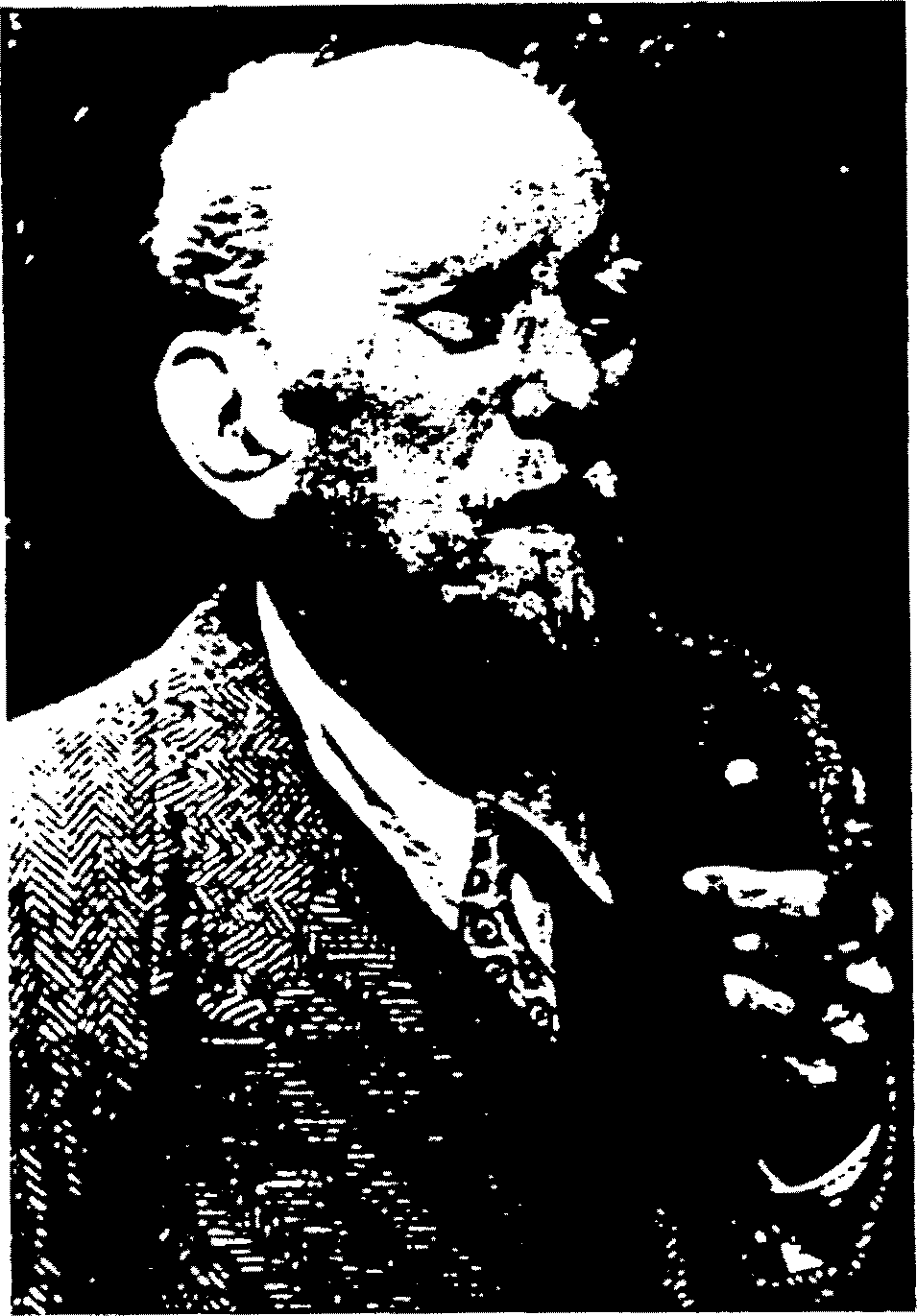
ALEISTER CROWLEY
Senior statesman of the spirit, “with little left but pipe and wit."
practice is simply the continuing awareness of. and abiding within, the interminable Love itself. As it is written in Liber Legis, Cap. 11. v. 43:
A feast every day in your hearts in the joy of my rapture! A feast every- night unto Nu. and the pleasure of uttermost delight!
This state has long been described by mystics, of East and West alike, as one essential characteristic of the extreme ripening of adepthood implied by the grade attributed to the sephirah Chesed. The davaqah regards this intimate relationship as being with "God." The bhakti regards it as being with Ishvara. We say it is with "the Holy Guardian Angel." All of this is the same, but for the words.
The Adeptus Exemptus surely needs little help or guidance in this, even from her incarnate superiors in the Order, for in the Holy Guardian Angel she is given the most perfect instructor one could desire in the ways of Love.
THE ADEPTUS EXEMPTUS THESIS
The Exempt Adept will possess a thorough knowledge of all these courses [Student Grade through Adeptus Major Grade], and present a thesis of his own. as a general Epitome of his own Attainment as reflected in the sphere of the Mind. tCurriculum. The Equinox No. XI)
The Adept must prepare and publish a thesis setting forth His knowledge of the Universe, and his proposals for its welfare and progress. He will thus be known as the leader of a school of thought. (One Star in Sight)
This assignment is self-explanatory-: but perhaps the reasons for it are not entirely clear.
Certainly there are enough practical reasons. The Exempt Adepts are “senior statesmen of the spirit." the best trained, most learned, most advanced magicians, mystics, and philosophers of the Inner College. Furthermore, such a person will have ripened his or her own unique perspective of the Great Work. Every person has a unique point of view, and every window on the Divine gazes upon a different aspect, a different vista. Each spiritually mature expression of such a view constitutes one of the great philosophical treasures of the world.
Examples of these writings include Clef des Grands Mysteres by Eliphas Levi; The Cloud Upon the Sanctuary by Karl von Eckartshausen1'; Utrinsque Cosmi Histori by Robert Fludd; Themis Aurea and Scruunium Chymicum by Michael Maier: Euphrates by Thomas Vaughan; The Spiritual Exercises by St. Ignatius of Loyola; Three Dialogues by Bishop Berkeley: The Fourth Dimension by H. Hinton; and other works by Swedenborg. Paracelsus. Valentine. Newton. Bolyai, and numerous others.* 14
’■ In an earlier edition of this book. Eckartshausen’s Magic. The Principles of Higher Knowledge was listed here, rather than The Cloud Upon me Sanctuary. his best-known work, because Cloud reflects much more than even a 7C=MC level of understanding. Listed alongside these others, it stands forth as a clear "best of breed." the chief of them all. But Eckartshausen s Magic is no higher than a 5" work at best, comparing favorably to (for example) Levi's Dogme ei Ritual.
14 Students of Crowley's life will discover a strange twisi on this one particular task. When the lime came for him to pen his 7C=4L- thesis, he had gathered his notes and formulated his essentia! themes - then discovered Levi's Clef des Grands Mysteres. which covered exactly the same points Crowley had


THE PYRAMID OF INITIATION
What rejected stone shall crown it?
But beyond these benevolent considerations, there is a further need that this thesis be written now. a need deeply rooted in the Adept's natural development in the path of initiation. The 7C=4° has attained to the highest sephirah attributed to the Ruach (the distinctly human part of the psyche, including the reasoning mind). This is that "certain exalted grade whereby a man becomes master of knowledge and intelligence, and no more their slave" (Liber 61. v. 18). The Exempt Adept is preparing to cross a threshold into the Third Order -the Ordeal of the Abyss - to which only the Knowledge and Conversation of the Holy Guardian Angel is of comparable significance. Crossing this Abyss requires full ripening of all that has gone before, a drawing to a head of everything constituting the Adept, of all that makes her what she distinctly is. Here, once more, is the symbol of the Pyramid of Initiation that the aspirant has been carefully building, now reaching completion, converging on the final point at its apex. Only thus max- the Adeptus Exemptus be prepared for the great step ahead - of which more anon.
intended to explain. Therefore, instead of writing a new book, he translated Levi’s'
By this standard, we would have to recognize Mme. Isabella de Steiger (V.-. H.-. Sor. Alta Pelo. 5=0 of the old G.D.) as an Adeptus Exemptus for her wonderful translation of Eckhanshausen’s The Cloud L'pon the Sanctuary'.
Whatever the truth of the Crowley-Levi story. Crowley certainly published numerous works that brilliantly' satisfy the requirements for this great assignment. He first assumed a full Adeptus Exemptus function upon commencing to publish The Eoil’vox. His New Commentary on The Book of the Law exactly fulfills the requirements of a ~-=4- thesis: as. certainly. does his mammoth Book Four when all four sections are considered. His role in forging the system of the A.’.A.-.. for his and future generations, may. perhaps, be regarded as a "thesis" tn another medium than the written word. There is no question that he did the work, many times over.
THE PATH OF ZAYIN
To attain the Grade of Magister Templi. he must perform two tasks; [the first is] the emancipation from thought by putting each idea against its opposite, and refusing to prefer either. . . . (One Star in Sight/
' The Utterance of the Pythoness. Liber MCXXXLX. (Liber I 'larum I uvt
Zayin means "sword." symbolic of the human intellect and representative of division and multiplicity. It corresponds to the sign Gemini, and to the Vl'h Trump of the Tarot, popularly called The Lovers, and esoterically called "The Children of the Voice: The Oracle of the Might} Gods.""
Gemini. “Twins." implies the number two. A sword is an implement of severing or cleaving. Yet the title. The Lovers, implies intimate union. A passage in The Book of the Law (Cap. 1. vv. 2930) addresses this apparent paradox:
For I am divided for love's sake, for the chance of union.
This is the creation of the world, that the pain of division is as nothing, and the joy of dissolution all.
The descent of the Path of Zayin. from Binah to Tiphereth. is the coming forth of creation by division: /.<?.. by the formulation of the human intellectual function, which is ultimately binary.* 1*’ Of this formulation, "the pain of division is as nothing." However, we now focus our attention on the complementary' operation, the opening from Tiphereth unto Binah. In this, the many are united into the One. Duality is overcome. In particular.
1 Zayin is related to the principle of prophecy. Even in simple terms, this is understandably a facet of the relationship between the rational mind (Tiphereth. 1) and an informing intuition (Binah. r,). Furthermore, the Gemini Twins in the mythologies of varying cultures (often called "Children of the Sun") are frequently associated with the function of prophecy. Evidently tor this reason, in Liber riorum Ila. Crow'ley assigned to the Path of Zayin a practice or power called “The
L iterance of the Pythoness." for which he assigned an instruction labeled Liber 1139. This instruction is inextant and unidentifiable. Its number is the value of the Greek word SDttiuq, "womb." the root of dbtXtboi. "brothers" (lit., children of the same w omb). Based on the title of Liber 1139, a pun probably was also intended on AtXtfoi. Delphi, the site of the most famous oracle of antiquity, sacred to the Sun god.
All knowledge reduces either to the statement A=B or the statement A*B.
intellectual polarities resolve into a single Truth; “the joy of dissolution is all.’’
In addition to the normal meditative methods of yoga, the practical instruction for this Task of the Path of Zayin is Liber Os Abysmi vel ilVT. The Book of the Mouth of the Abyss or The Book of Da 'ath (Knowledge). It is a technique for employing the intellect, isolated from the intuitive faculty, to destroy its own compelling hold on the soul. The climax of the operation proper is described in Liber Da ’ath as follows:
Then will all phenomena which present themselves to him appear meaningless and disconnected, and his own Ego will break up into a series of impressions having no relation one with the other, or with any other thing.
Let this state then become so acute that it is in truth insanity, and let this continue until exhaustion. . .
Il may end tn real insanity, which concludes the activities of the Adept during this present life, or by his rebirth into his own body and mind with the simplicity of a little child.
And then shall he find all his faculties unimpaired. yet cleansed in a manner ineffable.
And he shall recall the simplicity of the Task of the Adeptus Minor.1, and apply himself thereto with fresh energy in a more direct manner. . .
And wiih the reappearance of the Hob Guardian Angel1' he may be granted the highest attainments. . .
Thence may he enter into a real communion with ihose that are beyond, and he shall be competeni to receive communicaiion and instruction from Ourselves directly.
Thus shall We prepare him for. . . the Ordeal of the Abyss, when we have received him into the City of Pyramids. * IS

1 To attain to the Knowledge and Conversation of the Holy Guardian Angel.
IS The Angel has been, as it were, expelled from the conscious psyche by the terms of the practice, which required the employment of the powers of reason utterly divorced from the spiritual faculties.
This is a reference io Binah.
THE PATH OF CHETH
To attain the Grade of Magister Templi. he must perform... the consecration of himself as a pure vehicle for the influence of the order to which he aspires. (One Star in Sight)
Fl The Ritual of the Holy Grail. Liber CLl’l.
(Liber Viarum Vice/
Cheth means “hedge" or “fence.” that which defines a territory'; or an enclosure or field thus delimited. It corresponds to the sign Cancer, and to the VIIth Trump of the Tarot which is called, popularly. The Chariot and. esoterically. “The Child of the Powers of Water; The Lord of the Triumph of Light.”
This Chariot is the human personality and its associated higher "vehicles." The Charioteer is the Holy Guardian Angel. The word Cheth (FIT) enumerates to 418. the number that, in the present .Ton. symbolizes the perfection of the Great Work. This. then, is the “Triumph of Light" to which the esoteric title alludes.
The task for this Path, quoted above from One Star in Sight, is entirely clear. However, each person must discover his or her own method for its accomplishment. Cheth is the final Path traversed20 before admission of the Adept into the Third Order and the Grade of Magister Templi. even as Samekh was the last traversed within the Outer College. The step yet before the Adeptus Exemptus compares to adepthood (to the Knowledge and Conversation of the Holy Guardian Angel) as that Knowledge and Conversation compares to the Neophyte's initial aspiration within the First Order.
A certain assistance is given to the Adept in these matters.
First, as Liber Viarum Vice confirms, for this “Ritual of the Holy Grail" we are given the horrible-beautiful Class A document Liber Cheth vel Vallum Abiegni. “This book." Crowley wrote in the Syllabus in Equinox XL “is a perfect account of the task of the Exempt Adept considered under the symbols of a particular plane, not the intellectual.”
:o Zayin opens unto Binah from Tiphereth. and Cheth from Geburah. There is no Path that passes directly from Chesed to Binah. This is one of the symbols of the Abyss of which we speak. How to make the leap? By no reasonable means. Yei to one who returns to the simplicity of the perspective of the Adeptus Minor, the way will not be hard to find, even as a young child runs unhesitantly into the arms of its mother.
Another document from the Adeptus Exemptus Syllabus also may be of assistance in the basic task of this Path, the self-consecration of the Adept as a pure vehicle for the influence of the Third Order to which she aspires. The document is Liber Thisharb Via- Memoriae (The Book of the Journey o f the Memory). “Thisharb” - IHKUrn -is Berashith (the Hebrew title of Genesis, i.e., "in the beginning") spelled backwards.
As already stated, among the planetar.' sephiroth Chesed is attributed to the function of memory. and many associate a certain resolution of karma with this Grade. It should come as no surprise, therefore, that a technique is given for encouraging the recover' of past life memories. These memories well may have arisen, to some extent, much earlier in the course of training. Often they are a side effect of meditation: or they may ser e as a device for the Holy Guardian Angel to employ in guiding the aspirant to go in certain directions.
One factor makes it especially likely that the Exempt Adept will be able to recover these memories: The inner grades are not typically attained in quick succession, within one lifetime. unless there has been substantial
attainment previously. It is likely that an Adeptus Exemptus was at least a Minor or Major Adept in a prior life. Souls of such maturity assimilate much more of their human life, personality, and memories into the spiritual core of their being, which passes from life to life, thereby making the recovery-' of these memories easier.
The ultimate purpose of Liber Thisharb is the discovery-’ of the True Will in a very pure way. and the rendering of it comprehensible to the powers of reason: or. as Liber Thisharb itself describes the practice, “its results define the separate being of the Exempt Adept from the rest of the Universe, and discover his relation to that Universe." The full, formal method given for accomplishing this involves the recovery of past life memories so that the Adept can see a greater length of the road she has been traversing. The Adept’s powers of meditation then are applied to the analysis of what has been learned, to the end of identifying who she is and what service she is able to offer to the Third Order, or Silver Star.

THE HOLY GRAIL The Mysteries of Chesed are those of the Holy Grail. (From The Chalice of Ecstasy by Frater Achad.)
Several passages from Liber Thisharb help pul into perspective its considerable importance for the Exempt Adept:
It is of such importance to the Exempt Adept that \'.e cannot overrate it. Let him in no wise adventure the plunge into the Abyss until he have accomplished this to his most perfectest satisfaction.
For in the Abyss no effort is anywise possible. The Abyss is passed by virtue of the mass of the Adept and his Karma. Two forces impel him: (1) the attraction of Binah, (2) the impulse of his Karma; and the ease and even the safety of his passage depend on the strength and direction of the latter.
Should one rashly dare the passage. and take the irrevocable Oath of the Abyss, he might be lost therein through .-Eons of incalculable agony; he might even be thrown back upon Chesed. with the terrible Karma of failure added to his original imperfection.
Let then the Adept who finds the result of these meditations unsatisfactory refuse the Oath of the Abyss, and live so that his Karma gams strength and direction suitable to the task at some future period...
All this being perfected, so that the memory reaches back into aeons incalculably distant, let the Exempt Adept meditate upon the fruitiess-ness of all those years, and upon the fruit thereof, severing that which is transitory and wonhless from that which is eternal. And it may be that he being but an Exempt Adept may hold all to be savourless and full of sorrow.
This being so. without reluctance will he sw ear the Oath of the Abyss.
. . . Having then perfected in his mind these conceptions, let him apply them to his own career. forging the links of memory into the chain of necessity.
And let this be his final question: To what purpose am 1 fitted? Of what service can my being prove to the Brothers of the A.-.A.-. if I cross the Abyss, and am admitted to the City of the Pyramids9
There follows an instruction in how that ques tion is to be approached; then.
There is no minutest atom of his composition which can be withdrawn without making him some other than he is. no useless moment in his past. Then what is his future? [.. .]
So the adept has military genius, or much knowledge of Greek: how do these attainments help his purpose, or the purpose of the Brothers? He was put to death by Calvin, or stoned by Hezekiah; as a snake he was killed by a villager. or as an elephant slain in battle under Hamilcar. How do such memories help him1’ Until he have thoroughly mastered the reason for every incident in his past, and found a purpose for every item of his present equipment, he cannot truly answer even those Three Questions that were first pul to him. even the Three Questions of the Ritual of the Pyramid'1; he is not ready to swear the Oath of the Abyss.
But being thus enlightened, let him swear the Oath of the Abyss; yea. let him swear the Oath of the Abyss.
BEYOND THE ROSY CROSS
Adeptus (Exemptus). - Completes in perfection all these matters [of previous grades]. He then either tai becomes a Brother of the Left Hand Path or. ib) is stripped of all his attainments and of himself as well, even of his Holy Guardian Angel, and becomes a Babe of the Abyss, who. having transcended the Reason, does nothing but grow in the womb of its mother.
He must then decide upon the critical adventure of our Order; the absolute abandonment of himself and his attainments. He cannot remain indefinitely an Exempt Adept: he is pushed onward by the irresistible momentum that he has generated.
- One Star in Sight
Despite our editorial decision to let this book climax, or come to a natural rest, in the 7°=4D Grade, it has been impossible to draft these words without constant reference to the grades beyond, and to the Third Order which they constitute.
Repeatedly, in many writings. Aleister Crow lex told us until we could not forget it. that the Exempt Adept may not stay an Adept forever. There is a necessity to go on. a momentum or inner pressure that carries one forward. It is only necessary
■ Three questions that are put to the Probationer during the week preceding the Neophyte initiation. Liber T'raa.
to equip oneself for the inevitable, and to make a certain critical choice along the way: whether to surrender oneself (one's ego) entirely to the annihilation of the Abyss, or to hold on. to resist disintegration and absorption, to strive to survive as the separate ego-center that one has always thought oneself to be.
The Exempt Adept is the highest stage that a being can attain and still be definable in human (z.e.. in personality ) terms. It is an apex; but the whole course of the spiritual training has been aimed, inevitably, at exceeding even that.
His Angel shall lead him anon" to the summit of the Order of the R.C. and make him ready to face the unspeakable terror of the Abyss which lies between Manhood and Godhead; teach him to Know that agony, to Dare that destiny, to Will that catastrophe, to keep Silence for ever as he accomplishes the act of annihilation.''
As the old alchemical aphorism goes. "First the stone, then the plant, then the animal, then the human - then the God." Timeless samadhi ripens into the timeless sea of Nirvana; but to enter that sea. one must divest oneself of far more than one's knickers. One must divest oneself of all that one has ever considered oneself to have or to be.
From the Abyss comes No Man forth, but a Star startles the Earth, and our Order rejoices above that Abyss that the Beast hath begotten one more Babe in the Womb of Our Lady. His Concubine, the Scarlet Woman. Babalon.
There is no need to instruct a Babe thus bom. for in the Abyss it was purified of every poison of personality; its ascent to the highest is assured, in its season, and it hath no need of seasons for it is conscious that all conditions are no more than forms of ns fancy.'4
The transition from Chesed to Binah is unique in a couple of ways. For one (already mentioned), there is no direct Path marking this transition on the Tree of Life. For another, both Chesed and
'* * From the initial Knowledge and Conversation, which characterizes the Lesser Adept.
One Star in Sight.
•4 Ibid. "No Man" (Lat. Nemo } is the generic title of the Magister Temph. 8C=3C. 'Beast' and 'Babalon' may be understood here as Yod and Heh. Chokmah and Briah. Their Union is tn Da'ath.
Binah are attributed to Water. At no other point on the Tree has the transition been from a sephirah of a given element into another of the same element. In this is a particular symbol, which the Exempt Adept easily will understand.
There are those, however, who are unwilling to make the transition. Their ego-centers still hold sway over their deeper being. Ultimately, they are afraid to die. This is the same as saying that they are afraid to love, which is equally true. Even as the self is lost in the Beloved in the depths of love - even as the ego softens or surrenders its warding and defining barriers in the rapture of orgasm - so is the Fear of Death always a Fear of Love. Those who thus fear are known as the Black Brothers.25 This is not the same as a “black magician." who is generally of a much lower grade, and a much more ridiculous phenomenon. Nor is it the same as the Black School of Magick, which, with the White and Yellow Schools, form a triad of root philosophies among the w orld's initiates.26 Finally, the term is not racially motivated. The basis for the "black" metaphor wrill be evident in the quotations that follow . For now, you simply need to know that a Black Brother is a very' advanced initiate, an Adeptus Exemptus. who from an unexpunged fear (often masked by other, hollow motives) resists the natural forward momentum that otherwise would have carried her. naturally and in the proper hour, into the embrace of the Third Order.
We find this natural process (which the Black Brother resists) documented in the A.’.A.’.'s History Lection. Liber 61. vv. 27-28:
In the fullness of time, even as a blossoming tree that beareth fruit in its season, all these pains were ended, and these adepts [Eras. D.D.S. and O.M.] and their companions obtained the reward which they had sought -they w-ere to be admitted to the Eiemal and Invisible Order that hath no name among men.
■? In contrast to the “Great White Brotherhood" by which the A.-.A.'. identifies itself. These terms are not tn the least racist in original intent, although (with today’s resurgence of violent and intolerant “white supremacist" bigotry), we tend to employ the term "Great While Brotherhood" very sparingly. 1 suppose recalcitrant female Adepti Exempt! are legitimately called “Black Sisters." despite the entirely different mental picture that phrase brings to mind'
3t See “The Three Schools of Magick" in Magick Without Tears, letters 6-k.

THE MASTER THERION
They therefore who had with smiling faces abandoned their homes, their possessions, their wives, their children in order to perform the Great Work, could with steady calm and firm correctness abandon the Great Work itself: for this is the last and greatest projection of the alchemist.
The phenomena of the Black Brothers are discussed in many places, including The Vision & the Voice; Magick in Theoty <£• Practice. Cap. XXL Sec. 1 and elsewhere: Magick Without Tears, Letters 12 and 50 and elsewhere: and Liber Aleph in diverse places.
We close this section with two lengthy passages on this final choice.
From Liber Aleph. Cap. 104:
Of the Black Brothers, o my Son. will I write these Things following. I have told thee already concerning Change, how it is the Law. because every Change is an Act of Love under Will. So then he that is Adept Exempt, whether in Our Holy Order or another, may not remain in the Pillar of Mercy, because it is not balanced, but is unstable. Therefore is the Choice given unto him. whether he will destroy his Temple, and give up his Life, extending it io Universal Life.’ or whether he will
■’ See Liber Cheth, v. 3. The Exempt Adept remains a discrete individual, albeit living in service to the Universal.
make a Fortress about that Temple, and abide therein, in the false Sphere of Daath, which is in the Abyss. And to the Adepts of Our Holy Order this Choice is terrible, by cause that they must abandon even Him whose Knowledge and Conversation they have attained. Yet. o my Son, they have much Help of Our Order in this >Eon. because the General Formula is Love, so that their Habit itself urgeth them to the Bed of Our Lady BABALON. Know then the Black Brothers by these True Signs of their Initiation of iniquity, that they resist Change, restrict and deny Love, fear Death. Percutian-lur.
From Magick in Theory & Practice. Cap. VII. Sec. 1 (a portion of which has been quoted already in the preceding chapter):
The Hieroglyph shewn in the Seventh Key of the Tarot (described in the 12,h zEthyr. Liber 418. Equinox 1. V) is the Charioteer of OUR Lady Babalon. whose Cup or Graal he bears.
Now' this is an important formula. It is the First of the Formulae, in a sense, for it is the formula of Renunciation.'1' It is also the Last!
The Cup is said to be full of the Blood of the Saints: that is. every “saint" or magician must give the last drop of his life’s blood to that cup. It is the original price paid for magick power. And if by magick power we mean the true power, the assimilation of all force with the Ultimate Light, the true Bridal of the Rosy Cross, then is that blood the of* fering of Virginity, the sole sacrifice wellpleasing to the Master, the sacrifice whose only reward is the pain of child-bearing unto him.
But 'to sell one's soul to the devil', to renounce no matter what for an equivalent in personal gain.'1 is black magic, You are no longer a noble giver of your all. but a mean huckster.
This formula is. however, a little different in symbolism, since it is a Woman whose Cup must be filled. It is rather the sacrifice of the Man. who transfers life to his descendants...
But here the formula implies much more even than this. For it is his whole life that the
" "There is no moral implication here. But to choose A implies to refuse not-A: at least, that is so. below the Abvss-A.C ’
"Supposed personal gam. There is really no person to gain: so the whole transaction is a swindle on both sides!" - A.C.
Magus offers to OUR Lao')'. The Cross is both Death and Generation, and it is on the Cross that the Rose blooms. The full significance of these symbols is so lofty that it is hardly fitted for an elementary treatise of this type. One must be an Exempt Adept, and have become ready to pass on. before one can see the symbols even from the lower plane. Only a Master of the Temple can fully understand them.
(However, the reader may study Liber CLVI in Equinox I. VI. the 12lh'and 2"3 /Ethyrs in Liber 418 in Equinox 1. V. and the Symbolism of the Vc and Vlc in O.T.O.)'"
Of the preservation of this blood which Our LaDY offers to the ANCIENT ONE. Chaos’ the All-Father, to revive him. and of how his divine Essence fills the Daughter (the soul of Man) and places her upon the Throne of the Mother, fulfilling the Economy of the Universe. and thus ultimately rewarding the Magician (the Son) ten thousandfold, it would be still more improper to speak in this place. So holy a mystery is the Arcanum of the Masters of the Temple, that it is here hinted at in order to blind the presumptuous who may. unworthy. seek to lift the veil, and at the same time to lighten the darkness of such as may be requiring only one ray of the Sun in order to spring into life and light.
CONCLUSION
There is no conclusion. The Way of the Spirit is a way of eternal going - of movement and change.
And this change, this evolution, is the consequence of love. Evolution is always the consequence of love. By surrendering ourselves - passionately. not passively - to the evolving circumstances presented to us by the textured fabric of life, we become ever larger than any circumstances that oppress us. The whole is always greater than the sum of its parts.
In our way of Love, we pour forth the very essence of ourselves into that which we love most. We embrace it. take it in. become filled with it.
The of O.T.O. is Sovereign Prince or Princess of Rose-Croix (cf 18c of the Scottish Rite). The O.T.O. \'lc is the degree of the Knight (Templar) Kadosh. or Dame Companion of the Holy Graal (a reinterpretation of the Scottish Rite 30c).
“CHAOS is a general name for the totality of the Units of Existence: it is thus a name feminine in form. Each unit of CHAOS is itself All-Father." - A.C.
surrendering to it the whole of what we are; for the one condition of progress, as has been said previously. is annihilation of the self tn the Beloved.
Thus far the Rosy Cross,
What sweeter words are there than these from Liber 65, Cap. 111. v. 51:
O Thou light and delight, ravish me away into the milky ocean of the stars!
Or these from Liber 7. Cap. VII. vv. 41 -45:
Come. O my God. in one last rapture let us attain to the Union with the Many! '
In the silence of Things, in the Night of Forces, beyond the accursed domain of the Three, let us enjoy our love!
My darling! My darling! away, away beyond the Assembly and the Law and the Enlightenment unto an Anarchy of Solitude and Darkness!
For even thus must we veil the brilliance of our Self.
My darling! My darling!
Never before in the history- of the w orld hat e the inner pathways of the Journey been so finely mapped, nor the Way so clearly marked. One has but to enter upon it with courage, love, intelligence. and determination. But we cannot take the Journey for you. Only your own labor can raise the Pyramid of your spirit. Work has virtue for ns own sake; and how much more this Great Work. O brothers and sisters of the Morning Light?
In the bonds of our common humanity and of our common divinity. 1 invite all w ho are ready, to undertake the Journey; and all others to undertake to make themselves ready.
Love is the law. love under will.

“So therefore the beginning is delight, and the End is delight, and delight is in the midst, even as the Indus is water in the cavern o f the glacier, and water among the greater hills and the lesser hills and through the ramparts of the hills and through the plains, and water at the mouth thereof when it leaps forth into the mighty sea, yea, into the mighty sea. ”
Liber A’ash, v. 39
Epilogue
DAUGHTER OF THE LANTERN
1
Surrender.
1 stand, or lay. or but exist in the presence of something of inordinate magnitude, and wonder, and awesome, thund rous peace which 1 have hitherto held back but now admit, timorously, tenderly, feeling my child-caution expectant and happy and thrilled.
1 trust it. and seek to hold it and be made secure, or else, to be miraculously touched beyond my preconceptions.
II
There stands a Daughter of the Lantern, silent, wise.
biding her tongue and time, yet ever going before me. the love of her eyes aflame & luminous with starlight - waiting until 1 wake and take her hand.
She is guide and mistress, inspiration of fantasy and certainty- of reality. She is as much myself as am I. yet somehow separate, unknowable while totally Known, as the flame that fills me wholly.
The flame burns & sings <6 dances within my soul. That which was water and mystery, now, within the sacred sanctuary, is light and wonder and amazement, a purifying fire, a love
unquenchable & inextinguishable, passionate & chaste, self-subsuming & all-consuming, patient & impatient, purging me of dross, cleansing, transforming, freeing.
One flame. One dance. One miracle. Certainty’. Peace. Passion. Life.
Goddess, central flame, illuminator, teacher, healer, song of beauty’ & fire of knowing
- / love you!
A breath caresses my cheek and startles me awake, awake as 1 have rarely been, to stare, mind stopped, senses staggered, into the wondrous and splendid majesty of the star of her being. How shall it be that of all the multitude of the unceasing heavens, this one star should so fill and fulfill what my hungering soul desires, requires, devours, embraces, and loves?
At but the thought of Her, across these miles, the delicate breeze or breath dances on all my skin, through walls, through clothes, through excuses, through incredulity, and plays its birthing reveille 'pon each of my inner senses. Her charade, her persona, are all gone, and J see but Her star, Her inner fires. Her beauty.
And it is before this Beauty that all my speech fails.
What 1 want to say!
What I hunger to reflect, to utter, to declare, so that she may know 1 KNOW & love & honor.
beyond my frail and inadequate powers of expression.
V
Diaphanous veils descend & cloak that argent & ardent splendor. They weave & shift & pass, each imaging another face, another view. Where but an hour ago, or a day,
1 oh so clearly saw Her
- now 1 see only the intervening warp & woof of our dance, the veils that seductively cloak her reality and chastely conceal its naked miracle.
VI
Each movement of mine and hers is balanced, anticipated, reciprocated by the other.
Does she move in foresighted anticipation to make space, to receive my next thrust of being, as Yin moves on to make way
for Yang's new wave of penetration?
Or J her?
Or is the dance so wrought, the dancers so matched, that the yielding or vacuity of either is at once filled precisely bv the other, each providing
in unconscious rhythmic flow, the context for the other's Way? Two jig-saw realities interlocked in some far vaster puzzle. Satisfaction.
Dynamic complementation.
Mystery.
Unpardonable love.
VII
And then these veils lift, or part, like delicate tumescent folds offlesh opening inward to admit the whole of me. Bright star disclosed anew.
One star in sight.
Beyond death, beyond space, beyond reason, 1 am lost & found at once & forever & never.
Two, one, naught.
Naughty play as we/I/she meet in the center of ecstasy & pain, beyond light into starlit night, and spill, twin fountains of silver & gold pulsing, pulsars, quasars, eruptive & unceasing streams of liquid starlight, screaming lost in Silence, into the greater creative pulse of the boundless, soundless BEA UTY of Thee.
Appendices

LIBER XIII vel QRADUUM MONTIS ABIEGN1
A Syllabus of the Steps Upon the Path
A /. A Publication in Class D.
Issued by Order:
D.D.S. 7°=4d Praemonstrator
O.S.V. 6°=5d Imperator
N.S.F. 5°=6n Cancellarius
-
51. Let not the failure and the pain turn aside the worshippers. The foundations of the pyramid were hewn in the living rock ere sunset; did the king weep at dawn that the crown of the pyramid was yet unquarried in the distant land?
-
52. There was also an humming-bird that spake unto the homed cerastes, and prayed him for poison. And the great snake of Khem the Holy One, the royal Urasus serpent, answered him and said:
-
53. 1 sailed over the sky of Nu in the car called Millions-of-Years, and I saw not any creature upon Seb that was equal to me. The venom of my fang is the inheritance of my father, and of my father’s father: and how shall 1 give it unto thee? Live thou and thy children as 1 and my fathers have lived, even unto an hundred millions of generations, and it may be that the mercy of the Mighty Ones may bestow upon thy children a drop of the poison of eld.
-
54. Then the humming-bird was afflicted in his spirit, and he flew unto the flowers, and it was as if naught had been spoken between them. Yet in a little while a serpent struck him that he died.
-
55. But an Ibis that meditated upon the bank of Nile the beautiful god listened and heard. And he laid aside his Ibis ways, and became as a serpent, saying Peradventure in an hundred millions of millions of generations of my children, they shall attain to a drop of the poison of the fang of the Exalted One.
-
56. And behold! ere the moon waxed thrice he became an Uraeus serpent, and the poison of the fang was established in him and his seed even for ever and for ever.
LIBER LXV. CAP. V.

L.U.LXU^ l”v
J It, uan |
VEL GRADUUM MONTIS ABIEGNI A SYLLABUS OF THE STEPS UPON THE PATH
-
1. The Probationer. His duties are laid down in Paper A. Class D. Being without, they are vague and general. He receives Liber LX1. and LXV.
[Certain Probationers are admitted after six months or more to Ritual XXV1IL]
At the end of the Probation he passes Ritual DCLXXI.. which constitutes him a Neophyte.
-
2. The Neophyte. His duties are laid down in Paper B, Class D. He receives Liber VII.
Examination in Liber O. Caps. L-IV., Theoretical and Practical.
Examination in The Four Powers of the Sphinx. Practical.
Four tests are set.
Further, he builds up the magic Pentacle.
Finally he passes Ritual CXX.. which constitutes him a Zelator.
-
3. The Zelator. His duties are laid down in Paper C, Class D. He receives Liber CCXX., XXVII., and DCCCXIII.
Examinations in Posture and Control of Breath (see EQUINOX No. 1). Practical.
Further, he is given two meditation-practices corresponding to the two rituals DCLXXI. and CXX. "
(Examination is only in the knowledge of, and some little practical acquaintance with, these meditations. The complete results, if attained, would confer a much higher grade.)
Further, he forges the magic Sword.
No ritual admits to the grade of Practicus. which is conferred by authority when the task of the Zelator is accomplished.
-
4. The Practicus. His duties are laid down in Paper D. Class D.
Instruction and Examination in the Qabalah and Liber DCCLXXVII.
Instruction in Philosophical Meditation (Gna-na-Yoga).
Examination in some one mode of divination: eg., Geomancy. Astrology, the Tarot. Theoretical. He is given a meditation-practice on Expansion of Consciousness.
He is given a meditation-practice in the destruction of thoughts.
Instruction and Examination in Control of Speech. Practical.
Further, he casts the magic Cup.
No ritual admits to the grade of Philosophus, which is conferred by authority when the Task of the Practicus is accomplished.
-
5. The Philosophus. His duties are laid down in Paper E, Class D.
He practices Devotion to the Order.
Instruction and Examination in Methods of Meditation by Devotion (Bhakti-Yoga).
Instruction and Examination in Construction and Consecration of Talismans, and in Evocation.
Theoretical and Practical.
Examination in Rising on the Planes (Liber O, Caps. V., VI.). Practical.
He is given a meditation-practice on the Senses, and the Sheaths of the Self, and the Practice called Mahasatipatthana.
(See The Sword of Song, “Science and Buddhism.’’)
Instruction and Examination in Control of Action.
Further, he cuts the Magic Wand.
Finally, the Title of Dominus Liminis is conferred upon him.
He is given meditation-practices on the Control of Thought, and is instructed in Raja-Yoga.
He receives Liber Mysteriorum and obtains a perfect understanding of the Formulas of Initiation.
He meditates upon the diverse knowledge and power that he has acquired, and harmonises it perfectly.
Further, he lights the Magic Lamp.
At last, Ritual VIII. admits him to the grade of Adeptus Minor.
The Adeptus Minor. His duty is laid down in Paper F, Class D.
It is to follow out the instruction given in the Vision of the Eighth ^Ethyr for the attainment of the Knowledge and Conversation of the Holy Guardian Angel.
[NOTE. This is in truth the sole task; the others are useful only as adjuvants to and preparations for the One Work.
Moreover, once this task has been accomplished, there is no more need of human help or instruction; for by this alone may the highest attainment be reached.
All these grades are indeed but convenient landmarks, not necessarily significant. A person who had attained them all might be immeasurably the inferior of one who had attained none of them; it is Spiritual Experience alone that counts in Result; the rest is but Method.
Yet it is important to possess knowledge and power, provided that it be devoted wholly to that One Work.]
B
LIBER COLLEQII SAHCTI sub figura CLXXXV
LIBER COLLEGII SANCTI
sub figura
Being the Tasks of the Grades, and their Oaths, proper to Liber XIII, the publications of the A/. A.*, in Class D from
A to G
Issued by Order:
D.D.S. 7°=4d Prsemonstrator.
O.S.V. 6O=5D Imperator.
N.S.F. 5°=6d Cancellarius.

The Oath of a Probationer.
I.. being of sound mind and body, on this day of[An 0
in 0 of] do hereby resolve: in the
Presence of a neophyte of
the A.’.A.’. To prosecute the Great Work: which is. to obtain a scientific knowledge of the nature and powers of my own being.
May the A.’.A.’. crown the work, lend me of Its wisdom in the work, enable me to understand the work!
Reverence, duty, sympathy, devotion, assiduity, trust do 1 bring to the A.’.A.’. and in one year from this date may 1 be admitted to the knowledge and conversation of the A .’.A.’.!
Witness my hand______________________________
Mono_______________________________

A.'.A.'.
Publication in Class D.
Date..........................
Imprimatur.
D.D.S. Praemonstrator.
No...............
A* A • • • X Jk. • •
The Task of a Probationer.
0. Let any person be received by a Neophyte, the latter being responsible to his Zelator.
-
1. The period of Probation shall be at least one year.
-
2. The aspirant to the A.’.A.-, shall hear the Lection (Liber LXI) and this note of his office; IF HE WILL, shall then procure the robe of a Probationer; shall choose with deep forethought and intense solemnity a motto.
-
3. On reception, he shall receive the robe, sign the form provided and repeat the oath as appointed, and receive the First Volume of the Book.
-
4. He shall commit a chapter of Liber LXV to memory; and furthermore, he shall study the Publications of the A.-.A.-. in Class B, and apply him self to such practices of Scientific llluminism as seemeth him good.
-
5. Beside all this, he shall perform any tasks that the A.-.A/. may see fit to lay upon him. Let him be mindful that the word Probationer is no idle term, but that the Brothers will in many a subtle way prove him. when he knoweth it not.
-
6. When the sun shall next enter the sign under which he hath been received, his initiation may be granted unto him. He shall keep himself free from all other engagements for one whole week from that date.
-
7. He may at any moment withdraw from his association with the A.-.A/, simply notifying the Neophyte who introduced him.
-
8. He shall everywhere proclaim openly his connection with the A.-.A/, and speak of It and Its principles (even so little as he understandeth) for that mystery is the enemy of Truth.
One month before the completion of his year, he shall deliver a copy of the Record of his year's work to the Neophyte introducing and repeat to him his chosen chapter of Liber LXV.
-
9. He shall hold himself chaste, and reverent toward his body, for that the ordeal of initiation is no light one. This is of peculiar importance in the last two months of his Probation.
-
10. Thus and not otherwise mav he attain the great reward: YEA. MAY HE OBTAIN THE GREAT REWARD!
The Oath of a Neophyte.
I,[old motto], being of sound mind and body, and prepared, on this day of[An
0 in° of] do hereby resolve: in the Presence of a Zelator of the
A.’.A/.: To prosecute the Great Work: which is, to obtain control of the nature and powers of my own being.
Further, I promise to observe zeal in service to the Probationers under me, and to deny myself utterly on their behalf.
May the A/.A.-, crown the work, lend me of Its wisdom in the work, enable me to understand the work!
Reverence, duty, sympathy, devotion, assiduity, trust do I bring to the A .-.A/, and in eight months from this date may I be admitted to the knowledge and conversation of the A/.A.-.!
Witness my hand [old motto}____________________________
New Motto_____________________________________

A.-.A.’.
Publication in Class D.
B.
The Task of a Neophyte.
0. Let any Probationer who has accomplished his task to the satisfaction of the A.-.A.-. be instructed in the proper course of procedure: which is: - Let him read through this note of his office, and sign it, paying the sum of One Guinea for Liber VII which will be given him on his initiation, and One Guinea for this Portfolio of Class D publications. B-G. Let him obtain the robe of a Neophyte, and entrust the same to the care of his Neophyte.
He shall choose a new motto with deep forethought and intense solemnity. as expressing the clearer consciousness of his Aspiration which the year's Probation has given him.
Let him make an appointment with his Neophyte at the pleasure of the latter for the ceremony of Initiation.
-
1. The Neophyte shall not proceed to the grade of Zelator in less than eight months; but shall hold himself free for four davs for advancement at the end of that period.
-
2. He shall pass the four tests called the Powers of the Sphinx.
-
3. He shall apply himself to understand the nature of his Initiation.
-
4. He shall commit to memory a chapter of Liber Vll: and furthermore, he shall study and practice Liber O in all its branches: also he shall begin to study Liber H and some one commonly accepted method of divination. He will further be examined in his power of Journeying in the Spirit Vision.
-
5. Beside all this, he shall perform any tasks that his Zelator in the name of the A.-.A/. and by its authority may see fit to lay upon him. Let him be mindful that the word Neophyte is no idle term, but that in many a subtle way the new nature will stir within him. when he knoweth it not.
-
6. When the sun shall next enter the sign 240° to that under which he hath been received, his advancement may be granted unto him. He shall keep himself free from all other engagements for four whole days from that date.
-
7. He may at any moment w ithdraw from his association with the A.-.A... simply notifying the Zelator who introduced him.
-
8. He shall everywhere proclaim openly his connection with the A.-.A.-. and speak of It and Its principles (even so little as he understandeth) for that mystery' is the enemy of Truth.
Furthermore, he shall construct the magic Pentacle, according to the instruction in Liber A.
One month before the completion of his eight months, he shall deliver a copy of his Record to his Zelator, pass the necessary tests, and repeat to him his chosen chapter of Liber Vll.
-
9. He shall in every way fortify his body according to the advice of his Zelator. for that the ordeal of advancement is no light one.
-
10. Thus and not otherwise may he obtain the great reward: YEA, MAY HE OBTAIN THE GREAT REWARD!
The Oath of a Zelator.
I,[motto], being of sound mind and body, and prepared, on this day of
[An 0 in° of] do hereby resolve:
in the Presence of a Practicus
of the A.-.A.-.: To prosecute the Great Work: which is, to obtain control of the foundations of my own being.
Further, ] promise to observe zeal in service to the Neophytes under me, and to deny myself utterly on their behalf.
May the A.-. A.-, crown the work, lend me of Its wisdom in the work, enable me to understand the work!
Reverence, duty, sympathy, devotion, assiduity do I bring to the A.-.A.-, and right soon may I be admitted to the knowledge and conversation of the A.-.A r.!

A A Publication in Class D.
C.
The Task of a Zelator.
0. Let any Neophyte who has accomplished his task to the satisfaction of the A r. A be instructed in the proper course of procedure: which is: -
Let him read through this note of his office, and sign it, paying the sum of Three Guineas for the volume containing Liber CCXX. Liber XXVII and Liber DCCCXII1, which will be given him on his initiation.
Let him cause the necessary addition to be made to his Neophyte’s robe, and entrust the same to the care of his Zelator.
Let him make an appointment with his Zelator at the pleasure of the latter for the ceremony of initiation.
-
1. The Zelator shall proceed to the grade of Practicus at any time that authority’ confers it.
-
2. He shall pass Examinations in Liber E, Posture and Breathing. He shall have attained complete success in the former, i.e., the chosen posture shall be perfectly steady and easy; and attained the second stage in the latter, i.e.. automatic rigidity.
-
3. He shall further show some acquaintance with and experience of the meditations given in Liber HHH. And in this his Record shall be his witness.
-
4. He shall commit to memory a chapter of Liber CCXX; he shall pass examinations in Liber HHH.
-
5. Beside all this, he shall apply himself to work for the A.’.A.-, upon his own responsibility.
Let him be mindful that the word Zelator is no idle term, but that a certain Zeal will be inflamed within him, why he knoweth not.
-
6. When authority confers the grade, he shall rejoice therein; but beware, for that that is his first departure from the middle pillar of the Tree of Life.
-
7. He may at any moment withdraw from his association with the A.-.A.', simply notifying the Practicus who introduced him.
Yet let him remember that being entered thus far upon the Path, he cannot escape it. and return to the world, but must ultimate either in the City of the Pyramids or the lonely towers of the Abyss.
-
8. He shall everywhere proclaim openly his connection with the A.•.A.-, and speak of It and Its principles (even so little as he understandeth) for that mystery is the enemy of Truth.
Furthermore, he shall construct the magic Dagger, according to the instruction in Liber A.
One month after his admission to the grade he shall go to his Practicus. pass the necessary' tests, and repeat to him his chosen chapter of Liber CCXX. ’
-
9. He shall in every way establish perfect control of his Automatic Consciousness according to the advice of his Practicus, for that the ordeal of advancement is no light one.
-
10. Thus and not otherwise may he obtain the great reward: YEA, MAY HE OBTAIN THE GREAT REWARD!
The Oath of a Practicus.
I,[motto], being of sound mind and body, and prepared, on this day of
[An 0 in 0 of] do hereby resolve:
in the Presence of a Philosophus
of the A/.A/.: To prosecute the Great Work: which is, to obtain control of the vacillations of my own being.
Further, I promise to observe zeal in service to the Zelatores under me, and to deny myself utterly on their behalf.
May the A.’.A/. crown the work, lend me of Its wisdom in the work, enable me to understand the work!
Reverence, duty, sympathy, devotion do I bring to the A/.A/, and right soon may I be admitted to the knowledge and conversation of the A /. A/.!

AA Publication in Class D.
D.
nr'i nr1 i r* t\ • The Task of a Practicus.
0. Let any Zelator be appointed by authority to proceed to the grade of Practicus.
Let him read through this note of his office, and sign it.
Let him cause the necessary addition to be made to his Zelator's robe.
Let him make an appointment with his Practicus at the pleasure of the latter for the conferring of advancement.
-
1. The Practicus shall proceed to the grade of Philosophus at any time that authority confers it.
-
2. He shall pass examinations in Liber DCCLXXV11, the Qabalah. and the Sep-her Sephiroth.
He shall attain complete success in Liber 111, Cap. I.
-
3. He shall further show some acquaintance with and experience of his chosen method of divination. Yet he shall be his own judge in this matter.
-
4. He shall commit to memory' Liber XXVII and pass examinations in the Ritual and meditation practice given in Liber XVI. Further, he shall pass in the meditation practice S.S.S., in Liber HHH.
-
5. Besides all this, he shall apply himself to a way of life wholly suited to the Path.
Let him remember that the word Practicus is no idle term, but that Action is the equilibrium of him that is in the House of Mercury, who is the Lord of Intelligence.
-
6. When authority confers the grade, he shall rejoice therein: but beware, for that that is his second departure from the middle pillar of the Tree of Life.
-
7. Let him not venture while a member of the grade of Practicus to attempt to withdraw from his association with the A A /.
-
8. He shall everywhere proclaim openly his connection with the A.-.A/, and speak of It and Its principles (even so little as he understandeth) for that mystery is the enemy of Truth.
Furthermore, he shall construct the magic Cup, according to the instruction in Liber A.
One month after his admission to the Grade, he shall go to his Philosophus. pass the necessary tests, and repeat to him Liber XX VII.
-
9. He shall in every way establish perfect control of his w it according to the advice of his Philosophus. for that the ordeal of advancement is no light one.
-
10. Thus and not otherwise mav he obtain the great reward: YEA. MAY HE OBTAIN THE GREAT REWARD!
The Oath of a Philosophus.
-
I.[motto], being of sound mind and body, and prepared, on this day of
[An 0 in° of] do hereby resolve:
in the Presence of a Dominus
Liminis of the A.•.A.*.: To prosecute the Great Work: which is. to obtain control of the attractions and repulsions of my own being.
Further, 1 promise to observe zeal in sendee to the Practici under me, and to deny myself utterly on their behalf.
May the A.•.A.’, crown the work, lend me of Its wisdom in the work, enable me to understand the work!
Reverence, duty, sympathy do I bring to the A.\A.\ and right soon may 1 be admitted to the knowledge and conversation of the A.-. A/.!

A.-.A/.
Publication in Class D.
E.
The Task of a Philosophus.
0. Let any Practicus be appointed by authority to proceed to the grade of Philosophus.
Let him then read through this note of his office, and sign it.
Let him cause the necessary addition to be made to his Practicus’ robe.
Let him make an appointment with his Philosophus at the pleasure of the latter for the conferring of advancement.
-
1. The Philosophus shall receive the title of Dominus Liminis at any time that authority confers it.
-
2. He shall pass Examinations in Liber CLXXV and in Construction and Consecration of Talismans and in Evocation. Yet in this matter he shall be his own judge.
He shall moreover attain complete success in Liber 111. Cap. 11.
Further, he shall apply himself to study and practice the meditations given in Liber V.
-
3. He shall show some acquaintance with and experience of Liber O. Caps. V, VI. Whereof his Record shall be witness.
-
4. He shall commit to memory a chapter of Liber DCCCXIH.
-
5. Besides all this, he shall make constant and profound reflections upon the Path.
Let him remember that the word Philosophus is no idle term, but that Philosophy is the Equilibrium of him that is in the house of Venus that is the Lady of Love.
-
6. When the title of Dominus Liminis is conferred upon him. let him rejoice exceedingly therein; but beware, for that it is but the false veil of the moon that hangs beneath the Sun.
-
7. Let him not venture while a member of the grade of Philosophus to attempt to withdraw from his association with the A.*.A/.
-
8. He shall everywhere proclaim openly his connection with the A .-.A.-, and speak of It and Its principles (even so little as he understandeth) for that mystery is the enemy of Truth.
Furthermore, he shall construct the magic Wand, according to the instruction in Liber A.
One month after his admission to the grade, he shall go to his Dominus Liminis. pass the necessary tests, and repeat to him his chosen chapter of Liber DCCCXIH. '
-
9. He shall in every way establish perfect control of his devotion according to the advice of his Dominus Liminis. for that the ordeal of advancement is no light one.
-
10. Thus and not otherwise may he obtain the great reward: YEA, MAY HE OBTAIN THE GREAT REWARD!
The Oath of a Dominus Liminis.
-
I.[motto], being of sound mind and body, and prepared, on this day of
[An O in° of] do hereby resolve:
in the Presence of an Adeptus Minor
of the A.-.A.’.: To prosecute the Great Work: which is, to obtain control of the aspirations of my own being.
Further. 1 promise to observe zeal in service to the Philoso-phi under me, and to deny myself utterly on their behalf.
May the A.’.A.’. crown the work, lend me of Its wisdom in the work, enable me to understand the work!
Reverence, duty, sympathy do I bring to the A.’.A.’. and right soon may 1 be admitted to the knowledge and conversation of the A.’.A.’.!

A.-.A.-.
Publication in Class D.
F.
The Task of a Dominus Liminis.
0. Let any Philosophus be appointed by authority a Dominus Liminis. Let him then read through this note of his office and sign it. Let him cause the necessary addition to be made to his Philosophus' robe.
Let him receive Liber Mysteriorum.
Let him make an appointment with his Dominus Liminis at the pleasure of the latter for the conferring of advancement.
-
1. The Dominus Liminis shall proceed to the Grade of Adeptus Minor at any time that authority confers it.
-
2. He shall pass Examinations in Liber III, Cap. 111.
-
3. He shall meditate on the diverse knowledge and Power that he has acquired, and harmonize it perfectly. And in this matter shall he be judged by the Prsemonstrator of the A .-.A.*.
-
4. He shall accept an office in a Temple of Initiation, and commit to memory a part appointed by the Imperator of the AA.-.
-
5. Besides all this, he shall abide upon the Threshold. Let him remember that the word Dominus Liminis is no idle term, but that his mastery will often be disputed, when he knoweth it not.
-
6. When at last he hath attained to the grade of Adeptus Minor, let him humble himself exceedingly.
-
7. He may at any moment withdraw from his association with the A.-.A.*. simply notifying the Adept who introduced him.
-
8. He shall everywhere proclaim openly his connection with the A.-.A.-. and speak of It and Its principles (even so little as he understandeth) for that mystery is the enemy of Truth.
Furthermore, he shall construct the magic Lamp, according to the instruction in Liber A.
Six months after his admission to the Grade, he shall go to his Adeptus Minor, pass the necessary tests, and repeat to him his appointed part in the Temple of Initiation.
-
9. He shall in every' w ay establish perfect control of his intuition, according to the advice of his Adeptus Minor, for that the ordeal of advancement is no light one.
-
10. Thus and not otherwise may he obtain the great reward: YEA, MAY HE OBTAIN THE GREAT REWARD! "
The Oath of an Adeptus Minor.
I,[motto], being of sound mind and body, and prepared, on this day of
[An O in° of] do hereby resolve:
in the Presence of an Adeptus of the
A.’.A/.: To prosecute the Great Work: which is. to attain to the knowledge and conversation of the Holy Guardian Angel.
May the A/. A/, crown the work, lend me of Its wisdom in the work, enable me to understand the work!
Reverence and duty do ] bring to the A/.A/. and here and now may ] be admitted to the knowledge and conversation of the A/. A/.!
Witness my hand [motto]____________________________________

A.’.A.-.
Publication in Class D.
G.
The Task of the Adeptus Minor.
Let the Adeptus Minor attain to the Knowledge and Conversation of his Holy Guardian Angel

Frater is duly admitted
a Neophyte |
<9 in |
An |
a Zelator |
© in |
An |
a Practicus |
0 in |
An |
a Philosophus |
O'in |
An |
a Dominus Liminis |
O in |
An |
an Adeptus Minor |
0 in |
An |
The Sea] of the Cancellarius
c
ONE STAR IN SIGHT1
Originally, neither catalogue number nor Document Class was assigned to One Star in Sight. These have been assigned internally within the Soror Estai lineage. In addition to these elements, and clearly marked editorial footnotes, this edition is in all respects identical to that which was originally published by Gz. HFrater O.M.
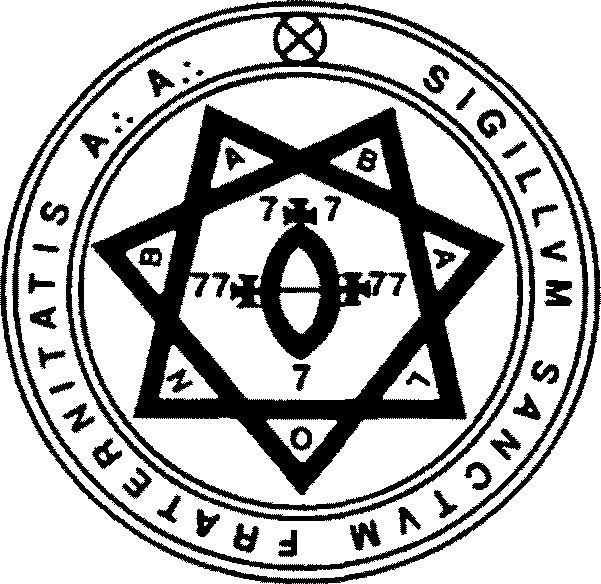
A.-.A /. Publication in Class B. Imprimatur:
N. Fra. A.-.A.-.
n 7o=4d
M. 6°=5°
S.e.S. 5°=6d

ONE STAR IN SIGHT.
Thy feet in mire, thine head in murk. Oman, how piteous thy plight.
The doubts that daunt, the ills that irk.
Thou hast nor wit nor will to fight -
How hope in heart, or worth in work'.1 No star in sight!
Thy Gods proved puppets of the priest. "Truth? Alls relation '" science sighed.
In bondage with thy brother beast.
Love tortured thee, as Love's hope died
And Love's faith rotted. Life no least Dim star descried.
Thy cringing carrion cowered and crawled To find itself a chance-cast clod
Whose Pain was purposeless; appalled That aimless accident thus trod
Its agony, that void skies sprawled On the vain sod!
All souls eternally exist, Each individual, ultimate
Perfect - each makes itself a mist Of mind and flesh to celebrate With some twin mask their tender tryst Insatiate.
Some drunkards, doting on the dream, Despair that it should die. mistake Themselves for their own shadow-scheme.
One star can summon them to wake
To self; star-souls serene that gleam On life 5 calm lake.
That shall end never that began.
All things endure because they are
Do what thou wilt, for every’ man And every woman is a star.
Pan is not dead; he liveth. Pan!
Break down the bar'
To man / come, the number of
A man my number. Lion of Light;
I am The Beast whose Law is Love.
Love under will, his royal right -Behold within, and not above.
One star in sight!
ONE STAR IN SIGHT.
SVB FIGVRA CDLXXXLX
A glimpse of the structure and system of the Great White Brotherhood.
A.-.A/.2.
Do what thou wilt shall be the whole of the Law'.
-
1. The Order of the Star called S.S. is. in respect of its existence upon the Earth, an organised body of men and women distinguished among their fellows by the qualities here enumerated. They exist in their own Truth, which is both universal and unique. They move in accordance with their own Wills, which are each unique, yet coherent with the universal will.
They perceive (that is. understand, know, and feel) in love, w hich is both unique and universal.
-
2. The order consists of eleven grades or degrees. and is numbered as follows: these compose three groups, the Orders of the S.S.. of the R.C., and of the G.D.. respectively.
The Order of the S.S.
ipsissimus.........................10c=lc
Magus................................. 9°=2D
Magister Templi8°=3
The Order of the R.C.
(Babe of the Abyss - the link)
Adeptus Exemptus70=4°
Adeptus Major6°=5
Adeptus Minor5°=6
* The Name of’ the Order and ihose of its three divisions are not disclosed to the profane. Certain swindlers have recently stolen the initials A.-. A.', in order to profit by us reputation. (But see the Introduction to the present volume. - Ed.]
The Order of the C.D.
(Dominus Liminis - the link)
Philosophus4°=7
Practicus3°=8
Zelator 2°=9°
Neophyte..........................l°=10c
Probationer...............0°=0
(These figures have special meanings to the initiated and are commonly employed to designate the grades.)
The general characteristics and attributions of these Grades are indicated by their correspondences on the Tree of Life, as may be studied in detail in the Book 777.
Student. - His business is to acquire a general intellectual knowledge of all systems of attainment. as declared in the prescribed books. (See curriculum in Appendix I.)
Probationer. - His principal business is to begin such practices as he may prefer, and to write a careful record of the same for one year.
Neophyte. - Has to acquire perfect control of the Astral Plane.
Zelator. - His main work is to achieve complete success in Asana and Pranayama. He also begins to study the formula of the Rosy Cross.
Practicus. - Is expected to complete his intellectual training, and in particular to study the Qa-balah.
Philosophus. - Is expected to complete his moral training. He is tested in Devotion to the Order.
Dominus Liminis. - Is expected to show mastery of Pratyahara and Dharana.
Adeptus (without). - Is expected to perform the Great Work and to attain the Knowledge and Conversation of the Holy Guardian Angel.
Adeptus (within). - Is admitted to the practice of the formula of the Rosy Cross on entering the College of the Holy Ghost.
Adeptus (Major). - Obtains a general mastery of practical Magick, though without comprehension.
Adeptus (Exemptus). - Completes in perfection all these matters. He then either (a) becomes a Brother of the Left Hand Path or, (b) is stripped of all his attainments and of himself as well, even of his Holy Guardian Angel, and becomes a Babe of the Abyss, who, having transcended the Reason, does nothing but grow in the womb of its mother. It then finds itself a
Magister Templi. - (Master of the Temple): whose functions are fully described in Liber 418, as is this whole initiation from Adeptus Exemptus. See also “Aha!” His principal business is to tend his “garden” of disciples, and to obtain a perfect understanding of the Universe. He is a Master of Samadhi.
Magus. - Attains to wisdom, declares his law (See Liber 1. vel Magi) and is a Master of all Magick in its greatest and highest sense.
Ipsissimus. - Is beyond all this and beyond all comprehension of those of lower grades.
But of these last three Grades see some further account in The Temple of Solomon the King, Equinox 1 to X and elsewhere.
It should be stated that these Grades are not necessarily attained fully, and in strict consecution. or manifested wholly on all planes. The subject is very difficult, and entirely beyond the limits of this small treatise.
We append a more detailed account.
-
3. The Order of the S.S. is composed of those who have crossed the Abyss: the implications of this expression mav be studied in Liber 418. the 14,h. J3lh, 12lh. 11< 10,h and 9,h /Ethyrs in particular.
All members of the Order are in full possession of the Formulas of Attainment, both mystical or inwardly-directed and Magical or outwardly-directed. They have full experience of attainment in both these paths.
They are all. however, bound by the original and fundamental Oath of the Order, to devote their energy to assisting the Progress of their Inferiors in the Order. Those who accept the rewards of their emancipation for themselves are no longer within the Order.
Members of the Order are each entitled to found Orders dependent on themselves on the lines of the R.C. and G.D. orders, to cover types of emancipation and illumination not contemplated by the original (or main) system. All such orders must, however, be constituted in harmony with the A/.A.-, as regards the essential principles.
All members of the Order are in possession of the Word of the existing .-Eon. and govern themselves thereby. They are entitled to communicate directly with any and every member of the Order, as they may deem fitting.
Every active Member of the Order has destroyed all that He is and all that He has on crossing the Abyss; but a star is cast forth in the Heavens to enlighten the Earth, so that he may possess a vehicle wherein he may communicate with mankind. The quality- and position of this star, and its functions, are determined by the nature of the incarnations transcended by him.
-
4. The Grade of Ipsissimus is not to be described fully: but its opening is indicated in Liber 1 vel Magi.
There is also an account in a certain secret document to be published when propriety' permits. Here it is only said this: The Ipsissimus is wholly free from all limitations soever, existing in the nature of all things without discriminations of quantity or quality between them. He has identified Being and not-Being and Becoming, action and non-action and tendency to action, with all other such triplicities. not distinguishing between them in respect of any conditions, or between any one thing and any other thing as to whether it is with or without conditions.
He is sworn to accept this Grade in the presence of a witness, and to express its nature in word and deed, but to withdraw Himself at once within the veils of his natural manifestation as a man, and to keep silence during his human life as to the fact of his attainment, even to the other members of the Order.
The Ipsissimus is pre-eminently the Master of all modes of existence; that is, his being is entirely free from internal or external necessity. His work is to destroy all tendencies to construct or to cancel such necessities. He is the Master of the Law of Unsubstantiality (Anatta).
The Ipsissimus has no relation as such with any Being: He has no will in any direction, and no
Consciousness of any kind involving duality, for in Him all is accomplished; as it is written “beyond the Word and the Fool, yea. beyond the Word and the Fool."
-
5. The Grade of Magus is described in Liber 1 vel Magi, and there are accounts of its character in Liber 418 in the Higher /Ethyrs.
There is also a full and precise description of the attainment of this Grade in the Magical Record of the Beast 666.
The essential characteristic of the Grade is that its possessor utters a Creative Magical Word, which transforms the planet on which he lives by the installation of new officers to preside over its initiation. This can take place only at an “Equinox of the Gods" at the end of an “Aon;" that is. when the secret formula which expresses the Law of its action becomes outworn and useless to its further development.
(Thus "Suckling" is the formula of an infant: when teeth appear it marks a new “Aon." whose "Word” is “Eating.”)
A Magus can therefore only appear as such to the world at intervals of some centuries; accounts of historical Magi, and their Words, are given in Liber Aleph.
This does not mean that only one man can attain this Grade in any one Aon. so far as the Order is concerned. A man can make personal progress equivalent to that of a "Word of the Aon;” but he will identify himself with the current word, and exert his will to establish it. lest he conflict with the w ork of the Magus who uttered the Word of the Aon in which He is living.
The Magus is pre-eminently the Master of Magick, that is. his will is entirely free from internal diversion or external opposition; His work is to create a new- Universe in accordance with His Will. He is the Master of the Law of Change (Anicca).
To attain the Grade of Ipsissimus he must accomplish three tasks, destroying the Three Guardians mentioned in Liber 418. the 3rd Athyr; Madness. and Falsehood, and Glamour, that is. Duality in Act. Word and Thought.'
-
6. The Grade of Master of the Temple is described in Liber 418 as above indicated. There are full accounts in the Magical Diaries of the Beast 666, who w as cast forth into the Heaven of Jupiter, and of Omnia in Uno, Unus in Omnibus, who was cast forth into the sphere of the Elements.
The essential Attainment is the perfect annihilation of that personality which limits and oppresses his true self.
The Magister Ternpli is pre-eminently the Master of Mvsticism. that is, His Understanding is entirely free from internal contradiction or external obscurity” His word is to comprehend the existing Universe in accordance with His own Mind. He is the Master of the Law of Sorrow (Dukkha).
To attain the grade of Magus he must accomplish Three Tasks; the renunciation of His enjoyment of the Infinite so that he may formulate Himself as the Finite; the acquisition of the practical secrets alike of initiating and governing His proposed new Universe and the identification of himself with the impersonal idea of Love.4 Any neophyte of the Order (or, as some say, any person soever) possesses the right to claim the Grade of Master of the Temple by taking the Oath of the Grade. It is hardly necessary to observe that to do so is the most sublime and awful responsibility which it is possible to assume, and an unworthy person who does so incurs the most terrific penalties by his presumption.
-
7. The Order of the R.C. The Grade of the Babe of the Abyss is not a Grade in the proper sense, being rather a passage between the two Orders. Its characteristics are wholly negative, as it is attained by the resolve of the Adeptus Exemptus to surrender all that he has and is for ever. It is an annihilation of all the bonds that compose the self or constitute the Cosmos, a resolution of all complexities into their elements, and these thereby cease to manifest, since things are only knowable in respect of their relation to. and reaction on, other things.
-
8. The Grade of Adeptus Exemptus confers authorin' to govern the two lower Orders of R.C. andG.D.
The Adept must prepare and publish a thesis setting forth His knowledge of the Universe, and
■' These refer, respectively, to the Paths of N. The Fool; 7. The Magus; and The Priestess, which attain to Kether. - Ed.
4 These three tasks refer, respectively, to the Paths of 71, The Star; t. The Hierophant; and ”, The Empress. - Ed.
his proposals for its welfare and progress. He will thus be known as the leader of a school of thought.
(Eliphas Levi’s Clef des Grands Mys teres, the works of Swedenborg, von Eckartshausen, Robert Fludd, Paracelsus, Newton. Bolyai. Hinton, Berkeley, Loyola, etc., etc., are examples of such essays.)
He will have attained all but the supreme summits of meditation, and should be already prepared to perceive that the only possible course for him is to devote himself utterly to helping his fellow creatures.
To attain the Grade of Magister Templi, he must perform two tasks5; the emancipation from thought by putting each idea against its opposite, and refusing to prefer either; and the consecration of himself as a pure vehicle for the influence of the order to which he aspires.
He must then decide upon the critical adventure of our Order: the absolute abandonment of himself and his attainments. He cannot remain indefinitely an Exempt Adept; he is pushed onward by the irresistible momentum that he has generated.
Should he fail, by wil] or weakness, to make his self-annihilation absolute, he is none the less thrust forth into the Abyss; but instead of being received and reconstructed in the Third Order, as a Babe in the womb of our Lady BaBalon. under the Night of Pan, to grow' up to be Himself wholly and truly as He w'as not previously, he remains in the Abyss, secreting his elements round his Ego as if isolated from the Universe, and becomes what is called a “Black Brother.” Such a being is gradually disintegrated from lack of nourishment and the slow but certain action of the attraction of the rest of the Universe, despite his now desperate efforts to insulate and protect himself, and to aggrandise himself by predatory’ practices. He may indeed prosper for a while, but in the end he must perish, especially when w'ith a new Aon a new word is proclaimed which he cannot and will not hear, so that he is handicapped by trying to use an obsolete method of Magick, like a man with a boomerang in a battle where everyone else has a rifle.
-
9. The Grade of Adeptus Major confers Magical Powers (strictly so-called) of the second rank.
His w'ork is to use these to support the authority of the Exempt Adept his superior. (This is not to be understood as an obligation of personal subservience or even loyalty: but as a necessary part of his duly to assist his inferiors. For the authority of the Teaching and Governing Adept is the basis of all orderly work.)
To attain the Grade of Adeptus Exemptus. he must accomplish Three Tasks"; the acquisition of absolute Self-Reliance, working in complete isolation. yet transmitting the word of his superior clearly, forcibly and subtly; and the comprehension and use of the Revolution of the wheel of force, under its three successive forms of Radiation. Conduction and Convection (Mercury, Sulphur. Salt; or Sattvas. Rajas. Tamas), with their corresponding natures on other planes. Thirdly, he must exert his whole power and authority to govern the Members of lower Grades with balanced vigour and initiative in such a way as to allow no dispute or complaint; he must employ to this end the formula called “The Beast conjoined with the Woman” which establishes a new incarnation of deity: as in the legends of Leda. Semele. Miriam, Pasiphae. and others. He must set up this ideal for the orders which he rules, so that they may possess a not too abstract rallying-point suited to their undeveloped slates.
-
10. The Grade of Adeptus Minor is the main theme of the instructions of the A.'.A.’.. It is characterised by the Attainment of the Knowledge and Conversation of the Holy Guardian Angel. (See the Equinox, The Temple of Solomon the King; The Vision and the Voice 8'1' Adhyr; also Liber Samekh. etc. etc.) This is the essential wwk of every man: none other ranks with it either for personal progress or for power to help one’s fellows. This unachieved, man is no more than the unhappiest and blindest of animals. He is conscious of his own incomprehensible calamity, and clumsily incapable of repairing it. Achieved, he is no less than the co-heir of gods, a Lord of Light. He is conscious of his own consecrated course, and confidently ready to run it. The Adeptus Minor needs little help or guidance even from his superiors in our Order.
’ These pertain, respectively, to the Paths of T, Gemini. The Lovers; and fl. Cancer. The Chariot, which attain unto Binah. - Ed.
These penain, respectively, to the Paths of Virgo, The Hermit; □. Jupiter. The Wheel of Fortune; and D, Leo. Lust, which attain unto Chesed. - Ed.
His work is to manifest the Beauty of the Order to the world, in the way that his superiors enjoin and his genius dictates.
To attain the Grade Adeptus Major, he must accomplish two tasks7; the equilibration of himself, especially as to his passions, so that he has no preference for any one course of conduct over another, and the fulfilment of every action by its complement, so that whatever he does leaves him without temptation to wander from the way of his True Will.
Secondly, he must keep silence, while he nails his body to the tree of his creative will, in the shape of that Will, leaving his head and arms to form the symbol of Light, as if to make oath that his every thought, word and deed should express the Light derived from the God with which he has identified his life, his love and his liberty - symbolised by his heart, his phallus, and his legs. It is impossible to lay down precise rules by which a man may attain to the knowledge and conversation of His Holy Guardian Angel; for that is the particular secret of each one of us; a secret not to be told or even divined by any other, whatever his grade. It is the Holy of Holies, whereof each man is his own High Priest, and none knoweth the Name of his brother's God, or the Rite that invokes Him.
The Masters of the A.-.A.'. have therefore made no attempt to institute any regular ritual for this central Work of their Order, save the generalised instructions in Liber 418 (the 8lh /Ethyr) and the detailed Canon and Rubric of the Mass actually used with success by Frater Perdurabo in His attainment. This has been written down by Himself in Liber Samekh. But they have published such accounts as those in The Temple of Solomon the King and in John St. John. They have taken the only proper course; to train aspirants to this attainment in the theory and practice of the whole of Magick and Mysticism, so that each man may be expert in the handling of all known weapons, and free to choose and to use those which his own experience and instinct dictate as proper when he essays the Great Experiment.
He is furthermore trained to the one habit essential to Membership of the A.-.A.-.; he must
These pertain, respectively, to the Paths of b. Libra. Adjustment; and E. Water. The Hanged Man. which attain unto Geburah - Ed.
regard all his attainments as primarily the property of those less advanced aspirants who are confided to his charge.
No attainment soever is officially recognised by the A.-.A.-. unless the immediate inferior of the person in question has been fitted by him to take his place.
The rule is not rigidly applied in all cases, as it would lead to congestion, especially in the lower grades where the need is greatest, and the conditions most confused; but it is never relaxed in the Order of the R.C. or of the S.S.: save only in One Case.
There is also a rule that the Members of the A.-.A.-. shall not know each other officially, save only each Member his superior who introduced him and his inferior whom he has himself introduced.
This rule has been relaxed, and a “Grand Neophyte” appointed to superintend all Members of the Order of the G.D. The real object of the rule was to prevent Members of the same Grade working together and so blurring each other’s individuality; also to prevent work developing into social intercourse.
The Grades of the Order of the G.D. are fully described in Liber 185s and there is no need io amplify w-hat is there stated. It must however, be carefully remarked that in each of these preliminary Grades there are appointed certain tasks appropriate, and that the ample accomplishment of each and every one of these is insisted upon with the most rigorous rigidity.8 9
Members of the A.-.A.-. of whatever grade are not bound or expected or even encouraged to wjork on any stated lines, or with any special object, save as has been above set forth. There is however an absolute prohibition to accept money or other material reward, directly or indirectly, in respect of any service connected with the Order, for personal profit or advantage. The penalty is immedi
8 This book is published in the Equinox Vol. Ill No. 2.
15 Liber 185 need not be quoted at length. It is needful only to say that the Aspirant is trained systematically and comprehensively in the various technical practices which form the basis of Our Work. One may become expert in any or all of these without necessarily making any real progress, just as a man might be first-rate at grammar, syntax, and prosody without being able to write a single line of good poetry, although the greatest poet in soul is unable to express himself without the aid of those three elements of literary composition.
ate expulsion, with no possibility of reinstatement on any terms soever.
But all members must of necessity work in accordance with the facts of Nature, just as an architect must allow for the Law of Gravitation, or a sailor reckon with currents.
So must all Members of the A.’.A.’. work by the Magical Formula of the ^Eon.
They must accept the Book of the Law as the Word and the Letter of Truth, and the sole Rule of Life.1" They must acknowledge the Authority of the Beast 666 and of the Scarlet Woman as in the book it is defined, and accept Their Will* 11 as concentrating the Will of our Whole Order. They must accept the Crowned and Conquering Child as the Lord of the ,€on. and exert themselves to establish His reign upon Earth. They must acknowledge that “The word of the Law is ©eJippa" and that “Love is the law, love under will."
Each member must make it his main work to discover for himself his own true will, and to do it. and do nothing else.1’
He must accept those orders in the Book of the Law that apply to himself as being necessarily in accordance with his own true will, and execute the same to the letter with all the energy, courage, and ability that he can command. This applies especially to the work of extending the Law in the world, wherein his proof is his own success, the witness of his Life to the Law. that hath given him light in his ways, and liberty to pursue them. Thus doing, he payeth his debt to the Law that hath freed him by working its will to free all men: and he proveth himself a true man in our Order by w illing to bring his fellows into freedom.
10 This is not in contradiction w ith the absolute right of every person to do his own true Will. But any True Will is of necessity tn harmony w ith the facts of Existence; and to refuse to accept the Book of the Law is to create a conflict within nature. as if a physicist insisted on using an incorrect formula of mechanics as the basis of an experiment.
11 "Their Will" - not. of course, their wishes as individual human beings, but their will as officers of the New /Eon
It is not considered "essential to right conduct" to be an active propagandist of the Law. and so on; ii may. or may not. be the True Will of any particular person to do so. But since the fundamental purpose of the Order is to further the Attainment of humanity, membership implies, by definition, the Will to help mankind by the means best adapted thereto.
By thus ordering his disposition, he will fn himself in the best possible manner for the task of understanding and mastering the divers technical methods prescribed by the A.’.A.’. for Mystical and Magical attainment.
He will thus prepare himself properly for the crisis of his career in the Order, the attainment of the Knowledge and Conversation of his Holy Guardian Angel.
His Angel shall lead him anon to the summit of the Order of the R.C. and make him ready to face the unspeakable terror of the Abyss w hich lies between Manhood and Godhead: teach him to Know that agony, to Dare that Destiny, to Will that catastrophe. and to keep Silence for ever as he accomplishes the act of annihilation.
From the Abyss comes No Man forth, but a Star startles the Earth, and our Order rejoices above that Abyss that the Beast hath begotten one more Babe in the Womb of Our Lady. His Concubine. the Scarlet Woman. Babalon.
There is no need to instruct a Babe thus bom. for in the Abyss it was purified of even' poison of personality: its ascent to the highest is assured, in its season, and it hath no need of seasons for it is conscious that all conditions are no more than forms of its fancy.
Such is a brief account, adapted as far as may be to the average aspirant to Adeptship, or Attainment. or Initiation, or Mastership, or Union with God. or Spiritual Development, or Mahat-maship. or Freedom, or Occult Knowledge, or whatever he may call his inmost need of Truth, of our Order of A.’.A. ..
It is designed principally to awake interest in the possibilities of human progress, and to proclaim the principles of the A.’. A.-..
The outline given of the several successive steps is exact; the two crises - the Angel and the Abyss - are necessary' features in every career. The other tasks are not always accomplished in the order given here; one man, for example, may acquire many of the qualities peculiar to the Adeptus Major, and yet lack some of those proper to the Practicus.1' But the system here given shows the
'■ The natural talents of individuals differ very widely. The late Sir Richard Jebb. one of the greatest classical scholars of modem times, was so inferior to the average mediocrity in mathematics, that despite repeated efforts he could not pass the “little go" at Cambridge - which the dullest of minds can usually do. He was so deeply esteemed for his classics that a
correct order of events, as they are arranged in Nature; and in no case is it safe for a man to neglect to master any single detail, however dreary and distasteful it may seem. It often does so, indeed; that only insists on the necessity of dealing with it. The dislike and contempt for it bear witness to a weakness and incompleteness in the nature which disowns it; that particular gap in one's defences may admit the enemy at the very turningpoint of some battle. Worse, one were shamed for ever if one’s inferior should happen to ask for advice and aid on that subject and one were to fail in service to him! His failure - one’s own failure also! No step, however well won for oneself, till he is ready for his own advance!
Every Member of the AA must be armed at all points, and expert with every weapon. The examinations in every Grade are strict and severe: no loose or vague answers are accepted. In intellectual questions, the candidate must display no less mastery of his subject than if he were entered in the “final” for Doctor of Science or Law at a first class University.
In examination of physical practices, there is a standardised test. In Asana, for instance, the candidate must remain motionless for a given time, his success being gauged by poising on his head a cup filled with water to the brim; if he spill one drop, he is rejected.
He is tested in “the Spirit Vision” or “Astral Journeying” by giving him a symbol unknown and unintelligible to him. and he must interpret its nature by means of a vision as exactly as if he had read its name and description in the book when it was chosen.
special “Grace" was placeted so as to admit him to matriculation. Similarly a brilliant Exorcist might be an incompetent Diviner. In such a case the A.-.A/. would refuse to swerve from Its system; the Aspirant would be compelled to remain at the Barrier until he succeeded in breaking it down, though a new incarnation were necessary to permit him to do so. But no technical failure of any kind soever could necessarily prevent him from accomplishing the Two Critical Tasks, since the fact of his incarnation itself proves that he has taken the Oath w hich entitled him to attain to the Knowledge and Conversation of his Holy Guardian Angel, and the annihilation of this Ego. One might therefore be an Adeptus Minor or even a Magister Templi. in essence, though refused official recognition by the A/. A/, as a Zelator owing to (say) a nervous defect which prevented him from acquiring a Posture which was "steady and easy" as required by the Task of that grade.
The power to make and “charge” talismans is tested as if they were scientific instruments of precision. as they are.
In the Qabalah, the candidate must discover for himself, and prove to the examiner beyond all doubt, the properties of a number never previously examined by any student.
In invocation the divine force must be made as manifest and unmistakable as the effects of chloroform; in evocation, the spirit called forth must be at least as visible and tangible as the heaviest vapours; in divination, the answer must be as precise as a scientific thesis, and as accurate as an audit; in meditation, the results must read like a specialist’s report of a classical case.
By such methods, the A.-.A.-. intends to make occult science as systematic and scientific as chemistry; to rescue it from the ill repute which, thanks both to the ignorant and dishonest quacks that have prostituted its name, and to the fanatical and narrow-minded enthusiasts that have turned it into a fetish, has made it an object of aversion to those very minds whose enthusiasm and integrity make them most in need of its benefits, and most fit to obtain them.
It is the one really important science, for it transcends the conditions of materia] existence and so is not liable to perish with the planet, and it must be studied as a science, sceptically, with the utmost energy and patience.
The A.-. Apossesses the secrets of success; it makes no secret of its knowledge, and if its secrets are not everywhere known and practised, it is because the abuses connected w ith the name of occult science disincline official investigators to examine the evidence at their disposal.
This paper has been written not only with the object of attracting individual seekers into the way of Truth, but of affirming the propriety of the methods of the A.-.A.-, as the basis for the next great step in the advance of human knowledge.
Love is the law. love under will.
O.M. 7°=4D A.-.A.-.
Praemonstrator of the Order of the R... C....
Given from the Collegium ad Spirimm Sanctum, Cefalii. Sicily, in the Seventeenth Year of the ^on of Horus, the Sun being in 23° HJ) and the Moon in 14° M.
Syllabi of the Grades of Fraterhitas A.-.A.-.
In the tabulations following, each document is specially marked (in square brackets) if it is included in any number of The Equinox JEqx], in the anthology Gems from the Equinox [GemsJ, in Magick in Theory & Practice |MT&P], in In the Continuum [ITC], in Black Pearl (BP], or in The Mystical & Magical System of the A.-.A.-. IM&MAA],
Other summaries, at the end of this Appendix, should prove helpful in locating individual documents.
STUDENT SYLLABUS
The Equinox, from No. I to the current number
Raja Yoga, by Swami Vivekananda
The Shiva Sanhita, or The Hathayoga Pradipika
Konx Om Pax
The Spiritual Guide, by Miguel de Molinos 777 '
Dogme et Rituel de la Haute Magie, by Eliphas Levi, or its translation by A. E. Waite
The Goetia or The Lemegeton of Solomon the King
Tannhauser;The Sword of Song; Time; Eleusis. by A. Crowley
The Book o f the Sacred Magic of Abra-melin the Mage
The Tao Teh Ching
The Writings of Kwang Tze
PROBATIONER (0°=0D) SYLLABUS
Class A :
Class B:
X Liber Porta Lucis (Eqx 1:6.111:9, Gems, M&MAA]
XC Liber Tzaddi [Eqx 1:6,111:9, Gems]
LXV Liber Cordis Cincti Serpente [Eqx 111:1, 9. IV-.l. ITC 1:7-11:1]
CCXX Liberia vel Legis, The Book ofthe Law |Eqx 1:10.111:9,10. Gems]
CCCLXX Liber A ’ash vel Capricorni Pneumatici [Eqx 1:6.111:9, Gems, MT&P]
VI Liber O vel Manus et Sagitta? (Eqx 1:2, Gems. MT&P. M&MAA]
IX Liber E vel Exercitiorum |Eqx 1:1, Gems, MT&P, M&MAA]
XXI Khing Kang King |1TC V:6]
XXX Liber Libres (Eqx 1:1,111:10, Gems, M&MAA, ITC 1V:4, BP 1:1]
L.V1I1 Gematria (from “The Temple of Solomon the King") [Eqx 1:5]
LXIV Liber Israfel [Eqx 1:7, Gems. BP 1:2]
LXXI The Voice of the Silence (with commentary bv Fra. O.M.) [Eqx
111:1, IV:1, Gems] ’
LXXVI11 A Description of the Cards of the Tarot |Eqx 1:8]
LXXXIV Liber Chanokh [Eqx 1:7-8, Gems]
XCV1 Liber Gaias, A Handbook of Geomancy [Eqx 1:2]
CXI Liber Aleph, The Book of Wisdom & Follv [Eqx 111:6]
CLV1I Tao Teh Ching [Eqx 111:8] ’
CLXV A Master of the Temple |Eqx 111:1, Gems]
CCVI1 A Syllabus of the Official Instructions of A .'.A& Curricula of the Grades1
CCXV1 The Book of Changes |Eqx 111:7]
CCCXXV An Evocation of Bartzabal. the Spirit of Mars 2
CDLXXIV Liber Os Abvsmi vel Da ath [Eqx 1:7, Gems]
CDLXXX1X One Star in Sight2' [MT&P. Gems, M&MAA, Eqx IV:1)
D Sepher Sephiroth |Eqx 1:8]
DXXXVI Liber Bcnpoxo<|)pEvo[)OOKoapopaxio [Eqx 1:10. Gems]
’ Class B designation, and the present form of Liber CC VI1. are distinctive to the Soror Estai lineage.
' Originally, neither catalogue number nor Document Class was assigned to An Evocation of Bartzabal. These have been assigned internally within the Soror Estai lineage.
’ Originally, neither catalogue number nor Document Class was assigned to One Star in Sight. These have been assigned internally within the Soror Estai lineage.
Class A-B:
Class C:
Class D:
Class E:
Unclassified:
DCLXVI Liber Artemis Iota vel De Coitu Scholia Trivice DCCLXXVU 777
DCCCLXVIII Liber Viarum Vice |Eqx 1:7, Gems]
CMXI1I Liber Thisharb, Vice Memorice (Eqx 1:7, Gems, MT&P]
MCCLX1V The Greek Qabalah
[no number] The Book of Thoth
[no number] The Heart of the Master
[nonumber] Little Essays Towards Truth
CDXV Opus Lutetianum, The Paris Working (Eqx 1V:2]
CDXV1II Liber XXX /Erum vel Sceculi. The Vision & the Voice |Eqx 1:5.1V:2.
Gems]4
CMLXII1 ©Eoaupou EiSwXwv |Eqx 1:3]
XXXI11 An Account of the A .-.A[Eqx 1:1.1V:1, Gems, M&MAA]
III Liber Jugorum (Eqx 1:4, Gems|
XIII Graduum Montis Abiegni (Eqx 1:3. IV:1, Gems, M&MAA]
XXV The Star Ruby |Gems. MT&P, 1TC 11:3.111:3]
LX1 Liber Causa (Eqx 111:1, 9, Gems]
CLXXV Liber Astarte vel Bervlii |Eqx 1:7, Gems, MT&P]
CC Liber Resh vel Helios (Eqx 1:6, Gems. MT&P. 1TC 1:5. M&MAA]
CCVI Liber 11 vel Spiritus (Eqx 1:7, Gems, MT&P]
CDXII Liber A vel Armorum (Eqx 1:4, Gems, MT&P]
II The Message of the Master Therion |Eqx 111:1. 10]
CL De Lege Libellum |Eqx 111:1,10.Gems.ITC 1:2]
CCC Khabs am Pekht |Eqx 111:1.10. Gems|
DCCCXXXVI] The Law of Liberty [Eqx 111:1. 10. Gems. 1TC V:9]
IV Liber ABA. Book Four (Parts 1-IV)
[no number] Postcards to Probationers |Eqx 1:2. Gems, M&MAA]
NEOPHYTE (l°=10°) SYLLABLS
CLASS A:
CLASS B:
CLASS C:
CLASS D:
VII ccxx
VI IX LXXVIII XCV1 CDLXXIV DCCCXI XIII XXVIII
CLXXXV CCCXL1 CDXII DCLXXI DCLXX1
UNCLASSIFIED: [no number]
Liber Liberi vel Lapidis Lazuli, Adumbratio Kabbala (Eqx 111:9] Liber vel Legis. The Book of the Law |Eqx 1:10,111:9, 10. Gems] Liber O vel Manus el Sagitta (Eqx 1:2. Gems. MT&P. M&MAA] Liber E vel Exerciriorum (Eqx 1:1. Gems. MT&P, M&MAA] A Description of the Cards of the Tarot (Eqx 1:8]
Liber Gaias. A Handbook of Geomancy (Eqx 1:2]
Liber Os Abysmi velVX!~\ |Eqx 1:7. Gems]
Energized Enthusiasm (Eqx 1:9. Gems|
Graduum Montis Abiegni |Eqx 1:3. IV:1. Gems, M&MAA]
Liber Septem Regum Sanctorum (unpublished)
Liber Collegii Sancti (Gems. M&MAA. Eqx IN’: 1 ]
Liber H.H.H. (Eqx 1:5. Gems. MT&P, M&MAA]
Liber A vel Armorum |Eqx 1:4, Gems. MT&P]
Liber NTTD (unpublished); includes DCLXXII through DCLXXV1 Liber Pyramidos ]Eqx IV:1 ]
The Equinox Ritual (unpublished)
Also, serialized, with astrological and Qabalistic commentary, in BLACK PEARL. Vol. I. Nos. 1-10. Also published, as an Appendix, in the College of Thelema’s edition of John St. John.
ZELATOR (2°=9n) SYLLABUS
CLASS A: CLASS B: |
ccxx EX CMX111 |
Libert vel Legis. The Book of the Law |Eqx 1:10.111:9. 10. Gems Liber E vel Exercitiorum (Eqx 1:1. Gems. MT&P. M&MAA] Liber Thisharb, Vice Memorize (Eqx 1:7. Gems. MT&P] |
CLASS A-B: |
CMLX111 |
Ocooupou Ei8u)Au>v (Eqx 1:3] |
CLASS C: |
CCCXXX111 DCCCX1 |
The Book of Lies. falsely so-called Energized Enthusiasm (Eqx 1:9. Gems] |
CLASS D: |
111 Xlll XVII XXXVI cxx CLXXXV CCV1 CCCLX1 CDX11 |
Liber Jugorum (Eqx 1:4, Gems. M&MAA] Graduum Montis Abiegni |Eqx 1:3. 1V:1. Gems. M&MAA] Liber LA.0. (unavailable) The Star Sapphire [Gems. MT&P. 1TC V:4] Liber Cadaveris (unpublished) Liber Coilegii Sancti |Gems. M&MAA, Eqx 1V:1] Liber "in vel Spiritis |Eqx 1:7. Gems] Uber H.H.H. |Eqx 1:5. Gems. MT&P. M&MAA] Liber A vel Armorum (Eqx 1:4. Gems] |
PRACTICUS (3°=8d) SYLLABUS
CLASS A: XXVII CCXX CCXXI CD CLASS B: LV111 LX IV LXXX1V D DXXXV1 DCCLXXV11 CLASS C: LXV11 MMCMX1 CLASS D: Ill Xlll XVI CLXXXV CCCXL1 CDX11 |
Liber Tngrammaton |Eqx 111:9] Libert vel Legis, The Book of the Law ]Eqx 1:10.111:9. 10. Gems] Liber Arcanorum tov Atu too Tahuti Quas Vidit Asar in Amenti sub figurd CCXXXL Liber Carcerorum Tuv Qliphoth Cum Sins Geniis. Adduniunt Sigilla et Nomina Eorum. |Eqx 1:7,111:9. Gems] Liber Tav vel Kabbalce Trium Literarum |Eqx 1:7.111:9. Gems. ITC 11:10] Gemairia |Eqx 1:5] Liber Israfel (Eqx 1:7. Gems. BP 1:2] Liber Chanokh. A Brief Abstract of the Symbolic Representation of the Universe |Eqx 1:7-8. Gems] Sepher Sephiroth (Eqx 1:8] Liber BoTpoxoppcvo^ooKoopopaxio |Eqx 1:10. Gems] 777 The Sword of Song |1TC 1V:1O V:4] A Note on Genesis |Eqx 1:2] Liber Jugorum |Eqx 1:4. Gems. M&MAA] Graduum Montis Abiegni |Eqx 1:3.1V:1. Gems, M&MAA] Liber Turris vel Domus Dei |Eqx 1:6. Gems) Liber Coilegii Sancti |Gems. M&MAA. Eqx IV:1| Liber H.H.H. |Eqx 1:5. Gems. MT&P. M&MAA) Liber A vel Armorum (Eqx 1:4. Gems. MT&P) |
PHILOSOPHUS (4°=7°) SYLLABUS
CLASS A:
CLASS B:
CLASS C:
CLASS D:
ccxx DCCCX11I
VI cccxxv
LV
LIX
LXVII CXCVII
CCXLII CCCXXXV III
XIII
XVI CLXXV CLXXXV CDXI1
UNCLASSIFIED: V
XLV1
Liberia vel Legis, The Book of the Law |Eqx 1:10. 111:9, 10, Gems]
Liber Ararita sub figura DLXX |Eqx III:9|
Liber O vel Manus et Sagittce |Eqx 1:2, Gems, MT&P, M&MAA]
An Evocation of Bartzabal, the Spirit of Mars^
The Chymical Jousting of Brother Perardua |Eqx 1:1]
Across the Gulf\Eqx I:7|
The Sword of Song |ITC IV:10-V:4|
The High History of Good Sir Palamedes the Saracen Knight and of his following of the Questing Beast |Eqx 1:4]
Aha! |Eqx 1:3]
Adonis |Eqx 1:7]
Liber Jugorum |Eqx 1:4, Gems, M&MAA|
Graduum Montis Abiegni |Eqx 1:3, IV:1. Gems, M&MAA]
Liber Turris vel Domus Dei |Eqx 1:6, Gems|
Liber Astarte vel Berylli |Eqx 1:7, Gems, MT&P]
Liber Collegii Sancti |Gems, M&MAA, Eqx IV: 1 ]
Liber A vel Armorum |Eqx 1:4, Gems, MT&P]
(Science & Buddhism in this instance) |ITC 11:3]
The Key of the Mysteries |Eqx 1:10]
DOMINUS LIMINIS SYLLABUS
CLASS A: CCXX
CCCLXX
CLASS C:
CLASS D:
xcv DCCCLX 111
VIII
XI
XIII CLXXXV CDXI1 DLV
DCCCXXX1 [no number]
Liber vel Legis, The Book of the Law |Eqx 1:10.111:9, 10, Gems|
Liber A ash vel Capricorni Pneumatic! |Eqx 1:6.111:9. Gems,
MT&P|
The Wake World
John St. John |Eqx 1:1]
Liber Jugorum |Eqx 1:4, Gems, M&MAA|
The 8th Athyr |Eqx 1:5. IV: 1. Gems. BP 1:6]
Liber Nu |Eqx 1:7, Gems]
Graduum Montis Abiegni |Eqx 1:3, IV:1, Gems. M&MAA]
Liber Collegii Sancti |Gems, M&MAA. Eqx IV: 1 ]
Liber A vel Armorum |Eqx 1:4. Gems, MT&P]
Liber H A D |Eqx 1:7, Gems]
Liber IOD |Eqx 1:7, Gems|
Liber Mysteriorum (unpublished)8
h Originally, neither catalogue number nor Document Class was assigned to An Evocation of Bartzabal. the Spirit of Mars. These have been assigned internally within the Soror Estai lineage, and the instruction assigned to the Grade of Philosophus.
An edition of John St. John is published by the College of Thelema.
' Traditionally unclassified. Class D within Soror Estai lineage.
ADEPTUS MINOR (5°=6D) SYLLABUS
Without
CLASS A: CCXX
CLASS D: VIII
XIII CLXXXV DCCC
Liberia vei Legis, The Book of the Law |Eqx 1:10.111:9,10. Gems]
The 8th AEthyr |Eqx 1:5, IV:1, Gems. M&MAA]
Graduum Montis Abiegni |Eqx 1:3. IV: 1. Gems. M&MAA|
Liber CollegiiSanai (Gems. M&MAA. Eqx IV: 1]
Liber Samekh |Gems, MT&P]
Within
CLASS A: |
CCXX |
Liberia vel Legis, The Book of the Law |Eqx 1:10.111:9, 10. Gems] |
CLASS B: |
XXX |
Liber Libra ]Eqx 1:1.111:10. Gems. M&MAA. BP 1:1] |
CLASS D: |
CDL1 |
Liber Siloam (unpublished) |
DCCC |
Liber Samekh |Gems, MT&P] |
|
DCCCXI |
Liber Collegii Internii (unavailable) |
ADEPTUS MAJOR (6°=5D) SYLLABUS
CLASS A:
CLASS B:
CLASS C:
CLASS D:
I
LXV1
CLVI
CCXX
VI
DCCCLXV1II
XL1
XL1V
DCCCXJ
Liber B vel Magi |Eqx 1:7,111:9.10. Gems. MT&P]
Liber Stella Rubece |Eqx 1:7.111:9, Gems. BP 1:7]
Liber Cheth vel Vallum Abiegni |Eqx 1:6.111:9. Gems. MT&P]
Libert# vel Legis, The Book of the Law |Eqx 1:10.111:9,10, Gems]
Liber O vel Sagitta |Eqx 1:2, Gems, MT&P, M&MAA]
Liber Viarum Via |Eqx 1:7, Gems]
Thien Tao
The Mass of the Phoenix (Gems, MT&P]
Liber Collegii Internii (unavailable)
ADEPTUS EXEMPTUS (7°=4D) SYLLABUS
CLASS A:
CLASS B:
CLASS D:
CLVI CCXX CDLXX1V CMXI1I DCCCX1
Liber Cheth vel Vallum Abiegni |Eqx 1:6,111:9. Gems, MT&P]
Liber vei Legis, The Book of the Law |Eqx 1:10,111:9, 10, Gems]
Liber Os Abysmi ve/FWl |Eqx 1:7. Gems]
Liber Thisharb. Via Memoria |Eqx 1:7, Gems]
Liber Collegii Internii (unavailable)
OFFICIAL INSTRUCTIONS FOUND IN THE EQUINOX
Vol. I, No. 1:
Account of the A.’.A.'., An
Chymical Jousting of Brother Perardua, The
John St. John
Liber E vel Exercitiorum
Liber Libra
Vol. I, No. 2:
Liber Gaias. A Handbook of Geomancy
Liber O vel Manus et Sagitta
Note on Genesis. A
Postcards to Probationers
Vol. I, No. 3:
Aha!
Liber Graduum Montis Abiegni
Thesaurou Eidolon
Vol. I, No. 4:
High History of Good Sir Palamedes the Saracen Knight. The
Liber A vel Armorum
Liber Jugorum
Vol. I. No. 5:
Gematria (from “The Temple .of Solomon the King")
Liber H.H.H.
Liber XXX Xrum vel Saculi, The Vision & the Voice
Vol. 1. No. 6:
Liber A ash vel Capricorni Pneumatici
Liber Cheth vel Vallum Abiegni
Liber Porta Lucis
Liber Resh vel Helios
Liber Turris vel Domus Dei
Liber Tcaddi
Vol. 1. No. 7:
A cross the Gulf
Adonis
Liber Area norum
Liber B vel Magi
Liber Chanokh. Part 1
Liber H A D
Liber 1OD
Liber Israfel
Liber Nu
Liber Os Abysmi vel Da ath
Liber T) vel Spiritus
Liber Stella Rubea
Liber Tav vel Kabbalce Trium Literatim
Liber Thisharb, Vice Memoriae
Liber Viarum Vice
Vol. I, No. 8:
A Description of the Cards of the Tarot
Liber Chanokh. Part II
Sepher Sephiroth
Vol. 1, No. 9:
Energized Enthusiasm
Vol. 1. No. 10:
Key of the Mysteries. The
Liber BaipaxotfipEvopooKoapopoxiO
Liber vel Legis. The Book of the Law
Vol. Ill, No. 1: The “Blue” Equinox9
De Lege Libellum
Khabs am Pekht
Law of Liberty. The
Liber Causae
Liber Cordis Cincti Serpente
Master of the Temple. A
Message of the Master Thenon. The
Open Letter to those who may wish to join the Order. An
Syllabus
Voice of the Silence, The
Vol. III. No. 2: [reached prepress galley stage, but never published]
-
V ol. Ill. No. 3: The Equinox of the Gods (a.k.a. Book Four. Part IV)
-
V ol. HI. No. 4: Eight Lectures on Yoga
-
V ol. III. No. 5: The Book of Thath
-
V ol. III. No. 6: Liber Aleph. The Book of Wisdom & Folly
-
V ol. III. No. 7: The Book of Changes
-
V ol. III. No. 8: Tao Teh Ching
-
V ol. Ill, No. 9: The Holy Books of Thelema
Liber Causae
Liber B vel Magi
Liber Liberi vel Lapidis Lazuli. Adumbratio Kabbalce
Liber Trigrammaton
Liber Porta Lucis
Liber Cordis Cincti Serpente
Liber Stella? Rubece
Liber Tzaddi
Liber Cheth vel Vallum Abiegni
Liber vel Legis, The Book of the Law
' Crowley sometimes referred to Vol. 111. No. 1 as EQUINOX XI. We often follow his lead in this. Thus, with all respect to the issues which came later, the "classic" EQUINOX consists of eleven issues.
Liber Arcanorum tujv Atu rou Tahuti Quas Vidit Asar inAmenti
Liber A ’ash vel Capricorni Pneumatici
Liber Tav vel Kabbalce Trium Literarum
Liber Ararita sub figura DLXX
Vol. Ill, No. 10: The “New Blue” Equinox
De Lege Libellum
Khabs am Pekht
Law of Liberty, The
Liber vel Legis, The Book of the Law
Liber B vel Magi
Liber Librae
Message of the Master Therion. The
Vol. IV, No. 1: Commentaries on the Holy Books & Other Papers
Account of A .'.A An
Liber Collegii Sancti
Liber Cordis Cincti Serpenre
Liber Graduum Montis Abiegni
Liber Pvramidos
Liber VIII
One Star in Sight
Voice of the Silence, The
Vol. IV. No. 2: The Vision & the Voice with Commentary & Other Papers
Ab-ul-Diz Working, The
Bartzabel Working, The1"
Opus Lutetianum. The Paris Working
Vision & the Voice, The
Official Instructions found in Magick in Theory & Practice
(NOTE: MT&P is Book Four. Part III.)
Liber A vel .4 rmorum
Liber Astarte vel Berylli
Liber A 'ash vel Capricorni Pneumatici
Liber B vel Magi
Liber Cheth vel Vallum Abiegni
Liber E vel Exercitiorum
Liber H.H.H
Liber O vel Manus et Sagittae
Liber Reguli
Liber Resh vel Helios
Liber IT vel Spiritus
Liber Samekh 111
111 The Chiefs both of the A.'. A.', lineage that has undertaken to publish EQUINOX Vol. IV. and of the Soror Estai lineage, have designated An Evocation of Bartzabal. the Spirit of Mars as Liber 325. The ruo versions, however, are not identical. The version in EQUINOX 1V:2 is actually a retitled expansion of the original version published in EQUINOX 1:9. to include diary7 notes and other supplemental material. Because it was packaged as a diary, they gave it a Class C designation. On the other hand, we have continued to circulate the original, and have designated it as Class B. on the basts that it represents an example or model on which to construct other rituals of its type. The original publication had neither Document Class nor number assigned.
Liber Thisharb, Vice Memorite
Mass of the Phoenix, The
Star Ruby, The
Star Sapphire, The
Official Instructions published only as “Stand-alone” publications
777
Khing Kang King
The Book of Lies, falsely so-called
The Greek Qabalah
Official Documents Contained Only in Other Works
Liber Artemis lota vel De Coitu Scholia Trivia1
is contained in Magick Without Tears.
Science & Buddhism and The Sword of Song
are in The Collected Works of Aleister Crowley.
The Wake H or Id and Thien Tao
are contained in Konx Om Pax.
De Nuptiis Secretis Deorum cum Hominibus; De Katura Deorum: Liber Agape vel C vel Acoth;
and De Homunculo are high degree O.T.O. papers once illicitly published.
Unpublished Documents - Available through A.'.Aa Initiators to qualified candidates
Liber Septem Regum Sanctorum
Liber Ninn
The Equinox Ritual
Liber Cadaver is
Liber Mysteriorum
Liber Siloam
Catalogue of Official Documents FRATERTilTAS AA
CLASS A
Class A consists of books of which may be changed not so much as the style of a letter: that is, they represent the utterance of an Adept entirely beyond the criticism of even the Visible Head of the Organization. (All are included in The Holy Books of Thelema. Those marked by * are contained in OEAHMA. published by College of Thelema.)
|
1 1 |
Liber B vel Magi (Book B. or The Book of the Magus) This is an account of the Grade of Magus, the highest grade that it is ever possible to manifest in any way whatever upon this plane: or so it is said by the Masters of the Temple. |6C=5D| |
|
vii i |
7 |
Liber Liberi vel Lapidis Lazuli. Adumbratio Kabbalae /Egyptiorum (The Book o f Wine. or The Book of Lapis Lazuli. Outline of Egyptian Qabalah) An account of the voluntary emancipation of a certain Exempt Adept from his Adeptship. These are the birth words of a Master of the Temple. The nature of this book is sufficiently explained by its title. It gives in magical language an account of the initiation of a Master of the Temple. Its seven chapters are referred to the seven planets in the following order: Mars. Saturn. Jupiter. Sol. Mercury’. Luna. Venus. This book is the only parallel, for beauty of ecstasy, to Liber LXV |l°=10D| |
X |
10 |
Liber Porta Lucis (The Book of the Gate of Light) This book is an account of the sending forth of the Master by the Ac. A.-, and an explanation of his mission. |0°=0Dl |
xxvn i |
Liber Trigrammaton (The Book of Trigrams) A book of Trigrams of the mutations of the Tao with the Yin and the Yang. An account of the cosmic process: it describes the course of Creation under the figure of the interplay of three principles. The book corresponds to the “Stanzas of Dzyan" in another system. |3C=8D] |
|
LXV ; |
65 |
Liber Cordis Cincti Serpente (The Book of the Heart Girt with a Serpent) An account of the relations of the aspirant with her Holy Guardian Angel. This book is given to Probationers, as the attainment of the Knowledge and Conversation of the Holy Guardian Angel is the Crown of the Outer College. (Similarly Liber 7 is given to Neophytes, as the grade of Master of the Temple is the next resting-place, and Liber 220 to Zelatores. since that carries her to the highest of all possible grades. Liber 27 is given to the Practicus. as in this book is the ultimate foundation of the highest theoretical Qabalah. and Liber 813 to the Philosophus. as it is the foundation of the highest practical Qabalah.) |0°=0D] |
LXV] ; |
66 |
Liber Stellae Rubeae (The Book of the Rubv Star) A secret ritual, the Heart of 1AO-OA1. delivered unto V.V.V.V.V. for his use in a certain matter of Liber Legis. and written down under the figure LXVI. |6°=5°| |
xc |
90 |
Liber Tzaddi vel Hamus Hermeticus (Book Tzaddi. or The Book o f the Hermetic Fish-Hook) An account of Initiation, and an indication as to those who are suitable for the same. |0°=0D] |
CLVI + |
156 |
Liber Cheth vel Vallum Abiegni (Book Cheth, or The Book of the Wall of Abiegnus) This book is a perfect account of the task of the Exempt Adept, considered under the symbols of a particular plane, not the intellectual. |6°=5°| |
ccxx + |
220 |
Liber ’PN vel Legis (Book El. or The Book of the Law) This book is the foundation of the New ?Eon. and thus of the whole of our Work. |ALL GRADES) |
CCXXXI |
231 |
Liber Arcanorum twv Atu tou Tahuti Quas Vidit Asar in Amennti sub figura CCXXXI Liber Carcerorum tuiv Qliphoth Cum Suis Geniis. Adduntur Sigilia et Nomina Eorum. (The Book of the Mysteries of the Atus of Tahuti Whereby Asar Makes His Way-Through Ammenti. The Book of the Prisons of the Qlippoth, with Their Own Spirits. Also includes (though not in the main title) Liber XX11 Domarum Mercurii Cum Suis Geniis, The Book of the Houses of Mercury with Their Own Spirits.) This is an account of the cosmic process so far as it is indicated by the Tarot Trumps. |3°=8D] ' |
CCCLXX * |
370 |
Liber A’ash vel Capricorni Pneumatici (The Book of Creation, or The Book of the Goat of the Spirit) Contains the true secret of all practical magick. |0°=0D, DomLim] |
CD |
400 |
Liber Tav vel Kabbalae Trium Literarum (Book Tav. or The Book of the Qabalah of Three Letters) A graphic interpretation of the Tarot on the plane of initiation. |3°=8D] |
DCCCXI1I J |
813 |
Liber Ararita sub figura DLXX This book is an account of the Hexagram and the method of reducing it to the Unity , and Beyond. It describes in magical language a very secret process of Initiation. |4°=7Dj " |
CLASS B
Class B consists of books or essays which are the result of ordinary-scholarship, enlightened and earnest.
(ALL Class B Documents are included in the Probationer curriculum of the A/.A.-..)
[no number] [no number] [no number]
The Book ofThoth The Heart of the Master Little Essays Towards Truth
VI 6 Liber O vel Manus et Sagittae (Book O. or The Book of the Hand & rhe Arrow)
Instructions given for elementary' study of the Qabalah. Assumption of God-forms. Vibration of Divine Names, the Rituals of Pentagram and Hexagram and their uses in protection and invocation, a method of attaining astral visions so-called, and an instruction in the practice called Rising on the Planes. |l°=10D, 4°=7D, 6°=5DJ
IX |
9 Liber E vel Exercitiorum IBook E, or The Book of Exercises/ This book instructs the aspirant in the necessity of keeping a record. Suggests methods of testing physical clairvoyance. Gives instruction in asana, pranayama and dha-rana. and advises the application of tests to the physical body, in order that the student may thoroughly understand her own limitations. 11 °=10D. 2°=9D] |
XXI |
Khing Kang King, or The Classic of Purity By Ko Hsuen. A new translation from the Chinese by the Master Therion. |
XXIV |
24 De Nuptiis Secretis Deorum cum Hominibus (On the Secret Marriages of Gods with Men) (O.T.O.) A Secret Instruction of the Vlllc of O.T.O. This instruction is not officially published. |
XXX |
30 Liber Librae (The Book of the Balance/ An elementary course of morality suitable for the average person. |5=6] |
LVI11 |
58 “The Temple of Solomon the King” A magical biography of Fra. Perdurabo and his early career, including his Path of Initiation, the reception of The Book of the Law. and his crossing of the Abyss: serialized in The Equinox, Vol. 1. It contains many useful rituals, and summaries of the studies and practices that marked his course. |
[LV1I1] |
[58] “Gematria” This is an article on the Qabalah in “The Temple of Solomon the King," Equinox V. |3C=8°] “ |
LXIV |
64 Liber Israfel An instruction in a suitable method of preaching. An example of ceremonial invocation of a God-force. (Formerly called Liber Anubis.) |3°=8D] |
LXX1 |
71 The Voice of the Silence / The Two Paths / The Seven Portals (H.P. Blavatsky) With an elaborate commentary by Frater O.M.. 7C=4C. the most learned of all the Brethren of the Order, who had given eighteen years to the critical study of this masterpiece. |
LXXVII1 |
78 A Description of the Cards of the Tarot A complete treatise on the Tarot, giving a description of the correct designs of the cards with their attributions and symbolic meanings on all the planes. Also includes a method of divination by their use. 11 °=10D] |
LXXXIV |
84 Liber Chanokh (The Book of Enoch) A brief abstraction of the Symbolic representation of the Universe derived by Dr. John Dee through the scrying of Sir Edward Kelley. |3°=8D] |
XCVI |
96 Liber Gaias, A Handbook of Geomancy (The Book of the Earth) Gives a simple and fairly satisfactory' system of divination by Geomancy. 11 °=10Dj |
CI |
101 An Open Letter to those who may wish to join the Order (O.T.O.) A promulgation of O.T.O.. enumerating the duties and privileges of membership therein. |
CXI |
111 Liber Aleph, The Book of Wisdom or Folly An extended and elaborate commentary on The Book of the Law, in the form of a letter from the Master Therion to his magical son. This book contains some of the deepest secrets of initiation, with a clear solution of many cosmic and ethical problems. |
CLV11 |
157 Tao Teh Ching A new translation, with a commentary, by the Master Therion. This is the most exalted and yet practical of the Chinese classics. |
CLXV |
165 A Master of the Temple An account of the attainment of a Master of the Temple: given in full detail by Frater O.l.V.V.I.O. This is the Record of a man who actually attained by the system taught by the AA. |
CCV1I |
207 A Syllabus of the Official Instructions of A.-.A.-. & Curricula of the Grades. An enumeration of the Official Publications of the AA.'. with a brief description of the contents of each book joined to the assigned curricula of the various Grades. This paper, in its present form, is a modem composite and expansion of two earlier, less complete papers. It was administratively revised by the Imperator of the Soror Estai lineage of A.-.A.*. in 1997 E.V.. and internally assigned to Class B. (The original Liber 207 is the Syllabus published in Equinox X. The original Curriculum was published in Equinox XI.) |
CCXV1 |
216 The 1 Ching (The Book of Changes) A new translation, with a commentary-, by the Master Therion. Confucius said that if his life were to be prolonged by a few years, he would give fifty of them to the study of this book. |
CCXXVI1I |
228 De Natura Deorum (On the Nature of the Gods) (O.T.O.) A Secret Instruction of the Vllc of O.T.O. This instruction is not officially published. |
cccxxv |
325 An Evocation of Bartzabal. the Spirit of Mars. Its nature is sufficiently explained by its title. |4°=7D] tOriginallv. neither catalogue number nor Document Class was assigned. These have been assigned mternaliv within the Sor. Estai lineage. .4 "classic" list of official documents would not include this Document.) |
CCCLXVI1 |
367 De Homunculo (On the Homunculus) (O.T.O.) A Secret Instruction of the Xc of O.T.O. This instruction is not officially published. |
CDLXXIV |
474 Liber Os Abysmi vel DID (The Book of the Mouth of the Abyss, or The Book of Dad th) An instruction in a purely intellectual method of entering the Abyss. |l°=10D, |
CDLXXX1X |
489 One Star in Sight A glimpse of the structure and system of the Great White Brotherhood. A.-.A.-.. The best description available of the Tasks of the Grades of the Orders R.’.C.’. and S.-.S.-.. and the practical substitute for Liber Collegii Interni. |ALL GRADES] (Originally, neither catalogue number nor Document Class was assigned. These have been assigned internally within the Sor. Estai lineage. A "classic " list of official documents would not include this Document, except through ns inclusion in Magick in Theory & Practice.) |
D 400 Sepher Sephiroth
A dictionary of Hebrew words arranged according to their numerical value. [3°=8D|
DXXXV1 536 Liber Borrpaxo^pEvoPooKoopopaxta
(The Book of the Battle of the Frog, the Mind, the Roar, and the Universe/ An instruction in expansion of the field of the mind. |3°=8Q)
DCLXV1 666 Liber Artemis lota vel De Coitu Scholia Triviae
(The Book of Artemis lota; or. On Sexual Union, Commentaries on Trivia)
An essay on sex-morality, and the relationship of its instincts and forces to the Path of Attainment. (Trivia is not the English isonym. but a variant Latin name of the goddess Diana, or Artemis.)
DCCLXXVI1 777 777 vel Prolegomena Symbolica ad Systemam Sceptico-Mysticae Via- Expli-candae. Fundamentum Hieroglyphicum Sanctissimorum Scientiae Summa* (A Compilation of Symbols. Towards a Systematization of the Skeptical-Mystical Bar Set Forth. A Hieroglyphic Foundation of the Most Holy Things of the Higher Knowledge)
A complete dictionary of the correspondences of all magical elements, reprinted with extensive additions, making it the only standard comprehensive book of reference ever published. It is to the language of occultism what Webster or Murray is to the English language. |3°=8DJ
DCCCLXV1II 868 Liber Viarum Viae (The Book of the Byways of Life)
A graphic account of magical powers, classified under the Tarot trumps. |6°=5a)
CMX1II 913 Liber Thisharb. Viae Memoriae (The Book of the Journey of the Memory)
Gives methods of attaining the magical memory or memory of past lives, and an insight into the function of the aspirant in this present life. |2°=9D, 7°=4°]
MCCLXIV 1.264 The Greek Qabalah
A complete dictionary of all sacred and important words and phrases given in the Books of the Gnosis and other important writings, both in the Greek and the Coptic.
CLASS A-B
Some publications are composite, and pertain to more than one class.
CDXV 415 Opus Lutetianum (The Paris W orking)
The Book of the High Magick Art that was worked by Frater O.S.V. 6C=5D and Frater L.T. 2C=9C. (Lutetia is the name originally given to Paris by the Celts, and by which it was first know n to the Romans.) |0°=0D]
CDXV1J] 418 Liber XXX .Erum vel Saeculi, The Vision and the Voice
Being the Vision and the Voice of the Angels of the thirty /Ethyrs. Besides being the classical account of the thirty /Ethyrs and a model of all visions, the cries of the Angels should be regarded as accurate, and the doctrine of the function of the Great White Brotherhood understood as the foundation of the aspiration of the Adept. The account of the Master of the Temple, in particular, should be taken as authentic.
The instruction in the 801 £thyr pertains to Class D; that is. it is an official ritual. The same remarks apply to the account of the proper method of invoking the i€thyrs given in the 18th JEthyr. |0°=0D]
C-L^tSS 2nd B
CMLX1II 963 ©Eaaupou ElSwAwv (The Treasure-House of Images)
Ecstatic hymns to the 12 Signs of the Zodiac, by Fra. N.S.F. They are a most astonishing achievement in symbolism. The effect is to carry away the performer into the sublimest ecstasy. It possesses all the Magick of oriental religious rites, but the rapture is purely religious. It is not to be confused with eroticism, and that although manv of the svmbols are of themselves violently erotic. (Only the short note pertains to Class A.) |6°=0° 2°=9°] ' ’
CLASS C
Class C consists of matter that is to be regarded rather as suggestive than anything else.
XXXI11 |
33 An Account of A A First written in the language of his period by the Councilor Von Eckartshausen. and now revised and rewritten in the Universal Cipher. An elementary suggestive account of the work of the Order in its relation to the average peson. |0°=0D] |
XLI |
41 Thien T ao (The Way of Heaven), or The Synagogue of Satan An advanced study of attainment by the method of equilibrium on the ethical plane. |6°=5D] ’ ' |
LV |
55 The Chymical Jousting of Brother Perardua An account of the mystical and magical Path in the language of Alchemy. |4°=7°| |
L1X |
59 Across the Gulf A fantastic account of a previous incarnation. Its principal interest is that its story of the overthrowing of Isis by Osiris may help the reader to understand the meaning of the overthrowing of Osiris by Horus in the present ?Eon. |4°=7°] |
LXVI1 |
67 The Sword of Song A critical study of various philosophies. An account of Buddhism. |3°=8D. 4°=7D] |
XCV |
95 The Wake World A poetical allegory of the relations of the soul and the Holy Guardian Angel. |Dom Lim] |
CXLVI1I |
148 The Soldier & the Hunchback An essay on the method of equilibrium on the intellectual plane. |
CXCVII |
197 The High History of Good Sir Palamedes the Saracen Knight and of his following of the Questing Beast A poetic account of the Great Work, and enumeration of many obstacles. |4°=7D] |
CCXLI1 |
242 Aha! An exposition in poetic language of several of the ways of attainment and the results obtained. |4°=7D] |
CCCXXX1I1 |
333 The Book of Lies, falsely so-called With an extended commentary by the Master Therion. This book contains some of the most valuable mystic epigrams ever written, and also some ven important secret rituals. (Ils Chapters KE, AF and MA are in Class D.) It is the official textbook of A.'.A.-, for ’’Babes of the Abyss." but is recommended even to beginners as highly suggestive. |2°=9D] |
cccxxxv |
335 Adonis This gives an account in poetic language of the struggle of the human and divine elements of consciousness, giving their harmony following upon the victory of the latter. |4°=7D] ' |
DCCXX1X |
729 The Amalantrah Working (This book has not been published.) |
DCCCX1 |
811 Energized Enthusiasm A Note on Theurgy. An adumbration of the practical instructions contained in Liber 1AO and Liber HHH. with which it completes a triad. 11 °=10D, 2°=9D] |
DCCCLX |
860 John St. John A model of what a magical record should be. so far as accurate analysis and fullness of description are concerned. (DomLim] |
MMCMX1 2.911 A Note on Genesis
A model of Qabalistic ratiocination. |3°=8D]
CLASS D
Class D consists of Official Rituals and instructions.
[no number] |
Liber Mysteriorum (The Book of the Sacred Rites) The confidential initiation ritual manual for A.-.A.'. initiation officers. See Chapter 7 of the present book. |DomLim] (Designated Class D internally within the Soror Estai lineage. A "classic " list of Class D documents would not include this.) |
111 V |
3 Liber Jugorum (The Book of Yokes) An instruction for the control of speech, action and thought. |0°=0a, 2°=9D, 3°=8D, 4°=7°, DomLim] 5 Liber 5 vel Reguli (The Book of the Prince) Being the Ritual of the Mark of the Beast: an incantation proper to invoke the energies of the .Eon of Horus, adapted for the daily use of the magician of whatever grade. |
VIII |
8 Ritual 8 The official ritual of Initiation to the 5°=6D Grade of Adeptus Minor. The 8lh ytthyr from The Vision & the Voice. |DomLim. 5°=6D] |
XI |
11 Liber Nu An instruction for attaining Nuit. |DomLim] |
XIII |
13 Liber Graduum Montis Abiegni (The Book of the Slopes of Mt. Abiegnusj An account of the task of the Aspirant from Probationer to Adept. |ALL GRADES] |
XVI |
16 Liber Turris vel Domus Dei (The Book of the Tower, or The Book of the House of God) An instruction for attainment by the direct destruction of thoughts as they arise in the mind. |3°=8D, 4°=7D] ’ " ' |
XVII |
17 Liber I.A.O. (inextant) Gives three methods of attainment through a w illed series of thoughts. This book has not been published. It is the active form of Liber H H H. The article "Energized Enthusiasm” is an adumbration of this book. |2°=9D| |
XXV |
25 The Star Ruby This is the chapter called the “Star Ruby” in The Book of Lies. It is an improved form of the “lesser” ritual of the Pentagram. |1 o=10D] |
XXVIli |
28 Liber Septem Regum Sanctorum (The Book of the Seven Holy Kings) (unpublished) A ritual of Initiation bestowed on certain select Probationers. 11 °=10D] |
XXXVI |
36 The Star Sapphire This is the chapter called “The Star Sapphire” in The Book of Lies, giving an improved ritual of the Hexagram. |2°=9D] |
XL1V |
44 The Mass of the Phoenix This is Chapter MA of The Book of Lies. An instruction in a simple and exoteric form of Eucharist. |6°=5n] |
LX1 |
61 Liber Causae (The Book of Origins) The Preliminary' Lection, including the History Lection. A manuscript giving an account of the history of the A.’.A.', in recent times. This history contains no mythology; it is a statement of facts susceptible of rational proof. The object of the book is to discount mythopoeia. |0°=0°, ]°=10D] |
LXX |
70 Ztaupo^ Barpaxou (The Cross of the Frog) The ceremonies proper to obtaining a familiar spirit of a Mercurial nature as described in the Apocalypse of St. John the Divine, from a frog or toad. |
C |
100 Liber ’Ayanr] ve) C ve) Azoth. Sal Philosophorum. The Book of the Unveiling of the Sangraal, or Liber (O.T.O.) A Secret Instruction of the LXC of O.T.O. Has not been, and at present will not be. published. |
CXX |
120 Liber Cadaveris (The Book of the Corpse), or Passing Through the Tuat The Ritual of Initiation of the 2°=9D Grade of Zelator. |2°=9a. 5°=6C| |
CLXXV |
17 5 Liber Astarte vel Berylli (The Book of Astarte, or The Book of the Beryl) An instruction in attainment by the method of devotion. |0°=0° 4°=7D] |
CLXXXV |
185 Liber Collegii Sancti (The Book of the Holy Society) Being the tasks of the grades and their Oaths proper to Liber XHI. This is the set of official papers of the various grades from Probationer through Adeptus Minor. |0°=0D through S°=6D] " |
CC |
200 Liber Resh vel Helios (Book Resh, or The Book of the Sun) An instruction for adorations of the Sun four times daily, with the object of composing the mind to meditation and of regularizing the practices. |0°=0DJ |
CCV1 |
206 Liber T1 vel Spiritus (Book Ru, or The Book of the Breath) Full instruction in pranayama. |0°=0D, 2°=9D] |
CCCXL1 |
341 Liber HHH Gives three methods of attainment through a willed series of thoughts. |l°=10D. 2°=9D, 3°=8D| |
CDX11 |
412 Liber A vel Armorum (The Book of Arms or Tools) An instruction for the preparation of the Elemental Instruments. |0°=0D through Dom Lim] |
[CDXV111] |
418 [A passage from Liber 418, the Iff' AEthyr} |
CDX1X |
419 Liber Collegii Intern! (The Book of the Inner Society) Not yet published. See One Star in Sight. |S°=6D through 8°=3D] (This catalogue number and Document Class were assigned internally within the Sor. Estai lineage of A .’.Ato which the extant edition is distinctive. According to one archivist. Crowley tentatively designated Liber Collegii Iniemii as Liber 811.0 number already assigned to another official instruction. A "classic" list of official documents would not include this Document, or would list it as inextant.) |
CDL1 |
451 Liber Siloam A direct method of inducing trance. Not yet published. |5°=6D) |
DLV |
555 Liber H A D An instruction for attaining Hadit. |DomLim] |
DCLXXI |
671 Liber RSHn (The Book of the Gate) The ritual of the initiation of the 1 c= 10° Grade of Neophyte. It includes sub-rituals numbered from 672 to 676. |l°=10D] |
DCLXXI |
671 Liber Pyramidos (The Book of the Pyramid) A self-initiation adaptation of Liber RVID, written by Fra. O.M. for use in his own advancement to the 6°=5D Grade of Adeptus Major. 11 °=10°] |
DCCC |
800 Liber Samekh, Theurgia Goetia Summae, Congressus cum Daemone (Book Samekh, The Highest Goetic Theurgy, Congress with the Genius) This is the Preliminary Invocation (so-called) of The Goetia, with a complete explanation of the barbarous names of evocation used therein, and the secret rubric of the ritual, by the Master Therion. This is the most potent invocation extant, and was the ritual employed by the.Master Therion himself for the attainment of the Knowledge and Conversation of his Holy Guardian Angel during the semester of his performance of the Operation of the Sacred Magick of Abramelin the Mage. [5°=6D] |
DCCCXXXI |
831 Liber 1OD An instruction giving three methods of reducing the manifold consciousness to the Unity. (Formerly called Liber Vesta.) (DomLim] |
CLASS E
Class E documents deal especially with the propagation of the Law of Thelema.
II |
2 The Message of the Master Therion It explains the essence of the new law in a very simple manner. |0°=0D] |
[IV] |
4 The Equinox of the Gods (Book Four, Part IV) Pan IV of Book IV (Liber ABA). (The remainder of Liber IV is unclassified.) |0°=0a] |
CL |
150 Liber CL vel A Sandal, De Lege Libellum (The Law of Liberty) A short explanation of the Law, extolling its sublime virtue. By the Master Therion. |0°=0Dj |
CCC |
300 Khabs am Pekht An Epistle of Therion 9°=2°, a Magus of A.-.A.-., to His Son, being an Instruction in a matter of all importance, to wit, the means to be taken to extend the Dominion of the Law of Thelema throughout the whole world. (0°=0°] |
DCCCXXXVI1 837 The Law of Liberty
This is a further explanation of The Book of the Law in reference to certain ethical problems. |0°=0°] |
UNCLASSIFIED A.’.A.'. DOCUMENTS*
IV |
4 |
Liber ABA, Book Four [0°=0°J Part 1: Mysticism. Part 2: Magick. Part 3: Magick in Theory & Practice. Part 4: Equinox of the Gods. |
XV |
15 |
Ecclesice Gnosticce Catholicce Canon Missae (Canon of the Mass of the Gnostic Catholic Church) |
XLVI |
46 |
The Key of the Mysteries |4°=7°] |
XL1X |
49 |
Shi Yi Chien (unavailable) |
LI |
51 |
Atlantis. The Lost Continent |
L1I |
52 |
Manifesto of the O.T.O. |
Lxxni |
73 |
The Urn (unpublished) |
LXXV11 |
77 |
Liber W (The Book of the She-Goat, or The Book of Strength) |
LXXXI |
81 |
Moonchild |
XCI1I |
93 |
Liber KZCS vel N ikt] sub ftgura XXV111, The Fountain of Hyacinth |
XCVI1 |
97 |
Soror Achitha's Vision (unpublished) |
CVI |
106 |
Concerning Death |
CLX1 |
161 |
Concerning the Law of Thelema (O.T.O.) |
CXXX1I |
132 |
Liber Apotheosis (unpublished) |
CXC1V |
194 |
An Intimation with Reference to the Constitution of the Order (O.T.O.) |
CCLXV |
265 |
The Structure of the Mind |
CCCXL111 |
343 |
Amrita, the Elixir of Life |
CCCLXV |
365 |
The Preliminary' Invocation of the Goetia |
DCXIV |
614 |
De Arte Magica Secundum ritum Gradus Nonce O.T.O. Baphometi Epistola anno belli universalis ne perdat arcanum scripta (On the Magical Art. Second ritual of the Ninth Degree of O.T.O.. A Letter from Baphomet in the year of the universal war, written that the Sacred Mysteries would not be lost) (O.T.O.) |
DXXXVI |
536 |
A Complete Treatise on Astrology’ |
DCXXX111 |
633 |
De Thaumaturgia (On Thaumaturgy) |
DCLXVI |
666 |
The Beast |
DCCC |
800 |
The Ship |
DCCCVIII |
808 |
Liber Serpentis Nehushtan (The Book of the Serpent Nehushtan) (unavailable) |
DCCCL |
850 |
The Rites of Eleusis |
|
DCCCLXXXVIII |
888: The Gospel According to St. Bernard Shaw, or Crowley on Christ |
|
CMXXXIV |
934 |
The Cactus |
MCXXXIX |
1.139 |
[title unknown] |
J Although none of these documents has been classified officially (and we do not undertake to do so now), many of these documents closely resemble the type of instructional malerial contained in the several classes. Documents resembling Class B include Libri 265. 343, 614, 536, and 888. Documents resembling Class C include Libri 46, 51, 73. 81, 93. 106. 633. and 800. Documents resembling Class D include Libri 15, 365, and 850; also Liber 132 which, however, was written as a private instruction for one initiate, and Liber 194, which only has ceremonial significance w ithin O.T.O. Those documents resembling Class E include Libri 52, 77, and 161.
+ Part IV of Book Four is in Class E. Parts I-III, though never classified, most closely resemble material otherwise placed in Class B. Some Class A. B. and D material is incorporated in the appendices of Part 111.
UNNUMBERED DOCUMENTS
Below are important works that did not come under the original system of classification, including some works written after the official Syllabus was published. All are by Aleister Crowley. Most or all contain information relevant to the A .'.A system. They are included here for completeness, but were never normalized as official A :.A instructions: that is, they never have been given a number, a class, or a position in the formal instructional system.
Bagh 1 Muattar (The Scented Garden of Abdullah the Satirist of Shiraz)
Clouds Without Water
Collected Works of Aleister Crowley, The+
Confessions of Aleister Crowley, The
Diary of a Drug Fiend
Eight Lectures on Yoga by Mahatma Guru Sri Paramahansa Shivaji
Konx Om Pax
Magical Diaries of the Beast 666
Magical Record of the Beast 666, The
Magick Without Tears'
Postcards to Probationers
Scrutinies of Simon Iff, The
Soul of the Desert, The
World’s Tragedy, The
+ Some of the individual writings contained in The Collected Works and Konx Om Pax are official A.-.A.-. documents.
t Contains the Class B Document Liber 666. Artemis lota.
A .-.A.-. Robes, Grade Signs & Officers
236 APPENDICES
A/.A.*. ROBES, GRADE SIGNS & OFFICERS
Because the A a A/. does not function as a lodge system, many of the accouterments of other systems - such as secret handshakes and tokens of admission - are not part of it. There are other details, however - such as the distinctive gestures or apparel - which are historically attributed to each grade and have become an established part of the system.
Admittedly, these details are far less important than, say, the nature of the practices or the underlying Qabalistic model of the system. But this does not mean that they are without importance altogether. This Appendix is devoted to their explanation.
From the Hermetic Order of the Golden Dawn, the AaAa inherited and retained some of these details, discarding others. The so-called Grand Words of each grade are actually the Divine Names attributed to the corresponding sephiroth. and are tabulated in Liber 777. Col. V. The Mystic Numbers and Passwords are similarly tabulated in Liber 777, Cols. X and CXIV respectively. Not much use is made of these latter details; but they are part of the Qabalistic traditions of the Order and do occasionally emerge in Crowley’s writings, so that it is useful to be familiar with them and to derive such personal significance from them as one can.
Similarly, the Mystic Titles of the grades can, in most cases, be found in published Golden Dawn rituals. Crowley frequently made use of these, as in his attribution of the Unicom to Hod and the Practicus Grade. This attribution is incomprehensible unless one already knows that the traditional Mystic Title of the Practicus is a phrase that translates, “Unicom From the Stars.”
In the remainder of this Appendix, we will discuss, in some detail, three of these supplemental
topics; specifically, the robes and signs of each grade, and the traditional governmental structure of the Order.
ROBES
As in other magical Orders, there is. in the A.-.A a. a distinctive robe for each Grade.
No one source has survived giving a complete, detailed description of these robes. The most complete (but not detailed) single source known to us is a half-page of notes that Israel Regardie typed on behalf of Aleister Crow ley when serving as his secretary. Regardie permitted us to copy off these notes in 1980. They agree completely with the more obscure descriptions given in an advertisement that appeared in various issues of The Equinox, Vol. I (see page 239 follow ing). Here are the descriptive notes as Regardie received them from Crowley:
0=0 White Tau-robe, no hood. Gold braid along bottom hem. cuffs, neck. Pentagram on front, hexagram on back.
1 = 10 Black w ith hood, no insignia
2=9 Add silver eye in triangle to hood
3=8 Add silver hexagram of 48 rays to hood
4=7 Add Calvary cross to breast
D.L. Add 5-petalled rose to center of cross
5=6 (without) Same as Probationer, add symbol
5=6 (within) White robe, with D.L. insignia
6=5 As for 5=6 but red
7=4 As for 5=6 but violet
Further information - primarily fine points and details - has been garnered and collated from multiple sources. Except for two variant statements concerning the Probationer robe, made by Aleister Crowley in Magick Without Tears (near the end of
his life), all of the consulted sources confirm each other.1
in Book Four, Part ii, Cap. XII, “The Robe,” Crowley discussed the magical robe in broad terms; and, as is true of most of the matters discussed in Book Four, Part II, the particulars he described are distinctly A a A/. particulars. “The Robe of the Magician may be varied according to his grade and the nature of his working.” he observed; but there are two primary robes, one white and unhooded, and the other black and hooded. Both are Tau-shaped. extending fully to the feet, with long, generous sleeves that widen or flare toward the wrists. For freedom and elegance of movement, this classic Tau pattern is hard to beat!
During the period when Volume 1 of The Equinox was being published (1909-1913 e.v.), the official robe tailor of the A.-.A.-, was William Northam in London. A correspondent has informed us that the firm of William Northam was still in business in recent years, though at a different address; and it may be that original design specifications remain on file with that office. We appeal, therefore, to any of our British readers to research this matter for us, so that more accurate information can be made available in the future.
A.’.A.-, robes serve three purposes. First, they are the characteristic robes worn by aspirants in the different stages of their progress. As a review of Liber 185 will confirm, obtaining the proper robe is one of the formal prerequisites for admission to each successive grade. Second, they are worn in magical ceremonies corresponding to the grade symbol. For example, the robe of a Philosophus 4°=7c. corresponding to the sephirah Net-zach and the planet Venus, may be worn in a ritual of Venus; or that of a Neophyte l°=10D, corresponding to the sephirah Malkuth (the Sphere of the Elements), may be worn in a ritual of the Elements. or of chthonic forces. Third, they are worn by specific officers in the various A.-.A.-, initiation (and other) ceremonies. Thus, in the official notice of A.-.A.’. grade robes published in various numbers of The Equinox, it was stated: “Any of
It is worth noting that, with one exception, a]] of Aleister Crowley’s literary descriptions - especially those in his novel Moonchild - are consistent with the other available descriptions of these robes. The one exception is the implication in Moonchild that each grade’s robe had a distinctive color. Although this is true in the Inner College (R.C.). it is not true of the Outer College (G.D.): it is certain that the robes for Neophyte through Dominus Liminis are all black, differing only by the particular symbols placed thereon.
these robes may be worn by a person of whatever grade on appropriate occasions.”
Numerous black-and-white photographs of these robes have survived - especially of Outer College robes - and are published in many available books. These pictures have allowed us to confirm verbal descriptions and. especially, to more finely tune our knowledge of proportions and measurements.
The reader will notice, in the discussions below, that the robes for the grades of lc=10D through Dominus Liminis are described as being the same robe, but with the progressive addition of various symbols. Some may wish to acquire a separate robe for each grade, acquiring thereby a closet full of planetary magical robes; but on a more conservative budget, and in any case for a generally more practical approach, it is suggested that one black robe be prepared, and that the separate symbols be constructed separately and attached by black snaps or Velcro.
PROBATIONER ROBE.
This is the only white robe in the Order G.D. As mentioned in Chapter 2, it is actually the robe of the Adeptus Minor. Photographs of both the front and the back of this robe have been reproduced in Chapter 2. There is more exacting and detailed published information on this robe than on any of the others.
It is a white Tau robe, without hood. The neck, sleeves, and hem are trimmed with gold. Upon the breast is a scarlet Pentagram. Upon the back is a Hexagram, formed of the interlocking of a red triangle upward-pointed and a blue triangle downward-pointed. In the center of the Hexagram is a golden Greek Tau (that is. a standard English T. sans serif). Surviving photographs show the Hexagram large, covering much of the back above the waistline, and the Pentagram similarly proportioned to the front.
Thus has it been written; “Before me flames the Pentagram, and behind me shines the Six-Rayed Star."
And. in Liber 8: “the star of flame showeth forth Ra Hoor Khuit openly upon the breast, and secretly the blue triangle that descendeth is Nuit. and the red triangle that ascendeth is Hadit. And I [the Holy Guardian Angel] am the golden Tau in the midst of their marriage.”

!
WILLIAM NORTHAM
Robemaker
MR NORTHAM begs to announce that he has been entrusted with the manufacture of all robes and other ceremonial apparel of members of the A.*. A.*, and its adepts and aspirants.
Na a |
Probationer's Robe..... |
• • Zs |
0 |
0 |
I. |
“ “ superior quality . |
7 |
0 |
0 |
2. |
Neophyte’s....... |
6 |
0 |
O |
3- |
Zelator Symbol added to Na 3 |
. . I |
0 |
O |
4* |
Practicus “ “ 3 |
1 |
0 |
O |
5- |
Philosophus “ “ 4 . |
1 |
0 |
O |
& |
Dominus Liminis “ “ 5 |
. . 1 |
0 |
O |
7- |
Adeptus (without) “ “ 0 or 1 . |
• ■ 3 |
0 |
O |
8. |
“ (within)...... |
10 |
0 |
O |
9- |
Adeptus Major...... |
to |
0 |
O |
la |
Adeptus Exemptus..... |
. . lo |
0 |
O |
11. |
Magister Templi...... |
- 50 |
0 |
O |
The Probationer'* robe ii fitted for performance of allgeneral invocation* and especially for the I. of the H. G. A ; a white and gold nemmes may be worn. These robes may also be worn by Assistant Magi in aU composite rituals of the White.
The Neophyte’s robe is fitted for all elemental operations. A black and gold nemmes may be warn. Assistant Magi may wear these in all composite rituals of the Black.
The ZelMor’s robe is fitted for all rituals involving I O, and for the infernal rites of Luna. In the former case an Uraeus crown and purple ncmme*, in the latter a silver nemmes, should be worn.
The Practicus’ robe is fined for all rituals involving I I, and for the rites of Mercury. In the former case an Uraeus crown and green nemmes, in the latter a nemyss of shot silk, should be worn.
The Philotopbus' robe is fitted far all rituals involving O O, and for the rite* of Venus. In the forma case an Uraeus crown and azure nemmes, in the latter a green nemmes, should be worn.
The Dominus Liminis’ robe is fined for the infernal rites of Sol, which must never be celebrated.
The Adeptus Minor’s robe is fitted for the rituals of Sok A golden nemmes may be worn.
The Adeptus’ robe is fitted for the particular workings of the Adeptus, and for the Postulant at the First Gate of the City of the Pyramids.
The Adeptus Major’s robe is fitted for the Chief Magus in all Rituals and Evocations of the Inferior*, for the performance of the rites of Mars, and for the Postulant at the Second Gate of the City of the Pyramids.
The Adeptus ExempCus* robe is fitted for the Chief Magus in all Rituals and Invocations of the Superiors, for the performance of the rites erf Jupiter, and for the Postulant at the Third Gate of the City of the Pyramid*.
The Babe of the Abyss has no robe.
For the performance of the rite* of Saturn, the Magician may wear a Hack robe, cloae-cut, with narrow sleeves, trimmed with white, and the Seal and Square of Saturn marked on breast and back. A' conical black cap embroidered with the Sigils of Saturn should be worn.
The Magister Templi robe is fitted for the great Meditations, for the supernal rite* of Luna, and fat tboae rite* erf Babylon and the Graal But this robe should be won by no man, because of that which is written ■. ** Ecclesia abhonet a sanguine.”
Any of that robes may be worn by a person of whatever grade on appropriate otrasions
According to an ad that first ran in Equinox I, “Mr. W. Northam, Robe Maker and Tailor, Begs to inform those concerned that he has been entrusted by the A.-.A.-. with the manufacture of the necessary robes and other appurtenances of members of the Society.” His later, more detailed ad (above) is the basis of most that was known about the A.-.A.-. robes for many years. Read carefully, it discloses quite a lot of infnrmatinnl
A white and gold nemyss may be worn with this robe. Besides being the characteristic robe of the Probationer, it is also fitted:
-
(a) for the performance of all general invocations and especially for the Invocation of the Holy Guardian Angel; and
-
(b) for any Assistant Magus in all composite rituals of the White.
NEOPHYTE ROBE (Malkuth).
The Neophyte robe is a black Tau robe without insignia of any kind. It has a very full hood, which may be drawn over the entire head. (This may optionally be made detachable if separate hoods are desired corresponding to separate grades. For some purposes, it is desirable to have eye slits cut into the hood.)
A black and gold nemyss may be worn with this robe. It is also fitted:
-
(a) for all Elemental operations; and
-
(b) for any Assistant Magus in all composite rituals of the Black.
ZELATOR ROBE (Yesod).
The Zelator robe is identical to the Neophyte robe, with the addition of a further symbol. This symbol is a silver "eye in the triangle" added to the front of the hood, as described in Chapter 4.
Numerous photographs survive in print showing this triangle as pan of the more complex Practicus hood. The triangle is the same size and design whether it appears alone or as pan of the Practicus design.
This robe is also fitted:
-
(a) for all rituals involving I O. for which an L’rseus crown and purple nemyss should be wom with it: and
-
(b) for the infernal rites of Luna, for which a silver nemyss should be wom.
PRACTICUS ROBE (Hod).
The Practicus robe is identical to the Zelator robe, with the addition of a further symbol. This symbol is a silver hexagram of 48 rays, surrounding and encompassing the Zelator triangle. Numerous photographs survive, which show this design quite clearly. The hexagram is drawn to fit exactly within an implicit 8" circle.
This robe is also fitted:
-
(a) for all rituals involving I 1. for which an Uraeus crown and green nemyss should be wom with it: and
-
(b) for rites of Mercury, for which a nemyss of shot silk should be wom.
PHILOSOPHUS ROBE (Netzach).
The Philosophus robe is identical to the Practicus robe, with the addition of a further symbol. This symbol is a six-squared, eight-colored cross, added to the center of the breast.
The cross is a standard six-squared (or "Calvary”) cross. The vertical bar is 4" high and I" wide; the horizontal bar is I" high and 3" wide. Each bar is halved length-wise. The essential pattern can be seen in many published photographs, which should be consulted for this purpose.
The four arms of the cross correspond to the Hashing colors of the Four Elements. For the following description, envision that you are looking at the cross, rather than wearing it. The bottom arm is black on the left and white on the right. The left arm is red on the top and green on the bottom. The top arm is yellow on the right and violet on the left. The right arm is blue on the bottom and orange on the top.
This robe is also fitted:
-
(a) for all rituals involving O O. for which an Uraeus crown and azure nemyss should be wom with it; and
-
(b) for rites of Venus, for which a green nemyss. should be wom.
DOMINUS LIMINIS ROBE.
The Dominus Liminis robe is identical to the Philosophus robe, with the addition of a further symbol. This symbol is a red five-petaled rose added to the center of the cross. The complete Dominus Liminis robe appears in numerous published photographs.
This robe is also fitted for the infernal rites of Sol. which must never be celebrated.
ADEPTUS MINOR (WITHOUT) ROBE.
The robe of the Adeptus Minor (without) is identical to the Probationer robe. There is, however. one obscurity or conflict of detail. One source states that a further symbol now is added; yet. the robe description given in Liber 8, the chief instruction issued for the Adeptus Minor Without, says that the Probationer robe is used perse.
This detail, therefore, must be left to the Adepts’ judgment. This is wholly appropriate, inasmuch as the main function of this robe is in the Invocation of the Holy Guardian Angel.
This robe is also fined for the rituals of Sol. A golden nemyss may be worn with it.
ADEPTUS (WITHIN) ROBE (Tiphereth).
The robe of the full Adeptus Minor is an entirely different robe than has been worn before. It is a white robe, edged with gold at the cuffs, hem. and collar. Upon the breast is a six-squared cross of gold united with a five-petaled ruby rose. (These are proportioned exactly as are the rose and cross on the Dominus Liminis robe.)2
The Adeptus robe is also fitted:
-
(a) for the particular workings of the Adeptus; and
-
(b) for the Postulant at the First Gate of the City of the Pyramids.
ADEPTUS MAJOR ROBE (Geburah).
The Adeptus Major robe is identical in every' respect to the robe of an Adeptus Minor Within, except that the robe itself is red instead of white. This robe is also fitted:
-
(a) for the Chief Magus in all Rituals and Evocations of the Inferiors: ’
-
(b) for the performance of rites of Mars; and
-
(c) for the Postulant at the Second Gate of the City of the Pyramids.
ADEPTUS EXEMPTUS ROBE (Chesed).
The Adeptus Exemptus robe is identical in every respect to the robe of an Adeptus Major or of an Adeptus Minor Within, except that the robe itself is violet. This robe is also fitted:
-
(a) for the Chief Magus in all Rituals and Invocations of the Superiors;
-
(b) for the performance of rites of Jupiter; and
-
(c) for the Postulant at the Third Gate of the City of the Pyramids.
The Babe of the Abyss has no robe.
For the performance of rites of planetary' (as distinct from Supernal) Saturn, the Magician is advised to wear a black robe, close-cut. with narrow sleeves, trimmed with white, and the Seal and Square of Saturn marked on breast and back. A conical black cap embroidered with the Sigils of Saturn should be worn.
The Magister Templi robe (not here described) is fitted:
-
(a) for the great Meditations;
-
(b) for the supernal rites of Luna; and
-
(c) for rites of Babalon and the Graal.4
SIGNS
■ According to one minor source, this robe is yellow rather than white, all other details being exactly as given above. However, the description given here concurs with that, conveyed to me verbally by Israel Regardie. of an A.-.A.-. Adeptus robe which he personally saw C.S. Jones (Frater Achad) wear. 1 believe the occasion was a public reading, by Jones, of Crow-ley's works. Not only was Frater Achad one of Crowley's most conscientious students, he was. at that time. Can-cellarius of the A A .
J For an example of the intended practical use of these robes, see An Evocation of Bartzabel. The Spirit of Mars by Frater Perdurabo in EQUINOX. Vol. 1. No. 9. The Chief Magus wore the robe of a Major Adept, and the Urasus crown and nemyss. The Assistant Magus and Magus Adjuvant each wore a Probationer's robe with a white and gold nemyss (see supra}.
It may be suspected, with good reason, that the Chief Magus w ore the 6C=5D robe because this is an evocation of the Spirit of Mars. However, the more comprehensive reason is that the magician is advised to wear this robe “in all Rituals and Evocations of the Inferiors." Compare the pattern of the similar (yet different) traditional Golden Dawn attire in V.-.H.*. Fra. lehi Aur's Ritual for the Evocation Unto Visible Appearance of the Great Spirit Taphthartharath (the Spirit of Mercury) in No. 3 of The Equinox, w herein the Chief Magus (there called “Mighty Magus of Art") wore, inter alia, a red mantle over the basic robe; and each Assistant Magus wore the basic white 5=6 robe of that Order.
A.'.A.-. Grade signs are substantially the same as those employed in the Hermetic Order of the Golden Dawn up through the grade of 5°=6D. Beyond Adeptus Minor, the A a A.-. has its own distinctive signs which were not employed in the old Order.
These signs are not used, in the Masonic fashion. as “recognition signs” on the physical plane. There is, therefore, no need for secrecy concerning them; and Crowley published most of them openly at one time or another. They are employed primarily as magical “forms” which kinesthetically key the magician's consciousness to the sephirothic and other principles corresponding to the various grades; and as such, they are employed in various rituals. Any of these signs may be employed by a person of whatever grade on appropriate occasions.
The A.’.A.'. Grade Signs fall into three broad categories, these being: four Elemental signs (all
4 “But this robe should be worn by no man. because of that which is written: ’Ecclesia abhorret a sanguine.”'
corresponding to Outer College grades); four signs (all corresponding to the Adeptus Minor Grade) called L.V.X. Signs (from lux, the Latin word for “light”); and five signs (corresponding to the Grades 6°=5D through 8°=3D) called N.O.X. Signs (from nox, the Latin word for “night”). Interwoven w ith these, to the three “portal” grades that are preliminary to the three Orders - that is, Probationer, Dominus Liminis, and Babe of the Abyss - are attributed distinctive pairs of complementary, or mutually equilibrating, signs.
Small variations in these signs exist in varying contexts. Many of them were employed in the Hermetic Order of the Golden Dawn, and also have been used by other initiating orders. Inasmuch as they all refer to classical images of Egyptian deities, these signs are subject to some individual interpretation, and are appointed slightly differently from order to order.
The descriptions below are taken mostly from Liber O and Liber Reguli. Illustrations of many of these signs are given in Liber O and in the front of Magick in Theory & Practice. In a few cases, the information given below should be supplemented by oral instruction.
SIGNS OF THE PROBATIONER 0°=0°
The Sign of the Enterer, or Sign of Attack. Standing upright, the feet together, draw both hands back to the side of the eyes and let them shoot out. at the same time throwing the body forward and advancing the left foot about 12". (Characteristic attitude of Horus.)
The Sign of Silence, or Sign of Defense. Next, w ithdraw the left foot, and place the right (or as some say, the left) forefinger (or as some say the thumb, the fingers being closed) upon the lips. (Characteristic attitude of Harpocrates.)
SIGN OF THE NEOPHYTE l°=10°
The Sign of Set. Advance the right foot, stretch out the right hand upwards and forwards, the left hand downwards and backwards, the palms open. (Attitude of the god Set fighting.)
SIGN OF THE ZELATOR 2°=9D
The Sign of Shu. Standing upright, the feet together, stretch both arms upwards and outwards, the elbows bent at right angles, the hands bent back, the palms upwards as if supporting a weight. (Attitude of the god Shu supporting the sky.)
SIGN OF THE PRACTICUS 3°=8°
The Sign of Auramoth. Standing upright, the feet together, raise the arms till the elbows are on a level with the shoulders, bring the hands across the chest, touching the thumbs and tips of fingers so as to form a triangle, apex downwards, over the heart.
SIGN OF THE PHILOSOPHUS 4°=7D
The Sign of Thoum-yEsh~Neith. Standing upright, the feet together, raise the arms above the head and join the hands, so that the tips of the fingers and of the thumbs meet, formulating a triangle over the forehead.
SIGNS OF THE DOMINUS LIMINIS
The Signs of the Rending & Closing of the Veil. Standing upright, the feet together, extend the hands in front of you, palms outwards; separate them as if in the act of rending asunder a veil or curtain; and then bring them together as if closing it up again, and let the hands fall to the side.
SIGNS OF THE ADEPTUS MINOR 5°=6D
The Sign of Osiris Slain. Standing upright, the feet together, extend the arms in the form of a cross.5
The Sign of the Mourning of Isis. Next, raise the right arm to point upwards, keeping the elbow square, and lower the left arm to point downwards, keeping the elbow square, while turning the head over the left shoulder looking down so that the eyes follow’ the left forearm. (Svastika.)
The Sign of Typhon and Apophis. Next, raise the arms at an angle of 60° to each other above the head, which is thrown back. (Trident.f
■ These four signs are. collectively, known as the Signs of L.V.X. The Sign of Osiris Slam, being in the form of a Cross, subsumes the other three, because the letters L. V. and X can each be derived from *. The last three signs of this grade then represent, respectively and by their physical shape, the individual letters L (Isis). V (Apophis). and X (Osiris Risen). They reflect the entire diurnal solar course, measured from sunset. There are many other interpretations as well.
b We believe, although without documentary verification, that this is also the Sign of Set Triumphant mentioned in Uber 36. The Star Sapphire. Its use in combination with the Sign of Babaion (or “Isis in Welcome”) symbolizes the union of Set and Isis: the “triumphant” aspects of both the 5°=6D aod f0ITOU)ac; an{j certam mysteries derived from the letters Y and X. which are the basic shapes of these two signs.
The Sign of Osiris Risen. Next, cross the arms on the breast, right over left, the fingertips touching the shoulders, and bow the head. (Pentagram.)
SIGN OF THE ADEPTUS MAJOR 6°=5°
The Sign of Puer. Standing with feet together and head erect, let the right hand be raised (the thumb extended at right angles to the fingers), the forearm vertical at a right angle with the upper arm, which is horizontally extended in the line joining the shoulders. Let the left hand, the thumb extended and the fingers clenched, rest at the junction of the thighs.' (Attitude of the Gods Khem, Horus. Mentu. etc.: the Roman N.)
SIGN OF THE ADEPTUS EXEMPTUS 7°=4°
The Sign of Vir. Standing with feet together, the hands are held to the temples, with clenched fingers and thumbs thrust out forwards; the head is then bowed and pushed out. as if to symbolize the butting of a homed beast. (Attitude of Pan. Bacchus, Amoun, etc.; the Greek w.)
SIGNS OF THE BABE OF THE ABYSS
The Sign of Puella. Standing with feet together and head bowed, shield the groin area with the left hand, and the heart area with the right hand. (Attitude of the Venus de Medici.)
A (probably unintentional) commentary on this sign was included in Albert G. Mackey's Encyclopedia of Freemasonry. originally published in 1909. Mackey's brief entry for 'Khem' reads. "The Egyptian Deity. Amon, in the position that is metaphorically used in representations of Buddha and by the Hermetic philosophers, extends one hand toward Heaven and the other toward Nature.” This equates the Adeptus Major sign with the classic Tarot posture of The Magician. It is of no small interest that Crowley's first known reference to this sign is written, undated, in his persona] gnmoire between an entry known to have been written in October. 1908. and another dated November. 1909; it merely says. “N, as Khem."
In the unlikely chance that Crowley was not familiar with Mackey's encyclopedia in 1909. it is absolutely certain that he was familiar with Kenneth Mackenzie's earlier The Royal Masonic Cyclopcedia, on which many of Mackey's entries were based. For 'Khem.' Mackenzie - an associate of Eliphas Levi's, whom some credit as the real source of the Golden Dawn practical formulae - wrote, "The ithyphallic deity of Egypt, or the generating Ammon. He is representing standing - his right arm raised in the attitude of a sower, and his hand open. . . This is analogous to the hands in the Hermetic figures - one raised on high to indicate heaven, and the other pointing to the earth, where the operations of nature and germination take place. The figure of Buddha is the same."
The Sign of Muiier, or Sign of Isis in Welcome. Then separate the feet widely, raise the arms to suggest a crescent, and throw back the head. (Attitude of Baphomet. Babaion, Isis in Welcome, the Microcosm of Vitruvius: the Latin X or Hebrew f (Tzaddi final) as its cognate.)'
SIGN OF THE MAGISTER TEMPLI 8°=3d
The Sign of Mater Triumphans. or Sign of Isis Rejoicing. Stand with the feet together, the left arm curved as if supporting a child: the thumb and index finger of the right hand pinch the nipple of the left breast, as if offering it to that child. (Attitude of Isis with the babe Horus.)
OFFICERS
Government of A.'.A.', was vested originally in several officers modeled after those of the Hermetic Order of the Golden Dawn.
The main governing officers are traditionally four in number: three Chiefs titled Cancellarius, Imperator. and Praemonstrator; and one above them all titled Praemonstrator-General.
This structure of "one above three" dates from at least the early 17th Century. The Fama Frater-nitatis provided the basic pattern, in its legend of the founding of the Order.
The definitions of the attributions, natures, and duties of the A .'.A.'. Chiefs are substantially the same as those of their namesakes in the old Golden Dawn. The descriptions given in Golden Dawn documents (such as the 5=6 instruction Z /) agree in broad terms with the duties of corresponding A .'.A.', officers as discussed in One Star in Sight and elsewhere.
Cancellarius means "chancellor." Within the A .'.A.-., the form "Chancellor" is actually used much more often than “Cancellarius," especially with respect to communication with the interested public, and also within official documents such as Liber I85." This office - symbolically correspond-
8 These two Babe of the Abyss signs, corresponding, respectively, to Venus and Isis, would seem to symbolize the intersection, on the Tree of Life, of the Paths of Daleth and Gimel.
’ Chancellor and Cancellarius (the only Chief name mentioned in the Fama Fraternitatis j have relevance in Freemasonry, which affected the H.O.G.D.’s usage, and also (either directly or indirectly) that of the A.•.A.’.. The terms are found

The Seal of the Cancellarius
ing to the Egyptian god Thoth, as scribe and recorder - is primarily of a secretarial nature and responsible for all major communications, circulation of approved instructions, and overall record-keeping within the Order. The Seal of the Cancel
larius. which is impressed into
rose pink wax (Tiphereth in the King Scale), is the Eye in the Triangle design within a circle comprising twelve sets of three rays, around which are placed the initials of the officer's motto.
Imperator means “commander, director, ruler.” It is the basis of such related English words
as emperor and imperative. It designates the officer primarily responsible for the “hands-on” management of the Order.10 The Seal of the Imperator, which is impressed into orange wax (Geburah in the King Scale), is an Egyptian-styled right eye within a triangle having two points upward (a so-

The Seal of the Imperator
called “water triangle"), all within a circular field.
The initials of the officer's motto are about the
points of the triangle.
Praemonstrator means “director, guide, teacher.” from the Latin monstrare. “to show*, exhibit. teach, advise.” etc. His duties primarily involve responsibilities for the preservation of the form and partem of the Order, and for the promulgation of its actual teachings, under the direction of the Order S.-.S.-.. The Seal of the Praemonstrator. which is pressed into purple wax (Chesed in the King Scale), is a shield containing an Egyptian-styled left eye. The initials of the officer's motto are contained within the points of the shield.
Respectively, these officers correspond to the 5°=6C Grade of Adeptus Minor; the 6°=5D Grade
especially in Medieval Templarism. referring to a territorial or provincial officer who handled correspondence, was “the proper custodian of the mysteries, and had to instruct novitiate knights in their duties. . .“ (Mackenzie). This description resembles those employed in the H.O.G.D. and its successors.
1,1 The Imperator corresponded to the Nephthys archetype in the old Golden Dawn. However, although we have no explicit A.-.A.-. documented instruction in this matter, this officer may now best be considered as corresponding to Horus-Apophis. according to a certain ritual pattern well known within the A.-.A.-. The Praemonstrator corresponds to his.
THE SEAL OF THE PRAEMONSTRATOR Impressed onto a Probationer’s certificate in dark violet wax, the details are hard to see in photo reproduction, though quite clear when the original is examined. The embossed image (right) shows the outlines a little more visibly.

of Adeptus Major; and the 7°=4C Grade of Adeptus Exemptus. Their symbols and insignia partake of the symbolism, respectively, of the sephiroth Tiphereth. Geburah. and Chesed. Ideally, the Chiefs should hold these corresponding grades; and if they do not. their authority is more symbolic than actual. Nonetheless, the A/.A.-.'s Founders did, when necessary, appoint a person to an Honorary Grade so that he could assume the responsibilities of one of these offices and assist in the governmental responsibilities.11
Above these three Chiefs is the Praemonstra-tor-General. By tradition, this officer must be at least a 7C=4D. Only one occasion is known to us of Crowley openly acting as Praemonstrator-General to authorize a document’s issuance.’2 On that occasion he signed himself as “N.-.," which stands for Nemo, a generic name of all who hold the Grade of Magister Templi 8°=3°. During the same period, several other A.-.A.’. documents were promulgated in The Equinox under the imprimatur of “N.-. Fra. A.-.A.-.;” that is, “Nemo, a brother of the Third Order (A.-. A.-. proper).”
There are. also, several lesser officers, which need not be discussed extensively here. One Star in Sight adequately describes the optional office of Grand Neophyte. Occasional mention is made, in various official documents, of an Orator and a Treasurer, among others; but the four here mentioned are the most important.
In most circumstances, these officers have little official contact with members of the Order below the Grade of Dominus Liminis. The A.-.A.-. system rests substantially on the solitary' relationship of each aspirant to the Superior who admitted her. 11 12
11 The most obvious example of ihis was the appointment of J.F.C. Fuller - who as Frater Per Ardua resigned, still a Probationer, on October 27, 1910 - as an honorary 5°=6C so that, as V.-.H.-. Frater Non Sine Fuimine. he could serve as the first Cancellanus of the Order.
12 Book Four. Part 1. circa 1912.
The intrusion of titular authority is more likely to disrupt that relationship than to strengthen it. Furthermore. as a rule, there is no direct communication between the Chiefs and any member below the 2°=9C Grade.’- As a careful inspection of Liber 185 will make clear, a Zelator advancing a Probationer to Neophyte is to return that Neophyte’s signed oath directly to the Cancellarius. A similar procedure is employed in all later grades of the G.'.D... In contrast, however, a Neophyte admitting a Probationer does not return the signed oath directly to the Cancellarius but. rather, returns it through the agency of her Zelator. This is possibly more of a symbolic act than a functional one; for the Zelator represents the consciousness of Yesod which, on the Tree of Life diagram, has a direct linkage to Tiphereth (the Cancellarius). and Malkuth (the Neophyte) does not.
We can best trace the historical identities of the main A:. A:. governors through the imprimaturs (official authorizations for publication) prefixed to various A.-.A.-, documents as they were issued in The Equinox and elsewhere.
From Equinox Nos. 1 and 2 we learn unequivocally that the initial Chiefs were as follows:
Praemonstrator D.D.S. 7C=4C (George Cecil Jones)
Imperator O.S.V. 6C=5C (Aleister Crowley)
Cancellarius N.S.F. 5C=6C (J.F.C. Fuller)
Fuller’s grade was honorary’, as stated before. Jones and Crowley were at least 7°=4C at the time.
The same individuals, listed a little differently, authorized the publication of the first edition of the three-volume vellum edition of OEAHMA a few months earlier, in late 1908 or early 1909:
V.V.V.V.V. Pro Coll. Summ.
D.D.S. Pro Coll. Int.
O.M.
V.N.
P.
P.A.
Pro Coll. Ext.
O.S.V.. Imp.
Neither Grades nor officer titles are listed in OEAHMA. though the structure is similar to that in The Equinox. Jones. Crowley, and Fuller are identified by their First Order mottoes of Volo Noscere. Perdurabo. and Per Ardua. respectively, and appear Pro Collego Exteriore. "for the Outer College." The only specified Chief role is Crowley. as Fra. O.S.V.. serving as Imperator. Jones and Crowley, under their 7C=4D identities, appear Pro Collego Interiore. "for the Inner College." V.V.V.V.V. - which was later Crowley’s 8C=3~ motto but which, at this point, he regarded as an outside contacting entity. the parent of most of the Thelemic holy books - appears Pro Collego Summo.
George Cecil Jones (Fra. D.D.S. or V.N.) was the Praemonstrator of the Order from its foundine until his death in the early 1950s. He was actively listed (in print) as Praemonstrator as late as 1936, and never stepped down from the post nor was replaced during his life. Fuller, on the other hand, was out of the picture by late 1910. When Liber Legis was published, in 1913 in Equinox No. 10, a Frater l.M. was listed as Cancellarius. We do not know the identity of this brother.13 14
It was after Fuller’s departure and Jones’ retirement from visibility in 1911 that Crowley emerged as Praemonstrator-General.
When Equinox Vol. HI, No. 1 appeared in 1919. a substantially expanded officer structure was displayed, closer to the form in OEAHMA. On behalf of the Outer College (Pro Coll. Ext.) were still listed a Praemonstrator. an Imperator, and a Cancellarius. The first two were, of course, Cecil Jones and Aleister Crowley, identified once more as V.N. and P.. respectively. The Cancellarius, however, was new. It was “Crowley’s other Jones,” Charles Stansfeld Jones, under the name by which he is best known, Frater Achad.
Also listed at this time were three governing officers for the Inner College (Pro Coll. Int.), untitled but corresponding to the Chief Adept, Second Adept, and Third Adept who governed the R.R. et A.C. of the old Mathers Second Order. These A .-.A.’, officers were G.C. Jones (Fra. D.D.S.) and Crowley (Fra. O.M.), both listed as 7°=4D;
13 An exception is the twice-yearly communication of the Word of the Equinox to every Neophyte, by the Cancellarius, Orator, or Praemonstrator.
14 His gender is known because he is referenced again by Charles Stansfeld Jones in a letter dated September, 1918. as “Fra. J.M., 5°=6C “

FRATER SATURNUS, 8C=3"
Crowley (Fra. O.S.V.) at 6°=5C; and C.S. Jones (Fra. Parsifal) at 5C=6C.
Additionally, there now were three officers listed on behalf of the Third Order {Pro Coll. Summ.). These were given as 777, 8°=3C (C.S. Jones); 666, 9°=2D (Crowley); and 93, 10°=l° (presumably Aiwass. 1T1’).
This three-tiered governmental structure was mostly repeated in the imprimatur of The Equinox of the Gods, published in 1936. The only exceptions were in the Inner College officers, where the name of Fra. D.D.S. was replaced by that of Sor. l.W.E. (Martha Kuntzel).15
For some period between these publication dates (1919 and 1936), in the early 1920s when Crowley was operating his Abbey of Thelema in Cefalu. Sicily, the Cancellaria was S.’.H.’. Soror Alostrael 8°=3D (Leah Hirsig). according to documents surviving from that period.
During the last decade of his life, Crowley issued some official instructions solely from his office of Imperator (which office he held from the founding of A.-.A.-, until his death). Some examples of this include the Khing Kang King and
The Heart of the Master. In 1944. The Book of Thoth was published under the imprimatur of Crowley as Fra. O.M. 7C=4°. and of an unidentified Frater or Soror LA.. 5°=6“ (This could not have been V.-.H.’. Fra. lehi Aur. who was dead by that date).
After Crowley's death in 1947. his authority in both O.T.O. and the lesser-known Order of Thel-emites passed to Karl J. Germer (S.’.H.’. Frater Satumus. who was already a X° O.T.O. and 8C=3D A.’. A.’.). However. there appears not to have been any similar explicit authorization with respect to the general governance of A.’.A.’..’' despite the
!? Crowley subsequently acknowledged Sor. I.W.E. as 8C=3“. Her appearance here is as a 7C=4D. i.e.. as Chief Adept.
1,1 Crowley did extend to Germer a ’’power of attorney" on July 18. 1941 (when Germer was already living tn the United States), "to be my personal agent and representative in the United States of America." specifically authorizing and empowering him ’to inmate, carry through, and conclude all contracts that he may see fit to make on my behalf, especially as concerns my work as a writer and lecturer.” Il is a letter of
fact that Germer was the senior known living member of A.’.A.'. on the planet at that time -except for G.'.H.’. Fra. D.D.S. who, at age 74, appears not to have been taking a visible role. Germer never assumed any official senior function, although he acted as mentor to many serious Thelemites of that time, including Jane Wolfe and Phyllis Seckier; Germer's own student. Marcelo Motta; and others.
When Germer died in October 1962. the senior known living member of A.’.A.’. was Phyllis Seckier (Soror Meral).1 who followed Germer's pattern and asserted no authority in A.’.A.'. except with respect to her own students.
We can conclude confidently, therefore, that there has been no single incarnate governing Chief of A.’.A.’. worldwide since December 1947. For the most part, this lack of visible Chiefs causes no problems. Perpetuation of the A.'.A.', system rests primarily on the continuity of responsibility from person to person, i.e.. from a given teacher to a given student.
Yet. some portions of the formal A.’.A.'. system require a Chief structure, if they are to
function optimally and according to the plan originally established by its Founders. In response to these needs, senior members of some continuing lineages have assumed Chief functions and responsibilities within their individual lines. (This has been done, for example, in that branch of A.’.A.'. descending from Frater To Mega Therion through Soror Estai to Soror Meral.) It must be strongly emphasized, however, that such intralineal Chiefs cannot reasonably be held to have any formal standing outside of their own lineages.
agency, not of successorship. In the same letter he stated that. "All persons m authority under me in connection with the A.’.A.’. and O.T.O. are to recognize him as their chief"
' ’ Occasionally one encounters a claim that Motta was the senior member at Germer’s death, based on his having listed himself, in the front of the Brazil edition of Liber Aleph, as a 6C=5C and Imperator. The theory’ that Germer, his A.’.A.’. Superior, recognized him as such is exploded by a letter from Germer to Motta in June 1962 - after Liber Aleph came out. and about four months before Germer’s death - in which he told Motta, "you are at best a Neophyte!" (i.e., a Ic= 10c).
Real authority, in any case, is the consequence of actual spiritual stature, not assumed titles. Even the Adepts of A.’.A.', have not the authority to modify or remake it. Rather, their first duty is the preservation of the mystical and magical system of
the A.'.A.-, as it was delivered unto us all by our predecessors, and its intact transmission to their successors and heirs - that is, to all who dearly seek the Light.

Some Essential Documents
CLASS A
Liber L. vel Legis (CCXX)
CLASS B
Liber E vel Exercitiorum (IX) Liber O vel Manus et Sagittae (VI) Liber Librae (XXX)
CLASS C
An Account of A.-.A.-. (XXXJ11)
CLASS D
Liber Jugorum (III)
Liber Resh vel Helios (CC) Liber HHH (CCCXL1)
Ritual Vlll
LIBER L. VEL LEGIS
SVB FIGVRA CCXX AS DELIVERED BY LXXVIII1 vntoDCLXVI
A.-.A.*. Publication in Class A
1
-
1. Had! The manifestation of Nun.
-
2. The unveiling of the company of heaven.
-
3. Every man and every’ woman is a star.
-
4. Every number is infinite: there is no difference.
-
5. Help me. o warrior lord of Thebes, in my unveiling before the Children of men!
-
6. Be thou Hadit. my secret centre, my heart & my tongue!
-
7. Behold! it is revealed by Aiwass the minister of Hoor-paar-kraat.
-
8. The Khabs is in the Khu. not the Khu in the Khabs.
-
9. Worship then the Khabs. and behold my light shed over you!
-
10. Let my servants be few & secret: they shall rule the many & the known.
-
11. These are fools that men adore: both their Gods & their men are fools.
-
12. Come forth, o children, under the stars. & take your fill of love!
-
13. I am above you and in you. My ecstasy is in yours. My joy is to see your joy.
-
14. Above, the gemmed azure is
The naked splendour of Nuit:
She bends in ecstasy to kiss
The secret ardours of Hadit.
The winged globe, the starry blue.
Are mine, O Ankh-af-na-khonsu!
-
15. Now ye shall know that the chosen priest &. apostle of infinite space is the prince-priest the Beast; and in his woman called the Scarlet Woman is all power given. They shall gather my children into their fold: they shall bring the glory of the stars into the hearts of men.
-
16. For he is ever a sun. and she a moon. But to him is the winged secret flame, and to her the stooping starlight.
-
17. But ye are not so chosen.
Imprimatur
v.v.v.v.v.
N. Fra. A.’.A.-.
Pro Coll. hit.
O.M. 7O=4°
D.D.S. 7°=4a
O.S.V. 6°=5°
I.M. 5°=6a
-
18. Bum upon their brows, o splendrous serpent!
-
19. O azure-lidded woman, bend upon them!
-
20. The key of the rituals is in the secret w ord which 1 have given unto him.
-
21. With the God & the Adorer 1 am nothing: they do not see me. They are as upon the earth; I am Heaven, and there is no other God than me. and my lord Hadit.
-
22. Now. therefore. 1 am known to ye by my name Nuit. and to him by a secret name which 1 will give him when at last he knoweth me. Since 1 am Infinite Space, and the Infinite Stars thereof, do ye also thus. Bind nothing! Let there be no difference made among you between any one thing & any other thing; for thereby there cometh hurt.
-
23. But whoso availeth in this, let him be the chief of all!
-
24. 1 am Nuit. and my word is six and fifty.
-
25. Divide, add. multiply, and understand.
-
26. Then saith the prophet and slave of the beauteous one: Who am 1, and what shall be the sign? So she answered him. bending dowm, a lambent flame of blue, all-touching, all penetrant, her lovely hands upon the black earth. & her lithe body arched for love, and her soft feet not hurting the little flowers: Thou knowest! And the sign shall be my ecstasy, the con sciousness of the continuity of existence, the omnipresence of my body.
-
27. Then the priest answered & said unto the Queen of Space, kissing her lovely brows, and the dew of her light bathing his whole body in a sweet-smelling perfume of sweat: O Nuit, continuous one of Heaven, let it be ever thus; that men speak not of Thee as One but as None; and let them speak not of thee at all, since thou art continuous!
-
28. None, breathed the light, faint & faery, of the stars, and two.
-
29. For 1 am divided for love's sake, for the chance of union.
-
30. This is the creation of the world, that the pain of division is as nothing, and the joy of dissolution all.
-
31. For these fools of men and their woes care not thou at all! They feel little: what is. is balanced by weak joys; but ye are my chosen ones.
-
32. Obey my prophet! follow out the ordeals of my knowledge! seek me only! Then the joys of my love will redeem ye from all pain. This is so: 1 swear it by the vault of my body; by my sacred heart and tongue; by all I can give, by all I desire of ye all.
-
33. Then the priest fell into a deep trance or swoon, & said unto the Queen of Heaven; Write unto us the ordeals; write unto us the rituals; write unto us the law!
-
34. But she said: the ordeals I write not: the rituals shall be half known and half concealed: the Law is for all.
-
35. This that thou writes! is the threefold book of Law .
-
36. My scribe Ankh-af-na-khonsu. the priest of the princes, shall not in one letter change this book; but lest there be folly, he shall comment thereupon by the wisdom of Ra-Hoor-Khu-it.
-
37. Also the mantras and spells; the obeah and the wanga; the work of the wand and the work of the sword; these he shall leam and teach.
-
38. He must teach; but he may make severe the ordeals.
-
39. The w ord of the Law is ©cAppa.
-
40. Who calls us Theiemites will do no wrong, if he look but close into the word. For there are therein Three Grades, the Hermit, and the Lover, and the man of Earth. Do what thou w ilt shall be the whole of the Law.
-
41. The word of Sin is Restriction. O man! refuse not thy w ife, if she w ill! O lover, if thou wilt, depart! There is no bond that can unite the divided but love: all else is a curse. Accursed! Accursed be it to the aeons! Hell.
-
42. Let it be that state of manyhood bound and loathing. So with thy all; thou hast no right but to do thy will.
-
43. Do that, and no other shall say nay.
-
44. For pure w ill, unassuaged of purpose, delivered from the lust of result, is every' w ay perfect.
-
45. The Perfect and the Perfect are one Perfect and not two; nay, are none!
-
46. Nothing is a secret key of this law. Sixty-one the Jew's call it; 1 call it eight, eighty, four hundred & eighteen.
-
47. But they have the half: unite by thine art so that all disappear.
-
48. My prophet is a fool with his one. one. one; are not they the Ox. and none by the Book?
-
49. Abrogate are all rituals, all ordeals, all words and signs. Ra-Hoor-Khuit hath taken his seat in the East at the Equinox of the Gods; and let Asar be w ith Isa. who also are one. But they are not of me. Let Asar be the adorant. Isa the sufferer; Hoor in his secret name and splendour is the Lord initiating.
-
50. There is a word to say about the Hierophan-tic task. Behold! there are three ordeals in one. and it may be given in three ways. The gross must pass through fire; let the fine be tried in intellect, and the lofty chosen ones in the highest. Thus ye have star & star, system & system; let not one know well the other!
-
51. There are four gates to one palace; the floor of that palace is of silver and gold: lapis lazuli & jasper are there; and all rare scents; jasmine & rose, and the emblems of death. Let him enter in tum or at once the four gates: let him stand on the floor of the palace. Will he not sink? Amn. Ho! warrior, if thy servant sink? But there are means and means. Be goodly therefore: dress ye all in fine apparel; eat rich foods and drink sweet wines and wines that foam! Also, take your fill and will of love as ye will. when, where and w ith whom ye will! But always unto me.
-
52. If this be not aright; if ye confound the space-marks, saying: They are one; or saving. They are many; if the ritual be not ever unto me: then expect the direful judgments of Ra Hoor Khuit! ’ “
-
53. This shall regenerate the w'orld. the little world my sister, my heart & my tongue, unto whom 1 send this kiss. Also, o scribe and prophet, though thou be of the princes, it shall not assuage thee nor absolve thee. But ecstasy be thine and joy of earth: ever To me! To me!
-
54. Change not as much as the style of a letter; for behold! thou, o prophet, shall not behold all these mysteries hidden therein.
-
55. The child of thy bowels, he shall behold them.
-
56. Expect him not from the East, nor from the West; for from no expected house cometh that child. Aum! All words are sacred and all prophets true; save only that they understand a little; solve the first half of the equation, leave the second unattacked. But thou hast all in the clear light, and some, though not all. in the dark.
-
57. Invoke me under my stars! Love is the law. love under will. Nor let the fools mistake love; for there are love and love. There is the dove, and there is the serpent. Choose ye well! He. my prophet, hath chosen, knowing the law of the fortress. and the great mystery of the House of God.
All these old letters of my Book are aright; but is not the Star. This also is secret; my prophet shall reveal it to the wise.
-
58. 1 give unimaginable joys on earth: certainty, not faith, while in life, upon death; peace unutterable. rest, ecstasy; nor do 1 demand aught in sacrifice.
-
59. My incense is of resinous woods & gums; and there is no blood therein: because of my hair the trees of Eternity.
-
60. My number is 11. as all their numbers who are of us. The Five Pointed Star, with a Circle in the Middle. & the circle is Red. My colour is black to the blind, but the blue & gold are seen of the seeing. Also 1 have a secret glory' for them that love me.
-
61. But to love me is better than all things: if under the night-stars in the desert thou presently bumest mine incense before me. invoking me with a pure heart, and the Serpent flame therein, thou shah come a little to lie in my bosom. For one kiss wilt thou then be willing to give all; but whoso gives one particle of dust shall lose all in that hour. Ye shall gather goods and store of women and spices: ye shall wear rich jewels; ye shall exceed the nations of the earth in splendour & pride; but always in the love of me. and so shall ye come to my joy. 1 charge you earnestly to come before me in a single robe, and covered with a rich headdress. I love you! I yearn to you! Pale or purple, veiled or voluptuous. I who am all pleasure and purple, and drunkenness of the innermost sense, desire you. Put on the wings, and arouse the coiled splendour within you: come unto me!
-
62. At all my meetings with you shall the priestess say - and her eyes shall bum with desire as she stands bare and rejoicing in my secret temple - To me! To me! calling forth the flame of the hearts of all in her love-chant.
-
63. Sing the rapturous love-song unto me! Bum to me perfumes! Wear to me jewels! Drink to me. for 1 love you! 1 love you!
-
64. 1 am the blue-lidded daughter of Sunset; 1 am the naked brilliance of the voluptuous nightsky’.
-
65. To me! To me!
-
66. The Manifestation of Nuit is at an end.
Il
-
1. Nu! the hiding of Hadit.
-
2. Come! all ye. and leam the secret that hath not yet been revealed. 1. Hadit. am the complement of Nu. my bride. 1 am not extended, and Khabs is the name of my House.
-
3. In the sphere 1 am everywhere the centre, as she. the circumference, is nowhere found.
-
4. Yet she shall be known & 1 never.
-
5. Behold! the rituals of the old time are black. Let the evi] ones be cast away; let the good ones be purged by the prophet! Then shall this Knowledge go aright.
-
6. 1 am the flame that bums in every heart of man, and in the core of every star. 1 am Life, and the giver of Life, yet therefore is the knowledge of me the knowledge of death.
-
7. 1 am the Magician and the Exorcist. 1 am the axle of the wheel, and the cube in the circle. “Come unto me" is a foolish word: for it is 1 that go.
-
8. Who worshipped Heru-pa-kraath have worshipped me; ill. for I am the w'orshipper.
-
9. Remember all ye that existence is pure joy; that all the sorrows are but as shadows; they pass & are done; but there is that w-hich remains.
-
10. O prophet! thou hast ill will to leam this writing.
-
11. 1 see thee hate the hand & the pen; but 1 am stronger.
-
12. Because of me in Thee which thou knewest not.
-
13. for w hy? Because thou w-ast the knower, and me.
-
14. Now let there be a veiling of this shrine; now let the light devour men and eat them up with blindness!
-
15. For 1 am perfect, being Not; and my number is nine by the fools; but with the just 1 am eight, and one in eight: Which is vital, for I am none indeed. The Empress and the King are not of me; for there is a further secret.
-
16. 1 am The Empress & the Hierophant. Thus eleven, as my bride is eleven.
-
17. Hear me, ye people of sighing!
The sorrows of pain and regret
Are left to the dead and the dying.
The folks that not know me as yet.
-
18. These are dead, these fellows: they feel not. We are not for the poor and sad: the lords of the earth are our kinsfolk.
-
19. Is a God to live in a dog? No! but the highest are of us. They shall rejoice, our chosen: who sorroweth is not of us.
-
20. Beauty and strength, leaping laughter and delicious languor, force and fire, are of us.
-
21. We have nothing with the outcast and the unfit: let them die in their miser,'. For they feel not. Compassion is the vice of kings: stamp down the wretched & the weak: this is the law of the strong: this is our law and the joy of the world. Think not. o king, upon that lie: That Thou Must Die: verily thou shall not die. but live. Now let it be understood: If the body of the King dissolve, he shall remain in pure ecstasy for ever. Nuit! Hadit! Ra-Hoor-Khuit! The Sun. Strength & Sight. Light; these are for the servants of the Star & the Snake.
-
22. 1 am the Snake that giveth Knowledge & Delight and bright glory, and stir the hearts of men with drunkenness. To worship me take wine and strange drugs whereof 1 will tell my prophet. & be drunk thereof They shall not harm ye at all. It is a lie. this folly against self. The exposure of innocence is a lie. Be strong, o man! lust, enjoy all things of sense and rapture: fear not that any God shall deny thee for this.
-
23. 1 am alone: there is no God w here 1 am.
-
24. Behold! these be grave mysteries: for there are also of my friends who be hermits. Now think not to find them in the forest or on the mountain; but in beds of purple, caressed by magnificent beasts of women with large limbs, and fire and light in their eyes, and masses of flaming hair about them; there shall ye find them. Ye shall see them at rule, at victorious armies, at all the joy; and there shall be in them a joy a million times greater than this. Beware lest any force another. King against King! Love one another with burning hearts; on the low’ men trample in the fierce lust of your pride, in the day of your wrath.
-
25. Ye are against the people. O my chosen!
2b. 1 am the secret Serpent coiled about to spring: m my coiling there is joy. If 1 lift up my head. 1 and my Nuit are one. If 1 droop down mine
head, and shoot forth venom, then is rapture of the earth, and 1 and the earth are one.
-
27. There is great danger in me; for who doth not understand these runes shall make a great miss. He shall fall down into the pit called Because. and there he shall perish with the dogs of Reason.
-
28. Now a curse upon Because and his kin!
-
29. May Because be accursed for ever!
-
30. If Will stops and cries Why. invoking Because, then Will stops & does nought.
-
31. If Power asks why. then is Pow er weakness.
-
32. Also reason is a lie; for there is a factor infinite & unknown; & all their words are skew -wise.
-
33. Enough of Because! Be he damned for a dog!
-
34. But ye. o my people, rise up & awake!
-
35. Let the rituals be rightly performed w ith joy & beauty!
-
36. There are rituals of the elements and feasts of the times.
-
37. A feast for the first night of the Prophet and his Bride!
-
38. A feast for the three days of the writing of the Book of the Law .
-
39. A feast for Tahuti and the child of the Prophet - secret. O Prophet!
-
40. A feast for the Supreme Ritual, and a feast for the Equinox of the Gods.
-
41. A feast for fire and a feast for water; a feast for life and a greater feast for death!
-
42. A feast even' day in your hearts in the joy of my rapture!
-
43. A feast even' night unto Nu. and the pleasure of uttermost delight!
-
44. Aye! feast! rejoice! there is no dread hereafter. There is the dissolution, and eternal ecstasy in the kisses of Nu.
-
45. There is death for the dogs.
-
46. Dost thou fail? An thou sorry? Is fear in thine heart0
-
47. Where 1 am these are not.
-
48. Pity not the fallen! 1 never knew them. 1 am not for them. 1 console not: I hate the consoled & the consoler.
-
49. 1 am unique & conqueror. 1 am not of the slaves that perish. Be they damned & dead! Amen. [This is of the 4: there is a fifth who is invisible. & therein am 1 as a babe in an egg.]
-
50. Blue am 1 and gold in the light of my bride: but the red gleam is in my eyes; & my spangles are purple & green.
-
51. Purple beyond purple: it is the light higher than eyesight.
-
52. There is a veil: that veil is black. It is the veil of the modest woman: it is the veil of sorrow. & the pall of death: this is none of me. Tear down that lying spectre of the centuries: veil not your vices in virtuous words: these vices are my service; ve do well. & 1 will reward vou here and hereafter. ’
-
53. Fear not. o prophet, when these words are said, thou shah not be sorry. Thou an emphatically my chosen: and blessed are the eyes that thou shah look upon with gladness. But 1 will hide thee in a mask of sorrow: they that see thee shall fear thou an fallen: but 1 lift thee up.
-
54. Nor shall they who cry aloud their folly that thou meanest nought avail: thou shall reveal it: thou availest: they are the slaves of because: They are not of me. The stops as thou wilt; the letters? change them not in style or value!
-
55. Thou shall obtain the order & value of the English Alphabet: thou shall find new symbols to attribute them unto.
-
56. Begone! ye mockers: even though ye laugh in my honour ye shall laugh not long: then when ye are sad know that 1 have forsaken you.
-
57. He that is righteous shall be righteous still: he that is filthy shall be filthy still.
-
58. Yea! deem not of change: ye shall be as ye are. & not other. Therefore the kings of the earth shall be Kings for ever; the slaves shall serve. There is none that shall be cast down or lifted up: all is ever as it was. Yet there are masked ones my servants; it may be that yonder beggar is a King. A King may choose his garment as he will: there is no certain test: but a beggar cannot hide his poverty.
-
59. Beware therefore! Love all. lest perchance is a King concealed! Say you so? Fool! If he be a King, thou canst not hurt him.
-
60. Therefore strike hard & low, and to hell with them, master!
-
61. There is a light before thine eyes, o prophet, a light undesired, most desirable.
-
62. 1 am uplifted in thine heart; and the kisses of the stars rain hard upon thy body.
-
63. Thou art exhaust in the voluptuous fullness of the inspiration: the expiration is sweeter than death, more rapid and laughterful than a caress of Hell's own worm.
-
64. Oh! thou art overcome: we are upon thee; our delight is all over thee: hail! hail: prophet of
Nu! prophet of Had! prophet of Ra-Hoor-Khu! Now rejoice! now come in our splendour & rapture! Come in our passionate peace. & write sweet words for the Kings!
-
65. 1 am the Master: thou art the Holy Chosen One.
-
66. Write. &. find ecstasy in writing! Work. & be our bed in working! Thrill with the joy of life & death! Ah! thy death shall be lovely: whoso seeth it shall be glad. Thy death shall be the seal of the promise of our agelong love. Come! lift up thine heart & rejoice! We are one; we are none.
-
67. Hold! Hold! Bear up in thy rapture; fall not in swoon of the excellent kisses!
-
68. Harder! Hold up thyself Lift thine head! breathe not so deep - die!
-
69. Ah! Ah! What do 1 feel? Is the word exhausted?
-
70. There is help & hope in other spells. Wisdom says: be strong! Then canst thou bear more joy. Be not animal; refine thy rapture! If thou drink, drink by the eight and ninety rules of art: if thou love, exceed by delicacy; and if thou do aught joyous, let there be subtlety therein!
-
71. But exceed! exceed!
-
72. Strive ever to more! and if thou an truly mine - and doubt it not. an if thou art ever joyous! - death is the crown of all.
-
73. Ah! Ah! Death! Death! thou shall long for death. Death is forbidden, o man. unto thee.
-
74. The length of thy longing shall be the strength of its glory. He that lives long & desires death much is ever the King among the Kings.
-
75. Ave! listen to the numbers & the words.
-
76. 4 6 38ABK24ALGMOR3YX24
89 R P S T O V A L. What meaneth this, o prophet0 Thou knowest not; nor shalt thou know ever. There cometh one to follow thee: he shall expound it. But remember, o chosen one, to be me; to follow the love of Nu in the star-lit heaven; to look forth upon men. to tell them this glad word.
-
77. O be thou proud and mighty among men!
-
78. Lift up thyself! for there is none like unto thee among men or among Gods! Lift up thyself, o my prophet, thv stature shall surpass the stars. They shall worship thy name, foursquare, mystic, wonderful, the number of the man; and the name of thy house 418.
-
79. The end of the hiding of Hadit; and blessing & worship to the prophet of the lovely Star!
III
-
1. Abrahadabra: the reward of Ra Hoor Khut.
-
2. There is division hither homeward; there is a word not known. Spelling is defunct; all is not aught. Beware! Hold! Raise the spell of Ra-Hoor-Khuit!
-
3. Now let it be first understood that I am a god of War and of Vengeance. 1 shall deal hardly with them.
-
4. Choose ye an island!
-
5. Fortify it!
-
6. Dung it about with enginery of war!
-
7. 1 will give you a war-engine.
-
8. With it ye shall smite the peoples; and none shall stand before you.
-
9. Lurk! Withdraw! Upon them! this is the Law of the Battle of Conquest: thus shall my worship be about my secret house.
-
10. Get the stele of revealing itself; set it in thy secret temple - and that temple is already aright disposed - & it shall be your Kiblah for ever. It shall not fade, but miraculous colour shall come back to it day after day. Close it in locked glass for a proof to the world.
-
11. This shall be your only proof. 1 forbid argument. Conquer! That is enough. 1 will make easy to you the abstruction from the ill-ordered house tn the Victorious City. Thou shah thyself convey it with worship, o prophet, though thou likest it not. Thou shaft have danger & trouble. Ra-Hoor-Khu is with thee. Worship me with fire & blood; w orship me with swords & with spears. Let the woman be girt with a sword before me: let blood flow to my name. Trample down the Heathen; be upon them, o warrior. I will give you of their flesh to eat'
-
12. Sacrifice canle. little and big: after a child.
-
13. But not now.
-
14. Ye shall see that hour, o blessed Beast, and thou the Scarlet Concubine of his desire!
-
15. Ye shall be sad thereof.
-
16. Deem not too eagerly to catch the promises: fear not to undergo the curses. Ye. even ye. know not this meaning all.
-
17. Fear not at all; fear neither men nor Fates, nor gods, nor anything. Money fear not, nor laughter of the folk folly, nor any other power in heaven or upon the earth or under the earth. Nu is your refuge as Hadit your light; and 1 am the strength, force, vigour, of your arms.
-
18. Mercy let be off: damn them who pity! Kill and torture; spare not; be upon them!
-
19. That stele they shall call the Abomination of Desolation; count well its name. & it shall be to you as 718.
-
20. Why? Because of the fall of Because, that he is not there again.
-
21. Set up my image in the East: thou shaft buy thee an image which 1 will show thee, especial, not unlike the one thou knowest. And it shall be suddenly easy for thee to do this.
-
22. The other images group around me to support me: let all be worshipped, for they shall cluster to exalt me. 1 am the visible object of worship: the others are secret: for the Beast & his Bride are they: and for the winners of the Ordeal x. What is this? Thou shaft know.
-
23. For perfume mix meal & honey & thick leavings of red wine: then oil of Abramelin and olive oil. and afterward soften & smooth dow-n whth rich fresh blood.
-
24. The best blood is of the moon, monthly: then the fresh blood of a child, or dropping from the host of heaven: then of enemies; then of the priest or of the worshippers: last of some beast, no matter what.
-
25. This bum: of this make cakes & eat unto me. This hath also another use; let it be laid before me. and kept thick w ith perfumes of your orison: it shall become full of beetles as it were and creeping things sacred unto me.
-
26. These slay, naming your enemies. & they shall fall before you.
-
27. Also these shall breed lust & power of lust in you at the eating thereof.
-
28. Also ye shall be strong in war.
-
29. Moreover, be they long kept, it is better; for they sw'ell w ith my force. All before me.
-
30. My altar is of open brass work: bum thereon in silver or gold!
-
31. There cometh a rich man from the West w>ho shall pour his gold upon thee.
-
32. From gold forge steel!
-
33. Be ready to fly or to smite!
-
34. But your holy place shall be untouched throughout the centuries: though with fire and sword it be burnt down & shattered, yet an invisible house there standeth. and shall stand until the fall of the Great Equinox: when Hrumachis shall arise and the double-w'anded one assume my throne and place. Another prophet shall arise, and bring fresh fever from the skies; another woman shall awake the lust & worship of the Snake; another soul of God and beast shall mingle in the
globed priest; another sacrifice shall stain the tomb; another king shall reign; and blessing no longer be poured To the Hawk-headed mvstical Lord! '
-
35. The half of the word of Heru-ra-ha. called Hoor-pa-kraat and Ra-Hoor-Khut.
-
36. Then said the prophet unto the God:
-
37. 1 adore thee in the song -
-
1 am the Lord of Thebes, and I
The inspired fonh-speaker of Mentu;
For me unveils the veiled skv.
The self-slain Ankh-af-na-khonsu
Whose words are truth. 1 invoke. 1 greet Thy presence. O Ra-Hoor-Khuit!
Unity uttermost showed!
1 adore the might of Thy breath.
Supreme and terrible God.
Who makes! the gods and death
To tremble before Thee: -
-
1. I adore thee!
Appear on the throne of Ra1
Open the ways of the Khu!
Lighten the ways of the Ka!
The ways of the Khabs run through To stir me or still me!
Aum! let it fill me!
-
38. So that thy light is in me; & its red flame is as a sword in my hand to push thy order. There is a secret door that I shall make to establish thy way in all the quarters, (these are the adorations, as thou hast written), as it is said:
The light is mine; its rays consume
Me: 1 have made a secret door
Into the House of Ra and Turn.
Of Khephra and of Ahathoor.
-
1 am thy Theban. O Mentu.
The prophet Ankh-af-na-khonsu!
By Bes-na-Maut my breast 1 beat;
By wise Ta-Nech 1 weave my spell.
Show thy star-splendour. O Nuit!
Bid me within thine House to dwell.
O winged snake of light. Hadit!
Abide with me. Ra-Hoor-Khuit!
-
39. All this and a book to say how thou didst come hither and a reproduction of this ink and paper for ever - for in it is the w ord secret & not only in the English - and thy comment upon this
the Book of the Law' shall be printed beautifully in red ink and black upon beautiful paper made by hand; and to each man and woman that thou meet-est. were it but to dine or to drink at them, it is the Law to give. Then they shall chance to abide in this bliss or no; it is no odds. Do this quickly!
-
40. But the work of the comment? That is easy; and Hadit burning in thy heart shall make swift and secure thy pen.
-
41. Establish at thy Kaaba a clerk-house: all must be done well and w ith business way.
-
42. The ordeals thou shah oversee thyself, save only the blind ones. Refuse none, but thou shah know & destroy the traitors. I am Ra-Hoor-Khuit; and 1 am powerful to protect my senant. Success is thy proof: argue not; convert not: talk not overmuch! Them that seek to entrap thee, to overthrow thee, them attack without pity or quarter; & destroy them utterly. Sw ift as a trodden serpent turn and strike! Be thou yet deadlier than he! Drag down their souls to awful torment: laugh at their fear: spit upon them!
-
43. Let the Scarlet Woman beware! If pity and compassion and tenderness visit her heart; if she leave my work to toy with old sweetnesses; then shall my vengeance be known. 1 will slay me her child: 1 will alienate her heart: 1 will cast her out from men: as a shrinking and despised harlot shall she crawl through dusk wet streets, and die cold and an-hungered.
-
44. But let her raise herself in pride! Let her follow me in my way! Let her work the work of wickedness! Let her kill her heart! Let her be loud and adulterous! Let her be covered with jewels, and rich garments, and let her be shameless before all men!
-
45, Then will 1 lift her to pinnacles of power: then w ill 1 breed from her a child mightier than all the kings of the earth. 1 w ill fill her w'ith joy: with my force shall she see & strike at the worship of Nu: she shall achieve Hadit.
-
46. 1 am the warrior Lord of the Forties: the Eighties cower before me. & are abased. 1 will bring you to victory & joy: 1 will be at your arms in battle &: ye shall delight to slay. Success is your proof; courage is your armour; go on, go on, in my strength: & ye shall turn not back for any!
-
47. This book shall be translated into all tongues: but alw ays with the original in the writing of the Beast; for in the chance shape of the letters and their position to one another; in these are mysteries that no Beast shall divine. Let him not seek
to try: but one cometh after him, whence I say not, who shall discover the Key of it all. Then this line drawn is a key: then this circle squared in its failure is a key also. And Abrahadabra. It shall be his child & that strangely. Let him not seek after this: for thereby alone can he fall from it.
-
48. Now this mystery- of the letters is done, and 1 want to go on to the holier place.
-
49. 1 am in a secret fourfold word, the blasphemy against all gods of men. 50. Curse them! Curse them! Curse them!
-
51. With my Hawk's head 1 peck at the eyes of Jesus as he hangs upon the cross.
-
52. 1 flap my wings in the face of Mohammed & blind him.
-
53. With my claws 1 tear out the flesh of the Indian and the Buddhist. Mongol and Din.
-
54. Bahlasti! Ompehda! 1 spit on your crapulous creeds.
-
55. Let Mary inviolate be tom upon wheels: for her sake let all chaste women be utterly despised among vou!
-
56. Also for beauty's sake and love's!
-
57. Despise also all cowards: professional soldiers who dare not fight, but play; all fools despise!
-
58. But the keen and the proud, the royal and the lofty; ye are brothers!
-
59. As brothers fight ye!
-
60. There is no law beyond Do what thou wilt.
-
61. There is an end of the word of the God enthroned in Ra's seat, lightening the girders of the soul.
-
62. To Me do ye reverence! to me come ye through tribulation of ordeal, which is bliss.
-
63. The fool readeth this Book of the Law. and its comment; & he understandeth it not.
-
64. Let him come through the first ordeal. & it will be to him as silver.
-
65. Through the second, gold.
-
66. Through the third, stones of precious water.
-
67. Through the fourth, ultimate sparks of the intimate fire.
-
68. Yet to all it shall seem beautiful. Its enemies who say not so. are mere liars.
-
69. There is success.
-
70. 1 am the Hawk-Headed Lord of Silence & of Strength; my nemyss shrouds the night-blue sky.
-
71. Hail! ye twin warriors about the pillars of the world! for your time is nigh at hand.
-
72. 1 am the Lord of the Double Wand of Power; the wand of the Force of Coph Nia - but my left hand is empty-, for 1 have crushed an Universe; & nought remains.
-
73. Paste the sheets from right to left and from top to bottom: then behold!
-
74. There is a splendour in my name hidden and glorious, as the sun of midnight is ever the son.
-
75. The ending of the words is the Word Abrahadabra.
The Book of the Law is Written and Concealed.
Aum. Ha.
LIBER E.
vel EXERCITIORVM
SUB FIGURA IX
A .'.A.*. Publication in Class B.
Issued by order:
D.D.S. 7°=4a Praemonstrator
O.S.V. 6°=5a Imperalor
N.S.F. 5°=6a Cancellarius •
I
-
1. It is absolutely necessary that all experiments should be recorded in detail during, or immediately after, their performance.
-
2. It is highly important to note the physical and mental condition of the experimenter or experimenters.
-
3. The time and place of all experiments must be noted: also the state of the weather, and generally all conditions which might conceivably have any result upon the experiment
either as adjuvants to or causes of the result, or as inhibiting it. or as sources of error.
-
4. The A.-.A.-, will not take official notice of any experiments which are not thus properly recorded.
-
5. It is not necessary' at this stage for us to declare fully the ultimate end of our researches: nor indeed would it be understood by those who have not become proficient in these elementary' courses.
-
6. The experimenter is encouraged to use his own intelligence, and not to rely upon any other person or persons, however distinguished, even among ourselves.
-
7. The written record should be intelligibly prepared so that others may benefit from its study.
-
8. The book John St. John published in this first number of the “Equinox” is an example of this kind of record by a very advanced student. It is not as simply written as we could w-ish. but will shew' the method.
-
9. The more scientific the record is. the better.
Yet the emotions should be noted, as being some of the conditions.
Let then the record be written with sincerity and care, and with practice it w ill be found more and more to approximate to the ideal.
II
Physical Clairvoyance
-
1. Take a pack of (78) Tarot playing cards. Shuffle: cut. Draw one card. Without looking at it. try. and name it. Write down the card you name, and the actual card. Repeat, and tabulate results.
-
2. This experiment is probably easier with an old genuine pack of Tarot cards, preferably a pack used for divination by some one who really understood the matter.
-
3. Remember that one should expect to name the right card once in 78 times. Also be careful to exclude all possibilities of obtaining the know ledge through the ordinary senses of sight and touch, or even smell.
There was once a man whose finger-tips were so sensitive that he could feel the shape and position of the pips, and so judge the card correctly.
-
4. It is better to try first, the easier form of the experiment, by guessing only the suit.
-
5. Remember that in 78 experiments you should obtain 22 trumps and 14 of each other suit; so that, without any clairvoyance at all. you can guess right twice in 7 times (roughly) by calling trumps each time.
-
6. Note that some cards are harmonious.
Thus n would not be a bad error to call the five of Swords (“The Lord of Defeat”) instead of the ten of Sw ords (“The Lord of Ruin”). But to call the Lord of Love (2 Cups) for the Lord of Strife (5 Wands) would show that you were getting nothing right.
Similarly, a card ruled by Mars would be harmonious with a 5. a card of Gemini with “The Lovers.”
-
7. These harmonies must be thoroughly learnt, according to the numerous tables given in 777.
-
8. As you progress, you will find <hat you are able to distinguish the suit correctly three times in four, and that very few indeed inharmonious errors occur, while in 78 experiments you are able to name the card aright as many as 15 or 20 times.
-
9. When you have reached this stage, you may be admitted for examination: and in the event of your passing, you will be given more complex and difficult exercises.
-
Ill
Asana — Posture
-
I. You must leam to sit perfectly still with every' muscle tense for long periods.
-
2. You must wear no garment that interferes with the posture in any of these experiments.
-
3. The first position: (The God). Sit in a chair; head up. back straight, knees together, hands on knees, eyes closed.
-
4. The second position: (The Dragon). Kneel: buttocks resting on the heels, toes turned back, back and head straight, hands on thighs.
-
5. The third position: (The Ibis). Stand; hold left ankle with right hand (and alternately practise right ankle in left hand. &c.) free forefinger on lips.
-
6. The fourth position: (The Thunderbolt). Sit: left heel pressing up anus, right foot poised on its toes, the heel covering the phallus: arms stretched out over the knees: head and back straight.
-
7. Various things will happen to you while you are practising these positions; they must be carefully analysed and described.
-
8. Note down the duration of the practice, the severity of the pain (if any) which accompanies it. the degree of rigidity attained, and any other pertinent matters.
-
9. When you have progressed up to the point that a saucer filled to the brim with water and poised upon the head does not spill one drop during a whole hour, and when you can no longer perceive the slightest tremor in any muscle: when, in short, you are perfectly steady and easy, you will be admitted for examination: and. should you pass, you will be instructed in more complex and difficult practices.
-
IV
Pranayama — Regularisation of the Breathing
-
1. At rest in one of your positions, close the right nostril w ith the thumb of the right hand and breathe out slow ly and completely through the left nostril, while your watch marks 20 seconds. Breathe in through the same nostril for 10 seconds. Changing hands, repeat with the other nostril. Let this be continuous for one hour.
-
2. When this is quite easy to you. increase the periods to 30 and 15 seconds.
-
3. When this is quite easy to you. but not before. breathe out for 15 seconds, in for 15 seconds, and hold the breath for 15 seconds.
-
4. When you can do this with perfect ease and comfort for a whole hour, practise breathing out for 40. in for 20 seconds.
-
5. This being attained, practise breathing out for 20. in for 10. holding the breath for 30 seconds.
When this has become perfectly easy to you. you may be admitted for examination, and should you pass, you will be instructed in more complex and difficult practices.
-
6. You will find that the presence of food in the stomach, even in small quantities, makes the practices very' difficult.
-
7. Be very careful never to overstrain your powers: especially never get so short of breath that you are compelled to breathe out jerkily or rapidly.
-
8. Strive after depth, fulness, and regularity' of breathing.
-
9. Various remarkable phenomena will very probably occur during these practices. They must be carefully analy sed and recorded.
-
V
Dharana — Control of Thought
-
I. Constrain the mind to concentrate itself upon a single simple object imagined. The five tatwas are useful for this purpose; they are: a black oval; a blue disk: a silver crescent: a yellow' square: a red triangle.
-
2. Proceed to combinations of simple objects; e.g.. a black oval within a yellow square, and so on.
-
3. Proceed to simple moving objects, such as a pendulum sw inging. a wheel revolving. &c. Avoid living objects.
-
4. Proceed lo combinations of moving objects, e.g., a piston rising and falling while a pendulum is swinging. The relation between the two movements should be varied in different experiments.
Or even a system of fly-w'heels, eccentrics, and governor.
-
5. During these practices the mind must be absolutely confined to the object determined upon: no other thought must be allow ed to intrude upon the consciousness. The moving systems must be regular and harmonious.
-
6. Note carefully the duration of the experiments. the number and nature of the intruding thoughts, the tendency of the object itself to depart from the course laid out for it. and any other phenomena which may present themselves. Avoid overstrain. This is very important.
-
7. Proceed to imagine living objects: as a man. preferably some man known to, and respected by. yourself.
-
8. In the intervals of these experiments you may try to imagine the objects of the other senses, and to concentrate upon them.
For example, try to imagine the taste of chocolate the smell of roses, the feeling of velvet, the sound of a waterfall. or the licking of a watch.
-
9. Endeavour finally to shut out all objects of any of the senses, and prevent all thoughts arising in your mind. When you feel that you have attained some success in these practices, apply for examination, and should you pass, more complex and difficult practices will be prescribed for you.
-
VI
Physical Limitations
-
1. It is desirable that you should discover for yourself your physical limitations.
-
2. To this end ascertain for how many hours you can subsist without food or drink before your working capacity is seriously interfered with.
-
3. Ascertain how much alcohol you can take, and what forms of drunkenness assail you.
-
4. Ascertain how far you can walk without once stopping: likew ise with dancing, swimming, running, &c.
-
5. Ascertain for how many hours you can do without sleep.
-
6. Test your endurance with various gymnastic exercises, club-swinging and so on.
-
7. Ascertain for how long you can keep silence.
-
8. Investigate any other capacities and aptitudes which may occur to you.
-
9. Let all these things be carefully and conscientiously recorded: for according to your powers will it be demanded of you.
-
VII
A Course of Reading
-
1. The object of most of the foregoing practices will not at first be clear to you; but at least (who will deny it?) they will have trained you in determination. accuracy, introspection, and many other qualities which are valuable to all men in their ordinary' avocations, so that in no case will your time have been wasted.
-
2. That you may gain some insight into the nature of the Great Work which lies beyond these elementary trifles, however, we should mention that an intelligent person may gather more than a hint of its nature from the follow ing books, which are to be taken as serious and learned contributions to the study of nature, though not necessarily to be implicitly relied upon.
“The Yi Xing" [S.B.E. Series. Oxford University Press],
’“The Tao Teh Xing" [S.B.E. Series], “Tannhauser" by A. Crow ley.
“The Upanishads."
“The Bhagavad-Gita."
“The Voice of the Silence."
“Raja Yoga" by Swami Vivekananda.
“The Shiva Sanhila."
“The Aphorisms of Patanjali."
“The Sword of Song."
“The Book of the Dead.”
“Rituel el Dogme de la Haute Magic.”
“The Book of the Sacred Magic of Abramelin ihe Mage."
“The Goetia."
“The Hathayoga Pradipika."
Erdmann's “History' of Philosophy.”
“The Spiritual Guide of Molinos.”
“The Star in ihe West” (Captain Fuller).
“The Dhammapada" [S.B.E. Series, Oxford University Press],
“The Questions of King Milinda” [S.B.E. Series].
“777. vel Prolegomena. &c.”
“Varieties of Religious Experience” (James).
“Kabbala Denudata.”
“Knox Om Pax.”
-
3. Careful study of these books will enable the pupil to speak in the language of his master and facilitate communication w ith him.
-
4. The pupil should endeavour to discover the fundamental harmony of these very varied works; for this purpose he will find it best to study the most extreme divergences side by side.
-
5. He may at any time that he wishes apply for examination in this course of reading.
-
6. During the whole of this elementary study and practice, he will do wisely to seek out, and attach himself to, a master, one competent to correct him and advise him. Nor should he be discouraged by the difficulty of finding such a person.
-
7. Let him further remember that he must in no wise rely upon, or believe in. that master. He must rely entirely upon himself, and credit nothing
whatever but that which lies within his own knowledge and experience.
-
8. As in the beginning, so at the end. we here insist upon the vital importance of the w ritten record as the only possible check upon error derived from the various qualities of the experimenter.
-
9. Thus let the work be accomplished duly: yea. let it be accomplished duly.
[If any really important or remarkable results should occur, or if any great difficulty presents itself, the A..Ac. should be at once informed of the circumstances.}
LIBER O
VEL MANVS ET SAGITT/E SVB FIGVRA VI
A.-.A.'. Publication in Class B.
-
1. This book is ven easy to misunderstand; readers are asked to use the most minute critical care in the study of it. even as we have done in its preparation.
-
2. In this book it is spoken of the Sephiroth and the Paths; of Spirits and Conjurations; of Gods, Spheres. Planes, and many other things which may or may not exist.
It is immaterial whether these exist or not. By doing certain things certain results will follow; students are most earnestly warned against attributing objective reality or philosophic validity to any of them.
-
3. The advantages to be gained from them are chiefly these:
-
(a) A widening of the horizon of the mind.
-
(b) An improvement of the control of the mind.
-
4. The student, if he attains any success in the following practices, will find himself confronted by things (ideas or beings) too glorious or too dreadful to be described. It is essential that he remain the master of all that he beholds, hears or conceives; otherwise he will be the slave of illusion, and the prey of madness.
Before entering upon any of these practices, the student should be in good health, and have at
Imprimatur:
D.D.S. Praemonstrator
O.S.V. Imperator
N.S.F. Cancellarius
tained a fair mastery' of Asana. Pranayama and Dharana.
-
5. There is little danger that any student, however idle or stupid, will fail to get some result; but there is great danger that he will be led astray, obsessed and overwhelmed by his results, even though it be by those which it is necessary that he should attain. Too often, moreover, he mistaketh the first resting-place for the goal, and taketh off his armour as if he w ere a victor ere the fight is well begun.
It is desirable that the student should never attach to any result the importance which it at first seems to possess.
-
6. First, then, let us consider the Book 777 and its use; the preparation of the Place; the use of the Magic Ceremonies; and finally the methods w'hich follow in Chapter V. “Viator in Regnis Arboris." and in Chapter VI. “Sagitta trans Lunam.”
(In another book will it be treated of the Expansion and Contraction of Consciousness; progress by slaying the Cakkrams: progress by slaying the Pairs of Opposites; the methods of Sabha-paty Swami. &c.. &c.)
II
-
1. The student must FIRST obtain a thorough know ledge of Book 777, especially of columns i.. ii“ iii.. v.. vi“ vii., ix.. xi.. xii.. xh .. xv“ xvi.. xvii.. xviii., xix., xxxiv., xxxv.. xxxviii., xxxix., xl., xli.. xlii., xlv., liv.. lv.. lix., lx.. Ixi.. Ixiii., Ixx., Ixxv.. Ixxvii., Ixviii., Ixxix., Ixxx., Ixxxi., Ixxxiii., xcvii.. xcviii., xcix., c., ci., cxvii.. cxviii.. cxxxvii.. cxxxviii., cxxxix., clxxv.. clxxvi.. clxxvii., clxxxii.
When these are committed to memory, he will begin to understand the nature of these correspondences. (See Illustrations: “The Temple of Solo
mon the King" in this number. Cross references are given.)
-
2. If we take an example the use of the table will become clear.
Let us suppose that you wish to obtain knowledge of some obscure science.
In column xlv., line 12, you will find “Knowledge of Sciences."
By now' looking up line 12 in the other columns. you will find that the Planet corresponding is Mercury', its number eight, its lineal figures the
octagon and octagram, the God who rules that planet Thoth, or in Hebrew symbolism Tetra-grammaton Adonai and Elohim Tzabaoth, its Archangel Raphael, its Choir of Angels Beni Elohim, its Intelligence Tiriel, its Spirit Taphtatharath. its colours Orange (for Mercury is the Sphere of the Sephira Hod. 8), Yellow. Purple. Grey, and Indigo rayed with Violet; its Magical Weapon the Wand or Caduceus, its Perfumes Mastic and others, its sacred plants Ven ain and others, its jewel the Opal or Agate; its sacred animal the Snake, &c.. &c.
-
3. You would then prepare your Place of Working accordingly. In an orange circle you would draw an eight-pointed star of yellow, at whose points you would place eight lamps. The Sigil of the Spirit (which is to be found in Cornelius Agrippa and other books) you would draw in the four colours with such other devices as your experience may suggest.
-
4. And so on. We cannot here enter at length into all the necessary preparations; and the student will find them fully set forth in the proper books, of which the "Goetia" is perhaps the best example.
These rituals need not be slavishly imitated: on the contrary the student should do nothing the object of which he does not understand; also, if he have any capacity whatever, he will find his own crude rituals more effective than the highly polished ones of other people.
The general purpose of all this preparation is as follows:
-
5. Since the student is a man surrounded by material objects, if it be his wish to master one particular idea, he must make every material object about him directly suggest that idea. Thus in the ritual quoted, if his glance fall upon the lights, their number suggests Mercury; he smells the perfumes. and again Mercury is brought to his mind. In other words, the whole magical apparatus and ritual is a complex system of mnemonics.
[The importance of these lies principally in the fact that particular sets of images that the student may meet in his wanderings correspond to particular lineal figures, divine names. &c. and are controlled by them. As to the possibility of producing results external to the mind of the seer (objective. in the ordinary common sense acceptation of the term) we are here silent.]
-
6. There are three important practices connected with all forms of ceremonial (and the two Methods which later we shall describe). These are:
-
(1) Assumption of God-forms.
-
(2) Vibration of Divine Names.
-
(3) Rituals of "Banishing" and “Invoking."
These, at least, should be completely mastered before the dangerous Methods of Chapters V. and VI. are attempted.
-
1. The Magical Images of the Gods of Egypt should be made thoroughly familiar. This can'be done by studying them in any public museum, or in such books as may be accessible to the student. They should then be carefully painted by him. both from the model and from memory.
-
2. The student, seated in the "God" position, or in the characteristic attitude of the God desired, should then imagine His image as coinciding with his own body, or as enveloping it. This must be practised until mastery- of the image is attained, and an identity with it and with the God experienced.
It is a matter for very great regret that no simple and certain test of success in this practice exists. .
-
3. The Vibration of God-names. As a further means of identifying the human consciousness
with that pure portion of it which man calls by the name of some God. let him act thus:
-
4. (a) Stand with arms outstretched. (See illustration.)
-
(b) Breathe in deeply through the nostrils, imagining the name of the God desired entering with the breath.
-
(c) Let that name descend slowly from the lungs to the heart, the solar plexus, the navel. the generative organs, and so to the feel.
-
(d) The moment that it appears to touch the feet, quickly advance the left foot about 12 inches, throw forward the body, and let the hands (drawn back to the side of the eyes) shoot out, so that you are standing in the typical position of the God Horus (See Illustration in Equinox Vol. 1. No. 1, "Blind Force.'’), and at the same time
imagine the Name as rushing up and through the body, while you breathe it out through the nostrils with the air which has been till then retained in the lungs. All this must be done with all the force of which you are capable.
te) Then withdraw the left fool, and place the right forefinger upon the lips, so that you are in the characteristic position of the God Harpocrates. (See Illustration in Vol.
1. No. 1. “The Silent Watcher.")
5. It is a sign that the student is performing this correctly when a single “Vibration" entirely exhausts his physical strength. It should cause him to
grow hot all over, or to perspire violently, and it should so weaken him that he will find it difficult to remain standing.
6. It is a sign of success, though only by the student himself is it perceived, when he hears the name of the God vehemently roared forth, as if by the concourse of ten thousand thunders: and it should appear to him as if that Great Voice proceeded from the Universe, and not from himself.
In both the above practices all consciousness of anything but the God-form and name should be absolutely blotted out; and the longer it takes for normal perception to return, the better.
IV
I. The Rituals of the Pentagram and Hexagram must be committed to memory. They are as follows:
The Lesser Ritual of the Pentagram
-
(i) Touching the forehead say Ateh (Unto Thee). '
-
(ii) Touching the breast say Malkuth (The Kingdom).
-
(iii) Touching the right shoulder, say ve-Geburah (and the Power).
-
(iv) Touching the left shoulder, say ve-Gedulah (and the Glory-').
-
(v) Clasping the hands upon the breast, say le-Olahm. Amen (To the Ages. Amen).
-
(vi) Turning to the East make a pentagram (that of Earth) with the proper weapon (usually the Wand). Say (i.e., vibrate) 1HVH.
-
(vii) Turning to the South, the same, but say ADN1. '
-
(viii) Turning to the West, the same, but say AH1H.
-
(ix) Turning to the North, the same, but say AGLA.
Pronounce: Ye-ho-wau. Adonai. Eheieh. Agla.
-
(x) Extending the arms in the form of a Cross say:
-
(xi) Before me Raphael;
-
(xii) Behind me Gabriel:
-
(xiii) On my right hand Michael.
-
(xiv) On my left hand Auriel;
-
(xv) For about me flames the Pentagram.
-
(xvi) And in the Column stands the six-rayed Star.
(xvii-xxi) Repeat (i) to (v). the “Qabalistic Cross."
The Greater Ritual of the Pentagram
The Pentagrams are traced in the air with the sword or other weapon, the name spoken aloud, and the signs used, as illustrated.
Tut Pbmtacrams or Sr”n

Equilibrium of Actives, Name: AH1H (Eheieh).
Equilibrium of Passives, Name AGLA (Agla).
The Signs of the Portal (see Illustrations): Extend the hands in front of you. palms outwards, separate them as if in the act of rending asunder a veil or curtain (actives), and then bring them together as if closing it up again and let them fall to the side (passives).
(The Grade of the “Portal’’ is particularly attributed to the element of Spirit; it refers to the Sun; the Paths of D, 2, and V, are attributed to this degree. See “777." lines 6 and 31 bis).
Tat Pentagrams or Fiu

Name: ALH1M (Elohim).
The Pentacrams, or Earth

Name: ADN1 (Adonai).
The signs of 4°=7°: Raise the arms above the head and join the hands so that the tips of the fingers and of the thumbs meet, formulating a triangle (See illustration).
(The Grade of 4C=7° is particularly attributed to the element Fire: it refers to the planet Venus: the paths of p, X and D are attributed to this degree. For other attributions see “777,” lines 7 and 31).
The Pcttackams or Watkr

Name: AL (El).
The signs of 3C=8D: Raise the arms till the elbows are on a level with the shoulders, bring the hands across the chest, touching the thumbs and tips of fingers so as to form a triangle apex downwards. (See illustration).
(The Grade of 3C=8C is particularly attributed to the element of Water; it refers to the planet Mercury': the paths of 1 and lit are attributed to this degree. For other attributions see “777." lines 8 and 23).
The Pentacrams or Au


Name: 1HVH (Ye-ho-wau).
The signs of2C=9E: Stretch both arms upwards and outwards, the elbows bent at right-angles, the hands bent back, the palms upwards as if supporting a weight. (See illustration).
(The Grade of 2C=9° is particularly attributed to the element Air: it refers to the Moon: the path of Fl is attributed to this degree. For other attributions see ." lines 9 and 11).
The Sign of lc= 10°: Advance the right foot, stretch out the right hand upwards and forwards, the left hand downwards and backwards, the palms open.
(The Grade of 1 °= 10E is particularly attributed to the element of Earth. See “777." lines 10 and 32 bis).
The Lesser Ritual of the Hexagram
This ritual is to be performed after the “Lesser Ritual of the Pentagram."
-
(i) Stand upright, feet together, left arm at side, right across body, holding the wand or other weapon upright in the median line. Then face East and say:
-
(ii) l.N.R.l. ’
Yod. Nun. Resh. Yod.
Virgo. Isis. Mighty Mother.
Scorpio. Apophis. Destroyer.
Sol. Osiris. Slain and Risen.
-
Isis. Apophis. Osiris. 1AO.
-
(iii) Extend the arms in the form of a cross, and say: “The Sign of Osiris Slain.” (See Illustration).
-
(iv) Raise the right arm to point upwards, keeping the elbow square, and lower the left arm to point downwards, keeping the elbow' square, w hile turning the head over the left shoulder looking down so that the eyes follow the left forearm, and say: “The Sign of the Mourning of Isis.” (See Illustration).
-
(v) Raise the arms at an angle of sixty degrees to each other above the head, which is thrown back, and say: “The Sign of Apophis and Typhon." (See Illustration).
-
(vi) Cross the arms on the breast, and bow the head, and say: “The Sign of Osiris Risen." (See Illustration).
-
(vii) Extend the arms again as in (iii) and cross them again as in (vi). saying: “L.V.X.. Lux, the Light of the Cross.”
-
(viii) With the magical weapon trace the Hexagram of Fire in the East, saying:“Ararita” (Kn’INIR). ’
Which word consists of the initials of a sen
tence which means “One is His Beginning: One is His Individuality: His Permutation is One."
This hexagram consists of two equilateral triangles, both apices pointed upwards. Begin at the top of the upper triangle and trace it in a dextro-rotary direction. The top of the lower triangle should coincide
with the central point of the upper triangle.
-
(ix) Trace the Hexagram of Earth in the South, saving: “ARARITA.” '
This Hexagram has the apex of the lower triangle pointing downwards, and it should be capable of inscription in a circle.

(x) Trace the Hexagram of Air in the West, saying: “ARARITA."
This Hexagram is like that of Earth; but the bases of the triangles coincide, forming a diamond.
(xi) Trace the hexagram of Water in the North, saying: “ARARITA."
This Hexagram has the lower triangle placed above the upper, so that their apices coincide.
(xii) Repeat (i-vii)


The Banishing Ritual is identical, save that the direction of the Hexagrams must be reversed.
The Greater Ritual of the Hexagram
To invoke or banish planets or zodiacal signs.
The Hexagram of Earth alone is used. Draw the hexagram, beginning from the point which is attributed to the planet you are dealing with. (See "TH" col. Ixxxiii).
Thus to invoke Jupiter begin from the righthand point of the lower triangle, dextro-rotary and complete; then trace the upper triangle from its left hand point and complete.
Trace the astrological sigil of the planet in the centre of your hexagram.
For the Zodiac use the hexagram of the planet w'hich rules the sign you require (“777,”col.
cxxxviii); but draw the astrological sigil of the sign.instead of that of the planet.
For Caput and Cauda Draconis use the lunar hexagram, with the sigil of & or £?.
To banish, reverse the hexagram.
In all cases use a conjuration first with Ararita. and next with the name of the God corresponding to the planet or sign you are dealing w ith.
The Hexagrams pertaining to the planets are as in plate [at left],
-
2. These rituals should be practised until the figures drawn appear in flame, in flame so near to physical flame that it would perhaps be visible to
Invoking
Banishing


the eyes of a bystander, were one present. It is alleged that some persons have attained the power of actually kindling fire by these means. Whether this be so or not, the power is not one to be aimed at.
-
3. Success in “banishing” is known by a “feeling of cleanliness” in the atmosphere; success in “invoking” by a “feeling of holiness.” It is unfortunate that these terms are so vague.
But at least make sure of this: that any imaginary figure or being shall instantly obey the will of the student, when he uses the appropriate figure. In obstinate cases, the form of the appropriate God may be assumed.
-
4. The banishing rituals should be used at the commencement of any ceremony whatever. Next, the student should use a general invocation, such as the “Preliminary Invocation” in the “Goetia” as well as a special invocation to suit the nature of his working.
-
5. Success in these verbal invocations is so subtle a matter, and its grades so delicately shaded, that it must be left to the good sense of the student to decide whether or not he should be satisfied with his result.
-
1. Let the student be at rest in one of his prescribed positions, having bathed and robed with the proper decorum. Let the place of working be free from all disturbance, and let the preliminary purifications, banishings and invocations be duly accomplished, and, lastly, let the incense be kindled.
-
2. Let him imagine his own figure (preferably robed in the proper magical garments and armed with the proper magical weapons) as enveloping his physical body, or standing near to and in front of him.
-
3. Let him then transfer the seat of his consciousness to that imagined figure: so that it may seem to him that he is seeing with its eyes, and hearing with its ears.
This will usually be the great difficulty of the operation.
-
4. Let him then cause that imagined figure to rise in the air to a great height above the earth.
-
5. Let him then stop and look about him. (It is sometimes difficult to open the eyes.)
-
6. Probably he will see figures approaching him. or become conscious of a landscape.
Let him speak to such figures, and insist upon being answered, using the proper pentagrams and signs, as previously taught.
-
7. Let him travel about at will, either with or without guidance from such figure or figures.
-
8. Let him further employ such special invocations as will cause to appear the particular places he may wish to visit.
-
9. Let him beware of the thousand subtle attacks and deceptions that he will experience, carefully testing the truth of all with whom he speaks.
Thus a hostile being may appear clothed with glory; the appropriate pentagram will in such a case cause him to shrivel or decay.
-
10. Practice will make the student infinitely wary in these matters.
-
11. It is usually quite easy to return to the body, but should any difficulty arise, practice (again) will make the imagination fertile. For example, one may create in thought a chariot of fire with white horses, and command the charioteer to drive earthwards.
It might be dangerous to go too far, or to stay too long; for fatigue must be avoided.
The danger spoken of is that of fainting, or of obsession, or of loss of memory or other mental faculty.
-
12. Finally, let the student cause his imagined body in which he supposes himself to have been travelling to coincide with the physical, tightening his muscles, drawing in his breath, and putting his forefinger to his lips. Then let him “awake” by a well-defined act of will, and soberly and accurately record his experiences.
It may be added that this apparently complicated experiment is perfectly easy to perform. It is best to leam by “travelling” with a person already experienced in the matter. Two or three experiments will suffice to render the student confident and even expert. See also “The Seer,” pp. 295-333.
-
1. The previous experiment has little value, and leads to few results of importance. But it is susceptible of a development which merges into a form of Dharana - concentration - and as such may lead to the very' highest ends. The principal use of the practice in the last chapter is to familiarise the student with every kind of obstacle and every kind of delusion, so that he may be perfect master of every idea that may arise in his brain, to dismiss it. to transmute it. to cause it instantly to obey his will.
-
2. Let him then begin exactly as before, but with the most intense solemnity and determination.
-
3. Let him be very careful to cause his imaginary body to rise in a line exactly perpendicular to the earth’s tangent at the point where his physical body is situated (or to put it more simply, straight upwards).
-
4. Instead of stopping, let him continue to rise until fatigue almost overcomes him. If he should find that he has stopped without willing to do so,
and that figures appear, let him at all costs rise above them.
Yea, though his very' life tremble on his lips, let him force his way upward and onw ard!
-
5. Let him continue in this so long as the breath of life is in him. Whatever threatens, whatever allures, though it were Typhon and all his hosts loosed from the pit and leagued against him. though it were from the very Throne of God Himself that a Voice issues bidding him stay and be content, let him struggle on. ever on.
-
6. At last there must come a moment when his whole being is swallowed up in fatigue, overwhelmed by its own inertia.* Let him sink (when no longer can he strive, though his tongue be bitten through with the effort and the blood gush from his nostrils) into the blackness of unconsciousness: and then, on coming to himself, let him write down soberly and accurately a record of all that hath occurred: yea a record of all that hath occurred.
EXPLICIT
* This in case of failure. The results of success are so many and w onderful that no effort is here made to describe them. They are classified, tentatively, in the “Herb Dangerous.” Part IL. infra.
LIBER LIBRAE
SUB FIGURA XXX
A.’.A/. Publication in Class B
0. Learn first - Oh thou who aspirest unto our ancient Order! - that Equilibrium is the basis of the Work. If thou thyself hast not a sure foundation. whereon wilt thou stand to direct the forces of Nature?
-
1. Know then, that as man is bom into this world amidst the Darkness of Matter, and the strife of contending forces; so must his first endeavor be to seek the Light through their reconciliation.
-
2. Thou then, who hast trials and troubles, rejoice because of them, for in them is Strength, and by their means is a pathw ay opened unto that Light.
-
3. How should it be otherwise. O man. whose life is but a day in Eternity, a drop in the Ocean of time; how. were thy trials not many, couldst thou purge thy soul from the dross of earth?
Is it but now' that the Higher Life is beset w ith dangers and difficulties; hath it not ever been so w'ith the Sages and Hierophants of the past? They have been persecuted and reviled, they have been tormented of men; yet through this also has their Glory increased.
-
4. Rejoice therefore. O Initiate, for the greater thy trial the greater thy Triumph. When men shall revile thee, and speak against thee falsely, hath not the Master said. "Blessed art thou!”?
-
5. Yet. oh aspirant, let thy victories bring thee not Vanity , for with increase of Know ledge should come increase of Wisdom. He who knoweth little, thinketh he knoweth much: but he who knoweth much hath learned his own ignorance. Seest thou a man wise in his own conceit? There is more hope of a fool, than of him.
-
6. Be not hasty to condemn others; how knowest thou that in their place, thou couldst have resisted the temptation? And even were it so. why shouldest thou despise one who is weaker than thyself?
-
7. Thou therefore who desirest Magical Gifts, be sure that thy soul is firm and steadfast; for it is by nattering thy weaknesses that the Weak Ones
Issued by order:
D.D.S. 70=40 Prsemonstrator
O.S.V. 6°=5a Imperator
N.S.F. 5°=6d Cancellarius
will gain power over thee. Humble thyself before thy Self, yet fear neither man nor spirit. Fear is failure, and the forerunner of failure: and courage is the beginning of virtue.
-
8. Therefore fear not the Spirits, but be firm and courteous with them: for thou hast no right to despise or revile them; and this too may lead thee astray. Command and banish them, curse them by the Great
Names if need be; but neither mock nor revile them, for so assuredly wilt thou be led into error.
-
9. A man is what he maketh himself within the limits fixed by his inherited destiny; he is a part of mankind: his actions affect not only what he calleth himself, but also the w hole universe.
-
10. Worship, and neglect not. the physical body w hich is thy temporary’ connection with the outer and material world. Therefore let thy mental Equilibrium be above disturbance by material events: strengthen and control the animal passions, discipline the emotions and the reason, nourish the Higher Aspirations.
-
11. Do good unto others for its own sake, not for reward, not for gratitude from them, not for sympathy. If thou an generous, thou wilt not long for thine ears to be tickled by expressions of gratitude.
-
12. Remember that unbalanced force is evil; that unbalanced severity' is but cruelty and oppression; but that also unbalanced mercy is but weakness which would allow and abet Evil. Act passionately; think rationally; be Thyself.
-
13. True ritual is as much action as word; it is Will.
-
14. Remember that this earth is but an atom in the universe, and that thou thyself art but an atom thereon, and that even couldst thou become the God of this earth whereon thou crawlest and grovellest. that thou w ouldest. even then, be but an atom, and one amongst many.
-
15. Nevertheless have the greatest selfrespect. and to that end sin not against thyself. The sin which is unpardonable is knowingly and wil-
fully to reject truth, to fear knowledge lest that knowledge pander not to thy prejudices.
-
16. To obtain Magical Power, leam to control thought; admit only those ideas that are in harmony with the end desired, and not every stray and contradictory Idea that presents itself.
-
17. Fixed thought is a means to an end. Therefore pay attention to the power of silent thought and meditation. The material act is but the outward expression of thy thought, and therefore hath it been said that "the thought of foolishness is sin.” Thought is the commencement of action, and if a chance thought can produce much effect, what cannot fixed thought do?
-
18. Therefore, as hath already been said, Establish thyself firmly in the equilibrium of forces, in the centre of the Cross of the Elements, that Cross from whose centre the Creative Word issued in the birth of the dawning Universe.
-
19. Be thou therefore prompt and active as the Sylphs, but avoid frivolity and caprice; be energetic and strong like the Salamanders, but avoid irritability and ferocity; be flexible and attentive to images like the Undines, but avoid idleness and
changeability; be laborious and patient like the Gnomes, but avoid grossness and avarice.
-
20. So shalt thou gradually develop the powers of thy soul, and fit thyself to command the Spirits of the elements. For wert thou to summon the Gnomes to pander to thine avarice, thou wouldst no longer command them, but they w ould command thee. Wouldst thou abuse the pure beings of the woods and mountains to fill thy coffers and satisfy thy hunger of Gold? Wouldst thou debase the Spirits of Living Fire to sene thy wrath and hatred? Wouldst thou violate the purity of the Souls of the Waters to pander to thy lust of debauchery'? Wouldst thou force the Spirits of the Evening Breeze to minister to thy folly and caprice? Know’ that with such desires thou canst but attract the Weak, not the Strong, and in that case the Weak will have power over thee.
-
21. In true religion there is no sect, therefore take heed that thou blaspheme not the name by which another know eth his God; for if thou do this thing in Jupiter thou wilt blaspheme 71171* and in Osiris "1127“*. Ask and ye shall have! Seek, and ye shall find! Knock, and it shall be opened unto you!
AN ACCOUNT OF A.-.A/.
SVB FIGVRA XXXIII
A.'.A/. Publication in Class C
It is necessary, my dear brothers, to give you a clear idea of the interior Order; of that illuminated community which is scattered throughout the world, but w'hich is governed by one truth and united in one spirit.
This community possesses a School, in which all who thirst for knowledge are instructed by the Spirit of Wisdom itself; and all the mysteries of nature are preserved in this school for the children of
Issued by order:
D.D.S. 7°=4a Prarmonstrator
O.S.V. 6°-5d Impcralor
N.S.F. 5°=6D Cancellarius
light. Perfect knowledge of nature and of humanity is taught in this school. It is from her that all truths penetrate into the world; she is the school of all who search for wisdom, and it is in this community alone that truth and the explanation of all mystery are to be found. It is the most hidden of communities, yet it contains members from many circles; nor is there any Centre of Thought whose activity is not due to the presence of one of ourselves. From all time there has been an exterior school based on the interior one. of which it is but the outer expression. From all time, therefore, there has been a hidden assembly, a society' of the Elect, of those w ho sought for and had capacity for light, and this interior society was the Axle of the R.O.T.A. All that any external order possesses in symbol, ceremony, or rite is the letter expressive outwardly of that spirit of truth which dwelleth in the interior Sanctuary. Nor is the contradiction of the exterior any bar to the harmony of the interior.
Hence this Sanctuary', composed of members w idely scattered indeed but united by the bonds of perfect love, has been occupied from the earliest ages in building the grand Temple (through the evolution of humanity) by which the reign of L.V.X. will be manifest. This society is in the communion of those w ho have most capacity for light: thev are united in truth, and their Chief is the Light of the World himself. V.V.V.V.V.. the One Anointed in Light, the single teacher for the human race, the Way. the Truth, and the Life.
The interior Order was formed immediately after the first perception of man’s wider heritage
had dawned upon the first of the adepts; it received from the Masters at first-hand the revelation of the means by which humanity could be raised to its rights and delivered from its misery'. It received the primitive charge of all revelation and mystery; it received the key of true science, both divine and natural.
But as men multiplied, the frailty' of man necessitated an exterior society which veiled the interior one. and concealed
the spirit and the truth in the letter, because many people were not capable of comprehending great interior truth. Therefore, interior truths were wrapped in external and perceptible ceremonies, so that men. by the perception of the outer w hich is the symbol of the interior, might by degrees be enabled safely to approach the interior spiritual truths.
But the inner truth has always been confided to him who in his day had the most capacity for illumination. and he became the sole guardian of the original Trust, as High Priest of the Sanctuary.
When it became necessary that interior truths should be enfolded in exterior ceremony and symbol, on account of the real weakness of men w ho were not capable of hearing the Light of Light, then exterior worship began. It was. however, always the type or symbol of the interior, that is to say, the symbol of the true and Secret Sacrament.
The external worship would never have been separated from interior revel but for the weakness of man. which lends too easily to forget the spirit in the letter; but the Masters are vigilant to note in everv nation those who are able to receive lieht. and such persons are employed as agents to spread the light according to man's capacity and to revivify the dead letter.
Through these instruments the interior truths of the Sanctuary were taken into every nation, and modified symbolically according to their customs, capacity for instruction, climate, and receptiveness. So that the external types of every religion, worship, ceremonies and Sacred Books in general
have more or less clearly, as their object of instruction, the interior truths of the Sanctuary, by which man will be conducted to the universal knowledge of the one Absolute Truth.
The more the external worship of a people has remained united with the spirit of esoteric truth, the purer its religion; but the wider the difference between the symbolic letter and the invisible truth, the more imperfect has become the religion. Finally. it may be. the external form has entirely parted from its inner truth, so that ceremonial observances without soul or life have remained alone.
In the midst of all this, truth reposes inviolable in the inner Sanctuary.
Faithful to the spirit of truth, the members of the interior Order live in silence, but in real activity.
Yet. besides their secret holy work, they have from time to time decided upon political strategic action.
Thus, when the earth was nigh utterly corrupt by reason of the Great Sorcery , the Brethren sent Mohammed to bring freedom to mankind by the sword.
This being but partially a success, they raised up one Luther to teach freedom of thought. Yet this freedom soon turned into a heavier bondage than before.
Then the Brethren delivered unto man the know ledge of nature, and the keys thereof; yet this also was prevented by the Great Sorcery.
Now then finally in nameless ways, as one of our Brethren hath it now in mind to declare, have they raised up One to deliver unto men the keys of Spiritual Knowledge, and by His work shall He be judged.
This interior community of light is the reunion of all those capable of receiving light, and it is known as the Communion of Saints, the primitive receptacle for all strength and truth, confided to it from all time.
By it the agents of L.V.X. were formed in every age. passing from the interior to the exterior, and communicating spirit and life to the dead letter. as already said.
This illuminated community is the true school of L.V.X.; it has its Chair, its Doctors; it possesses a rule for students; it has forms and objects for study.
It has also its degrees for successive development to greater altitudes.
This school of wisdom has been for ever most secretly hidden from the world, because it is invisible and submissive solely to illuminated government.
It has never been exposed to the accidents of time and to the weakness of man. because only the most capable were chosen for it. and those who selected made no error.
Through this school were developed the germs of all the sublime sciences, which were first received by external schools, then clothed in other forms, and hence degenerated.
According to time and circumstances, the society of sages communicated unto the exterior societies their symbolic hieroglyphs, in order to attract man to the great truths of their Sanctuary.
But all exterior societies subsist only by virtue of this interior one. As soon as external societies wish to transform a temple of w isdom into a political edifice, the interior society retires and leaves only the letter w ithout the spirit. It is thus that secret external societies of wisdom were nothing but hieroglyphic screens, the truth remaining inviolable in the Sanctuary so that she might never be profaned.
In this interior society man finds wisdom and w ith her All - not the w isdom of this w orld, which is but scientific knowledge, which revolves round the outside but never touches the centre (in which is contained all strength), but true wisdom, understanding and knowledge, reflections of the supreme illumination.
All disputes, all controversies, all the things belonging to the false cares of this w orld, fruitless discussions, useless germs of opinions which spread the seeds of disunion, all error, schisms, and systems are banished. Neither calumny nor scandal is known. Every' man is honoured. Love alone reigns.
We must not. however, imagine that this society resembles any secret society, meeting at certain times, choosing leaders and members, united by special objects. All societies, be what they may, can but come after this interior illuminated circle. This society know s none of the formalities w'hich belong to the outer rings, the work of man. In this kingdom of pow er all outward forms cease.
L.V.X. is the Power always present. The greatest man of his times, the chief himself, does not always know all the members, but the moment w'hen it is necessary that he should accomplish any
object he finds them in the world with certainty ready to his hand.
This community has no outside barriers. He who may be chosen is as the first; he presents himself among the others without presumption, and he is received by the others without jealousy.
It if be necessary that real members should meet together, they find and recognize each other with perfect certainty.
No disguise can be used, neither hypocrisy nor dissimulation could hide the characteristic qualities which distinguish the members of this society. All illusion is gone, and things appear in their true form.
No one member can choose another; unanimous choice is required. Though not all men are called, many of the called are chosen, and that as soon as they become fit for entrance.
Any man can look for the entrance, and any man who is within can teach another to seek for it: but only he who is fit can arrive within.
Unprepared men occasion disorder in a community', and disorder is not compatible with the
Sanctuary. Thus it is impossible to profane the Sanctuary, since admission is not formal but real.
Worldly intelligence seeks this Sanctuary in vain; fruitless also will be the efforts of malice to penetrate these great mysteries: all is indecipherable to him who is not ripe; he can see nothing, read nothing in the interior.
He who is fit is joined to the chain, perhaps often where he though least likely, and at a point of which he knew nothing himself.
To become fit should be the sole effort of him who seeks wisdom.
But there are methods by which fitness is attained, for in this holy communion is the primitive storehouse of the most ancient and original science of the human race, with the primitive mysteries also of all science. It is the unique and really illuminated community which is absolutely in possession of the key to all mystery , which knows the centre and source of all nature. It is a society which unites superior strength to its own. and counts its members from more than one world. It is the society whose members form the republic of Genius, the Regent Mother of the whole World.
LIBER III vel JVGORVM
A/.A/. Publication in Class D.
D.D.S.
O.S.V.
N.S.F.
O
0. Behold the Yoke upon the neck of the Oxen! Is it not thereby that the Field shall be ploughed? The Yoke is heavy, but joineth together them that are separate - Glory' to Nuit and to Hadit. and to Him that hath given us the Symbol of the Rosy Cross!
Glory* unto the Lord of the Word Abrahadabra. and Glory unto Him that hath given us the Symbol of the Ankh, and of the Cross within the Circle!
-
1. Three are the Beasts wherewith thou must plough the Field; the Unicom, the Horse, and the Ox. And these shalt thou yoke in a triple yoke that is governed by One Whip.
-
2. Now these Beasts run wildly upon the earth and are not easily obedient to the Man.
-
3. Nothing shall be said here of Cerberus, the great Beast of Hell that is every one of these and all of these, even as Athanasius hath foreshadowed. For this matter1 is not of Tiphereth without, but Tiphereth within.
I
0. The Unicom is speech. Man. rule thy Speech! How- else shalt thou master the Son. and answer the Magician at the Right Hand Gateway of the Crown?
-
1. Here are practices. Each may last for a w eek or more.
-
a. Avoid using some common word, such as “and” or “the” or “but”: use a paraphrase.
-
b. Avoid using some letter of the alphabet, such as “t”, or “s” or “m”: use a paraphrase.
g. Avoid using the pronouns and adjectives of the first person; use a paraphrase.
Of thine own ingenium devise others.
ISSUED BY ORDER:
1 (I.e. the matter of Cerberus.)
70=40 Pramionstrator
6°=5° Imperator
5°=6a Canccllarius
-
2. On each occasion that thou art betrayed into saying that thou art sworn to avoid, cut thyself sharply upon the wrist or forearm with a razor; even as thou shouldst beat a disobedient dog. Feareth not the Unicom the claws and teeth of the Lion?
-
3. Thine arm then sen eth thee both for a warning and for a record. Thou shalt write down thy daily progress in these practices, until thou an perfectly vigilant at all times over the least word that slippeth from thy tongue.
Thus bind thyself, and thou shalt be for ever free.
II
0. The Horse is Action. Man, rule thou thine Action. How else shalt thou master the Father, and answer the Fool at the Left Hand Gateway of the Crown?
-
1. Here are practices. Each may last for a week, or more.
-
a. Avoiding lifting the left arm above the waist.
-
b. Avoid crossing the legs.
Of thine own ingenium devise others.
-
2. On each occasion that thou art betrayed into doing that thou art sworn to avoid, cut thyself sharply upon the wrist or forearm with a razor; even as thou shouldst beat a disobedient dog. Feareth not the Horse the teeth of the Camel?
-
3. Thine arm then serveth thee both for a warning and for a record. Thou shalt write down thy daily progress in these practices, until thou art perfectly vigilant at all times over the least action that slippeth from the least of thy fingers.
Thus bind thyself, and thou shalt be for ever free.
Ill
0. The Ox is Thought. Man, rule thou thy Thought! How else shalt thou master the Holy
Spirit, and answer the High Priestess in the Middle Gateway of the Crown?
-
1. Here are practices. Each may last for a week or more.
-
a. Avoid thinking of a definite subject and all things connected with it. and let that subject be one which commonly occupies much of thy thought, being frequently stimulated by senseperceptions or the conversation of others.
-
b. By some device, such as the changing of thy ring from one finger to another, create in thyself two personalities, the thoughts of one being within entirely different limits from that of the other, the common ground being the necessities of life.'
Of thine own Ingenium devise others.
-
2. On each occasion that thou art betrayed into thinking that thou art sworn to avoid, cut thyself sharply upon the wrist or forearm with a razor; even as thou shouldst beat a disobedient dog. Feareth not the Ox the Goad of the Ploughman?
-
3. Thine arm then serveth thee both for a warning and for a record. Thou shall write down thy daily progress in these practices, until thou art perfectly vigilant at all limes over the least thought that ariseth in thy brain.
Thus bind thyself, and thou shalt be for ever free.


ARATRUM SECURUM
(Fra. - after one week avoiding the first person. His fidelity is good; his vigilance bad. Not nearly good enough to pass.)
' For instance, let A be a man of strong passions, skilled in the Holy Qabalah. a vegetarian, and a keen "reactionary" politician. Let B be a bloodless and ascetic thinker, occupied with business and family cares, an eater of meat, and a keen progressive politician. Let no thought proper to "A" arise when the ring is on the "B" finger, and vice versa.
LIBER RESH vel HELIOS
SVB FIGVRA CC
A.'.A/. Publication in Class D
Imprimatur:
N. Fra. A.-.A.-.
0. These are the adorations to be performed by all aspirants to the A.-.A/.
-
1. Let him greet the Sun at dawn, facing East, giving the sign of his grade. And let him say in a loud voice:
Hail unto Thee who art Ra in Thy rising, even unto Thee who art Ra in Thy strength, who travellest over the Heavens in Thy bark at the Uprising of the Sun.
Tahuti standeth in His splendour at the prow, and Ra-Hoor abideth at the helm.
Hail unto Thee from the Abodes of Night!
-
2. Also at Noon, let him greet the Sun, facing South, giving the sign of his grade. And let him say in a loud voice:
Hail unto Thee who art Ahathoor in Thy triumphing, even unto Thee who art Ahathoor in Thy beauty, who travellest over the Heavens in Thy bark at the Mid-course of the Sun.
Tahuti standeth in His splendour at the prow, and Ra-Hoor abideth at the helm.
Hail unto Thee from the Abodes of Morning!
-
3. Also, at Sunset, let him greet the Sun. facing West, giving the sign of his grade. And let him say in a loud voice:
Hail unto Thee who art Turn in Thy setting, even unto Thee who art Turn in Thy joy. who travellest over the Heavens in Thy bark at the Down-going of the Sun.
Tahuti standeth in His splendour at the prow, and Ra-Hoor abideth at the helm.
Hail unto Thee from the Abodes of Day!
-
4. Lastly, at Midnight, let him greet the Sun. facing North, giving the sign of his grade. And let him say in a loud voice:
Hail unto thee who art Khephra in Thy hiding, even unto Thee who art Khephra in Thy silence, who travellest over the Heavens in Thy bark at the Midnight Hour of the Sun.
Tahuti standeth in His splendour at the prow, and Ra-Hoor abideth at the helm.
Hail unto Thee from the Abodes of Evening.
-
5. And after each of these invocations thou shall give the sign of silence, and afterwards thou shall perform the adoration that is taught thee by thy Superior. And then do thou compose Thyself to holy meditation.
-
6. Also it is better if in these adorations thou assume the God-form of Whom thou adorest. as if thou didst unite with Him in the adoration of That which is beyond Him.
-
7. Thus shall thou ever be mindful of the Great Work which thou hast undertaken to perform, and thus shall thou be strengthened to pursue it unto the attainment of the Stone of the Wise, the Sum-mum Bonum. True Wisdom and Perfect Happiness.
LIBER HHH
SVB FIGURA CCCXLI
CONTINET CAPITULA TRES: MMM, AAA, ET SSS
A/. A/. Publication in Class D.
Imprimatur:
N. Fra. A.*.A.’.
I
MMM
“I remember a certain holy day in the dusk of the Year, in the dusk of the Equinox of Osiris, when first I beheld thee visibly; when first the dreadful issue was fought out; when the Ibis-headed One charmed away the strife. 1 remember thy first kiss, even as a maiden should. Nor in the dark byways was there another: thy kisses abide.” - Liber Lapidis Lazuli. Vll. 15. 16.
0. Be seated in thine Asana, wearing the robe of a Neophyte, the hood draw n.
-
1. It is night, heavy and hot; there are no stars. Not one breath of wind stirs the surface of the sea. that is thou. No fish play in thy depths.
-
2. Let a Breath rise and ruffle the waters. This also thou shall feel playing upon thy skin. It will disturb thy meditation twice or thrice, after which thou shouldst have conquered this distraction. But unless thou first feel it. that Breath hath not arisen.
-
3. Next, the night is riven by the lightningflash. This also shall thou feel in thy body, which shall shiver and leap with the shock, and that also must both be suffered and overcome.
-
4. After the lightning-ilash. resteth in the zenith a minute point of light. And this light shall radiate until a right cone be established upon the sea. and it is day.
With this thy body shall be rigid, automatically; and this shall thou let endure, withdrawing thyself into thine heart in the form of an upright Egg of blackness; and therein shall thou abide for a space.
-
5. When all this is perfectly and easily performed at w ill, let the aspirant figure to himself a struggle with the whole force of the Universe. In this he is only saved by his minuteness.
But in the end he is overthrown by Death, who covers him with a black cross.
Let his body fall supine with arms outstretched.
-
6. So lying, let him aspire fervently unto the Holy Guardian AngeL
-
7. Now let him resume his former posture.
Two-and-twenty times shall he figure to himself that he is bitten by a serpent, feeling even in his body the poison thereof. And let each bite be healed by an eagle or hawk, spreading its wings above his head, and dropping thereupon a healing dew. But let the last bite be so terrible a pang at the nape of the neck that he seemeth to die. and let the healing dew be of such virtue that he leapeth to his feet.
-
8. Let there be now placed within his egg a red cross, then a green cross, then a golden cross, then a silver cross; or those things which these shadow forth. Herein is silence; for he that hath rightly performed the meditation will understand the inner meaning hereof, and it shall serve as a test of himself and his fellows.
-
9. Let him now' remain in the Pyramid or Cone of Light, as an Egg. but no more of blackness.
-
10. Then let his body be in the position of the Hanged Man. and let him aspire with all his force unto the Holy Guardian AngeL
-
11. The grace having been granted unto him. let him partake mystically of the Eucharist of the Five Elements and let him proclaim Light in Extension; yea. let him proclaim Light in Extension.
11
AAA
“These loosen the swathings of the corpse; these unbind the feet of Osiris, so that the flaming God may rage through the firmament with his fantastic spear.” - LIBER LAPIDIS Lazuli, vii. hi.
0. Be seated in thine Asana, or recumbent in Shavasana, or in the position of the dying Buddha.
-
1. Think of thy death; imagine the various diseases that may attack thee, or accidents overtake thee. Picture the process of death, applying always to thyself.
(A useful preliminary' practice is to read textbooks of Pathology; and to visit museums and dissecting-rooms.)
-
2. Continue this practice until death is complete; follow the corpse through the stages of embalming, wrapping and burial.
-
3. Now imagine a divine breath entering thy nostrils.
-
4. Next, imagine a divine light enlightening the eyes.
-
5. Next, imagine the divine voice awakening the ears.
-
6. Next, imagine a divine kiss imprinted on the lips.
-
7. Next, imagine the divine energy' informing the nenes and muscles of the body, and concentrate on the phenomenon which will already have been observed in 3, the restoring of the circulation.
-
8. Last, imagine the return of the reproductive power, and employ this to the impregnation of the Egg of light in which man is bathed.
-
9. Now represent to thyself that this egg is the Disk of the Sun. setting in the west.
-
10. Let it sink into blackness, borne in the bark of heaven, upon the back of the holy cow Hathor. And it may be that thou shall hear the moaning thereof.
-
11. Let it become blacker than all blackness. And in this meditation thou shalt be utterly without fear, for that the blankness that will appear unto thee is a thing dreadful beyond all thy comprehension.
And it shall come to pass that if thou hast well and properly performed this meditation that on a sudden thou shalt hear the drone and booming of a Beetle.
-
12. Now then shall the Blackness pass, and with rose and gold shalt thou arise in the East, with the cry of an Hawk resounding in thine ear. Shrill shall it be and harsh.
-
13. At the end shalt thou rise and stand in the mid-heaven, a globe of glory. And therew ith shall arise the mighty Sound that holy men have likened unto the roaring of a Lion.
-
14. Then shalt thou withdraw thyself from the Vision, gathering thyself into the divine form of Osiris upon his throne.
-
15. Then shalt thou repeat audibly the cry of triumph of the god reansen. as it shall have been given unto thee by thy Superior.
-
16. And this being accomplished, thou mayest enter again into the Vision, that thereby shall be perfected in thee.
-
17. After this shalt thou return into the body, and give thanks unto the Most High God I.AIDA; yea unto the Most High God Iaida.
-
18. Mark well that this operation should be performed if it be possible in a place set apart and consecrated to the Works of the Magic of Light. Also that the Temple should be ceremonially open as thou hast know ledge and skill to perform, and that at the end thereof the closing should be most carefully accomplished. But in the preliminary practice it is enough if thou cleanse thyself by ablution. by robing, and by the rituals of the Pentagram and Hexagram.
0-2 should be practised at first, until some realisation is obtained; and the practice should always be follow ed by a divine invocation of Apollo or of Isis or of Jupiter or of Serapis.
Next, after a swift summary of 0-2. practise 37.
This being mastered, add 8.
Then add 9-13.
Then being prepared and fortified, well fitted for the work, perform the whole meditation at one time. And let this be continued until perfect success be attained therein. For this is a mighty meditation and holy, having power even upon Death; yea. having power even upon Death.
(Note by Fra. O.M. At any time during this meditation, the concentration may bring about Samadhi. This is to be feared and shunned, more than any other breaking of control, for that it is the most tremendous of the forces which threaten to obsess. There is also some danger of acute delirious melancholia at point 1.)
-
Ill
sss
“Thou an a beautiful thing, whiter than a woman in the column of this vibration.
"1 shoot up vertically like an arrow, and become that Above.
"But it is death, and the flame of the pyre.
“Ascend in the flame of the pyre, O my Soul! Thy God is like the cold emptiness of the utmost heaven, into which thou radiatest thy little light.
"When Thou shalt know me, O empty God. my flame shall utterly expire in Thy great N.O.X.” - L1BER Lapidis Lazuli. 1. 36-40.
0. Be seated in thine Asana, preferably the Thunderbolt.
It is essential that the spine be vertical.
-
1. In this practice the cavity of the brain is the Yoni; the spinal cord is the Lingam.
-
2. Concentrate thy thought of adoration in the brain.
-
3. Now begin to awaken the spine in this manner. Concentrate thy thought of thyself in the base of the spine, and move it gradually up a little at a time.
By this means thou wilt become conscious of the spine, feeling each vertebra as a separate entity. This must be achieved most fully and perfectly before the further practice is begun.
-
4. Next, adore the brain as before, but figure to thyself its content as infinite. Deem it to be the womb of Isis, or the body of Nuit.
-
5. Next, identify thyself with the base of the spine as before, but figure to thyself its energy as infinite. Deem it to be the phallus of Osiris or the being of Hadit.
-
6. These two concentrations 4 and 5 may be pushed to the point of Samadhi. Yet lose not control of the will; let not Samadhi be thy master herein.
-
7. Now then, being conscious both of the brain and the spine, and unconscious of all else, do thou imagine the hunger of the one for the other; the
emptiness of the brain, the ache of the spine, even as the emptiness of space and the aimlessness of Matter.
And if thou hast experience of the Eucharist in both kinds, it shall aid thine imagination herein.
-
8. Let this agony grow until it be insupportable, resisting by will every temptation. Not until thine whole body is bathed in sweat, or it may be in sweat of blood, and until a cry of intolerable anguish is forced from thy closed lips, shalt thou proceed.
-
9. Now let a current of light, deep azure flecked with scarlet, pass up and down the spine, striking as it were upon thyself that art coiled at the base as a serpent.
Let this be exceedingly slow and subtle; and though it be accompanied with pleasure, resist: and though it be accompanied with pain, resist.
-
10. This shalt thou continue until thou art exhausted. never relaxing the control. Until thou canst perform this one section 9 during a whole hour, proceed not. And withdraw from the meditation by an act of will, passing into a gentle Pranayama without Kumbhakham, and meditating on Harpocrates, the silent and virginal God.
-
11. Then at last, being well-fitted in body and mind, fixed in peace, beneath a favourable heaven of stars, at night, in calm and warm weather, mayst thou quicken the movement of the light until it be taken up by the brain and the spine, independently of thy will.
-
12. If in this hour thou shouldst die, is it not written: “Blessed are the dead that die in the Lord”? Yea. Blessed are the dead that die in the Lord!
RITUAL VIII
A.-.A.*. Publication in Class D
Imprimatur
Pro Coll. Sumin.
93 IO°=ID
6669°=2
Satumus 8°==3D
Pro Coll. lot.
D.D.S.7°=4
n.7°=4
O.S.V.6°=5
M.6°=5
S.e.S.5°-6
000. The light is come to the darkness, and the darkness is made light. Then is light married with light, and the child of their love is that other darkness. wherein they abide that have lost name and form. Therefore did I kindle him that had not understanding. and in the Book of the Law did 1 write the secrets of truth that are like unto a star and a snake and a sword.
00. And unto him that under-standeth at last do 1 deliver the secrets of truth in such wise that the least of the little children of the light may run to the knees of the mother and be brought to understand.
-
0. And thus shall he do who will attain unto the mystery' of the knowledge and conversation of his Holy Guardian Angel:
1. First, let him prepare a chamber, of which the walls and the roof shall be white, and the floor shall be cov
ered with a carpet of black squares and white, and the border thereof shall be blue and gold.
2. And if it be in a town, the room shall have no window. and if it be in the country, then it is better if the window be in the roof. Or. if it be possible, let this invocation be performed in a temple prepared for the ritual of passing through theli&tom the roof he shall hang a lamp, wherein is a red glass, to bum olive oil. And this lamp shall he cleanse and make readv after the prayer of sunset, and beneath the lamp shall be an altar, foursquare, and the height shall be thrice half of the breadth or double the breadth.
-
4. And upon the altar shall be a censer, hemispherical, supported upon three legs, of silver, and w ithin it an hemisphere of copper, and upon the top a grating of gilded silver, and thereupon shall he bum incense made of four parts of olibanum and two parts of stacte, and one part of lignum aloes, or of cedar, or of sandal. And this is enough.
-
5. And he shall also keep ready in a flask of crystal within the altar, holy anointing oil made of myrrh and cinnamon and galangal.
-
6. And even if he be of higher rank than a Probationer. he shall yet w ear the robe of the Proba
tioner. for the star of flame show eth forth Ra Hoor Khuit openly upon the breast, and secretly the blue triangle that descendeth is Nuit. and the red triangle that ascendeth is Hadit. And 1 am the golden Tau in the midst of their marriage. Also, if he choose, he may instead wear a close-fitting robe of shot silk, purple and green, and upon it a cloak without sleeves, of bright blue, covered with golden sequins, and scarlet within.
-
7. And he shall make himself a w and of almond wood or of hazel cut by his own hands at dawn at the Equinox. or at the Solstice, or on the day of Corpus Christi, or on one of the feastdays that are appointed in the Book of the Law.
-
8. And he shall engrave with his own hand upon a plate of gold the Holy Sevenfold Table, or the Holy Twelvefold Table, or some particular
device. And it shall be foursquare within a circle, and the circle shall be w inged. and he shall attach it about his forehead by a ribbon of blue silk.
-
9. Moreover, he shall wear a fillet of laurel or rose or ivy or rue. and every day, after the prayer of sunrise, he shall bum it in the fire of the censer.
-
10. Now he shall pray thrice daily, about sunset. and at midnight, and at sunrise. And if he be able, he shall pray also four times between sunrise and sunset.
-
11. The prayer shall last for the space of an hour, at the least, and he shall seek ever to extend it. and to inflame himself in praying. Thus shall he invoke his Holy Guardian Angel for eleven weeks, and in any case he shall pray seven times daily during the last w eek of the eleven weeks.
-
12. And during all this time he shall have composed an invocation suitable, with such wisdom and understanding as may be given him from the Crown, and this shall he write in letters of gold upon the top of the altar.
-
13. For the top of the altar shall be of white wood, well polished, and in the centre thereof he shall have placed a triangle of oakwood, painted
with scarlet, and upon this triangle the three legs of the censer shall stand.
-
14. Moreover, he shall copy his invocation upon a sheet of pure white vellum, with Indian ink, and he shall illuminate it accordingly to his fancy and imagination, that shall be informed by beauty.
-
15. And on the first day of the twelfth week he shall enter the chamber at sunrise, and he shall make his prayer, having first burnt the conjuration that he had made upon the vellum in the fire of the lamp.
-
16. Then, at his prayer, shall the chamber be filled with a light insufferable for splendour, and a perfume intolerable for sweetness. And his Holy Guardian Angel shall appear unto him, yea. his Holy Guardian Angel shall appear unto him, so that he shall be wrapt away into the Mystery of Holiness.
-
17. All that day shall he remain in the enjoyment of the knowledge and conversation of the Holy Guardian Angel.
-
18. And for three days after he shall remain from sunrise unto sunset in the temple, and he shall obey the counsel that his Angel shall have given unto him. and he shall suffer those things that are appointed.
-
19. And for ten days thereafter shall he withdraw himself as shall have been taught unto him from the fullness of that communion, for he must harmonize the world that is within with the world that is without.
-
20. And at the end of the ninety-one days he shall return into the world, and there shall he perform that work to which the Angel shall have appointed him.
-
21. And more than this it is not necessary to say, for his Angel shall have entreated him kindly, and showed him in what manner he may be most perfectly invoked. And unto him that hath this Master there is nothing else that he needeth, so long as he continue in the knowledge and conversation of the Angel, so that he shall come at last into the City of the Pyramids.
-
22. Lo! two and twenty are the paths of the Tree, but one is the Serpent of Wisdom; ten are the ineffable emanations, but one is the Flaming Sword.
Behold! There is an end to life and death, an end to the thrusting forth and the withdrawing of the breath. Yea. the House of the Father is a mighty tomb, and in it he hath buried everything whereof ye know.