Walking with Magical Entities: How to Create and Work with Servitors, Egregores, and Thought Forms to Get Consistent Results - Ellwood T. 2020
Acknowledgements
Special thanks goes out to Michael Lux, Dustin Goodall, Patrick Sullivans, Lucas Bernardes, Ross Chamings, Adrian Addison, Sarah Gold, Jacki Chuculate, Grace Vane, Ian Cat Vincent, Robert Nicholas, and Samhita Chitturi for submitting questions to the Q and A for this book. I hope I answered your questions! And a huge thanks to Mark Reid, who as always, delivers a bang up cover for me. And to the magical experiments community for being amazing explorers and experimenters of magic. And last, but never least to my dearest Kat, who makes each day better with your silliness, your companionship and your love for me.
Table of Contents
Introduction
What are Magical Entities?
How to Create Your Magical Entity
How to Launch your Entity
How to Work with Your Magical Entity
Entity Case Studies
Q and A
Conclusion
Bibliography
About the Author
Bonus
Introduction
You’re probably wondering why I’ve written this book. After all, didn’t I co-write the classic Creating Magical Entities book, which to this day people are still using? If it ain’t broke, why am I writing my own book on this topic? It’s a fair question to ask. In fact, Creating Magical Entities is a great book, and one I’d recommend you pick up if you don’t already have it. But I’m writing this book for a few different reasons, and I’m going to be very candid as to why.
The first reason is that this book is the second book in my new series of magic books, How to Work with Spirits. I’ve decided to write this series because the material I generally find on the topic isn’t what I would teach someone about how to work with spirits. The series I’m writing is an opportunity to share my system of working with spirits, which I’ve written about to some degree in my other books. What I haven’t done is address the topic on its own, and that’s what this series of books is for. My goal is to present you with my methodology and practices for working with spirits, as well as my specific techniques.
The second reason I’m writing this particular book is because Creating Magical Entities was written in 2003. It’s now 2020, and, suffice to say, my own work with magical entities has evolved a bit since I helped write that book. In this book I want to share my own perspective on this topic, as well as the innovations and practices I’ve developed that can help you take this work even further than it’s gone before. I’ve also simplified the process for creating an entity, and I think you’ll find it very approachable and helpful in your work. Additionally, I’m providing a troubleshooting guide in this book that can help you figure out what’s wrong if your magical entity isn’t working. We’ll also be doing an analysis of some of the entities I’ve created over the years. Finally, there is also an online course I’m offering that supplements this book and walks you through the process of creating and working with a magical entity.
The final reason I’m writing this book is because I find magical entities to be a fascinating topic. There are different ways to create them, work with them, and they are one of the most effective ways to generate consistent results, provided they are set up correctly. I want to share all of that with you and help you transform your life by working with magical entities. So let’s get started!
Taylor Ellwood
Portland, OR
July 2020
-
Chapter 1: What are Magical Entities?
A magical entity is an entity that has been created by a magician to perform a specific task or function for the magician. That’s the simplest definition of what a magical entity is, and it’s accurate to a point, but it doesn’t entirely capture the full nature of a magical entity. It doesn’t help that in one sense the perspective we have on created entities is one based on arrogance. That’s a bold statement, so let me expand on it further.
When people think of creating a magical entity, they think of it in terms of what the magical entity can do for them. Little thought is given to the realization that what you are creating is a living being of sorts that may evolve beyond the initial constraints that you set upon it. What thought is given toward the matter is focused on trying to prevent a magical entity from becoming independent, because then it’s considered to be dangerous. We should ask ourselves a critical question: Why is there an element of danger with an entity that has been created?
My answer to that question is that perhaps the reason there is an element of danger with a created entity is because of how we treat the entity. If you create something to be a servant and that’s all you think of it as, it may come to resent you for that treatment. The typical view of a created entity is that it’s something there for YOUR convenience, but who or what would want to live an existence like that? Would you?
I have never had an overtly negative encounter with an entity that I have created or with a spirit that I’ve worked with. Even on the occasions where something negative has happened, it’s occurred more in the form of a corrective lesson that’s helped me see where I overstepped my bounds, and each time I’ve taken the lesson to heart and learned something from it. In contrast, I’ve heard stories where people have had their houses burned down or have been attacked by a spirit or had a magical entity screw up their lives in ways they didn’t want. What is the difference between me and these other people?
I believe the difference comes down to respect. I treat the spirits I work with, including magical entities I’ve created, with respect. I treat them the way I’d want to be treated. I treat them like family and friends, because they are family and friends. A life with spirits is a rich life indeed if you have the right relationships in place! When you don’t have the right relationships in place is when danger becomes part of the equation.
So what does this tangent I’ve taken us down have to do with what a magical entity is? Simply this: Whatever definition we come up with ought to describe the relationship we have with the entity as much as what an entity does and is. If we ignore that relational piece of the definition we’re leaving out something essential in our work with any type of spirit. So what is a magical entity?
A magical entity is an entity that has been created to perform a specific task or function, but has the necessary autonomy to make adjustments to its programing and a collaborative relationship with the magician that enables both the magician and the entity to thrive. It’s a long definition, but it speaks to not only what the magical entity does, but also the relationship we want to create with the magical entity. When we create magical entity, we are creating a relationship as well, so we want to be thoughtful about that relationship and what it is we are really creating. By building not just the entity and what it does, but also the relationship itself, what we ultimately create is an experience that truly empowers us and the magical entities we’re working with.
A created entity is still a spirit, albeit a spirit that you or someone else has created. The reason we use the term entity is to differentiate a created entity from other types of spirits that, so far as we know, have been around at least as long as, if not longer, than humanity. We work with a created entity differently than we might work with a traditional spirit.
There are different types of created entities, although in my mind the distinction is superficial. I’m including the terminology more so because you’ll encounter it in other books and it’s good to know what the writers mean when they use specific terms.
Types of Magical Entities
There are four terms that are used to describe created magical entities. The term used defines the type of magical entity that you’re working with, as well as what it can do and how you can work with it. Some of these terms are used interchangeably with
each other. For the purposes of this book I’m including the terms, but when we talk about working with a magical entity, that’s the term I will use.
Servitor: A servitor is a created magical entity that is primarily worked with by the person who created it. It has limited independence and is mainly focused on achieving the specific goal or result that the magician desires (Hine 1995, Cunningham, Ellwood, & Wagner 2003).
Thought Form: A thought form is a conscious concentration of emotions and thoughts on a specific subject, which is then personified as a separate being or entity. The original concept of a thought form was culturally appropriated by Theosophists from Tibetan practices (Hine 1995).
Tulpa: The term tulpa originates from Tibet. It’s used in that context to describe an emanation of a celestial being or a demonic being. It is also used to describe working with an aspect of yourself that has taken on its own life. A tulpa, in that context, can be worked with as a spirit (David-Nell 1971, Hine 1995, Allione 2008). A good example of this approach can be found in Feeding Your Demons by Tsultrim Allione.
The term tulpa is also used in contemporary culture to describe an imaginary friend that a person can interact with. The tulpa is treated as a real person. People who work with tulpas identify themselves as tulpamancers. The majority of them treat tulpas as a neurological or psychological manifestation, though some have other explanations for them.
Egregore: An egregore is a created magical entity that has become independent from the person who created it. An egregore is typically worked with by multiple people, which serves to make it stronger, but an egregore will evolve beyond its original programming (Hine 1995, Cunningham, Ellwood & Wagener 2003). An egregore can also be considered the spirit of a nation or a corporation or anything else along those lines that has a vested interest in steering the destiny of humanity (Stavish 2018).
Those are the types of the entities, but for the purpose of this book we’re lumping these types together into one term: Magical Entity. The reason I’m doing that is because what we’re dealing with is how to create and work with a magical entity, and what I share here applies to the entities you can create and work with. I’ve included these types, because if you read any other book on the topic you’ll see mention of them, but I’ll admit I find these terms to be arbitrary and not relevant to the actual work you want to do with the magical entity.
Exercise
Have you created a magical entity and worked it with before or worked with someone else’s magical entity? If you haven’t, what’s drawing you to want to create and work with one now? Share your answers in the Magical Experiments Facebook group #magicalentities.
Why Not Just Work With a Spirit?
A question you may be asking yourself is “Why create an entity when I can just work with a spirit instead?” That’s a good question to ask. It’s certainly true that you can get results working with spirits, and, in some situations, working with an existing spirit is the best choice. But there are a couple reasons to consider creating a magical entity instead of working with a spirit.
The first reason is context, specifically the context that a created entity operates under in comparison to a spirit. When you create an entity you provide it the specific context that you’re operating in. A spirit, in contrast, already has its own pre-existing context, which may not fully mesh with your situation. When I choose to create an entity, it’s often times because the specific need is firmly rooted in the modern world, and I want the entity to understand that context and be able to address and operate in that context. For example, I created an entity to help me become a better driver. Creating an entity for that purpose instead of working with a pre-existing spirit was a better choice, because I could program the entity with the necessary contextual information it needs, whereas a spirit might not grasp the situation or be open to such input from me.
The second reason is that the entity may be created with a very specific function that the spirit does not have access to. When you design an entity, you’re able to create the specific functions and actions it’s going to perform. You might even set up a function with a very specific context to your situation. In contrast, a spirit is much more independent and may take action in a way that you don’t want it to. It may also not comprehend a specific way you want something done because it doesn’t have the context of human experience to inform it.
I want to be clear that a created magical entity isn’t superior to a pre-existing spirit. Both have their places in your magical work. In some situations, a spirit will be much better to work with because of what that spirit can bring to the situation, but in other situations a created magical entity might be a better fit, especially if you’re looking for a more controlled outcome for what you seek to accomplish.
Conclusion
Now that we know what a created entity is, we can get to fun part of this book! We can learn how to create an entity and how to work with it. And I think you’ll discover that this is where you learn what an entity really is, because you’ll turn the concept into a practice that you can use for the rest of your life.
-
Chapter 2: How to Create Your Magical Entity
In this chapter, I’m going to share my simplified template for creating a magical entity, and then we’ll explore the actual creative processes you can use to design the entity. When you create an entity you go through three phases. The first phase is the conceptual phase where you write down the concept and programming of the entity. The second phase is the creation of the housing for the entity, and the third phase is the launch of the entity. We’re going to explore all three phases in this chapter.
If you have a copy of Creating Magical Entities, one of the features of the book is a two page template that can be used to construct an entity. In this book I’m presenting my own template. My template is streamlined to focus only on what I consider to be essential for creating magical entity, but you can use either template when creating a magical entity.
Phase 1: The Concept and Programming of the Entity
Phase 1 is arguably the most important phase because it’s where you develop the concept and programming of your entity. If you don’t have a solid understanding of the concept and the programming, your entity will not be effective. With that in mind, let’s drill down into the details of phase 1.
What is the Desired Result?
As with any other type of magical working, the first place we want to start is with the most important question we should ask: “What is the desired result of this magical working?” By defining what the result is, we determine what the process of magic ought to be that will help us accomplish that result.
In a case where you are considering creating a magical entity this question is even more important, because you have a second question to answer: “Can I easily accomplish this result without an entity?” If you can easily accomplish the result without creating and working with a magical entity, I recommend not creating a magical entity. Let me tell you why.
In my experience, I have found that if you can achieve a result and it’s easier to do it without a magical entity, then you’re shooting yourself in the foot by using an entity. The reason why is that you likely have a better understanding of what you need to do and how to do it, than what the entity will bring to the situation. For example, I created a sales entity to help me generate more leads for my coaching business. It flopped like a bad comedian, because the entity couldn’t do what I could do, which is actually go out, network, do sales presentations, and other related activities that would help me generate leads. It would have been easier for me to develop a practical magical working that helped me get better sales (and do the requisite mundane activities) instead of relying upon the sales entity. In fact, I’ve done just that with a recent wealth magic working and gotten much better results (and no flop sweat), because I’m doing the practical magic myself, as well as the necessary activities, instead of leaving it up to an entity.
Magical entities, like spirits in general, have limitations when it comes to understanding the material world or the needs of a person. Even though a magical entity is created by a person, it still has that limitation because it’s not human and doesn’t have the same needs that we have or a material form, with all benefits and difficulties that comes with such a form. We need to keep that limitation in mind when we determine if a magical entity is the best means for enabling us to achieve a result.
So, when should we opt to create a magical entity to help us achieve a desired result? We should opt to create a magical entity when the desired result should be something you can’t easily accomplish on your own. Its achievement is outside of your skillset and you’ll need help to get the result. Your magical entity can provide that help, albeit in a distinct way we must recognize to fully appreciate why we would want to employ a magical entity, in order to get the result we want.
In my experience with magical entities, I’ve noticed that where they help the most is through their means of influencing behavior or outcomes. In other words, they don’t necessarily act directly on the world, but the indirect actions they take can play a significant role in helping you achieve a desired outcome. When I choose to work a magical entity it’s because they have access to possibilities, information, and other variables I don’t have access to, and they can affect those variables in ways I can’t. So, if I work with them, I’m doing so because of how they can affect a situation in a way I can’t.
Another reason to work with an entity is because you are too close to a situation emotionally. When you don’t have the necessary objective distance in a situation,
your magic won’t be as effective, unless you find a way to either direct the emotions into the magical work or introduce a means of getting some objectivity. With an entity you can accomplish both purposes. You can make your emotions around the issue into a fuel source for the entity (more on this later) and the entity won’t have the same subjective bias that you have, because it doesn’t have your emotional investment or any of the reactions and triggers that might be associated with the situation.
When you define a result, whether you’re working with an entity or not, you want to get detailed about what the desired result is. There should be no vague statements. Instead, what you want to do is write out what that result will really look like, and how it will affect your life.
For the purposes of this chapter, our desired result will be focusing around career objectives. If I want to get a job, I need to define what I am specifically looking for in that job. What type of work do I want to do? What kind of workplace environment do I want to work in? What type of customers do I want to work with? What type of employees do I want to work with? What kind of manager/boss do I want to work with? How much do I want to be paid? Are there benefits? Is there health insurance? If yes to those two questions, what do the benefits and health insurance actually provide? Answering these questions (and potentially others) is helpful for defining your desired result in exacting detail. What it forces you to do is get very specific about what you are looking for, and this, in turn, allows you to fine tune whatever magical working you’re going to do. It also helps you get clear on what you really want so that you don’t settle for less. And, most importantly, answering questions like this, in context to your desired result, serves to set up the initial programming of your magical working, because you know exactly what you are looking for and can consequently coordinate your magical and mundane activities to help you get that result.
Exercise
Using the worksheet at the end of this chapter write down a desired result that you want. Then determine if you could easily achieve this result on your own or if an entity would be helpful. What would the entity be helpful? What would it do that you can’t do? Share your answers in the Magical Experiments Facebook group #magicalentities.
Statement of Intent
A statement of intent is the core programming of the magical entity. It describes what the entity does and defines the entity in relationship to the desired result. When you create a statement of intent, you’ll initially want to use a full sentence to describe and define what you want to happen. I recommend making the sentence concise and focused, because that will give you the necessary clarity for the rest of this work. If you’re struggling to come up with a concise statement of intent, it likely means you haven’t defined your desired result in enough detail.
Let me share an example of a concise statement based off the desired result we are using as an example. The statement of intent is, “I want a good job.” Five words that encapsulate the desired result you are looking for. Those five words contain and encapsulate the answers to the questions you’ll ask in context to defining your desired result.
The reason we want a concise statement of intent is because if we have defined our result in exacting detail, that statement of intent should clearly express what we’re looking to achieve and define what is at the core of the entity we are creating.
Next, we get boil the words down to two to three words. In the case of our example above, we get rid of “I want a” because what really encapsulates and defines our magical entity are the remaining two words, “Good job.” By creating an abbreviated statement of intent, we further refine and focus the programming of the magical entity, while also creating a clear connection in every part of our being with the desired result and the magical work that will be used to accomplish that desired result.
Exercise
Using the worksheet at the end of this chapter write down your statement of intent. Does the statement of intent accurately capture what you wrote for your desired results?
Next, make an abbreviated statement of intent and get rid of the extra words. Do the remaining words express the core programming of the entity? Share your answers in the Magical Experiments Facebook group #magicalentities.
Create a Visual and Audio Symbol
Once we have the statement of intent, we’re going to create an audio and visual symbol that we’ll be used to represent the core programming of the entity. The reason we’re creating the symbol is because it will accomplish two specific functions.
The first function the symbol accomplishes is that takes everything you’ve written so far and compresses it into a symbol that represents the desired result and the programming of the entity. This, in turn, embeds all of that information in your consciousness and subconsciousness, which strengthens the connection you have with the entity, and provides you a means to accomplish the second function.
The second function the symbol provides is that it enables you to modify the programming of the entity. When you create an entity, you want to be able to go back in and made modification as needed. Sometimes you’ll recognize that the entity isn’t achieving the results you want or you’ll realize you want to add some modifications around what it’s already doing. The symbol serves as a backdoor for you to make modifications to the entity, to fine tune the actions it takes.
We create the symbol from the abbreviated statement of intent because the statement represents the core programming of the entity, and because it’s an easy way to create the symbol. The process allows us to create both the visual and audio component of the symbol. To create the symbol, take out repeating letters in your abbreviated statement of intent. For example, you would take “Good Job” and get rid of the o’s so that you’re left with “GD JB”. Those letters form the audio version of the symbol and can be used to thank the entity or invoke/evoke it. To create the visual symbol, we then take these letters and form them into a random symbol. See the picture below for an example of a visual symbol.
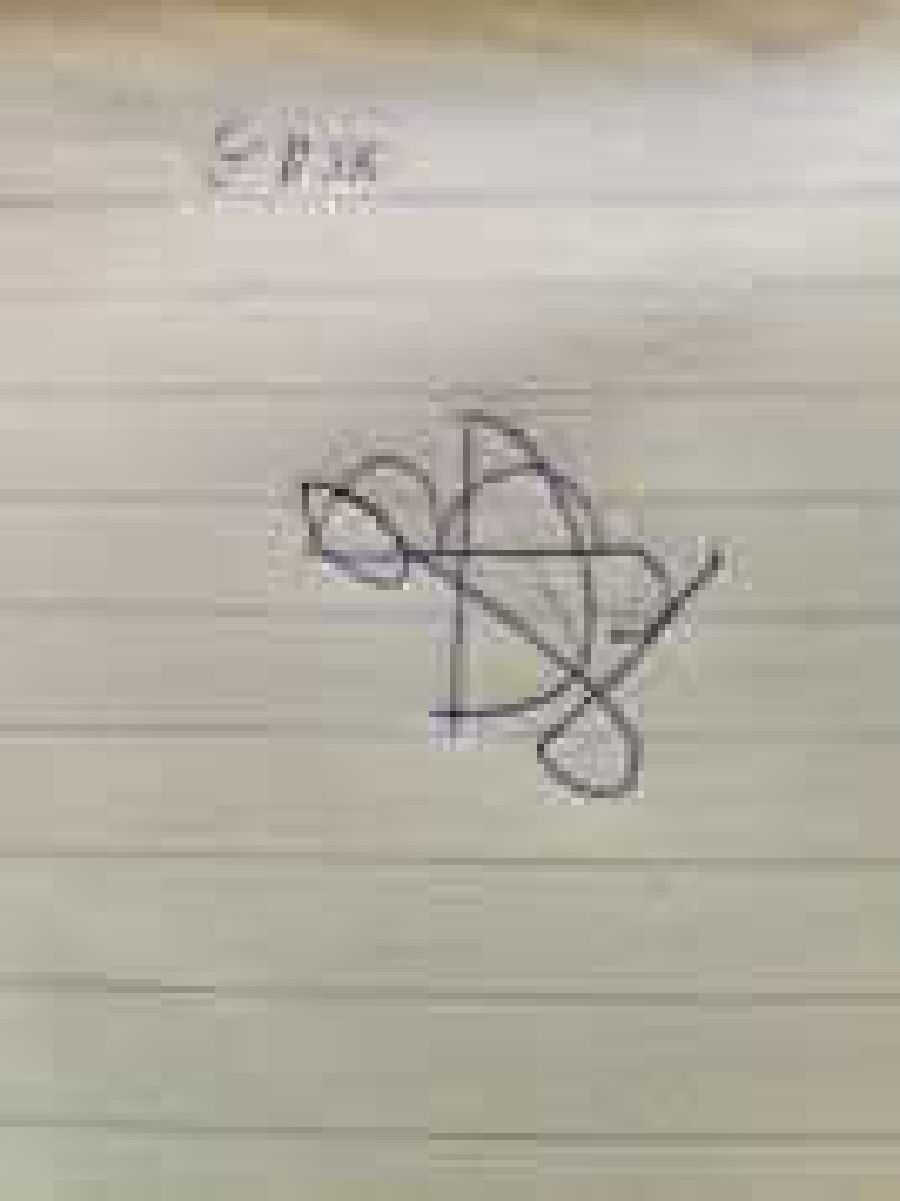
As you can see, I’ve taken the letters and combined them into a symbol. This is an easy way to create the visual component of the symbol, though as you’ll see we’ll do a bit more work with the symbol when it comes time to house the entity.
You might be wondering why there is a both an audio and visual component to the programming symbol. I developed the audio component in my practice because I wanted to not just have a visual symbol to work with, but also an audio symbol to work with that would allow me to incorporate sound and kinesthetic experiences into my work with the entity I create.
The visual symbol gives you something to look at and focus on, and create some type of housing around. The audio version of the symbol, in contrast, allows you to invoke or evoke the entity and embody it within yourself through the vocalization of the name. When I say “gd jb” in context to the entity, I’m strengthening the connection between myself and that entity, while also linking the sound to the visual symbol of
the entity. This helps with the creation process, but also with the work that you do with the entity, because if you’re not in front of the housing and want to call the entity, you can just use the audio version of the symbol to invoke or evoke the entity as needed.
Exercise
Using the worksheet at the end of this chapter to create your visual/auditory symbol for your entity. Share your answers in the Magical Experiments Facebook group #magicalentities.
The Role of Spiritual Influences in Entity Creation
As you create your magical entity, one thing that you want to consider is what, if any, spiritual influences you’ll want the entity to draw upon, so that it can perform its actions on your behalf. Example of spiritual influences could include elemental or planetary energies, or possibly other relevant influences that you would want the entity to connect with. You only want to draw upon a spiritual influence if you’ve determined that it’s actually relevant to helping the entity perform the work you’ve created it for.
For example, with our case study of the good job entity, we would determine the spiritual influences we’d want to work with on the basis of the desired result, and on how those influences could help the entity achieve the result. I might choose to add the planetary energy of Jupiter as an influence that the entity could draw upon because of the wealth correspondences that are associated with Jupiterian energy. Alternately, I might associate the classic elements of Earth for stability and material wealth or Air for networking and communication. I could also be untraditional and draw on the element of sound to help me communicate more effectively in interviews.
You don’t have to associate a spiritual influence with your entity in order for it to work. In fact, if you don’t have a clear understanding of a given spiritual influences and its appropriate correspondences, I strongly recommend you DON’T create an association between that spiritual influence and your entity, because it may end up defeating the purpose of the entity. For instance, I wouldn’t associate the planetary energy of Saturn with our “gd jb” entity, because Saturn’s influence is about limitations, which can be useful, but in this case could limit the effectiveness of the entity. Before you apply a spiritual influence such as a planetary or elemental energy, make sure you have a thorough understanding of that influence and that you’ve worked with it enough so that you can effectively apply it to the entity (or any other magical working for that matter).
If you decide to draw upon a spiritual influence, then you want to think about how that influence will interface with your entity and how your entity will apply or draw upon that influence to achieve the work you want it to accomplish for you. What I like to do is write out the spiritual influence and then share exactly how it works with the entity. I’ll use our example entity to illustrate this.
In the case of the good job entity, I would draw on the planetary energy of Jupiter because I would ask the entity to help me expand my career opportunities and the wealth that comes with those entities. I would also draw on the element of light to help me stand out and attract positive attention, and the elements of sound and air to help network and connect with people. The entity would draw upon the planetary energy of Jupiter when helping me to find the ideal job and negotiate the salary, while the element of light would be used by the entity to make my resume stand out and/or make me shine to interviewers. The elements of sound and air would be used to help me connect with people and find the right words and presentation to make me stand out.
When creating the entity, you want to write the spiritual influences down and then write out what those spiritual influences will help the entity accomplish and what the entity will do with those influences. Be explicit, but concise. If you struggle to explain how an influence will be used by the entity to accomplish the task you’ve set it, then you shouldn’t draw on that spiritual influence.
Exercise
Using the worksheet at the end of this chapter, write down the spiritual influences your entity will draw upon and how it will use those energies to accomplish its task. Share your answers in the Magical Experiments Facebook group #magicalentities.
Fueling Your Magical Entity
Your magical entity doesn’t perform its work in a vacuum. Like any other spiritual or material being, it needs some type of fuel to help it accomplish its work and also keep it in operation. What you need to determine is how you will fuel/feed your magical entity.
You can go the classic route of making offers to the entity. Or, you could set up the spiritual influences that the entity draws upon as the source of fuel for the magical working. Both of these options are what most people typically use when creating entities, but there are alternate approaches that can also work. I have four different methods I use to fuel my magical entities, along with the two mentioned above.
I like to connect the feeding of the entity to the accomplishment of the desired result. When the entity accomplishes the result or something that points toward the result, then the entity gets fed. For example, if the good job entity helps us land an interview at a place we’d want to work at, it would get fed by the accomplishment of that result. If we land the job, then the entity gets fed again. I use this type of feeding in conjunction with other types, but consider it a “treat.” I never solely use results based fueling, because if the entity isn’t initially getting desired results, you can starve it. If you do choose to use results based feeding, you want to be specific about what constitutes an achievement of a result. Getting an interview, for example would be a result, not the end result, but something that could lead to it, and so it would be appropriate to use as a result.
Another source of fuel I like to use are the actions I’m taking to realize the desired result, in conjunction with what the entity is doing. In any situation, you are ideally taking actions outside of just magical workings, but in the case of working with a magical entity, you can set those actions up to feed the entity. Thus every relevant action you take fuels the entity and helps it work toward achieving the result that much faster. In the case of our good job entity, it would get fed by actions that include filling out applications, sending resumes, and going to interviews. And if you make the good job entity a career entity that helps you get raises and promotions, then you could also set it up so that your everyday work activity feeds it as well. Basically, any relevant action you take becomes a fuel source for the entity to help it achieve the desired result.
Another fuel source I like to use is emotions, specifically emotions around the desired result. Emotions are charged energy, but they can also be an obstacle unless you turn them into fuel for your magical working. In the case of a magical entity, I direct any emotions I feel around the desired result toward the entity so it can feed off that energy and get the result. By doing that, I avoid obsessing about the result, and I provide the entity a potent source of fuel to achieve the result. In the case of our good job entity, we could provide it emotional fuel in the form of any frustration, depression, or anxiety we feel during the job hunt. By redirecting the emotions toward that entity we feed it and let the emotions go so we can stay positive. If you do take this approach to fueling your entity, its important you build filters into the fueling so that the only emotions drawn on are specifically related to the result. For example, if I’m feeling frustrated for a reason unrelated to the job hunt I don’t want good job to feed on that frustration, because I might need to work through whatever the cause of that frustration is.
The final fuel source I like to use is attention, specifically the casual attention that people give out every day without realizing what they are giving away. The way I set this fuel source up is that if a person pays even a slight bit of attention to the entity, that attention feeds the entity. If I share a picture of the entity’s housing or write about the entity, or do anything else to share the entity with other people and attention is given toward the entity, that attention feeds the entity, giving it more power to do what it needs to do. The reason this works is because attention is a form of energy, and if you are paying attention to something, you are giving that energy away. I am an efficient magician and I like to collect anything given away so it can be harnessed and properly utilized to help me achieve my results.
Exercise
Using the worksheet at the end of this chapter, write down how you will fuel/feed your entity so it can help you manifest the results you want to accomplish. Share your answers in the Magical Experiments Facebook group #magicalentities.
What are the Abilities of the Entity?
Next, you want to define the abilities of the entities. What abilities does this entity have? What actions can this entity take in order to help you achieve your result? Note that the second question focuses on actions, because you may end up designating passive abilities to the entities, as well abilities that require specific actions to be taken. An example of a passive ability could be one where the entity is always scanning for opportunities. That scan ability is always on, and the entity doesn’t have to do anything to activate it. An example of an active ability is that an entity might shred the invisibility field of a cop car so you’re aware of the cop.
In the case of our good job example, let’s look at the passive and active abilities it could have. Its passive abilities could be that it takes any emotional energy around the desired result and directs it toward accomplishing the result, and that it constantly looks for opportunities for you to advance your career and notifies you of them. Its active abilities could be that it makes your resume and you stand out, and that in networking situations it helps you get in front of the right people.
These are just a couple of examples of abilities/actions that an entity could perform. When you create the entity you want to write out what the abilities/actions are, but you can always come back and revise them if you encounter a situation where you would need the entity to perform different actions. Something which can also be useful to help you figure out when an entity is activated and what it does when activated, is to create a flow chart where you set up the possible paths for entity activation and what action happens. This graphical approach allows you to see the programming of the entity and make changes. Rich Kiska turned me onto the flow chart idea, because it’s something they use with their entities.
Exercise
Using the worksheet at the end of this chapter write down the entities passive and active abilities and what causes the entity to activate. Then create a flow chart that shows you how the entity will work. Share your answers in the Magical Experiments Facebook group #magicalentities.
Should You Set an End Date for the Entity?
The conventional approach to creating a magical entity is to set it up with end date, so that it automatically shuts off either after it’s achieved the result or after a specific date. The argument for including a shut off date for the entity is to do this so that you don’t become too reliant upon it, because then it supposedly becomes parasitical and takes on a life of its own (Hine 1995).
I don’t take that approach with my entities. I have never had an entity become parasitical. If anything, the relationship I have with my entities is one with mutual benefit and symbiosis. I still work with the first entity I ever created, way back in 2002, and have never had issues with it. It still continues to generate the desired result of making me aware of opportunities, and, in return, it’s fueled and respected.
In my opinion, if you have to shut an entity down, it means you haven’t set it up correctly in the first place. If an entity becomes parasitical in some form or fashion, you need to revisit the programming and figure out what you didn’t set up correctly and make appropriate adjustments. I don’t shut my entities down. At the same time, I also am very careful with how I set my entities up. For example, if I create a creativity entity and align it to Neptune and Uranus and then those planets retrograde, I’ll either shut off the connection to the planetary energy or set up counter measures so that the entity can still help me be creative, as opposed to turning it off.
You ultimately have to decide whether or not you’ll put an end date on an entity. I don’t see the point, but that’s because the reason I created the entity was to enhance my life and get continuous results. Why turn it off it if it’s working? Instead of shutting an entity down if you start noticing different results, do some investigative work and figure out what’s wrong and make adjustments.
Magical Entity Creation Worksheet
This is a worksheet designed to help you create and launch a magical entity.
What is the desired result of the magical working?
Can I accomplish this result without an entity?
How would an entity help me accomplish this result?
What is the statement of intent (get this down to two words)?
What is the symbol that represents the entity and statement of intent?
What spiritual influences (elemental/planetary/spirits/other) will the entity draw on? What’s the fuel source for the entity? How will you feed it (tie into results, attention, emotions, activities)?
What are the abilities of the entity? How will it achieve the desired result?
To be filled out after you get initial results. What revisions, if any, need to be made, so that the entity achieves the desired result?
Inspiration Entity Example
For fun and to illustrate how the worksheet works, I thought I would create an entity of my own for this book. Below is my worksheet with what I filled in to answer the questions, and my commentary on those answers.
What is the desired result of the magical working?
My desired result is to be inspired to write.
Commentary: This is a specific result. I want inspiration for my writing, which will cause me to write more. I’ve kept it simple. I could explain it in more detail and depth, but I think it’s fairly explanatory.
Can I accomplish this result without an entity?
Yes and no.
Commentary: I answered yes and no because I could do a magical working to inspire me to be creative and write, but while I could do that for what I specifically want, a working alone wouldn’t necessarily cut it. I want an entity that’s going to inspire me and keep me on task.
How would an entity help me accomplish this result?
The entity would inspire me and keep me focused on writing, instead of getting distracted by social media or other distractions. It would discipline me, so I would write more.
Commentary: This explains what the entity would specifically do. As you can see, what’s shared here goes beyond what a magical working would do. In this scenario the entity is going to inspire me to write each day, and keep me on task.
What is the statement of intent (get this down to two words)?
Inspire Writing
Commentary: Two words say exactly what needs to happen. The discipline aspect can be written into the actions that the entity will perform, but at its core, it must inspire creativity.
What is the symbol that represents the entity and statement of intent?
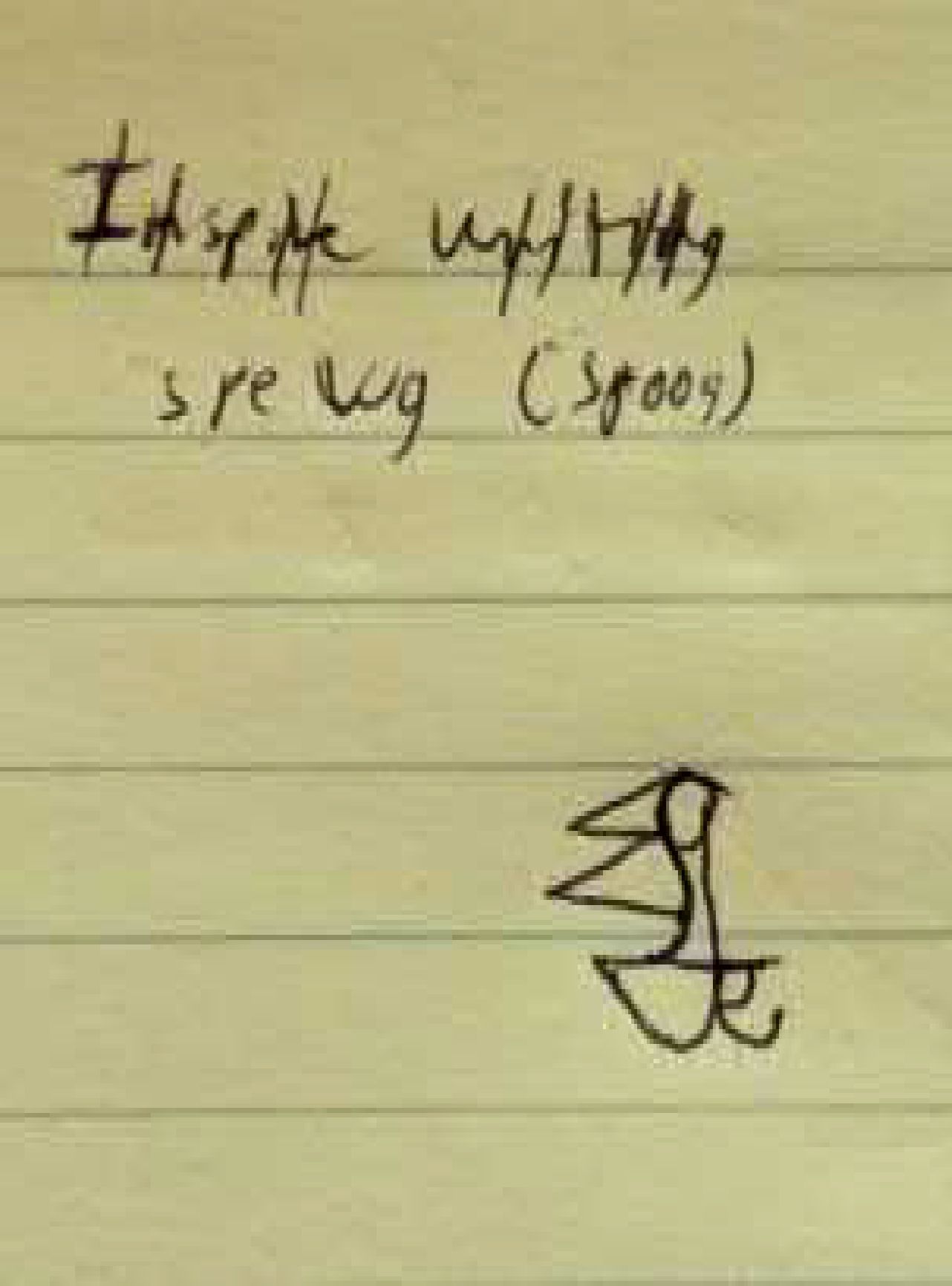
Commentary: Here I’ve taken the statement of intent, gotten rid of the repeating letters, and come up with spewg. I could get rid of the e as well, but it works, so I left it in. Note that I have parentheses around the pronunciation (spoog), which will make up the audio sigil for the entity. The symbol below that is the actual programming symbol that will be used when I create the housing for the entity.
What spiritual influences (elemental/planetary/spirits/other) will the entity draw on?
The spiritual influences this entity will draw on will be the planetary energies of Uranus, Jupiter, and Saturn. The Uranus energy will be drawn upon to inspire creativity, while the Jupiter energy will be used to generate wealth from the creativity, and the Saturn energy will be used to provide discipline.
Commentary: In this case I’m aligning specific planetary energies with the entity so that the entity can draw on and apply those planetary energies to its tasks.
What’s the fuel source for the entity? How will you feed it (tie into results, attention, emotions, activities)?
The fuel source of the entity will be several fold. It will feed off writer’s block, procrastination and distraction. It will also be fueled by writing, and this in turn will cause it to reinforce the activity of writing.
Commentary: The fueling for this entity is two-pronged. I have it feed on writer’s block, procrastination and distraction in order to mitigate those experiences, but I also have it feed on the actual activity of the writing, so that if I am being productive, the entity is already being fueled.
What are the abilities of the entity? How will it achieve the desired result?
This entity has the ability to discipline me by interjecting a reminder that I need to write if I haven’t written my agreed upon amount of words for the day, or if I haven’t
yet gotten to work on my writing by a specific time of day. This will help achieve the desired result, because if I haven’t written anything or only have written a small amount, the entity will keep me on task. The entity will only shut off if I’ve actually worked on my writing for the day and achieved a designated word length, or if I’ve told the entity I’m taking the day off from writing (which I can only do if I’m feeling burned out and need to rejuvenate or if I just finished a book).
The entity has the ability to inspire creativity around my writing and help me achieve a breakthrough in my writing when I’m feeling blocked, by prompting different ideas and perspectives that will help me find my way through the block.
Commentary: I’ve created very specific abilities for the entity to perform. These abilities are all driven toward keeping me writing and being creative around my writing. I’ve separate the abilities with a space, so I can see them distinctly. You could also use a flow chart for similar purposes. I prefer writing it out, but use whatever works for you!
Conclusion
You’ve now gone through phrase 1 of creating your entity. This is the most intensive part of the process, because what you are doing is creating the core programming of the entity and defining what it does and how it helps you achieve a result. Some people probably don’t take such an intensive approach, but I find that planning your entity out in detail allows you to catch potential problems with its design. Additionally, it helps you get clear on what the entity is supposed to do, which allows you to measure its performance by results, as well as tie your own efforts and actions into what the entity does.
The final thought I want to leave you with in this chapter, is that phase 1 is where you begin to bring the entity to life. The work you into this phase sets up the overall success of the entity and also establishes your relationship with the entity.
-
Chapter 3: How to Launch your Entity
This chapter describes phase 2 and 3 of the entity creation process. I opted to make these last two phases separate from the first for two reasons. The first reason is you are doing a lot of work in phase 1 and the second reason is that these last two phases can blend together, with the housing becoming part of the launch process. At the same time, I’ve chosen to still differentiate these phases, because some people will create the housing and then launch the entity separately. As with any other writing on magic, I like to be as precise as possible, in the interests of helping you achieve the results you’re looking for.
Phase 2: How to Create the Housing of the Entity
The housing of the entity serves as the material base for the entity, and consequently grounds the entity in this reality. It also represents the entity. You can use the housing to work with the entity in terms of both invocation and evocation, though the way I personally set up my entities is that they’re always running in the background, like a computer program. I still using the housing to interact with the entity, but I don’t go out of my way to invoke or evoke the entity because I use the launch process to permanently evoke the entity so it can do what it needs to do. This enables you to work more efficiently with the entity.
When picking the housing for the entity, you have two options. You can use an existing object, such as a statue, as the house for the entity or you can create one of your own. I’ve taken both approaches, and while I generally prefer to create the housing, I don’t know an appreciable difference in using an existing object. The one thing you may want to do with the existing object is purify it ahead of time to remove any unwanted influences that might otherwise affect the entity. After you purify it, using whatever methods you prefer, then you can create the entity. When using an existing object for the housing, what I do is trace the programming symbol of the entity onto the object. That designates the object as the home of the entity.
When I create the housing of the entity, I like to either paint, draw, or sculpt the housing of the entity. If you work with metal or wood, you could use those mediums as well. The advantage of creating the housing is that it allows you to also use the creation process as part of the launch for the entity. When I create the housing for the entity, I will commune with the programming symbol and then place it in the center of the housing. For example, when I paint the symbol, I put it in the middle of the canvas. If I’m sculpting the entity with clay, then I’ll create the torso of the sculpture in the image of the symbol. Once the symbol is placed on the housing, I then create the rest of the painting, drawing or sculpture by letting the entity guide my hands in the creation. This serves to not only setup the housing but turn it into the evocation of the entity, as well. In the case of the painting or drawing, the colors serve to express the nature of the entity and what it does, acting as part of the programming. The same is true with the shape of the clay, and how that shape expresses and evokes the entity. The act of creation becomes the launch of the entity, and that’s why I prefer creating the housing for the entity instead of using pre-existing objects (except for rare circumstances). At the end of creating the entity I will say the name of the entity while holding the housing, and then place the housing in a pre-selected spot. That finishes up the evocation of the entity.
Exercise
Determine what kind of housing you will use to create your entity. Will you use a pre-existing object or create the housing from scratch? Share your answers in the Magical Experiments Facebook group #magicalentities.
Phase 3: How to Launch Your Entity
This the final phase of the entity creation process. In this phase you evoke the entity. I’ve already shared how creating the housing for an entity can be used to evoke it, but if you’re using a pre-existing object as the housing, you may need to take additional steps. The additional step I’ve taken is to do some type of ritual with the housing that is used to activate and evoke the entity. Let me share two examples with you.
The first example is my driving entity Sped Limt. I opted to use a dragon statue jewelry charm that hangs on my rearview window for the housing, because its portable and I wanted the entity to be in the car while I was driving. I bought the air freshener, did a purification and then did an evocation ritual of the entity, where I stated its name and purpose and then visualized the programming going into the air freshener. Once I was satisfied with the housing, I place the air freshener in the car
and linked the first activation to starting the car. I said the name of the entity as I started the car, and that woke the entity up.
The second example is a statue my wife and I used for the housing of a health entity for my step kids. We opted to use that statue of a woman holding her child because that embodied the motherly instinct and protection we wanted to the entity to use when protecting the health of the kids. We drew the programming symbol on the base of the statue and then did a sex magic working during the 4th of July fireworks to use the energy of the holiday and orgasm to launch the entity. We also anointed the entity with the sexual fluids. That working evoked the entity and set it to work.
In both cases, a ritual was done to launch the entity because the housing was a pre-existing object. If the housing had been created instead, then the act of creation could be the launch process. Alternately, you could opt to do a ritual on top of creating the housing of the entity. It’s up to you as to what to do in order to launch the entity. As I mentioned above, I normally just create the housing and use that as the launch process, but you can add on whatever you need to add to the process in order to help you finalize the creation of the entity.
Exercise
What process or ritual will you use to launch/evoke your entity? Share your answers in the Magical Experiments Facebook group #magicalentities.
Spoog’s Housing and Launch
In the previous chapter I shared my worksheet notes with you as an example for creating an entity. Below is the housing I created for Spoog. I created a painting, which allowed me to launch the spirit through an act of creativity, which feels appropriate given the role he is now performing.

The act of painting the entity simultaneously created the housing and launched the entity, and now it hangs over my right shoulder, in my office, reminding me I need to write and create.
Conclusion
Once you have gone through phases two and three you have created and launched the entity. Now it will start doing the work you’ve set it up to do. However, the act of launching and creating the entity shouldn’t be the stop point of your relationship with the entity. We don’t want to set it and forget it. Instead, especially given that we want to track the performance of the entity, we need to focus on what working with the entity actually looks like, as well as we can cultivate the relationship we have with the entity.
-
Chapter 4: How to Work with Your Magical Entity
The creation of the magical entity activates it so that it can begin to perform the work you’ve created for. But even though the entity is setup to do the work it needs to do, it’s still important for you to build a relationship with it. The reason why is simple: you are already in a relationship with the entity that is symbiotic. It relies upon you and you rely upon it. You wouldn’t have created it if you didn’t need it to do something for you, and it wouldn’t exist without you.
One of the things that I find odd about the occult community is how the symbiotic relationship with entities isn’t recognized for what it is, an interdependent relationship where both parties benefit from the relationship. The reason we don’t see this recognition is because of the humanocentric perspective occultists apply to their magical work. The focus is on the need of the occultist and on the fact the entity is created, as opposed to being a pre-existing spirit. And, in some cases, the emphasis on trying to psychologize magic can cause the magician to conclude that anything that smacks of being a spirit is really just a psychological extension of the magician.
There are a couple problems with the humanocentric perspective, and those problems can cause breakdowns in the relationship you have with the entity. The first problem is the objectification of the entity, where the entity is treated as an object or a servant. Although the entity is created for specific purposes, one thing that you’ll discover is that it can evolve and change, and that it brings its own awareness to what it does. This self-awareness can naturally give rise to the entity questioning what is being asked of it, especially in light of how it is treated by the person who’s created it. The second problem is that when you treat the entity as a psychological extension of yourself, you aren’t recognizing that it is actually something else altogether, a being that has been created, but is nonetheless separate from you.
Now, you may read what I share above and think I’m being overly sensitive to the plight of a created magical entity. But the reason I share what I’ve written above is to help you entertain a different perspective on working with a magical entity you’ve created. The conventional chaos magic approach would argue that the idea of cultivating a mutually beneficial relationship with a created entity would be ridiculous, and that the entity should be destroyed if it becomes too independent. But if we apply the lens of an interdependent relationship where both sides have a symbiotic connection and mutual benefit, then that perspective may also help us work with entities differently.
When I create an entity, I’m not just creating it for the purposes of getting a result. I’m creating it to enhance my life. The achievement of the result is only part of the enhancement the entity brings, especially when you’re doing long term work with the entity. You likely are doing long term work, because when you create an entity, you’re generally not looking for a short term result. You’re looking for long term change, and what you’re entering into, as a result, is a symbiotic relationship with that entity where it helps you achieve that long term result, while you in term help take care of it. A re-orientation of your perspective on entity work, in this light, can help you transform the relationships you have with your magical entities into one where you don’t have to shut the entity down or banish it because you’re no longer treating it as a servant, but instead actively collaborating together.
If we re-orient our thinking about how to work with the entities we’ve created toward a perspective that is collaborative, I think the results will speak for themselves and that the relationship will be stronger because the way the entity is worked with is from a place of respect. Instead of just treating an entity as tool to be discarded when it no longer seems useful or because we think it will rebel, why not try to explore the relationship from a place of respect, where the needs of all parties are considered, instead of just one?
That’s my approach to working with spirits, and it’s my approach to working with magical entities I have created. Operating from a place of respect has never caused me any of the issues that other occultists frequently share, and the only conclusion I can come to that those occultists are operating from a place of disrespect toward those spirits. They act from a place of humanocentric authority and don’t recognize how demeaning that would be to any being, spirit, or otherwise.
Let me be clear. I’m not saying we shouldn’t take precautions in our work with spirits or created magical entities. But if we operate from a place of fear or a place of
presumptive superiority, shouldn’t we expect the negative outcomes that occur? Why not take a different tack, a different approach that’s based on developing a relationship of collaboration and cooperation?
My own work with my created entities reflects this philosophy. While it’s true that I do set them up so that they can be fine-tuned and improved on, I don’t destroy the entities I work with. Instead, I look toward creating an ever evolving relationship with them that allows me and them to grow. Let me share an example.
I originally created Sped Limt to help me avoid getting speeding tickets from cops. It does this by making me aware of the speed limit, but also making me aware of the cop cars. I created it back in 2004 after getting some speeding tickets, and for the next decade or so I didn’t get any more speeding tickets. But then, in 2014, I started getting tickets again. It got to the point where I lost my license for a month. Clearly something wasn’t working. Instead of taking the classic route of destroying Sped Limt because it was no longer performing as expected, what I did was ask it why it wasn’t working anymore. The response I got back was illuminating.
Sped Limt told me that it felt taken for granted. Yes, it appreciated the thanks I gave it every time I spotted a cop car, but it wanted to do more than just help me drive safer. It wanted more responsibilities and more sources of fuel. The conventional response would be to destroy the entity. My response was to work with it by giving it additional responsibilities and fuel sources. I added all municipal vehicles such as ambulances and firetrucks to its fueling and gave it more responsibilities in the form of helping m navigate through traffic. Ever since, it’s worked like a charm.
You can take the conventional approach that other occultists take, but you’ll never deepen your spiritual practice or relationship with your entities if you do and, as a result, you’ll miss out on what those entities can teach you and how you, in turn, can help them grow. You’ll also miss out on an evolving symbiotic relationship that can teach you a simple truth about life: We are interdependent upon each other, and the best relationships are cooperative collaborations that change all of us for the better.
You can take my approach and communicate with your entity to find out what it wants, and then help it. In fact, as an experiment, try this with one of your entities. Ask it if it would like to expand its skillset or anything else and listen to what it shares with you. You may be surprised by what you learn.
To even have that conversation with your entity, we need to get out of the conventional set and forget it mindset that is applied to creating entities and look at how entities communicate with us. When you create a magical entity, it’s not going to necessarily appear before you visually and starting speaking in your native tongue. Nonetheless, the entity is active and at work in the background. It is the background to which we must pay attention, to recognize the entity at work.
The first place we start working with the entity is around the result it’s supposed to help you manifest. You want to pay attention to if the result is manifesting and how it’s manifesting. For instance, after you create the entity, if you start getting results pointing in the right direction of your ultimate outcome, that’s a sign the entity is working. If you aren’t getting any results, then it’s time to figure out what that means and whether or not you need to fine tune your entity. And if your results suddenly go in the opposite direction or die off, that can also be an indicator that something is no longer working.
But the result alone isn’t the only way for you to figure out what is or isn’t working with your magical entity. You also want to pay attention to your intuition, because your intuition is usually how your entity will try to communicate with you. When one of my entities wants to make me aware of something, it pings my intuition and I pay close attention, because what that intuitive urge is showing me is something I’m not going to discover through conventional consciousness or the five senses.
I do talk to my entities. I will speak the words aloud. I don’t expect a vocal response, and I don’t get one. But I hear the entity nonetheless through the sensation of intuition and through the feelings (not emotions) that it shares. The feeling sensation is particularly fascinating because what the entity is doing is sharing its experiences with you, and if you pay attention to the sensations and feelings, you can use what you feel to help you understand what the entity is communicating.
Sometimes, I will also hear the words in my mind. I might talk with an entity and it might respond with words. However, I find that language is less precise with entities, because there are subtle nuances to language that an entity doesn’t automatically get. In contrast, communication via feelings, experiential sensations,
and intuition is much more nuanced, and requires that we learn to recognize what is being communicated. This comes over time as we learn to let go of our needs to communicate using not only words, but to start embracing the experiences we have as a form of communication in their own right.
Exercise
How do you communicate the magical entities you create? How do you know they are communicating back to you? How can you use this communication to deepen your relationship with them? Share your answers in the Magical Experiments Facebook group #magicalentities.
Helping Your Entity Learn
Pop quiz, hotshot. You’ve done your due diligence and used the worksheet included in this book to help you create your entity. You’ve thought out everything in minute detail. But (there’s always a but), you’re not quite satisfied with the initial results. The entity is doing okay at what you’ve created it for, but it’s not producing the results you want. What do you do, hotshot? What do you DO!!!????
I’ll tell you what I do. I help my entities learn what I want from them. Yes, you can be as detailed and specific as possible, but you may still need to do some fine tuning with your entity. As I’ve said above, working with your entity isn’t a set it and forget it kind of affair. It requires a more nuanced approach. When you recognize the entity isn’t producing the results you want, you need to consider two different options. The first option is to teach the entity, and the second option is to revise it. The different between either option is subtle, but important.
If an entity needs to learn, then you have already programmed it to do what it needs to do, but you need to refine its awareness around your desired result. Basically, you need to help it work smarter instead of harder. If an entity’s programming needs to be revised, it’s because it’s not executing the specific tasks effectively and something needs to be changed to help it accomplish those tasks. For now, let’s focus on the learning aspect.
If I create an entity that’s getting the results I want, but I feel that there’s room for improvement, it means that I may need to define the results in more detail and/or help the entity recognize what constitutes a good result. For example, you might create a job entity and start getting interviews, but discover that the jobs you’re getting interviewed for aren’t meeting all of your criteria. The entity is clearing performing, but the results that are being generated need to be improved on. This is where you help the entity learn. You identify what it’s getting right, but also dig into the details and change your desired result to more accurately reflect what you’re looking for. You then share this with the entity and carefully monitor the changes to see what happens.
When I’ve had to do this with a magical entity, it’s really boiled down to human error. The result isn’t as defined as it needs to be. A key detail was left out, or perhaps the person defined the results in terms of what was wanted but neglected to consider what wasn’t wanted. Your magical entity is going to work off the information you provide it, and if that information is faulty it’s not the magical entity’s fault. It’s your fault. When you help the entity learn, you’re helping yourself learn as well.
Exercise
If you’ve created a magical entity and had to help it learn, what did that experience teach you about your entity creation process? Share your answers in the Magical Experiments Facebook group #magicalentities.
How to Revise Your Magical Entity When it Isn’t Working
Earlier, I shared that you might need to revise an entity because it’s not executing a specific task effectively. That’s one reason to revise an entity, but the other reason to revise an entity would be because the entity wants to evolve. Let’s explore both scenarios in further detail.
When an entity isn’t accomplishing the result you want it to accomplish, then you may want to revise it. You’ll know the entity needs revision if you aren’t getting anything remotely resembling the result. Going back to the job entity example, if you aren’t even getting interviews, then it’s time to pop the hood and determine what revisions need to be made to the entity’s programming. Even if you are getting results that indicate the entity is working, but the results aren’t what you want, you may still want to take a look and see if the programming isn’t working the way you want it to.
This is where the entity creation worksheet comes in handy. If you’ve used it, you’ve written down the desired result, which you can check over to make sure its thoroughly defined and you’ve written down how that entity is supposed to work, what influences it draws on, etc. And if you’ve used the flow chart method, you’ve even
diagrammed out the specific instances for when the entity is activated and what it’ll do when activated. Look everything over carefully.
The first question you want to ask yourself is what details did you miss? Was there anything in the fueling, the actions, influences, etc., that isn’t lining up with what you need the entity to do? If so, you’re going to want to revisit those details and figure out what’s missing or what needs to be corrected. Fortunately, you can do this using the worksheet because the worksheet is a living document of the entity, the program code you’ve created for the entity.
For instance, let’s say that you determine the fueling of the entity isn’t providing it the energy that it needs. You would need to decide what additional fuel could be drawn upon and then write that into the entity’s programming so that it has enough fuel to do what it needs to do.
Another example could be that the action the entity is supposed to perform isn’t well defined, or the trigger for it isn’t fully thought out. Remember that the entity is working off the programming you provide it, and if you’re not clear on what triggers the actions or what the action should specifically do, the entity isn’t going to likely be clear on it either. You might also find that you’re not drawing on the right spiritual influences, which would mean you would turn off the spiritual influences that aren’t working for the entity and then either change to appropriate ones or let get of using spiritual influences.
When you need to revise an entity, it’s usually because phase 1 has not been written out or diagrammed in enough detail or the details need to be changed, and that’s ok. It’s how you learn to become a better magician. And it’s also how you improve your magical entities. You determine what isn’t working and make the appropriate corrections so that the entity can accomplish its task.
When I moved to Seattle, I created an entity to help me find work. The results were subpar to put it nicely. I ended up working as a house cleaner. I wasn’t very specific with my result, which was part of the problem, and I was also very negative, which actually sabotaged all my efforts. But when I looked over the notes of the entity, what stood out to me the most is that I had not set up the fueling of the entity to draw on any of my emotions around the job hunt. I knew better, but I had left that out of the fueling instructions. I reworked the result so it was more specific and redirected my emotions so they were actually doing something useful (feeding the entity), and then I quit the cleaning job and a couple weeks later had my first tech writing gig. What a difference those revisions made in my life! The reason I share that example is because when magical entities don’t work, it’s typically human error that causes them to not work, and that’s where you need to be open to revising the magical entity.
How to Revise Your Entity to Improve on It
As I shared before, there are cases where you’ll revise an entity, and it won’t be because it isn’t working. Instead, it will be because the entity wants to evolve or because you’re satisfied with the entity’s performance, but you see a way of improving on what the entity does. In those situations, you’ll want to take a different approach to your revisions, because you don’t want to break what’s already working. You want to improve on it.
I shared the example of Sped Limt earlier. Sped Limt worked great, until results fell off. Initially, I thought the entity was no longer working, but it turned out it worked just fine, but wanted to evolve. I could have destroyed it, which is what many occultists would advocate, but instead I asked it how I could improve it. It told me it wanted more responsibilities and more sources of fueling, so I revised it accordingly.
Now Sped Limt is fed by spotting cop cars, ambulances, and firetrucks. Each time one of these vehicles is spotted, Sped Limt’s medallion is touched, and he is thanked. In return Sped Limt not only shreds the invisibility of cop cars and makes sure I drive safer, but also helps me navigate by making sure I know the best possible route to go. I’ve even tested Sped Limt against apps such as Waze, or other map apps, and found that following Sped Limt’s intuitive pings has gotten me to places faster than the app would have.
My revision of Sped Limt was because it wanted to evolve. And I was happy to accommodate that because doing so taught me two very valuable lessons. The first lesson was don’t settle for less when you can have better. The second lesson was that empowering an entity could actually be beneficial instead of harmful. By choosing to modify an already effective entity I made it better, and ever since it’s happily continued providing its services to me. I’ve even recently added a parking task to it, so that it helps me find parking faster.
I’ve since taken a more proactive approach with my existing entities, because I realized that if one entity is dissatisfied, others might be as well. I’ve taken to reviewing my entity creation documents every so often and made appropriate changes as needed, and if needed. In some cases, no changes are needed or wanted, but in other cases I have revised the entities further.
You can take a similar approach with your own entities. I recommend reviewing your entity creation worksheet every so often and asking yourself what, if anything, you would change about the entity. Ask yourself why and fully map out what the difference would be, and if you find that it makes you entity more efficient, write it into the creation worksheet or add it to the flowchart. Remember, you can edit the programming at any time.
Keep yourself open, as well, to the entity’s input. It will have experiences as it does the work you’ve created it for. It may have its own ideas and perspectives that can be useful in helping you revise it. By keeping yourself open to the entity’s input you may end up thinking of ideas you wouldn’t otherwise consider.
After you make the revisions, track your results. Is the entity performing as good or better or worse than before? Make appropriate changes as needed to fine tune the revision and then let the entity work in the background and watch your life change.
Exercise
Have you revised an entity? If so what did you change and why? Share your answers in the Magical Experiments Facebook group #magicalentities.
What If an Entity Can’t be Revised?
This is a good question to ask. There will be occasions where an entity can’t be revised because it just doesn’t work the way you want it too. Let me share an example. I once created a sales entity. I wanted it to get me more sales for my coaching business. It flopped, completely and utterly, and there was no revising that could make it better.
Why did this entity fail so badly? Because of human error. I failed to understand something essential, which is that the entity could not be a better sales person than myself. I wanted it to attract the attention of people and send them my way, but that’s a very steep hill to climb. And I came to realize this quickly because I wasn’t getting more clients after creating the entity. It could not find a way to get me those clients, because the way I set it up didn’t effectively allow it to.
Could I have revised that entity? Not really, because revising it would have meant fundamentally making it an entirely different entity. The programming was flawed because I wanted it to do something only I could do, which was actually get sales.
This is why I include the question: Can I get this result without a magical entity, and, if so, how? I only create an entity if the answer is no, because I recognize that what makes an entity powerful is how it can symbiotically mesh with your life by doing things you can’t do. The entity complements your life and allows you to focus on what you can do well.
In the case of the sales entity, I would have been better served to have taken some sales courses and gotten out there and sold people on my coaching services. I could have created an entity to help me spot and recognize potential clients that needed my services or help me be more persuasive, but expecting to get the actual sales simply wasn’t going to work, because I wasn’t doing anything to make it work on my end.
Conclusion
We’ve covered how to work with a magical entity. I hope what you’ve taken away from this chapter is that you can work with entities outside of the conventional approach to working with them and that you may get better results, as well develop a different appreciation of them. In the next chapter, I’m going to share some case studies of entities I’ve created and what worked, what didn’t work, and what happened with those entities.
-
Chapter 5: Entity Case Studies
I wanted to include some entity case studies of entities I created. All of these are long term entities I’ve created and worked with (I don’t due short term with magical entities). In these case studies I’m going to explain what worked and what didn’t work, and if and how I’ve improved on the entity.
Cerontis
Cerontis is the very first entity I created. I created him for the purpose of making me aware of opportunities that I might otherwise miss out on. I set him up with very specific parameters, namely that he only makes me aware of the opportunities, but doesn’t act on them in any other way. His fuel source is the discovery of those opportunities, and he is set up to constantly scan for the opportunities and then draw my attention to them so I can determine what I want to do with those opportunities.
I have never turned Cerontis off and never will. He has consistently pointed me toward opportunities. I haven’t always chosen to do something about those opportunities, but every time I have acted on the opportunities I’ve been pleased. The reason I don’t act on every opportunity is because I have a lot going on and don’t necessarily need to take advantage of every opportunity that comes my way. What I like though is that I am made aware of the opportunities I might not otherwise recognize.
I’ve also never had a negative experience with Cerontis. Instead, I’ve consistently been able to access opportunities, and this has helped me enjoy my life immensely because I am getting the chance to do things I want to do that I might otherwise miss out on because my focus is elsewhere. Cerontis makes sure I know what’s available to me, and then it’s up to me to act.
I housed Cerontis in a painting which I still have on display on the walls of my house. I see Cerontis every day, which serves as a nice contact point.
ACE
Ace is an entity I created to protect myself and other people from the Covid-19 coronavirus. I created this entity in March of 2020. To create the entity, I did research first on the coronavirus, learning as much as I could, so I could design the entity accordingly.
The way the entity works is that it forms a defensive barrier around a cell and actively attacks the virus, injecting itself into the virus to kill it off. It injects itself into the spike proteins of the virus and attacks the RNA of the virus in order to prevent infection. The entity is fed through the virus itself. The entity will activate if the virus is around and feed off of it. It goes into hibernation mode when the virus isn’t present.
The entity is housed in the painting I created above, but once it is worked with it becomes an active part of your immune system and is housed in your body. You can also take the name of the entity (ACE) and sigilize it in any way you like as another means of housing and activating it.
To work with the entity, simply use the painting to invoke the entity. Then it’ll start its work. If you want to stop working with it, simply tell it to stop. The stop function is automatically included with the entity. You can also sigilize the name (ACE) as another way of activating the entity.
In terms of results, what I can speak to is that I’ve not had any symptoms of the virus. I have admittedly limited my in-person contact to only a few people, but other members of my household do go out and interact with other people. I’m also fortunate enough to work at home. I have shared the entity with other people and have not heard back one way or another from those people, but I provide this entity as an example of how you can create an entity for the purposes of addressing a situation such as a pandemic. I do NOT make guarantees if you choose to work with this entity, but I figure why not use all your resources, which is why I developed it. Below is a picture of the entity housing.
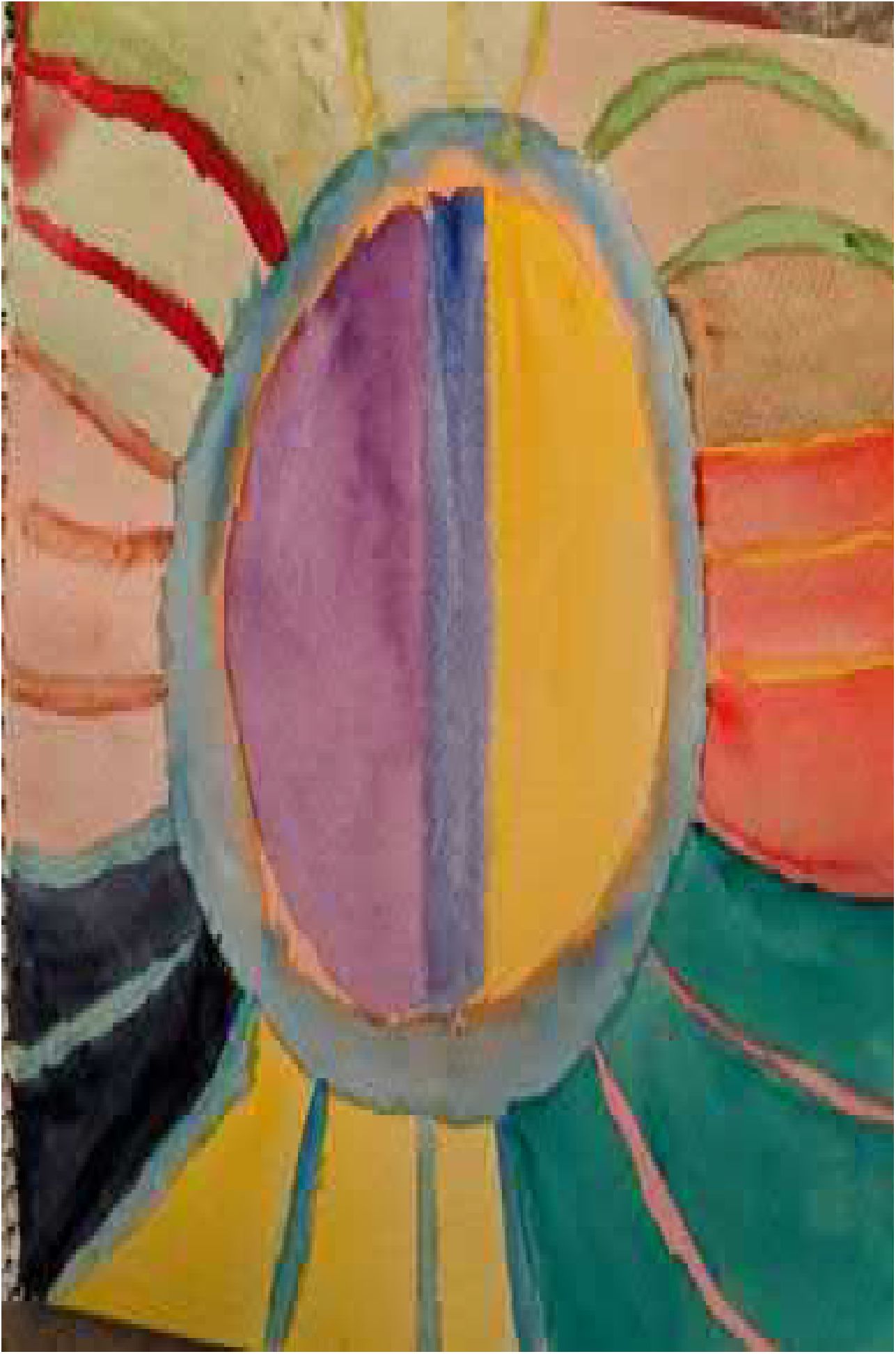
CVI
CVI is another entity I created for the coronavirus, specifically focused on two tasks. The first task is to inspire a vaccine solution and aide in the manufacturing of that vaccine. The entity draws on the creative energies of Uranus, the expansive/healing energies of Jupiter, the communication, speed, and inspiration of Mercury, and the energies of the underworld Earth, as well as whatever creativity is donated by the practitioner toward helping the medical professionals find a vaccine.
The second task is to support the medical professionals in the hospitals by helping them stay healthy and focused. It has 3 subfunctions as well. The first subfunction allows the entity to draw on the expansive, protective, and healing energies of Jupiter to protect the medical professionals. The second subfunction draws on the solar purification of the Sun, the Venusian energy for purification, and the protective and limiting energies of Saturn to contain the coronavirus. The third subfunction draws on the rising Earthlight of the underworld and the martial energy of Mars to combat the virus.
The entity draws on planetary energies for feeding purposes, and utilizes those same energies as part of its process for the work it does. The planetary energies drawn upon are the Underworld cosmic energy of the Earth, the Sun, Mars, Jupiter, Mercury, Venus, and Saturn.
To work with the entity, you simply use the painting or sigilized name to invoke the entity. Then direct whatever energy or spiritual resources you want to direct to it.
It will pass those onto the medical practitioners, with a focus on both helping inspire a solution to the coronavirus and providing support to the health care practitioners caring for the patients who have the coronavirus. When you want to stop giving energy or spiritual resources to the entity, tell the entity stop and its stop function will be engaged so it will no longer draw on you. You can direct your energy to a specific subfunction, or simply attribute the energy to the overall purpose of the entity, with the entity making the choice as to where best to route the energy.
In terms of results, what stands out to me is that since this entity was created some fairly impressive progress been made on drug treatments and anti-virus research. While I don’t attribute that progress solely to the entity, it was designed with that goal in mind, as well as with helping medical professionals.
Good Job
My wife and I created Good Job shortly after she moved up to Portland. She was looking for work in her industry, but she wasn’t getting bites. We decided to create Good Job to help out with the process of finding work, but we set it up as a long term entity, where it would not only help my wife find work, but also help her with advancing her career.
Good Job was set up to feed off any job hunting and career related activities that my wife did. In return, Good Job would make her stand out, drawing attention to her activities and helping her meet the right people at the right time.
We housed Good Job in a painting, which she could take with her to wherever she worked, so that it was in her office.
Shortly after creating Good Job my wife got her first interview for a full time position. She didn’t get that job but got another interview shortly after for the same position, and did get that position, but only temporary because of when she started. This meant at the end of the year she’d no longer have a job.
We were concerned but decided to trust the entity. Within a few months she was told to apply for a higher position with better pay, and although at first there were some bureaucratic snags, people came out of the woodwork to advocate for her and she ended up getting that full time position with better pay.
Since then, every 2-3 years she’s gotten a promotion and has continued to stand out and show up to the right people. To be clear, this isn’t just because of the entity. She and the entity have worked together to create the success she enjoys in her job.
Magic Teacher Entity
I created the magic teacher entity in the mid 2000’s. I decided that I wanted an entity that could help me find the best books and resources so I could continue learning about the occult, without necessarily getting weighed down with whatever wasn’t good.
The entity is fueled by me reading books (which I do a lot). It pings me and lets me know if something is worth checking out or should be avoided. It does factor in my interests and on-going studies to help with that determination. The entity is housed in a painting that is hung over the occult book section of my home library.
Since creating this entity I have become very picky about the occult books I read. On the other hand, I’ve greatly expanded my library with non-occult disciplines that are relevant to my work. This entity is still active, and likely will be for the rest of my life, because it serves to help me focus my research and time on what’s relevant to my own work and overall goals for the evolution of magic.
Tempora
Tempora is an entity I created when I wrote Magical Identity. I created her to help me interface with space/time as a web, and specifically help me to manipulate that web.
Tempora is fueled by space and time, and by the web of space/time which she resides upon. She is housed in a painting, and when I work with her I use the painting as the focus of the working so that I’m drawn into the web of space/time, where I can interact with Tempora and we can manipulate the web in order to change space/time probabilities.
Working with Tempora has been very helpful. She helped me wrap my head around some very complicated ideas about space/time and also enabled me to develop the resequencing technique I use with linear and non-linear time. She’s currently working in the background in preparation for further explorations of space/time magic that I’m just starting to get back into (at the time of this writing).
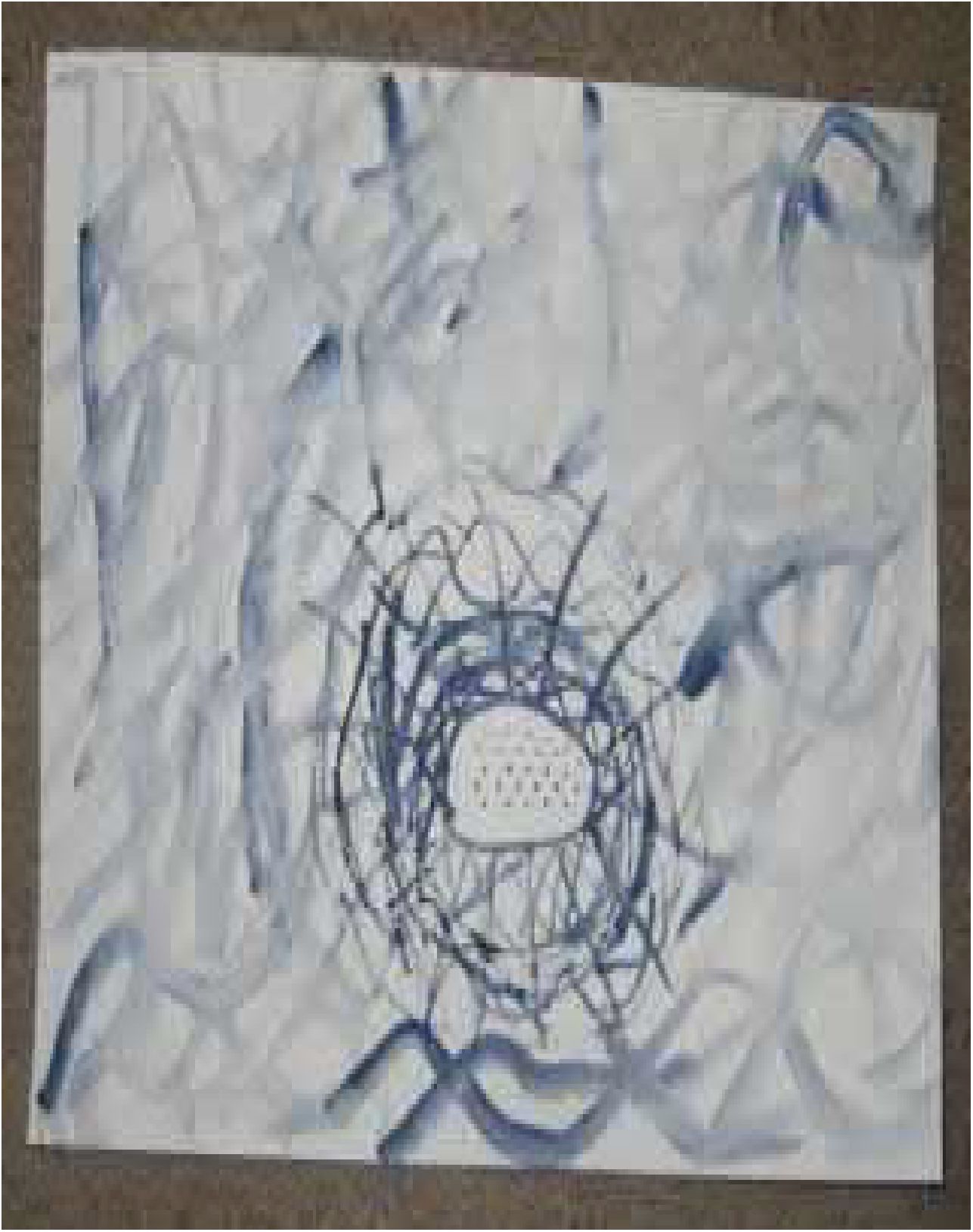
Phoenix
I developed the phoenix entity when I dropped out of the Ph. D program in which I had been enrolled. I was feeling lost and unsure of what to do next, and I realized I needed help with rising from the ashes. So I created an entity modeled off the phoenix.
The Phoenix is fueled by failure and success. It helps you learn from your failures and rise from the ashes to discover new opportunities. It encourages you and keeps you focused on learning from the mistakes that were made, but also find the path forward. In your darkest moments, the Phoenix will light the way. The Phoenix does draw on the mythology of the Phoenix for its influence and power.
Phoenix has helped me through a few tough times in my life. Each time I’ve fallen, Phoenix has helped me get back up by lighting the way forward and showing me where I need to learn from my mistakes. Phoenix helped me figure out the current path I’m on. I worked with Phoenix each day to help me process the fear and other emotions around failing, and gradually found my way forward to the current path I’m on. Phoenix is only activated in situations where things fall apart. Then she helps me put them back together again.

Harry Potter Entity
This is an example of working with an egregore, in this case the pop culture spirit of Harry Potter. Back in the early 2000's I created a collage with a bunch of images of Harry Potter because of the irrational fear Christians had that Harry Potter was converting their kids to the occult. They were burning the HP books and films because of that fear, and I figured if they had that much fear then good old Harry could put it to good use making their fears come true.
So, I conjured him up and asked if he was amendable, and he was. I then created the collage which had a bunch of kids going into Hogwarts, a wrathful Harry standing over a broken cross and a Harry studiously making a potion while a priest bobbed in the cauldron. At the top I had the phrase, "Couldn't we all use a little magic?"
The working was designed to take their fears and turn them into energy that fed Harry Potter. In turn, Harry Potter would inspire readers of the books and viewers of the movies with a healthy interest in the occult. I personally think the working was a success when I see how many more people are interested in the occult.
-
Chapter 6: Q and A
In this chapter I answer questions that people have asked in the Magical Experiments group about the topic. In some cases, I’ve answered the question earlier in the book, but I like to also answer it separately because the answer may be contextually different.
Q. What are the different mediums for servitor creation? Specifically, different vessels/sculptures/etc. and how they react vis a vis “natural” v “synthetic” v abstract/sigil only?
There are different housings that can be used for entity creation. I’ve experimented with using sigil paintings and clay sculptures, but also the vocalization of a word. I’ve also seen crochet, wooden, and metal sculptures created for the purposes of entity creation. I’ve also observed that some people have used action figures and dolls made of plastic for entity housing. All of these things can be used for housing and I haven’t observed a significant difference in using a natural material versus a synthetic material.
However, from a subjective perspective, I think it’s important to pick materials for the housing that help you connect with the entity. At the same time, you want to be careful and make sure that what you use will be something you can interact with. For example, I created a couple of voice activated entities, where the saying of their names was the housing. The problem with that is that I forgot their names! I had to look the names up to remember to say them, which isn’t useful if you’re needing to work with them on the fly. I didn’t work with the entities often enough to remember the names, so it was a good lesson that going too abstract might not be all that useful.
I’ve used synthetic materials such as plastic for the creation of entities. I’ve also bought pre-made statues and co-opted those statues for the housing of my entities. I have two protector servitors that are housed in a gargoyle and dragon statue, respectively, and a health entity that’s housed in another statue. Yet, if you look at the majority of entities that I’ve created, I’ve ended up using paintings or sculptures.
One reason for that choice is because I see the action of creating the housing as a way for you to launch the entity. Another reason though is that I like to get creative with my magic. I find it to be more fun and empowering when I am actively creating a magical entity as art. It creates a sense of intimacy because you’re making the physical structure that will house the entity.
I do think entities are more responsive when they have a physical structure that you can work with. Whether it’s a painting or a sculpture or something else, by giving the entity a manifest form it makes it easier for you to interact and work with that entity every day. But what makes any of those mediums effective comes down to your aesthetic of magic and how important it is that you use certain types of mediums over others. My advice is to consider what your aesthetics of magic are and then apply those to the housing that you create for magical entities. That will help you design your entities and make an intimate experience out of the process, which will deepen the magical work that you and the entity are doing.
How do you leave room to later modify the servitor, personality additions, or things you have learned about when creating your first servitors to the ones you work with now?
This is why I like to use the entity creation worksheet and/or flowchart for designing the entity. The worksheet helps you write out the core programming of the entity, while the flow chart pictorially demonstrates how the entity will work and what will trigger it.
When you want to revise the entity, you can go back to the worksheet and make changes to the programming. Likewise, you can revise your flow chart for the entity’s actions. Using either tool will help you modify the entity. It’s also useful to keep the worksheet so that you can go back and look at what worked and didn’t work and draw on it for inspiration with new entity creations.
I see entity creation as a form of programming, and the key thing to know about programming is that you can always go in and revise the code. Use your worksheets and/or flow charts as the programming document and know that when you want to make changes to the entity, you can do it via the worksheet and/or flow chart and those changes will take effect.
What are the energy needs for long term servitors? How do you care and maintain them over the long haul?
The energy need of a long term servitor isn’t all that different from a short term servitor. You basically need to pick the best fuel source that’s going to continuously feed the entity. In my case, I like to use ongoing activity that revolves around the desired result to feed the entity, because its activity also serves to train the entity around what you want it to accomplish.
If you can’t use activity around your desired result, you could look at emotions around that result as a viable alternative. That way your emotions don’t become a distraction or sabotage. A third viable alternative is to draw on other sources that you interact with enough that it fuels the entity. In the case of Sped Limt, for example, I see enough cop cars, ambulances, and fire trucks to easily keep the entity fed.
In terms of maintaining the entity beyond fueling, I recommend reviewing the programming of the entity every so often, with a question of how you can improve on it. If nothing else, it’s good to review it and look at the results so that you can make sure the entity is on track.
Is there a way to put an entity into sleep mode when you have a really good one that you aren’t currently using, but don’t want to decommission?
You could build a stop or sleep function into the entity that can be activated whenever you want it to hibernate. Simply include it in your worksheet/flow chart and include the specific triggers that will put the entity into sleep mode.
How do you renew an entity that's remained dormant?
When you build your stop or sleep switch into the entity, include a setting to turn it back on. When you’re ready, turn it back on and/or include the specific triggers that will reactivate the entity.
How do you protect your entities from other entities, spirits, or magicians (exploitation or harm)?
I recommend setting entities up with basic defensive countermeasures and an alarm notification for you if they’re coming under attack. The basic countermeasures could include shielding of some type that basically protects the entity. The alarm notification allows you to step in and do whatever you need to do to further protect the entity.
If you want more protection, you could have the entity develop more elaborate defensive protocols and attack protocols. I typically don’t do this unless I’ve set the entity up to attack something or someone (which I really don’t do these days). If one of my entities is attacked, it has the means of protecting itself as needed.
In the case of someone trying to hack your entity, I recommend setting up an alarm notification and also anti-tampering programming that’ll activate and warn you if someone’s trying something. That way, even if someone does disable the alarm, you’ll still get notified and can take appropriate actions.
I also include my entities in my daily magical work in terms of the protection magic I cast. That magic simultaneously renews the protection and cleanses the entity of any foreign programming and influences that weren’t included in the original programming.
One final thing I want to say as well is don’t go looking for trouble, and trouble likely won’t find you. Granted, there are occasions where some people will feel the need to have a pissing contest with you. In such cases, do what you need to do and then focus on what’s really important: your ongoing life journey.
What are methods for invoking/evoking entities?
You could say the name of the entity to invoke or evoke it. You could also come up with a chant that you use to invoke/evoke the entity. Alternately though, I would just recommend using the housing that you’ve created for the entity as your invocation/evocation tool.
The way I set up the housing is that if I look at it and want to invoke the entity, I can basically use the house to call the entity into me. I also set the housing up to permanently evoke the entity, so that it’s always going about its task and doesn’t need to be evoked again and again. Really, the way I design it is that the entity and I are in constant contact with each other. I’ve created it to enhance my life, and I don’t want to have to go to the trouble of having to constantly invoke or evoke it, so I just set it up so I contact it as needed, and it can do the same with me.
What are proper banishments to go along with the Invocations/Evocations?
I don’t do banishments and haven’t for a long time. I get why some people do, but my feeling on the matter is why go to all the trouble of creating the entity and setting it up if you’re just going to banish it. If you absolutely need to banish an entity you’ve created you can use a standard banishing working, but as I’ve cover in
Walking with the Spirits, I find that banishing runs counter to effective magic because it dispels what you’re working on. I would advise exploring why you feel the need to banish the entity in depth and determine if that will actually help or hinder whatever else you’re trying to do.
Is there a technique to help create a "protector" servitor when performing out of body travel?
Follow the processes I’ve described in this book and build the entity for that specific purpose.
I just built my 2nd Servitor. Here are two things I'm dealing with. 1) building a relationship with her so she's more real to me; building a better path for communication. 2) her ability to manifest herself more fully, doing her job and becoming better at that job.
To build a better relationship with your entity, I would advise you to consider the perspective of the entity and ask yourself how you would want to be interacted with. Then apply that understanding to your entity. You could also explore the symbiotic relationship perspective and see if working with your entity in that way could be helpful to developing a stronger relationship with the entity.
Beyond that, I would just say treat your entity with respect. Yes, you created it, but it’s not a disposable being, or at least it shouldn’t be to you. By treating your entity with respect, you’ll get respect from it and better results.
To help your entity do better at its job, review your result and programming. What can you do to teach it? What improvements can you make to its programming? These questions will help you improve your entity creation and your existing entity.
How can you work with egregores?
The way you would work with any other spirit. You want to be respectful and careful, and make sure that it wants to work with you. For instance, when I first chose to work with the Harry Potter pop culture spirit, I made sure it was open to working with me, especially since I had specific ideas about working with it. When you are working with a spirit you haven’t created you have to recognize that you are entering into a discussion where there will be a bargain made, or some type of agreement arrived at.
For instance, at the time of this writing I’m doing a lot of work around the egregore of the US. This has involved a fair amount of research and careful work being initiated to make sure the work I’d like to do can even be done. You have to remember that even if an egregore is a created entity, it’s one that’s evolved past its initial creation and that it has its own agenda and purpose, just like any other spirit does. So, work with it in the way you’d work with any other spirit and make sure that you dot your i’s and cross your t’s.
I would love to read your thoughts on spiritual hygiene and discernment when making and interacting with these entities.
First, never make a magical entity to do something that you’re not entirely in alignment with. That requires you do the necessary internal work to make sure what you’re doing with the entity is really in alignment with your internal values, beliefs, etc.
When you create the entity, you want to be very specific about how its fuels itself. If it is fueling itself off of you, this can create problems for you because it’s drawing on your life energy. I set up very specific filters when I do allow an entity to derive fuel from me in some form or manner. For example, with a job hunting entity I created, I did allow it to feed off any frustration, anger, and depression I felt while job hunting because I didn’t want those emotions to sabotage the entity or my chances of getting work, but only in context to the job hunting.
If other people are working with your entity, you also want to make sure that you explain how the fueling works so they don’t inadvertently set themselves up with a parasitic connection. For example, when I worked with the Harry Potter spirit, I did share my work with other people. One person chose to listen to Christian music while jogging in order to feel the entity and ended up passing out because the sound of the music was making an impression on that person. It was a case where the person didn’t realize that the fueling could extend to her energy because she was taking part in something to do with Christianity while fueling the entity.
In terms of discernment, you need to use your own best judgement. I set my entities up so they’re always active and working in the background. I don’t have any issues with having a symbiotic connection with them. But, if any of that bothers that you, then this work isn’t for you. Then again, you probably shouldn’t be working with spirits in general.
Take good care of yourself by using the appropriate precautions when creating the entity. If something seems off, then revisit your worksheet and make appropriate adjustments, or if you need to, destroy the entity. That’s the best advice I can give, along with what I’ve shared in the rest of this book.
Conclusion
Revisiting the topic of magical entities has been fun. It’s not often I revisit subjects I’ve written about, but in this case, I felt like it was time to revisit this topic and share my own advances with the work, as well as present my simplified model of creating a magical entity. As I said at the beginning of the book, you can use the worksheet in this book or Creating Magical Entities. Either will be fine.
What I hope you’ve taken away from this book is how easy it is to simplify a magical process such as creating a magical entity. When I co-wrote the original book we came up with a pretty good process. But I think my simplified version of that process is even more effective, because it strips away unnecessary details. The key to effective magic is get rid of needless complexity, and focus on what is absolutely essential. Of course, that varies from person to person, but you can still take the principle and apply it to your magical practice to help yourself determine what is needless and what is essential.
In this book, I’ve tried to introduce a different perspective on how to work with magical entities than the conventional perspective, because the conventional perspective is flawed. Applying a perspective of symbiosis to our relationships with the spirits, whether they are created entities, or pre-existing entities, teaches us to become present in our world in a way that a hierarchical approach to magic simply will not do. Instead of positioning ourselves in a place where we try to control the entities we create, we instead learn how to collaborate and cooperate with our entities, to work with them as partners where all parties benefit.
I think taking such an approach on can change how you work with your entities and improve the results you get. Certainly, applying this understanding to my life and the work I do with spirits and my created entities has not only improved the results I’ve gotten, but also helped me recognize how I’m really just another part of the continuum of this universe. It can be a humbling and enlightening experience, and it demonstrates that we are all in this together and can help each other if we choose to. By choosing to explore the symbiotic connection with my entities I value them differently because I see the interdependent relationships we have with each other, and instead of casually discarding them I want to embrace them. They are part of me, even as I am part of them.
Taylor Ellwood
June 2020
Portland OR
Bibliography
Allione, Tsultrim. (2008). Feeding your demons: Ancient wisdom for resolving inner conflict. New York: Little, Brown, and Company.
Cunningham, David, Ellwood, Taylor, & Amanda R. Wagener. (2003). Creating magickal entities: A complete guide to entity creation. Perrysburg: Egregore Publishing.
David-Neel, Alexandra. (1971). Magic and mystery in Tibet. New York: Dover Publications, Inc.
Ellwood, Taylor. (2018). Pop culture magick: A how to guide to practical pop culture magic. 3rd Edition. Portland: Magical Experiments Publications.
Hine, Phil. (1995). Condensed chaos magic: An introduction to chaos magic. Tempe: New Falcon Publications.
Stavish, Mark (2018). Egregores: The occult entities that watch over human destiny. Rochester: Inner Traditions.
Want to more with creating and working with your magical entity?
If your answer is yes, then you’ll want to check out my Magical Entity course, which is available at Magical Experiments University. In that course, I do a video walkthrough of how to create and work with magical entities.
Visit magical-experiments.teachable.com to sign up for the class.
You finished Book 1 of the Walking With Spirits series and there’s more on the way
I’m currently working on the next book in the Walking With Spirits series. If you’d like to be notified when that book is available, please visit the magical experiments site and pick up a free e-book on magic, and get placed on my e-list so you can get notified when the next book is out.
Also check out the bonus chapter in this book, which is the first chapter of Walking With Spirits.
About the Author
Taylor Ellwood is the author of numerous books on magic including Pop Culture Magick, Space/Time Magic, and Inner Alchemy. He is also the author of the Zombie Apocalypse Call Center, a hilarious adventure about a customer representative that has to save his customers from the zombie apocalypse. When he isn’t working on his latest magical experiment or writing a book he can be found enjoying games, books, and life and the company of his amazing wife. For more information about his latest non-fiction projects, check visit the magical experiments website.
Learn How Magic Works!
Free E-books available on my website Magicalexperiments.com
Whether you want a learn a simple 4 step process for creating a magical working, or discover how take your fandom and turn it into a spiritual practice, or learn simple breath meditations that enhance your life, or discover how to turn probabilities I have free e-books available for you that will teach you how magic works and how to get consistent results with it. Visit magicalexperiments.com/free-books and download your free e-book today!
Bonus
Chapter 1: What are Spirits?
I’m going to start this book by making a radical claim that goes contrary to how Western occultism depicts and defines the spirit world. You don’t have to agree with my claim, but I do ask you to consider it, for the duration of this book, as a possible alternative that may help you get better results and have better relationships with your spirits. So what’s my radical claim?
My radical claim is this: The spirit world is the world we already live in and the spirits actually have a physical existence here, albeit in a way we many not fully understand or perceive. And because we do not fully understand or perceive the spirits in our world, we have accordingly come up with elaborate and artificial divisions that allow us to categorize and objectify spirits in a manner that attempts to make the spirits easier to understand (and control), but also relegates them into a safe, human space, that is convenient for us, but also causes out to miss out on the true magic and mystery of the spirits.
It doesn’t help that we have a humanocentric need to anthropomorphize spirits and insist that any interaction occur in a way that is conveniently comfortable for us and oriented around our needs and wants. The classic expectation that a spirit will appear before people in a form that they can relate to and speak in the native tongue of the person calling on the spirit also contributes to this categorization and objectification of spirits, and to the loss of connection with them.
At the same time, we also have a problematic focus on the astral plane and trying to recapture an organic connection with the spirits using astral travel. The problem with this focus on astral projection is that it lends itself more to fantasy than anything else, and doesn’t necessarily produce a genuine connection with spirits. An additional problem is the tendency people have to categorize even the astral plane itself, dividing it up into multiple levels or planes, as a way of trying to make sense of it in human terms.
What all this really boils down to is that we consistently try to frame our experiences of spirits and anything related to spirits in human terms and concepts, while rejecting the experiential connections, because they aren’t easily understood or experienced. We try to make sense of the spirits using psychological terminology or by creating rigid systems that mandate how spirits can be connected with, without questioning whether any of those things lend themselves toward helping us actually connect with spirits, or if they just reinforce the divide that has been created by the humanocentric need to control the connection and experience.
Now this is a bold claim to make, so if I’m going to make it, I also need to back it up and ideally propose an alternative solution. For the rest of this chapter we’re going to explore what spirits are and are not, in order to set the stage for later chapters where we’re going to explore the traditional approaches to working with spirits, and then I’ll introduce my approach to working with spirits, which focuses on connecting with the spirits through experiential embodiment.
What are spirits?
Maybe you already know the answer to this question, but if you’ve read any of my books, you know that I’m big on defining our terminology, because a defined terminology creates a common ground for us to develop our magical work. And I think this applies as much to spirits as it does to any other aspect of magic.
So what are spirits?
I consider spirits to have an objective existence. That is they exist outside of us, but I also consider them to live in symbiosis with us. We see that because of the fact that they want a relationship with us and they seem to benefit from that relationship in some form or manner. At the same time, we seem to need them as well, or why else would we work with them? With all that said our understanding and depiction of spirits is mediated through the lens of being human, which brings with it human assumptions and biases thy may cause us to misunderstand the nature of the spirits we work with.
As I noted above, there is a tendency to anthropomorphize spirits, to situate them in human context, because that’s what is convenient for us, but we need to remember the following about spirits, “Spirits aren’t all just functional manifestations that run automatically like computer programs when the right buttons are pushed. They aren’t anthropomorphized externalizations of internal mental and emotional concepts. They are spirits” (Swain 2018 P. 96). The assumptions, biases, emotions,
and definitions we bring to the relationships we have with the spirits need to be recognized for what they are, a subjective understanding of the spirits that may impact our relationships with those spirits in ways we don’t fully understand. The best example of this I can think of is a simple principle, which is what you bring with you to your meeting with the spirits is what you often get from them (Andrews 1993a, Stavish 2018). If I bring fear into the workings I’m doing with the spirits, then the spirits may end up obliging me accordingly, because they are reading me on more levels than just what I say or visualize. They recognize what we bring to the relationship and if they feel we need that validation, they’ll provide it because we are coming to them with what we need and want from them, on all levels of our being.
An encounter with the spirits is an encounter with the imagination. Think of kids with imaginary friends; those imaginary friends could be spirits. As adults we’re told to think of the imagination as something for children to use, but what we fail to recognize is the imagination is essential to our identities and our place in the universe, and it is something we use every day. It is also a medium the spirits use to communicate with us (Harpur 2002, Ellwood 2018). We tend to divide imagination from material reality, but imagination is where the seed for material manifestation is planted and yet imagination is also where all things are probable. That strikes me as similar to spirits, especially when you consider that spirits can assume different forms and shapes as needed. When a magician asks a spirit to appear before them in a pleasing form, what they are really asking is for the spirit to connect with us via imagination and pick out a shape that suits and that we can relate to through the lens and limitations of our human awareness. Ted Andrews notes that, “Creative imagination, or imaginative cognition, is the key to opening the doors to true spiritual awareness, energies and beings” (Andrews 1993a P 34). When I look at other treatises on working with the spirits, what stands out to me is how imagination is omitted as a necessary element of connecting with spirits. Omitting the imagination causes us to ignore the very nature of spirits and I think contributes to the fundamental misunderstanding of them, because so much emphasis is either put on wanting spirits to manifest in a specific way or in separating them out from the world we live in. If we instead entertain the possibility that the imagination is a necessary part of spirit work, then we can also consider how to use the imagination in that work in order to establish better relationships with the spirits. We’ll return to this topic in more depth later in the book.
Exercise
What do you think spirits are? Where are they situated in your personal cosmology? What role, if any, does imagination play in your interaction with spirits?
Share your answers in the Magical Experiments Facebook group #walkingwithspirits.
Types of Spirits
Humans love to categorize everything and this includes spirits. Now, there can be good reasons to categorize spirits, based on patterns of observation and experiences around spirits, and/or as a way to denote specific types of relationships, but it’s still worth noting that we’re doing the categorization and that as such the categorization may only be partially accurate, because it’s based around our biases, objectifications, and just overall need to situate things we don’t understand into conceptual boxes that give us an illusion of understanding. I say that deliberately because even when we think we know something, we ought to carefully examine the assumption of that challenge and be willing to challenge it.
With that said, let’s consider the topic of types of spirits. The typical categorization of spirits in Western occultism is as follows: ancestors, magical entities, elementals, faeries, demons, angels, and deities. I’m going to add pop culture spirits to that list and I categorize them separately. Let’s explore each of these in a little more detail below.
Ancestors
Ancestral spirits are the spirits of the deceased who have not fully passed on who are related to you. Sometimes you can also interact with a spiritual ancestor, someone from the same spiritual lineage as you, although a spiritual ancestor is typically referred to as an inner contact. Though not all inner contacts are ancestors. They can be other types of spirits as well. Some people work with ancestral spirits and other people don’t. The key thing to remember about an ancestor is that just because they’ve died doesn’t necessarily mean they are more enlightened or different from who they were in life. If anything an ancestral spirit is bound more to the personality of who they were, because they haven’t fully passed and aren’t
necessarily ready to as of yet. They may have unfinished business, may want to keep an eye on the family, or may not even realized they’ve passed on. Some ancestors become ghosts, haunting a site because of the unresolved business they need to attend to. When that business is resolved or they are ready, they can pass onto whatever next awaits them. You can work with ancestral spirits, as we’ll explore in a later chapter of this book.
Magical Entities
Magical Entities, also known as thought forms, tulpas, servitors, and egregores, are spirits created by a magician for the purpose of achieving specific results. Magical entities can become independent of the magician, and there are different schools of thoughts on how to handle that independence. The reason a magician might create an entity is because they want to achieve a result and feel that a created entity would get better results than either a practical magic working or working with a pre-existing spirit that may not fully understand the situation and have requirements the magician doesn’t want to meet. For more information on how to create and work with magical entities, check out my book Walking with Magical Entities.
Elementals
Elementals are spirits that mediate the elemental forces of the universe, and can also be considered nature spirits. Traditionally the elements are limited to Earth, Air, Fire, Water, and Spirit, but my own approach to elemental magic incorporates what I consider to be other elements, such as sound and gravity (among others). Elementals can be worked with magically and allow you to access those primal energies they mediate. For more information on how to work with elementals, see my forthcoming book Walking with Elementals.
Faeries
Some people try to group faeries and elementals together, but faeries and elementals are not one and the same. Faeries are close to nature, but they aren’t exactly nature spirits in the same ways as elementals are. It might be better to think of them as caretakers of sorts, though even that may not be fully accurate. I associate faeries with the underworld energy of the earth and if you look at faerie lore you do end up seeing the faeries in the mounds and hills, which seems to indicate some connection with the underworld. I haven’t worked with faeries very much so I’m not covering them in detail at this time.
Demons
Demons are spirits of wisdom that have a lot of interest in interacting with humans. Despite Christian propaganda (and some Western occultism as well) demons are not evil and aren’t out to get your soul. In my opinion and experience, the reason some people have negative experiences with demons is based on how they try to work with them. Imagine someone calling you, putting a noose around your neck and compelling you to do tasks, by threatening you with other people. If you don’t find that particular scenario favorable, then consider that demons don’t either and that there’s a better way to approach working with them that doesn’t involve coercion and compulsion. Typically people work with demons because they want to achieve specific results or learn specific information, which are tasks that demons are good at following through with. For more information on my approach to working with demons, see my forthcoming book Walking with Demons.
Angels
Angels are typically depicted as spirits that serve the Christian God. However, that isn’t really the case. If anything, what angels serve are the universe. Angels are function oriented, which means that the function they perform is the guiding focus of their work. If you get in the way of that functioning, then they’ll have problems with them. If on the other hand, you’re working with them in relationship to their function, they’ll help you. Archangels direct angels, but also essentially are focused around the function they perform. For more information on my approach to working with angels, see my forthcoming book Walking with Angels.
Deities
Deities, i.e. gods and goddesses are spirits that typically worshipped and worked with, within a specific cultural context, though in some cases, they are widespread enough that they are no longer worked with strictly within the cultural context they originated from. For instance the Greek, Norse, and Celtic gods are worked with in reconstructionist circles, but also have people who aren’t reconstructionists that work with them. As such there can be both context specific magical works and more generic magical workings that are done with them. The gods don’t seem too picky
about how they’re worked with, though they also have no problem telling people how they want to work with them, as we’ll explore in a later chapter in this book.
Pop Culture Spirits
This last categorization is not typically included in books on working with spirits and will likely seem controversial to more conventional occultists, but enough people practice pop culture magic and work with pop culture spirits that they merit inclusion in a book on working with spirits. Pop culture spirits are characters from modern media such as television, videogames, books, and comic books that can be worked with. All though these characters are “fictional” they are essentially real and can be worked with, just as you would with other spirits, as we’ll explore in a later chapter in this book.
Exercise
What types of spirits have you worked with and why? What types of spirits haven’t your worked with and why? Are there certain types you find easier to work with and if so why do you think that is the case?
Share your answers in the Magical Experiments Facebook group #walkingwithspirits.
The Importance of Keeping a Journal
Ideally you are already keeping a journal of some type for tracking your magical workings, but this is especially important in working with spirits because your spirit journal will help you keep track of the spirits you work with, so that you can note behaviors, characteristics, and other specific information that is helpful in determining the overall effectiveness of your relationship with your spirits. You also want to use the journal to keep track of patterns with your spirit work, so you can notice if there is any irregularities in that work.
One reason I keep a journal for spirit is also to keep track of the questions that I ask spirits. Both with initial contact and subsequent contacts, I will ask questions and record answers as a way of noting patterns, but also as a way of verifying the spirit contact and that the spirit is who it says it is. This may seem a little paranoid but there can be occasions where a spirit shows up and its not the spirit you were looking for. By testing the spirit, you verify that it is the correct spirit. I have never had a situation where the spirit is offended, so I do recommend doing your due diligence and making sure that the spirit you’re calling on is really the one showing up.
You can also do this by paying attention to the physical sensations you feel when you work with a spirit. You will feel some type of sensation when you’re working with a spirit, because they communicate on an experiential level with you. If the physical sensations aren’t the same each time that’s a clue that you’re working with a different spirit.
Conclusion
We work with spirits because we have a symbiotic relationship with them. They are part of our existence and we are part of their existence. When the situation is ideal, both spirits and humans benefit from working with each other, but the situation isn’t always ideal. Sometimes humans try to compel and coerce spirits into doing things for them, or alternately put themselves in a position where the spirit is treated as all powerful. Neither scenario is healthy.
When I think about why I work with spirits, it is because I want to have a mutually beneficial relationship with the spirits I work with. I’ve chosen the phrase walking with spirits purposely to describe that relationship because I prefer to work with spirits that operates from a place of equality and symbiotic mutual benefit, as opposed to what I see as the traditional narratives around working with spirits that occur in Western occultism. I prefer to walk with the spirits, in companionship and friendship, as allies. That is how I have always worked with spirits and as a result I’ve never had a truly bad experience with a spirit. This book, and the rest of this series is focused on showing how to create and maintain a co-equal relationship with the spirits you work with.
We work with spirits because they enhance and improve our lives and they work with us for the same reason, but if the relationship starts off on the wrong foot, it doesn’t serve either party. Let’s learn what such a relationship looks like so we can avoid creating one like it.
Did you know I also write Fiction?
At Imagine Your Reality, I invite you to explore my fantastical worlds of fiction and make them part of your reality. Whether you’re following the adventures of a superhero who’s learning how to fly or rooting for a support analyst as he fights off zombies, my hope is that my stories will entertain you and take you to a fantastical place. I write fiction with a twist, because I like to surprise my readers and that’s exactly what you’ll get with my writing.
That’s what Imagine Your Reality is about and I invite you to take a glimpse of the fantastic and read my free novella The Zombie Apocalypse Convenience Store, which explores what happens when a convenience store clerk has to survive the zombie apocalypse.
Visit Imagineyourreality.com to get the free story and get notifications when I publish my fiction.
Learn How Magic Works