Original Magic: The Rituals and Initiations of the Persian Magi - Stephen E. Flowers Ph.D. 2017
The Wheels Of Power
Theories of Mazdan Magic
Many are familiar with the Indian doctrine of chakras (wheels), which seems to have been an Indo-European teaching with various manifestations in different cultural systems. The practical importance of this theory is in the fact that it allows the individual to embody magical teachings and thus internalize them in a pro-found way. The link between the chakra system and the teachings of Zarathustra is well made by Shahriar Shahriari in his article “Amesha Spentas and Chakras.”6 For the sake of distinction between the Mazdan tradition and that of the Indians, we will call these centers by the Persian word charkh, “wheel,” which is cognate with chakra (from Sanskrit cakra).
The Charkhs
7 Ahura Mazda—white
6 Ameretat—violet
5 Haurvatat—blue
4 Spenta Armaiti—green
3 Khshathra—yellow
2 Vohu Manah—orange
1 Asha—red
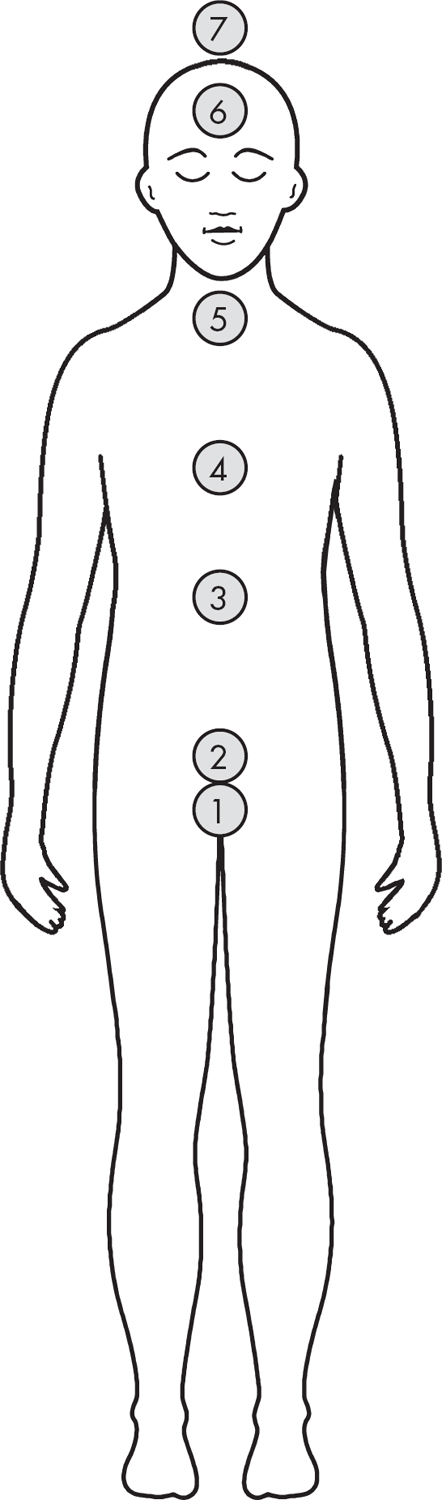
Fig. 3.3. The charkhs
This doctrine is linked to the most ancient teachings of Zarathustra who saw the Amesha Spentas not so much as independent divinities or angels but more as pure emanations of the one Wise Lord. As such, the meanings of these emanations as connected to the wheels are as follows:
1. Asha: Order, law, and the root of the good existence as created by Ahura Mazda. It is the connection to the Earth through the laws of the physical world. Experience and understanding of these laws leads to actions based on this understanding, and thus to desired effects. Its color arcs from black to vivid red.
2. Vohu Manah: Creativity, the plan and blueprint for beneficial action so that the individual can come to desire and imagine what is necessary and participate in the co-creation of the universe using active, creative, and procreative power. At this level, as at all others, the wheel, properly activated, helps the individual make right and good choices.
3. Khshathra: Manifestation and action based on the plans of the individual so that desire can be realized. This is the power to alter the environment, the power of the realization of the will.
4. Spenta Armaiti: Love, devotion, and faith. This center gives the power to love and be loved, to give and receive the gift of love both between and among one’s fellow human being and also between Man and the Divine. Here the individual is endowed with the spirit to make the right choices to further the good creation and lead to individual happiness (ushta).
5. Haurvatat: Perfection, the conscious realization of the essence of the first four wheels results is a communicable form of awareness of the web-work of universal knowledge. The actions of the first four wheels are reflected as the word in the fifth.
6. Ameretat: Immortality comes with understanding and the realization of the timeless essence of the creations. This is an understanding that stands beyond the realm of getig, the manifest universe. One who can center consciousness in this wheel has so-called psychic powers, because the timeless realm, in which all possibilities exist, is made available to the mind.
7. Ahura Mazda: Consciousness, focused yet all inclusive of all that is conscious and therefore good and powerful. White light contains all light, and it is from this pure light that all other colors emanate. It is pure silent thought.
These emanations are connected on a vertical axis and channel, its “purpose . . . is to create a mechanism . . . that can manifest the divine into the physical plane.”7 A meditational exploration of these bodily centers can be a method of tuning the individual’s magical body for works of magic.
Clearly this system of levels of consciousness and colors esoterically underlies the idea of the “rainbow bridge.” The internal magical product of initiation forms the bridge between the worlds and is also reflected in the idea of the Chinvat Bridge, or bridge of sorting.
In the practical training of the magicians they should make this system come alive in the body by following the instructions in chapter 4.
Certain other esoteric or magical doctrines recognize sixteen charkhs (chakras), which are centers or vortices of energy. These act as receivers and transmitters of forces and/or memes of information. These are the tools by which the individual student is able to interact with parts of the soul on a magical or operative level.