Low Magick: It's All In Your Head ... You Just Have No Idea How Big Your Head Is - Lon Milo DuQuette 2010
Pop Goes Ganesha!
All around the mulberry bush
The monkey chased the weasel;
The monkey thought ’twas all in fun,
Pop! goes the weasel.
A penny for a spool of thread,
A penny for a needle—
That’s the way the money goes,
Pop! goes the weasel.
TRADITIONAL NURSERY RHYME
I am now going to describe to you a little ritual that whirled into my bag of magical tricks about ten years ago. I first created it to be a whimsical meditation that I could quickly perform mentally to begin and end my morning routine, but it soon became for me something much more. In fact, within the context of its goofy simplicity, I have found not only a powerful banishing ceremony, but also a profound and breathtakingly effective technique of invocation. As it has become a key component to both my meditation and magical rituals, and because I will be referring to it in several places in the chapters that follow, I would like to share it with you now.
It is one thing to have an intellectual grasp and appreciation of the Great G, but it is quite another to allow oneself to gushingly melt in giddy adoration to it. I’ll admit, as I was growing up I had a real problem loving God. No. That’s not quite correct. I had a problem loving what seemed to be the monster everyone around me was calling God. Nevertheless, as I grew older I knew that if I was ever going to evolve into a sane and competent magician—if I ever hoped to perform a proper invocation, and become duly and truly connected with the divine “above,” I would have to come to grips with my deep-seated negative attitudes. I would need to discover how to open my heart and fall in love with the Great G and set off the divine love feedback I spoke of a moment ago.
My first challenge was to settle on a tangible image, a form, a name for this formless and most abstract of abstract spiritual concepts. It would seem logical that I would try to personify the Great G in the likeness of one of the deities of my religion. After all, as a practicing Thelemite and archbishop75 of my church,76 my life is not bereft of gods and goddesses, foremost of which is a trinity of infinities that define the fundamental principals of Thelemic cosmology:
· Nuit—the Egyptian goddess of the night sky often depicted in Egyptian art as azure in color, tall and slender, arching over the earth. She is the infinity of an ultimately expanded universe (the circumference of the circle).
· Hadit—Nuit’s lover. In Thelemic/Egyptian iconography depicted as a winged solar disk. He is the infinity of an ultimately contracted universe, the point in the center of
the circle. If Hadit were a phenomenon of physics I see him in his most fundamental character as the pre—Big-Bang singularity.
· Ra-Hoor-Khuit—the hawk-headed Crowned and Conquering Child of the union of Nuit and Hadit. Because Nuit’s expansion (the infinite “out”) and Hadit’s contraction (the infinite “in”) are both infinitely everywhere, so too must be their points of contact. This infinite contact creates Ra-Hoor-Khuit, a field of operation in which the universe can manifest.
Nuit, Hadit, and Ra-Hoor-Khuit are perfectly lovely cosmic concepts—awesome in fact—more than enough to qualify as proper deities to invoke. But, as much as I love my religion and the iconography of ancient Egypt, and as much as I respect these profound concepts, I personally find it very difficult (at least initially) to get emotionally warm and fuzzy at the thought of loving (and being loved by) the cold expanded universe, its dimensionless center, and the everything that lies between.
I also consider myself a hermetic Qabalist, and as such I worship the Great G as the threefold negativities that precede creation: “Ain, Ain Soph, and Ain Soph Aur.” The concept of these three varieties of nothingness is as cool as modern jazz and (in my mind) catapults esoteric Judaism into the subtle stratosphere of Zen Buddhism (and vice versa). I sip my virtual espresso and snap beatnik fingers to applaud such hip transcendent realities, but honestly, how can I be expected to warm up to three wacky kinds of nothing?
If my magical career was to evolve, I realized I would need to find a sweet and simple god upon whom I could project all the infinite and sublime Great G concepts that already held my soul in jaw-dropping awe. I needed to gather all my infinites and omni-everythings (I’m making words up again) and bundle them together into one irresistible and lovable package. And so, I set to work combing the pantheons of the world’s religions, great and small, in search of a deity whose image and character resonates with my peculiar menu of spiritual programming. About ten years ago, I settled ever so comfortably on a deity that fills the bill perfectly, the potbellied remover of obstacles, Ganesha.77
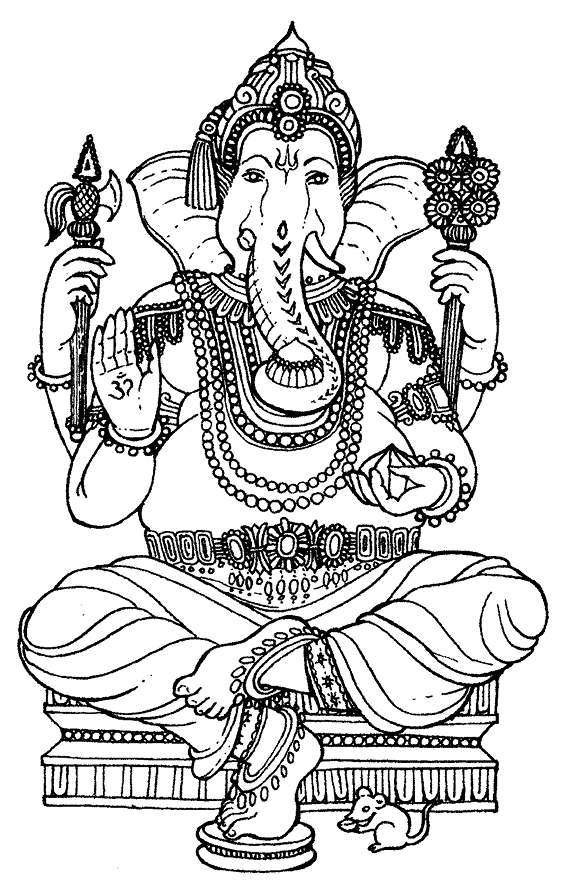
Ganesha
Now, before you read anything unduly sectarian into my special relationship with Ganesha, I want you to know that I do not claim to be a devotee of Ganesha in the orthodox sense of the word. I do not belong to any Ganesha cults or sects. I don’t travel to Ganesha pujas or festivals, nor have I memorized the 108 Names of Lord Ganesha (although they are wonderful beyond words).
Also, please be clear on this—I am not advocating that you or anyone else necessarily need to select the image, character, or concept of Ganesha as your tangible icon of the intangible, the supreme consciousness of the cosmos. It’s your life, your spiritual cosmos, your magick. You are your own magician. Get your own God! If Ganesha floats your Great G devotional boat, fine! It’s no business of mine or anyone else.
Everything I am about to describe in the following little banishing and invoking ritual can just as easily be applied using the character and image of any deity or object of your devotion—or any character or any thing of your choosing. I chose Ganesha because when I travel in vision to the throne-room of the supreme consciousness of the Great G, I can instantly and effortlessly imagine that I am beholding the all-loving and beautiful sweet face of Ganesha. My heart swells and overflows with a current of love for the divine, and I can joyously plunge my soul into the massive and cozy heart of that deity. But just as easily, I find myself totally receptive to that same flood of divine love and bliss coming from Ganesha, and therein lies the key.
Once I became comfortable with my new relationship with the Great G in the image and personality of Ganesha, I automatically began to acknowledge his presence and enlist his blessing and guidance prior to embarking on any serious undertaking. His huge ears were perpetually attuned to my prayers; his unjudgmental eyes lovingly bore witness to my noblest thoughts and deeds, and my vilest vices and vanities. At day’s end, I comfortably rested in the folds of his great curled trunk as he rocked me to sleep.
Okay, I confess. I was dangerously close to becoming a Ganesha nut! (No offense to real Ganesha nuts). I even seriously thought about memorizing his 108 attributes, i.e., Lord of the Whole World, Remover of Obstacles, Beloved and Lovable Child, Moon-Crested Lord, Master of Poets, Lord of Music, Huge-Bellied Lord (Boy! Could I identify with a huge-bellied god!), One Who Is Easy to Appease, Destroyer of All Obstacles and Impediments, etc. But I’m a lazy man, and as my Lord Ganesha is easy to appease, I resolved that I would simply chant his name 108 times as a mantra prior to meditation or magick, or in the quiet moments before my lectures or musical performances, or indeed, before I did anything important.
A friend gave me a rosary of 108 beads78 and for a while I used that to help me count off the “Ganeshas.” Sadly, I ended up leaving it behind in an airplane seat somewhere between Copenhagen and London. I felt kind of funny using the rosary in public anyway, especially when I flew (and I fly a lot). Other passengers looked at me like I was some kind of white-haired terrorist saying my last suicidal prayers.
No. I needed a quick and easy way to silently and secretly chant the name of Ganesha 108 times while counting on my fingers. After much experimentation I discovered the perfect technique. I determined that if I sang the word Ganesh (or Ganesha) repeatedly to the tune of Pop Goes the Weasel I need only sing four and one half verses. Each full verse (example below) equals 24 repetitions of the Divine Name.
4½ verses = 108
Ganesh Ganesh Ga-ne-esh Ganesh
Ganesh Ganesh Ganesh-a
Ganesh Ganesh Ga-ne-esh Ganesh
Ga—a—a—nesh-a.
Ganesh Ganesh Ganesh Ganesh
Ganesh Ganesh Ga—ne—sha
Ganesh Ganesh Ganesh Ganesh
Ga—a—a—nesh-a.
It works perfectly. I just keep track on the fingers of one hand. I can do it while driving the car. I can do it mentally while standing in line at the airport. I can do it while flying without alarming my fellow passengers, and, I eventually discovered, I could do it to both banish my magical circle and invoke the Great G.
In order for you to appreciate the simplicity of this little ritual, you need to understand the magical dynamics of how the magician moves about the temple in ritual in order to initiate and direct the flow of energy that either invokes or banishes a specific magical force.
INVOKING
(with the Sun)
In order to invoke (bring in the desired magical force), the general magical rule of thumb suggests that the magician move about the temple in a clockwise direction (i.e., around the perimeter or circle of the temple space, moving from east to south to west to north, returning to the east). This movement with the Sun’s apparent daily path is called “deosil.”
Standing in one place and spinning (rotating) clockwise is also considered an invoking movement.
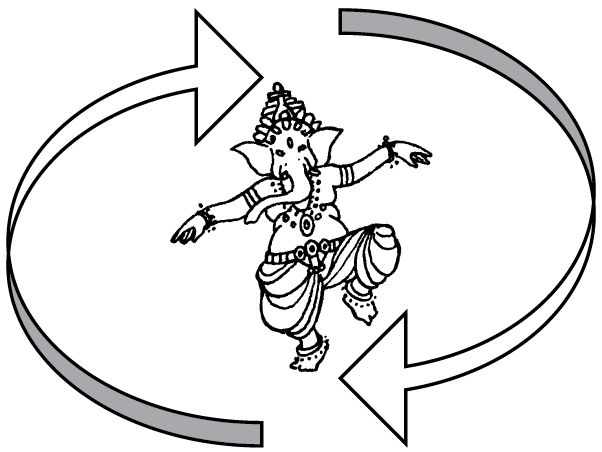
Rotating clockwise (deosil) on one’s axis also invokes.
The magician can also invoke by moving in a spiral pattern starting at the circumference of the temple circle and moving inwardly until coming to rest in the center—as if you were pulling the force or entity into the center of the temple.
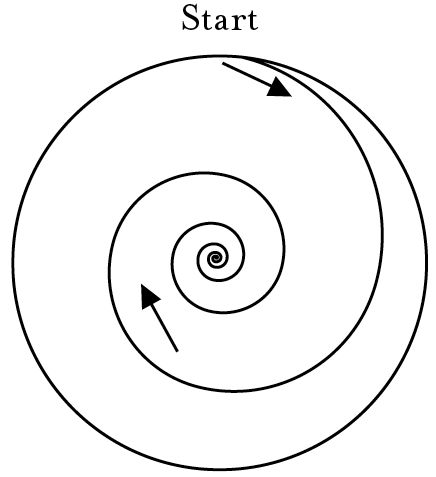
Movement in a clockwise (deosil) direction and spiraling inward invokes.
Naturally the power of this invoking movement is further amplified if the inward-turning spiral was performed in a clockwise (deosil) direction, and amplified even more if the magician was also performing deosil rotations while moving along the path of the inward-turning spiral.
BANISHING
(against the Sun)
Conversely, in order to banish (or send away), the general magical rule of thumb suggests movement about the temple in a counter-clockwise direction (i.e., east to north to west to south, returning to the east). This movement against the Sun’s apparent daily path is called “widdershins.”
Standing in one place and spinning (rotating) counterclockwise is also considered a banishing movement.
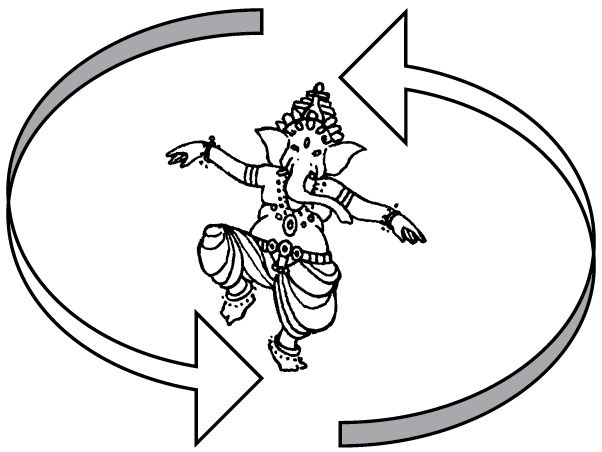
Rotating counterclockwise (widdershins) also banishes.
By now you’ve probably surmised that you can also banish by moving in a spiral pattern starting from the center and moving widdershins outwardly until coming to rest at the far circumference of the circle—as if you were pushing everything out and away from the center of the temple. Naturally, the power of this banishing movement is further amplified if the outward-turning spiral is also performed in a counterclockwise (widdershins) direction, and strengthened even more if the magician is also performing widdershins rotations while moving along the path of the outward turning spiral.79
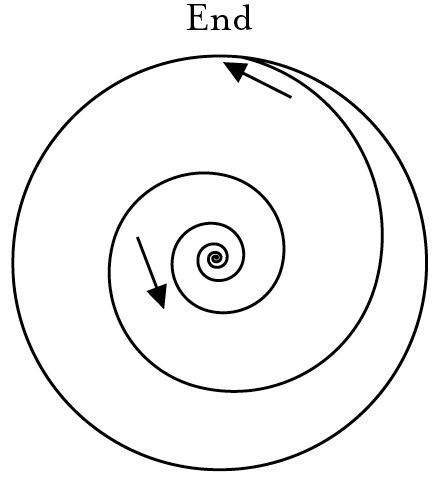
Movement in a counterclockwise (widdershins) direction
and spiraling outward banishes.
I call this little banishing/invoking ceremony “The Dance of Ganesha” and remind the reader it, like most other magical rituals, is much easier to actually perform and visualize than it is to read about it.
LIBER CVIII
THE DANCE OF GANESHA
A Ritual/Meditation
Part I. The Banishing
· The magician sits down in the center of the circle facing east, eyes closed. The entire ritual/meditation is accomplished in the mind’s eye.
· Once relaxed and settled, the magician formulates in the mind a tiny living image of Ganesha80—standing in his colorful glory in the center of the magician’s brain.
· Then, the tiny Ganesha bursts forth from the brain and stands on the floor directly in front of the magician. Magically, the image of the deity has now grown to about three feet high.
· Ganesha begins to gracefully whirl widdershins. (The image of spinning Ganesha should bring delight into the heart of the magician.)
· The magician now begins to chant the Pop Goes Ganesha mantra.
· While continuing to whirl widdershins, Ganesha now begins to move widdershins in an outwardly spiraling circle around the magician. (See figure on next page.)
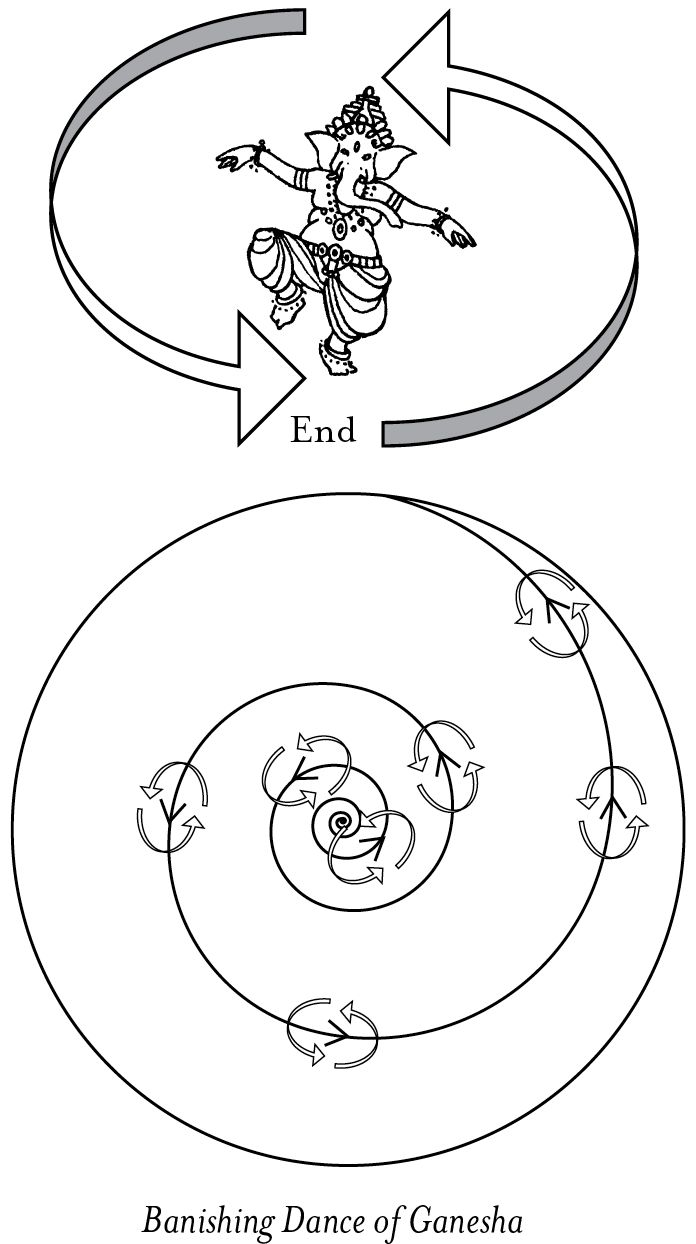
· As the spiral takes Ganesha farther and farther away from the center of the circle and the seated magician, the image of the deity grows in size.
· By the time the chant has reached the end of the first half of the first verse …
Ganesh Ganesh Ga-ne-esh Ganesh
Ganesh Ganesh Ganesh-a
Ganesh Ganesh Ga-ne-esh Ganesh
Ga—a—a—nesh-a.
… Ganesha’s whirling spiral dance has brought him again directly in front of the magician, but by now the spiral has carried him to the far eastern limits of the temple room. The image of Ganesha is now about twelve feet tall.
· By the time the chant has reached the end of the second half of the first verse …
Ganesh Ganesh Ganesh Ganesh
Ganesh Ganesh Ga—ne—sha
Ganesh Ganesh Ganesh Ganesh
Ga—a—a—nesh-a.
… Ganesha’s whirling spiral dance brings him again directly in front of the magician, but by now the spiral has carried him to the far eastern limits of the continent (in my case, North America). The image of Ganesha is now many thousands of miles tall.
· By the time the chant as reached the end of the first half of the second verse, Ganesha’s whirling spiral dance has now encompassed the sphere of the earth and the orbit of the moon. The image of Ganesha is now hundreds of thousands of miles tall.
· By the time the chant has reached the end of the second half of the second verse, Ganesha’s whirling spiral dance has encompassed the Sun and the orbits of all the planets in our solar system. Ganesha is now many millions of miles in size.
· By the time the chant has reached the end of the first half of the third verse, the dance has enclosed the Milky Way and Ganesha is now hundred of thousands of light years in stature.
· By the time the chant has reached the second half of the third verse, Ganesha’s spiral dance has circumscribed the local group of galaxies in the neighborhood of the Milky Way. Ganesha is now millions of light years in size.
· By the time the chant has reached the end of the first half of the fourth verse, Ganesha’s dance has reached so far into space that the Milky Way and our local group of galaxies look merely like one fuzzy star in the midst of billions of other star/galaxy groups. Ganesha is billions of light years in size.
· By the time the chant has reached the end of the second half of the fourth verse, Ganesha’s spiral dance has pushed the physical universe to its inscrutable limits. There is no beyond. There is no size bigger. Space has been transcended. The concept of center and circumference has been obliterated. There is only the infinite immensity of Ganesha … and the infinite smallness of the magician seated in the deity’s dimensionless center.
· The banishing is completed.
Part II. The Invocation
The magician has now chanted four complete verses of the Pop Goes Ganesha mantra. During those four verses, the ever-growing image of dancing Ganesha has banished (pushed away) the entire universe by whirling widdershins in a counterclockwise spiral until it has reached the limits of space-time. There is no more universe left for the now infinitely immense Ganesha to circumscribe—no outside of itself—not even empty space. When the magician has grasped the absolute immensity of this idea, he or she is now ready to invoke.
The infinitely large image of Ganesha standing before the magician now begins to gracefully spin clockwise. During the first of the four lines of the chant remaining, the spinning Ganesha will move in a very short inward clockwise arc until it enters into the magician’s right ear. This movement completely drags the first quarter of the cosmos with it and deposits it inside the magician’s own head.
Ganesh Ganesh Ganesh Ganesh
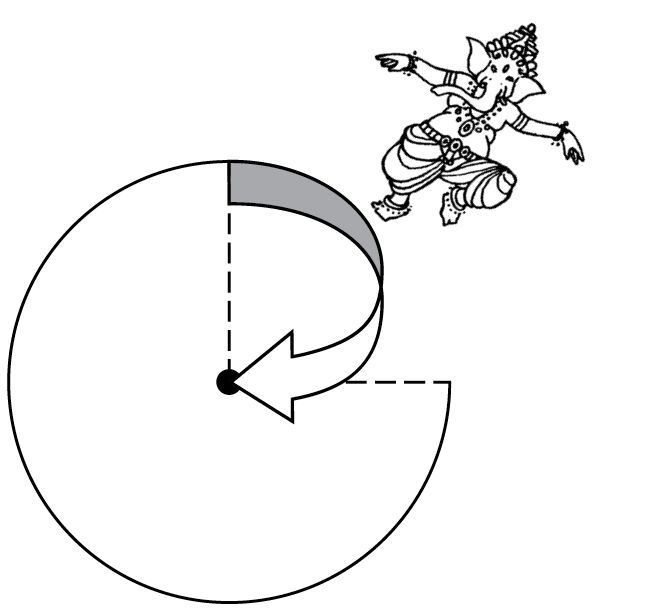
During the second of the four lines of the chant remaining, the spinning Ganesha moves in a very short inward clockwise arc until it enters into the back of the magician’s skull. This movement completely drags the second quarter of the cosmos with it and deposits it inside the magician’s own head.
Ganesh Ganesh Ga—ne—sha
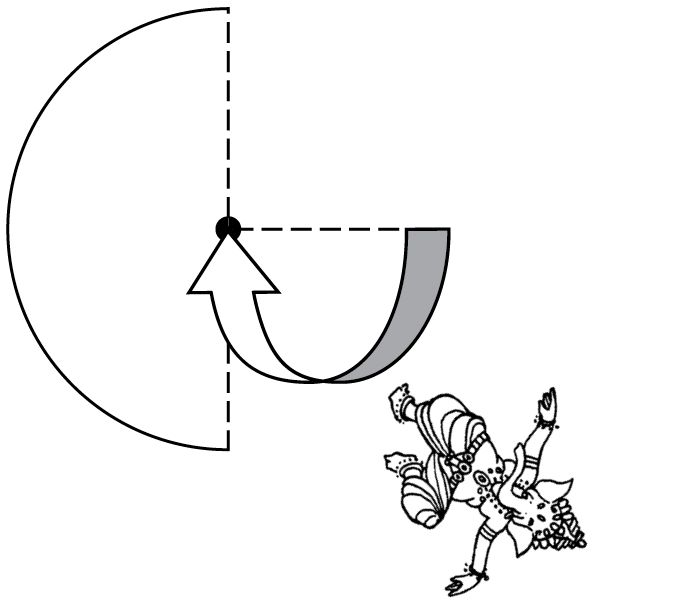
During the third of the four lines of the chant remaining, the spinning Ganesha moves in a very short inward clockwise arc until it enters into the magician’s left ear. This movement completely drags the third quarter of the cosmos with it and deposits it inside the magician’s own head.
Ganesh Ganesh Ganesh Ganesh
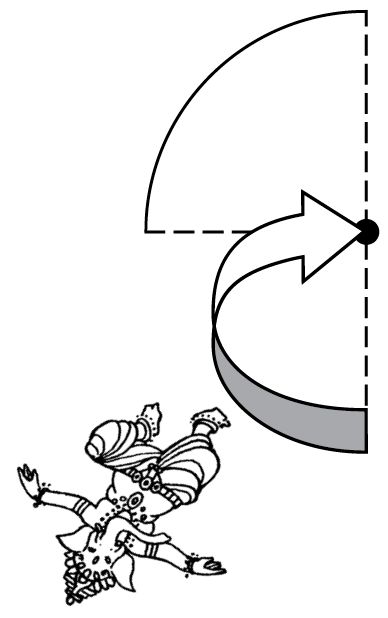
During the fourth and final of the four lines of the chant remaining, the spinning Ganesha moves in a very short inward clockwise arc until it enters into the magician’s forehead. This movement completely drags the remaining the cosmos with it and deposits inside the magician’s own head.
Ga—a—a—nesh-a.
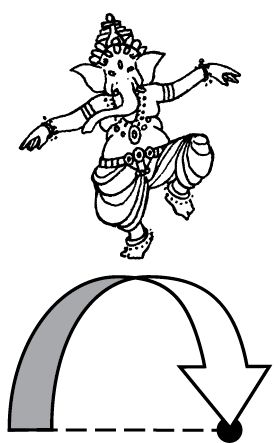
For a golden moment, the magician is Ganesha, the Supreme Intelligence, the Great G. There is “no outside” of the magician. The invocation is complete.
[contents]
75 See chapter 13 and appendix 2.
76 Ecclesia Gnostica Catholica (EGC), the ecclesiastical arm of Ordo Templi Orientis.
77 Alternately spelled Ganesa (and known in the East as Ganapati, Vinayaka, and Pillaiyar). Arguably, Ganesha is the best-known and most widely worshipped deity in the world. Hindus, regardless of sect or traditions, venerate the elephant-headed god, as do Jains, Buddhists, and millions of nonaffiliated devotees around the world.
78 I hope the reader will forgive me for not attempting to write another entire book on the subject of 108 and why the Hindus and others hold it in such veneration. One need only type “Why 108 beads?” on any search engine to begin your “never-ending” journey.
79 There are, of course, variations on this theme that magicians use to mix or match the dynamics of deosil and widdershins movements for specific magical effects. For this little ritual, however, we are applying them in the most simple and generic manner.
80 Or the image of the deity or spiritual personage that represents the object of the magician’s devotion.