Horse Magick: Spells and Rituals for Self-Empowerment, Protection, and Prosperity - Lawren Leo 2020
The Fashion Horse
Hoof, mane, and velvety equine muzzle regularly grace fashion magazines and are perpetually in vogue. Why? Owning a horse and learning to ride one have long been privileges of the wealthy. This remains largely true today. The mystique and allure of hobnobbing with the rich and famous by riding in a fox hunt, attending a royal polo match, buying the right hat to attend a famous horse race, or visiting the stables behind the scenes at the Kentucky Derby are undeniable.
Designers began capitalizing on this cachet as early as 1953, when Gucci introduced the men's moccasin with a snaffle bit in metal that has since made its way onto purses and other accessories. The jockey style is connected historically to Chanel. Dior created the well-known saddlebag purse. Ferragamo, Courrèges, and Lanvin have also had their equine moments. The house of Hermès is renowned for providing luxury equipage—riding apparel like saddles and tack, as well as clothing for the ultra-rich. Ralph Lauren made his enduring claim to fame with his Polo brand, an image of a polo rider with mallet held high in pursuit of a ball—a logo that is emblazoned like modern-day heraldry on all his clothes. He also plays on the all-American spirit of the cowboy with his line called Chaps. The quintessentially English design house, Burberry, also uses an equine logo.
The grand couturiers quote endlessly from riding motifs, and models saunter down the catwalk with high veiled hats reminiscent of women riding side-saddle, jodhpurs, shining leather knee-high riding boots, and velvet riding helmets. The late, great, bad boy of fashion, Alexander McQueen, the cutting-edge deconstructionist Martin Margiela, and the flamboyant John Galliano are famous for including horses in their shows or posing on them in promotional shots. Indeed, the “fashion horse”—defined in its figurative sense as “a person whose sole function seems to be to show off clothes”—has been around since the mid-19th century and will probably never stray far from the pages of Vogue, Vanity Fair, and GQ.1 As magickal practitioners, we can use this incarnation of Horse Spirit to bring good fortune and success to our lives.
Paimon and Haziel
One of the most wonderful aspects of magick is that there is an opposite for every spell, rite, ritual, or pact. This holds true for magickal beings, entities, and spirits as well. To climb the ladder of success, many are drawn to the demon Paimon (as named in the Lesser Key of Solomon, also known as the Goetia). He is a grand seducer, who would draw you into a pact in which he promises to provide fame and wealth in return for your career, or perhaps something else that he considers a fair exchange for great advancement. But beware the consequences! Once entangled with Paimon's energies, it can be next to impossible to escape or break the pact. If you don't give him what he considers his just due, he will surely retaliate with a curse.
Luckily, there is another daemon (Latin for “spirit”) with a less demanding approach to magickal pacts. His name is Haziel (Hebrew for “God sees”). Haziel—whose secret number is fifty-three in numerological traditions—appears as a young man in his late twenties or early thirties with short brown hair in loose curls. He wears a long, flowing white tunic that trails approximately ten feet behind him. He exudes holiness and wisdom, and his demeanor is simultaneously serious, compassionate, and loving.
Haziel wants us to understand that there is nothing whatsoever wrong with the desire to reach the pinnacle of success in the mundane world. This can happen in whatever field you desire, as long as your success serves a benevolent purpose. His message teaches us that there is no need to turn to darker energies to achieve this kind of success.
In a tarot deck, each of the thirty-six numbered cards, also known as pips, has an angel who presides over it by day and one who presides over it by night. Haziel is the holy entity who presides over the nine of pentacles by day.2 The nine of pentacles indicates the arrival of good luck, money, fortune, savings, and a brilliant idea that will manifest into financial success.

SPELL TO REACH THE PINNACLE OF SUCCESS
I created this spell to give you the ability to tap into the positive energies of the nine of pentacles through the permission of the angel Haziel. It will also automatically negate any evil, greed, curse, enemies, or unsettling energies that may have been following you under the guise of the demon Paimon.
What you need:
An oil diffuser, essential oil of verbena, a piece of rough rose quartz, a light-blue candle, the nine of pentacles from a traditional tarot deck, a pen and paper, and the sigil of Haziel.
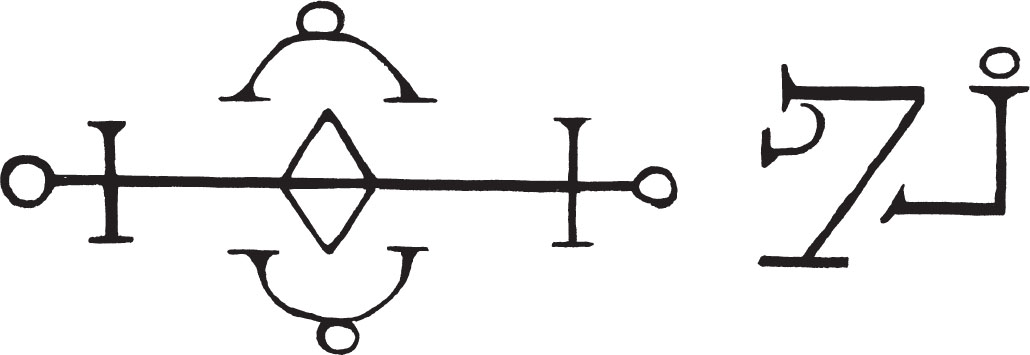
Sigil of Haziel.
Instructions:
Place the light-blue candle, the oil diffuser with verbena in it, and the rough rose quartz on your altar. Set your goal and write it on a piece of paper about three inches high and eight inches wide.
Decide in what field you want to succeed. Composing music? Acting? Modeling? Real estate? Sales? Networking? Writing? Or perhaps something totally different. It's up to you; just make sure that your intent includes a benevolent or altruistic purpose.
On the other side of the paper, trace the sigil of Haziel. (You may want to practice drawing the sigil a couple times before finally tracing it on your goal paper.) Fold the paper three times and put it under the piece of rough rose quartz. Light the oil diffuser with essential oil of verbena in it. Light the light-blue candle. Say:
Fifty-three! Haziel! Holy one! Whose name means “God
sees.” Accept my humble offerings. Teach me how to channel
all your positive energies, teach me how to foster a relationship
with your kind, reveal your secrets to me, and grant me that
which I need that I do not even know to ask for, so that I may
help myself and those both close and near to me.
State your wish.
Bring me to the pinnacle of success in the field of [state your
desire].
Speak to Haziel in a heartfelt manner. The angels like to hear why you aspire to such lofty goals and what you will do once you achieve them. End by saying this affirmation three times:
Now, I continue to build my career around successful endeavors.
So be it!
Extinguish the candle and thank Haziel in advance.
Perform the above rite seven days in a row. Fourteen is even better. And forty days (an alchemical month) is the best to achieve strong results.
Concentrate every night on the sigil. Stare at it. Draw it until you can see it clearly in your mind's eye, without discomfort or struggle. When you call out “fifty-three,” imagine the sigil emblazoned in white in your mind's eye.
After you have finished the seven-, fourteen-, or forty-day rite, burn the goal paper and blow the ashes to the wind. Keep the rough rose quartz in a special place. Repeat this rite whenever you like. Try to light the candle and perform the rite during the day—before sunset.
Because Haziel is the angel of the third quinance of Virgo (an astrological phase of five degrees), this rite is especially powerful when you perform it during the astrological month of Virgo. To add even more potency, chant Psalm 25:6 as many times as you like after saying your affirmations: “Remember, Lord, your great mercy and love, for they are from of old.”
Why did I choose essential oil of verbena? Verbena, also known as vervain, is the chosen herb and fragrance of Haziel and therefore makes a suitable offering to him. It is also used to enhance magickal operations and invoke solar energies used for illumination.
Why did I choose rough rose quartz? The angel Haziel is associated with the element of earth, wealth, self-love, and forgiveness, all of which are associated with rose quartz. Rough rose quartz is a more natural, “earthy” form.
Why did I choose a light-blue candle? Light blue is associated with spirituality, lofty ideals, and peace. It is Haziel's chosen color.
ADDITIONAL RESOURCES
Secondary sources
Crowley, Aleister, Hymenaeus Beta, and Samuel Liddell MacGregor Mathers, trans. and ed. The Goetia: The Lesser Key of Solomon the King: Lemegeton—Clavicula Salomonis Regis, Book 1 (Boston: Red Wheel, 1995).
DuQuette, Lon Milo. Tarot of Ceremonial Magick: A Pictorial Synthesis of Three Great Pillars of Magick (Astrology, Enochian Magick, Goetia) (York Beach, ME: Samuel Weiser, Inc., 1995).
Godwin, David. Godwin's Cabalistic Encyclopedia: Complete Guide to Both Practical and Esoteric Applications, 3rd ed. (Woodbury, MN: Llewellyn Publications, 2003); Haziel's sigil is found on p. 138.
NOTES
1 Retrieved from https://etymonline.com (accessed 1/11/2019).
2 On this subject, see DuQuette, 1995, pp. 200—201.