The Herbal Alchemist’s Handbook: A Complete Guide to Magickal Herbs and How to Use Them - Karen Harrison 2020
Necessary Supplies
Appendix
To prepare and engage in all the recipes, rituals, and meditations in this book, you will need a wide selection of basic supplies. Over time, you will add to these basic supplies, but the following list will get you started in good style.
Herbal Supplies
Jars and bottles
You can never have enough jars and bottles in which to store all your creations! Wide-mouthed jars are necessary for your Incenses and herbs, for easy storage and removal. A four- or six-ounce jar should be sufficient for most Incense storage, and you will find that recycled baby food jars or small food jars that once contained relish or other condiments are perfect. If you prefer, you can purchase canning jars or wide-mouthed bottles with cork lids at stores that specialize in cookware, like Williams-Sonoma. Stores such as Pier 1 or Cost Plus often have nice jars and bottles at a reasonable price. Keep your herbs and herbal mixtures in a cool, dark, dry place, and they'll last much longer. If you store larger quantities of dried herbs, you may wish to simply keep each of them in a separate brown kraft paper bag, like a paper grocery bag. As long as you keep the bags from getting wet and away from unnecessary heat, they will work just fine for dried herbs and resins.
Vials
You want a laboratory-grade glass vial for your essential oils and essential oil blends. When you purchase an essential oil, it will come in a laboratory-grade vial. It's helpful to have a selection of varying sizes in your vials from one dram size (one-eighth ounce) up to eight ounces. For most oil blends, you will find that one dram, two dram, and one-half ounce are perfect. If you decide to make a massage oil, a four-ounce bottle should be sufficient, and you may prefer to keep that oil in a plastic bottle with a squeeze top for safety. A slippery, oily hand can cause you to drop and break a glass bottle.
Dropper Bottles
You will need at least one one-ounce bottle that has a dropper cap to store alcohol. You use this bottle for dispersing drops of essential oil without contaminating the contents of your essential oil bottles. Using the dropper, you can count exactly how many drops of oil you are adding at any given time. Cleaning out the dropper by drawing some alcohol into the dropper and then shaking out excess alcohol in between applications of the different oils you are using ensures that you don't inadvertently get any essential oils mixed into other essential oil bottles, keeping the scents pure. You just want to be sure that before drawing up a new essential oil into the dropper that you shake all the alcohol out of the dropper. If you drip alcohol into your essential oil, it can make it cloudy.
Labels
Keep a supply of sticky-backed labels on hand so that you can label everything as you make it. You may think that you will remember what a particular bottle or jar contains, but I guarantee you won't! Labels are available at all office supply stores and often at the grocery store as well.
Journal
Speaking of what you won't remember later, invest now in a journal or notebook in which you can record all your recipe blends as you create. You may not believe me now, but the first time you make the most marvelous blend of your life, then want to recreate it from memory, you will wish fervently that you had written it down.
Mortar and Pestle
The mortar is the bowl that contains the herb or resin that you are crushing; the pestle is the rounded implement with which you crush. Glass or ceramic mortars work best as they do not react with any herb, oil, or resin and are easy to clean. Soapstone mortars are iffy as they are porous and can absorb essential oils into their surface. Metal mortar and pestles can react with some herbs and oils and become discolored. A mortar that is at least three inches is the smallest size that is useful; larger is even better. I have known people who have forgone the enjoyment of crushing and blending with a mortar and pestle and actually blend their Incenses in a food processor. I must say I don't relate to this use of an electrical tool, but it works for them. However, if you are ever tempted to crush up your herbs this way, please do not add any resins to your mixture while it is in the food processor. The heat from the moving blades will soften the resin enough to cause it to adhere to the blades and interior of the food processor. This is a big mess to clean up and can even burn up the motor in the food processor if there is enough resin in the mix.
Glass, Enamel, and Ceramic Bowls
You will want to have at least one cereal-size bowl in which to blend Bath Salts. Essential oils can react to metal, so you want your bowl to be made from a nonporous, neutral material.
Herbs
You'll want to have at least one herb or resin for each Planetary energy so that you are prepared to create any Incense, Herbal Amulet, or other implement whenever the need arises. I recommend having the following on hand:
frankincense resin for the Sun (success, personal power)
jasmin flowers for the Moon (psychic ability, subconscious, dreams)
red sandalwood for Mars (energy, courage, protection)
cinnamon for Mercury (memory, mental sharpness)
cedar for Jupiter (abundance, growth)
rose for Venus (love, beauty, art)
patchouli for Saturn (grounding, protection)
white willow for Neptune (inspiration)
nutmeg for Uranus (change, health, visions)
myrrh resin for Pluto (inner knowledge, karma)
Essential Oils
Have one bottle of each of the following oils to be able to create Ritual Oil blends, Bath Salts, and Ritual Incenses:
frankincense oil for the Sun
white sandalwood oil for the Moon
ginger oil for Mars
lavender oil for Mercury
cedar oil for Jupiter
rose oil for Venus
patchouli oil for Saturn
neroli oil for Neptune
allspice oil for Uranus
myrrh oil for Pluto
Trusted Medicinal Herb Book
Many of the blends you create are going to come into contact with your body through ingestion, inhalation, or application to the skin. Before you incorporate an herb or oil into your formula, you need to determine what, if any, physical effect that herb or oil might have. Here are some medicinal herb books that I like:
The Scientific Validation of Herbal Medicine by Dr. Daniel Mowrey
The Herb Book by John Lust
The Complete Book of Essential Oils and Aromatherapy by Valerie Ann Worwood
Magickal Supplies
Candles
Keep candles on hand in these colors:
white (purification)
black (blocking)
green (prosperity, health)
blue (peace, tranquility)
orange (energy, vitality)
pink (love, beauty)
purple (spiritual evolution, meditation)
You will be purchasing other colors as you develop rituals you want to do, but these colors will cover just about anything you may run up against at the last minute. You will also need a candle snuffer, matches, and at least six candleholders. You will not always need six holders for each ritual, but you'll want to be prepared in case.
Incense Supplies
In a small box, keep your Incense charcoal, matches or lighter, and insulating material (such as sand, kitty litter, or garden soil). You want to keep all moisture away from those items. If your Incense charcoal comes in contact with moisture, it will absorb some of the humidity or liquid and will not light correctly when you are ready to use it. You will want to invest in an Incense burner in which to burn your creations. It's a good idea to have an Incense spoon to dish out a small amount of your Incenses to avoid getting Incense stuck under your fingernails and to dispense the correct amount onto the Incense charcoal. You'll also want a few small containers in which to place your Incense on your altar at each ritual.
Other Ritual Supplies
You will probably end up with more than one altar cloth (you may want to color-coordinate your altar cloths with the type of energy you're invoking at various rituals), but you need at least one black altar cloth around three feet square for general purposes.
Keep on hand sea salt and spring water for cleansing the energy of objects and casting your Circle. You'll need a small container in which to place your salt for use on your altar. Generally speaking, you'll be using your Chalice on your altar to contain your water for cleansing.
You'll need parchment and pen for drawing Talismans and writing spells. Some people like to use feather quills and Magickal inks for this type of work, but you can also use a good quality pen or Sharpies in different colors, too. Rather than using parchment, you may want to visit your art supply store and pick up an array of paper in different colors.
Try to have available the following crystals and stones for general spellwork:
jade or green aventurine for prosperity
hematite or onyx for protection and grounding
carnelian or gold tiger's-eye for healing
amethyst or moonstone for meditation or spiritual work
Go to your local fabric store and check out the remnants section. You can pick up a yard or less of fabric in different colors so that you are ready to create an Herbal Amulet. Just be sure that the material you select is a natural, nonsynthetic one—cotton, silk, or wool. While you are there, get some nonsynthetic cord or ribbon in various colors for tying your Herbal Amulet bags.
Focus and Intention
The most important ingredient in everything you create is your intention. Your herbs, oils, and resins are all tools and definitely contain energy and spirit vibration that do the work, but they must be focused with your intention in the specific direction toward which you are working. A car may sit in your driveway, full of gas, but until you get in and turn the key with your destination in mind, it will not go anywhere. Your Magickal tools of alchemical creation work the same way. You are the main ingredient that causes them to work.
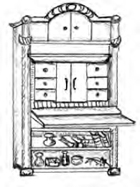
Initially, due to space limitations or budget, you may just store your tools and accoutrements in a cardboard or plastic storage container that you can obtain at your local hardware store. Once you have gotten out all the things you need for a particular working, you can cover this storage box with your altar cloth and use it as your altar as well. Eventually you will need an actual cabinet (it's amazing how much stuff one can collect!) and you may want to check out garage sales or flea markets for a china cabinet to use as permanent storage.