The Dark Lord: H.P. Lovecraft, Kenneth Grant, and the Typhonian Tradition in Magic - Peter Levenda 2013
The Mauve Zone
And I went into the sunset with Her sign, and into the night past accursed and desolate places and cyclopean ruins, and so came at last to the City of Chorazin. And there a great tower of Black Basalt was raised, that was part of a castle whose further battlements reeled over the gulf of stars.
—Jack Parsons, The Book of Antichrist
Then, presently, from the blind land behind the mountain, comes one heavy groan, then the sound of a fall, made vile by a titter of malignant tinkling laughter.
There follow ghoulish wailings.
The mystery, the evil darkness of these incoherent cries, sets my teeth on edge with horror. And yet I cannot give up the hope which thrilled me at the Voice. But so keen, so desolate, so deadly, is the pain of my spirit that blank darkness overwhelms me altogether.
—Aleister Crowley, The Heart of the Master
It seemed plain to us ... that there were ancient and elaborate alliances between the hidden outer creatures and certain members of the human race. ... There seemed to be an awful, immemorial linkage in several definite stages betwixt man and nameless infinity. The blasphemies which appeared on earth, it was hinted, came from the dark planet Yuggoth, at the rim of the solar system; but this was itself merely the populous outpost of a frightful interstellar race whose ultimate source must lie far outside even the Einsteinian space-time continuum or greatest known cosmos.
—H. P. Lovecraft, “The Whisperer in Darkness”
Does this mean that those from Outside will actually put in an appearance on earth? If so, then the secret rites hinted at in grimoires such as the Necronomicon, and the Books of Thoth, of Dzyan, of Enoch, contain the keys to their summoning and we have for long aeons been blind to their usage.
—Kenneth Grant, Outside the Circles of Time
IN THE LATER VOLUMES OF the Typhonian Trilogies, Grant reprises the sexo-magical rituals we have already described and demonstrates how they can be used to penetrate the veils that conceal from our sight the vast reaches of deep space and deep time. In fact, he cites other magicians who—he claims—have already penetrated those veils and opened a hole in the earth's protective atmosphere allowing the entry of the Old Ones. In other words, they have opened a Gate.
This dangerous process certainly was begun by Crowley, but later was amplified by his American follower Jack Parsons. Grant claims that the atomic explosions of 1945 disturbed the delicate psychic membrane covering our planet to the extent that other forces began massing at the rent in the veil and by 1947 began pouring through in greater and greater numbers. This, of course, was the UFO phenomenon which Grant links directly to the type of magical operations begun by Crowley and continued by his followers. This is a scenario straight out of H. P. Lovecraft and especially, “The Call of Cthulhu.”
As always throughout this study, we have to remember that events that take place in the “real” world are mirrors of events that transpire in the inner, invisible, or secret world and that these two worlds influence each other in ways that are not obvious to any but the most dedicated adept ... or most paranoid conspiracy theorist. There is, in fact, little difference between the world view of the occultist and the nagging fears of the conspiracy theorist; except that the occultist has a more positive approach to the same material, seeing in the activities of the sinister forces that influence world events (as well as personal ones) the possibility of reversing the process through an act of will coupled with a knowledge of technique.
It is this realm of the invisible world that occupies us in this chapter, for it is the backdrop against which all of the theory and practice takes place. In a sense, we can call this world R'lyeh, to use Lovecraft's designation for the secret city below the ocean waves where Cthulhu waits, dead but dreaming.
But to Kenneth Grant, it is the Mauve Zone.
The Sri Chakra
... the Sri Chakra conceals in its symbolism more than the possibility of alien contact, it conceals the keys to doors Outside.182
Grant's main focus where Tantra is concerned is the group of beliefs and practices that come under the general rubric of Sri Vidya, with its all-important Sri Chakra mandala. Grant claims that there is a surviving cult of the original Typhonian Tradition known as the Anuttara Amnaya, which just happens to have the same initials as the secret society founded by Aleister Crowley, the Astrum Argenteum, or A A The Anuttara Amnaya is the repository, again according to Grant, of the true practices of the Sri Vidya cult which links it to the ancient and all-but-forgotten mysteries of the Great Old Ones.
Before we go too deeply into the weeds of this concept, it is perhaps beneficial if we pull back a little and briefly describe the Sri Vidya cultus and identify the Anuttara Amnaya as best we can.
The word vidya has the same root as Veda, and means “knowledge.” The word Sri is used to mean “divine” or “sacred,” so Sri Vidya means, literally, the sacred knowledge. It is an early form of Tantra, one which several groups (including the Kaula sect) claim as their own lineage.
Sri Vidya is also identified as the worship of Sri Devi, the great Mother Goddess, who in this system manifests as Lakshmi Tripura Sundari, or Lakshmi (“the Playful”) of the Three Cities. (The identity of the “three cities” is subject to controversy but may be identified as sat-cit-ananda—Existence-Consciousness-Bliss—and in Grant's schema Consciousness is identified as having three states: waking, sleeping and dreaming.) Lakshmi Tripura Sundari is usually depicted as a Red Goddess, a young girl of sixteen years of age dressed completely in red and sitting on a red lotus throne, adorned by a single lunar digit, or kala. In this mode she is called Shodashi (“sixteen” as in “sixteen years old” but also clearly a reference to the Sixteenth Kala) or even simply Bala (“young girl”). Her power is the power of Consciousness itself, or Cit-Shakti. It is Lakshmi Tripura Sundari who is worshipped via the Sri Vidya cult's most famous emblem, the Sri Cakra which is her symbol and which represents the entire cosmos.
The Anuttara Amnaya is one of six “subsidiary” vidyas of the Sri Vidya tradition. The word amnaya is related to agama, a word that can mean “religion” or a type of special knowledge that is handed down from generation to generation, such as a “sacred tradition.” It is often used as a reference to sacred texts in general and to Tantra itself. The word anuttara is usually translated as “highest” or “absolute.”183 Thus, Anuttara Amnaya is the Highest Tradition or the Supreme Tantra. It does not refer to a specific group of devotees or sect, but is usually used to identify a specific set of Vidyas within the Sri Vidya tradition, a school of Tantra with its own mandala, teachings, etc. Followers of the Sri Vidya tradition may be initiated (diksha) into one or all of the six amnayas, so that the Anuttara Amnaya is really a school within the greater Sri Vidya tradition. Yet, Anuttara Amnaya is also referred to as the “seat” of the Goddess Lakshmi Tripura Sundari: subtle, difficult of access, but a path above and beyond all others.
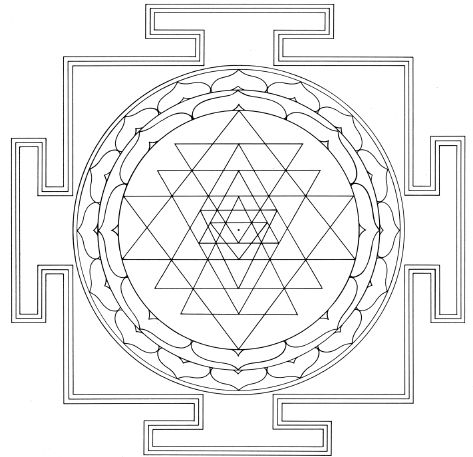
The Sri Yantra or Sri Chakra is an ancient geometric depiction of the body of the Goddess.
There is, however, a darker aspect to all of this and it involves Shiva in his incarnation as Hatakeswara or Hatakeshvara. In this incarnation, Shiva is the ruler of one of the seven infernal hells or Patala of Indian religion, specifically Vitala. The hells of Patala are inhabited by the Nagas (or serpent gods) as well as by the various Indian demons, such as the Yakshas. Yet, oddly, it is precisely Shiva in his form of Hatakeswara who rules Anuttara Amnaya and guarantees immediate enlightenment to its practitioners. According to the Hatakeswara Stotra (a hymn to Hatakeswara), the Lords of Hell pour forth from the mouth of Shiva-Hatakeswara. Thus, in this manifestation, Shiva is nothing other than the Dark Lord himself and the ruler of Kenneth Grant's Anuttara Amnaya cult ... and the Goddess of the Sri Vidya tradition is a form of the Scarlet Woman, the Goddess Sixteen.
Now for the weeds.
Marmas, Sandhis ... and Qlippot
The Sri Chakra is a map similar in nature—if not design—to the Kabbalistic Tree of Life and perhaps related more closely to the Enochian Tablets as employed by the Golden Dawn. It consists of nine large triangles—four pointing up, five down—superimposed on each other and thus making a total of 43 triangles and the intersection points (the marmas and sandhis) between them.184 Around these triangles are an eight-petaled lotus, a sixteen-petaled lotus, and three concentric circles around them. Around that is often drawn a diagram representing four Gates in the four cardinal directions. The Sri Chakra is an entire cosmological system but it is also the body of the Goddess in schematic form. Although it is a two-dimensional figure—a drawing—it also has been made in three-dimensions: the only one of all the Indian chakras permitted to be constructed this way.
The characterization of the Sri Chakra as the body of the Goddess is not an idle one. The marmas—the intersection points where triangles overlap—have their analogues in marmas in the human body: similar, in fact, to acupuncture points in Chinese medicine. Ayurvedic medicine is concerned with applying pressure, through massage, to the appropriate marmas in order to promote healing. There is even an Indian martial arts technique called marma adi, which is a method of killing or disabling a human being by the correct application of pressure—a strike—at one of the twelve “death marmas” on the body (there are 96 healing marmas, and 12 “death” marmas, for a total of 108 marmas in the human body).
To Grant, the marmas on the Sri Chakra and the marmas on the body are reflections of each other. During the ritual we described in the last chapter, the magician is to make passes (or mudras) over the body of the priestess in order to stimulate the activity of specific marmas which in turn affect the chakras. Grant believes that the kalas are brought down from the Mauve Zone into the body of the priestess during the ritual and that the stimulation of the appropriate marmas helps to accomplish this. Then the Kundalini—which Grant has begun calling the Fire Snake—is encouraged to rise through the body of the priestess, sealing the chakras as it proceeds to the cranial vault.
According to Grant in “mystical” Tantra (if such a thing truly exists), the raising of the Fire Snake to the cranial vault is the ultimate goal, for when the Goddess Kundalini and the God Shiva meet the hierogamos or sacred marriage is complete. The Tantrika eventually achieves union with the Absolute and attains advaita, or non-duality. But in the Kaula Circles that are the primary channel for Sri Vidya, the power that has been raised is drawn back down to the muladhara chakra where it is collected by the magician. This is the “magical” approach to Tantra rather than a mystical one and Grant is not bashful about this. He implies that the acquisition of siddhis—magical powers—is the goal of his system. He equates the first type of Tantra with the elixir vitae of the alchemists (the amrita), and the second form of Tantra with the Stone of the Wise, the Philosopher's Stone. To a Tantrika, this is an unenlightened approach and one that is usually condemned as unworthy; moreover it is factually incorrect. The Tantras do indeed prescribe the oral consumption of the kalas directly from the genital outlet, the yoni, of the priestess and in fact also generally insist that the elixir is obtained by the mixture of both the kalas—the menstrual discharges—and the semen of the male operator, what is known in the Gnostic Mass as the “cakes of light.” The only deviations from this rule concern the ability of the male Tantrika to achieve orgasm without ejaculation, in which the absence of semen is acceptable, or when the male Tantrika is engaged in maithuna—the sexual embrace—with a married woman not his wife, in which case (and according to some Tantras) it is preferable that the Tantrika not ejaculate or not ejaculate in the yoni of his partner. (The Tantras are all over the place where ritual requirements are concerned, and what is and is not desirable or permissable.) What Grant discusses is perfectly comprehensible in terms of the Western magical tradition, with its conscious manipulation and exploitation of mind and body, and that is perhaps where he parts company with normative Tantra. His focus on the raw technology of the system rather than on the philosophy behind it—the Hindu and Buddhist ethical and spiritual traditions—alienates Tantric scholars and Tantrikas. However, it satisfies the need of Western occultists who are not interested in the ethos of the system (who see such considerations as purely theological and thus ideological) but in the psycho-biological apparatus of the human body itself, and how altered states of consciousness and experiences of other realities can be attained through manipulating its inner processes.
In addition, Grant's claim that the kalas are brought down from Beyond to the body of the priestess implies that there is a strong stellar or astral component to what appears to be a psycho-sexual or bio-chemical process. Of course, when the full details of the rite are considered—which includes the lunar phases and other astrological considerations—it becomes obvious that what Grant claims has, in fact, validity. Imagine a solar panel in a land where there is no sun: it doesn't matter that the panel is created perfectly and all its parts are in working order; if there is no sun, there is no power. In the case of what Grant begins to call the Ritual of the Fire Snake, the body of the priestess is the solar panel; the ritual must be timed so that the “sun” is present in the right place at the right time for the panel to provide energy.
This is true of all ceremonial magic, as any glance at the medieval grimoires would certainly reveal. Magical rituals depend as much on correct timing as they do on the preparation of the magician and the occult implements to be employed. It is this emphasis on timing—in Tantra, in Daoist magic, in alchemy, and in Western magic—that reveals the deeper character of occultism in its dependence on the interrelationship between the microcosm and the macrocosm. What casual observers may not realize, however, is that the macrocosm can be just as dangerous as the microcosm. After all, Cthulhu can be summoned only “when the stars are right.”
This leads to another element of Grant's thesis: that these marmas or entry points into the Mauve Zone exist in space, exist in the human body, and exist on the earth. Here they are power-zones on the body of the planet, exploited by cults or groups of adepts who are sensitive to their use and initiated into their mysteries. Such marmas represent, as the blurb on the first edition of Grant's Outside the Circles of Time states:
... a network more complex than was ever imagined: a network not unlike H. P. Lovecraft's dark vision of sinister forces lurking at the rim of the universe.
The Sri Chakra, like any perfect cosmological system, must take into account the existence of what the non-initiate may term “evil.” Some of the marmas and sandhis provide means of entering areas of existence that are inimical or hostile to normal human consciousness: the realms of the demons, or Nagas. It is, in fact, precisely these regions that most attract the attention of Kenneth Grant.
One of the schemes that can introduce the Western occultist to this concept is that of Liber 231, a small treatise by Crowley that is concerned entirely with the realm of the Shells, the qlippot. In order to appreciate this text it is necessary to understand that the Tree of Life of the Kabbalists—consisting of ten spheres or sefirot joined by twenty-two paths representing the twenty-two letters of the Hebrew alphabet—also has a “dark side.”
According to the Golden Dawn system of interpreting the Tree of Life, there is a “space between” the lower seven sefirot and the upper three. This “space between” is referred to as the Abyss. It is sometimes believed to be the realm of another sefirah, Daath. In diagrams of the Tree this sphere is often shown with a dotted instead of a solid circle to signify that it is not a “true” sefirah in the scheme of things but a “shadow sphere.”
In the seventeenth and eighteenth centuries, Daath was the subject of much speculation and it was Jacob Frank—a messianic figure of the eighteenth century who combined Jewish, Islamic and Christian concepts in his movement—who emphasized the importance of Daath to his own system. To Grant, Daath is the “Outer Gateway” to the Mauve Zone. It is a kind of “anti-sefirah.”
In addition to Daath, there are the qlippot which are described in Crowley's Liber 231. These are the shells of a shattered sphere from the first Creation (according to one tradition) and they occupy twenty-two “anti-paths” on the Tree of Life. The marmas and sandhis on the Sri Chakra are points, or bindus, on the diagram that are the intersections of lines; the qlippot are paths between the spheres on the Tree of Life, so they more resemble lines than points. But this is a superficial difference. In practice, the qlippot are as much gateways to the Other Side as specific marmas or sandhis.
Liber 231 is one of the Holy Books, which was received, along with the others we have already discussed earlier, that were written by Crowley during a white heat of inspiration at the same time that Lovecraft decided the Rites of Cthulhu were taking place in New Orleans. Crowley does not give any instructions for how the mysterious tables of the 22 qlippot—the 22 “scales of the serpent”—should be used. It was eventually up to Grant and his Lodge to explore the possibilities and to use the tables as a map for penetrating the Mauve Zone. These 22 “demonic” or “qlippothic” paths are the Tunnels of Set that Grant opines lies between the realm of dreams and the realm of dreamless sleep (which latter is itself analogous to the state of non-duality). They are reflexes of the 22 paths on the Tree of Life, shadows of those paths, forming a Shadow Tree of which Daath is the central Gate. His New Isis Lodge worked extensively with the qlippot and specifically with Liber 231 in an attempt to map its potentialities.
Grant goes further, attempting to link the 22 qlippot with an equal number of kalas. The number of kalas seem to multiply with the systems applied, and this equating of them with the Tunnels of Set may be ill-advised. (A similar problem exists with Crowley's attribution of the I Jing trigrams with the sefirot on the Tree of Life; the number systems do not equate and it is a violence to try to force them to fit. There are other, better solutions.) While the kalas are vaginal secretions that can be used as elixirs it is not certain whether these secretions can or should be equated with the qlippot on a one-to-one basis. If the qlippot are pathways—the Tunnels of Set, as Grant calls them—then the kalas may very well be the fuel that enables one to travel them, or the keys to opening their gates.
Grant employs both systems—Tantra and Kabbalah—in his lengthy digressions on the nature of the Mauve Zone and the realm of Darkness where the Old Ones dwell. And it is through ceremonial technologies such as the Ritual of the Fire Snake that contact can be made with this realm by using specific gateways. The Kabbalists would employ the qlippot system and the sphere of the Abyss, Daath, in their approach to what Grant calls the “Nightside of Eden.” And the practitioners of the Kaula Circles or the Anuttara Amnaya would employ appropriate marmas and sandhis of the Sri Chakra, in combination with the kalas and the ojas. In either case, a psycho-sexual technique is employed: either the sexual magic of Aleister Crowley, the OTO, or the Hermetic Brotherhood of Light, or the Tantric rituals of the Kaula Circles. Kenneth Grant was able to combine both of these approaches, largely through identifying cognate ideas and methods and by “porting” one system over to the other, incorporating Tantric techniques within a Western, ceremonial framework.
While this approach may seem wholly arbitrary to some, the infusion of genuine Tantric methods within the Thelemic rituale produced a spark of new life into the latter. As we can see from Grant's published work the new insights that were obtained by using Tantric techniques in a Western ceremonial setting were remarkable. And the rush of prose out of Grant's pen due to this combustible mix is alone evidence of how the secret rites of the Nu-Isis Lodge were able to fuel nine non-fiction works on the subject, as well as much fiction and poetry, not counting the contributions of other members of the Grant circle.
And this is as it should be, according to Grant, for it is the Mauve Zone that is the source of all human creativity, imagination, fascination, and obsession. It is represented in the microcosm by a zone that exists between the dream state and the deeper, dreamless state, and is the source of artistic impulses and contact with divine and demonic forces. But these are its positive characteristics. There are negative ones as well, and they are the forces that challenge the magician on an individual basis just as they confront society in general. These are the demonic forces that so frighten the protagonists of the Lovecraft ouevre. And summoning them—or any aspect of the Mauve Zone—can have disastrous consequences.
The French poet Artur Rimbaud famously declared that it was necessary, in order to become a Seer, to engage the complete “derangement of the senses.” Our normal sensory state is designed to cope with the visible world, in order to ensure the survival of the body; only the shamans, initiates, magicians and alchemists look beyond maintaining the integrity of the physical body and extending consciousness beyond that of the visible, tangible universe. In order to do this, risks are taken.
The methods used to “derange the senses” or alter perception may include drugs, alcohol, fasting, or other tools that are potentially dangerous to the human organism and counter-intuitive when it comes to discussing the health and survival of the body. It is as if the body's normal systems and processes must be challenged in order that a space be made for the new experiences. This is because our minds and bodies are part of an integrated “psychosomatic” system, and an effect on one will have an impact on the other. This is what Grant calls the “retroversion” of the body's normal processes. Retroversion is a method he identifies specifically with Set, the Dark Lord—as Set represents “evil” in the cosmic scheme, or those things that challenge the status quo.
We have already seen this in our discussion of the necessity of conscious control over the body's autonomic nervous system and the reptilian brain. In order to experience altered states of the mind it is therefore necessary to alter the state of the body.
In the Afro-Caribbean tradition, this altering of the body's autonomic systems can be effected through the use of drums. Drums exert a control over the heartbeat of the devotees, which is one of the autonomic processes. In this situation, the drummers control the psycho-biological response of an entire group of devotees, and it is within this highly-charged environment that the phenomenon of possession by the gods takes place, often in multiple devotees. The type of drums used and the rhythms employed will change the results, invoking specific deities. But the drumming still takes place within the greater context of the ritual itself, which is under the control of the priest. These methods—while they can cause change to occur in and of themselves—must be used within the ritual structure in order to be effective. Anyone can take drugs or alcohol, for instance, but although the senses may be deranged as a result, the long-term effects will not be conducive to the attainment of spiritual illumination or occult capabilities. As we have already indicated, sexual activity by itself is not capable of producing the type of spiritual breakthroughs of which the writings of Grant, Crowley, and the entire field of the Tantras are an indication. What is necessary is the deliberate structure of the ritual, for that is where the effect of the Will will be felt and that is what will provide the channel for the energy raised. As the Crowleyan imperative has it, “love under will.”
There is no guarantee that the experience will be pleasant or productive. The ritual structure will provide a certain level of operational security if the ritual participants have been prepared carefully beforehand. This preparation is not only in terms of yogic-type practices, meditation, etc. but also intellectual study so that the various moving parts of the ritual are understood and made part of the psyches of the participants. In other words, the various techniques used to insure protection must be internalized so that they are second-nature. The instinctual response of the individuals to perceived danger is what will protect them, since there is no physical weapon that can be used to defeat what is essentially an ethereal or at least non-corporeal threat. The mind will be forced to locate the appropriate defense mechanism—for instance, during a confrontation with an entity from the Mauve Zone that appears hostile or somehow dangerous—and the only weapons at its disposal will be those learned in the preliminary phase of the training.
Even then, however, the effects of such intense ritual workings may be felt for days, weeks, or even years after the fact as the experience is digested and connections to other—unconscious—material is strengthened. That is why such an experienced occultist as Francis Israel Regardie—a one-time secretary to Aleister Crowley and a Golden Dawn and Rosicrucian initiate—strongly recommended that those interested in entering onto a path of occult practice first go through several years of psychological analysis in order to identify as much as possible any deeply hidden problems that would be inadvertently triggered or exacerbated by occult practice.
To Grant, who experienced most of the twentieth century and the first decade of the twenty-first, the enormous changes that took place during that time were an indication that something had gone terribly wrong with the cosmos. Grant believed that the type of changes a magician effects on his own psyche as a result of his occult practice can have an impact on the world at large. This is, after all, the whole basis of magic as a system for manipulating reality and the experience of reality. Grant's thesis is that the present state of affairs is the result of an accumulation of occult operations on the one hand (acting on the ethereal plane, perhaps), and scientific, social, and technological operations on the other operating in the “real” world.
Today we hear of sights and sounds experienced outside the body, in the skies, in the oceans, and deep within the earth. It is as if a cosmic Fire Snake activated the terrestrial power-zones, or reflected into space the chakras awakened by sub-atomic radiations. ... the Earth is beginning to exhibit the catastrophic effects of such artificial stimulations of the Fire Snake.185
When Grant writes “as if” he is being coy, for it is clear that he believes this is precisely what happened. One must read Grant carefully with a view towards extrapolating some of the broader statements from the minutiae of sexual rituals and Hebrew, Greek and even English gematria. His clearest paragraphs are those that reveal his certainty that the stories of H. P. Lovecraft, the art of the Surrealists and of Austin Osman Spare, and the modern phenomena of UFOs and abductees, are all in a sense reflections of a real universe beyond our own. His incorporation of Tantra, Kabbalah, magic, and all the rest can be seen as an attempt to reconcile his deeper, inner belief in the reality of the horror fantasies of Lovecraft with a comprehensive worldview that could explain them in some kind of internally-consistent way.
Grant clearly believed that the world was undergoing an invasion from some other dimension or from somewhere Beyond. This invasion was being experienced as the UFO phenomenon, among other things. The eruption of interest in occultism, horror films, alternative religions, etc. indicated to Grant that something was already working its way into our world and that the only ones who could interpret this event were the sensitives. Not limited to magicians or occultists, sensitives include artists, writers, and other people who deal extensively with imagination and creativity: qualities that are associated with the Mauve Zone. In this Grant takes his cue from Lovecraft, of course, but that doesn't make his conclusions any less reasonable.
In present times, with the massive reawakening in man of the subtle faculties connected with the Ajna-Vishuddha complex of chakras, a more sinister element pervades the picture. Man is no longer subject only to his innate tendencies, his organism has undergone changes which render him increasingly susceptible to influences from Outside. ... Whatever ’it’ is, or whatever its provenance, it poses serious problems for the magician. Alien intelligence is intimately involved with the movements of the Fire Snake, the energies of which are known to be interactive with the denizens of other dimensions.186
At the same time, there are occultists who are deliberately attempting to make contact with these beings from other dimensions, other worlds, through the medium of the Mauve Zone, and they included the membership of his own occult lodge in London. These contacts did not stop when his lodge ceased activity in the 1960s, however, for he writes:
... there are today magicians who are forging links with power-zones in unfathomable space and with voids beyond time.187
Again, we can clearly recognize the Lovecraftian influence in Grant's vision. Grant specifically links Cthulhu with the Fire Snake, i.e. with Kundalini, as it is asleep in the waters of the deep (which Grant links to the two lowest chakras, the muladhara and svadisthana chakras)188 and can be raised by the right evocations and when the “stars are right.” To support this, he also quotes frequently from the Schlangekraft recension of the Necronomicon.
It is quite possible that the famous Lovecraftian description of Cthulhu as “dead but dreaming” indicates Kundalini which is asleep until it is awakened, but also refers to Grant's three forms of consciousness: awake, dreaming, and dreamless sleep. Cthulhu, as “dead but dreaming” seems to refer to a realm between “death”—dreamless sleep—and dreams: in other words, the Mauve Zone. Kundalini is also a Serpent, an amphibious creature that could be linked with Cthulhu. A Serpent in her cave beneath the earth; Cthulhu in his house beneath the sea. Both raised by magicians and occult practice and, when they do, they change our world forever.
This is the point at which Grant makes a rather astonishing claim, among many astonishing claims. He begins a story that sounds like something out of a fantasy magazine yet later insists that it is not metaphor but an account of a real event that occurred “recently” (Beyond the Mauve Zone was published in 1999). It contains much that is only comprehensible if the previous material we have discussed is understood.
In this tale, Grant references an Order that exists in the present Indian state of Assam. This Order is Tantric and initiates into the type of Tantra we have been discussing. He links this Order to “stray references” found in the Necronomicon, among other places, and says it represents an oral tradition spanning generations. The Order at some point created or contacted or somehow incarnated an Entity from the realm of what Grant calls “transplutonic Isis”: a star not necessarily in our dimension, but one from which Grant's Nu-Isis or New Isis Lodge obtained its heritage and legacy.
The Entity dwelled on the Earth during which time “more and more women gave birth to offspring imbued with the ’child's’ alien propensities. ... Many earth-dwellers experience strange dreams and horrendous nightmares in which they glimpse the fantastic force of their own terror.”189 Eventually, our planet became a “far-flung outpost of Nu-Isis.”190
But that is not the end of the story. Eventually, the Entity spends “many years in Assam studying with a Tantric Adept” after which they both disappear, only to “surface” in a network of tunnels underneath Kamrup which Grant calls “the terrestrial power-zone of the Fire Snake.” The Entity then assumes the identity of an eccentric scientist—I am not making this up—who has an image of Nu-Isis in a cabinet before which burns an eternal flame. The image was of a woman, “suave, metallic, her body cast in vitrified ojas ...” and at a particular time the image comes to life and the scientist “cohabited regularly” with this “alien embodiment of the Fire Snake” until an explosion destroyed the scientist's laboratory and “the surrounding terrain was violently upheaved by the impact of a series of elemental disasters.”191 However, all was not lost for a daughter had been born out of the cohabiting of the scientist with the statue—although she seems somewhat unpleasant.
After this, Grant writes that it is not a magical allegory but an account of the “recent astral history of the earth.”192
Let us take a moment to deconstruct the narrative, for it will yield some fascinating fruits.
In the first place, Assam is considered by some historians to have been the birthplace of Tantra. It is located on the far north-eastern end of India connected to the rest of the sub-continent by a narrow pass throught the mountains. Its ancient name was Kamrup, and it represented an independent kingdom bordering on Tibet. Grant identifies Kamrup as the ancient capital of Assam, but that is not technically true as Kamrup was the name of the entire kingdom (now a district of Assam).
It is the story of the eccentric and reclusive scientist, however, that is intriguing for a number of reasons.
In the 1930s H. P. Lovecraft went to Florida to visit Robert Barlow, a young man who was an aspiring writer. They had developed a friendship through correspondence, and Barlow was thrilled to have his idol come down from Rhode Island to see him in the Sunshine State. After visiting Barlow in De Land, Volusia County, Lovecraft went down to Key West. This first visit was in May—June of 1931. There were several other trips to Florida thereafter.
However, this visit to Key West opens up a number of intriguing possibilities. At that time, there was a strange, eccentric and reclusive scientist living in Key West, moreover someone who had been involved in the occult back in his native Germany, and who had spent time in India studying with gurus before eventually winding up in Australia at the beginning of the First World War. Significantly, he befriended a Sri Lankan monk who was a friend of Crowley's mentor, Alan Bennett.
His story was one of the most bizarre episodes in Florida (or any state's) history. The man was known variously as Count Carl von Cosel, or Carl Tanzler, or Georg Karl Tänzler (1877-1952).
Tanzler was born in Dresden, Germany, and according to a lengthy article he had written for Fantastic Adventures magazine, he had paranormal experiences since he was a young man living in his family's castle. He had recurring visions of a lovely woman—a famous ancestor—and another vision of a woman whom he called by various names, including Ayesha. But these were incorporeal women and disappeared as soon as he was aware of them. Fearing he was being haunted, he contacted several important paranormal experts in the region around Dresden.
These included names that are perhaps not as well known today, but were famous in their time. In the list were Carl du Prel (1839-1899), J. K. F. Zöllner (1834-1882) and Carl Kiesewetter (1854-1895) among many others. The problem with Tanzler's list is that most of these men would have been dead by the time he was having his experiences. In fact, du Prel died at the age of sixty and would have been alive at the time Tanzler was having his strange visions, but Zöllner would have died when Tanzler when was only five years old, and Kiesewetter would have died when Tanzler was only eighteen. According to Tanzler's own account he was 20 years old when he asked these venerable gentlemen to assist him in his confusion. So it seems Tanzler was not being completely honest in compiling this list in an article published in September, 1947.
Eventually he left Germany for a tour to Asia, stopping first in Italy where he had another strong vision of this ethereal woman, Ayesha. Then at some point before the outset of World War One Tanzler found himself in India.
In that country, where he claimed he was studying Indian religion, he woke up one day to find himself in a morgue. Evidently something had gone wrong with one of his meditations and the local people thought he had died.
From India, he went to Australia where he was interned during the War even though he had become a naturalized British citizen. While he was in the internment camp, he made the acquaintance of a Sri Lanken monk named Nyanatiloka Thera. This particular monk was a friend of Crowley's mentor Alan Bennett when the latter was known as the Bhikku Ananda Metteya. The two monks lived in the same ashram for a period of time.
From there, Tanzler went back to Germany after the end of the war and was encouraged by his family to emigrate to the United States. He stayed in Germany from 1920-1925, the period that saw the collapse of German society due to their loss of the war, the Depression, and the rise of Nazism with the famous Beer Hall Putsch of 1923. In April, 1926 he arrived in the United States and moved first to Zephyrhills, Florida and then to Key West where he found work as a radiologist in 1927.
On April 22, 1930 he met a young woman, a tuberculosis patient by the name of Maria Elena Milagro de Hoyos. She was a twenty-one-year-old Cuban-American woman and a local beauty. Tanzler recognized her as the woman in the visions he had been having all his life, and fell in love with her. He courted her even though they were both married to other people. He tried various means to cure her of her illness, and claimed to have made good progress. But her family intervened. They did not want her seeing this self-professed medical man, but instead insisted that she return to the hospital and do whatever the regular doctors told her to do.
Maria Hoyos died on October 25, 1931. That should have been the end of the story, but things became increasingly strange after that.
Tanzler built her an elaborate mausoleum in the local cemetery, one to which he alone would have the key. While visiting her constantly he began a series of bizarre medical procedures designed first to keep her from decomposing, and then to raise her from the dead. In fact, as far as Tanzler was concerned, she was not really dead at all.
The story of how he attended to her is told in great detail in the Fantastic Adventures article, but suffice it to say that he claimed his ministrations were successful. Maria Elena was able to open her eyes, move her limbs, and speak. Tanzler kept several IVs pumping fluids into her body and removing other fluids and fighting a constant battle with maggots, but in the end he was certain that he was successful in bringing her back to life.
It was only a hurricane—Grant's “elemental disasters”—that disrupted Tanzler's operation. He was forced to take Maria Elena's body out of the mausoleum in the dead of night and bring it to his home—where he built a special cabinet for her (in the shape of an aircraft ... Tanzler had been making preparations to fly them both out of Florida as soon as she was “well enough” to make the trip).
Eventually, however, he was discovered by members of the young woman's family. This was in October, 1940. That means almost ten years after her death. Tanzler had been living with the corpse in his house and—according to some accounts—“cohabiting” with it—all that time.
He was arrested but the charges were dropped due to the expiration of the statute of limitations for corpse-tampering. Maria Elena's body was buried in an unmarked grave and Tanzler, who could no longer stay in Key West due to the notoriety, moved back to the Zephyrhills area and then eventually wrote the story that appeared in Fantastic Adventures.
We have one certain indication, other than Tanzler's own insistence, that he was involved with the occult long these events transpired. He wrote an article about his experience in the Australian internment camp for none other than the Rosicrucian Digest, published in March, 1939. This was before his arrest, but years after the death of Maria Elena Milagro (“miracle”) de Hoyos. When he finally died in 1952, he was found with a life-size effigy of Ms. de Hoyos.
Some dreams never die.
There are so many coincidences between this story and the one told by Grant in Beyond the Mauve Zone that we are forced to consider the possibility that they are one and the same. Add to this the idea that Lovecraft almost certainly knew of this story—it would have appealed to him immensely—and one wonders if it could have inspired his famous story “Herbet West—Re-Animator” (1921-1922) except this tale was written ten years before the events in question, while Tanzler was still in Germany. Another case of Lovecraft seeing into the future?
Tanzler does not refer to any German or American occult orders or initiations in his few autobiographical writings. He seems to have belonged to AMORC—the publisher of the Rosicrucian Digest—and he claims to have lived for awhile in India (somewhere in the period from about 1912-1914 or so) and studied yoga and Indian mysticism. His close friendship with one of Alan Bennett's fellow monks is also intriguing, but in the end we do not have much more information than that.
Was Tanzler a member of any occult lodge or secret society? We can't answer that for sure, but his account of how he tended to the corpse of his beloved Maria Elena has all the hallmarks of an occult operation and seems to fit some of the details given by Grant—who may have heard the story from someone else. The interesting detail given in Grant and not in Tanzler is the existence of a “child,” a daughter (presumably non-human) born out of this unholy wedlock. Depending on how Tanzler was “cohabiting” with her corpse—if there were Tantric elements involved—Grant could have been revealing some privileged knowledge about the case.
The woman that Tanzler kept seeing he identified at one point as a priestess named Ayesha. Ayesha then materialized in the form of Maria Elena, who then died from tuberculosis before they could be married. Tuberculosis, of course, is the illness most associated with popular ideas about vampirism: the condition of a corpse who has died of TB bears resemblance to ideas about vampires, and as someone wastes away from the disease they exhibit all the symptoms popularly associated with having their blood sucked from their bodies.
There is much to work with here, indeed, and perhaps one day we will come a little closer to understanding what really motivated Tanzler—an otherwise responsible, scientific-minded German, a world-traveler, a man of at least three nationalities (his native German, plus his naturalized British then his naturalized American citizenships), friend of monks and practitioner of Asian mysticism, and even member of a Rosicrucian group.
But what brings it all together is sexual magic.
Sexuality is the key that opens the Gate to the Mauve Zone. That does not necessarily mean that sexual intercourse within a ritual setting is the only way this can be done. Instead, other methods of awakening the Fire Snake may be employed, including purely passive methods such as meditation and yoga, as well as the other means of “deranging the senses” that are available, from drugs to drumming. Systems that involve the autonomic nervous system directly are the easiest—i.e., fastest—way to accomplish this goal, but they are also (obviously) the most dangerous. Tantric experts insist that no self-initiation in Tantra is possible; that one should always seek the help and training of a qualified guru. The problem with this advice, as good as it is, is that so many gurus have been exposed as dangerous themselves, or at least as unreliable and corrupt. Thus, many seekers have fallen back on self-initiation as the only possible way, not realizing that this path may be at least as dangerous as following a false teacher.
The sorcerers that populate Lovecraft's works often work in groups. There was the orgiastic cult in “The Call of Cthulhu,” and the devil-worshippers in “The Thing on the Doorstep,” as well as the Starry Wisdom cult, and the Dagon worshippers in “The Shadow Over Innsmouth.” But there were also solitary practitioners, such as Old Whateley in “The Dunwich Horror.” What connected all of these disparate characters was the Tradition itself.
Lovecraft's Weltanschauung is fairly consistent. There was an ancient race from beyond the stars who visited or populated the Earth at some vastly distant time, but whose devotees still exist in the world, usually intent on bringing back the Old Ones to rule the Earth again. Alternatively, there are ancient texts found by independent sorcerers—texts like the Necronomicon—that provide formulas for evoking these seemingly unpleasant creatures from their extra-dimensional, supramundane homes for reasons that are hard to fathom. No one really knows why Old Whateley wanted to bring down one of these creatures to impregnate his own daughter. No one really explains why these cults in the swamps outside New Orleans would want Cthulhu to awaken from his million-years-slumber. It seems to be understood, if unspoken, that there exists in some human beings a deep desire to experience what is on the other side of the great divide that separates us from true knowledge; that the experience of the occult is addictive; and that contact with beings from “other worlds” may be scientifically impossible or unproveable, but nonetheless real to those who have had that contact—for it changes their lives forever.
Many people have experiences that can be described as paranormal or otherworldly. No matter how much scientific minds try to explain these experiences away using perfectly rational arguments, the emotional content of these experiences remain stronger than the best common-sense explanation. The occultist makes a deliberate attempt to have as many of these experiences as possible, in a controlled environment and under repeatable circumstances. The approach to these paranormal or otherworldly experiences is a carefully-constructed one. It often has as its purpose the attainment of superior knowledge and ability, or the acquisition of paranormal powers. This has the potential to derange the average person.
The human psycho-biological organism has been trained for survival. Every action must be understood as somehow promoting that need. When actions do not make sense as survival strategies—such as ritual magic, and other processes deemed “retroversions” of the survival instinct—then the organism is stressed. It finds itself forced to come up with a rationale for these actions. If the occultist is not well-trained, then the psyche is vulnerable to the effects of deep-seated psychoses and the mind can find itself obsessed or even a bit more deranged than even Rimbaud would be comfortable experiencing.
While this can occur in an individual—and it does, with more regularity than one might believe—the effects have wider consequences. When an occult ritual goes awry with even the most competent magician—with side effects that Kenneth Grant refers to as “tangential tantrums”193—then the results can be felt in the immediate environment. Strange phenomena occur, some banal, others weirdly compelling, experienced by non-occultists as well as those with a vested interest in the outcome of the ritual.
This is the Mauve Zone making itself felt through a rent in the veil that separates it from the “real world,” something about which the Schlangekraft recension of the Necronomicon warns us when it insists that we close the Gate lest something creep through when we are unaware. This is also consistent with medieval attitudes towards demonic conjuration, when the correct construction of the magic circle is required and its physical integrity insisted upon. The circle is the Gate the magician uses to venture into the Mauve Zone; it is also the wall that he erects between himself and the entities that live there.
One of the requirements of both Tantra and magic is that one's partners in the rituals be selected carefully beforehand. There are numerous examples given in the Tantras of the correct type of priestess; the grimoires of magic are rather less clear on the subject, but it is nevertheless an important factor. One can control one's own actions during the ritual; it is much more difficult to do that and to control the actions and reactions of others, whether the priestess in a rite of maithuna, or assistants in a ritual of ceremonial magic.
It was quite likely this particular problem led to one of the most famous—and influential—rituals of modern times. It involved one of Crowley's most brilliant disciples, a man who was literally a rocket scientist. It ended in the destruction of the magician on the one hand and the creation of a new cult on the other.
No discussion of the Mauve Zone would be complete without reference to the example of John Whiteside Parsons (1914-1952): an example of how an occult life can go terribly wrong and yet still contribute so much.
We are used to the example of famous artists and writers being car wrecks as human beings. Edgar Allan Poe is one example, a brilliant author and poet who was an alcoholic and who died in a gutter. Vincent Van Gogh is another, as are any number of modern rock stars. Hemingway committed suicide.
Some of Lovecraft's inner circle can be included, such as the creator of Conan, the Barbarian: Robert E. Howard who committed suicide at a young age. And Lovecraft's own literary executor, the brilliant scholar Robert Barlow, committed suicide in Mexico on January 2, 1951 when he was still a young man in his thirties.
The artistic life can have that effect on people. Too close contact with the Mauve Zone, over too long and extended a period of time, is poisonous if it is not controlled. Once that Gate is opened it must be constantly policed, and closed if the threat level rises.
Therefore, in the occult world there are similar lists.
One of the most important names on that list is Jack Parsons.
His story has been told in several places and we won't go into too much detail here. He was a rocket scientist who made an important contribution to the war effort in the 1940s, and was a founding member of the Jet Propulsion Laboratory. Most famously, he has a crater on the Moon named after him: a fact that should be of some importance to those who follow the Kaula path, for Parsons was also a magician and a follower of Aleister Crowley. For a time he ran the only active OTO lodge in the United States, in Pasadena, California. It was probably due to this, and to several unlucky friendships, that he eventually lost his all-important security clearance and subsequently had a hard time finding work. It was the Cold War, and paranoia about crazy California occultists ran about as high as it did for crazy California communists.
In June of 1952, at the age of thirty-eight, Parsons blew himself up in a garage outside his home. Opinions differ as to whether it was an accident, a suicide, or a murder. There is room for all three versions.
But it was in 1946 that everything changed.
Parsons had met a science-fiction author and Naval officer named L. Ron Hubbard as the war came to a close. Parsons had run a kind of salon out of his home for writers and for people interested in the occult. Hubbard had heard of it, and began frequenting the home, meeting Parsons and developing a close relationship with him. Hubbard's background was sketchy. Declassified FBI files on Hubbard tell a story that is somewhat at odds with the official version promoted by Hubbard's creature, the “religion” known as Scientology.
Regardless, from January to March, 1946, Parsons enlisted the assistance of Hubbard in a series of ambitious magical rituals known as the Babalon Working. The goal was to summon or incarnate the Scarlet Woman herself with a view towards creating a “magical child.” The inspiration for this manouver was evidently Crowley's novel, Moonchild, which we have already referenced. The method was consistent with Crowleyan sex-magical techniques, such as we have been discussing at length in these pages, and the result—at least, according to Grant—was predictable.
At the completion of the first part of the ritual, a red-headed woman—Marjorie Cameron—appeared at Parsons's home, waiting for him as he returned from the ritual in the desert. Parsons took this to be a sign that the ritual had been successful, for the Scarlet Woman is famously a red-head. They soon formed a relationship and married. The next phase of the ritual was to use IXth degree OTO sex magic rituals in order to incarnate a magical child who would be the Thelemic messiah.
A study of this event is instructive for anyone who has managed to follow this report thus far. Everything we have been discussing comes together in the story of Parsons and Hubbard and the Babalon Working, from Thelema to the OTO, sex magic, Babalon, creating magical offspring ... and opening a Gate that perhaps should never have been opened.
Hubbard's agenda in all of this is a mystery, except that in the end he made off with a great deal of Parsons's money in a venture called Allied Enterprises. Hubbard absconded with the funds to Florida (and Parsons's former girlfriend Sara Northrup) where he bought a boat and tried to escape. According to the story as it has been told many times, Parsons chased Hubbard to Florida and when he saw that his former partner making for open waters, he conjured a spirit to raise a tempest and force the ship back to shore ... and that is exactly what happened. Hubbard was detained by the Coast Guard and told by the court to repay the money he had stolen from Parsons.
Within a few short years, Hubbard would write Dianetics—the book for which he is best known—and began the creation of what would become Scientology. In the early years of the movement he would often claim to have met Aleister Crowley and to praise him in speeches and talks he gave to his followers. Later, he would drop all references to Crowley and downplay his involvement with the Parsons lodge of the OTO.
One thing, however, seems to be agreed upon by those who study the case, and that is that the rituals performed by Parsons, Hubbard and Marjorie Cameron were effective, but in ways no one had expected or planned. The common analysis has it that the rituals “blew a hole in the space-time continuum” through which ... something ... came in.
The rituals took place from January to March, 1946. Parsons wrote the text that he claimed was the “fourth chapter” of the Book of the Law, The Book of Babalon. By June, 1947, the UFO phenomenon had begun with the Kenneth Arnold “flying saucer” sightings, and the Roswell incident the following month. The Dead Sea Scrolls were discovered that year, and the CIA was founded in the Fall.
And on December 1, 1947, the Great Beast himself, Therion, Aleister Crowley the Prophet of the New Aeon, died at his home in England.
Kenneth Grant, who had been studying with Crowley in 1945, was at the Beast's funeral and later worked closely with John Symonds, one of Crowley's literary executors. He became involved with the OTO and by 1955 his Nu Isis Lodge began the intense workings that became the basis for his Typhonian Trilogies. He would focus on sex magic, and on the concept that a Gate could be opened between this world and the next by the experienced or capable magician.
His group worked with fiction—short stories and novels—as magical environments, which was an inspired strategy. What difference is there, after all, between the narrative we find in fiction and that which we find in the myths and legends that make up scriptures and Tantras? If a story works—if it conveys a truth, elicits an emotional response, tells us something we did not know before and allows us to own that something—then it has much the same function as a scriptural text. The first dramas were religious in nature; the first theatrical performances were rituals. It was through this direct experience of working with fiction to provide ritual elements that Grant and his lodge came to realize that inspired fiction was as legitimate a source of occult knowledge and technique as sacred texts.
Science fiction authors have made contributions to science, such as Arthur C. Clarke and his invention of the geosynchronous satellite, among other ideas. Fantasy and horror authors make (unconscious) contributions to occultism and magic by identifying information at deep levels of the human psyche. By focusing on fear and horror, these authors directly address our most hidden nature, which is another way of saying that they open a Gate into the Mauve Zone.
182 Kenneth Grant, Beyond the Mauve Zone, p. 57.
183 Technically speaking, the prefix “an-” would seem to indicate that anuttara (an-uttara) is a negative or comparative term, most likely indicating “not surpassed” or “unsurpassable” rather than a positive term such as “absolute” or “highest,” but the sense is more or less the same.
184 A marma is the point where three lines intersect on the Sri Chakra. There are traditionally 28 marmas, but some authorities insist on variously 37, 38, 39, 40 or 41 such marmas depending on how they are calculated. The sandhis are the points where two lines intersect. There are traditionally 24 sandhis in the Sri Chakra. The sum of these numbers—28 + 24—gives us the 52 letters of the Sanskrit alphabet and thus a kind of Kabbalistic format that could be used to create (or analyze, or diagram) mantras.
185 Kenneth Grant, Beyond the Mauve Zone, p. 70.
186 Ibid., p. 60.
187 Ibid., p. 80.
188 Ibid., p. 58.
189 Ibid., p. 133-134.
190 Ibid., p. 134.
191 Ibid., p. 134-135.
192 Ibid., p. 135
193 Kenneth Grant, Beyond the Mauve Zone, p. 77 and in Grant's Hecate's Fountain.