Curanderismo Soul Retrieval: Ancient Shamanic Wisdom to Restore the Sacred Energy of the Soul - Erika Buenaflor M.A. J.D. 2019
Ancient Maya Animal Coessences
Soul Retrieval Work: Animal Coessences and Animal Guardians
The shamanic relationships of the ancient Maya with animals were also complex and multilayered. Most of the information we have on this subject comes from their artwork: Classic period polychrome vases and lintels. From this we know that they believed that people could have more than one animal coessence; an animal could share a soul with a person; the energy between a person and their animal coessence was powerful and sacred; capturing someone’s animal coessence, or sending one’s animal coessence against someone else, was powerful but potentially detrimental magic; and animal coessence energy was likely concentrated in the head and could exit from and return into the mouth.18 Although the ancient artwork does not explicitly show that rulers or nobles could shape-shift into animals, the story of the K’iché’ ruler Tecun Uman, who fought against the Spaniards in 1524, indicates that their relationships with their animal companions included shape-shifting abilities.19
The hieroglyph that has been strongly associated with the animal coessence is way, wahy, or wahyis (identified as way herein). The root of way is the word for sleep in many Maya languages and has various semantic extensions, including dream, witchcraft, nagual, animal transformation, and other spirit or animal coessence.20 Similarly, the root of way is the word for sleep and dream in colonial Tzotzil, which parallels with the belief of the modern Tzotzil in Chamula, and many other Maya peoples, that one’s way can make itself known in dreams.21
In the Classic period inscriptions, the hieroglyph way consists of a stylized human face, or possibly an ajaw face, partially covered by jaguar skin.22 When first analyzed by Nikolai Grube, and also independently by Stephen Houston and David Stuart, the way hieroglyph was identified with an animal coessence of a supernatural being or human.23 On the exteriors of polychrome drinking vessels, wayob’ (plural of way) are shown as animal composites, or as animals with unusual behavioral or bodily attributes. The way was explicitly linked with people, ancient royal souls, or parts of their souls.24
Recently, scholars have gained a much broader understanding of the Maya concept of way. Stuart later reevaluated the hieroglyph and determined that it was also related to notions of soul illnesses and diseases and witchcraft, and that Classic-period kings used knowledge of their own way and those of their enemies as a form of royal witchcraft.25 Pilar Asensio indicates that the variety of characters in the artwork and their iconography suggests that they were involved in different types of wayrelated rituals.26 These rituals probably involved sending soul illnesses or diseases*11 to another as a way, or perhaps the way was being exorcised from the person. These rituals also seem to depict methods of acquiring an animal coessence as a type of sacred essence energy and thereby increasing one’s supernatural power to defeat enemies.27
The rituals associated with way could also serve to legitimize an heir to a throne. In lintels 14 and 15 of Yaxchilán, the way glyph and the serpent vision are associated with a ritual that served to consecrate Chel Te, son of the Ahau Bird Jaguar, as a legitimate heir to the throne.28
Way could also denote an energy, harmful or vivifying, that was sent to another. This transmission was not necessarily limited to the physical world and could exist outside of the physical body.29 A person could also become a way, or send way energy in many forms, including gas, illness, fire, fog, air, animals, insects, zoomorphic beings, vapor, and half-human/half-animal beings.30 The macabre beings and scenes within the artwork suggest that way essence energy comes from darker regions of the Middleworld—the forest and darkness—and the Underworld.31
Through ritual acts, like dancing, bloodletting, scrying into mirrors and using them to communicate with the spiritual Otherworld, and taking entheogens, shamans reached ecstatic trance states and could transform into their way.32 Among high-ranking Maya individuals, the jaguar was the most common animal coessence, preferred for its prowess, ferocity, and dominance in the forest (see fig. 4.1,).33
The Maya could also become, seek guidance from, or invoke more than one way animal or insect. The Kerr Vase 2929 depicts a zoomorphic human figure that is depicted as a rabbit-jaguar. It is likely falling into trance and communicating with his wayob’ and/or embodying them (see plate 4).34 The vase depicts a hybrid of a dog and jaguar contorting on the ground. This being and the insect on it are likely a way. The current Tzotzil of Larráinzar believe that some of the most fearsome wayob’ are insects, particularly the butterfly and cricket.35
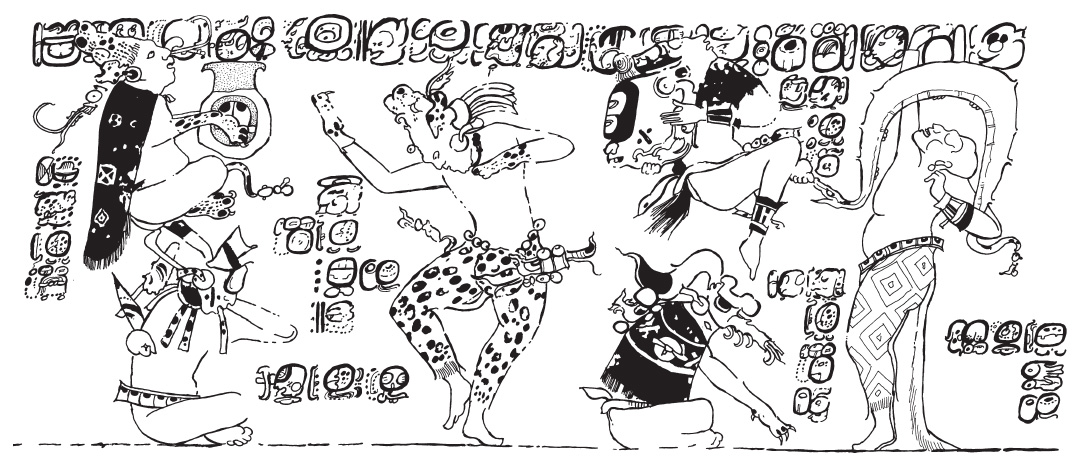
Fig. 4.1. Late Classic rollout drawing of “The Altar Vase” at Altar de Sacrificios, depicting six supernaturals identified as wayob’.
The man dancing in jaguar pants is likely in the act of transforming into his jaguar coessence: ancient Maya men wore kilts and loincloths, not tight-fitting pants.
Courtesy of Ancient Americas at LACMA. SD-5504. Maya.
Drawing by Linda Schele. Copyright © David Schele.
Tecún Umán, one of the last rulers of the K’iché’ Maya in Guatemala, was said to have been able to shape-shift into his wayob’. Before the arrival of the Spaniards, Tecun reportedly flew up into the sky as a quetzal. But afterward he took on a larger form, possibly an eagle. Defending his people against the Spanish invasion in 1524, Tecún was reportedly killed by the conquistador Pedro de Alvarado.36 Apparently there were others who also changed into their way animals, in forms that included snakes and vermin, to fight against the Spaniards.37